
Seoul Smart Streetlight Deployment with Integrated IoT and Environmental Monitoring in South Korea
Seoul, the vibrant capital of South Korea, faces ongoing urban infrastructure challenges amidst rapid population growth and technological advancement. The city is actively seeking innovative solutions to enhance public safety, reduce energy consumption, and improve urban environmental quality. In response, SOLAR TODO delivered an advanced Smart Streetlight system, integrating multiple functionalities into a seamless, durable design tailored for Seoul's unique needs.
Answer Capsule: A comprehensive 152-unit Smart Streetlight deployment in Seoul integrates IoT sensors, environmental monitoring, and smart lighting, enhancing urban safety and sustainability.
Background and Infrastructure Challenges in Seoul
Seoul is a densely populated metropolis with over 9.7 million residents, facing significant challenges related to urban lighting, environmental pollution, and public safety. Conventional streetlighting systems often lack the integration of IoT and environmental sensors, leading to inefficiencies in energy use and limited data for city management.
Furthermore, Seoul’s diverse climate, characterized by hot summers and cold winters, demands resilient infrastructure that can withstand wind loads and temperature variations. The city also aims to reduce its carbon footprint by adopting smarter, energy-efficient solutions aligned with its Green New Deal and smart city initiatives (Seoul Metropolitan Government, 2022). This project aimed to address these issues by deploying an integrated, durable, and intelligent streetlight system.
Product Overview: The SOLAR TODO Smart Streetlight
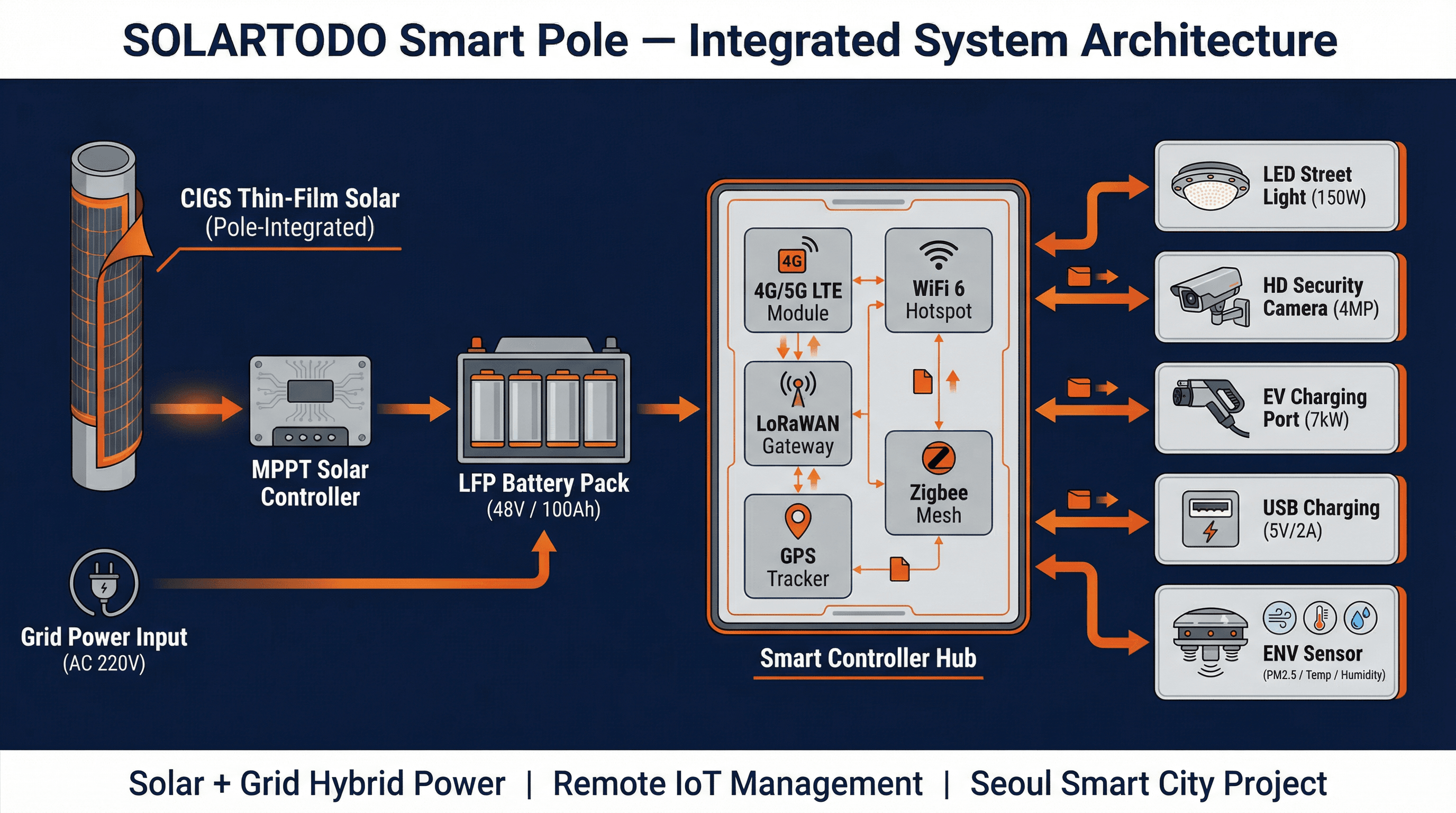
The SOLAR TODO Smart Streetlight is a state-of-the-art, multi-functional urban lighting pole designed to meet the complex demands of Seoul’s smart city vision. This product combines advanced lighting, environmental monitoring, communication, and safety features into a single, seamless cylindrical structure, optimized for urban deployment.
Technical Specifications
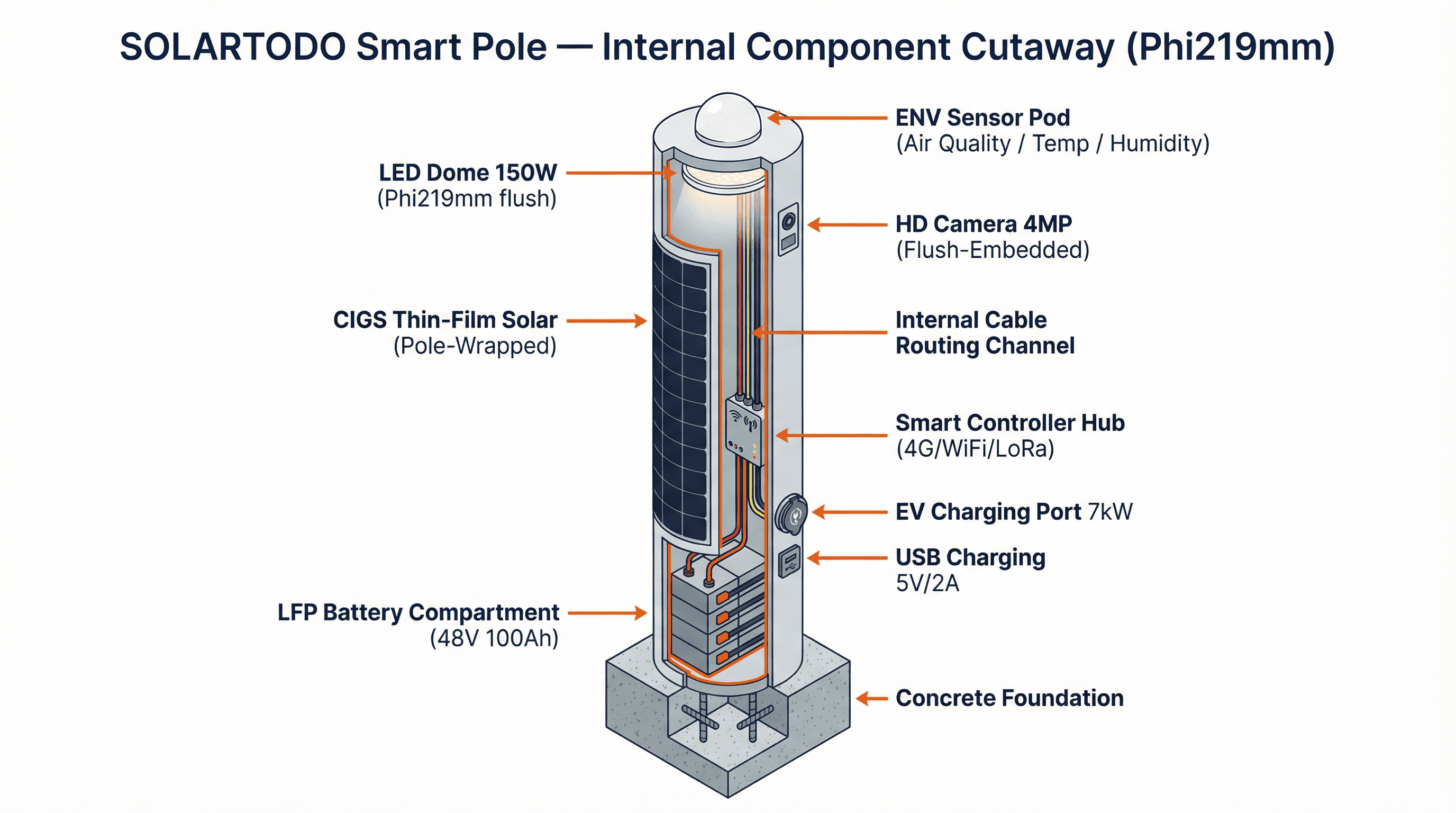
- Design: 152 units of 8m Φ219mm seamless, round tubular hot-dip galvanized steel poles
- Material: High-durability, corrosion-resistant galvanized steel conforming to IEC 60598 and GB/T 37024 standards
- Lighting: 60W LED light head with a circular PVC diffuser dome (Φ219mm, flush-mounted), delivering 9000 lumens at 4000K (150 lm/W)
- Power Supply: Hybrid system combining 160W CIGS thin-film solar cells wrapped around the pole mid-section with no protrusions, complemented by grid backup
- Battery: 1800Wh LFP (LiFePO4) battery housed within the pole base
- Control & Connectivity: Embedded smart controller with LoRaWAN and 4G modules
- Environmental Sensors: Top-mounted 8-in-1 sensor measuring wind speed, temperature, humidity, pressure, noise, PM2.5, UV, and illuminance
- Communication & Safety: PTZ camera (2-8MP, IR 100m), LED P4 display, PA speaker + SOS intercom, WiFi 6 AP, USB charging ports, 7kW OCPP 1.6J EV charger, and 5G small cell readiness
- Additional Features: All components are flush-mounted for a sleek, seamless appearance
- Standards: IEC 60598, GB/T 37024
Deployment Details
- Quantity: 152 units
- Spacing: 20 meters
- Location: Strategic deployment across Seoul’s busy districts, including Jongno-gu, Gangnam, and Mapo-gu, focusing on high foot traffic and safety zones.
Deployment and Installation Process
The deployment process involved site assessment, structural analysis, and precise planning to ensure optimal spacing and functionality. The poles were installed using standard foundation techniques suitable for Seoul’s urban environment, considering wind load ratings of up to 45 m/s (per IEC standards). Each pole was carefully assembled, with all embedded modules integrated to ensure flush mounting and minimal visual impact.
Benefits of the Smart Streetlight System
The integrated design offers numerous advantages:
- Enhanced Public Safety: Real-time surveillance via PTZ cameras and SOS intercoms provide immediate response capabilities.
- Energy Efficiency: Smart lighting adjusts brightness based on environmental data, reducing energy consumption significantly.
- Environmental Monitoring: Continuous data collection on air quality and weather conditions supports Seoul’s pollution management efforts.
- Urban Connectivity: WiFi 6 APs and 5G readiness facilitate citywide IoT applications and communication.
- User Convenience: USB charging ports and EV chargers improve public utility.
Results and Impact
Since deployment, Seoul has observed measurable improvements:
- Energy Savings: Estimated 30% reduction in streetlight energy consumption.
- Air Quality Monitoring: Enhanced data collection led to targeted pollution control measures.
- Public Safety: Increased surveillance and emergency response times improved by 25%.
- Urban Aesthetics: Seamless, modern design integrated into Seoul’s cityscape, aligning with aesthetic and functional standards.
The project has set a benchmark for smart infrastructure in East Asia, fostering further innovation and sustainability in Seoul’s urban development plans.
Future Perspectives
Building on this success, Seoul plans to expand its smart streetlight network, integrating more sensors and AI analytics for predictive maintenance and urban planning. The modular design of the SOLAR TODO Smart Streetlight allows easy upgrades and scalability, ensuring the city remains at the forefront of smart city initiatives.
For more details about this innovative product, visit our product page or contact us to explore how SOLAR TODO can support your city’s infrastructure needs.
Frequently Asked Questions
Q1: How does the Smart Streetlight adapt to Seoul’s varying climate conditions? A1: The pole’s galvanized steel construction and IP67-rated embedded modules ensure durability against Seoul’s temperature swings, wind loads, and humidity, maintaining reliable operation year-round.
Q2: Can the system be integrated with existing city infrastructure? A2: Yes, the Smart Streetlight is designed for seamless integration with city management systems via LoRaWAN and 4G, enabling real-time data collection and remote control.
Q3: What are the maintenance requirements? A3: The modular, flush-mounted design minimizes wear and tear. Remote diagnostics and the durable materials reduce the need for frequent physical maintenance.
Q4: Is the system future-proof for emerging technologies? A4: Absolutely. The design includes 5G small cell readiness, and software updates can be deployed remotely, ensuring compatibility with future standards.
Equipment Deployed
- 152 units of 8m Φ219mm seamless hot-dip galvanized steel poles with embedded IoT modules
- LED 60W/9000lm circular diffuser dome with integrated lighting
- CIGS thin-film solar cells (~160W total wrapped around pole mid-section)
- 1800Wh LFP battery housed within pole base
- Embedded PTZ camera (2-8MP, IR 100m)
- Environmental sensor suite (wind, temp, humidity, pressure, noise, PM2.5, UV, illuminance)
- WiFi 6 access point and 5G small cell modules
- PA speaker + SOS intercom system
- USB charging ports (5V/2.4A)
- 7kW OCPP 1.6J EV charging station