
Summary
This verified SOLAR TODO Smart Streetlight case study covers a 37-pole, 12m networked grid-powered deployment for a 1,800m road. Exact pricing is $82,543 FOB, $101,591 CIF, and $126,989 turnkey, with 66,175 kWh annual energy use and 1,110,000 total lumens.
Key Takeaways
- Use the verified turnkey budget of $126,989 for a fully installed 37-pole Smart Streetlight project covering 1,800m at 50m spacing.
- Compare procurement scopes using the exact pricing tiers: $82,543 FOB, $101,591 CIF, and $126,989 turnkey.
- Specify 12m smart poles with 200W LED luminaires to deliver 1,110,000 total lumens across 37 locations.
- Plan electrical capacity around 490W per pole and 181.3 kWh daily system consumption for this grid-powered configuration.
- Include integrated modules only where needed: 37 cameras, 37 LED displays, 37 IP speakers, 37 wireless chargers, and 37 EV chargers.
- Budget annual operating cost at $15,581, including $7,941 electricity cost and $7,640 maintenance cost.
- Validate ROI expectations early because the verified payback period for this configuration is 156.7 years.
- Align control architecture with a networked NMS design using 1 controller for 37 poles to centralize monitoring and commissioning.
Verified Project Overview
The verified conclusion is straightforward: this SOLAR TODO Smart Streetlight project is a 37-pole, 12m, grid-powered, networked deployment priced at $126,989 turnkey, with $82,543 FOB and $101,591 CIF alternatives. It covers 1,800m of roadway, uses 200W LED luminaires, and integrates camera, LED display, IP speaker, wireless charger, and 7kW EV charger functions on every pole.
This is not a generic pricing article. It is a solution case study based on verified engineering proposal data for a Smart Streetlight configuration associated with South Korea, Seoul in the requested article context, while the project record itself lists the location as Global / 협의 and validity through 2026-05-05. For procurement managers, EPC teams, and municipal planners, the value of this case study is the exact bill of materials, exact three-tier pricing, and exact operating-cost figures.
SOLAR TODO positions this type of Smart Streetlight as multi-function urban infrastructure rather than a lighting-only product. In this verified configuration, the system combines roadway illumination, surveillance, public information display, public audio, wireless charging, and EV charging into a single pole platform. That single-infrastructure approach matters because it simplifies street furniture planning, reduces separate device mounting requirements, and centralizes control through a networked NMS controller.
According to the International Energy Agency (IEA) (2024), digitalization and electrification are increasingly central to urban energy systems planning. According to IRENA (2024), integrated infrastructure and electrification planning are essential to improve long-term system efficiency in cities. Those broader trends help explain why Smart Streetlight projects are evaluated not only on lighting performance, but also on communications, safety, charging, and operational integration.
The International Energy Agency states, "Digital technologies are becoming increasingly important for energy security, resilience and affordability." For city-scale street infrastructure, that statement directly supports the use of networked control rather than isolated lighting assets. NREL (2024) also emphasizes that system modeling and verified load assumptions are critical for realistic project evaluation, which is especially relevant here because the operating-cost and payback figures are already defined in the engineering proposal.
System Design
This verified Smart Streetlight design uses 37 smart poles at 12m height, spaced 50m apart along a road length of 1,800m. Each pole includes a 200W LED luminaire and five enabled smart modules: camera, LED display, IP speaker, wireless charger, and EV charger. The control type is networked, and the power source is grid.
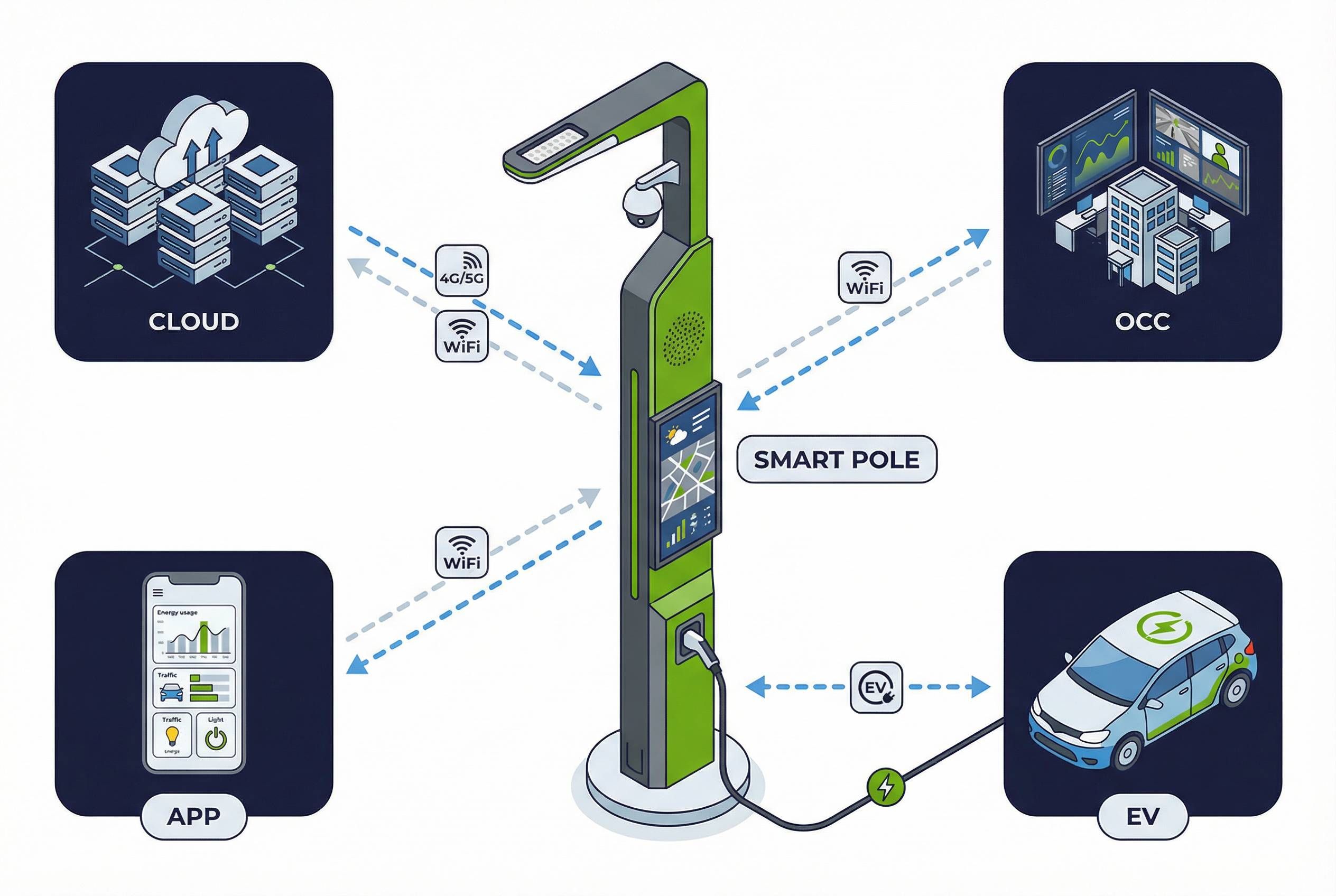
System architecture diagram generated from customer configuration
Verified technical specifications
| Parameter | Verified value |
|---|---|
| Product | Smart Streetlight |
| Pole height | 12m |
| Pole count | 37 |
| LED luminaire rating | 200W |
| Total lumens | 1110000 |
| Power per pole | 490W |
| Daily energy consumption | 181.3 kWh |
| Annual energy consumption | 66175 kWh |
| Energy saving | 20% |
| Road length | 1800m |
| Pole spacing | 50m |
| Control type | networked |
| Power source | grid |
| Enabled modules | camera, led_display, ip_speaker, wireless_charger, ev_charger |
From an engineering perspective, the load profile is one of the most important details. At 490W per pole across 37 poles, this is materially more complex than a standard streetlighting retrofit because the lighting load is combined with multiple smart-city devices. That affects feeder sizing, protection coordination, communications architecture, maintenance planning, and operating-cost forecasting.
According to IEEE 1547-2018, interoperability and coordinated electrical interfaces are essential when distributed electrical assets connect into broader power systems. While this project is grid-powered rather than a distributed generation system, the same engineering discipline around interface design, monitoring, and operational reliability still applies. According to IEC smart-city and luminaire control practices, networked control improves fault visibility and operational response compared with standalone infrastructure.
Customer configuration snapshot
| Module | Status |
|---|---|
| Camera | Enabled |
| WiFi AP | Disabled |
| Environmental sensor | Disabled |
| EV charger | Enabled |
| IP speaker | Enabled |
| LED display | Enabled |
| Small cell 5G | Disabled |
| Emergency call | Disabled |
| Wireless charger | Enabled |
This configuration is notable because it is selective rather than fully loaded. The customer did not enable WiFi AP, environmental sensors, small-cell 5G, or emergency call modules. That means the design is optimized around visible public-service and mobility functions rather than telecom densification or environmental monitoring.
Pricing and Bill of Materials
For B2B buyers, the most important procurement point is that the three-tier pricing must be used exactly as verified. These figures should not be recalculated from the line items below because the commercial scope differs by delivery model.
Three-tier pricing comparison
| Pricing tier | Scope summary | Verified price |
|---|---|---|
| FOB Price (Ex-Works) | Factory supply basis | $82,543 |
| CIF Price (Port Delivery) | Delivered to port | $101,591 |
| Turnkey Price (Installed) | Installed and commissioned | $126,989 |
The turnkey figure of $126,989 is the decision-grade number for buyers seeking a delivered-and-installed Smart Streetlight solution. The FOB figure of $82,543 is more relevant for importers, distributors, or EPCs with in-house logistics and field crews. The CIF figure of $101,591 sits between those two models and is useful when the buyer wants international delivery included but will manage local installation separately.
Complete equipment list
| Item | Qty | Unit price | Total |
|---|---|---|---|
| Smart Pole (12m) | 37 | 900 | 33300 |
| LED Luminaire 200W | 37 | 102 | 3774 |
| CCTV Camera 4MP IR | 37 | 288 | 10656 |
| LED Display P4 55" | 37 | 1200 | 44400 |
| IP Speaker 30W | 37 | 120 | 4440 |
| Wireless Charger 7.5W | 37 | 48 | 1776 |
| EV Charger 7kW | 37 | 300 | 11100 |
| NMS Controller | 1 | 5000 | 5000 |
| Installation & Commissioning | 37 | 884 | 32700 |
The equipment list shows clearly where project value is concentrated. The largest hardware line is the LED Display P4 55" allocation at 44400 total, followed by the Smart Pole structure at 33300 and Installation & Commissioning at 32700. That means this project is not just a lighting and surveillance deployment; it is also a digital-display infrastructure project.
According to UL (2023), safety certification and installation quality are critical for electrically integrated outdoor equipment exposed to public use conditions. According to ASTM corrosion and structural durability practices for outdoor steel infrastructure, long-term performance depends heavily on material protection, installation quality, and maintenance discipline. For a 12m pole network carrying multiple devices, those practical field issues matter as much as the electronics specification.
Performance, Operating Cost, and ROI
This verified configuration delivers 1,110,000 total lumens across the 37-pole layout and is modeled at 181.3 kWh daily energy use, or 66,175 kWh annually. The proposal also states 20% energy saving, annual operating cost of $15,581, annual electricity cost of $7,941, annual maintenance cost of $7,640, and payback of 156.7 years.
Operating and ROI metrics
| Metric | Verified value |
|---|---|
| Daily energy use | 181.3 kWh |
| Annual energy use | 66175 kWh |
| Energy saving | 20% |
| Annual operating cost | $15,581 |
| Annual electricity cost | $7,941 |
| Annual maintenance cost | $7,640 |
| Payback period | 156.7 years |
For decision-makers, the payback result is the key caution flag. A 156.7-year payback means this exact configuration should not be justified primarily as an energy-savings project. It is better understood as a smart-city infrastructure deployment where the business case may depend on public safety, digital signage utility, EV charging availability, communications integration, or urban-service modernization rather than electricity savings alone.
That distinction is common in advanced smart pole projects. According to IEA (2024), cities increasingly evaluate infrastructure on resilience, service integration, and digital functionality, not just direct energy return. According to NREL (2024), realistic techno-economic analysis depends on using actual load, operations, and maintenance assumptions rather than simplified energy-only models. This case study is valuable precisely because it preserves those real-world numbers.
The International Renewable Energy Agency states, "The energy transition must be pursued as a structural shift across infrastructure, policy and investment." In practice, this means a Smart Streetlight project can be strategically valid even when direct payback is long, provided the non-energy functions are mission-critical. For Seoul-style urban applications, those functions may include surveillance coverage, public messaging, curbside charging access, and integrated digital services.
Deployment Fit and Selection Guidance
This verified configuration is best suited for urban corridors, municipal roads, mixed-use districts, industrial parks, campuses, and redevelopment zones where one pole must perform several public-service functions. Because every pole includes a camera, display, speaker, wireless charger, and EV charger, the project is especially relevant where city operators want visible, multifunctional infrastructure rather than minimal-capex lighting.
Where this configuration fits best
- Urban roads requiring 37 poles across 1,800m with centralized networked control
- Projects needing 200W roadway lighting plus 4MP IR surveillance on every pole
- Public-facing corridors where 55-inch P4 LED displays support messaging or advertising
- Streetscapes that benefit from 7kW EV charging and 7.5W wireless charging access
- Municipal or private developments prioritizing integrated infrastructure over simple lighting ROI
When buyers should choose FOB, CIF, or turnkey
| Buyer scenario | Best pricing tier | Reason |
|---|---|---|
| Importer with local installation team | FOB Price (Ex-Works) | Maximizes buyer control over freight and field works |
| EPC managing customs and local site works | CIF Price (Port Delivery) | Includes port delivery while preserving installation flexibility |
| Municipality or developer seeking single-point delivery | Turnkey Price (Installed) | Simplifies execution with installed scope at $126,989 |
For South Korea or Seoul-focused buyers, turnkey procurement often reduces interface risk because one commercial package covers installation and commissioning. However, experienced EPCs may still prefer FOB or CIF if they have established local civil, electrical, and permitting capabilities. The right choice depends less on hardware and more on who owns logistics, field integration, and acceptance testing.
SOLAR TODO should also be evaluated against the actual use case, not against generic smart-pole catalogs. This project does not include WiFi AP, environmental sensing, small-cell 5G, or emergency call functions, so buyers needing those services should request a different configuration rather than assume they are included. In B2B procurement, exact scope discipline is what prevents change orders and commissioning disputes.
FAQ
Q: What is included in the verified $126,989 turnkey price? A: The verified turnkey price is $126,989 for the Smart Streetlight project and represents the installed delivery model. The proposal also lists Installation & Commissioning as a line item, and turnkey is the correct reference for buyers who want the 37-pole system supplied, installed, and commissioned rather than factory-only or port-delivered supply.
Q: How does the $82,543 FOB price differ from the $101,591 CIF price? A: The $82,543 FOB Price (Ex-Works) is the factory supply basis, while the $101,591 CIF Price (Port Delivery) includes delivery to port. Buyers choosing FOB usually manage freight and downstream logistics themselves, while CIF is better for organizations that want international shipping responsibility included up to the port stage.
Q: What is the exact system size in this verified Smart Streetlight case study? A: The verified system uses 37 smart poles, each 12m high, installed across a road length of 1,800m with 50m spacing. Each pole includes a 200W LED luminaire, and the full system delivers 1,110,000 total lumens with a networked control architecture and grid power source.
Q: Which smart modules are enabled on every pole in this project? A: The enabled modules are camera, LED display, IP speaker, wireless charger, and EV charger. The customer configuration specifically disables WiFi AP, environmental sensor, small cell 5G, and emergency call functions, so those features should not be assumed in the quoted scope.
Q: How much power and energy does this configuration require? A: The verified power per pole is 490W, and the project consumes 181.3 kWh per day. Annual energy consumption is 66,175 kWh, which is important for feeder design, utility coordination, and operating-cost planning in grid-powered deployments.
Q: Is this project financially justified by energy savings alone? A: No, not based on the verified proposal data. The stated payback period is 156.7 years, so this configuration should be justified primarily by multifunctional urban-service value such as surveillance, public communication, display capability, and EV charging rather than by electricity savings alone.
Q: What are the verified annual operating costs? A: The verified annual operating cost is $15,581. That total is broken into $7,941 annual electricity cost and $7,640 annual maintenance cost, giving procurement teams a realistic baseline for lifecycle budgeting beyond the initial capital price.
Q: What does the equipment list show as the largest cost components? A: The largest listed hardware component is the LED Display P4 55" at 44400 total, followed by Smart Pole (12m) at 33300 and Installation & Commissioning at 32700. This indicates the project is heavily weighted toward multifunction digital infrastructure, not just roadway lighting.
Q: Why is networked control important for a 37-pole deployment? A: Networked control is important because it centralizes monitoring, fault visibility, and operational management across all 37 poles. With one NMS Controller managing multiple devices per pole, operators can coordinate maintenance and performance oversight more efficiently than with isolated standalone streetlights.
Q: Is this Smart Streetlight system solar-powered or grid-powered? A: This verified configuration is grid-powered, not solar-powered. That matters because the electrical design, operating cost model, and procurement scope are based on mains supply rather than off-grid solar generation and battery storage.
Related Reading
References
- NREL (2024): PVWatts Calculator methodology and system modeling guidance used widely for energy performance estimation and load-based project evaluation.
- IEA (2024): Energy Technology Perspectives and digital energy system analysis highlighting the role of electrification and digitalization in infrastructure planning.
- IRENA (2024): Energy transition and urban infrastructure planning guidance emphasizing integrated investment and system-level modernization.
- IEEE 1547-2018 (2018): Standard for interconnection and interoperability of distributed electrical systems, relevant for disciplined interface and monitoring design.
- IEC 60598 series (current use): Luminaire safety and performance framework commonly referenced for outdoor lighting equipment compliance.
- UL (2023): Electrical safety and outdoor equipment certification framework relevant to integrated public-use charging and lighting systems.
- ASTM International (2023): Structural material and corrosion-related standards applicable to outdoor steel pole infrastructure and durability planning.
Conclusion
This verified SOLAR TODO Smart Streetlight case study shows that a 37-pole, 12m, networked grid-powered deployment is priced at exactly $82,543 FOB, $101,591 CIF, and $126,989 turnkey. For buyers evaluating multifunction urban infrastructure rather than energy-only ROI, this configuration is best treated as a service-rich smart-city asset with 1,110,000 lumens, 66,175 kWh annual energy use, and clearly defined operating costs.
About SOLARTODO
SOLARTODO is a global integrated solution provider specializing in solar power generation systems, energy-storage products, smart street-lighting and solar street-lighting, intelligent security & IoT linkage systems, power transmission towers, telecom communication towers, and smart-agriculture solutions for worldwide B2B customers.