
Summary
This verified SOLAR TODO case study covers a 35-pole smart streetlight deployment for an Urban Corridor in Ho Chi Minh City, Vietnam. The system uses 10 m poles, 100 W LED modules, 525,000 total lumens, and a turnkey installed price of $144,986.
Key Takeaways
- Use the verified turnkey budget of $144,986 for a fully installed 35-pole smart streetlight project in Ho Chi Minh City.
- Compare procurement options using the exact three-tier pricing: FOB $94,241, CIF $115,989, and Turnkey $144,986.
- Specify 35 smart poles at 10 m height with 100 W LED streetlight modules across a 1,000 m urban corridor.
- Plan for a connected load of 380 W per pole, with 133 kWh daily energy use and 48,545 kWh annual energy use.
- Budget annual operating cost at $14,465, including $5,825 electricity and $8,640 maintenance.
- Validate lighting scale with 525,000 total lumens and 30 m pole spacing for corridor-level urban coverage.
- Confirm enabled modules per pole: camera, WiFi AP, environmental sensor, EV charger, LED display, and wireless charger.
- Review ROI carefully because the verified payback is 63.1 years and the LCOE is $413 per pole-year.
Project Overview
The verified conclusion is straightforward: this Ho Chi Minh City smart streetlight project is a 35-pole, grid-powered, standalone-controlled deployment priced at $144,986 turnkey, with 48,545 kWh annual energy use and a modeled 63.1-year payback. For B2B buyers, the case is strongest when the goal is multi-function urban infrastructure rather than energy-cost savings alone.
This is a real configuration from a verified engineering proposal for an Urban Corridor application. The system combines roadway lighting, surveillance, connectivity, environmental monitoring, public information display, EV charging, and wireless charging into a single pole platform. Because the pricing and bill of materials are verified, procurement managers and project engineers can use the figures directly for benchmarking, tender comparison, and scope validation.
SOLAR TODO positions this type of smart streetlight as integrated urban infrastructure rather than a simple lighting upgrade. That distinction matters. A conventional pole normally covers only illumination, while this design consolidates six enabled smart modules plus lighting on each pole, reducing the need for separate roadside assets and helping municipalities standardize deployment.
According to the International Energy Agency, “digitalization is becoming increasingly important for energy systems and infrastructure planning.” That statement is highly relevant here because the project value is tied not only to lumens and watts, but also to data capture, communications, and service delivery at the edge of the road network.
System Design
The system is configured as a grid-powered smart streetlight network with standalone control. It covers a 1,000 m road length using 35 poles at 30 m spacing, each with a 10 m Smart Pole Structure and a 100 W LED Streetlight Module. The verified total lighting output is 525,000 lumens.
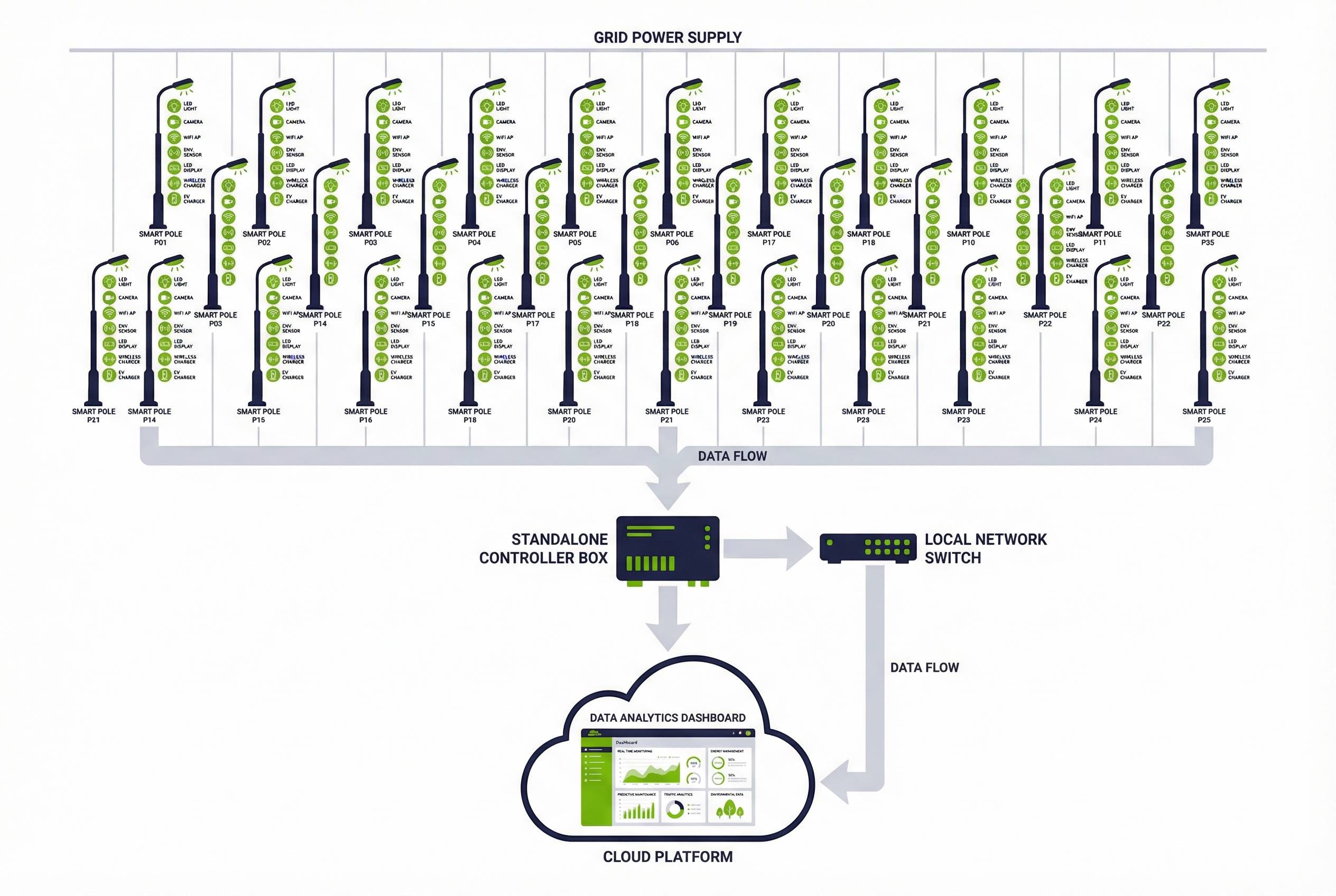
System architecture diagram generated from customer configuration
Verified technical specifications
| Parameter | Verified Value |
|---|---|
| Location | Urban Corridor, Ho Chi Minh City, Vietnam |
| Pole count | 35 |
| Pole height | 10 m |
| LED wattage | 100 W |
| Total lumens | 525,000 |
| Power per pole | 380 W |
| Daily energy | 133 kWh |
| Annual energy | 48,545 kWh |
| Energy saving | 60% |
| Road length | 1,000 m |
| Pole spacing | 30 m |
| Control type | standalone |
| Power source | grid |
Enabled modules in this customer configuration
| Module | Status |
|---|---|
| Camera | Enabled |
| WiFi AP | Enabled |
| Environmental sensor | Enabled |
| EV charger | Enabled |
| IP speaker | Not enabled |
| LED display | Enabled |
| Small cell 5G | Not enabled |
| Emergency call | Not enabled |
| Wireless charger | Enabled |
Each pole is designed as a multi-service node. The HD Surveillance Camera (400W IR) supports corridor security and incident review. The WiFi Access Point adds public or managed connectivity. The Environmental Sensor supports local air and environmental data collection. The LED Information Display (P4) enables public messaging, wayfinding, or commercial notices. The EV Charger (7.4kW) and Wireless Charging Pad extend the pole’s role beyond lighting into mobility and convenience services.
According to NREL (2024), connected infrastructure projects benefit from clear system boundary definitions because performance, maintenance, and operating cost assumptions can otherwise be misread. In this case, the verified engineering proposal already defines the boundary: grid-powered operation, standalone control, and the exact module stack listed above.
The International Energy Agency states, “Electricity demand from digital infrastructure is rising as economies become more connected.” For project managers, this is a reminder that smart poles should be evaluated as digital urban assets with power, communications, and maintenance implications, not as commodity luminaires.
Verified Pricing and Equipment Scope
The most important commercial point is that this case study uses verified proposal pricing only. No recalculation, approximation, or estimated package pricing is used below. For Ho Chi Minh City procurement teams, this creates a reliable benchmark for supplier comparison and scope review.
Three-tier pricing comparison
| Pricing Tier | Scope Basis | Verified Price |
|---|---|---|
| FOB Price | Ex-Works | $94,241 |
| CIF Price | Port Delivery | $115,989 |
| Turnkey Price | Installed | $144,986 |
For many B2B buyers, the spread between FOB and turnkey is as important as the headline installed cost. Here, the difference between FOB $94,241 and Turnkey $144,986 reflects logistics, delivery, installation, and project execution scope rather than a change in hardware configuration. The CIF level at $115,989 is useful for importers who want delivered-to-port visibility before local installation contracting.
Complete equipment list from the engineering proposal
| Item | Qty | Unit Price | Total |
|---|---|---|---|
| Smart Pole Structure | 35 | $1127 | $39445 |
| LED Streetlight Module (100W) | 35 | $66 | $2310 |
| LED Driver | 35 | $10 | $350 |
| HD Surveillance Camera (400W IR) | 35 | $288 | $10080 |
| WiFi Access Point | 35 | $144 | $5040 |
| Environmental Sensor | 35 | $216 | $7560 |
| LED Information Display (P4) | 35 | $1200 | $42000 |
| Wireless Charging Pad | 35 | $48 | $1680 |
| EV Charger (7.4kW) | 35 | $300 | $10500 |
| Standalone Controller System | 1 | $2000 | $2000 |
| Cabling & Conduit | 1 | $3500 | $3500 |
| Mounting Hardware & Accessories | 1 | $1200 | $1200 |
The equipment table shows where the hardware value is concentrated. The largest line items are the LED Information Display (P4) at $42,000, the Smart Pole Structure at $39,445, and the EV Charger (7.4kW) at $10,500. This means cost optimization discussions should focus first on display strategy, pole architecture, and charging scope rather than on the LED luminaire itself, which totals only $2,310.
For SOLAR TODO and comparable suppliers, this is a common pattern in multifunction smart poles: the intelligence and service modules often outweigh the lighting package in cost contribution. Procurement teams should therefore evaluate the project as a bundled urban platform and not assume that reducing luminaire wattage alone will materially change total CAPEX.
Operating Cost, ROI, and Decision Criteria
This project delivers a verified 60% energy saving figure, but the financial return remains long because the solution includes multiple non-lighting functions. The verified annual operating cost is $14,465, consisting of $5,825 annual electricity cost and $8,640 annual maintenance cost. The verified payback is 63.1 years.
Verified ROI metrics
| Metric | Verified Value |
|---|---|
| Payback period | 63.1 years |
| Annual operating cost | $14,465 |
| Annual electricity cost | $5,825 |
| Annual maintenance cost | $8,640 |
| LCOE | $413 per pole-year |
| Annual savings | null |
For engineering and procurement teams, the key lesson is that this is not a pure energy-efficiency business case. If the project were evaluated only on utility savings, the economics would appear weak. However, that would ignore the value of surveillance, public WiFi, environmental sensing, digital signage, EV charging access, and wireless charging. In municipal or developer-led projects, these functions may be justified under separate budgets or service outcomes.
According to IRENA (2024), integrated infrastructure planning improves asset utilization when multiple public services are delivered through shared platforms. That principle aligns directly with this Ho Chi Minh City configuration. Instead of deploying separate poles, camera masts, WiFi nodes, environmental stations, and display structures, the project consolidates them into 35 multifunction poles.
According to IEEE 1547-2018, interoperability and system interface discipline are essential whenever distributed electrical assets and connected equipment are deployed in the field. Even though this project is grid-powered rather than solar-powered, the same engineering logic applies: define interfaces, maintenance ownership, and operating responsibilities before installation starts.
When this configuration makes sense
- Use this design when the corridor needs lighting, surveillance, connectivity, and public information in one streetscape asset.
- Choose this scope when urban planners want to reduce roadside clutter by consolidating equipment onto 35 integrated poles.
- Accept the long 63.1-year payback when project value is driven by public safety, smart city data, and service visibility rather than electricity savings alone.
- Benchmark the turnkey budget at $144,986 when comparing integrated smart pole tenders in Vietnam.
When buyers should reconsider scope
- Reassess the LED Information Display (P4) count if digital signage is not essential on all 35 poles.
- Review whether EV Charger (7.4kW) deployment is needed at every location or only at selected nodes.
- Validate maintenance planning because the verified annual maintenance cost is $8,640, which is a significant share of annual operating cost.
- Confirm local use cases for WiFi and environmental sensing so the enabled modules support measurable operational outcomes.
Deployment Considerations for Ho Chi Minh City
For Ho Chi Minh City, this smart streetlight configuration fits dense urban corridors where municipal visibility, traffic movement, and public engagement matter more than simple lighting replacement. The 10 m pole height and 30 m spacing support corridor deployment logic, while the standalone control approach can simplify local system architecture where centralized networking is not required in the base design.
SOLAR TODO should be evaluated here as an infrastructure integrator. The project scope spans civil interface items such as Cabling & Conduit and Mounting Hardware & Accessories, plus electrical, communications, and service modules. This means project success depends on cross-functional coordination among procurement, electrical engineering, ICT, and operations teams.
According to IEC system standards practice, compliance-led design reduces lifecycle risk by clarifying safety, construction, and performance requirements before field execution. In Vietnam deployments, buyers should align local permitting, utility coordination, and roadside civil works with the verified equipment list rather than treating the project as a standard lighting retrofit.
A practical selection framework for this project is to ask four questions:
- Is the corridor value primarily lighting, or is it smart city service delivery?
- Are all six enabled modules required on all 35 poles?
- Is the buyer comparing FOB $94,241, CIF $115,989, and Turnkey $144,986 on an equal scope basis?
- Can the operator support the verified annual OPEX of $14,465?
If the answer to those questions is yes, this verified SOLAR TODO configuration is a strong benchmark for multifunction urban corridors. If not, the buyer may need a reduced-module variant with fewer service layers.
FAQ
Q: What is included in the $144,986 turnkey price for this smart streetlight project? A: The verified turnkey price is $144,986 for the installed 35-pole project. It corresponds to the full configured system for the Urban Corridor case, including the listed smart pole equipment, lighting, camera, WiFi AP, environmental sensor, LED display, EV charger, wireless charger, controller, cabling, conduit, and mounting accessories.
Q: What does the FOB price of $94,241 mean in this case study? A: The verified FOB price is $94,241 on an ex-works basis. It is the hardware supply benchmark before port-delivery and installed-project scope are added, making it useful for importers or EPC buyers who want to manage logistics and local installation separately.
Q: What does the CIF price of $115,989 cover compared with FOB? A: The verified CIF price is $115,989 for port delivery. Compared with FOB $94,241, it adds the delivered-to-port commercial layer, which helps buyers compare import-stage budgeting before local installation and commissioning are contracted under a separate scope.
Q: How many smart poles are included and what are their main specifications? A: This project includes 35 smart poles. Each pole is 10 m high, uses a 100 W LED streetlight module, and the overall system delivers 525,000 lumens across a 1,000 m corridor with 30 m pole spacing.
Q: What smart modules are enabled on each pole in this Vietnam project? A: The enabled modules are camera, WiFi AP, environmental sensor, EV charger, LED display, and wireless charger. The customer configuration specifically does not enable IP speaker, small cell 5G, or emergency call, so the case study should be compared on that exact scope only.
Q: Is this system solar-powered or grid-powered? A: This verified project is grid-powered, not solar-powered. It also uses standalone control, which means buyers should evaluate it as a mains-supplied smart streetlight platform rather than an off-grid solar streetlight installation.
Q: What is the total energy consumption of the system? A: The verified energy figures are 133 kWh per day and 48,545 kWh per year. The configured connected load is 380 W per pole, reflecting the combined lighting and enabled smart-module architecture used in this customer proposal.
Q: What are the annual operating and maintenance costs? A: The verified annual operating cost is $14,465. That total includes $5,825 annual electricity cost and $8,640 annual maintenance cost, which are important figures for lifecycle budgeting and municipal operating approval.
Q: What is the payback period for this smart streetlight deployment? A: The verified payback period is 63.1 years. This long payback indicates the project should be justified primarily by multifunction urban value such as surveillance, connectivity, environmental monitoring, public display, and charging services rather than by electricity savings alone.
Q: Why is the payback so long even with 60% energy saving? A: The verified energy saving is 60%, but the project includes multiple non-lighting modules that increase CAPEX and maintenance scope. In this configuration, the business case is broader than energy efficiency, because the poles also deliver security, communications, environmental data, signage, and charging functions.
Q: Which equipment items contribute the most to project cost? A: The largest verified equipment totals are LED Information Display (P4) at $42,000, Smart Pole Structure at $39,445, and EV Charger (7.4kW) at $10,500. These are the first items procurement teams should review if they need to optimize project scope or phase deployment.
Q: Is this a good fit for Ho Chi Minh City urban corridors? A: Yes, it can be a strong fit where the goal is integrated urban infrastructure on a 1,000 m corridor. For Ho Chi Minh City applications, the value is highest when public lighting, surveillance, WiFi, environmental sensing, digital display, and charging services are all needed from the same pole network.
Related Reading
References
- NREL (2024): PVWatts Calculator methodology and distributed energy modeling guidance relevant to project energy estimation practices.
- IEA (2024): Energy Technology Perspectives and digital energy system analysis on the growing role of connected infrastructure.
- IRENA (2024): Renewable power and integrated infrastructure planning insights relevant to lifecycle and shared-asset evaluation.
- IEEE 1547-2018 (2018): Standard for interconnection and interoperability of distributed electrical resources and associated interfaces.
- IEC 60598 series (current reference framework): Luminaire safety and performance framework relevant to street lighting equipment evaluation.
- IEC 62262 (2021): Degrees of protection provided by enclosures for electrical equipment against external mechanical impacts.
Conclusion
For Ho Chi Minh City, this verified SOLAR TODO smart streetlight case study is best understood as a 35-pole multifunction urban corridor platform priced at $144,986 turnkey, not as a simple lighting retrofit. Bottom line: if the project needs lighting, surveillance, WiFi, sensing, display, and charging in one asset base, this exact configuration is a credible benchmark; if the goal is only fast energy ROI, the verified 63.1-year payback suggests a reduced-scope design should be considered.
About SOLARTODO
SOLARTODO is a global integrated solution provider specializing in solar power generation systems, energy-storage products, smart street-lighting and solar street-lighting, intelligent security & IoT linkage systems, power transmission towers, telecom communication towers, and smart-agriculture solutions for worldwide B2B customers.