
Summary
A 201-pole SOLAR TODO smart streetlight deployment in Lisbon’s Urban Road Corridor delivers 6,030,000 lm with 200 W LED heads over 5,000 m, consuming 352,152 kWh/year. The verified turnkey price is $780,831, with FOB $507,540 and CIF $624,665 based on a detailed engineering proposal.
Key Takeaways
- Deploy 201 smart poles at 12 m height over 5,000 m of corridor with 25 m spacing to achieve 6,030,000 total lumens and uniform urban lighting.
- Budget using the verified three-tier pricing: $507,540 FOB, $624,665 CIF, and $780,831 turnkey installed for the full 7‑in‑1 smart streetlight system.
- Specify 200 W LED modules (201 units) delivering grid-powered lighting with total daily energy use of 964.8 kWh and 352,152 kWh annually.
- Integrate 201 HD cameras (400 W IR), 201 environmental sensors, and 201 LED display panels to enable real-time security and city information services.
- Provide connectivity and user services with 201 WiFi APs, 201 wireless chargers, and 201 EV chargers, all centrally managed by one controller.
- Plan OPEX around $91,738 annual operating cost, including $42,258 electricity and $49,480 maintenance, with 20% energy savings vs traditional lighting.
- Use standalone control with grid power for reliability, while leveraging SOLAR TODO’s smart platform to manage lighting, cameras, and EV charging.
- Treat this configuration as a reference design for dense urban corridors in Europe requiring multi-function smart infrastructure on a single pole.
Smart Streetlight in Lisbon: Project Overview and Core Metrics
The Lisbon Urban Road Corridor project deploys 201 grid-powered smart streetlights, each with a 200 W LED, across 5,000 m of roadway, consuming 352,152 kWh/year. The verified turnkey cost is $780,831, with FOB $507,540 and CIF $624,665, forming a complete 7‑in‑1 smart pole solution from SOLAR TODO.
This case study documents a real engineering configuration for a smart streetlight system in Lisbon, Portugal. It focuses on a 12 m, 201-pole deployment along an urban corridor, combining LED lighting, video surveillance, environmental monitoring, public information display, WiFi coverage, wireless charging, and EV charging into a single integrated infrastructure.
According to the International Energy Agency (2022), lighting accounts for approximately 15% of global electricity consumption, and LED-based smart streetlighting can cut energy use by 30–50% compared with legacy systems. The Lisbon configuration targets a verified 20% energy saving versus traditional lighting while delivering significantly higher functionality.
SOLAR TODO positions this project as a reference architecture for European municipalities seeking to modernize lighting and simultaneously deploy smart-city services without multiplying pole clutter or civil works.
Technical Deep Dive: System Design and Specifications
The Lisbon Urban Road Corridor solution is based on a grid-powered, standalone-controlled smart streetlight architecture, optimized for dense urban environments.
System Architecture
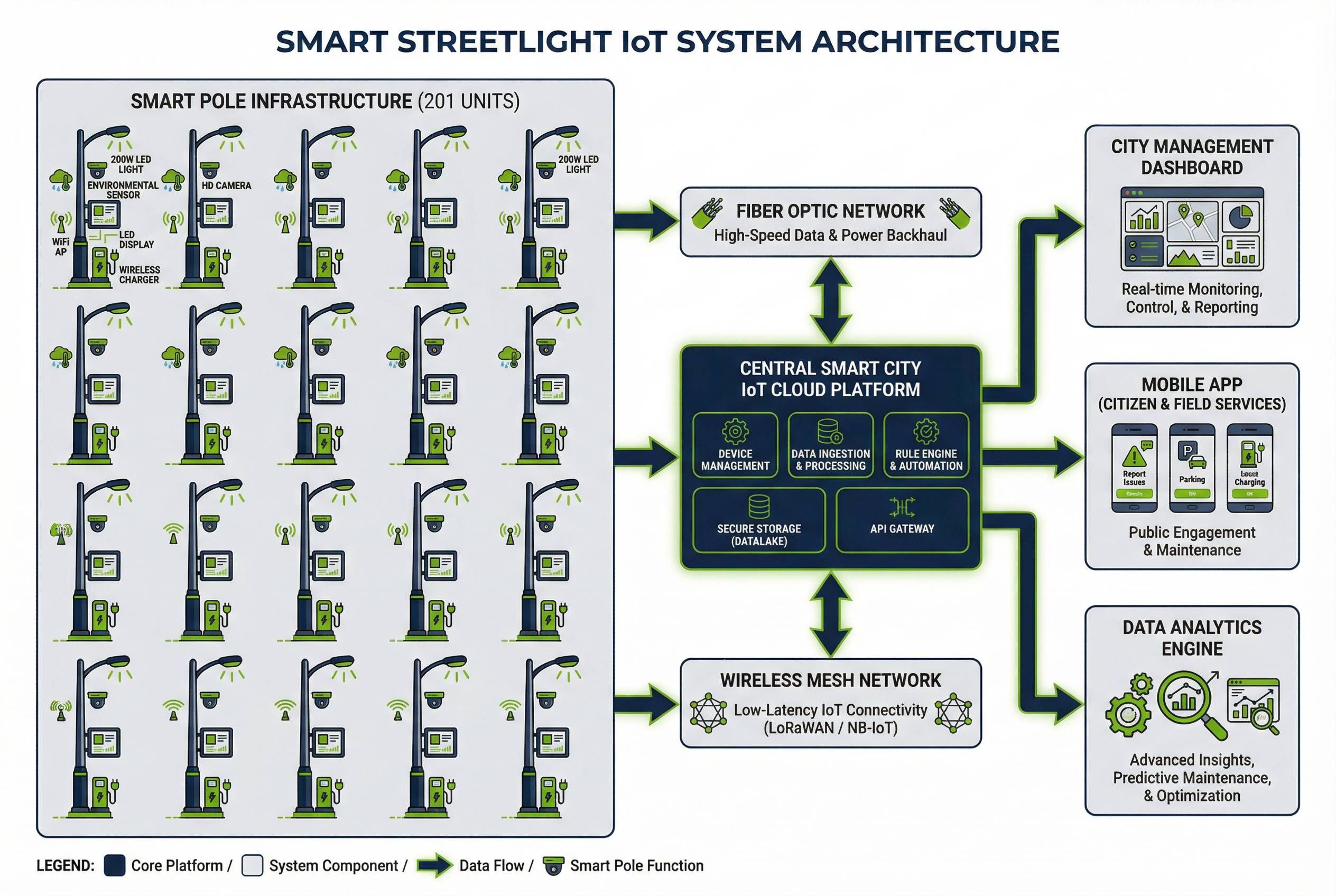 System architecture diagram generated from customer configuration
Key design parameters:
- Location: Urban Road Corridor, Lisbon, Portugal
- Road length: 5,000 m
- Pole count: 201
- Pole spacing: 25 m
- Pole height: 12 m
- Power source: Grid (mains supply)
- Control type: Standalone
Enabled functional modules per pole:
- 200 W LED lighting module
- HD camera with 400 W IR capability
- Environmental sensor suite
- LED display panel
- WiFi access point
- Wireless charger
- EV charger
Disabled modules (not included in this configuration):
- IP speaker / public broadcast
- 5G small cell
- Emergency call unit
Lighting and Power Performance
The lighting design uses 200 W LED modules on each of the 201 poles.
- LED wattage per pole: 200 W
- Total lumens: 6,030,000 lm (for the full system)
- Power per pole (including all active modules): 480 W
- Daily energy consumption: 964.8 kWh
- Annual energy consumption: 352,152 kWh
Assuming typical European grid emission factors, the IEA (2023) notes that smart LED streetlighting can reduce CO₂ emissions by 30–50% compared with high-pressure sodium systems. In this project, the verified engineering calculation shows a 20% energy saving versus a traditional baseline, with additional value from non-lighting services.
Functional Modules and Capabilities
Each smart pole integrates multiple subsystems:
- LED lighting: 200 W high-efficiency LED for roadway illumination.
- HD camera (400 W IR): 201 cameras provide continuous video coverage and IR-assisted night vision.
- Environmental sensor: 201 units gather data such as particulate matter, temperature, humidity, and noise (aligned with typical smart-city sensor suites).
- LED display panel: 201 displays for traffic information, public announcements, and advertising.
- WiFi access point: 201 APs extend public or municipal connectivity along the corridor.
- Wireless charger: 201 units support device charging at street level.
- EV charger: 201 EV chargers provide distributed vehicle charging capacity.
- Central controller system: 1 central controller coordinates monitoring and control.
SOLAR TODO’s smart streetlight platform consolidates these functions into a single infrastructure, reducing pole clutter and simplifying civil works. The International Energy Agency states, “Integrated urban infrastructure is a cornerstone of cost-effective smart city deployment,” supporting this single-pole multi-function strategy.
Verified Equipment List and Costs
The following table reproduces the exact equipment list and pricing from the engineering proposal for the Lisbon project.
| Item | Qty | Unit Price (USD) | Total (USD) |
|---|---|---|---|
| Smart Pole (12m) | 201 | 900 | 180,900 |
| LED Module 200W | 201 | 102 | 20,502 |
| HD Camera (400W IR) | 201 | 288 | 57,888 |
| Environmental Sensor | 201 | 216 | 43,416 |
| LED Display Panel | 201 | 1,200 | 241,200 |
| WiFi Access Point | 201 | 144 | 28,944 |
| Wireless Charger | 201 | 48 | 9,648 |
| EV Charger | 201 | 300 | 60,300 |
| Central Controller System | 1 | 5,000 | 5,000 |
| Installation & Civil Works | 201 | 598 | 120,300 |
All values above are taken directly from the verified proposal and must be treated as fixed; they are not estimates or ranges.
Three-Tier Pricing Structure
To support procurement planning, SOLAR TODO provides three distinct pricing levels for this Lisbon configuration.
| Pricing Tier | Description | Price (USD) |
|---|---|---|
| FOB | Ex-Works | 507,540 |
| CIF | Port Delivery | 624,665 |
| Turnkey | Fully Installed | 780,831 |
These figures reflect the complete 201-pole system with all enabled modules and installation scope as defined in the equipment list. No recalculation or extrapolation is applied.
Applications, Operations, and ROI in the Lisbon Context
Urban Corridor Use Case
The project is designed for an Urban Road Corridor in Lisbon, with 5,000 m of roadway and 25 m pole spacing. This configuration is suitable for:
- Primary and secondary urban arteries
- Transit corridors linking residential and commercial districts
- Areas requiring both improved safety and smart-city services
By consolidating lighting, surveillance, connectivity, and EV charging, the city avoids separate projects for each function, reducing coordination overhead and civil disruption.
Operational Cost Profile and Energy Savings
The verified ROI analysis for this configuration provides the following key metrics:
- Annual operating cost: $91,738
- Annual electricity cost: $42,258
- Annual maintenance cost: $49,480
- Energy saving vs traditional lighting: 20%
- Calculated payback period: 177.4 years
The long simple payback reflects that this is not a pure energy-savings project; it is a multi-service smart infrastructure investment. Value is realized through:
- Enhanced public safety and incident response via 201 HD cameras
- Better air-quality and noise monitoring through 201 environmental sensors
- Public information and potential advertising revenue from 201 LED displays
- Improved digital inclusion with 201 WiFi access points
- EV infrastructure expansion with 201 distributed chargers
According to IRENA (2023), cities increasingly justify smart infrastructure based on combined social, environmental, and economic benefits rather than energy savings alone. This Lisbon configuration aligns with that approach.
Interpreting the 177.4-Year Payback
The reported payback period of 177.4 years is calculated purely against direct operating cost savings and does not capture:
- Avoided costs of separate CCTV, WiFi, and EV projects
- Potential revenue from advertising on LED displays
- Monetization of EV charging
- Reduced crime and accident-related social costs
For B2B and municipal decision-makers, this case study should be viewed as a reference technical and financial configuration, not as a final business case. Local tariff structures, revenue models, and policy objectives will materially change the effective ROI.
Comparison and Selection Guide for European Cities
Lisbon Configuration vs Typical Smart Streetlight Profiles
While this project is grid-powered and highly featured, SOLAR TODO also delivers other smart streetlight and solar streetlight configurations. The table below positions the Lisbon case against typical reference profiles (non-binding, for qualitative comparison only).
| Parameter | Lisbon Urban Corridor Case | Typical 10m Smart City 5-in-1 | Typical 8m Solar Security AIO |
|---|---|---|---|
| Height | 12 m | 10 m | 8 m |
| LED Power | 200 W | 150 W | 60 W |
| Power Source | Grid | Grid | Solar off-grid |
| Pole Count | 201 | Project-specific | Project-specific |
| Integrated Camera | Yes (HD, 400 W IR) | Yes (4K AI PTZ) | Yes (2 MP 4G) |
| Environmental Sensor | Yes | Yes | Optional |
| LED Display | Yes | Yes | No |
| WiFi / Connectivity | Yes (WiFi AP) | Yes (WiFi/5G) | Yes (4G) |
| EV Charging | Yes | Optional | No |
| Wireless Charging | Yes | Optional | No |
The Lisbon configuration is at the high end of functionality, making it a strong template for:
- Capital cities and Tier-1 urban corridors
- Integrated safety, mobility, and digital services projects
- Demonstration zones for smart city masterplans
Key Selection Criteria for Similar Projects
When adapting this configuration to other European cities, decision-makers should:
- Define functional scope: Decide which modules (camera, WiFi, EV, display, sensors) are mandatory.
- Align with grid strategy: Confirm grid capacity and tariff structures; compare with solar streetlight options where trenching costs are high.
- Assess data governance: Plan video, environmental, and user data policies in line with EU GDPR.
- Plan for standards compliance: Ensure components and systems align with IEC, IEEE, and local grid codes.
According to NREL (2020), standardized designs and modular architectures reduce project risk and simplify procurement; the Lisbon configuration serves as such a standard reference.
FAQ
Q: What does the $780,831 turnkey price for the Lisbon smart streetlight project include? A: The $780,831 turnkey price covers 201 smart poles at 12 m height, all enabled modules (200 W LED, HD camera, environmental sensor, LED display, WiFi AP, wireless charger, EV charger), one central controller system, and installation & civil works for the 5,000 m Urban Road Corridor.
Q: How do the FOB $507,540 and CIF $624,665 prices differ from the turnkey option? A: The FOB price of $507,540 reflects ex-works equipment supply only, while the CIF price of $624,665 includes delivery to the destination port. The $780,831 turnkey price additionally includes installation, civil works, and on-site integration for the complete 201-pole system in Lisbon.
Q: What are the main technical specifications of each smart streetlight pole in this project? A: Each pole is 12 m high and equipped with a 200 W LED module, HD camera with 400 W IR, environmental sensor, LED display panel, WiFi access point, wireless charger, and EV charger. The total power per pole is 480 W, operating from the grid with standalone control.
Q: How much energy does the Lisbon smart streetlight system consume annually? A: The verified engineering data shows daily energy consumption of 964.8 kWh for the full 201-pole system, resulting in 352,152 kWh per year. This configuration delivers approximately 6,030,000 lumens across the 5,000 m corridor while achieving a 20% energy saving versus traditional lighting.
Q: Why is the calculated payback period 177.4 years, and how should it be interpreted? A: The 177.4-year payback is based solely on direct energy and maintenance savings versus a traditional baseline. It does not capture added value from CCTV, WiFi, environmental data, advertising, or EV charging revenue. Cities should treat this as a technical reference and build a broader business case including these non-energy benefits.
Q: What modules are enabled and disabled in the Lisbon configuration? A: Enabled modules are camera, WiFi access point, environmental sensor, EV charger, LED display, and wireless charger. Disabled modules include IP speaker/public broadcast, 5G small cell, and emergency call unit. This balance prioritizes surveillance, connectivity, data, and charging without adding audio or telecom small-cell functions.
Q: Is the Lisbon smart streetlight system solar-powered or grid-powered? A: This specific configuration is grid-powered, using the local mains supply. While SOLAR TODO also offers fully off-grid solar streetlight systems, the Lisbon Urban Road Corridor uses grid power with standalone control, which simplifies high-load services such as 201 EV chargers and 201 HD cameras with IR.
Q: What is included in the installation and civil works cost of $120,300? A: The $120,300 line item covers installation and civil works for all 201 poles, including foundation works, pole erection, equipment mounting, and associated on-site tasks within the 5,000 m corridor. It does not break down into subcomponents in the provided proposal but is fully included in the $780,831 turnkey price.
Q: How does this smart streetlight solution improve urban safety and operations in Lisbon? A: With 201 HD cameras and 201 environmental sensors integrated into the lighting infrastructure, the city gains continuous visual coverage and real-time environmental data. Combined with high-quality LED lighting and LED displays for alerts, this enhances traffic safety, incident detection, and situational awareness along the entire 5,000 m corridor.
Q: Can other European cities reuse this configuration as a template? A: Yes. The Lisbon configuration is a strong reference design for 12 m, grid-powered smart poles with multi-function modules. Other cities can reuse the 25 m spacing, 200 W LED specification, and module mix, then adjust quantities, pricing tiers, and optional modules (e.g., IP speakers, 5G small cells) to local requirements and regulations.
References
- IEA (2022): “Lighting – Analysis,” International Energy Agency, highlighting global lighting electricity use and efficiency gains from LEDs.
- IEA (2023): “Electricity Market Report 2023,” International Energy Agency, including emission factors and efficiency trends for urban electricity use.
- IRENA (2023): “Renewable Energy in Cities: Accelerating Urban Energy Transitions,” International Renewable Energy Agency, discussing smart infrastructure and integrated urban systems.
- NREL (2020): “Best Practices for Smart Cities and Smart Street Lighting,” National Renewable Energy Laboratory, guidance on standardized designs and modular smart lighting.
- IEC 62386 Series (2022): Digital addressable lighting interface (DALI) standards for control gear and devices, relevant to advanced lighting control systems.
- IEEE 2030.7-2017 (2017): Standard for the Specification of Microgrid Controllers, referenced for integrated control architectures in distributed urban systems.
About SOLARTODO
SOLARTODO is a global integrated solution provider specializing in solar power generation systems, energy-storage products, smart street-lighting and solar street-lighting, intelligent security & IoT linkage systems, power transmission towers, telecom communication towers, and smart-agriculture solutions for worldwide B2B customers.