
Doha Smart Streetlight Project: 147 Integrated Poles with 100W LED Lighting, PTZ Security, Environmental Monitoring, WiFi 6, and EV Charging
Summary: SOLAR TODO delivered 147 smart streetlights in Doha, Qatar, using 8 m octagonal galvanized steel poles equipped with 100W LED luminaires rated at 15,000 lm and 4000K. The deployment combines adaptive public lighting, PTZ video surveillance, 8-in-1 environmental sensing, WiFi 6 connectivity, and 7 kW OCPP 1.6J EV charging on 15% of poles. The project shows how one roadside asset can support lighting, safety, data collection, connectivity, and e-mobility in a scalable urban infrastructure model for municipalities, developers, and EPC contractors.
Project Overview
In Doha, Qatar, SOLAR TODO implemented a 147-unit smart streetlight network designed to function as both public lighting infrastructure and a digital urban platform. Instead of deploying separate poles for lighting, surveillance, sensing, communications, and charging, the project consolidated these functions into standardized 8-meter octagonal galvanized steel poles. This reduced roadside clutter, simplified field coordination, and improved asset utilization across the streetscape.
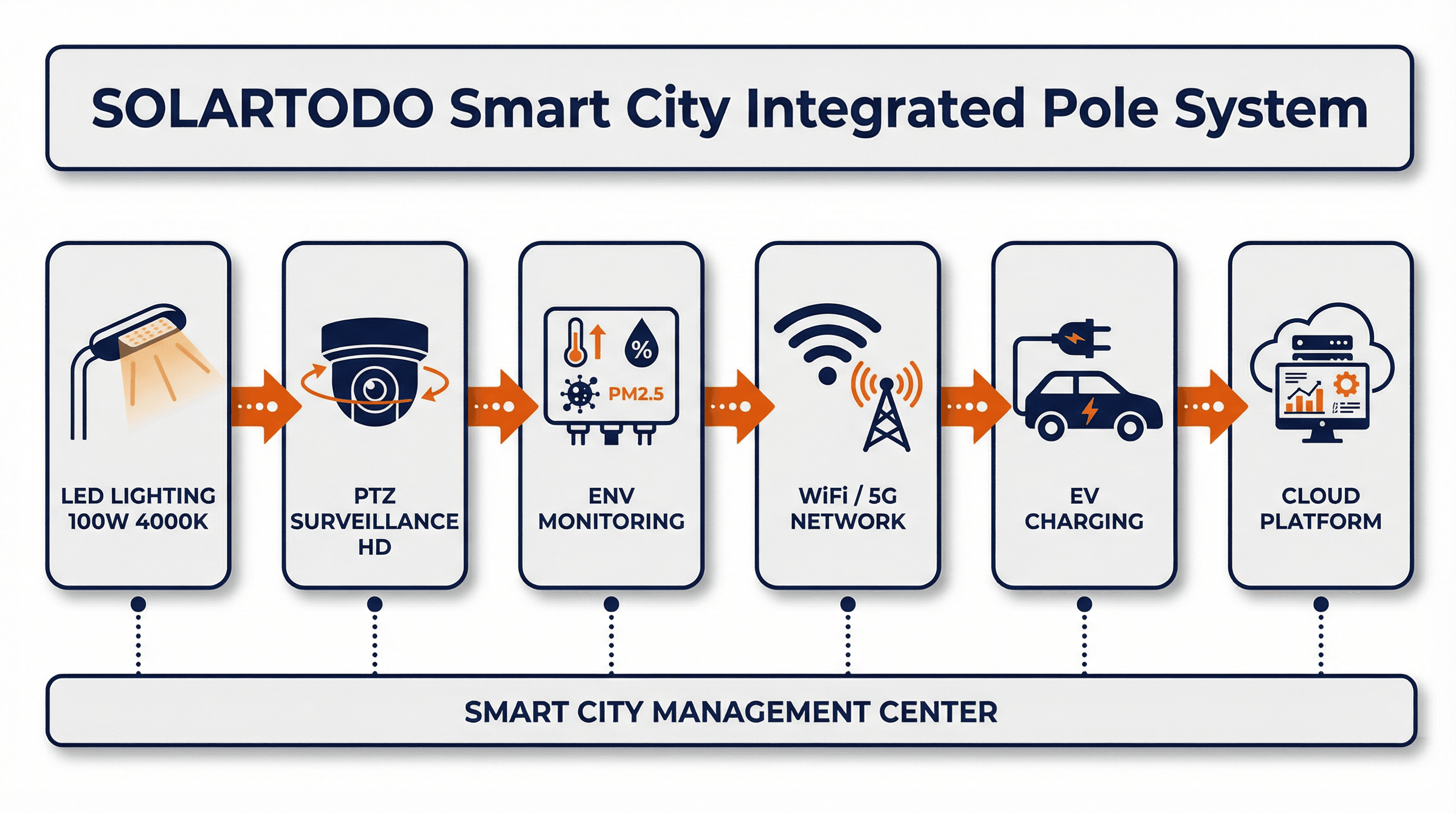
Each pole was configured with a 100W LED luminaire delivering 15,000 lumens at 4000K, providing roadway-grade illumination for mixed urban environments. Every unit also supports PTZ security monitoring, environmental data collection, and WiFi 6 communications capability. Approximately 15% of the network, or about 22 poles, includes 7 kW EV charging based on OCPP 1.6J interoperability.
This Doha deployment is commercially important because it moved beyond pilot scale into a meaningful city-scale installation. For municipalities and infrastructure owners, it provides a practical reference for integrating multiple smart city functions into one engineered field asset. For B2B buyers, the project demonstrates how to increase infrastructure density without multiplying foundations, power drops, trenching, or maintenance footprints.
Key Takeaways for B2B Buyers
- 147 smart poles deployed at city scale: This is a full multi-function rollout in a real urban environment, not a limited proof of concept or demo corridor.
- 100W LED lighting with 15,000 lm output: Each pole delivers roadway-grade illumination at 4000K, suitable for municipal roads, mixed-use districts, and public spaces.
- PTZ surveillance integrated on every pole: The project combines lighting and active visual monitoring without requiring separate camera masts or duplicate utility infrastructure.
- 8-in-1 environmental sensing across the network: Distributed street-level data collection supports air quality visibility, urban operations, and ESG-related reporting.
- WiFi 6 turns each pole into a connectivity node: The system is designed to support edge communications, connected devices, and future smart city applications.
- About 22 poles include 7 kW EV charging: Selective deployment of OCPP 1.6J chargers aligns charging investment with expected demand and site priorities.
- Higher ROI per installation point: Combining lighting, safety, sensing, communications, and charging improves the long-term value of each roadside asset.
Why This Smart Streetlight Solution Matters in Doha
Doha’s urban infrastructure must operate reliably in high heat, dust exposure, and continuous public use conditions. In this environment, separate systems for lighting, surveillance, environmental monitoring, and charging can increase maintenance complexity and create fragmented operations. A smart pole architecture addresses this challenge by consolidating multiple functions into one managed field asset.
The value of this approach extends beyond LED energy savings alone. A smart streetlight network can support public safety, environmental visibility, digital access, and EV charging readiness from the same physical footprint. That makes each pole more productive over its lifecycle and improves the economics of urban modernization.
The 147-unit scale is also commercially significant because it demonstrates repeatability, not just technical feasibility. The project shows that a common pole platform can be standardized across a city while still allowing selective upgrades based on local demand. That modular logic is especially relevant for fast-growing Gulf cities planning phased smart infrastructure investment.
Deployment Snapshot
| Item | Project Value |
|---|---|
| Total smart poles | 147 units |
| Pole height | 8 m |
| Pole type | Octagonal galvanized steel |
| LED luminaire power | 100W |
| Luminous flux | 15,000 lm |
| Color temperature | 4000K |
| Estimated luminaire efficacy | Approximately 150 lm/W |
| Security system | PTZ camera integration |
| Environmental sensing | 8-in-1 sensor package |
| Wireless connectivity | WiFi 6 |
| EV charging coverage | 15% of poles |
| Estimated EV charging poles | Approximately 22 units |
| Charger power | 7 kW AC |
| Charging protocol | OCPP 1.6J |
Technical Configuration of the 147-Unit Deployment
8 m Octagonal Galvanized Pole Structure
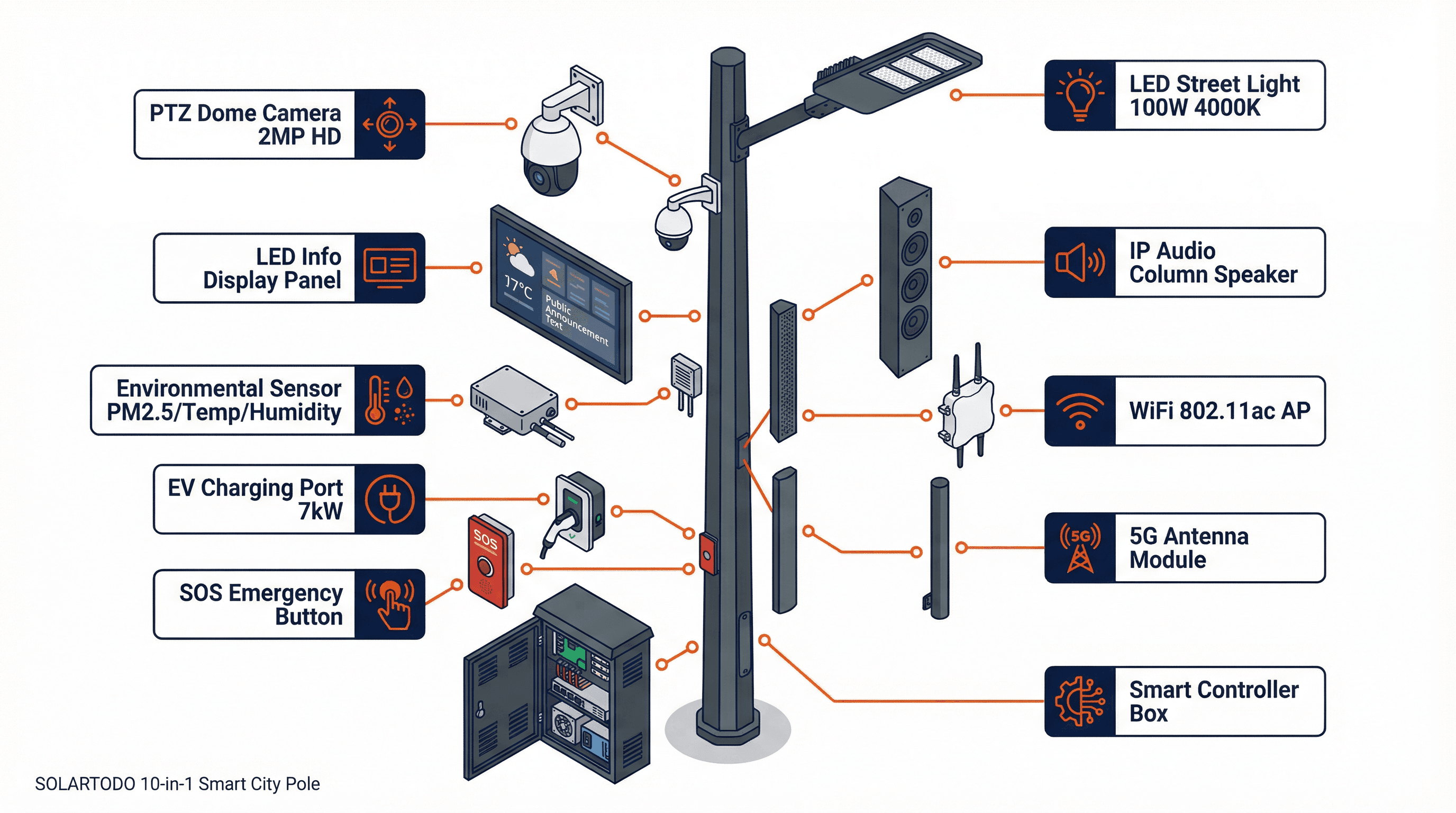
Each smart streetlight was installed on an 8-meter octagonal galvanized steel pole designed for multi-device integration. Octagonal geometry is commonly selected for municipal applications because it offers structural rigidity, clean visual lines, and practical mounting surfaces for luminaires, cameras, antennas, and sensor enclosures. The galvanized finish improves corrosion resistance, which is especially important in hot, dusty, and occasionally saline Gulf environments.
The 8 m height supports broad lighting distribution while also providing effective elevation for PTZ surveillance and wireless equipment. From an engineering standpoint, this height helps balance optical coverage, line-of-sight requirements, and maintainability. It also allows the network to be standardized around a repeatable pole architecture that field teams can service efficiently.
LED Lighting: 100W, 15,000 lm, 4000K
The lighting engine in each unit is rated at 100W and delivers 15,000 lumens, equivalent to an efficacy of roughly 150 lm/W at the luminaire output level. This performance is suitable for urban roads, access streets, commercial corridors, and pedestrian-adjacent spaces where visibility and energy efficiency must be balanced. The 4000K correlated color temperature provides a neutral white appearance that supports recognition and comfort without the harsher tone often associated with cooler lighting.
For B2B buyers, this specification confirms that the smart pole remains a serious lighting asset rather than a digitally enhanced but underpowered column. Core roadway illumination is preserved while additional systems are integrated into the same structure. That is important for projects where compliance with lighting performance expectations cannot be compromised by added smart city features.
PTZ Security Camera Integration
Each pole includes PTZ, or pan-tilt-zoom, surveillance capability to support active monitoring, incident review, and targeted observation. Compared with fixed cameras, PTZ systems allow operators to adjust the field of view in real time, which is useful for traffic monitoring, perimeter security, and event-based response. This flexibility increases the operational value of the streetlight network beyond illumination.
Integrating PTZ cameras directly onto the lighting pole reduces the need for separate surveillance structures and duplicate cabling routes. That can simplify deployment schedules, reduce visual clutter, and improve coordination between electrical and communications works. It also creates a more centralized asset inventory for operators responsible for both lighting and public safety infrastructure.
8-in-1 Environmental Sensing
The Doha smart poles include an 8-in-1 environmental sensing package that enables distributed measurement of localized urban conditions. Depending on project configuration, this class of sensor suite commonly covers PM2.5, PM10, temperature, humidity, noise, CO, NO2, and SO2, or similar atmospheric indicators. Embedding these sensors into the lighting network provides broader spatial coverage than relying only on a few standalone monitoring stations.
For municipalities, this supports better visibility into air quality trends, climate conditions, and environmental risk at street level. For private developments and campuses, the data can support ESG reporting, sustainability dashboards, and occupant communication. The result is a more data-rich streetscape without the cost and complexity of building a separate sensing network.
WiFi 6 Connectivity
WiFi 6 capability extends the role of each pole from utility infrastructure to edge communications node. In practical terms, this supports local wireless access, connected devices, and future smart city applications that depend on distributed bandwidth and low-latency field connectivity. As urban services become more data-driven, communications readiness is increasingly a baseline requirement rather than an optional enhancement.
For infrastructure owners, embedding wireless capability from the start helps future-proof the network. A city may initially prioritize lighting and surveillance, then later add digital services, connected sensors, or localized user access. The Doha project shows how communications infrastructure can be integrated from day one instead of added later at higher retrofit cost.
7 kW EV Charging on 15% of Poles
Approximately 15% of the 147 poles were equipped with 7 kW EV charging, which translates to about 22 charging-enabled poles across the deployment. This selective rollout model is commercially efficient because it places charging where demand is most likely while avoiding unnecessary capital expenditure across the full network. It also preserves a common pole design while allowing differentiated functionality by location.
The chargers use OCPP 1.6J, a widely adopted protocol that enables communication with central charging management systems. This supports remote monitoring, user administration, billing workflows, and charger status reporting. In dense urban areas, integrating EV charging into smart poles can be more space-efficient than installing standalone charger structures with separate civil works.
Comparison: Smart Pole Network vs Conventional Separate Infrastructure
| Criteria | Smart Pole Network | Conventional Separate Systems |
|---|---|---|
| Lighting | Integrated into one pole platform | Standalone lighting columns |
| Surveillance | PTZ camera mounted on same pole | Separate camera mast or building mount |
| Environmental sensing | Distributed street-level sensing | Independent monitoring stations |
| Wireless connectivity | Embedded WiFi 6 node | Separate communications hardware |
| EV charging | Selective charging on chosen poles | Standalone charger installations |
| Civil works | Reduced trenching and fewer roadside assets | Higher duplication of foundations and cabling |
| Maintenance model | Centralized multi-system asset management | Fragmented maintenance across vendors |
| Urban aesthetics | Cleaner streetscape with fewer structures | More visual clutter |
Business Value of a Multi-Function Smart Pole Network
Reduced Infrastructure Redundancy
Traditional urban projects often deploy separate poles, cabinets, or enclosures for lighting, cameras, sensors, wireless equipment, and EV chargers. That increases trenching, cabling, permitting coordination, and roadside clutter. A multi-function smart pole reduces this duplication by combining several systems into one engineered structure.
For procurement teams and EPC contractors, that can improve project efficiency and simplify vendor coordination. Fewer discrete assets also make roadside planning easier in dense urban areas where space is limited. The result is a cleaner installation model with lower infrastructure redundancy.
Improved Return on Streetscape Investment
Every municipal pole is a long-life capital asset, so maximizing utility at each installation point is increasingly important. In the Doha deployment, each pole contributes not only to lighting but also to safety, environmental visibility, digital connectivity, and in selected locations, EV charging. This increases the functional value of the same physical footprint.
For developers and public agencies, the ROI case therefore extends beyond energy savings alone. Stakeholders can also evaluate security benefits, environmental intelligence, communications readiness, and mobility support. That broader value framework is central to modern smart city investment decisions.
Scalable and Modular Deployment Logic
One of the strongest features of this project is its modular distribution of capabilities. All 147 poles include core smart lighting, surveillance, sensing, and connectivity functions, while only 15% were upgraded with EV charging. This allows infrastructure owners to align spending with actual use patterns rather than overbuilding every location.
Scalability matters because urban demand rarely develops evenly across a city. A common pole standard with selective upgrades makes future expansion easier and lowers redesign risk. The Doha project demonstrates how a standardized platform can still support location-specific business cases.
Engineering and Standards Considerations
Smart streetlight projects intended for long-term public deployment should align with recognized engineering, safety, and interoperability frameworks. Final compliance requirements vary by jurisdiction, but buyers should review lighting performance, electrical protection, communications architecture, charger interoperability, and environmental durability at the subsystem level. A documented standards strategy reduces approval risk and supports smoother commissioning, operation, and maintenance.
For road lighting performance, IEC 60598 for luminaires and IEC 62262 for impact protection are relevant references, while IEC 60529 helps define ingress protection expectations for outdoor enclosures exposed to dust and moisture. In power quality and system integration, IEEE references are commonly used for surge protection, grounding practice, communications reliability, and design discipline. Buyers should also request test reports for thermal performance, corrosion resistance, and electrical safety before procurement approval.
The U.S. National Renewable Energy Laboratory, or NREL, is widely referenced for best practices in distributed energy planning, EV charging integration, and infrastructure modeling. For projects that include charger loads, future solar-ready logic, or broader resilience goals, NREL guidance can improve assumptions around load interaction, utilization, and upgrade planning. In charging deployments, buyers should verify OCPP 1.6J compatibility claims and request subsystem validation for luminaires, cameras, sensors, networking devices, and chargers.
Deployment Considerations for Similar Projects in the Middle East
Climate Resilience
Projects in Qatar and across the Middle East must account for high ambient temperatures, intense solar exposure, dust loading, and occasional corrosive conditions. These factors affect optics, electronics, seals, coatings, and maintenance intervals over time. Galvanized poles, properly rated enclosures, and strong thermal management are therefore essential design requirements.
For smart poles carrying multiple active devices, thermal design becomes even more important because cameras, wireless modules, sensors, and chargers all add to the electrical and heat profile. Buyers should verify operating temperature ranges, ingress protection ratings, and long-term reliability data. This is particularly important for installations expected to operate continuously in exposed roadside corridors.
Power and Networking Architecture
Because smart poles aggregate several subsystems, the power design must be segmented, protected, and serviceable. Lighting, surveillance, sensors, wireless equipment, and EV chargers all have different load profiles and uptime priorities. A robust design should include circuit protection, surge protection, remote diagnostics, and maintainable internal distribution from the outset.
Networking architecture is equally critical because PTZ video, environmental telemetry, WiFi services, and charger communications place different demands on bandwidth and latency. A stable communications backbone and manageable software layer are necessary to ensure the pole behaves as one coordinated system. Without that, the network can become a collection of disconnected devices rather than a usable smart infrastructure platform.
Operations and Maintenance Strategy
Multi-function poles require a structured O&M plan covering both physical and digital assets. This includes luminaire cleaning, camera alignment checks, sensor verification, charger diagnostics, firmware updates, and communications monitoring. Without a defined maintenance strategy, the long-term performance of integrated smart infrastructure can decline quickly.
From a procurement perspective, buyers should ask suppliers about spare parts planning, remote monitoring tools, fault escalation procedures, and preventive maintenance intervals. A strong supplier should support lifecycle operations, not just installation and commissioning. This is especially important for public-facing assets that affect safety, mobility, and service quality.
Who This Solution Is Best For
This type of smart streetlight solution is well suited for municipalities, smart city authorities, transport agencies, industrial parks, airports, universities, mixed-use developers, and large real estate operators. It is particularly valuable where public lighting must also support safety, connectivity, environmental visibility, and future mobility services. The strongest fit is usually in projects where land efficiency and digital readiness are both strategic priorities.
It is also a good match for organizations planning phased modernization rather than one-time full-feature deployment. A common smart pole platform allows features to be activated according to budget, site demand, and policy priorities. The Doha case shows how this phased logic can work at meaningful scale while preserving system consistency.
Frequently Asked Questions
What makes this Doha smart streetlight project different from a standard LED street lighting upgrade?
A standard LED upgrade mainly improves energy efficiency and lighting quality. This Doha project goes further by combining 100W LED lighting with PTZ surveillance, 8-in-1 environmental sensing, WiFi 6, and 7 kW EV charging on selected poles. The result is a multi-function urban infrastructure platform rather than a lighting-only replacement.
How many poles included EV charging in the 147-unit deployment?
Fifteen percent of the 147 poles were equipped with 7 kW EV chargers using OCPP 1.6J. That equals approximately 22 poles, depending on final site allocation. This selective deployment model helps align charging capacity with expected demand and budget priorities.
Why is 4000K often chosen for smart streetlight projects?
4000K provides a balanced white light that supports visibility, recognition, and public comfort in urban settings. It is widely used in roads, commercial districts, and mixed-use environments because it offers good visual clarity without appearing excessively cool. For B2B buyers, it is often a practical compromise between performance and user acceptance.
Why is OCPP 1.6J important for EV charging poles?
OCPP 1.6J is a widely adopted communication protocol that allows EV chargers to connect with central management platforms. This supports remote monitoring, user management, billing workflows, and fault diagnostics. For municipal and commercial buyers, interoperability helps reduce vendor lock-in risk.
What standards should buyers review when evaluating smart pole systems?
Buyers should review subsystem compliance against relevant references such as IEC 60598 for luminaires, IEC 60529 for enclosure ingress protection, and applicable IEEE references for electrical and communications design. NREL guidance is also useful for EV charging integration and infrastructure planning. In addition, buyers should request formal certification and test documentation for luminaires, chargers, cameras, sensors, and networking equipment.
Is a smart pole network more expensive than separate infrastructure?
Initial unit cost per pole can be higher because multiple subsystems are integrated into one structure. However, total project economics may improve when fewer foundations, less trenching, reduced cabling duplication, and simpler asset coordination are considered. The financial case is strongest when several urban functions are needed in the same corridor.
Can all poles be built with the same features?
They can, but many projects benefit from a modular approach instead. Standardizing the pole platform while varying the feature set by location helps control capital expenditure and match actual demand. The Doha deployment is a good example, with all poles sharing core functions and only selected poles adding EV charging.
Why are galvanized octagonal poles commonly used in smart streetlight projects?
Galvanized octagonal poles offer a good balance of strength, corrosion resistance, and clean urban aesthetics. Their geometry is also practical for mounting multiple devices such as luminaires, cameras, antennas, and sensors. In harsh climates, galvanization helps extend service life and reduce surface degradation.
What operational data can cities gain from 8-in-1 environmental sensors?
Depending on configuration, cities can monitor particulate matter, temperature, humidity, noise, and gas-related indicators such as CO or NO2. This data can support air quality management, public communication, and climate-responsive operations. Distributed sensing also gives better local granularity than relying only on a few centralized stations.
Why is WiFi 6 relevant in a smart pole deployment?
WiFi 6 improves wireless efficiency, device density handling, and overall network responsiveness compared with earlier WiFi generations. In a smart pole context, it can support public connectivity, field devices, and future edge applications from the same infrastructure point. This makes the pole more useful as a long-term digital asset, not just a lighting column.
What should buyers verify before approving a multi-function smart pole supplier?
Buyers should verify subsystem certifications, operating temperature range, ingress protection, structural calculations, surge protection design, and software interoperability claims. They should also review maintenance workflows, spare parts availability, and remote monitoring capabilities. A strong supplier should provide both technical documentation and lifecycle support commitments.
How does a smart pole network improve urban land efficiency?
By combining lighting, surveillance, sensing, connectivity, and charging into one roadside asset, a smart pole reduces the need for multiple separate structures. This lowers visual clutter and can reduce trenching, foundations, and utility interfaces. In dense urban corridors, that land-efficiency benefit can be as valuable as the technology itself.
Is this deployment model suitable only for new developments?
No, the model can work in both new-build and retrofit projects. In retrofit scenarios, replacing legacy lighting columns with standardized smart poles can modernize several urban services at once. The best fit depends on existing power availability, communications backbone, and local operational priorities.
References
- NREL: U.S. National Renewable Energy Laboratory resources on EV charging integration, distributed energy planning, and infrastructure modeling.
- IEC 60598: Luminaires standard relevant to safety and performance evaluation for outdoor lighting equipment.
- IEC 60529: Degrees of protection provided by enclosures, commonly referenced for IP ratings in outdoor smart pole components.
- IEC 62262: Degrees of protection against external mechanical impacts, relevant for public-facing urban equipment.
- IEEE Standards: Relevant references for electrical engineering, communications reliability, interoperability, grounding, and power quality planning.
- OCPP 1.6J: Open Charge Point Protocol reference for charger-to-management-system communication and interoperability.
Conclusion
The 147-unit smart streetlight deployment in Doha shows how public lighting can evolve into a broader urban services platform. Built on 8 m octagonal galvanized steel poles, the system combines 100W, 15,000 lm LED lighting with PTZ surveillance, 8-in-1 environmental sensing, WiFi 6, and selective 7 kW OCPP 1.6J EV charging. This creates a higher-value roadside asset for municipalities and developers seeking to unify safety, sustainability, connectivity, and mobility.
For B2B decision-makers, the project is important because it presents a scalable and commercially realistic model. Not every pole needs every feature, but every pole can belong to one consistent smart infrastructure architecture. In fast-growing urban markets such as Qatar, that flexibility is critical for building resilient, data-enabled, and future-ready public environments.