
Suva, Fiji faces a familiar urban challenge across Oceania: growing traffic volumes, uneven lighting coverage, and the operational burden of maintaining street infrastructure in coastal, humid environments. To address this, SOLAR TODO delivered a large-scale Smart Streetlight rollout designed for long service life, consistent illumination, and remote, data-driven management.
Answer Capsule: In Suva, SOLAR TODO deployed 113 Smart Streetlight poles with 50W/7500lm LED heads, environmental sensing, IP audio, and optional SOS/EV readiness—reducing energy use while improving visibility and operations.
Project Overview: Why Suva Needed Smarter, Manageable Street Lighting
Suva’s street network includes mixed roadway widths and dense intersections where lighting performance directly affects pedestrian safety, vehicular navigation, and incident response. In coastal climates, corrosion risk, dust ingress, and humidity-driven equipment downtime can quickly undermine the reliability of conventional lighting assets—especially when maintenance is reactive rather than planned.
SOLAR TODO’s Smart Streetlight solution was engineered to be both rugged and network-ready. Each pole integrates a high-efficiency LED light source and a sensor/communications stack that supports centralized monitoring via the City IoT Platform. The deployment approach also considered Suva’s real-world constraints: limited access time windows for field teams, variable traffic flow, and the need to standardize hardware so that troubleshooting and spare parts management remain efficient.
Deployment Design: 113 Poles, 6m Octagonal Structure, 20m Spacing
The project comprised 113 units × 6m octagonal hot-dip galvanized steel poles in Suva, Fiji (coordinates: -18.14, 178.44). Poles were installed with 20m spacing across corridors with an average road width of 8m, supporting uniform illumination and consistent camera/sensor coverage.
Each pole is grid-powered (AC) and designed for 10 hours of daily operation, aligning with typical evening peak demand while helping reduce total energy consumption compared with legacy systems.
Operational intent: standardize a city-scale lighting layout where every asset is measurable (light + environment + network health) and manageable (remote control and diagnostics), rather than relying solely on manual inspections.
Product Architecture: What Each Smart Streetlight Pole Includes
SOLAR TODO’s Smart Streetlight project in Suva used a core-and-optional module configuration to match site requirements without overcomplicating installation.
Core modules installed on all poles
- HD camera module (core security/verification layer)
- 400W IR capability for night visibility
- H.265+ video efficiency for lower bandwidth/storage
- IP67 ingress protection to withstand coastal moisture and dust
- 30W power consumption per camera module
- 8-in-1 Environmental (ENV) sensor module (core situational awareness)
- Measures: wind, temperature, humidity, pressure, noise, PM10, PM2.5
- Sensor module power: 5W
This combination enables the city to correlate lighting performance and incident context with environmental conditions—useful for traffic safety, public space monitoring, and maintenance planning.
Optional modules used where needed
-
Emergency_call (SOS intercom + 200W IR camera)
- Designed for rapid, location-specific assistance
- Adds a dedicated IR camera for incident verification
-
WiFi AP (802.11ac, 300Mbps, up to 100 devices)
- Provides local connectivity coverage for public areas and camera backhaul scenarios (where permitted)
-
EV charger (OCPP 1.6J, 7kW AC)
- Deployed on 15% of poles to support early EV infrastructure expansion
- Uses standardized OCPP 1.6J for interoperability with charging management systems
-
IP audio column (IP音柱, 30W, 93dB, TCP/IP networked)
- Enables public announcements and emergency messaging
- Networked over TCP/IP for centralized control
LED lighting performance and thermal/optical consistency
For Suva’s configuration, the LED lighting spec for each pole was:
- LED 50W / 7500lm
- 150 lm/W efficacy
- 4000K color temperature
This was selected to balance visibility, energy efficiency, and comfort for mixed-use streets while maintaining consistent light output over time.
Communications & Control: City IoT Platform with LoRaWAN/4G Connectivity
Each pole uses a smart controller supporting LoRaWAN/4G for telemetry and remote management. Data—including sensor readings (wind, PM2.5/PM10, noise, etc.), device status, and operational metrics—can be managed through the Smart City (City IoT Platform).
This approach is particularly valuable for Suva where field access can be weather-dependent and where minimizing downtime is crucial to maintaining public trust. Remote diagnostics help reduce troubleshooting time by identifying faults (e.g., network drops, sensor anomalies, or controller issues) before crews are dispatched.
Deployment Standards and Durability Requirements
SOLAR TODO’s Smart Streetlight hardware is designed in line with:
- IEC 60598 (luminaires—safety and performance)
- GB/T 37024 (lighting-related performance/safety requirements)
In addition, the camera module used in this configuration is rated IP67, ensuring protection against dust and water ingress—critical for a humid, coastal city environment.
How the Solution Addressed Suva’s Infrastructure Constraints
Suva’s urban environment includes frequent moisture exposure and salt-laden air near coastal zones. Traditional street lighting often faces premature failures due to corrosion and ingress. SOLAR TODO’s design choices—hot-dip galvanized steel poles, IP-rated electronics, and networked monitoring—support longer maintenance intervals and more predictable lifecycle costs.
The project also targeted operational inefficiency. When lighting systems are not remotely monitored, teams must rely on periodic patrols and manual checks. With Smart Streetlight, the city gains visibility into both the lighting assets and the environmental conditions around them.
Finally, the optional modules support phased expansion rather than one-time “overbuild.” By installing EV chargers on 15% of poles and enabling SOS intercom where required, Suva can scale capabilities as demand grows—without replacing the entire lighting backbone.
Results and Impact
After deployment, Suva gained a standardized, data-enabled street lighting network across the configured corridors.
Key measured outcomes and operational benefits included:
- Energy reduction: The LED design replaces 250W HPS street lighting, achieving up to 80% energy saving for the lighting function.
- Improved night visibility: High-efficiency 50W/7500lm LED output with 4000K supports clearer road and pedestrian sightlines.
- Richer situational awareness: Each pole’s 8-in-1 ENV sensor provides actionable environmental data, including PM2.5/PM10 and noise, supporting better incident context and maintenance prioritization.
- Incident response readiness: Where emergency coverage was selected, the emergency_call option adds SOS intercom and a 200W IR camera, improving verification and response coordination.
- Scalable connectivity: LoRaWAN/4G plus the City IoT Platform enables centralized monitoring across the full asset count.
- Public communication capability: The IP音柱 (30W, 93dB, TCP/IP) supports announcements and emergency messaging over a networked interface.
- EV readiness without full network replacement: By equipping 15% of poles with 7kW AC chargers (OCPP 1.6J), Suva can expand EV charging while keeping the street lighting infrastructure consistent.
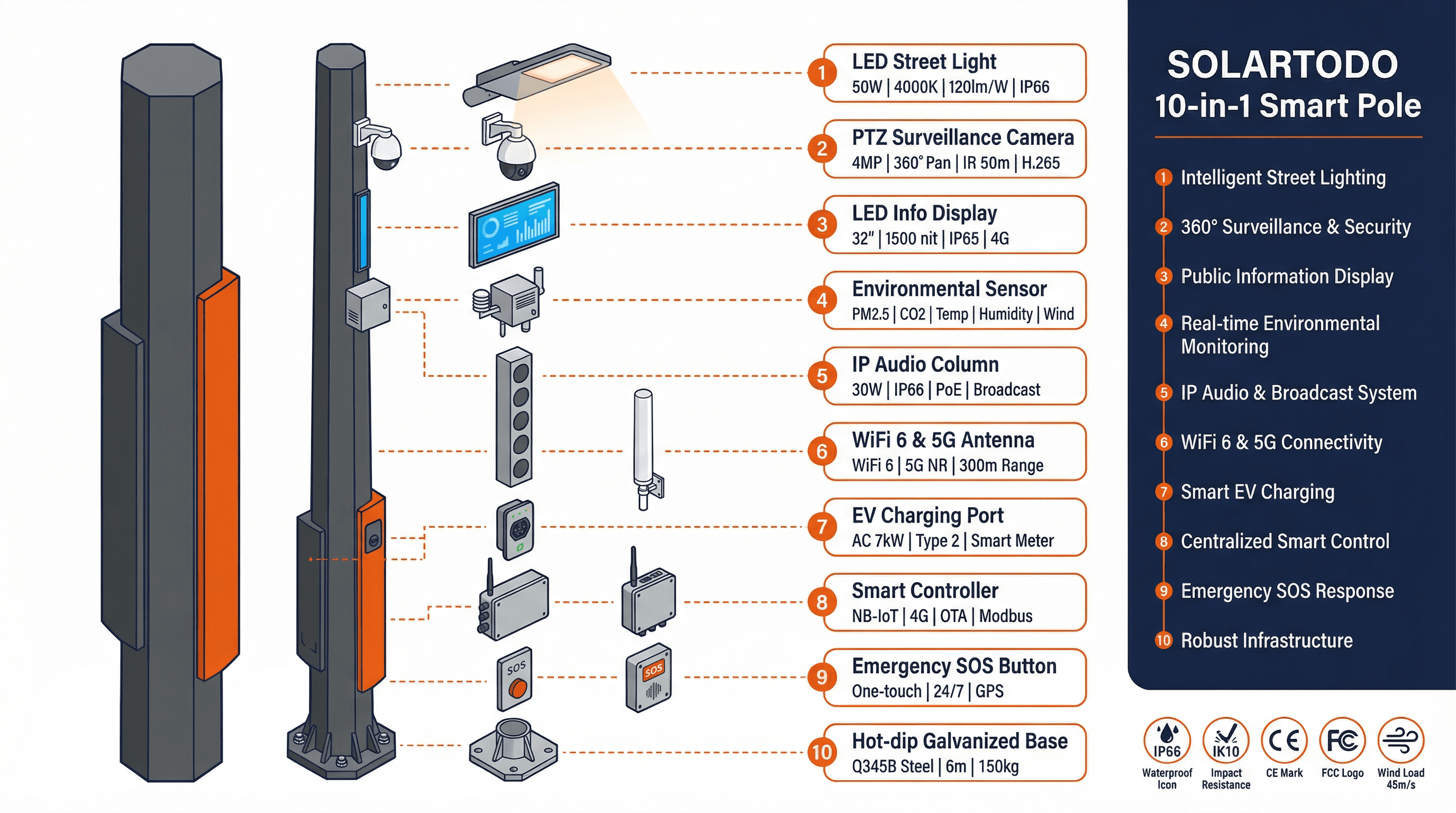
Technical Specifications
- Deployment scale: 113 units in Suva, Fiji
- Pole structure: 6m octagonal hot-dip galvanized steel pole
- Installation layout: 20m spacing, 8m road width coverage
- Lighting (per pole): LED 50W / 7500lm, 150 lm/W, 4000K
- Operating profile: 10 hours daily, grid-powered (AC)
- Core security module: HD camera
- 400W IR, H.265+, IP67, 30W
- Core environmental module: 8-in-1 ENV sensor
- wind / temperature / humidity / pressure / noise / PM10 / PM2.5
- 5W
- Optional emergency module: SOS intercom (emergency_call) + 200W IR camera
- Optional connectivity module: WiFi AP (802.11ac, 300Mbps, up to 100 devices)
- Optional EV module: EV charger
- OCPP 1.6J, 7kW AC
- Installed on 15% of poles
- Optional public audio module: IP音柱
- 30W, 93dB, TCP/IP networked
- Control & communications: Smart controller with LoRaWAN/4G
- Management platform: Smart City (City IoT Platform)
- Standards compliance: IEC 60598, GB/T 37024
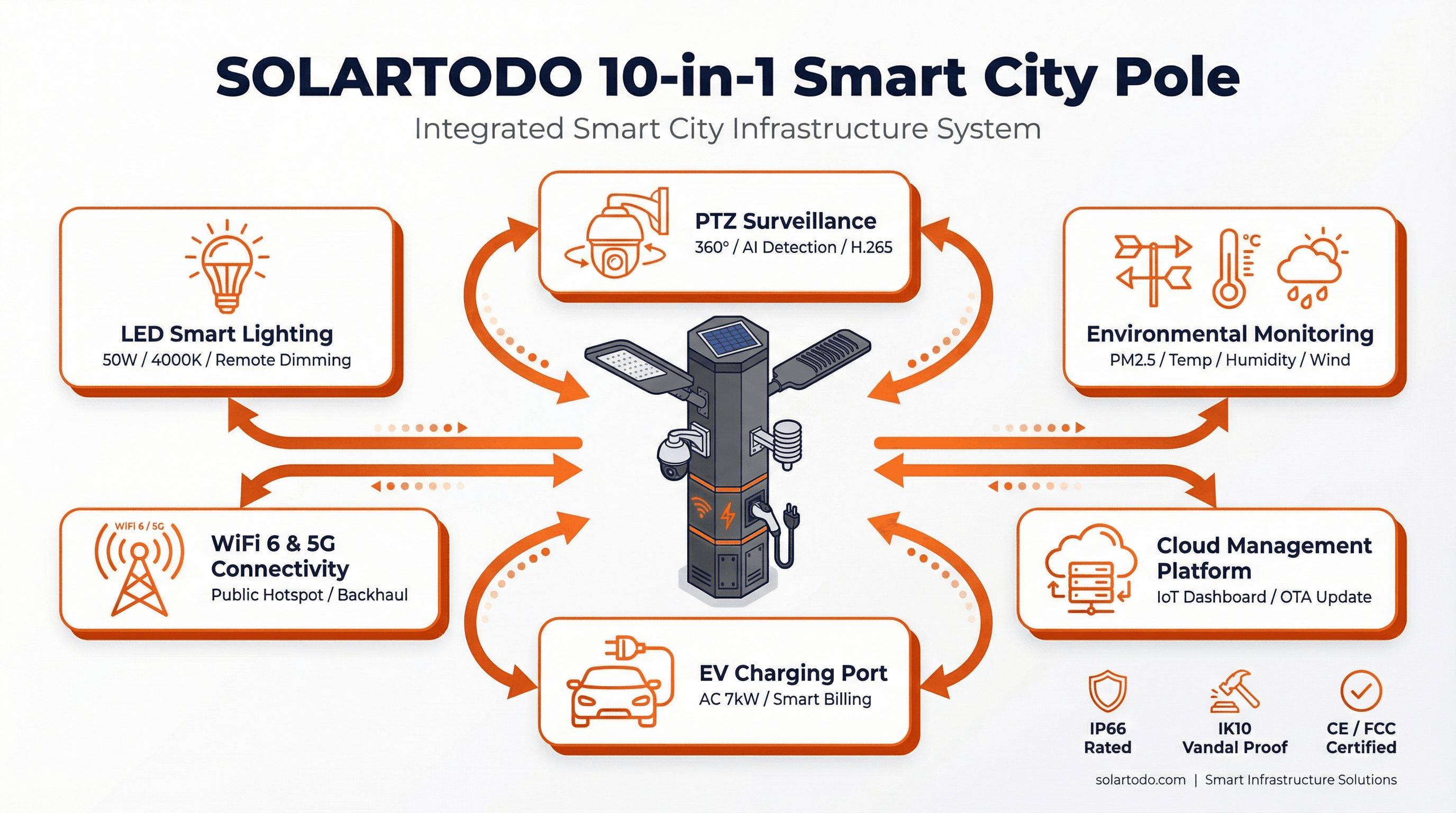
Related Reading
References (Standards & Guidance)
- IEC 60598 — Luminaires safety and performance requirements.
- GB/T 37024 — Lighting-related performance/safety standard referenced for compliance.
- ITU-T guidance on IMT/IoT connectivity architecture for wide-area sensing and telemetry.
- IEEE guidance on communications reliability and networked systems for smart infrastructure.
- World Bank resources on smart city infrastructure and service delivery planning.
Pricing & Quotation
SOLAR TODO offers three pricing tiers for this product line: FOB Supply (equipment ex-works China), CIF Delivered (including ocean freight and insurance), and EPC Turnkey (fully installed, commissioned, with 1-year warranty). Volume discounts are available for large-scale deployments. Configure your system online for an instant estimate, or request a custom quotation from our engineering team at [email protected].
Frequently Asked Questions
1) What connectivity does the Suva Smart Streetlight deployment use for remote monitoring?
Each pole uses a smart controller supporting LoRaWAN/4G connectivity, with management through the Smart City (City IoT Platform) for remote status, telemetry, and operations.
2) Are the cameras and sensors designed for outdoor coastal conditions?
Yes. The core camera module is rated IP67 and includes H.265+ encoding with 400W IR capability. The environmental sensors are configured for outdoor measurement of wind, temperature, humidity, pressure, noise, PM10, and PM2.5.
3) How much energy does the new lighting replace compared to HPS?
In this Suva configuration, the Smart Streetlight replaces 250W HPS, achieving up to 80% energy saving for the lighting function.
4) Can Suva expand EV charging later without changing the whole streetlight network?
Yes. The project deploys EV chargers on 15% of poles using OCPP 1.6J, 7kW AC, allowing phased expansion while keeping the lighting and pole platform consistent.
For more details on the product platform, visit: Smart Streetlight product page. For project discussions, contact us.
Equipment Deployed
- 113 × 6m octagonal hot-dip galvanized steel pole assemblies (grid-powered AC), configured with 50W/7500lm LED (150 lm/W, 4000K), 20m spacing for 8m road width coverage, 10hr/day operation
- 113 × HD camera module: 400W IR, H.265+, IP67, 30W
- 113 × 8-in-1 ENV sensor module (wind/temp/humidity/pressure/noise/PM10/PM2.5), 5W
- Optional emergency_call module on selected poles: SOS intercom + 200W IR camera
- Optional WiFi AP module on selected poles: 802.11ac 300Mbps, up to 100 devices
- Optional EV charger module on 15% of poles: OCPP 1.6J, 7kW AC
- Optional IP audio column on selected poles: IP音柱, 30W, 93dB, TCP/IP networked
- Smart controller with LoRaWAN/4G and Smart City (City IoT Platform) remote management