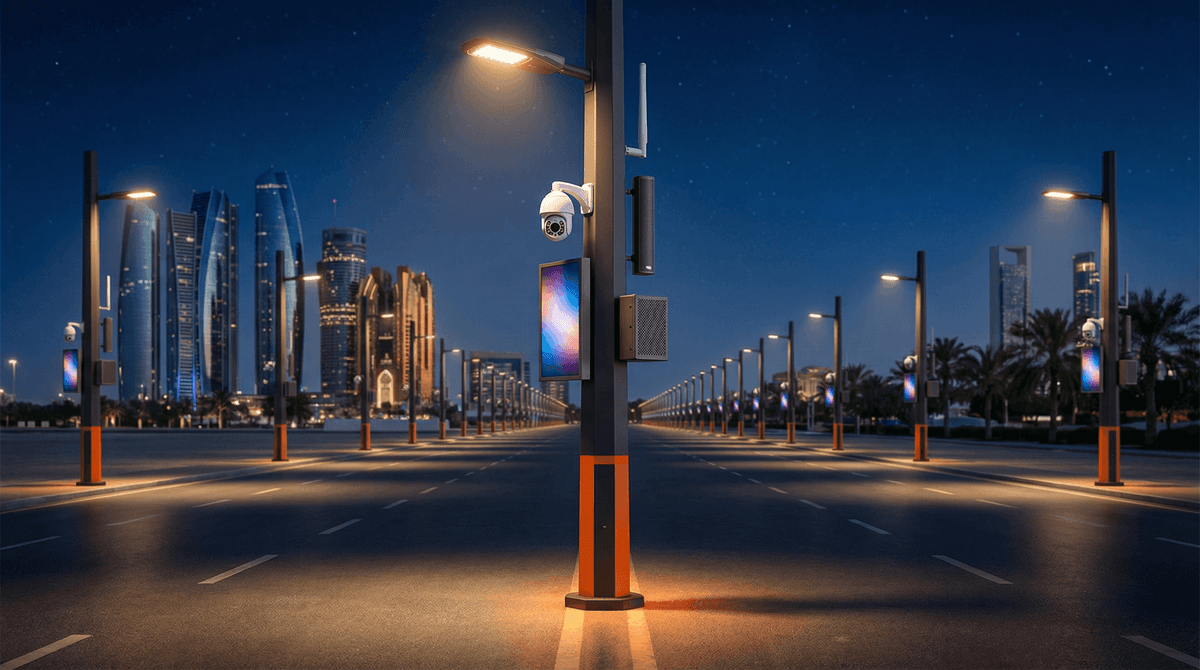
Smart Streetlight Deployment in Abu Dhabi, UAE: 323 Grid-Powered Poles with LED Lighting, Environmental Sensing, and Cloud Control
SOLAR TODO delivered a citywide Smart Streetlight deployment in Abu Dhabi, UAE, built around a highly integrated and standards-driven pole platform designed for long service life, stable roadway illumination, and real-time environmental awareness. The project combined efficient LED lighting, multi-parameter sensing, camera-based visibility, and centralized cloud management in a repeatable urban deployment model. The result is a smarter street infrastructure system tailored to the operating conditions of a major MENA city.
Answer Capsule: In Abu Dhabi, SOLAR TODO installed 323 Smart Streetlights on 6m octagonal poles at 20m spacing to replace 250W HPS. The system provides 50W / 7500lm LED lighting, 8-in-1 environmental sensing, HD camera capability, and cloud-managed controls through a Smart Cloud Gateway.
Key Takeaways
- 323 smart poles deployed across Abu Dhabi street sections with standardized geometry.
- 50W LED luminaires replaced 250W HPS, targeting up to 80% energy saving.
- 6m octagonal hot-dip galvanized steel poles were installed at 20m spacing on 8m road width segments.
- Each pole integrates HD camera capability, 8-in-1 environmental sensing, and remote cloud monitoring.
- Grid-powered AC operation with a 10-hour daily schedule supports stable lighting and communications performance.
- IEC 60598-aligned lighting design and robust enclosure protection help support reliability in hot, dusty urban conditions.
- Optional SOS intercom and IR camera add emergency-response functionality in designated areas.
Project Overview: Smart Streetlights for Abu Dhabi’s Urban Operations
Abu Dhabi’s road network requires more than basic illumination. Municipal operators need predictable lighting performance, remote diagnostics, and location-specific environmental data to support traffic safety, maintenance planning, and public-space operations. These needs become more important in areas affected by heat, airborne dust, and continuous road activity.
The SOLAR TODO Smart Streetlight project addressed these requirements with a pole-based smart infrastructure platform configured for Abu Dhabi’s street layout and maintenance model. The deployment used grid-powered AC operation with a 10-hour daily schedule, helping ensure stable performance for lighting, sensing, and communications. Cloud-based management also reduced dependence on manual inspection as the primary maintenance method.
From a deployment perspective, the project focused on streets with 8m road width and standardized installation constraints. With 20m pole spacing, the lighting layout supported uniform roadway coverage while maintaining practical installation efficiency. This repeatable geometry also simplified commissioning, future servicing, and fleet-level asset management.
Infrastructure Challenge: Reliability, Visibility, and Maintenance at Scale
In Abu Dhabi, high temperatures, dust events, and dense urban traffic create a demanding environment for street infrastructure. Conventional systems such as 250W high-pressure sodium (HPS) often require more frequent lamp replacement, provide less precise optical control, and offer little operational feedback once installed. For municipalities managing large road networks, this can increase maintenance workload and delay fault detection.
Environmental conditions can also change significantly during the day. Street-level factors such as PM2.5, PM10, wind speed, humidity, pressure, and ambient noise affect visibility, comfort, and operational awareness, yet many legacy lighting assets do not capture this data. By contrast, smart poles can function as distributed sensing nodes that support broader urban management objectives.
At the fleet level, operators must monitor hundreds of field devices across multiple districts. Without centralized control, issues such as driver faults, communication interruptions, or sensor anomalies may remain unnoticed until a site visit is scheduled. SOLAR TODO’s Smart Streetlight configuration was designed to reduce these gaps by combining efficient LED lighting, multi-parameter sensing, and remote management through a Smart Cloud Gateway.
Solution Design: The Smart Streetlight Pole Platform
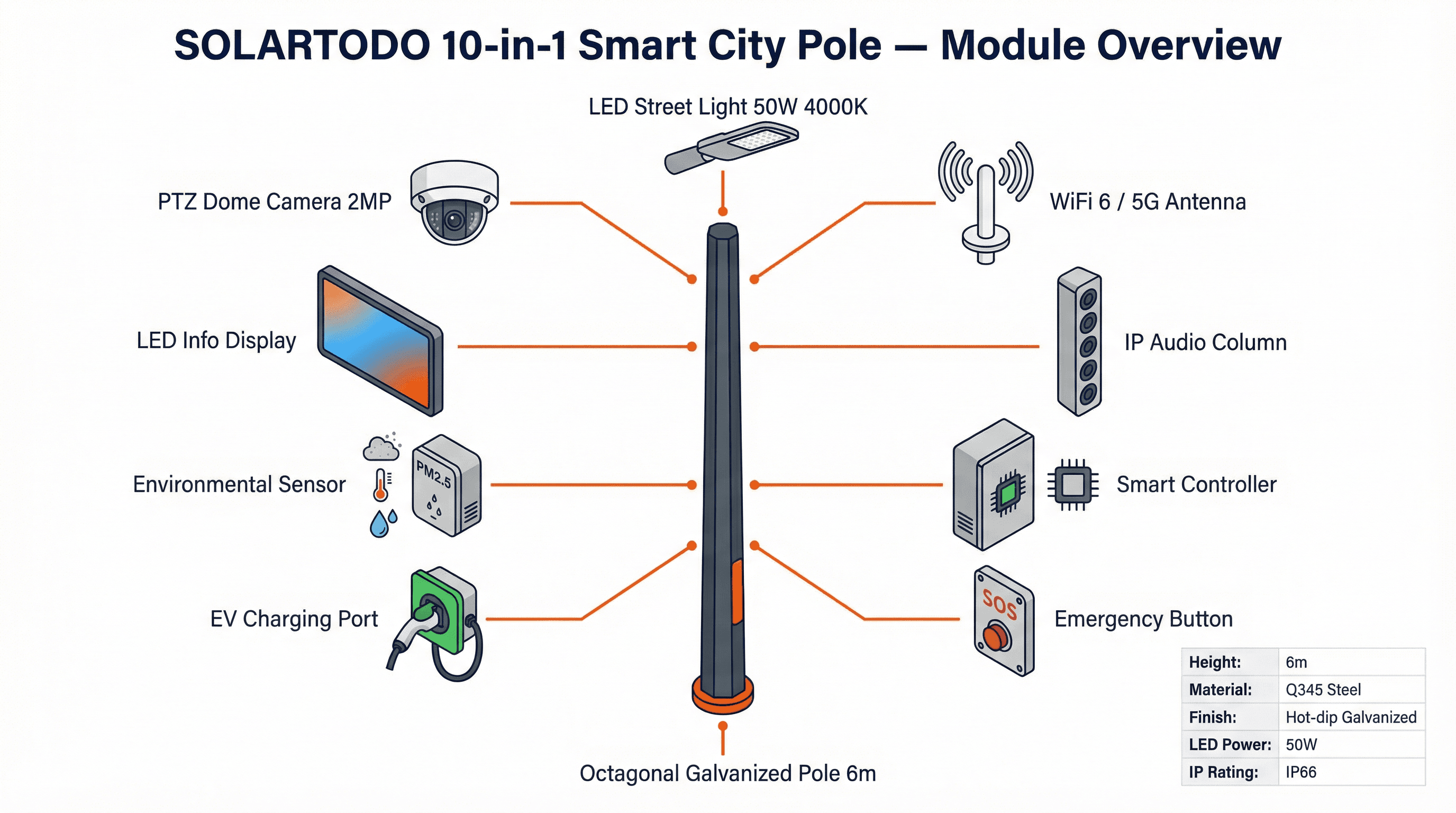
This Abu Dhabi deployment used 323 units of 6m octagonal hot-dip galvanized steel poles in a standardized street geometry. The poles were arranged at 20m spacing along roads with 8m width, creating a repeatable lighting and sensing footprint. Each unit was configured as a multi-function smart pole that combines illumination, monitoring, and communications in one structure.
The design emphasizes operational consistency and long-term maintainability. Hot-dip galvanization supports corrosion resistance in coastal desert environments, while integrated modules reduce the need for separate roadside devices. The result is a compact smart infrastructure platform suitable for urban roads that require both lighting and data visibility.
Core Optical and Environmental Modules
The lighting and sensing stack was engineered to provide both roadway illumination and actionable environmental intelligence. Each pole includes a 50W LED luminaire delivering 7500 lumens at 150 lm/W and 4000K, a color temperature commonly selected for clear roadway visibility and balanced visual comfort. Compared with legacy HPS systems, LED lighting typically offers better optical control, faster startup, and lower maintenance demand.
The core camera module is an HD camera with 400W IR, H.265+, IP67 protection, and 30W power. This supports video capture with efficient compression for networked deployment and improved performance in low-light conditions. The IP67 rating is important in dusty and weather-exposed roadside environments.
Each pole also integrates an 8-in-1 environmental sensor covering wind, temperature, humidity, pressure, noise, PM10, and PM2.5, with a 5W power profile. This enables municipalities to collect localized environmental data directly from existing street assets rather than relying only on sparse monitoring points. In practical terms, that means better visibility into changing road and air-quality conditions across the network.
Optional Emergency Call Configuration
To support safety and incident response, selected segments were equipped with an emergency_call option. This configuration includes an SOS intercom and a 200W IR camera, allowing users or operators to initiate assistance requests directly from the pole. The added imaging capability improves situational awareness during response workflows.
This optional module is particularly useful in areas where rapid communication with control teams is a priority. Integrating emergency functions into the lighting pole reduces the need for separate support structures. It also keeps roadside equipment more standardized from an installation and maintenance perspective.
Connectivity and Control Architecture
The poles operate using a standalone Smart Cloud Gateway model with grid-powered AC as the primary energy source. A 10-hour daily operating schedule was configured to align with project lighting requirements while supporting stable system behavior. This architecture prioritizes predictable uptime and simplified power management.
For communications, the smart controller supports LoRaWAN and 4G within the overall pole controller design. That enables remote monitoring, telemetry collection, and fleet-level control without requiring frequent roadside intervention. In large municipal deployments, this kind of connectivity is essential for reducing truck rolls and improving maintenance response times.
Technical Specifications
- Pole quantity: 323 units
- Pole height and form: 6m octagonal hot-dip galvanized steel pole
- Road layout: 20m spacing; 8m road width
- Illumination: LED 50W / 7500lm (150 lm/W), 4000K
- Standards referenced in project configuration: IEC 60598, GB/T 37024
- Core HD camera: 400W IR, H.265+, IP67, 30W
- Environmental sensor: 8-in-1 (wind/temp/humidity/pressure/noise/PM10/PM2.5), 5W
- Optional emergency call module: SOS intercom + 200W IR camera
- Control: standalone Smart Cloud Gateway
- Power mode: Grid-powered (AC)
- Operation schedule: 10 hours daily
- Energy replacement benchmark: replaces 250W HPS with target 80% energy saving
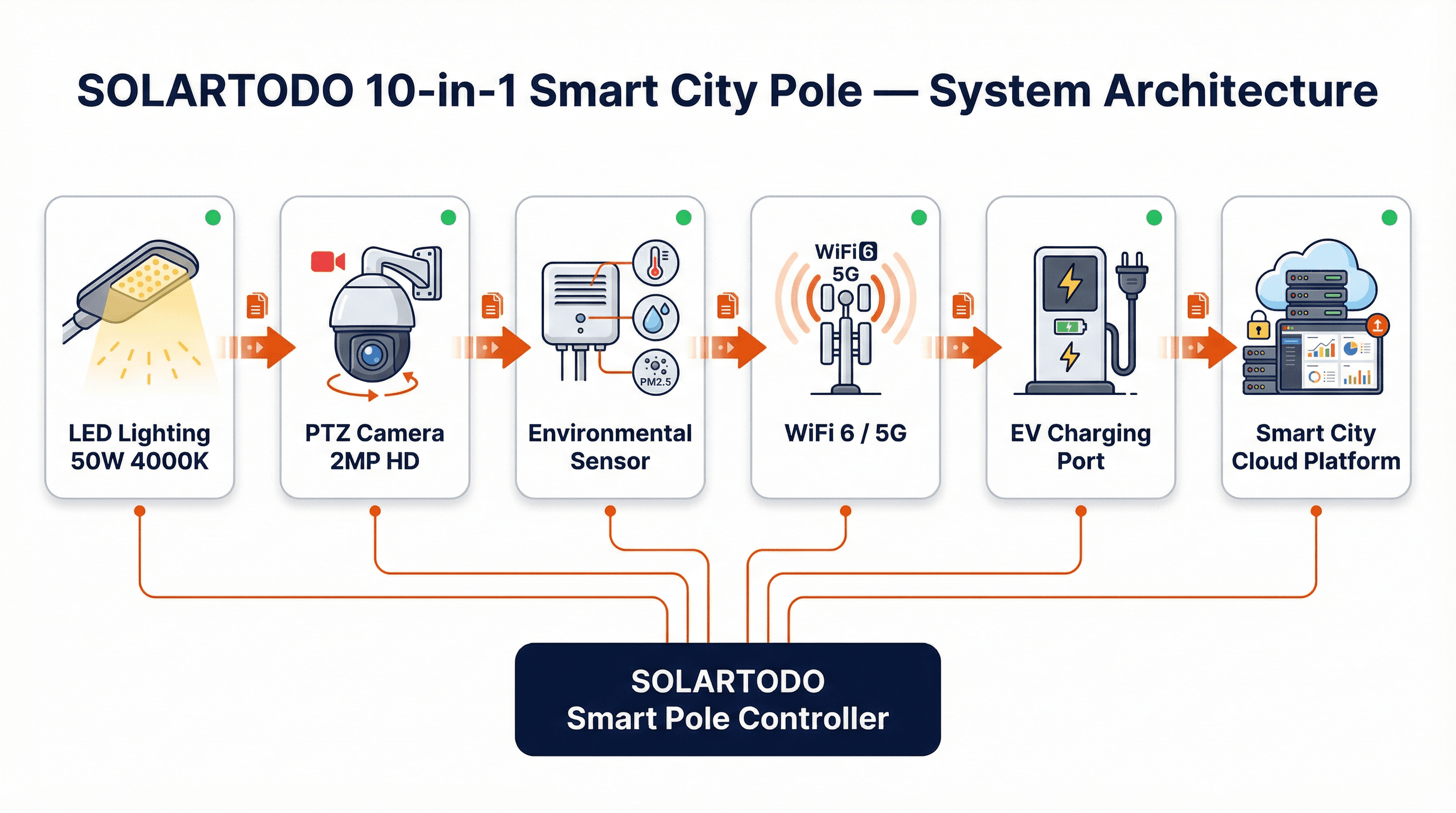
Deployment Approach in Abu Dhabi
SOLAR TODO implemented the project using a repeatable installation workflow aligned with Abu Dhabi’s street constraints and municipal operating needs. Standardization was important because it improved installation speed, reduced variation between sites, and simplified later maintenance. The deployment model also supported more consistent data quality across the full fleet of poles.
1. Site Survey and Spacing Verification
The project team first confirmed road sections with 8m width and validated the 20m pole spacing requirement. This step helped preserve lighting uniformity and ensured that the installed geometry matched the intended optical design. It also reduced the risk of field adjustments that could affect coverage or maintenance access.
2. Pole Installation for Harsh Urban Conditions
The project used hot-dip galvanized steel poles to improve durability in a coastal desert environment. In such conditions, corrosion resistance and long-term structural protection are critical for reducing lifecycle cost. The octagonal form also supports a clean urban appearance while providing a robust mounting platform for integrated devices.
3. Standardized Module Integration
Each pole was equipped with the core HD camera and 8-in-1 environmental sensor according to the same configuration standard. This simplified commissioning and helped ensure comparable performance across the network. Standardized hardware also makes spare-parts planning and technician training more efficient.
4. Emergency Call Enablement Where Required
In designated segments, the deployment included the SOS intercom + 200W IR camera emergency package. This allowed the smart pole to serve not only as a lighting point but also as a public-safety support asset. By integrating the emergency function into the same pole platform, the project avoided unnecessary roadside equipment duplication.
5. Commissioning and Cloud Onboarding
After installation, each pole was connected to the Smart Cloud Gateway for remote monitoring and configuration management. This gave operators visibility into asset status, communications performance, and device-level telemetry. Cloud onboarding also established the foundation for scalable maintenance workflows across the entire deployment.
Why This Configuration Fits Abu Dhabi Streets
Abu Dhabi requires stable illumination, durable hardware, and reliable sensing because roads operate under heat, dust, and heavy traffic exposure. The 4000K LED lighting supports clear roadway perception, while the 8-in-1 sensor adds local awareness of pollutants and weather-related variables. Together, these functions turn the streetlight into both a lighting asset and an operational data point.
The use of IP67-rated components helps improve resilience against dust ingress and harsh weather exposure. This is especially relevant in MENA environments, where roadside maintenance can be time-consuming and environmental stress is persistent. A more protected device architecture can contribute to lower service disruption and better long-term reliability.
The project’s cloud-managed control model also fits large municipal operations. Instead of relying only on manual inspection, operators can review device status remotely and prioritize field visits based on actual need. That approach is consistent with modern smart-city maintenance strategies focused on efficiency and asset visibility.
Results and Impact
This deployment delivered improvements in lighting efficiency, operational visibility, and remote maintenance capability. By replacing 250W HPS with 50W LED, the project targeted up to 80% energy saving while maintaining modern lighting output at 7500 lumens. That reduction aligns with broader industry findings that LED street lighting can significantly lower municipal energy use when paired with appropriate controls and optical design.
Each of the 323 poles also functions as a distributed sensing node. With the integrated 8-in-1 environmental sensor, operators gain access to localized data on wind, temperature, humidity, pressure, noise, PM10, and PM2.5. This expands the value of the streetlight beyond illumination and supports smarter decisions related to traffic operations, environmental monitoring, and maintenance planning.
Cloud-based monitoring through the Smart Cloud Gateway improves fault visibility and can reduce unnecessary truck rolls. Instead of waiting for public reports or scheduled inspections, operators can identify issues earlier through remote diagnostics. In segments where the emergency package is enabled, the SOS intercom and IR camera further strengthen safety response capability.
Standards, Engineering Basis, and References
SOLAR TODO engineered the Smart Streetlight configuration to align with relevant lighting and product safety requirements, including IEC 60598 for luminaires and lighting safety. The project configuration also references GB/T 37024 as part of its technical framework. These standards-based considerations support consistent product design, safety, and deployment quality.
For energy and lighting performance context, the U.S. Department of Energy and National Renewable Energy Laboratory (NREL) have widely documented the efficiency advantages of LED lighting in outdoor applications, especially when replacing legacy HID systems. Their research consistently shows that LED street lighting can reduce energy use and maintenance burden when combined with quality optics, controls, and proper system design. This supports the project’s use of 50W LED luminaires as a replacement benchmark for 250W HPS.
On the communications side, best practices from organizations such as IEEE and ITU support the importance of reliable telemetry, network planning, and resilient device connectivity in distributed infrastructure systems. For smart streetlight fleets, these principles matter because communications reliability directly affects monitoring quality, fault detection speed, and long-term maintainability. In other words, lighting performance alone is not enough; the control layer must also be dependable.
Frequently Asked Questions
1) How many smart streetlights were deployed in Abu Dhabi?
The project deployed 323 smart streetlight poles in Abu Dhabi. This unit count is consistent across the deployment description, technical specifications, equipment list, and project summary.
2) What makes this Smart Streetlight different from a standard street lamp?
This system combines 50W / 7500lm LED lighting with an HD camera, an 8-in-1 environmental sensor, and cloud-based remote management. A conventional street lamp typically provides illumination only, with little or no operational data. The Abu Dhabi deployment turns each pole into a connected urban infrastructure node.
3) How are the poles sized and spaced for Abu Dhabi streets?
The deployment uses 6m octagonal hot-dip galvanized steel poles installed at 20m spacing on roads with 8m width. This standardized geometry supports repeatable installation and consistent lighting distribution. It also simplifies maintenance and future expansion planning.
4) Does the system support emergency calling?
Yes. In designated segments, the project includes an emergency_call option with an SOS intercom and a 200W IR camera. This allows direct aid requests from the pole and improves incident visibility for operators.
5) What power source and operating schedule does the project use?
The poles are grid-powered (AC) and configured for 10 hours of daily operation. This approach supports stable performance for lighting, communications, and connected modules. It also simplifies energy planning compared with more variable off-grid conditions.
6) What environmental data does the system collect?
Each pole includes an 8-in-1 environmental sensor that monitors wind, temperature, humidity, pressure, noise, PM10, and PM2.5. This provides localized street-level environmental visibility. Such data can support traffic operations, public-environment monitoring, and maintenance prioritization.
7) Which communications technologies are used for remote management?
The controller architecture supports LoRaWAN and 4G, with management handled through a Smart Cloud Gateway. This enables remote telemetry, status monitoring, and fleet-level control across multiple street sections.
8) Which standards are referenced in the project configuration?
The project references IEC 60598 for luminaire safety and performance considerations and GB/T 37024 within the technical configuration framework. These references support a more standardized engineering basis for deployment.
9) Why was 4000K selected for the lighting configuration?
4000K is commonly used in roadway lighting because it provides clear white light and balanced visual perception. It can improve object recognition compared with older HPS lighting, which has a warmer color appearance and lower color rendering. In practical terms, it supports safer and more consistent roadway visibility.
10) How does remote management reduce maintenance workload?
With the Smart Cloud Gateway, operators can monitor device status, identify faults, and review telemetry without immediately dispatching field crews. This helps reduce unnecessary site visits and improves response speed for confirmed issues. Over time, that can lower maintenance cost and improve service continuity.
11) Why is IP67 protection important for this project?
IP67-rated components are better suited to dusty and weather-exposed roadside environments. In Abu Dhabi, airborne particles and harsh outdoor conditions can challenge unprotected equipment. Strong enclosure protection supports reliability and can help extend service life.
12) What is the expected energy-saving logic behind replacing 250W HPS with 50W LED?
The project targets up to 80% energy saving by replacing a higher-wattage legacy HPS fixture with a more efficient LED luminaire. LEDs also direct light more precisely, which can improve useful illumination with less wasted energy. This combination of lower wattage and better optical efficiency is a major reason municipalities adopt LED street lighting.
References
- IEC 60598-1 — Luminaires — Part 1: General requirements and tests. International Electrotechnical Commission.
- GB/T 37024 — Technical standard referenced in the project configuration framework.
- U.S. Department of Energy (DOE) — Solid-State Lighting / LED Lighting Guidance for Outdoor and Street Lighting Applications.
- National Renewable Energy Laboratory (NREL) — Research publications on energy-efficient outdoor lighting, LED system performance, and municipal energy savings.
- IEEE — Engineering guidance and standards relevant to reliable communications, telemetry, and distributed infrastructure systems.
- ITU — Telecommunications recommendations relevant to network planning, connectivity reliability, and operational communications.
- LoRa Alliance — Technical ecosystem guidance for LoRaWAN deployment in low-power wide-area network applications.
If you would like to discuss a Smart Streetlight deployment in Abu Dhabi or other MENA cities, contact SOLAR TODO: contact us or explore the product: Smart Streetlight.
Equipment Deployed
- 323 × 6m octagonal hot-dip galvanized steel poles in dark grey, grid-powered AC, configured for 20m spacing on 8m road width
- LED lighting module: 50W / 7500lm (150 lm/W), 4000K; designed to replace 250W HPS with target 80% energy saving; aligned with IEC 60598 and GB/T 37024
- Core HD camera module: 400W IR, H.265+, IP67, 30W
- 8-in-1 ENV sensor module: wind, temperature, humidity, pressure, noise, PM10, PM2.5; 5W
- Emergency call option: SOS intercom + 200W IR camera
- Control and management: standalone Smart Cloud Gateway with remote cloud management; controller supports LoRaWAN / 4G