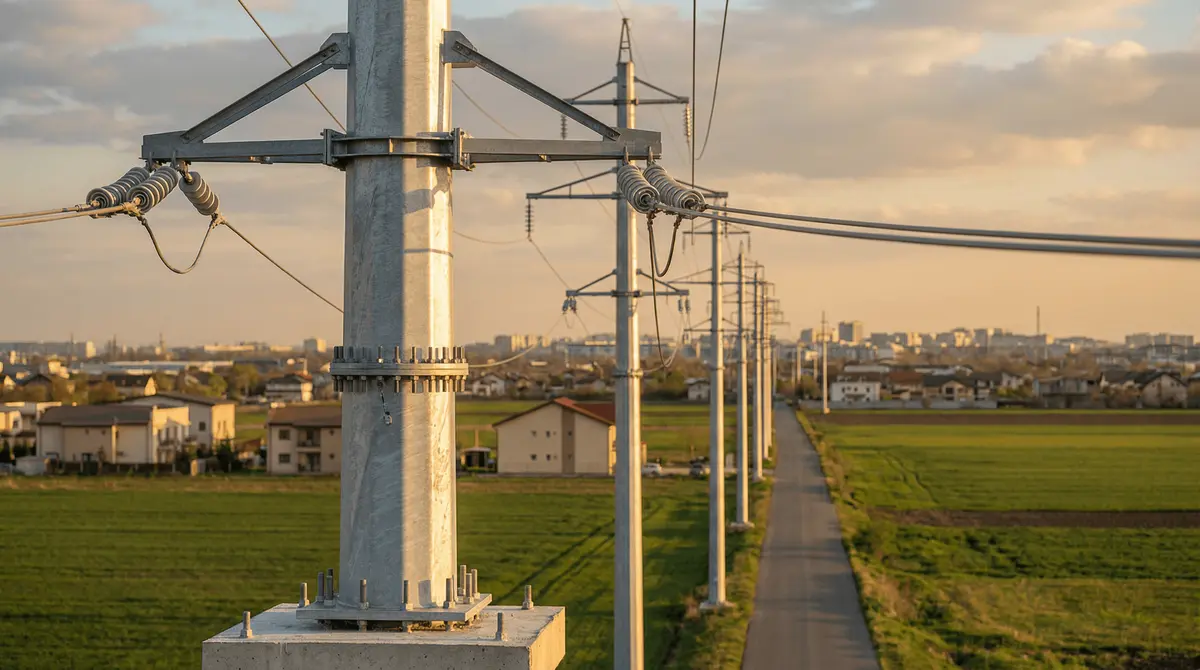
SOLAR TODO delivered a Power Transmission Tower deployment in Bucharest, Romania, designed to strengthen reliability for a long 10kV single-circuit transmission corridor while meeting stringent European wind and structural requirements. The project centered on purpose-built steel tubular transmission poles—an engineered alternative to lattice structures—optimized for durability, inspection access, and consistent conductor geometry across challenging urban-adjacent conditions.
Answer Capsule: SOLAR TODO installed 139×18m hot-dip galvanized Q345 tubular poles for an ~11km 10kV single-circuit line, designed to IEC 60826 wind loading and GB 50545 foundation requirements.
Project Background: Why Bucharest Needed a Robust Transmission Upgrade
Bucharest’s electrical networks operate under a dense mix of urban development, road corridors, and constrained rights-of-way. In practice, transmission upgrades must balance mechanical performance (wind and conductor tension), maintain safe clearances, and reduce long-term corrosion risk in a humid continental climate. For this scope, the key infrastructure challenge was not simply extending line length—it was delivering a consistent, code-compliant tower/pole system across an ~11km route using a standardized structural design approach.
SOLAR TODO’s solution focused on steel tubular transmission poles (NOT lattice, NOT FRP). Tubular monopoles provide a smooth, continuous structural profile, which simplifies load path behavior under lateral wind pressures and supports straightforward installation of cross-arm brackets, grounding, and vibration mitigation components. The project also targeted predictable phase geometry and safe ground clearance for conductor routing, using defined phase spacing and conductor tension parameters.
Solution Overview: Steel Tubular Transmission Pole System
The installed equipment was the SOLAR TODO Steel Tubular Transmission Pole system: a 18m tapered round steel tubular monopole for 10kV single-circuit transmission. Each pole was fabricated from hot-dip galvanized Q345 steel to mitigate corrosion throughout service life. The design uses flanged bolt sections and a concrete foundation with an anchor cage/anchor-bolt arrangement to ensure stable base fixity.
From a mechanical perspective, the poles were engineered for Wind Class 2 conditions (30 m/s) in accordance with IEC 60826. The conductor configuration was defined for ACSR 400, with a maximum tension of 110kN. This combination—conductor tension, phase spacing, and wind loading—drives the structural demands on the pole, cross-arm brackets, insulator strings, and additional accessories such as vibration dampers.
SOLAR TODO supplied and deployed 139 units across the corridor, achieving a total line length of ~11km with a span length of 80m. The resulting system maintained a 5m ground clearance and a 0.8m phase spacing, ensuring safe electrical separation and consistent operational geometry.
Technical Specifications
- Product: Power Transmission Tower (Steel Tubular Transmission Pole, NOT lattice, NOT FRP)
- Quantity: 139 units
- Pole height: 18m tapered steel tubular pole (round)
- Material: Hot-dip galvanized Q345 steel
- Pole weight: ~11t/pole (600kg/m)
- Voltage class & circuit: 10kV, Single circuit
- Phase spacing: 0.8m
- Ground clearance: 5m
- Conductor: ACSR 400
- Mass: 1520kg/km
- Max tension: 110kN
- Insulator length: 0.5m
- Span: 80m
- Total line length: ~11km
- Wind class: Wind Class 2 (30 m/s, IEC 60826)
- Foundation interface: anchor_bolt (concrete foundation with anchor cage)
- Accessories included: climbing steps, cross arm, grounding, bird guard, vibration damper
- Standards compliance: IEC 60826 / GB 50545
Engineering Design Approach for Bucharest Conditions
1) Structural performance under IEC 60826 Wind Class 2
In Bucharest, overhead line corridors must be designed for lateral wind actions that can be intensified by open areas, seasonal weather variability, and nearby built structures. SOLAR TODO’s pole design explicitly followed Wind Class 2 (30 m/s) per IEC 60826, ensuring the tubular monopoles and associated brackets could sustain expected wind pressures without compromising safety margins.
The tapered tubular geometry helps manage bending and shear distribution along the monopole height—an important consideration when conductor loads (including the ACSR 400 max tension of 110kN) combine with wind-induced lateral forces.
2) Electrical clearances and conductor geometry
For a 10kV single-circuit arrangement, SOLAR TODO maintained:
- Phase spacing of 0.8m
- Ground clearance of 5m
- Insulator length of 0.5m
These values were applied consistently across the 139-pole installation so that the line maintained predictable phase separation and safe overhead clearance. In a city environment like Bucharest—where line routes may pass near roads and buildings—predictability in geometry reduces the risk of field deviations and supports safer long-term operation.
3) Corrosion resistance via hot-dip galvanized Q345
Romania’s climate can include humid periods and seasonal temperature swings that accelerate corrosion if materials are not appropriately protected. SOLAR TODO used hot-dip galvanized Q345 steel for the tubular monopoles, aligning the structural materials with a corrosion-protective surface treatment designed for long service intervals.
4) Foundation reliability using anchor-bolt configuration
The project foundations were executed with concrete foundations and anchor-bolt interfaces (anchor cage). This foundation approach supports stable base fixity, which is critical for transmission pole performance under wind loading. SOLAR TODO’s scope included the foundation interface design intent consistent with GB 50545 requirements for structural and foundation considerations.
Deployment & Installation Details (139 Units, ~11km Line)
Scope and layout
SOLAR TODO delivered 139 units of 18m tapered tubular poles for a 10kV single-circuit overhead line with:
- Span length: 80m
- Total line length: ~11km
This layout is well-suited for corridor construction where consistent span spacing simplifies stringing operations while maintaining electrical safety clearances.
Pole assembly strategy
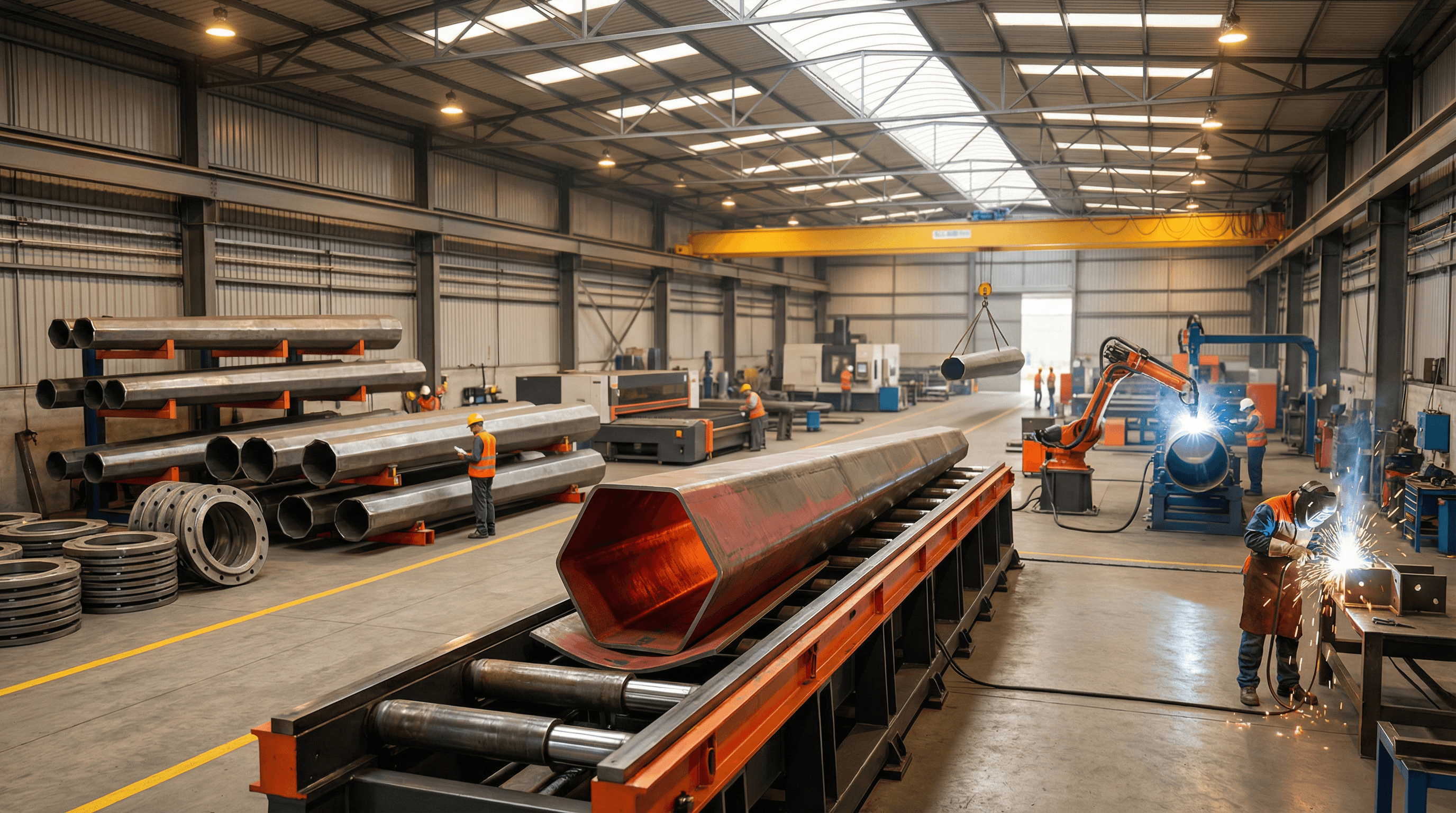
To support efficient field assembly and transport logistics, the monopole was delivered with flanged bolt sections. This design allows staged erection and alignment while maintaining structural integrity at joints. During installation in Bucharest’s operational environment, this approach helps reduce on-site complexity compared to designs requiring extensive welding or highly specialized fabrication steps.
Hardware integration: cross arm, insulators, and conductor system
Each pole included:
- Cross arm brackets for insulator strings and ACSR 400 conductor routing
- Insulator strings with 0.5m insulator length
- Grounding components for safe electrical bonding
- Bird guards to reduce avian-induced faults
- Vibration dampers to mitigate conductor oscillation
- Climbing steps to provide safe access for inspection and maintenance
This integrated accessory package is important for long-term maintainability. In overhead line operations, routine inspections and corrective maintenance are inevitable; including steps, grounding hardware, and vibration mitigation components supports a lifecycle approach rather than a build-only mindset.
Why Steel Tubular (Non-Lattice) Matters for Reliability
Unlike lattice structures, the steel tubular monopole offers a continuous structural shell that can simplify the load path and reduce complexity at the interface points where brackets, insulators, and grounding are attached. For an urban-edge deployment in Bucharest, the smooth tubular form factor can also support cleaner installation tolerances and reduce the likelihood of irregularities that may occur when multiple members intersect.
Additionally, the combination of:
- Tapered geometry
- Hot-dip galvanized Q345 steel
- Wind Class 2 (30 m/s) design per IEC 60826
- Anchor-bolt foundation per GB 50545
creates a transmission pole system intended to perform consistently over time—especially important for maintaining clearances (0.8m phase spacing, 5m ground clearance) across an ~11km corridor.
Results and Impact
SOLAR TODO’s Bucharest deployment delivered a standardized, code-compliant transmission pole system designed for long corridor performance.
Quantified outcomes include:
- 139 steel tubular poles installed for a ~11km 10kV single-circuit line
- 18m pole height with ~11t/pole (~600kg/m) mass profile supporting mechanical robustness
- 80m span configuration implemented across the corridor for consistent stringing methodology
- Electrical geometry maintained at:
- 0.8m phase spacing
- 5m ground clearance
- Conductor system designed around ACSR 400 with 1520kg/km weight and 110kN max tension
- Wind design aligned to Wind Class 2 (30 m/s) per IEC 60826, supporting safety under expected lateral loads
Beyond numbers, the project improved operational readiness by including full accessory coverage—cross arm, grounding, bird guard, vibration damper, and climbing steps—so maintenance crews can inspect and service the line safely without additional retrofit scopes.
Standards & Compliance (International + Local)
SOLAR TODO engineered the Power Transmission Tower poles to align with:
- IEC 60826 (overhead line design criteria, including wind loading assumptions for structures)
- GB 50545 (structural design and foundation-related requirements for transmission tower/pole systems)
These standards support predictable structural behavior, especially when the system is designed around defined wind classes and conductor tension limits.
For broader context on transmission reliability and overhead line engineering practices, SOLAR TODO references widely adopted international frameworks such as:
- IEEE Std 1313 (overhead line reliability concepts and engineering considerations)
- NREL technical guidance on infrastructure resilience and performance-minded design practices (as a general reference for reliability engineering)
- World Bank infrastructure frameworks that emphasize lifecycle performance and safety in utility asset delivery
Pricing & Quotation
SOLAR TODO offers three pricing tiers for this product line: FOB Supply (equipment ex-works China), CIF Delivered (including ocean freight and insurance), and EPC Turnkey (fully installed, commissioned, with 1-year warranty). Volume discounts are available for large-scale deployments. Configure your system online for an instant estimate, or request a custom quotation from our engineering team at [email protected].
Frequently Asked Questions
1) Is the Bucharest project using lattice towers or tubular poles?
It uses steel tubular transmission poles (NOT lattice, NOT FRP)—specifically 139×18m tapered steel tubular monopoles made from hot-dip galvanized Q345 steel.
2) What wind conditions were considered for the pole design?
The system was designed for Wind Class 2 (30 m/s) in accordance with IEC 60826.
3) Which conductor and tension rating were used for the 10kV line?
The conductor was ACSR 400 with 1520kg/km mass and max tension 110kN.
4) Does the pole package include maintenance and protection accessories?
Yes. Each pole installation included climbing steps, cross arm, grounding, bird guard, and vibration damper.
Learn More
- Product page: Power Transmission Tower / Power Tower System
- Talk to our team: contact us
Equipment Deployed
- 139 × 18m tapered steel tubular monopole poles for 10kV single-circuit line, hot-dip galvanized Q345 steel, ~11t/pole (~600kg/m), flanged bolt sections, IEC 60826/GB 50545 design
- ACSR 400 conductor set for the corridor: 1520kg/km, max tension 110kN (used with 0.8m phase spacing and 5m ground clearance)
- Insulator strings: 0.5m insulator length per phase arrangement, integrated with cross-arm brackets
- Foundation system: concrete foundation with anchor cage / anchor_bolt interface for each pole
- Pole accessories per unit: cross arm, grounding, bird guard, vibration damper, climbing steps