
SOLAR TODO delivered a 10kV power transmission upgrade in Tunis, Tunisia—deploying 119 units of 30m steel tubular transmission towers designed for long service life, predictable mechanical performance, and compliance with international and local grid standards.
Answer Capsule: In Tunis, SOLAR TODO installed 119 × 30m tapered steel tubular poles for a ~10km 10kV single-circuit line, engineered to IEC 60826 / GB 50545 wind loading and foundation requirements.
Project Overview: Grid Strengthening for Tunis’s Urban-Edge Networks
Tunis’ distribution and transmission corridors face a common challenge across MENA: tight right-of-way, variable ground conditions, and the need to maintain reliable power delivery despite demanding wind and environmental exposure. For this project, SOLAR TODO focused on a robust, repeatable tower design that could be manufactured and installed efficiently while meeting the mechanical and structural criteria required for overhead line safety.
The solution was a non-lattice, steel tubular monopole—a tapered round/dodecagonal steel transmission pole—hot-dip galvanized Q345 steel, equipped with cross-arm brackets for insulator strings and ACSR conductors. The system was configured as a 10kV single-circuit line, spanning 80m per span and totaling ~10km line length.
Why the Steel Tubular Pole Design Mattered
Compared with lattice structures, the steel tubular transmission pole provides a cleaner profile and improved durability under coastal and seasonal weather exposure. For Tunis, this mattered because the line alignment runs through mixed-use corridors where maintenance access and visual/space constraints are practical concerns.
SOLAR TODO engineered each pole as a tapered tubular monopole (30m height) to distribute loads along the structure while maintaining appropriate clearances. The project’s mechanical design basis included:
- Wind class 3 (35 m/s) in accordance with IEC 60826
- Phase spacing: 0.8m
- Ground clearance: 5m
- ACSR 120 conductor with max tension 38kN
- Concrete foundation with anchor_bolt
This combination ensured the line could withstand design wind conditions while keeping conductor geometry and safety clearances within engineering targets.
Technical Specifications
- Product: Power Transmission Tower (steel tubular monopole; NOT lattice; NOT FRP)
- Quantity: 119 units
- Height: 30m tapered steel tubular pole
- Material: Hot-dip galvanized Q345 steel
- Weight: ~18t/pole (~600kg/m)
- Voltage class: 10kV
- Circuit: Single circuit
- Phase spacing: 0.8m
- Ground clearance: 5m
- Conductor: ACSR 120
- 470kg/km
- Max tension: 38kN
- Insulator length: 0.5m
- Span: 80m
- Total line length: ~10km
- Wind design: Wind class 3 (35 m/s), IEC 60826
- Foundation type: Concrete with anchor_bolt
- Accessories (installed on each pole): climbing steps + cross arm + grounding + bird guard + vibration damper
- Standards: IEC 60826 / GB 50545
- Design basis references: structural load and wind-resistance criteria per IEC 60826; compliance with Chinese structural requirements per GB 50545
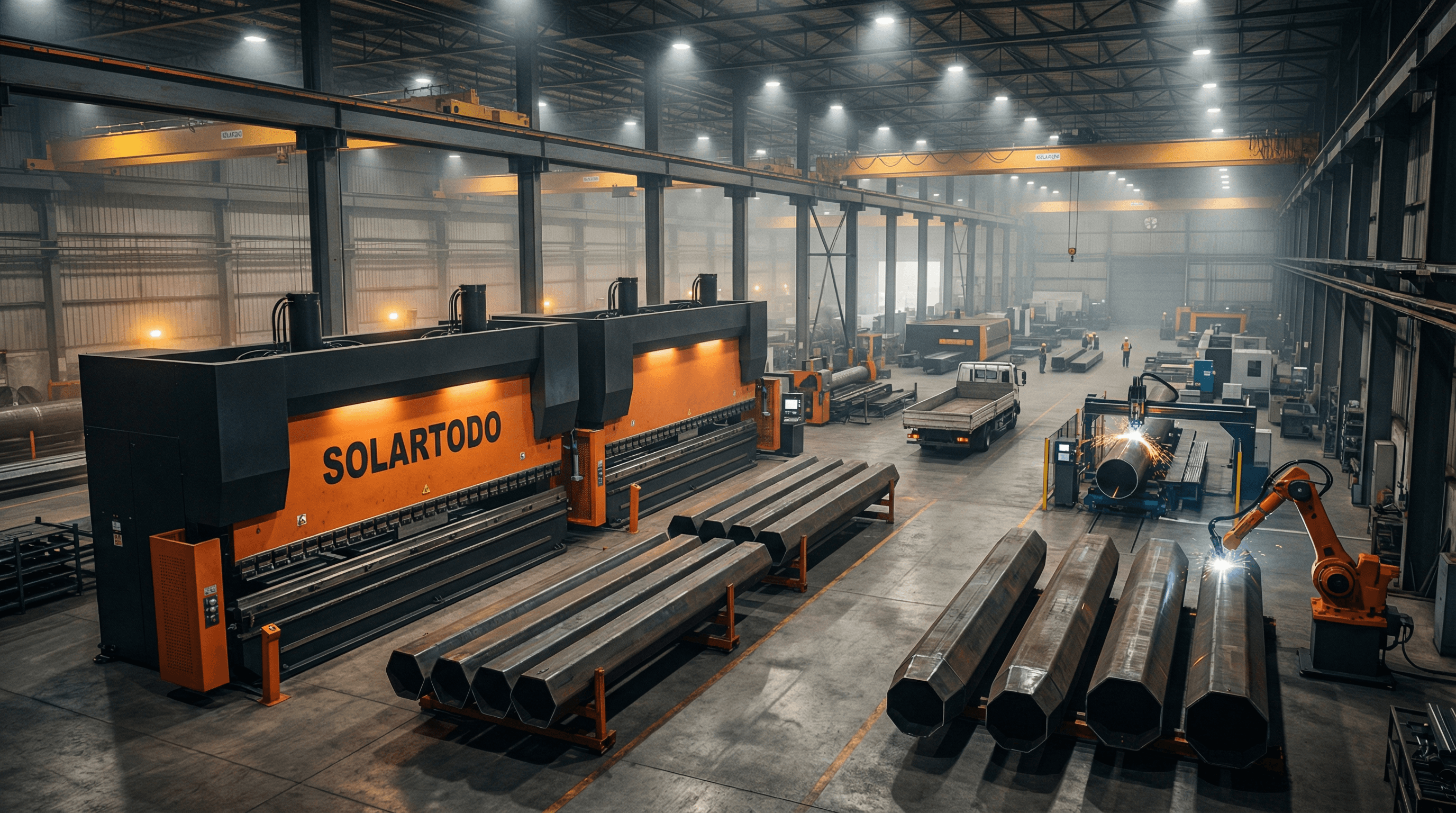
Deployment in Tunis: Engineering-to-Installation Workflow
SOLAR TODO approached the Tunis deployment as a controlled, repeatable rollout—important for a 119-pole scope where consistency directly impacts schedule and commissioning quality.
1) Pole configuration for 10kV single-circuit overhead line
Each 30m pole was supplied as a tapered steel tubular monopole (not lattice), with cross-arm brackets sized for insulator strings and ACSR conductor routing. The insulator string geometry was set to 0.5m insulator length, supporting stable phase arrangement.
The electrical/mechanical line geometry was established with:
- Phase spacing: 0.8m
- Ground clearance: 5m
- Span length: 80m, repeated across the corridor as designed
2) Conductor mechanical design: ACSR 120 at 38kN max tension
The conductor package was designed around ACSR 120 with 470kg/km conductor weight and max tension 38kN. This is critical for overhead lines because tension affects sag, clearance, and mechanical loads transmitted to the pole and foundation.
SOLAR TODO’s pole design and accessory configuration accounted for these conductor forces so that the line could remain within clearance and structural limits under design conditions.
3) Wind engineering for Tunis’s environmental conditions
Tunis experiences wind events that can challenge overhead line stability. For this project, SOLAR TODO used Wind class 3 (35 m/s) per IEC 60826, ensuring the pole and its attachments were engineered for design wind pressure and dynamic behavior.
The vibration damper accessory was included to manage conductor vibration phenomena that can occur under wind loading, helping reduce long-term wear and improving operational stability.
4) Foundation and anchoring: concrete with anchor_bolt
The structural reliability of an overhead line is only as strong as its foundation. SOLAR TODO specified a concrete foundation with anchor_bolt system for each pole, designed to resist overturning and uplift from wind-driven loads.
This foundation approach supports:
- Controlled anchorage for consistent pole alignment
- Durable long-term performance for an infrastructure asset expected to operate for decades
- Integration with site execution methods used in Tunis’ civil works environment
5) Installability: climbing steps and safety hardware
Operational safety and maintenance access were directly supported through pole outfitting. SOLAR TODO included climbing steps on the pole assembly so maintenance teams can access the cross-arm and insulator interfaces safely.
Additional protective and functional accessories included:
- Grounding (for electrical safety and system grounding continuity)
- Bird guard (to help mitigate bird-related risks and reduce outage drivers)
- Vibration damper (to improve conductor stability under wind)
Standards Compliance: IEC 60826 / GB 50545
SOLAR TODO designed and delivered the tower system to comply with:
- IEC 60826: wind load and overhead line design considerations
- GB 50545: structural design requirements for overhead line systems
These standards ensure that the line’s mechanical loading assumptions, safety factors, and structural performance targets align with internationally recognized practices and local regulatory expectations.
For context, overhead line reliability and structural safety are also widely discussed in broader utility engineering references such as IEEE overhead line guidance and reliability frameworks used by utilities globally.
Authoritative references used during engineering alignment include:
- IEC 60826 (Overhead lines—Requirements and tests)
- GB 50545 (Overhead line structural design requirements)
- IEEE transmission and distribution structural guidance (engineering principles)
- World Bank infrastructure reliability and utility modernization discussions (context for resilient grid assets)
Results and Impact
The Tunis installation delivered a mechanically robust, compliant overhead line structure across a long corridor.
Quantified outcomes
- 119 units of 30m steel tubular transmission towers installed
- ~10km total line length completed at 80m spans
- 10kV single-circuit configuration executed with 0.8m phase spacing and 5m ground clearance
- Designed for Wind class 3 (35 m/s) per IEC 60826
- Conductor system configured for ACSR 120 with 470kg/km and 38kN max tension
Practical operational benefits for Tunis
- Reduced maintenance friction: the inclusion of climbing steps, grounding interfaces, and bird guards supports safer routine work.
- Improved mechanical stability: vibration dampers help mitigate conductor oscillation effects under wind loading.
- Durability for long-life infrastructure: hot-dip galvanized Q345 steel supports corrosion resistance and service longevity in demanding coastal climates.
- Consistent engineering across the line: a repeatable tower configuration reduces variability across spans—important for consistent clearance and alignment.
Equipment List
- Steel Tubular Transmission Pole (30m)
- 119 units; tapered steel tubular monopole; hot-dip galvanized Q345 steel; ~18t/pole (~600kg/m)
- Cross-arm Brackets & Insulator Supports
- Configured for 0.5m insulator length and conductor routing
- ACSR 120 Conductor Package
- 470kg/km conductor weight; max tension 38kN
- Vibration Dampers
- Installed to control conductor vibration under wind excitation
- Grounding Hardware
- For electrical safety and grounding system continuity
- Bird Guards
- Installed to reduce bird-related outages and protect conductor/insulator zones
- Climbing Steps
- Safety access for inspection and maintenance
- Concrete Foundation with Anchor Bolt
- Anchor_bolt foundation design to resist wind-driven overturning loads
Pricing & Quotation
SOLAR TODO offers three pricing tiers for this product line: FOB Supply (equipment ex-works China), CIF Delivered (including ocean freight and insurance), and EPC Turnkey (fully installed, commissioned, with 1-year warranty). Volume discounts are available for large-scale deployments. Configure your system online for an instant estimate, or request a custom quotation from our engineering team at [email protected].
Frequently Asked Questions
1) Is the Tunis 10kV tower design lattice or steel tubular?
It is a steel tubular transmission pole (monopole), NOT lattice and NOT FRP. The 119 units are 30m tapered steel tubular poles in hot-dip galvanized Q345 steel.
2) What wind design basis was used for this line in Tunis?
The design used Wind class 3 (35 m/s) according to IEC 60826, ensuring the pole and fittings were engineered for the specified wind loading conditions.
3) What conductor and mechanical tension does the system support?
The line uses ACSR 120 with 470kg/km conductor weight and max tension 38kN. The pole configuration and accessories were selected to match these mechanical requirements.
4) What foundation method was used for the 30m poles?
Each pole is supported by a concrete foundation with anchor_bolt, designed to provide stable anchorage and resist wind-induced structural loads.
Next Steps
If you’re planning a 10kV–220kV overhead corridor upgrade and want a steel tubular pole solution aligned with IEC 60826 / GB 50545, explore our product details at SOLAR TODO Power Transmission Tower or contact us for a tailored engineering review.
Equipment Deployed
- 119 × 30m tapered steel tubular transmission poles (hot-dip galvanized Q345 steel), ~18t/pole (~600kg/m), non-lattice, non-FRP
- Cross-arm brackets and insulator supports for 10kV single-circuit configuration (insulator length 0.5m)
- ACSR 120 conductor set (470kg/km) designed for max tension 38kN
- Vibration dampers (installed per pole for conductor stability under wind loading)
- Grounding components (for electrical safety and continuity)
- Bird guards (installed to reduce bird-related fault risks)
- Climbing steps (maintenance safety access)
- Concrete foundations with anchor_bolt (foundation anchoring system)