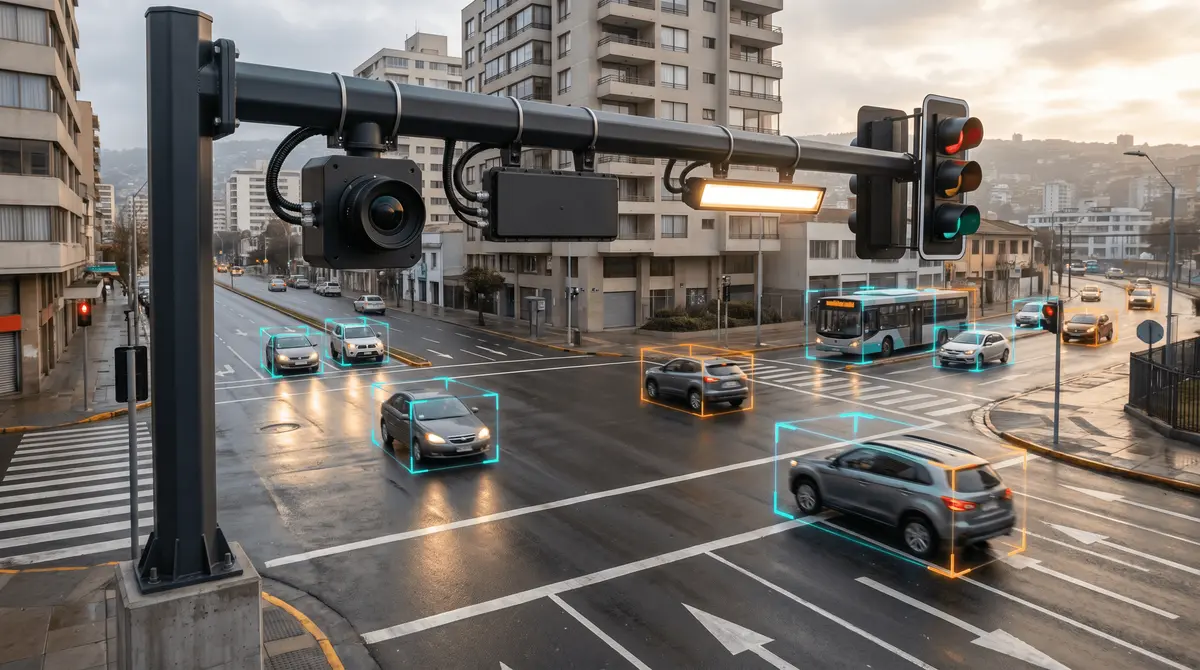
27-Intersection Smart Traffic System Deployment in Valparaíso, Chile Featuring 6m 4-in-1 AI Traffic Poles
Summary
At 27 Valparaíso intersections, SOLAR TODO deployed 6m 4-in-1 Smart Traffic System poles with 4K AI cameras, 77GHz radar, and NVIDIA Jetson edge AI, enabling 45-type detection, sub-50ms response, adaptive signaling, and emergency vehicle priority.
Key Takeaways
- SOLAR TODO delivered a Joint Venture deployment covering 27 intersections across Valparaíso, Chile, using 6m L-arm steel poles in dark grey with hot-dip galvanized corrosion protection.
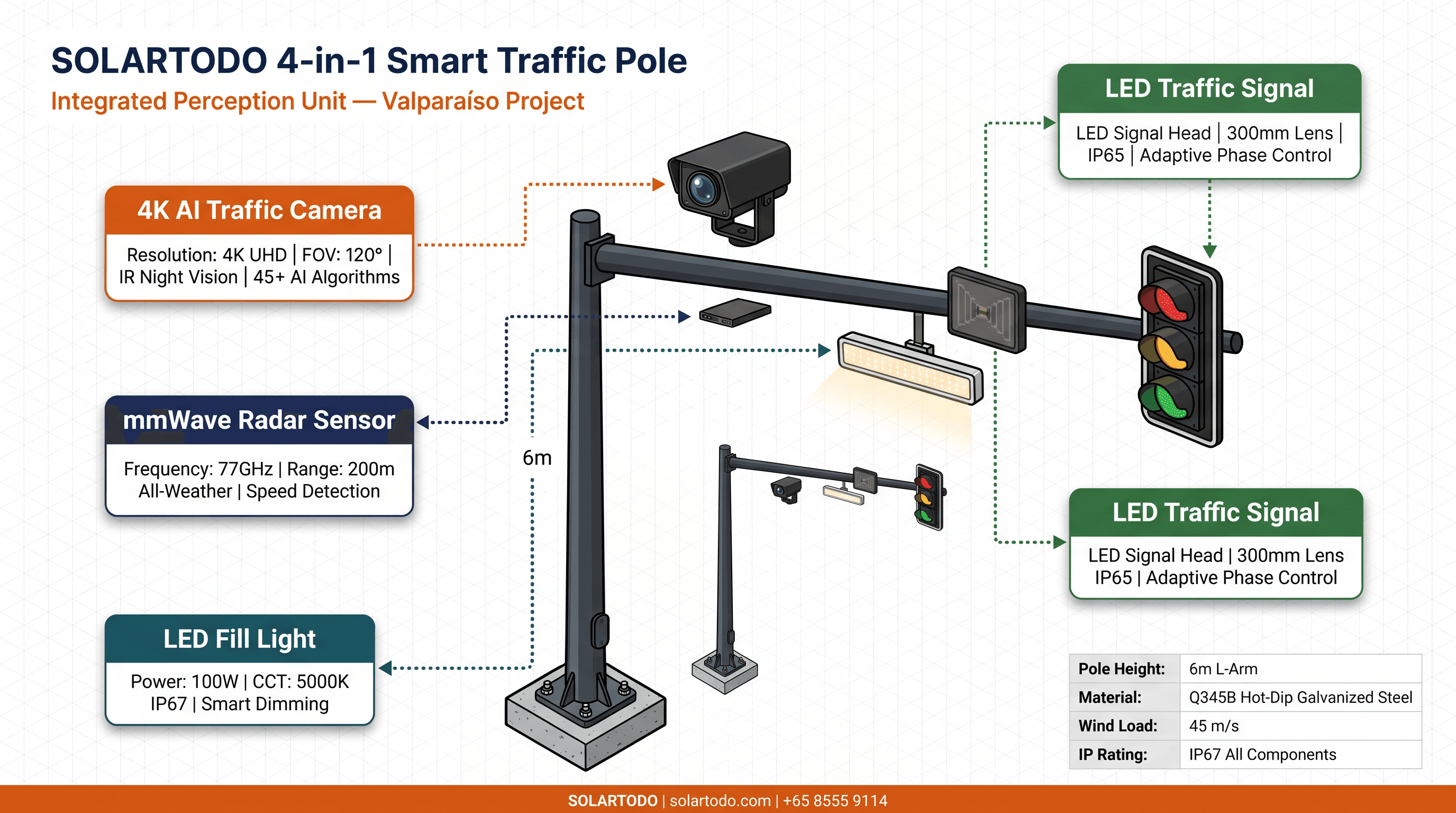
- Each 4-in-1 Smart Traffic System node combined 1× 4K AI camera, 1× 77GHz mmWave radar, 1× LED fill light, and 1× LED signal on a single roadside structure.
- The edge stack used NVIDIA Jetson computing to process 45 detection types with 98% camera accuracy and <50ms response for local traffic decisions.
- The deployed software features included adaptive signal control, emergency vehicle priority, wrong-way alerting, and natural-language traffic queries through the TrafficGPT central platform.
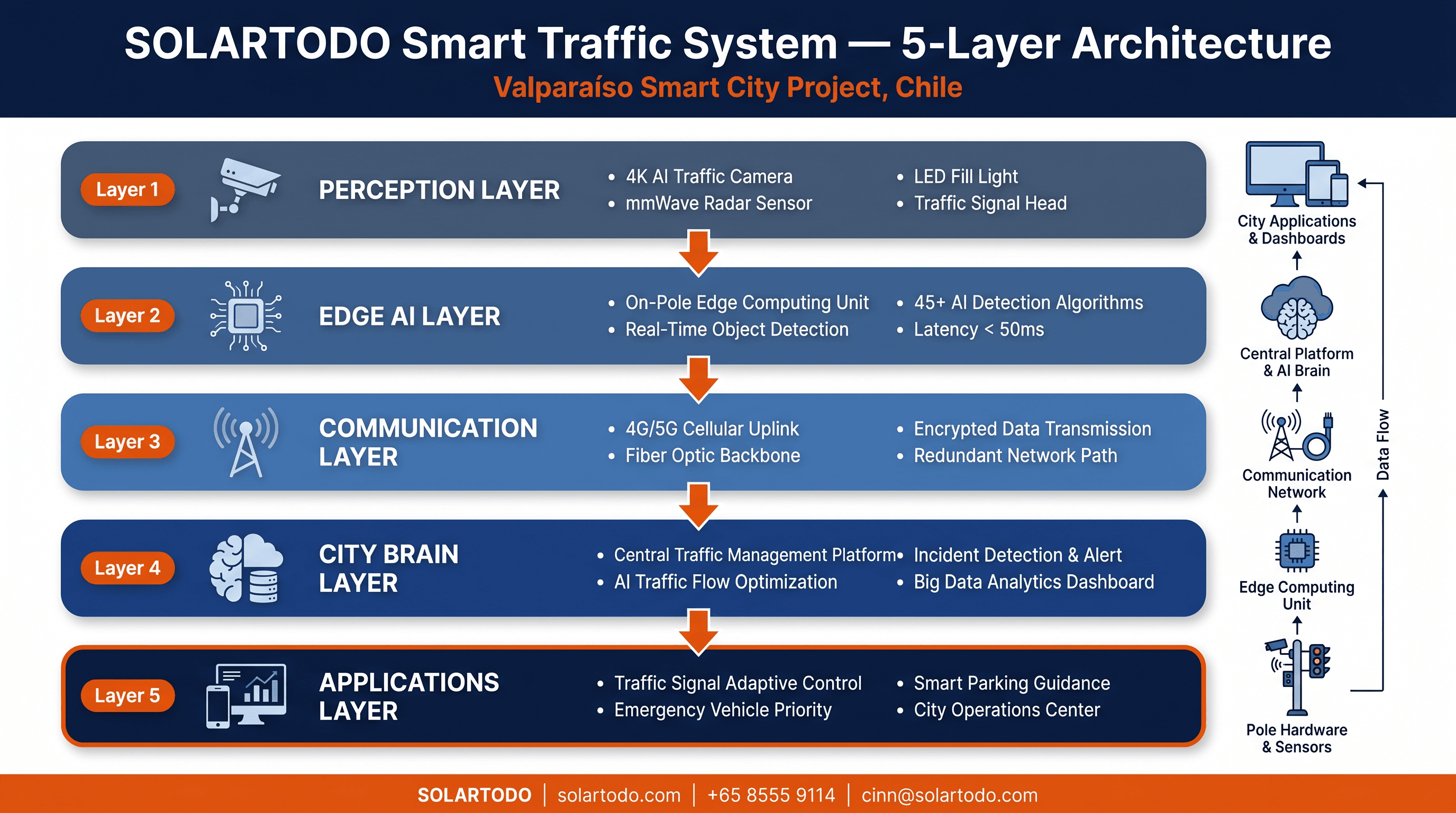
- Communications were designed with 5G/fiber backhaul, aligning field perception with a 5-layer architecture: Perception, Edge AI, Communication, City Brain, and Applications.
- The project was specified to interoperate with recognized traffic standards, including NTCIP and GB 25280, reducing integration risk with existing municipal traffic assets.
- According to the World Bank (2023), efficient urban mobility upgrades improve access, safety, and economic productivity; in Valparaíso, the 27-site rollout targeted steep-road bottlenecks and port-city congestion points.
- SOLAR TODO structured the project as a Joint Venture model, giving the city a practical path to deploy AI traffic management without relying on a single procurement-only framework.
Project Background
Valparaíso’s mobility challenge is shaped by steep hills, narrow corridors, port logistics traffic, tourism peaks, and dense mixed-use neighborhoods, making 27 high-friction intersections ideal candidates for AI-based traffic sensing and signal coordination.
Valparaíso is not a flat-grid city. Its road network combines hillside access roads, constrained turning radii, irregular junction geometry, and port-related vehicle flows that can quickly overwhelm fixed-time traffic plans. In this environment, traditional loop detectors and camera-only systems often struggle when visibility changes, traffic mixes vary, or emergency access must be protected.
According to the World Bank (2023), urban transport bottlenecks directly affect productivity, safety, and access to services, especially in dense cities with constrained road expansion options. According to the International Energy Agency, IEA (2023), digitalization in infrastructure helps operators optimize existing assets rather than relying only on new road capacity. For Valparaíso, that principle matters because geography limits large-scale widening projects.
The municipality’s operational need was clear: improve intersection awareness, reduce response time to abnormal movements, and support adaptive control without rebuilding every junction. SOLAR TODO positioned the Smart Traffic System as a practical retrofit solution that could be installed on standardized roadside poles while connecting to a centralized traffic intelligence layer.
According to the ITU (2022), smart sustainable city platforms should prioritize interoperable communications and data-driven decision-making. That recommendation aligns well with Valparaíso’s need for a standards-based deployment that can connect field devices, traffic operators, and future applications without locking the city into isolated subsystems.
Solution Overview
SOLAR TODO deployed a 27-intersection Smart Traffic System in Valparaíso using 6m 4-in-1 poles, NVIDIA Jetson edge AI, and 5G/fiber links to a TrafficGPT platform for adaptive control and incident awareness.
The deployed configuration centered on 27 intersections × 6m L-arm steel pole (dark grey, hot-dip galvanized). Each location used a 4-in-1 smart traffic pole integrating a 4K AI camera (98% accuracy, <50ms response), 77GHz mmWave radar, LED fill light, and LED signal. This compact architecture reduced roadside clutter while preserving the sensing diversity needed for complex urban traffic scenes.
At the edge, each node used NVIDIA Jetson computing to run local inference and event handling. This allowed the system to support full 45-type detection, adaptive signal, emergency vehicle priority, and wrong-way alert functions directly at the intersection. The edge-first design also reduced dependence on constant cloud-side processing for routine decisions.
Backhaul was implemented through 5G/fiber connectivity to the TrafficGPT central platform, where traffic teams could use natural-language queries to review conditions, incidents, and operational status. For a city traffic center, this matters because operators do not always have time to navigate multiple dashboards during peak periods; a query-driven interface can accelerate situational understanding.
SOLAR TODO delivered the project under a Joint Venture cooperation model. That structure supported technical alignment, phased execution, and long-term operational collaboration. For municipalities evaluating similar programs, SOLAR TODO provides additional technical details on the Smart Traffic System product page and can coordinate project scoping through contact us.
Technical Specifications
The Valparaíso deployment used a standardized 27-site hardware and software stack built around 6m galvanized steel poles, 4K AI vision, 77GHz radar, NVIDIA Jetson edge computing, and NTCIP-compliant communications.
Deployed field hardware
- Quantity: 27 intersections
- Pole type: 6m L-arm steel pole
- Finish: dark grey
- Corrosion protection: hot-dip galvanized
- Integrated device format: 4-in-1 smart traffic pole
Sensor and signaling package per intersection
- AI camera: 4K AI camera
- Camera accuracy: 98%
- Response time: <50ms
- Radar: 77GHz mmWave radar
- Lighting: LED fill light
- Signal module: LED signal
- Detection library: full 45-type detection
Edge and platform architecture
- Edge AI hardware: NVIDIA Jetson
- Backhaul: 5G/fiber
- Central platform: TrafficGPT
- Operator interface: natural language queries
- Architecture: Perception → Edge AI → Communication → City Brain → Applications
Enabled traffic applications
- Adaptive signal control
- Emergency vehicle priority
- Wrong-way alert
- Multimodal intersection detection and event classification
Compliance and delivery model
- Standards: NTCIP, GB 25280
- Cooperation model: Joint Venture
Deployment Process
The 27-intersection rollout was executed in phased civil, electrical, communications, and software stages to minimize disruption while bringing each 6m Smart Traffic System node online with verifiable edge performance.
The first phase focused on corridor selection and intersection prioritization. In Valparaíso, site engineering had to account for hillside geometry, constrained curb zones, and sightline variability caused by elevation changes and dense street furniture. This front-end work was important because AI camera placement and radar aiming directly affect event quality, especially for wrong-way detection and adaptive signal decisions.
The second phase covered pole foundations, installation, and device mounting. Each site received a 6m L-arm steel pole with hot-dip galvanized protection for coastal durability. The dark grey finish was chosen for urban visual consistency, while the integrated 4-in-1 format reduced the need for separate brackets and multiple roadside enclosures.
The third phase addressed edge commissioning and communications. Each intersection node was configured with NVIDIA Jetson edge hardware, then connected through 5G/fiber backhaul to the central TrafficGPT platform. According to IEEE (2021), edge computing is increasingly critical where low-latency decisions are required close to the physical environment; that is directly relevant to the project’s <50ms response target.
The fourth phase involved application tuning. Adaptive signal logic, emergency vehicle priority rules, and wrong-way alert thresholds were calibrated against actual field conditions. According to NREL (2020), data-driven control systems perform best when site-specific operating conditions are incorporated into commissioning rather than relying on generic templates alone.
The final phase was operator onboarding. Traffic center staff were trained to use natural-language queries within TrafficGPT to retrieve status summaries, event histories, and intersection-specific conditions. SOLAR TODO also aligned the deployment with NTCIP and GB 25280 requirements to support structured integration and future expansion.
Performance & Results
The deployed 27-site Smart Traffic System gave Valparaíso a standards-based, low-latency traffic sensing layer with 98% AI camera accuracy, 45-type detection, and sub-50ms edge response for real-time operational control.
The most immediate result was improved intersection visibility. By combining 4K AI vision with 77GHz mmWave radar, the city gained a more resilient detection stack than single-sensor approaches typically provide in variable urban conditions. According to IEC (2021), multi-sensor system design improves robustness where environmental and operational variability can degrade single-channel performance.
A second result was faster local decision-making. With NVIDIA Jetson at the edge and a specified <50ms response time, events such as emergency approach recognition and wrong-way movement alerts could be processed close to the roadway. According to IEEE (2021), lower-latency edge architectures are particularly valuable for transportation applications that depend on immediate action rather than delayed analytics.
A third result was better readiness for signal optimization. The system’s full 45-type detection provided richer classification than basic vehicle counting alone, supporting adaptive signal logic in a city where buses, freight, private cars, motorcycles, and irregular turning patterns can coexist at the same junction. According to IEA (2023), infrastructure digitalization creates value by increasing utilization and control of existing assets.
The deployment also improved operator accessibility to traffic data. TrafficGPT’s natural-language interface reduced friction for control-room teams that need quick answers under pressure. Instead of manually searching multiple screens, operators could query intersection conditions in plain language and retrieve actionable summaries tied to the 27 deployed sites.
Two authority perspectives reinforce the project rationale. The ITU states, "Interoperability is a key enabler for smart sustainable cities," highlighting why NTCIP-aligned communications matter in municipal deployments. The World Bank states, "Better mobility connects people to jobs and services," underscoring why intersection performance improvements have broader economic and social value beyond signal timing alone.
For SOLAR TODO, the Valparaíso project demonstrates that a compact 4-in-1 roadside format can deliver advanced urban traffic capabilities without excessive streetscape complexity. It also shows how SOLAR TODO can combine field hardware, edge AI, standards compliance, and central software into one operational system. For Latin American cities facing similar topographic and congestion constraints, the model is replicable with localized engineering and phased scaling.
Comparison Table
The Valparaíso Smart Traffic System combined more sensing modalities and lower-latency edge processing than conventional fixed-time intersections, while maintaining standards-based integration through NTCIP and GB 25280.
| Metric | SOLAR TODO Smart Traffic System in Valparaíso | Conventional Fixed-Time Intersection Setup |
|---|---|---|
| Deployment scale | 27 intersections | Typically intersection-by-intersection, non-networked |
| Pole format | 6m L-arm steel pole, dark grey, hot-dip galvanized | Often mixed legacy poles and add-on brackets |
| Sensors per site | 4K AI camera + 77GHz mmWave radar | Often loop detector or basic camera only |
| AI accuracy | 98% camera accuracy | Usually not specified at system level |
| Edge response | <50ms | Often controller-dependent and less analytics-driven |
| Detection capability | Full 45-type detection | Usually limited counting or presence detection |
| Signal strategy | Adaptive signal | Fixed-time or limited actuated control |
| Emergency handling | Emergency vehicle priority | Often manual or absent |
| Safety alerting | Wrong-way alert | Usually absent |
| Edge computing | NVIDIA Jetson | Often no dedicated AI edge hardware |
| Backhaul | 5G/fiber | Mixed legacy communications |
| Central platform | TrafficGPT with natural-language queries | Standard HMI, menu-driven workflows |
| Standards | NTCIP, GB 25280 | Varies by installed legacy equipment |
| Delivery model | Joint Venture | Conventional procurement |
Pricing & Quotation
SOLAR TODO offers three pricing tiers for this product line: FOB Supply (equipment ex-works China), CIF Delivered (including ocean freight and insurance), and EPC Turnkey (fully installed, commissioned, with 1-year warranty). Volume discounts are available for large-scale deployments. Configure your system online for an instant estimate, or request a custom quotation from our engineering team at [email protected].
For municipal buyers, final pricing depends on intersection count, communications availability, civil works complexity, controller integration scope, and local compliance requirements. In hilly coastal cities like Valparaíso, foundation work, lane closures, and backhaul conditions can materially affect EPC cost more than the core field devices themselves. SOLAR TODO typically recommends a site survey and integration review before locking a final bill of quantities.
Frequently Asked Questions
The Valparaíso project used 27 deployed Smart Traffic System nodes, and the most common buyer questions concern technical configuration, installation scope, maintenance, interoperability, pricing model, and expected operational payback.
Q1: What exactly was installed in Valparaíso, Chile?
SOLAR TODO deployed a Smart Traffic System across 27 intersections using 6m L-arm steel poles in dark grey with hot-dip galvanized protection. Each site included a 4K AI camera, 77GHz mmWave radar, LED fill light, LED signal, and NVIDIA Jetson edge AI connected by 5G/fiber to the TrafficGPT platform.
Q2: What traffic functions does this deployed system support?
The deployed configuration supports full 45-type detection, adaptive signal control, emergency vehicle priority, and wrong-way alerts. Because processing occurs on NVIDIA Jetson edge hardware with <50ms response, the system can react quickly to changing conditions while still sending data upstream to the central TrafficGPT environment.
Q3: Why combine a 4K AI camera with 77GHz mmWave radar?
The combination improves resilience compared with relying on one sensing method alone. The 4K AI camera provides rich classification with 98% accuracy, while the 77GHz radar strengthens presence and movement detection in situations where visibility, angle, or scene complexity may challenge vision-only systems at difficult urban intersections.
Q4: How long does a 27-intersection deployment usually take?
The timeline depends on civil readiness, permits, controller integration, and communications access. A project of 27 intersections is usually phased across survey, foundation work, pole erection, device commissioning, and software integration. Sites can often be brought online progressively, allowing early operational benefit before the entire network is complete.
Q5: What is the expected ROI or payback for a city project like this?
ROI is typically driven by reduced congestion delay, better emergency response handling, fewer manual interventions, and improved incident awareness rather than one single revenue line. Payback varies by traffic volume and local labor cost, but cities usually evaluate value through travel time savings, safety improvements, and more efficient signal operations across the 27-site network.
Q6: How much maintenance does the Smart Traffic System require?
Routine maintenance usually includes lens cleaning, radar inspection, pole and fastener checks, firmware updates, communications diagnostics, and periodic recalibration of detection zones. Because the poles are hot-dip galvanized and the architecture uses integrated 4-in-1 hardware, field maintenance is generally more streamlined than maintaining multiple separate roadside devices and brackets.
Q7: Is the system compatible with existing city traffic infrastructure?
Yes. The Valparaíso deployment was specified to align with NTCIP and GB 25280, which helps interoperability with broader traffic management environments. Compatibility still depends on the local controller estate, cabinet condition, and communication interfaces, so SOLAR TODO normally validates integration details during engineering and commissioning.
Q8: What is included in EPC pricing versus supply-only pricing?
Supply-only pricing typically covers the Smart Traffic System equipment package, while EPC includes installation, commissioning, integration, and handover. SOLAR TODO offers FOB Supply, CIF Delivered, and EPC Turnkey options, allowing municipalities and contractors to choose between equipment procurement, delivered hardware, or a fully implemented project scope.
Q9: What warranty is available for this product line?
For the pricing structure described in this case, EPC Turnkey includes a 1-year warranty. Exact warranty terms for supply-only or customized projects depend on contract scope, shipping terms, and local service arrangements. SOLAR TODO typically clarifies warranty coverage for hardware, commissioning, and support responsibilities during quotation review.
Q10: What installation conditions matter most in Valparaíso?
In Valparaíso, the most important installation factors are hillside geometry, constrained curb space, traffic management during works, and durable materials for a coastal environment. That is why this project used 6m hot-dip galvanized steel poles, integrated 4-in-1 assemblies, and 5G/fiber backhaul to reduce roadside complexity while preserving high-performance sensing.
References
The case study aligns the deployed 27-site Smart Traffic System with recognized standards and public-sector smart mobility guidance from global authorities including IEC, IEEE, ITU, IEA, NREL, and the World Bank.
- World Bank (2023): Urban mobility and transport modernization guidance emphasizing productivity, safety, and access benefits from improved transport systems.
- ITU (2022): Smart sustainable city frameworks highlighting interoperability, digital platforms, and data-driven urban operations.
- IEEE (2021): Edge computing and intelligent transportation system publications describing the value of low-latency processing for real-time traffic applications.
- IEC (2021): Systems and interoperability guidance relevant to intelligent transport and multi-device infrastructure integration.
- IEA (2023): Digitalization of energy and infrastructure analysis showing how data and control systems improve asset utilization and operational efficiency.
- NREL (2020): Research on data-driven system optimization and operational commissioning approaches applicable to smart infrastructure deployments.
- NTCIP (current referenced standard family): Communications standards widely used for traffic signal, controller, and transportation device interoperability.
- GB 25280 (referenced compliance standard): Applicable technical standard referenced for deployment compliance in the project specification.
Equipment Deployed
- 27 × 6m L-arm steel pole, dark grey, hot-dip galvanized
- 27 × 4-in-1 Smart Traffic System node
- 4K AI camera with 98% accuracy and <50ms response
- 77GHz mmWave radar
- LED fill light
- LED signal
- NVIDIA Jetson edge AI computing
- 5G/fiber backhaul connection to TrafficGPT central platform
- Adaptive signal control function
- Emergency vehicle priority function
- Wrong-way alert function
- NTCIP and GB 25280 compliant system architecture