Tirana Smart Streetlight Market Analysis: 41-Unit Hybrid 11m Configuration Guide for Urban Corridors
Summary
Tirana’s urban corridors combine growing traffic demand, Mediterranean solar resource, and dense mixed-use streetscapes that suit an approximately 41-unit, 11m hybrid Smart Streetlight layout at 32m spacing. A recommended configuration pairs 2×80W LED lighting, 7kW AC EV charging, and 5kWh LFP storage under IEC 60598 and IEC 62196-2.
Key Takeaways
- Tirana has a municipal area of about 1,110 km² and a population above 598,000, according to INSTAT (2023), which supports corridor-scale smart lighting upgrades rather than isolated pole replacements.
- Albania’s electricity system reached about 8.9 TWh of domestic generation in 2023, with hydropower still dominant, according to IEA (2024), so hybrid poles with grid backup fit resilience planning during dry-year variability.
- A typical 41-unit deployment at 32m spacing covers about 1.31 km of urban roadway and would suit boulevard, transit-connector, or mixed commercial frontage in Tirana.
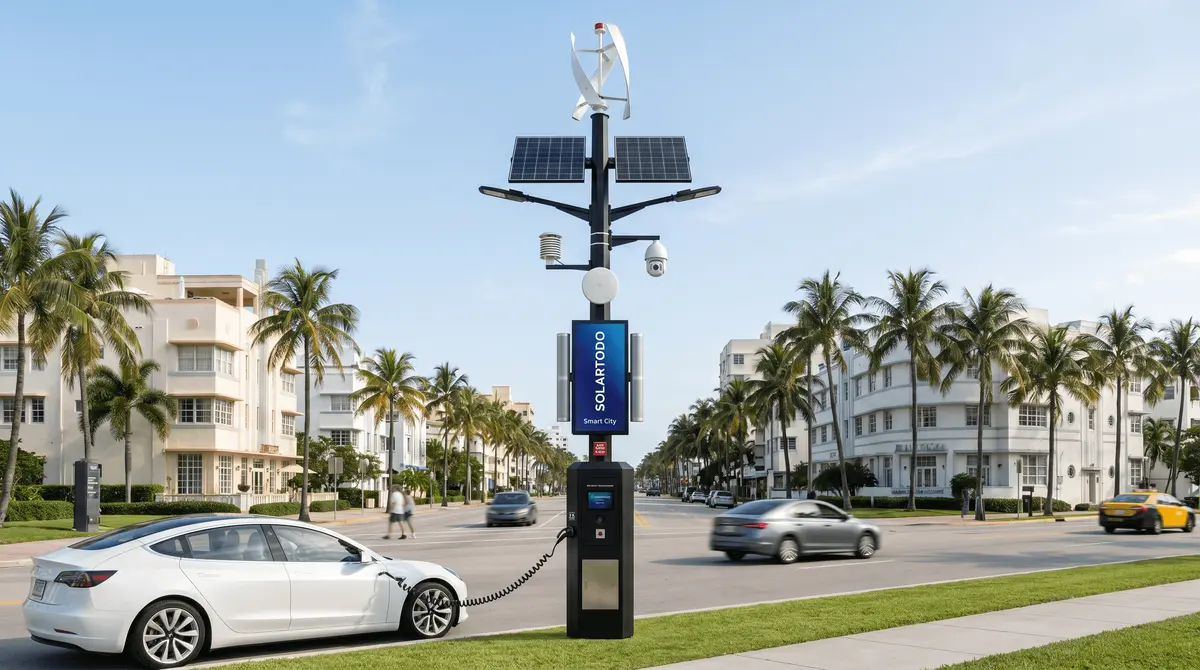
- The recommended pole is an 11m octagonal tapered steel Smart Streetlight with base Ø45cm and top Ø15cm, including an integrated 2.2m EV charging section welded as one structure.
- Each pole would carry 2×80W LED luminaires at 150 lm/W and 4000K, delivering 160W total connected lighting load per pole for urban street illumination.
- The hybrid package combines a 400W Gorlov-type helical VAWT, 2×100W monocrystalline panels at 15° tilt, and a 5kWh LFP battery with MPPT controller for local autonomy and backup support.
- Communications and safety hardware include WiFi 6 at 1.8Gbps for up to 256 devices, a 25x PTZ camera with 150m IR range, 8-parameter environmental sensing, and SOS broadcast linkage.
- For B2B procurement, SOLAR TODO should be evaluated as a corridor-infrastructure platform rather than only a lamp pole, because the same steel structure combines lighting, monitoring, charging, display, and public-address functions.
Market Context for Tirana
Tirana’s urban growth pattern and transport density make multi-function street infrastructure more relevant on collector and boulevard corridors than single-purpose lighting poles. According to INSTAT (2023), the Municipality of Tirana has a resident population above 598,000, while the wider metropolitan catchment is materially larger due to commuting and service concentration. That population density matters because a 25-50m smart-pole spacing model is most effective where pedestrian activity, curb turnover, and municipal monitoring needs all overlap within 1-2 km corridors.
Tirana also has a climate profile that supports hybrid generation but still benefits from grid backup. According to the World Bank Climate Change Knowledge Portal (2021), Albania has a Mediterranean climate with hot summers, wetter winters, and strong seasonal rainfall variation. According to Global Solar Atlas (World Bank/ESMAP, 2024), the Tirana area has favorable photovoltaic resource, with long-term average daily solar irradiation sufficient to support auxiliary loads and battery charging on distributed street assets. For a Smart Streetlight, that means solar can offset part of the communications and standby load, while the grid remains the stable source for 7kW EV charging and full-night lighting during low-resource periods.
Power-system context also supports a hybrid recommendation instead of a fully off-grid street asset. According to IEA (2024), Albania’s electricity supply remains highly dependent on hydropower, which creates seasonal sensitivity in dry years even when annual output is adequate. OST and national grid planning in Albania continue to reinforce transmission and distribution reliability, but municipal street infrastructure still benefits from local storage in the 5kWh class for ride-through capability, outage resilience, and reduced nuisance interruption of cameras, WiFi, and SOS systems.
Telecom and public-space digitization are additional drivers. According to ITU country ICT indicators and World Bank digital development datasets, Albania’s mobile and broadband usage levels continue to rise, increasing demand for curbside WiFi, surveillance backhaul, and edge-mounted public information systems. In a corridor with bus stops, retail frontage, and public parking turnover, a single 11m Smart Streetlight can host lighting, PTZ security, environmental sensing, WiFi 6, public address, and EV charging without requiring 5 or 6 separate street fixtures.
For Tirana specifically, the right size class is an urban street Smart Streetlight rather than a highway mast or a park bollard. The product brief defines urban spacing at 25-50m and 30-50 poles per km, which aligns with boulevard and arterial frontage conditions common in central Tirana. A typical corridor upgrade would therefore use an 11m class smart pole with dual-arm LED lighting, not a 6-8m garden pole and not a 12m+ highway traffic mast.
Two standards-based points shape the specification. IEC states, "Luminaires - Part 1: General requirements and tests," in IEC 60598, which remains the baseline for road-lighting fixture safety and construction. IEC also states in IEC 62196-2 that AC charging interfaces for electric vehicles must follow defined dimensional and compatibility requirements; for Albania’s European context, that makes Type 2 the logical connector standard for public curbside AC charging.
Recommended Technical Configuration
A typical 41-unit deployment in Tirana would cover approximately 1.31 km at 32m spacing and is best specified as an 11m hybrid Smart Streetlight with integrated EV charging, surveillance, public address, and WiFi. This configuration fits dense urban corridors where lighting, safety, and curbside charging need to share one steel structure instead of multiplying street furniture.
The recommended form factor is the project-specific hybrid configuration rather than a basic modular pole. Each unit would use an 11m octagonal tapered steel pole with a base diameter of 45cm and top diameter of 15cm, finished in black RAL9005 powder coating. The lower 2.2m of the pole is the EV charging cabinet itself, welded as one continuous steel structure rather than attached as a separate pillar, which is important for narrow sidewalks and cleaner streetscape control.
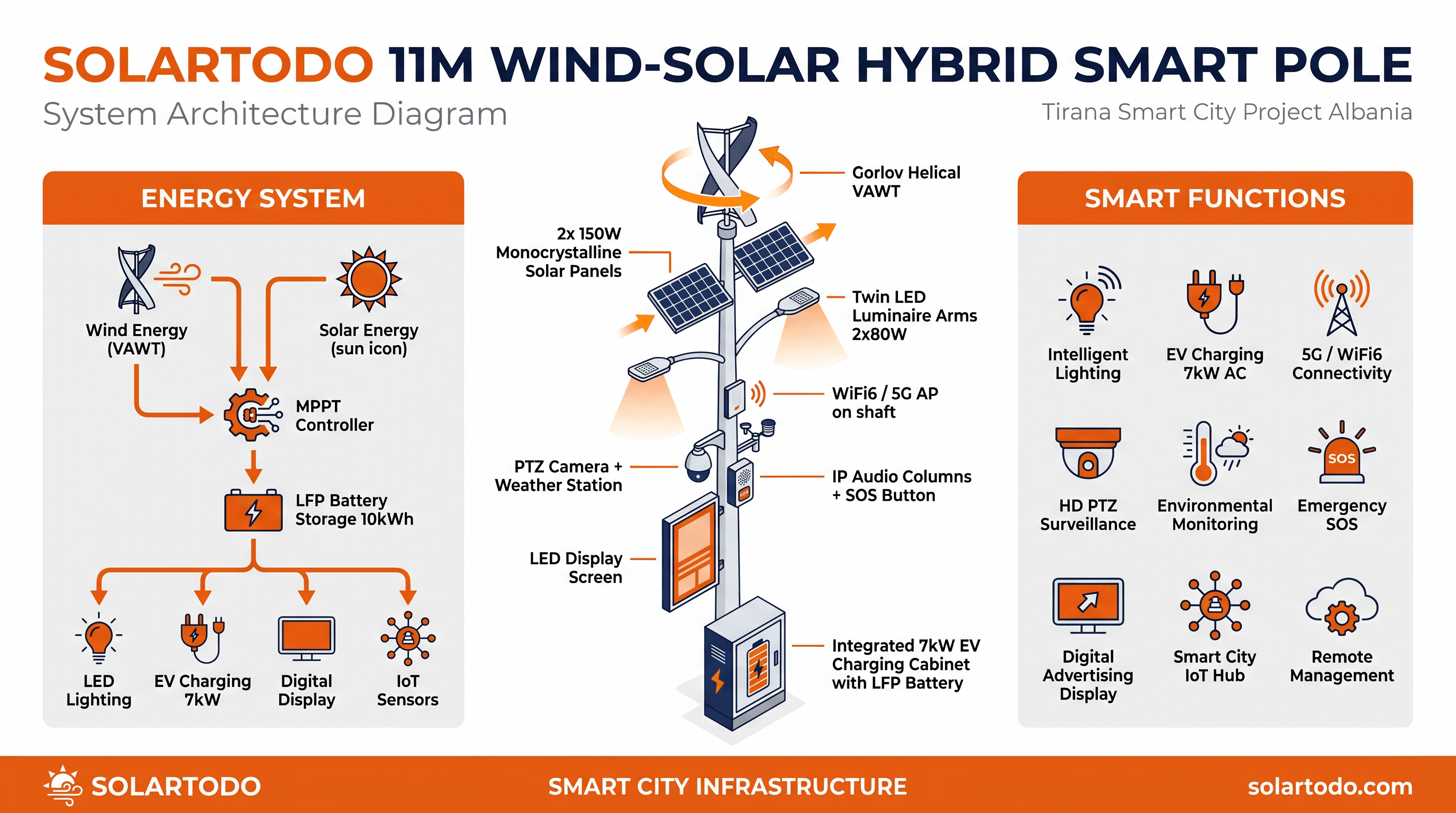
A typical 41-unit deployment of this scale would consist of the following functional layers:
- Lighting layer: twin 1.5m symmetric arms with +8° upward tilt and 2×80W LED luminaires at 150 lm/W, 4000K.
- Hybrid power layer: 1×400W Gorlov-type helical VAWT plus 2×100W deep-black monocrystalline panels on east-west A-frame brackets at 15° tilt.
- Storage layer: 5kWh LFP battery inside the pole base with MPPT controller and backup grid tie.
- Security layer: 22cm white PTZ dome camera with 360° rotation, 25x zoom, and IR distance up to 150m on a 50cm L-bracket outrigger.
- Environmental layer: 8-parameter top sensor for temperature, humidity, wind, pressure, noise, PM2.5, PM10, and illuminance.
- Public communication layer: 2× IP audio columns, each Ø10×50cm, 30W and 93dB, plus SOS/panic alarm linkage and emergency broadcast trigger.
- User service layer: integrated 7kW single-gun AC charger with Type 2, OCPP 1.6J, 5m coiled cable, touchscreen, E-stop, USB-C PD 30W, and USB-A.
- Digital layer: P5 vertical LED display at 1280×2560mm and WiFi 6 AP at 8.7m supporting 256 devices and up to 1.8Gbps.
This specification is stronger than a standard light pole where Tirana needs mixed municipal functions on constrained sidewalks. One steel asset replaces a lamp column, CCTV mast, WiFi post, emergency call point, small information totem, and AC charging pedestal. For a city center corridor with parking turnover and evening activity, that consolidation can reduce civil clutter and simplify utility coordination across a 1 km segment.
SOLAR TODO should therefore be considered in Tirana as a corridor platform product, not only as lighting equipment. The integrated charger section is especially relevant where pedestrian clear width is limited, because a separate charger pedestal often adds 0.4-0.6m of additional obstruction. By keeping the lower 2.2m inside the pole envelope, the streetscape remains more compact while preserving EV access and maintenance-door serviceability.
Technical Specifications
The recommended Tirana configuration is an approximately 41-unit, 11m hybrid Smart Streetlight package with 160W lighting load, 7kW AC charging, and 5kWh LFP storage per pole under IEC 60598, GB/T 37024, and IEC 62196-2.
- Quantity basis: approximately 41 units for a typical 1.31 km urban corridor
- Pole type: 11m octagonal tapered steel Smart Streetlight
- Pole geometry: base Ø45cm to top Ø15cm
- Finish: black RAL9005 powder coat
- Structural integration: lower 2.2m of pole is the EV charging cabinet, welded as one continuous steel structure
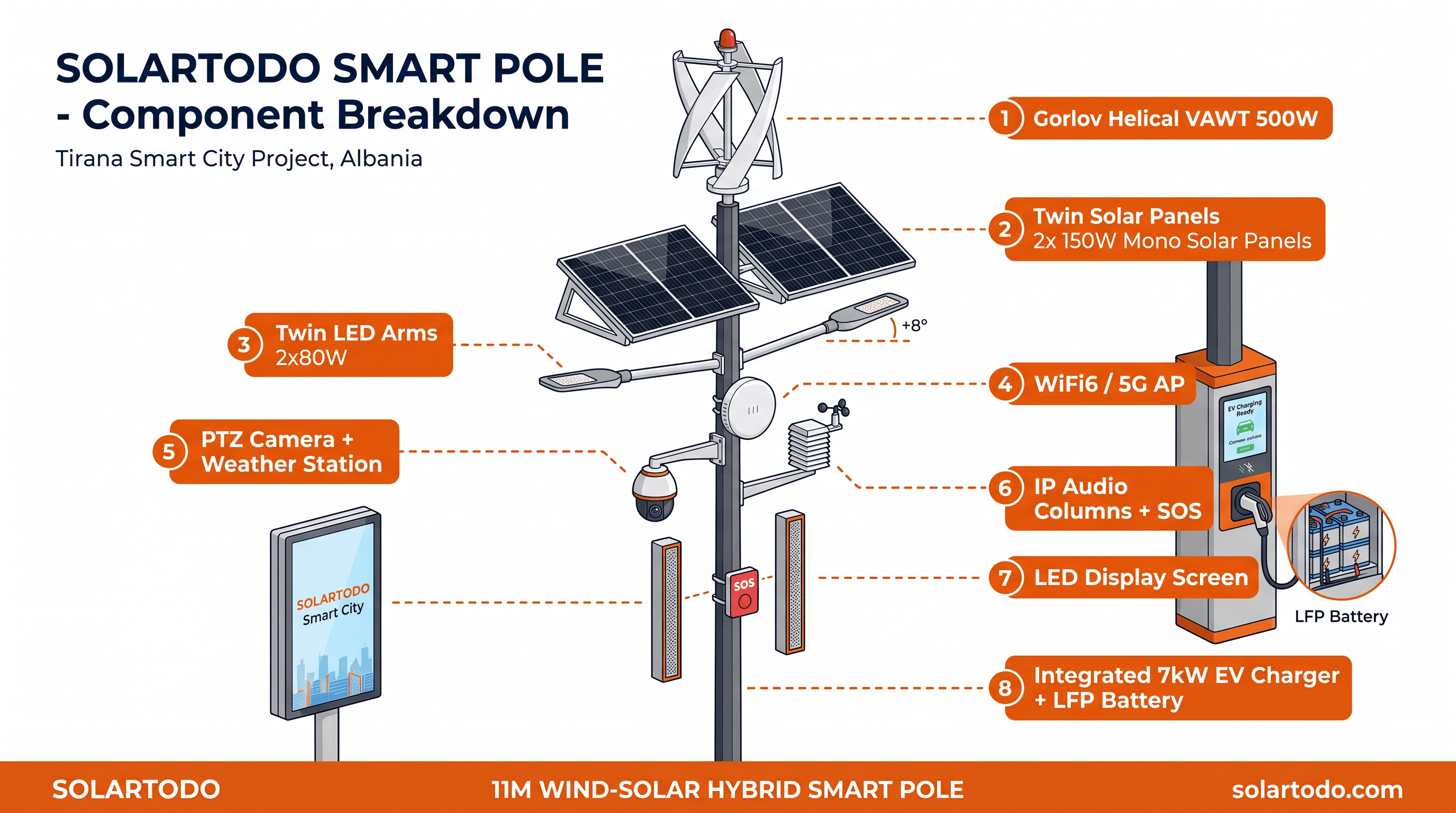
- Wind turbine: Gorlov-type helical VAWT, 3 twisted white aluminum blades, Ø70×100cm, 400W, red aviation LED
- Solar module set: 2×100W monocrystalline deep-black panels
- Solar mounting: mid-pole A-frame brackets, symmetric east-west pair, 15° tilt
- Battery system: LFP 5kWh inside pole base
- Charge control: MPPT controller with backup grid tie
- Luminaire arrangement: twin symmetric arms, 1.5m each, +8° upward tilt
- LED specification: 2×80W LED, 150 lm/W, 4000K
- Total lighting power per pole: 160W
- Camera: 22cm white PTZ dome, 360° rotation, 25x zoom, IR 150m
- Camera bracket: 50cm L-bracket outrigger
- Environmental sensor: 8 parameters including temperature, humidity, wind, pressure, noise, PM2.5, PM10, illuminance
- Public address: 2× IP audio columns, Ø10×50cm, 30W, 93dB, TCP/IP networked, side-clamp mounted
- Emergency system: SOS + panic alarm + camera linkage + emergency broadcast trigger
- EV charging: integrated 7kW single-gun AC charger, Type 2, OCPP 1.6J
- Charging accessories: 5m coiled cable, touchscreen, E-stop, maintenance door
- LED display: P5 vertical screen, 1280×2560mm, portrait, >5000 cd/m²
- Display content control: recommended municipal branding or service messaging; project-specific sample content may use “SOLARTODO Smart City” on deep blue during factory testing
- WiFi: 802.11ax WiFi 6 AP, 256 devices, 1.8Gbps
- WiFi mounting height: 8.7m on pole shaft
- User charging ports: USB-C PD 30W + USB-A
- Typical spacing: 32m
- Applicable standards: IEC 60598, GB/T 37024, IEC 62196-2
Implementation Approach
A 41-unit Tirana corridor would typically be implemented in 4 phases over about 16-24 weeks, depending on civil permits, utility approvals, and customs lead time. The sequence should prioritize corridor survey, foundation coordination, and grid-interface review before steel fabrication starts.
Phase 1 is design freeze and utility mapping. This usually takes 3-5 weeks and should verify sidewalk width, parking-bay geometry, underground utilities, and charger feeder availability. Because each pole includes a 7kW AC charger and 160W lighting load, the electrical design should separate essential loads, battery-backed loads, and metered EV charging loads to simplify maintenance and OCPP billing.
Phase 2 is fabrication and factory acceptance. For SOLAR TODO, the critical fabrication issue is the integrated lower 2.2m charger section because it is part of the pole body, not a bolt-on cabinet. Factory checks should confirm charger door alignment, cable handling, display fitment, PTZ bracket welding, and coating thickness before shipment. A CKD or semi-knocked-down logistics plan may be considered if port handling constraints or municipal storage space are tight.
Phase 3 is civil and electrical installation. A typical 41-unit corridor at 32m spacing would require staged excavation, anchor/foundation works, conduit placement, and feeder testing over 4-8 weeks depending on road occupancy restrictions. The 11m poles should be erected only after insulation resistance tests, earthing verification, and charger communication checks are complete at each location.
Phase 4 is commissioning and software integration. This usually takes 2-3 weeks for lighting schedules, camera presets, WiFi authentication, environmental data mapping, and OCPP charger enrollment. Municipal operators should receive a punch-list handover covering LED driver configuration, battery SOC thresholds, emergency broadcast logic, and preventive inspection intervals in month 1, month 6, and month 12.
Expected Performance & ROI
A hybrid 41-unit Smart Streetlight corridor in Tirana would primarily deliver value through asset consolidation, lower trenching duplication, and digital-service revenue options rather than through solar-only energy savings. The strongest business case usually comes from replacing 4-6 separate street assets with one 11m integrated structure.
According to IEA (2022), LEDs can reduce lighting electricity use by around 50% or more compared with legacy street-lighting technologies when paired with proper controls. In this configuration, each pole uses 160W of LED lighting, so 41 poles create a nominal connected lighting load of 6.56kW before dimming schedules are applied. If a corridor currently uses older 250W-400W luminaires, the lighting-only reduction can be material even before counting maintenance savings.
Battery-backed hybrid generation improves service continuity for communications and control loads. The 400W VAWT plus 200W solar package is not intended to carry continuous 7kW EV charging, but it can offset auxiliary loads such as WiFi, sensors, controller electronics, display standby, and part of lighting demand during favorable conditions. According to NREL (2023), distributed energy plus storage on public infrastructure can improve resilience value where outage avoidance and service continuity matter more than pure kWh arbitrage.
For ROI, municipalities usually assess 3 buckets: avoided civil works, reduced energy and maintenance cost, and added service revenue. A corridor that would otherwise require separate CCTV poles, emergency posts, WiFi fixtures, and charger pedestals may avoid repeated foundation and conduit packages. Depending on utilization, the 7kW Type 2 charger can also create recurring parking-energy revenue, while the 1280×2560mm LED display can support municipal messaging or regulated advertising inventory.
A practical payback range for a Tirana corridor would often be evaluated in the 5-9 year band under moderate charger utilization and active multi-service use, but the exact figure depends on local labor rates, feeder distance, permit cost, software scope, and whether display inventory is monetized. Public-safety functions such as SOS, PTZ surveillance, and emergency broadcast usually improve the procurement case even when they are not modeled as direct cash return.
According to IRENA (2023), battery-backed distributed assets are increasingly valued for resilience and service continuity, not only for direct electricity savings. BloombergNEF has also noted in multiple EV infrastructure outlooks that public charging utilization is highly location-sensitive; in Tirana, sites near mixed retail, municipal buildings, and transit interchanges would generally outperform purely residential curbside segments.
Comparison Table
A corridor in Tirana generally performs best with the 11m hybrid integrated-charger configuration because it combines 160W lighting, 7kW charging, and 5kWh storage in one pole at 32m spacing.
| Metric | Recommended Tirana Hybrid Smart Streetlight | Basic Modular Smart Pole | Separate Light Pole + EV Pedestal + CCTV Pole |
|---|---|---|---|
| Pole height | 11m | 8-10m typical | 8-10m + separate assets |
| Spacing basis | 32m | 25-40m | 25-40m |
| Units for 1.31 km | 41 | 41-52 | 41 light poles + extra pedestals/poles |
| Lighting per pole | 2×80W = 160W | 80-150W typical | 80-150W typical |
| EV charging | Integrated 7kW Type 2 | Optional module | Separate 7kW pedestal |
| Local storage | 5kWh LFP | Often none | Usually none at pole |
| Hybrid generation | 400W wind + 200W solar | Usually grid only | Usually grid only |
| Camera | PTZ 25x, IR 150m | Optional fixed/PTZ | Separate CCTV mast often needed |
| Public address | 2×30W IP audio columns | Optional | Separate PA fixture |
| WiFi | WiFi 6, 256 devices, 1.8Gbps | Optional | Separate AP mount often needed |
| Display | P5 1280×2560mm | Optional/smaller | Separate totem often needed |
| Sidewalk clutter | Lower | Medium | Highest |
| Civil coordination complexity | Medium | Medium | High |
Pricing & Quotation
SOLAR TODO offers three pricing tiers for this product line: FOB Supply (equipment ex-works China), CIF Delivered (including ocean freight and insurance), and EPC Turnkey (fully installed, commissioned, with 1-year warranty). Volume discounts are available for large-scale deployments. Configure your system online for an instant estimate, or request a custom quotation from our engineering team at [email protected].
For Tirana, quotation quality depends on 6 variables: foundation type, feeder distance, charger metering scope, software integration, customs route, and corridor traffic management. Buyers comparing SOLAR TODO with conventional poles should request a like-for-like bill of materials that includes charger integration, PTZ bracketry, battery system, display brightness above 5000 cd/m², and WiFi 6 capacity at 256 devices. Product details are also available on the Smart Streetlight product page, and site-specific layouts can be discussed via the contact page.
Frequently Asked Questions
A Tirana buyer usually needs 10 direct answers covering pole specs, charger integration, timeline, maintenance, ROI, standards, and quotation scope before issuing a corridor-scale Smart Streetlight RFQ.
Q1: What Smart Streetlight configuration is most suitable for Tirana’s urban roads?
For mixed-use boulevards and collector roads in Tirana, the strongest fit is an 11m hybrid Smart Streetlight at 32m spacing. The recommended package uses 41 units for about 1.31 km, with 2×80W LEDs, a 7kW Type 2 charger, PTZ surveillance, WiFi 6, and a 5kWh LFP battery in each pole.
Q2: Is the EV charger a separate pedestal beside the pole?
No. In this configuration, the lower 2.2m of the pole is the EV charging cabinet itself. It is welded as one continuous steel structure, not installed as a separate pillar. That matters on tighter Tirana sidewalks because it reduces clutter and keeps the charger within the pole footprint.
Q3: Can the hybrid wind-solar system power the full 7kW EV charger off-grid?
No. The 400W wind turbine, 200W solar array, and 5kWh battery are intended to support auxiliary loads, resilience, and partial offset, not full continuous 7kW charging. The charger should be specified with grid tie, while the hybrid package helps maintain communications, controls, and selected loads during short disruptions.
Q4: What installation timeline should buyers expect for about 41 units?
A typical schedule is 16-24 weeks from design freeze to final commissioning. About 3-5 weeks are usually needed for survey and approvals, 6-8 weeks for fabrication and shipping, 4-8 weeks for civil/electrical installation, and 2-3 weeks for software setup, testing, and municipal acceptance.
Q5: What standards should be specified in the procurement documents?
At minimum, the RFQ should reference IEC 60598 for luminaires, IEC 62196-2 for the Type 2 AC charging interface, and GB/T 37024 for smart-pole framework alignment. Buyers may also add local electrical, earthing, accessibility, and municipal signage requirements so the final submittal matches Albania’s permitting environment.
Q6: What maintenance burden should municipalities expect?
Maintenance should be planned by subsystem, not only by pole. LEDs and steel structure usually require low routine attention, while the charger, PTZ camera, display, WiFi AP, and battery need scheduled checks. A practical plan is monthly remote diagnostics, quarterly cleaning and visual inspection, and annual electrical, charging, and battery-health testing.
Q7: How does this compare with a standard smart pole without hybrid power or integrated charging?
A standard smart pole can be cheaper at the equipment level, but it often omits the 5kWh battery, 400W wind turbine, 200W solar package, and integrated 7kW charger. In Tirana, the hybrid integrated model is stronger where resilience, curbside charging, and fewer separate street assets are priorities.
Q8: What payback period is realistic for Tirana?
A realistic planning assumption is often 5-9 years, but it depends on charger utilization, avoided civil works, software scope, and whether the LED display is monetized. Lighting savings alone rarely justify the full system; the better ROI case combines energy reduction, fewer separate poles, parking-energy revenue, and public-safety value.
Q9: What should be included in an EPC quotation request?
A complete EPC RFQ should state corridor length, target spacing, feeder distance, foundation assumptions, charger metering requirements, backhaul method, display policy, and software interfaces. It should also confirm whether the buyer wants 41 full-featured poles or a mixed layout with some poles carrying reduced accessory packages.
Q10: What warranty terms are typical for this type of product?
Warranty terms vary by scope, but buyers commonly request separate coverage schedules for steel structure, LED luminaires, charger electronics, battery, display, and communications devices. The pricing section above references a 1-year warranty for EPC turnkey scope; larger municipal tenders often negotiate extended component warranties and spare-part packages.
References
- INSTAT (2023): Population and administrative statistics for Tirana Municipality; used for urban demand and corridor density context.
- World Bank Climate Change Knowledge Portal (2021): Albania climate profile, including seasonal temperature and rainfall patterns relevant to outdoor equipment selection.
- Global Solar Atlas / World Bank Group and ESMAP (2024): Solar resource mapping for Albania and Tirana-area irradiation conditions.
- IEA (2024): Albania energy profile and electricity-sector context, including hydropower dependence and supply structure.
- IEC (2023): IEC 60598, Luminaires - Part 1: General requirements and tests.
- IEC (2022): IEC 62196-2, Plugs, socket-outlets, vehicle connectors and vehicle inlets - Conductive charging of electric vehicles.
- IRENA (2023): Distributed energy and storage market observations relevant to resilience value in public infrastructure.
- ITU (2023): Albania ICT indicators and digital access context relevant to WiFi, surveillance, and connected street assets.
- NREL (2023): Guidance on distributed energy, storage, and resilience applications for public infrastructure.
- BloombergNEF (2024): EV charging market outlooks indicating utilization sensitivity by site type and urban context.
Equipment Deployed
- Approximately 41 units of 11m octagonal tapered steel Smart Streetlight, base Ø45cm to top Ø15cm, black RAL9005 powder coat
- Integrated lower 2.2m EV charging cabinet welded as one continuous pole structure
- Gorlov-type helical VAWT, 3 twisted white aluminum blades, Ø70×100cm, 400W, with red aviation LED
- 2×100W monocrystalline deep-black solar panels on symmetric east-west A-frame brackets at 15° tilt
- LFP battery 5kWh inside pole base with MPPT controller and backup grid tie
- Twin 1.5m symmetric lighting arms with +8° upward tilt
- 2×80W LED luminaires, 150 lm/W, 4000K
- 22cm white PTZ dome camera, 360° rotation, 25x zoom, IR 150m, on 50cm L-bracket outrigger
- 8-parameter environmental sensor for temperature, humidity, wind, pressure, noise, PM2.5, PM10, illuminance
- 2× IP audio columns, Ø10×50cm, 30W, 93dB, TCP/IP networked
- SOS + panic alarm + camera linkage + emergency broadcast trigger
- Integrated 7kW single-gun AC charger, Type 2, OCPP 1.6J, 5m coiled cable, touchscreen, E-stop, maintenance door
- P5 vertical LED display, 1280×2560mm, portrait, >5000 cd/m²
- WiFi 6 AP, 802.11ax, 256 devices, 1.8Gbps, mounted at 8.7m
- USB-C PD 30W and USB-A user charging ports