Tijuana Power Transmission Tower Market Analysis: 10kV Municipal Distribution Configuration Guide
Summary
Tijuana’s dense urban growth, 40 m/s wind exposure, and municipal 10kV distribution needs make a medium-voltage steel Power Transmission Tower profile practical. A typical 9 km line would use approximately 94 poles at 25 m height, 100 m spans, and ACSR-70 conductor.
Key Takeaways
- Tijuana had 1,922,523 residents in the 2020 census, according to INEGI (2020), which supports continued medium-voltage distribution expansion in urban and peri-urban zones.
- A practical municipal distribution profile for this city is 10kV single circuit with approximately 94 steel tubular poles over about 9 km at 100 m average span.
- The project-specific configuration uses 25 m tapered hot-dip galvanized Q345 steel poles, about 10 t per pole, with 0.8 m phase spacing and 5 m ground clearance.
- Wind class 4 at 40 m/s is relevant for Tijuana’s coastal exposure; IEC 60826 load assumptions and spread footing foundations are suitable for this profile.
- The specified conductor is ACSR-70 at 275 kg/km with maximum tension of 22 kN, matched to a municipal medium-voltage line rather than sub-transmission duty.
- Accessories should include climbing steps, cross arm, grounding, bird guard, and vibration damper to support 30-year design life and routine maintenance access.
- According to CFE interconnection and network practice in Mexico, medium-voltage urban feeders typically prioritize compact rights-of-way, which favors tubular steel poles over wider-footprint structures.
- SOLAR TODO should position this product in Tijuana as a municipal distribution solution, not a 110kV or 220kV transmission structure, because conductor loading and line function are clearly medium-voltage.
Market Context for Tijuana
Tijuana is a large border city of 1,922,523 people with sustained urban and industrial load growth, and that scale supports ongoing 10kV and 13.2kV-class distribution reinforcement rather than only bulk transmission additions. According to INEGI (2020), Tijuana is the most populous municipality in Baja California, and according to the Baja California state government’s planning documents, the metro area continues to expand toward eastern and southern corridors where new feeders and service laterals are typically required.
The city’s geography matters for pole selection. Tijuana sits near 32.51, -117.03 on the Pacific side, with marine influence, variable topography, and seasonal wind exposure that can raise corrosion and structural loading concerns. According to NASA POWER (2024), coastal Baja California sees recurring wind events and moderate ambient temperature variation, while Mexico’s Servicio Meteorológico Nacional identifies strong regional Santa Ana wind episodes that can materially affect overhead line design assumptions. For this reason, a galvanized steel tubular form is usually more suitable than untreated alternatives in coastal municipal corridors.
Grid context also points toward medium-voltage distribution hardware. CFE distribution networks in urban Mexico commonly use medium-voltage feeder classes for municipal service extension, industrial park tie-ins, and reliability upgrades below the sub-transmission layer. According to SENER’s Programa de Desarrollo del Sistema Eléctrico Nacional, distribution reinforcement remains necessary in high-growth urban zones, while IEA (2023) notes that Mexico’s electricity demand continues to rise with industrial activity, electrification, and urban service expansion. In Tijuana, that means line extensions of several kilometers are credible planning cases for municipal infrastructure and industrial-adjacent districts.
A second local factor is right-of-way pressure. Tijuana’s built environment includes dense road corridors, hillside neighborhoods, and mixed residential-commercial strips where compact pole footprints reduce civil conflicts. According to the World Bank (2023), urban infrastructure efficiency in fast-growing cities depends heavily on minimizing land take and simplifying maintenance access. That directly supports the use of steel tubular poles with flanged bolt sections and concrete foundations, especially where municipal road reserves are constrained.
Two authority statements are relevant here. IEC states, "The loading and strength requirements of overhead lines shall be established using climatic, topographical and operational conditions" under IEC 60826, which is directly applicable to Tijuana’s wind and terrain profile. IRENA states, "Grid expansion and modernization are prerequisites for reliable electricity delivery in growing urban economies," a point that fits Tijuana’s industrial and municipal load pattern.
Recommended Technical Configuration
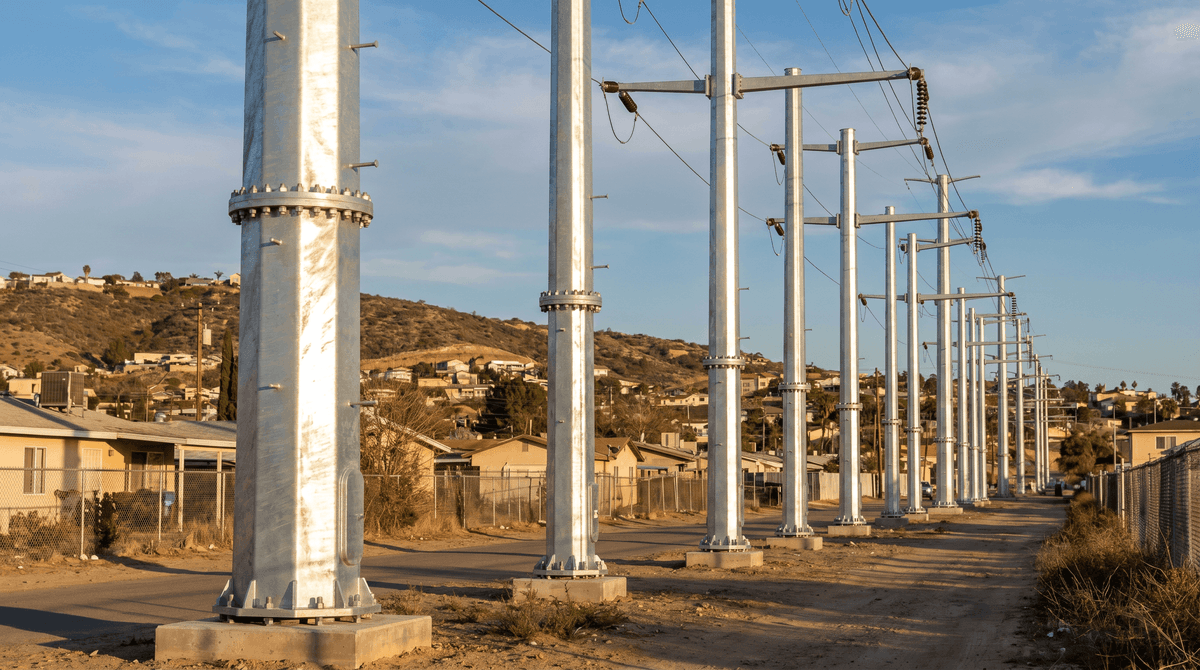
For Tijuana’s municipal medium-voltage profile, a practical recommendation is a 10kV single-circuit steel tubular Power Transmission Tower line using approximately 94 poles across about 9 km with 100 m spans.
The user-specified configuration fits a municipal distribution application even though the 25 m pole height is taller than the generic 10-35 kV reference range. The line function, conductor size, and accessory package clearly indicate medium-voltage urban distribution rather than 66-110 kV sub-transmission or 220 kV transmission duty. For procurement and engineering review, the voltage class should remain fixed at 10kV single circuit, with the taller pole profile treated as a route-specific choice that may address road crossings, terrain changes, clearance constraints, or municipal corridor standardization.
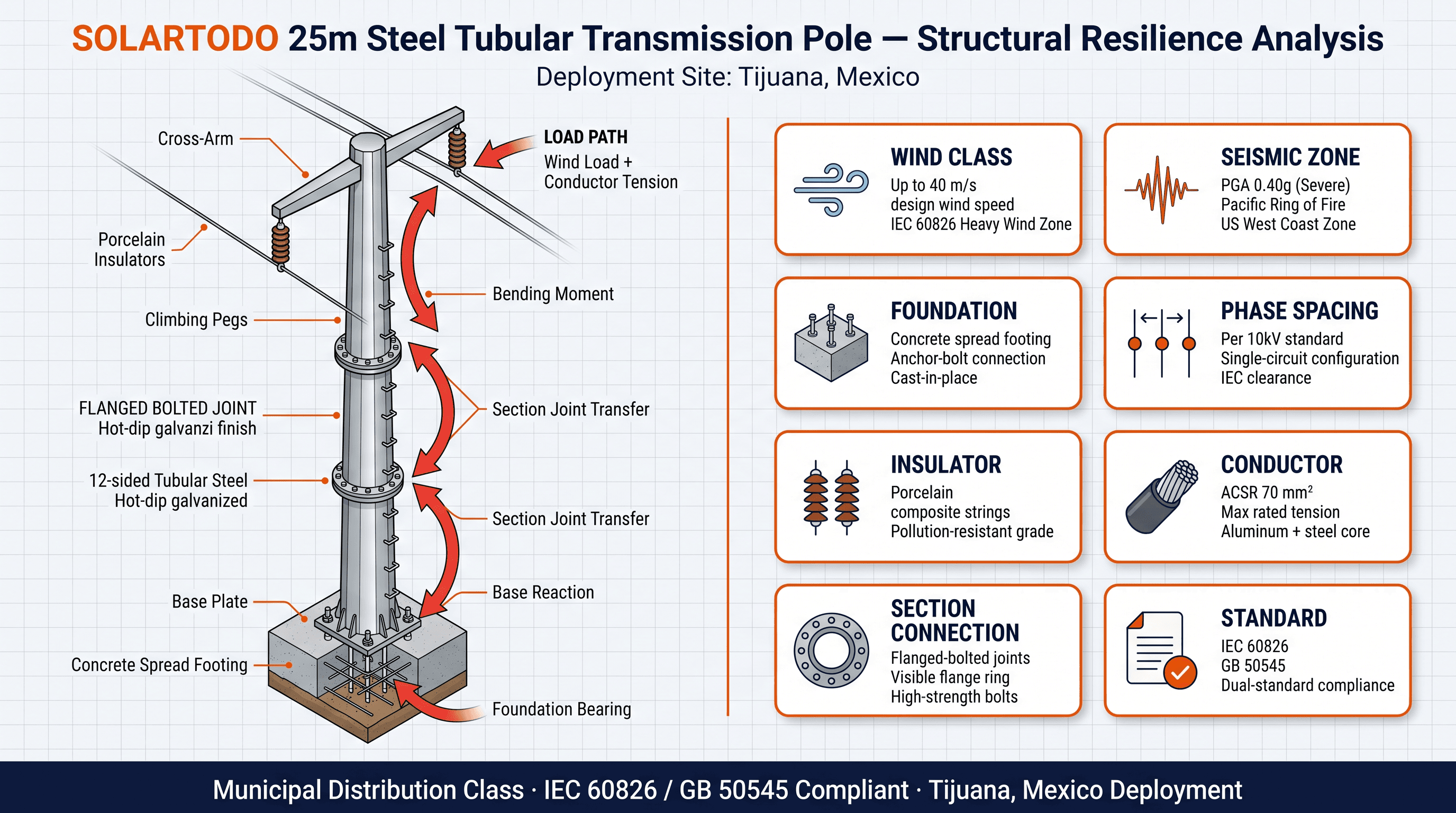
A typical deployment of this scale would consist of tapered steel tubular poles in hot-dip galvanized Q345 steel, flanged for sectional transport and bolted field assembly. The provided pole mass is about 10 t per unit, with an indicative steel consumption of roughly 400 kg/m. That is materially heavier than a basic 10kV roadside pole, so buyers in Tijuana should read this as a reinforced municipal distribution structure rather than a minimal rural feeder pole.
The electrical configuration is straightforward. ACSR-70 conductor at 275 kg/km and 22 kN maximum tension is suitable for a compact 10kV single-circuit line where span length is around 100 m and current demand is moderate. Phase spacing of 0.8 m and insulator length of 0.5 m align with a medium-voltage arrangement focused on compact geometry, while 5 m ground clearance supports municipal safety and road-adjacent routing subject to local code checks.
Wind and foundation choices are important in Tijuana. The specified wind class 4 at 40 m/s is credible for Baja California exposure, especially in open corridors and elevated terrain. A spread footing foundation is appropriate where geotechnical conditions permit, but local soil bearing capacity, slope stability, and seismic detailing should be confirmed before final IFC drawings. SOLAR TODO should therefore present this as a recommended city-fit configuration subject to route survey, geotechnical verification, and CFE or municipal utility approval.
For buyers comparing alternatives, tubular steel offers three practical advantages in this city: smaller footprint than lattice structures, better urban visual acceptance, and easier corrosion protection through hot-dip galvanizing. SOLAR TODO can also support route-specific bracket and grounding revisions if Tijuana’s feeder alignment includes mixed roadside, industrial, and hillside segments. For technical review or quotation, see the Power Transmission Tower product page or contact us.
Technical Specifications
The recommended Tijuana configuration is a 10kV single-circuit municipal distribution line with approximately 94 galvanized steel poles, 25 m height, 100 m span, and ACSR-70 conductor over about 9 km.
- Product type: Steel tubular Power Transmission Tower, tapered monopole form
- Application class: Medium-voltage municipal distribution
- Voltage: 10kV
- Circuit arrangement: Single circuit
- Pole quantity: Approximately 94 units
- Pole height: 25 m
- Pole material: Q345 steel
- Surface protection: Hot-dip galvanized
- Pole weight: Approximately 10 t per pole
- Indicative steel intensity: About 400 kg/m
- Line length: About 9 km
- Average span: 100 m
- Conductor type: ACSR-70
- Conductor mass: 275 kg/km
- Maximum conductor tension: 22 kN
- Phase spacing: 0.8 m
- Insulator length: 0.5 m
- Ground clearance: 5 m
- Wind class: Class 4
- Basic wind speed: 40 m/s
- Foundation type: Spread footing foundation
- Accessories: Climbing steps, cross arm, grounding, bird guard, vibration damper
- Design life: 30 years
- Standards basis: IEC 60826 / GB 50545
From a standards perspective, IEC 60826 is the key overhead line loading reference for wind, conductor tension, and structural reliability. GB 50545 is also commonly used for transmission and distribution structural design checks in fabricated steel pole projects. In Tijuana, local adaptation should additionally review Mexican utility practice, seismic detailing, and municipal clearance rules before construction release.
Implementation Approach
A 9 km, approximately 94-pole municipal distribution project in Tijuana would typically be implemented in 4 phases: route survey, factory fabrication, civil works, and line erection plus commissioning.
The first phase is route definition and design validation. This usually includes topographic survey, utility conflict mapping, geotechnical borings at representative locations, and confirmation of road, drainage, and crossing clearances. For a 9 km route with 100 m spans, the design team would normally verify every angle point, dead-end location, and foundation geometry before releasing fabrication drawings. In Tijuana’s hillside districts, this phase also needs slope review and access planning for cranes or gin-pole erection methods.
The second phase is manufacturing and logistics. Tubular steel poles are commonly fabricated in flanged sections to simplify ocean freight and inland trucking. Hot-dip galvanizing should be specified to the required coating thickness, with bolt sets, anchor assemblies, and accessories packed by structure number. A CKD-style shipment approach is often practical for Latin American utility projects because it reduces transport envelope size and improves site handling control.
The third phase is civil construction. Spread footing foundations are excavated, reinforced where required, cast, and cured before pole erection. In municipal corridors, foundation sequencing usually follows traffic management windows and underground utility clearance permits. According to IEC 60826, structural performance depends on the combined action of wind, conductor tension, and support geometry, so foundation tolerances and anchor positioning need close QA checks.
The fourth phase is erection and energization. Pole sections are bolted, plumbed, and torqued; cross arms and accessories are installed; conductors are strung to the specified 22 kN limit; and grounding continuity is tested before commissioning. For a 94-pole line, the field schedule would depend on permit lead times, road access, and utility outage windows, but buyers should expect civil and erection work to be staged by segment rather than as one uninterrupted corridor.
Expected Performance & ROI
For a 10kV, 9 km municipal feeder in Tijuana, the main value case is lower lifecycle maintenance, compact right-of-way use, and 30-year service life rather than short-term energy-cost payback.
Unlike generation equipment, a Power Transmission Tower does not create direct energy revenue by itself, so ROI should be evaluated through avoided outage cost, lower corrosion-related replacement frequency, and reduced maintenance interventions. According to the World Bank (2023), reliability improvements in urban distribution systems can materially reduce economic losses from service interruptions, especially in industrial and border-manufacturing cities. In Tijuana, where commercial and industrial continuity matters, a stronger steel pole specification can be justified if it lowers forced outage exposure during wind events.
Maintenance economics also favor galvanized tubular steel in coastal environments. According to NREL (2023), corrosion management is a major lifecycle cost driver for outdoor energy infrastructure in marine or semi-marine climates. A hot-dip galvanized Q345 pole with bird guards, dampers, and proper grounding can reduce recurrent remedial work compared with structures that require more frequent surface treatment or occupy larger footprints that complicate access.
Expected operating performance should be measured using four practical indicators:
- Structural compliance with 40 m/s wind criteria
- Conductor sag and tension kept within design limits at 22 kN maximum
- Ground clearance maintained at 5 m minimum under operating conditions
- Routine inspection intervals that support a 30-year design life
For municipal buyers, the payback discussion is usually framed as total cost of ownership over 20 to 30 years. A heavier 10 t pole may increase upfront capex versus lighter alternatives, but the tradeoff can be acceptable where wind resilience, corrosion resistance, and urban durability are more important than lowest initial material tonnage. SOLAR TODO should therefore present ROI in terms of asset life, maintenance burden, and network reliability, not speculative revenue assumptions.
Results and Impact
A Tijuana deployment profile of approximately 94 medium-voltage steel poles over 9 km would primarily improve feeder continuity, corridor efficiency, and maintenance access in wind-exposed municipal areas.
The most likely system impact is not megawatt-scale capacity gain but better distribution reach and stronger physical resilience. In practical terms, 100 m span planning can reduce the number of support points compared with denser short-span roadside construction, while still keeping the line in a municipal distribution category. For city planners, that can mean fewer foundations, fewer roadside obstructions, and cleaner corridor management if the route is properly surveyed.
There is also an operational impact for maintenance crews. Climbing steps, bird guards, vibration dampers, and defined grounding hardware simplify inspection routines and reduce ad hoc retrofits after energization. In a coastal-border city with mixed industrial and urban loads, that matters because maintenance windows are limited and access constraints can quickly increase O&M cost.
From a procurement perspective, the specified configuration gives Tijuana buyers a clear baseline: 10kV single circuit, 25 m tubular steel, ACSR-70, 40 m/s wind class, and spread footing foundations. That allows utilities, EPCs, and municipal engineering teams to compare alternatives on the right basis rather than mixing medium-voltage distribution needs with sub-transmission or bulk transmission structures.
Comparison Table
The table below compares the recommended Tijuana configuration with adjacent utility classes so buyers do not over-specify or under-specify the line.
| Parameter | Recommended Tijuana Profile | Standard 10-35 kV Distribution Reference | 66-110 kV Sub-Transmission Reference |
|---|---|---|---|
| Voltage class | 10kV | 10-35 kV | 66-110 kV |
| Circuit | Single | Single or double | Single or double |
| Pole form | Tubular steel monopole | Tubular steel monopole | Tubular steel monopole |
| Pole height | 25 m | 12-18 m | 18-30 m |
| Pole weight | ~10 t | 1-3 t/pole | 5-15 t/pole |
| Span | 100 m | 80-150 m | 200-300 m |
| Poles per km | ~10.4 | 8-12 | 4-5 |
| Conductor | ACSR-70 | ACSR family | ACSR family |
| Wind basis | 40 m/s | Project-specific | Project-specific |
| Foundation | Spread footing | Concrete foundation | Concrete foundation |
| Typical use | Municipal distribution with route constraints | General distribution | Regional feeder/sub-transmission |
Pricing & Quotation
SOLAR TODO offers three pricing tiers for this product line: FOB Supply (equipment ex-works China), CIF Delivered (including ocean freight and insurance), and EPC Turnkey (fully installed, commissioned, with 1-year warranty). Volume discounts are available for large-scale deployments. Configure your system online for an instant estimate, or request a custom quotation from our engineering team at [email protected].
Frequently Asked Questions
This FAQ answers 10 common buyer questions on Tijuana’s 10kV steel tubular pole configuration, including structure size, installation sequence, maintenance, warranty scope, and quotation practice.
Q1: What is the recommended pole type for this Tijuana application?
A tapered steel tubular monopole in hot-dip galvanized Q345 steel is the recommended type. For this city profile, the specified configuration is 25 m height, single circuit, and about 10 t per pole. That combination suits a 10kV municipal distribution route where corridor width, corrosion resistance, and wind loading matter.
Q2: Why is a tubular pole preferable to a lattice tower in urban Tijuana?
Tubular poles use a smaller footprint and are easier to place along roads, industrial edges, and constrained municipal corridors. In a 9 km route with about 94 supports, that can simplify land coordination and traffic management. The galvanized surface also helps in coastal exposure where corrosion control is a procurement concern.
Q3: What conductor is specified for this configuration?
The specified conductor is ACSR-70 with a mass of 275 kg/km and maximum tension of 22 kN. That is appropriate for a 10kV single-circuit municipal feeder with 100 m spans. It is not intended to represent a 66-110 kV or 220 kV transmission conductor package.
Q4: How long would a project like this typically take to implement?
A project of about 94 poles over 9 km would usually move through survey, fabrication, civil works, erection, and commissioning over several months. Actual timing depends on permits, geotechnical conditions, and utility outage windows. Fabrication and galvanizing often run in parallel with foundation preparation to shorten the schedule.
Q5: What foundation type is recommended in Tijuana?
The specified foundation is a spread footing foundation, which is commonly suitable for medium-voltage tubular poles when soil bearing capacity is adequate. However, final sizing should follow geotechnical data, slope conditions, and seismic checks. In hillside or weak-soil segments, the footing geometry may need route-specific adjustment.
Q6: What maintenance should buyers expect over a 30-year design life?
Routine maintenance usually includes visual inspection of galvanizing, bolt torque checks, grounding continuity tests, bird guard condition, and conductor hardware review. A structured inspection cycle every 1 to 3 years is common, with extra checks after high-wind events near 40 m/s. Tubular steel generally reduces maintenance complexity in compact urban corridors.
Q7: How should ROI be evaluated for a Power Transmission Tower project?
ROI is usually measured through total cost of ownership, reduced outage exposure, and lower maintenance burden rather than direct revenue generation. For Tijuana, the value case is stronger network reliability in a dense urban-industrial environment. Buyers should compare 20- to 30-year lifecycle cost, not only initial steel tonnage or ex-works pricing.
Q8: Does SOLAR TODO provide EPC pricing or supply-only options?
Yes. SOLAR TODO provides FOB Supply, CIF Delivered, and EPC Turnkey quotation structures for this product line. That lets utilities, distributors, and EPC firms choose between equipment-only procurement and full installation scope. Buyers can use the online configurator or send route data for a tailored engineering quotation.
Q9: What warranty scope is typical for this product line?
The standard commercial structure in the pricing section includes a 1-year warranty for EPC Turnkey scope. Supply-only orders typically define warranty terms in the contract based on fabrication, galvanizing, and accessory scope. Buyers should request clear clauses for coating performance, bolt sets, and missing-part replacement procedures.
Q10: What standards should be checked before final approval in Mexico?
At minimum, buyers should review IEC 60826 for overhead line loading and the specified GB 50545 structural basis, then align those with Mexican utility practice and local authority requirements. Clearance, grounding, and seismic detailing should be verified during detailed design. That is especially important in Tijuana because terrain and wind exposure vary by corridor.
References
- INEGI (2020): Population and Housing Census; Tijuana municipality population reported at 1,922,523.
- SENER (2023): Programa de Desarrollo del Sistema Eléctrico Nacional; outlines Mexico’s transmission and distribution expansion needs.
- IEA (2023): Mexico energy profile and electricity demand context; notes continued demand growth linked to economic activity.
- NASA POWER (2024): Climate data resources for wind and temperature conditions relevant to infrastructure planning at 32.51, -117.03.
- IEC (2017): IEC 60826, Design criteria of overhead transmission lines; load and strength methodology for wind, terrain, and reliability.
- World Bank (2023): Urban infrastructure and power reliability guidance; highlights economic value of resilient distribution systems.
- IRENA (2023): Grid modernization and network expansion analysis for reliable electricity delivery in growing urban economies.
Equipment Deployed
- Steel tubular Power Transmission Tower, tapered monopole, 25 m height, Q345 hot-dip galvanized steel
- 10kV single-circuit line configuration, approximately 94 units over about 9 km
- Pole weight approximately 10 t/pole, indicative steel intensity about 400 kg/m
- ACSR-70 conductor, 275 kg/km, maximum tension 22 kN
- Phase spacing 0.8 m
- Insulator length 0.5 m
- Ground clearance 5 m
- Wind class 4, basic wind speed 40 m/s
- Spread footing foundation
- Accessories: climbing steps, cross arm, grounding, bird guard, vibration damper
- Design life: 30 years
- Standards basis: IEC 60826 / GB 50545