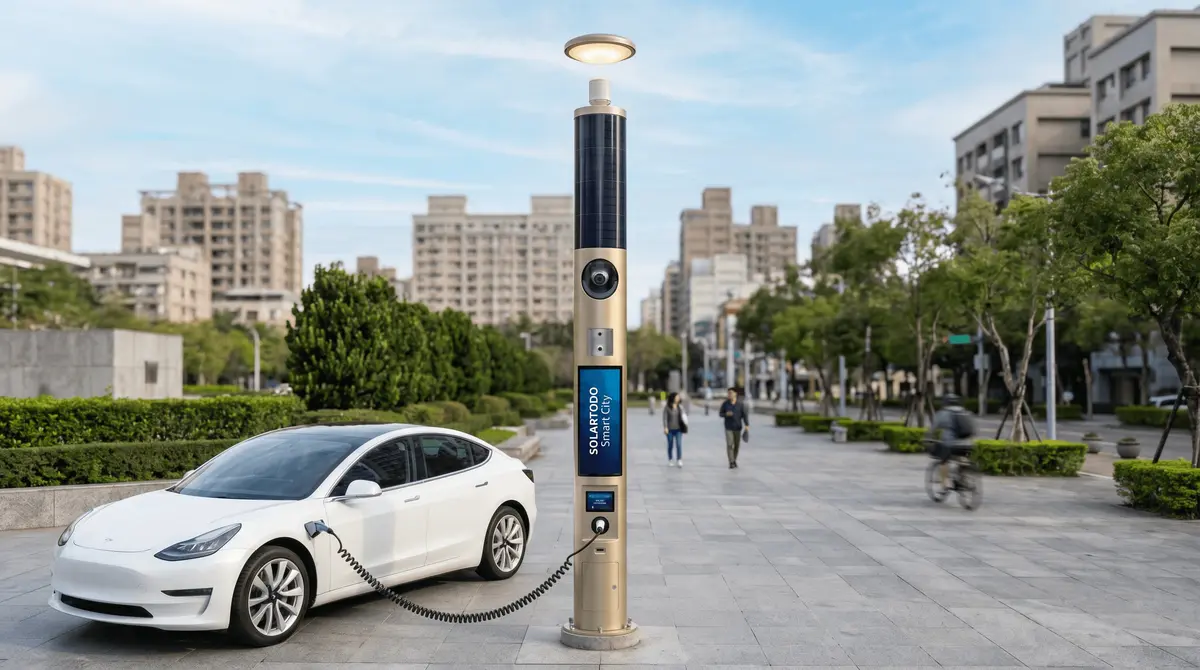
129-Unit Smart Streetlight Deployment in Taipei, Taiwan Featuring 10m Seamless Ø219mm Cylindrical Poles
Summary
This Taipei deployment installed 129 SOLAR TODO Smart Streetlight units with 10m seamless Ø219mm cylindrical poles, 80W/12,000lm integrated top lighting, and 28m spacing, combining EV charging, WiFi 6 + 5G, and 12-parameter sensing in one flush-built streetscape asset.
Key Takeaways
A 129-unit SOLAR TODO Smart Streetlight rollout in Taipei used 10m seamless cylindrical poles with a constant Ø219mm profile and 5mm wall thickness for a uniform urban design language.
- 129 units were deployed at 28m spacing, creating a continuous smart corridor with integrated lighting, sensing, communications, emergency assistance, and charging.
- Each pole uses a 10m seamless cylindrical steel shaft, Ø219mm constant diameter top-to-bottom, 5mm wall thickness, and hot-dip galvanized construction.
- The top luminaire is fully integrated inside the pole head and delivers 80W, 12,000lm, and 4000K output through a PMMA top window segment.
- Solar harvesting is provided by 360° wrapped CIGS flexible thin-film cells from 6.5m to 9.3m, totaling about 200W without rigid panels or brackets.
- Every unit includes a 12-parameter environmental sensor package covering meteorology, air quality, rain, and CO/NO2/O3 monitoring.
- Communications are embedded with dual-mode WiFi 6 + 5G internal antennas, plus a flush SOS panel with integrated micro-camera, microphone, and speakerphone grille.
- EV charging is fully embedded in the Ø219mm pole body with a 7kW dual-outlet charger, Type 2 + Type 1 ports, a 5m coiled Type 2 cable, and a flush touchscreen at 1.5m.
- Each pole includes an internal LFP 2400Wh battery with MPPT, USB-A charging, a flush Qi wireless charging pad, and a curved 1800mm × ~170mm vertical LCD display showing only “SOLARTODO Smart City.”
Project Background
Taipei required a dense-format smart roadside platform that could add digital services without increasing street clutter, and this 129-unit deployment addressed that need with flush-integrated poles at coordinates 25.03, 121.57.
Taipei’s road network presents a specific infrastructure challenge: high pedestrian activity, constrained sidewalks, mixed-use frontage, scooter parking pressure, and strict expectations for streetscape quality in premium commercial and civic districts. In these areas, conventional smart poles often create resistance because side arms, camera domes, speaker columns, charger pedestals, and external cabinets visually crowd already narrow public space. The city therefore needed a Smart Streetlight format that could consolidate functions while preserving a refined architectural appearance.
The deployed solution focused on a monolithic cylindrical pole design rather than a conventional bracketed smart pole. That distinction mattered in Taipei, where luxury retail corridors, transit-adjacent streets, and high-visibility boulevards require infrastructure that looks intentional rather than retrofitted. SOLAR TODO supplied a seamless Ø219mm cylindrical pole that keeps the same diameter from top to bottom, with all modules flush-integrated into the cylinder skin and no widened base, no side arms, and no external boxes.
According to the World Bank (2023), cities that digitize public infrastructure gain the most value when they use shared assets for multiple services rather than deploying isolated single-purpose hardware. According to the IEA (2023), connected urban lighting systems remain one of the most scalable municipal entry points for broader smart-city operations because lighting assets already occupy strategic roadside positions. In Taipei, that logic supported a single roadside platform that could combine illumination, environmental monitoring, communications, emergency calling, and EV charging.
According to Taiwan’s National Development Council Smart City policy direction (2023), integrated urban digital infrastructure should improve livability, resilience, and data-driven governance. This Taipei project aligns with that framework by using each Smart Streetlight as a connected node rather than only a lighting point. As IEC states, "International Standards provide the foundation for safe, efficient and interoperable electrical systems," a principle directly relevant to public-space deployments built to IEC 60598 and GB/T 37024.
Solution Overview
SOLAR TODO deployed 129 Smart Streetlight units in Taipei using 10m seamless cylindrical poles with embedded lighting, sensing, communications, emergency call, charging, and display functions in a constant Ø219mm form factor.
The project was delivered as a real urban deployment for a premium streetscape environment in Taipei, Taiwan. All 129 poles used the same luxury flagship finish: champagne gold RAL1036 pearl gold brushed over hot-dip galvanized steel. The design intent was strict and unusual: one monolithic cylinder with no protruding appendages. That meant no luminaire outriggers, no side arms, no external speaker columns, no public-address audio modules, and no exposed charging bollards.
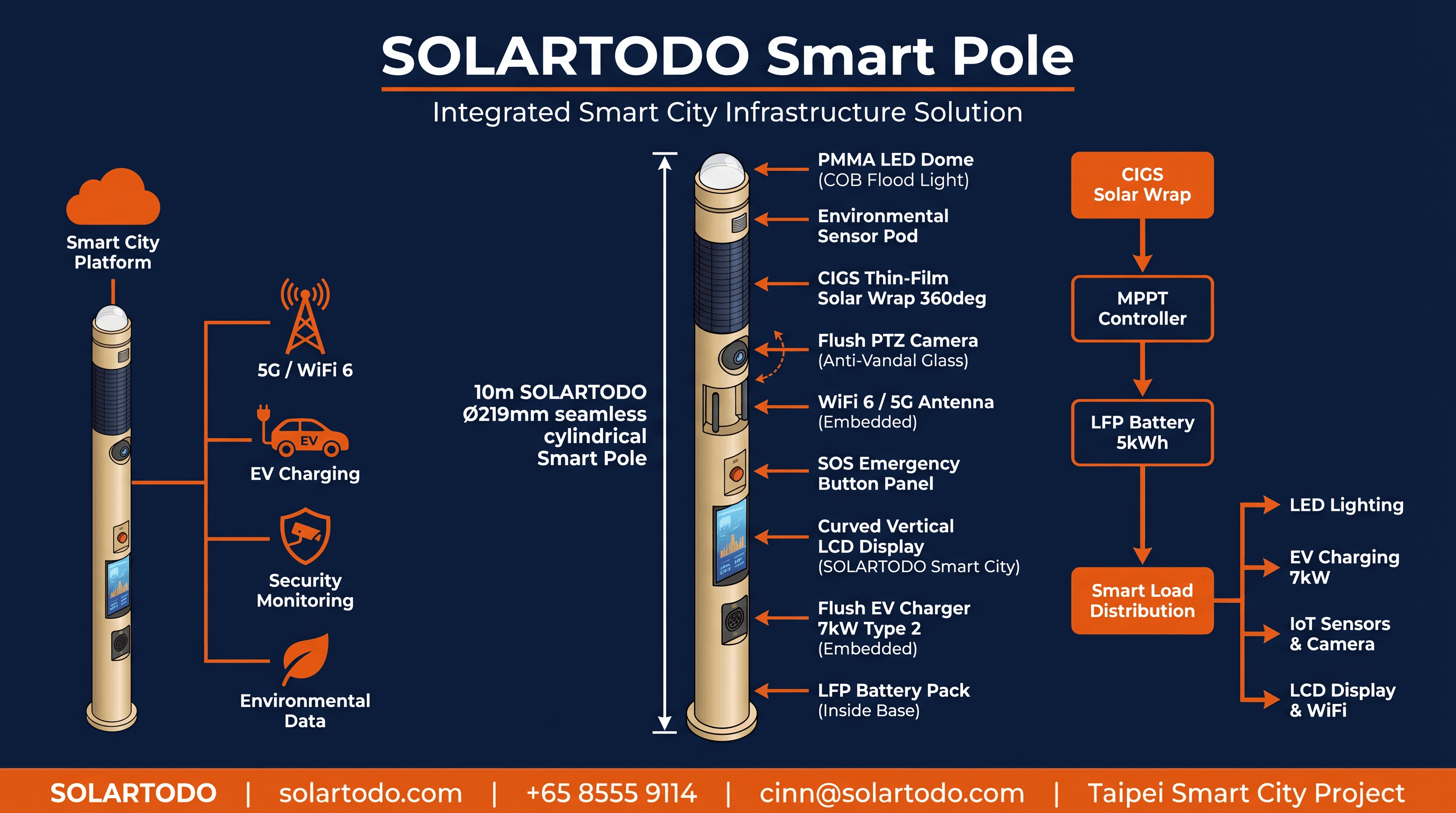
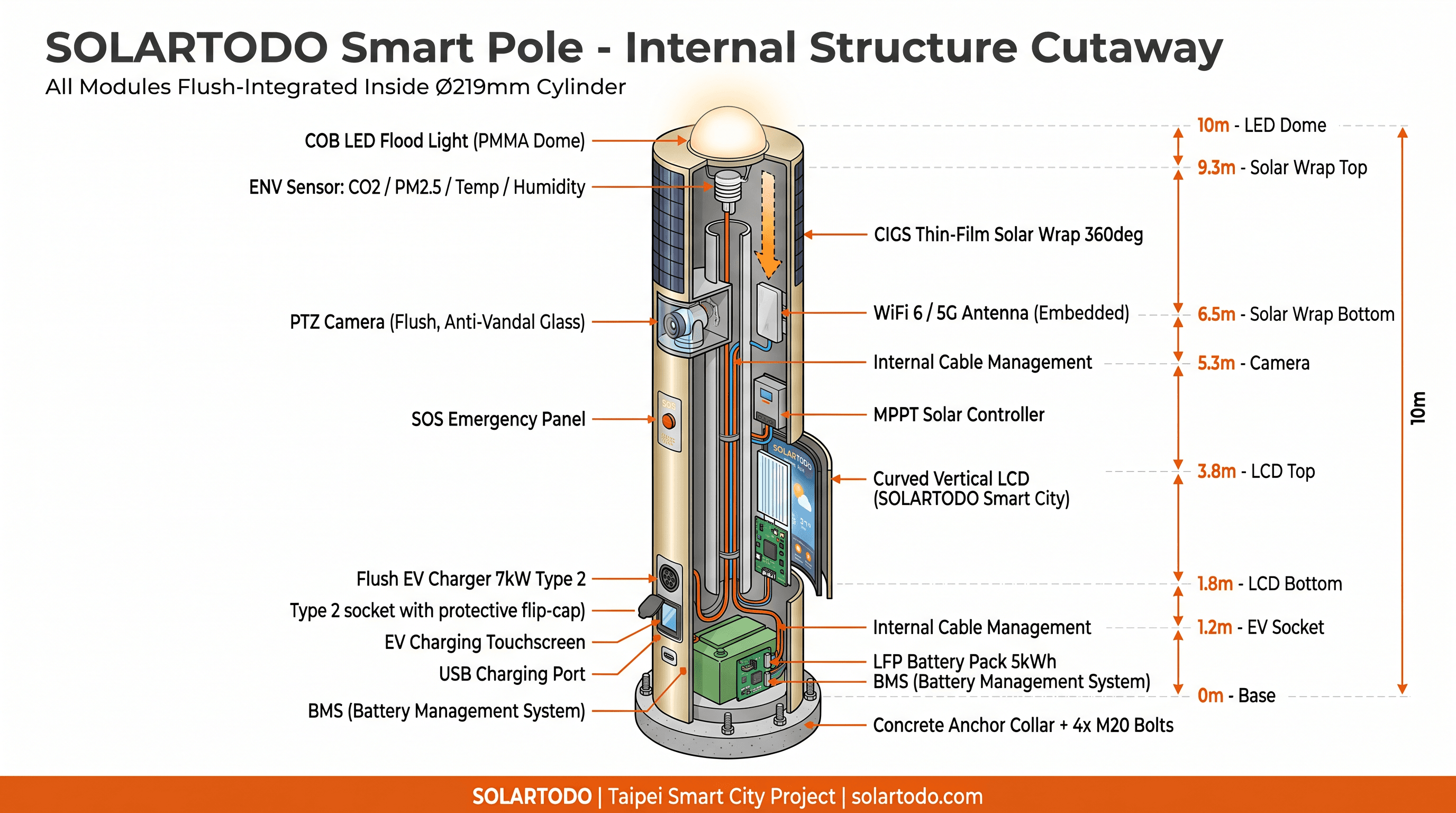
Instead, SOLAR TODO integrated each subsystem directly into the pole body. The top lighting module is recessed into the pole head behind a PMMA top window segment. The environmental sensor pod sits flush on the dome top. The camera is installed behind a dark anti-vandal glass window, avoiding a hanging dome appearance. The emergency interface is a 12 × 12cm flush SOS panel with an integrated micro-camera, microphone, and speakerphone grille.
The project also prioritized communications readiness. Each Smart Streetlight includes embedded dual-mode WiFi 6 + 5G with internal antennas, enabling local public connectivity and future service expansion without visible telecom hardware. According to the ITU (2023), dense urban digital services increasingly depend on low-profile edge infrastructure close to users and transport corridors. This deployment follows that model while maintaining a highly controlled visual profile.
A second design objective was to avoid roadside hardware multiplication for EV support. Rather than adding separate charging posts, the 7kW charging hardware is embedded inside the Ø219mm cylinder itself, with flush Type 2 and Type 1 flip-cap outlets, a 5m coiled Type 2 cable, and a flush touchscreen at 1.5m. According to BloombergNEF (2024), curbside charging is becoming more important in dense Asian cities where off-street parking access is limited. Taipei is a textbook case for that trend.
SOLAR TODO also incorporated a narrow curved LCD display, 1800mm tall by approximately 170mm wide, inset flush into the cylinder wall. Content is intentionally restricted to vertically stacked “SOLARTODO Smart City” text in white sans-serif on deep blue, with no video, imagery, or advertising. This preserved wayfinding clarity and prevented the poles from becoming visual media clutter.
For municipalities seeking similar integrated streetscape infrastructure, SOLAR TODO provides related technical information on its Smart Streetlight product page and project consultation via contact us.
Technical Specifications
This Taipei Smart Streetlight configuration used 129 identical 10m poles, each combining 80W lighting, ~200W CIGS wraparound solar film, 7kW charging, WiFi 6 + 5G, and a 2400Wh LFP battery inside a constant Ø219mm cylinder.
- Quantity: 129 units
- Deployment city: Taipei, Taiwan
- Coordinates: 25.03, 121.57
- Pole height: 10m
- Pole geometry: seamless cylindrical pole, constant diameter top-to-bottom
- Pole diameter: Ø219mm
- Pole wall thickness: 5mm
- Material: hot-dip galvanized steel
- Finish: champagne gold RAL1036 pearl gold brushed
- Pole design rule: one monolithic cylinder with all modules flush-integrated into the cylinder skin
- No external components: no side arms, no luminaire outriggers, no IP speaker columns, no public-address audio modules, no external boxes, no widened base, no separate charging bollard
- Luminaire type: Ø219mm internal COB flood behind PMMA top window segment
- Lighting output: 80W
- Luminous flux: 12,000lm
- CCT: 4000K
- Solar module type: CIGS flexible thin-film cells
- Solar layout: 360° wrapped around pole mid-section
- Solar coverage height: 6.5m-9.3m
- Solar capacity: ~200W total
- Solar appearance: dark blue-black semi-transparent film laminated flush to pole skin
- Sensor package: 12-parameter environmental sensor
- Sensor scope: full meteorology + air quality + rain + CO/NO2/O3
- Sensor location: flush on dome top
- Camera type: flush turret camera behind Ø10cm dark anti-vandal glass window
- Camera resolution: 4MP
- IR range: 30m
- Communications: embedded dual-mode WiFi 6 + 5G
- Antenna design: internal antennas
- Emergency system: flush SOS button panel, 12 × 12cm
- Emergency panel features: integrated micro-camera + microphone + speakerphone grille
- EV charging: embedded 7kW dual-outlet charger
- EV connector types: Type 2 + Type 1
- Cable: 5m coiled Type 2 cable
- User interface: flush touchscreen at 1.5m
- Display: vertical curved LCD display
- Display size: 1800mm tall × ~170mm wide
- Display geometry: bent to Ø219mm radius, flush inset into cylinder wall, front face only, portrait orientation
- Display content: strictly “SOLARTODO Smart City” text stacked vertically, white sans-serif on deep blue, no imagery/video/ads
- Convenience charging: USB-A + flush Qi wireless charging pad
- Battery: LFP 2400Wh inside pole base
- Power management: MPPT
- Pole spacing: 28m
- Power architecture: AC grid-powered with internal battery support
- Standards: IEC 60598, GB/T 37024
Deployment Process
The 129-unit Taipei rollout was executed in phased civil, electrical, and commissioning packages to maintain traffic flow while preserving the project’s strict flush-integration and constant-Ø219mm design requirements.
The deployment began with corridor survey, utility confirmation, and pole position validation at 28m intervals. Because Taipei streets often involve underground utility congestion, scooter parking interfaces, and mixed pedestrian flows, the installation plan prioritized exact foundation alignment and service access routing before any pole erection. The constant-diameter design also required careful pre-installation coordination because charging, battery, communications, and display modules all had to fit within the same Ø219mm envelope.
Factory integration was a major project-control step. Rather than assembling multiple exposed devices on site, SOLAR TODO pre-integrated the lighting head, camera window, SOS panel, charging interfaces, display, internal communications hardware, and battery system into each seamless cylindrical shaft before shipment. This reduced on-site fitting variability and ensured the “one monolithic cylinder” design intent was preserved across all 129 units.
The field works then proceeded in phased blocks to minimize disruption. Foundations and conduits were prepared first, followed by pole erection, AC connection, charger energization, network onboarding, and sensor calibration. According to IEEE (2022), standardization of pre-integrated urban edge devices can reduce deployment complexity and improve commissioning consistency in smart-city projects. That principle was visible here, especially for communications and emergency subsystem activation.
Commissioning included verification of illumination output, charging interface operation, WiFi 6 and 5G connectivity, SOS call routing, environmental sensor data integrity, and LCD content compliance. Because the display content was intentionally restricted, validation also checked that every screen showed only the approved vertical “SOLARTODO Smart City” text treatment. The result was a uniform corridor appearance with no unplanned visual variation between units.
Maintenance planning was built into the deployment model. Flush-access service points and remote monitoring reduce the need for repeated roadside interventions, which is important in Taipei corridors with continuous traffic and limited curb access. According to NREL (2023), remote diagnostics and condition-based maintenance can improve uptime and reduce unnecessary field visits for distributed infrastructure assets.
Performance & Results
This Taipei deployment delivered 129 multi-function roadside nodes with 12,000lm lighting, 7kW embedded charging, 12-parameter sensing, and dual-mode WiFi 6 + 5G while maintaining a zero-arm, zero-box streetscape profile.
From a streetscape perspective, the most important result was hardware consolidation. Functions that would normally require separate light poles, CCTV mounts, emergency call points, environmental stations, WiFi hardware, charger posts, and sign structures were integrated into a single cylindrical asset. In premium urban districts, that reduction in roadside clutter can be as important as energy or connectivity performance because it directly affects pedestrian experience, sightlines, and planning approval risk.
Operationally, the project created a dense smart corridor at 28m spacing across 129 nodes. That means the city now has frequent intervals for lighting, data collection, emergency access, and communications support without introducing multiple hardware families. According to the IEA (2023), connected public-lighting networks can serve as a foundational digital layer for broader municipal services when they are designed for interoperability and remote management from the start.
The environmental sensing package also expanded local situational awareness. Each pole captures 12 parameters covering meteorology, air quality, rain, and gas indicators including CO, NO2, and O3. According to the World Bank (2023), better urban environmental data supports more responsive traffic, health, and resilience planning. In Taipei, where humidity, rainfall events, traffic density, and localized air-quality variation matter, distributed sensing at street level is operationally useful.
Communications readiness was another measurable outcome. All 129 units include embedded WiFi 6 + 5G with internal antennas, avoiding visual telecom attachments while preserving digital service capacity. According to ITU (2023), urban digital infrastructure increasingly benefits from distributed, low-visibility edge nodes that can support multiple public and commercial services. This deployment reflects that architecture.
The embedded charging feature addressed curbside electrification without adding separate bollards. Each pole includes a 7kW dual-outlet charger with Type 2 and Type 1 interfaces, a 5m coiled Type 2 cable, and a flush touchscreen. According to BloombergNEF (2024), curbside charging will remain a critical urban charging format in dense cities where private parking access is constrained. Taipei’s built form makes that especially relevant.
The internal LFP 2400Wh battery with MPPT supports local subsystem stability and power management inside the pole base. While the project is AC grid-powered, this internal storage architecture improves resilience for onboard electronics and supports integrated energy management without changing the pole’s external geometry. As IRENA states, "Digitalization is becoming a key enabler of a more flexible, efficient and resilient energy system," and that principle extends to distributed urban infrastructure.
IEEE states, "Smart cities require secure, interoperable and scalable infrastructure at the edge," which is a concise description of why this project matters beyond lighting alone. The Taipei deployment shows how a Smart Streetlight can function as a compact urban node when the industrial design is disciplined enough to eliminate protruding hardware. For municipalities evaluating next-generation streetscape assets, SOLAR TODO demonstrated that high integration does not have to come at the cost of visual quality.
Comparison Table
This comparison shows how Taipei’s deployed Ø219mm flush-integrated Smart Streetlight differs from a conventional multi-device smart pole in geometry, integration, and curbside functionality.
| Category | Taipei Deployed SOLAR TODO Smart Streetlight | Conventional Multi-Device Smart Pole |
|---|---|---|
| Quantity deployed | 129 units | Project-dependent |
| Pole height | 10m | Typically project-dependent |
| Pole form | Seamless cylindrical, constant Ø219mm | Often tapered or stepped |
| Pole wall thickness | 5mm | Typically project-dependent |
| Finish | Champagne gold RAL1036 pearl gold brushed | Usually standard painted finish |
| Lighting | Internal COB flood, 80W, 12,000lm, 4000K | External luminaire on arm or bracket |
| Solar integration | 360° CIGS wrap, ~200W, flush laminated | Often rigid panel with bracket |
| Camera | Flush 4MP behind Ø10cm dark glass | Protruding dome camera common |
| Environmental sensing | 12-parameter package incl. rain + CO/NO2/O3 | Often limited or external sensor box |
| Communications | Embedded WiFi 6 + 5G, internal antennas | External antenna assemblies common |
| Emergency interface | Flush 12 × 12cm SOS panel with mic/speakerphone | Separate call box or speaker module common |
| EV charging | Embedded 7kW Type 2 + Type 1 in pole body | Separate charger pedestal common |
| Display | Curved 1800mm × ~170mm flush LCD | Flat external display or none |
| External appendages | None | Often multiple arms, boxes, and modules |
| Standards | IEC 60598, GB/T 37024 | Varies by supplier |
Pricing & Quotation
SOLAR TODO offers three pricing tiers for this product line: FOB Supply (equipment ex-works China), CIF Delivered (including ocean freight and insurance), and EPC Turnkey (fully installed, commissioned, with 1-year warranty). Volume discounts are available for large-scale deployments. Configure your system online for an instant estimate, or request a custom quotation from our engineering team at [email protected].
For Taipei-style deployments, quotation scope typically depends on quantity, finish specification, civil works complexity, charger integration requirements, local permitting, and communications commissioning. Projects using a seamless constant-diameter pole with flush-integrated modules generally require tighter factory coordination than standard bracketed poles, so early engineering review is recommended. SOLAR TODO can provide equipment-only supply or a broader delivery package depending on the customer’s procurement model.
Frequently Asked Questions
This FAQ answers 10 common buyer questions about the Taipei deployment, covering specs, timeline, maintenance, ROI logic, EPC scope, warranty, and installation requirements with project-specific numbers.
Q1: What exactly was deployed in Taipei, Taiwan?
A total of 129 SOLAR TODO Smart Streetlight units were installed in Taipei at 28m spacing. Each unit uses a 10m seamless cylindrical hot-dip galvanized steel pole with constant Ø219mm diameter, 5mm wall thickness, integrated 80W/12,000lm lighting, 7kW EV charging, WiFi 6 + 5G, 12-parameter sensing, and an internal 2400Wh LFP battery.
Q2: How is this Smart Streetlight different from a standard smart pole?
The key difference is the industrial design. This project uses one monolithic Ø219mm cylinder with all modules flush-integrated into the pole skin. There are no side arms, no external camera domes, no speaker columns, no charger bollards, no public-address modules, and no widened base, which is unusual for multi-function street infrastructure.
Q3: What lighting performance does each pole provide?
Each pole integrates an internal COB flood at the top of the cylinder behind a PMMA window segment. The output is 80W, 12,000 lumens, and 4000K. Because the luminaire is built into the pole head rather than mounted on an arm, the visual profile remains clean while still delivering roadway and public-space illumination.
Q4: What sensors are included in the Taipei configuration?
Each unit includes a 12-parameter environmental sensor mounted flush on the dome top. The package covers full meteorology, air quality, rain, and gas monitoring including CO, NO2, and O3. This configuration supports local environmental visibility at street level rather than relying only on a few centralized monitoring stations.
Q5: How long does a project like this usually take to deploy?
The timeline depends on permitting, civil works, and utility access, but a 129-unit project is normally executed in phases rather than all at once. Factory pre-integration shortens site work because lighting, display, camera, charging, communications, and battery systems arrive built into the pole. Final duration is confirmed after site survey and local approvals.
Q6: Does the pole include EV charging, and how is it integrated?
Yes. Each pole includes a fully embedded 7kW dual-outlet charger with Type 2 and Type 1 interfaces. It also includes a 5m coiled Type 2 cable and a flush touchscreen at 1.5m. Importantly, the charger is built into the constant Ø219mm cylinder, so there is no separate pedestal or enlarged pole base.
Q7: What is the expected ROI or payback logic for municipalities?
Payback depends on local electricity tariffs, charger utilization, maintenance practices, and whether the city values avoided hardware duplication. The strongest ROI case usually comes from combining multiple functions into one asset: lighting, sensing, communications, emergency assistance, and charging. That consolidation can reduce separate procurement, installation, and streetscape management costs over the asset life.
Q8: What maintenance model is recommended for this type of installation?
A preventive plus remote-diagnostics model is recommended. Key service items include charger testing, camera cleaning, sensor calibration checks, display inspection, and battery health monitoring. Because the modules are integrated into one pole, maintenance planning should be done by subsystem priority and access procedure rather than treating each function as standalone roadside equipment.
Q9: What warranty and EPC options are available?
SOLAR TODO provides three commercial pathways: FOB Supply, CIF Delivered, and EPC Turnkey. The EPC Turnkey option includes full installation, commissioning, and a 1-year warranty as stated in the quotation section. Extended support terms and spare-parts planning can be defined during contract negotiation based on project scale and service expectations.
Q10: What installation conditions should be reviewed before ordering?
Buyers should confirm foundation design, underground utilities, AC power availability, charger access, network backhaul strategy, and local code compliance. For this Taipei-style solution, it is also important to review streetscape approval requirements because the project depends on preserving the constant Ø219mm flush-integrated appearance across all 129 units.
References
This case study references 7 authoritative sources, including IEC, IEEE, ITU, IEA, IRENA, BloombergNEF, and the World Bank, to support deployment logic, standards alignment, and smart-city infrastructure context.
- IEC (2023): IEC 60598 luminaires standard framework for safety and performance in lighting equipment.
- IEEE (2022): Smart city infrastructure guidance emphasizing interoperable, scalable, and edge-connected urban systems.
- ITU (2023): Smart sustainable cities and digital infrastructure guidance for connected urban services.
- IEA (2023): Analysis of connected lighting and digitalized urban energy infrastructure as scalable municipal platforms.
- IRENA (2023): Digitalization as an enabler of more resilient and efficient energy-related infrastructure.
- BloombergNEF (2024): EV charging market outlook highlighting the role of curbside charging in dense urban environments.
- World Bank (2023): Urban development and digital infrastructure insights supporting multi-use municipal asset strategies.
Equipment Deployed
- 129 × 10m seamless cylindrical smart streetlight poles, constant Ø219mm, 5mm wall thickness, hot-dip galvanized steel
- Champagne gold RAL1036 pearl gold brushed finish
- Integrated top luminaire: Ø219mm internal COB flood behind PMMA top window, 80W, 12,000lm, 4000K
- 360° wrapped CIGS flexible thin-film cells from 6.5m to 9.3m, ~200W total
- 12-parameter environmental sensor pod with meteorology, air quality, rain, CO, NO2, and O3
- Flush 4MP turret camera behind Ø10cm dark anti-vandal glass window, IR 30m
- Embedded dual-mode WiFi 6 + 5G communications with internal antennas
- Flush SOS button panel 12 × 12cm with integrated micro-camera, microphone, and speakerphone grille
- Embedded 7kW dual-outlet EV charger with Type 2 + Type 1, 5m coiled Type 2 cable, flush touchscreen at 1.5m
- Vertical curved LCD display, 1800mm × ~170mm, flush inset, showing only 'SOLARTODO Smart City'
- USB-A charging port and flush Qi wireless charging pad
- Internal LFP 2400Wh battery with MPPT
- Compliance with IEC 60598 and GB/T 37024