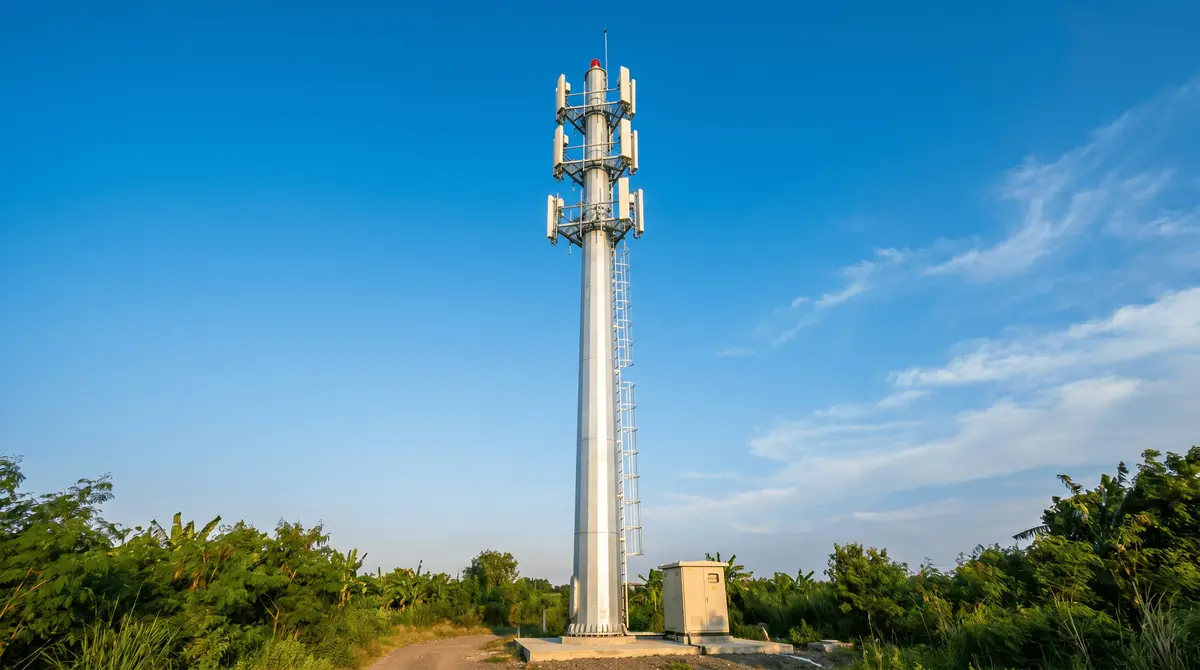
Surabaya Telecom Tower Market Analysis: 40m Steel Monopole Configuration Guide for Coastal 4G/5G Macro Coverage
Summary
Surabaya’s coastal telecom environment combines high urban density, salt-laden air, and monsoon wind exposure, making a 40m steel monopole a practical macro-site choice. For a typical 16-unit rollout, a Wind Class 4 design at 70 m/s, Q345 hot-dip galvanized steel, and concrete pad foundations fit dense regional coverage needs.
Key Takeaways
- Surabaya has a population of roughly 2.97 million, according to BPS Kota Surabaya (2024), which supports continued demand for macro telecom infrastructure in dense districts.
- A typical deployment of this scale would use approximately 16 units of 40m tapered steel monopole towers, matching the 35-45m highway/peri-urban size class for macro coverage.
- Each tower in this configuration weighs about 20t, based on the 500 kg/m engineering rule for a 40m telecom monopole.
- The recommended wind design is TIA-222-H Wind Class 4 at 70 m/s with a 1.55 factor, suitable for coastal exposure near sea-level coordinates around -7.25, 112.75.
- A practical antenna loading set is 9 panel antennas, 1 microwave dish, and 6 RRU units, supported by 3 antenna platforms on each 40m pole.
- Hot-dip galvanized Q345 steel with a 30-year design life and medium-corrosion specification fits Surabaya’s humid marine atmosphere better than painted-only carbon steel.
- CKD sectional shipping can reduce transport volume by about 60-70%, which matters for port-to-city logistics and staged installation across multiple urban parcels.
- A normal production window is 30-45 days, while site delivery, civil works, erection, and commissioning would typically be phased over several weeks depending on permit timing and utility access.
Market Context for Surabaya
Surabaya is Indonesia’s second-largest city and a major logistics, commercial, and port center, so telecom infrastructure demand is driven by both population density and enterprise traffic. According to BPS Kota Surabaya (2024), the city’s population is about 2.97 million, while the municipal area is roughly 350 km2, creating a dense urban profile that requires a mix of rooftop infill and macro towers. For mobile operators, this density increases the need for elevated sites that can support multi-band 4G and 5G equipment with stable backhaul.
Climate and coastal exposure are central design inputs at coordinates -7.25, 112.75. According to BMKG (2024), East Java’s north-coast cities experience high annual humidity, seasonal heavy rainfall, and strong monsoon conditions, all of which affect corrosion allowance, lightning protection, and wind loading. In Surabaya, a telecom tower near sea influence should be specified with hot-dip galvanizing, grounding, and a conservative wind class rather than using a lighter inland-only assumption.
The telecom demand side is also supported by national digital growth. According to the World Bank (2024), Indonesia continues to expand digital connectivity as urban service demand and data consumption rise across metropolitan areas. ITU states, "Broadband infrastructure is a foundational enabler of digital transformation," which is directly relevant in a city where industrial estates, residential districts, transport corridors, and port activity all compete for network capacity.
Surabaya’s role as a regional transport and trade hub changes the tower profile needed. A short 15-25m infill pole can work for rooftop or street-level gap filling, but macro coverage across arterial roads, peri-urban edges, and mixed industrial-residential zones usually requires the 35-45m class. Based on the product engineering table, that size class supports 6-9 panels plus 1-2 microwave links and a structural mass of about 22-30t; however, the project-specific configuration here uses a 40m monopole at about 20t, which remains consistent with the 500 kg/m rule.
A second local factor is land efficiency. In dense Indonesian cities, compound size and permitting often favor monopoles over lattice towers because the footprint is smaller and the visual profile is simpler. For Surabaya, where available parcels can be constrained by roads, drainage, and adjacent buildings, a flanged sectional steel monopole is often the more practical configuration for macro coverage than a wider-base lattice alternative.
Recommended Technical Configuration
For Surabaya’s coastal macro-cell profile, a typical 16-unit deployment would consist of 40m tapered steel monopole towers with Wind Class 4 loading, 3 antenna platforms, and one microwave backhaul path per site. This aligns with the 35-45m size class used for highway, peri-urban, and regional high-coverage telecom applications.
The recommended product form is a steel monopole tower, not lattice and not FRP. The specified tower is a tapered round or octagonal steel tube in hot-dip galvanized Q345 steel, fabricated in flanged bolt-on sections for transport and erection. For Surabaya, this sectional format matters because CKD packing can reduce shipping volume by 60-70%, helping movement from port handling to city delivery where truck access and laydown areas may be limited.
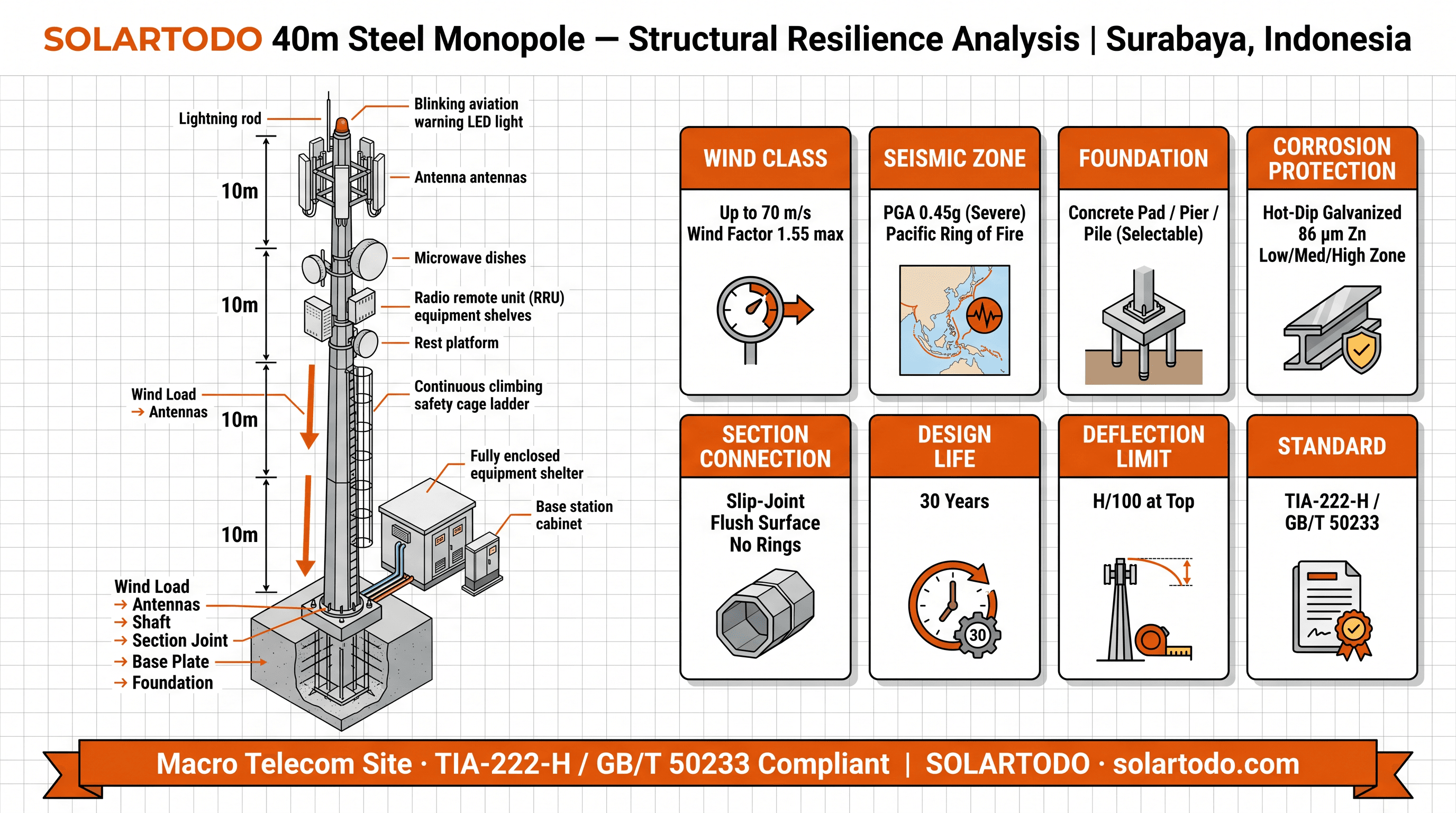
A typical 16-unit deployment of this scale would use the exact project configuration provided: 16 units × 40m tapered steel monopole tower, each at about 20t, with Wind Class 4 design at 70 m/s and factor 1.55. Antenna loading is 9 panel antennas, 1 microwave dish, and 6 RRU units per tower. This is heavier than a basic suburban 6-panel site but still suitable for a 40m regional macro tower when platform count, top diameter, and foundation are sized accordingly under TIA-222-H.
Concrete pad foundations are the recommended base solution for this profile. In Surabaya, many telecom parcels are compact and accessible to standard civil equipment, so a pad foundation is often more practical than piles unless geotechnical investigation identifies weak fill, high groundwater instability, or unusual bearing limits. Final footing dimensions should still be verified by local soil data, but the selected pad foundation is technically consistent with a 40m monopole and 20t steel mass.
The accessory package should include a climbing ladder, cable tray, aircraft warning light, grounding system, lightning rod, 3 antenna platforms, and safety cage. According to IEC 62305 guidance on lightning risk management, elevated metallic structures in thunderstorm-prone regions require coordinated air termination and earthing measures. In Surabaya’s humid coastal environment, grounding continuity and corrosion control at connections should be inspected carefully during installation and annual maintenance.
For buyers comparing options, SOLAR TODO should be evaluated on conformity to TIA-222-H and GB/T 50233, material traceability, galvanizing quality, sectional fit-up tolerance, and logistics efficiency. The key issue is not only tower height but whether the 40m pole can reliably carry 9 panels, 1 microwave dish, and 6 RRUs under 70 m/s wind conditions with acceptable deflection and fatigue margin over a 30-year design life.
Technical Specifications
This Surabaya-oriented configuration uses a 40m steel monopole at approximately 20t with 9 panel antennas, 1 microwave dish, 6 RRUs, and TIA-222-H Wind Class 4 loading at 70 m/s. The specification fits a regional macro / high-coverage tower rather than a rooftop infill structure.
- Product type: Telecom Tower, tapered steel monopole tower
- Deployment profile: Typical 16-unit macro coverage rollout for Surabaya, Indonesia
- Tower height: 40m
- Size class match: 35-45m | highway/peri-urban | 2-3 platforms | 6-9 panels + 1-2 microwave
- Pole class: Regional macro / high-coverage tower
- Tower weight: approximately 20t per tower
- Engineering weight rule: about 500 kg/m × 40m = 20,000 kg
- Material: Q345 steel
- Surface protection: Hot-dip galvanized
- Corrosion zone: Medium
- Structural form: Tapered round or octagonal steel tube, flanged bolt-on sectional design
- Shipping format: CKD, with about 60-70% volume reduction
- Wind standard: TIA-222-H
- Wind class: Class 4
- Design wind speed: 70 m/s
- Wind factor: 1.55
- Secondary standard: GB/T 50233
- Antenna load: 9 × panel antenna + 1 × microwave dish + 6 × RRU
- Platform count: 3 antenna platforms
- Foundation type: Concrete pad foundation
- Access system: Climbing ladder + safety cage
- Cable management: Cable tray
- Aviation marking: Aircraft warning light
- Lightning protection: Lightning rod + grounding system
- Design life: 30 years
- Production lead time: typically 30-45 days
Implementation Approach
A Surabaya telecom tower rollout of approximately 16 units would typically proceed in 5 stages: survey, engineering approval, factory production, civil works, and erection with commissioning. For a 40m monopole package, the critical path usually sits in permitting, geotechnical confirmation, and transport scheduling rather than steel fabrication alone.
Stage 1 is site screening and load confirmation. Each parcel should be checked for setback, access width, utility conflicts, and line-of-sight requirements for the microwave path. In a coastal city at near 0-10m elevation above sea level, drainage and groundwater conditions can affect excavation pace and concrete curing, so soil investigation should be completed before final foundation drawings are frozen.
Stage 2 is detailed structural and civil design. The tower should be checked to TIA-222-H using the exact appurtenance set of 9 panels, 1 microwave dish, and 6 RRUs, plus ladder, tray, platforms, and lightning rod. According to ANSI/TIA-222-H, telecommunication structures must be verified for wind, ice where applicable, serviceability, and appurtenance loading; in Surabaya, wind and corrosion are the dominant variables rather than ice.
Stage 3 is production and logistics. The stated production window of 30-45 days is realistic for a 16-unit steel monopole batch if mill supply, galvanizing slots, and flange machining are scheduled in advance. SOLAR TODO can ship in CKD sectional form, which reduces shipping volume by 60-70% and improves container utilization compared with shipping near-assembled poles.
Stage 4 is civil works and erection. Concrete pad foundations should be cast, cured, and surveyed before anchor alignment checks. Tower sections are then erected by crane, flanged together, and torqued to specification, after which platforms, ladders, cable trays, aircraft warning lights, and grounding components are installed.
Stage 5 is antenna mounting, electrical completion, and acceptance testing. RRUs, feeders or hybrid cables, microwave equipment, and grounding bonds are installed after structural completion. Final acceptance should include bolt torque verification, plumbness check, grounding resistance measurement, galvanizing inspection at field-touched areas, and documentation handover for maintenance planning.
Expected Performance & ROI
A 40m macro monopole in Surabaya would typically improve coverage radius, sector stability, and backhaul flexibility more effectively than a shorter 25-30m suburban pole, especially across mixed industrial and residential districts. The main value comes from fewer coverage shadows, better antenna elevation above clutter, and support for 9-panel multi-band loading on a single structure.
According to GSMA (2023), mobile data traffic growth in Asia continues to increase pressure on urban network layers, pushing operators toward denser and higher-capacity site configurations. For Surabaya, a 40m tower with 3 platforms can support current 4G/5G macro demand while preserving headroom for future antenna rearrangement. That reduces the need for early structural replacement if loading increases over a 5-10 year network cycle.
Lifecycle economics are usually stronger for galvanized monopoles than for lighter, lower-capacity alternatives that need earlier reinforcement. According to NREL (2023), lifecycle cost analysis should account for maintenance intervals, corrosion exposure, logistics, and service life rather than first-cost alone. In practical terms, a 30-year design life, hot-dip galvanizing, and standardized flanged sections can lower long-term outage risk and simplify replacement-part planning.
Maintenance demand should be moderate if galvanizing thickness, drainage detailing, and grounding are executed correctly. A normal inspection regime would include visual checks every 6-12 months and a more detailed structural review every 3-5 years, with extra checks after severe wind events. IEEE states, "Grounding is fundamental to personnel safety and equipment protection," which is especially relevant for coastal Indonesian macro sites with frequent thunderstorms.
For ROI, tower owners and operators generally evaluate payback through lease revenue, colocation potential, avoided network congestion, and reduced dropped-call or low-SINR areas rather than only steel cost. A 40m macro tower with 3 platforms has better colocation potential than a small infill pole, so the commercial return can improve if zoning and structural reserve allow additional tenancy. Buyers that need a quotation for this profile can review the Telecom Tower product page or contact us for project-specific engineering input.
Results and Impact
For Surabaya, a 40m Wind Class 4 steel monopole would typically deliver broader macro coverage, stronger microwave backhaul positioning, and lower land-take than a lattice alternative on comparable sites. In a 16-unit network layer, the practical impact would be improved service continuity across dense corridors, coastal industrial zones, and peri-urban edges.
The technical effect is strongest where clutter height is inconsistent. A 40m pole can clear more urban obstacles than a 25m infill structure while still using a smaller footprint than a conventional lattice tower. For operators balancing permit complexity, structural capacity, and long-term maintenance, this profile is a reasonable fit for Surabaya’s coastal metro conditions.
Comparison Table
This comparison shows why a 40m steel monopole is the preferred Surabaya macro configuration when coastal wind, antenna loading, and land efficiency are all considered together.
| Configuration | Height | Typical Load | Wind Design | Approx. Weight | Foundation | Best Use in Surabaya |
|---|---|---|---|---|---|---|
| Urban infill monopole | 25m | 3-6 panels | 40-50 m/s | 12.5t | Pad/pier | Rooftop gaps, short-range densification |
| Suburban monopole | 30m | 6 panels + light RRU | 50-60 m/s | 15t | Pad/pier | Residential districts with moderate clutter |
| Recommended macro monopole | 40m | 9 panels + 1 microwave + 6 RRU | 70 m/s, Class 4 | 20t | Concrete pad | Coastal macro coverage, arterial roads, industrial edges |
| Heavy rural macro pole | 45m | 9-12 panels + microwave | 70 m/s, Class 4 | 22.5t | Pad/pile | Wide-area coverage where parcel size is less constrained |
Pricing & Quotation
SOLAR TODO offers three pricing tiers for this product line: FOB Supply (equipment ex-works China), CIF Delivered (including ocean freight and insurance), and EPC Turnkey (fully installed, commissioned, with 1-year warranty). Volume discounts are available for large-scale deployments. Configure your system online for an instant estimate, or request a custom quotation from our engineering team at [email protected].
Frequently Asked Questions
This FAQ answers 10 common buyer questions on 40m telecom towers in Surabaya, including wind rating, corrosion protection, timeline, maintenance, EPC scope, and commercial evaluation. Each answer reflects the specified 16-unit, 40m, Q345 galvanized monopole configuration.
Q1: Why is a 40m monopole recommended for Surabaya instead of a 25m or 30m tower?
A 40m tower fits the 35-45m macro size class and provides better clearance above urban clutter, roadside structures, and mixed industrial buildings. In Surabaya’s dense coastal environment, that extra 10-15m can improve sector reach and microwave path quality. It also supports heavier loading such as 9 panels, 1 dish, and 6 RRUs.
Q2: Is Wind Class 4 at 70 m/s necessary for Surabaya?
For coastal exposure, Wind Class 4 is a conservative and practical specification. Surabaya faces monsoon weather, open coastal airflow, and thunderstorm conditions, so a 70 m/s design under TIA-222-H gives better structural margin than a lower inland assumption. This is especially important for 40m poles carrying multiple antennas and a microwave dish.
Q3: Why use Q345 hot-dip galvanized steel instead of painted steel only?
Q345 provides suitable structural strength for telecom monopoles, while hot-dip galvanizing gives more durable corrosion protection in humid marine air. Painted-only systems can need earlier touch-up and tighter maintenance intervals. For a 30-year design life in Surabaya, galvanized steel is usually the safer lifecycle choice, particularly at flanges, ladders, and platform connections.
Q4: What does the 20t tower weight mean for procurement and installation?
A 20t tower weight is consistent with the 500 kg/m engineering rule for a 40m monopole. It affects crane sizing, transport planning, anchor design, and foundation volume. Buyers should verify that the quoted weight includes platforms, ladder systems, and appurtenance allowances so the structural package matches the actual loading case.
Q5: How long would a 16-unit deployment typically take?
Production is typically 30-45 days for the steel package, but total project duration depends on permits, soil investigation, civil works, and site access. A 16-unit rollout is usually phased rather than erected simultaneously. If foundations, logistics, and antenna teams are coordinated well, installation can proceed in batches after steel delivery.
Q6: Why is a concrete pad foundation specified instead of piles?
Concrete pad foundations are often efficient for monopoles on accessible urban or peri-urban parcels where soil bearing is acceptable. They simplify civil scope and can reduce equipment requirements versus piles. However, pad foundations should only be finalized after geotechnical review, especially in coastal zones with fill material, drainage issues, or high groundwater.
Q7: What maintenance should buyers expect over 30 years?
Routine maintenance usually includes visual inspection every 6-12 months, grounding checks, fastener review, and corrosion inspection at damaged galvanizing areas. A more detailed structural review is commonly done every 3-5 years. After severe storms, operators should check plumbness, bolt torque, cable tray supports, and lightning protection continuity.
Q8: Can this 40m tower support future tenant or antenna expansion?
Potentially yes, but only if reserve capacity is included in the original structural analysis. The specified load already includes 9 panels, 1 microwave dish, and 6 RRUs, so any added tenancy should be checked against TIA-222-H loading, deflection, and foundation reserve. Buyers should request a future-load scenario during engineering review.
Q9: How does a monopole compare with a lattice tower in Surabaya?
A monopole usually needs less ground area and has a simpler visual profile, which can help on constrained urban plots. A lattice tower can carry very heavy loads efficiently, but it generally needs a larger footprint. For Surabaya parcels where land use, access, and permitting are tight, a 40m monopole is often the more practical macro option.
Q10: What is included in EPC turnkey scope versus supply only?
Supply-only usually covers the tower steel, accessories, and shipping terms such as FOB or CIF. EPC turnkey typically adds foundation works, erection, installation, commissioning, and a 1-year warranty. Buyers should confirm whether antenna mounting, grounding tests, obstruction lighting, and local permit support are included line by line in the quotation.
References
This guide uses public standards and market sources including Indonesian statistics, weather authorities, and international telecom and energy organizations to frame a realistic Surabaya configuration. Buyers should still validate final structural and civil inputs against local geotechnical, zoning, and operator-specific loading requirements.
- BPS Kota Surabaya (2024): Population and municipal statistics for Surabaya, including city population and area data.
- BMKG (2024): Climate and meteorological data for East Java and coastal urban weather conditions relevant to wind, rainfall, and humidity.
- ANSI/TIA (2022): TIA-222-H, Structural Standard for Antenna Supporting Structures, Antennas and Small Wind Turbine Support Structures.
- GB/T (2014): GB/T 50233, Code for construction and acceptance of electric power line structures and related steel structure practice references used in fabrication control.
- ITU (2023): Digital infrastructure and broadband guidance for connectivity expansion and network resilience.
- World Bank (2024): Indonesia digital development and connectivity context supporting telecom infrastructure growth.
- NREL (2023): Lifecycle cost analysis guidance applicable to infrastructure asset evaluation, maintenance planning, and service-life assessment.
- IEEE (2021): Grounding and protection guidance relevant to telecom site safety and equipment protection.
- GSMA (2023): Mobile network traffic and connectivity trends in Asia relevant to macro-site capacity planning.
- IEC (2010): IEC 62305 lightning protection framework relevant to elevated metallic structures and grounding design.
Equipment Deployed
- 16 × 40m tapered steel monopole Telecom Tower, approximately 20t per tower
- Hot-dip galvanized Q345 steel structure
- TIA-222-H Wind Class 4 design, 70 m/s, factor 1.55
- Medium-corrosion protection specification for coastal environment
- Antenna load per tower: 9 × panel antenna + 1 × microwave dish + 6 × RRU
- Concrete pad foundation
- 3 × antenna platforms per tower
- Climbing ladder with safety cage
- Cable tray system
- Aircraft warning light
- Grounding system
- Lightning rod
- Flanged bolt-on sectional connection
- CKD shipping format with 60-70% volume reduction