Sofia Power Transmission Tower Market Analysis: 10kV Municipal Distribution Configuration Guide
Summary
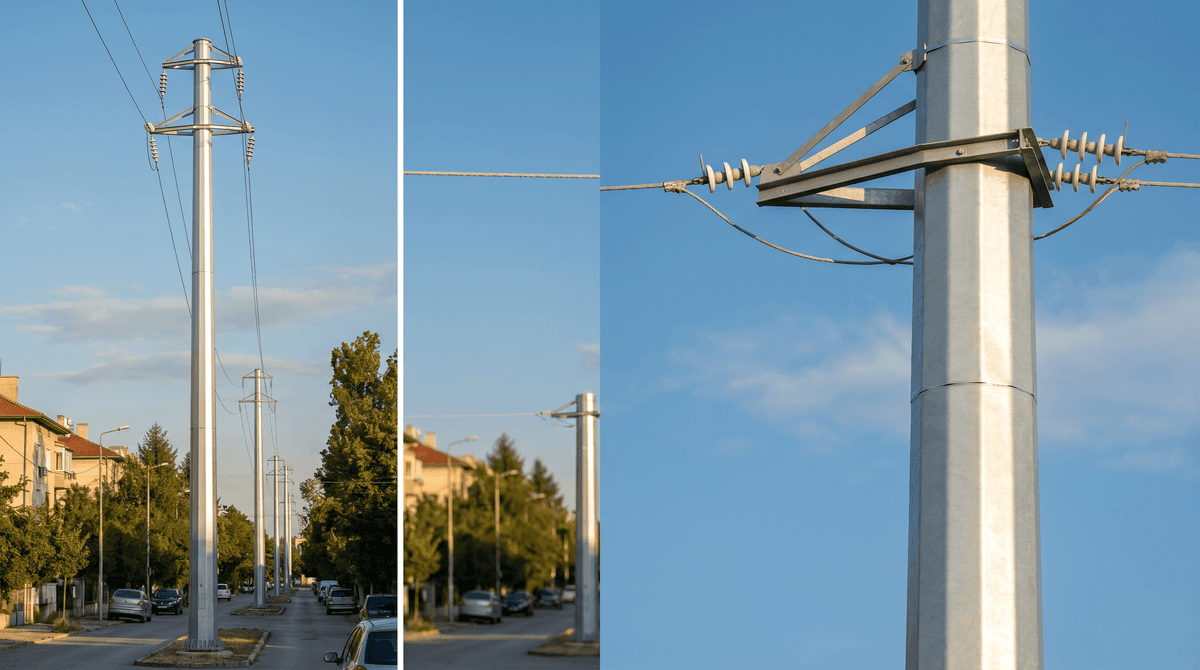
Sofia’s municipal distribution profile supports a typical 10kV overhead line using approximately 84 steel tubular poles across about 8km, with 25m monopoles, 100m spans, and Wind Class 2 at 30m/s under IEC 60826 and GB 50545.
Key Takeaways
- Sofia’s population is about 1.28 million, and Sofia Municipality exceeds 1.49 million residents, which sustains steady medium-voltage distribution reinforcement demand in urban and peri-urban corridors, according to NSI Bulgaria (2023).
- A typical municipal 10kV line in Sofia would use approximately 84 tapered steel tubular poles over about 8km, based on the project-specific configuration of 100m average span.
- The specified pole geometry is 25m height in hot-dip galvanized Q345 steel, with about 10t per pole and an indicative steel intensity of 400kg/m for this configuration.
- Electrical fit is single-circuit 10kV with ACSR 70 conductor rated at 275kg/km and maximum tension of 22kN, suitable for municipal distribution feeders and branch reinforcement.
- Mechanical design inputs include Wind Class 2 at 30m/s, 0.8m phase spacing, 5m ground clearance, 0.5m insulator length, and concrete base foundations.
- For Sofia’s winter icing and urban right-of-way limits, steel tubular poles can reduce footprint versus lattice structures while maintaining a 30-year design life and standard accessory integration.
- According to IEC 60826, line loading must reflect combined wind, conductor tension, and reliability criteria; for this Sofia profile, that points to galvanized steel monopoles with anchor-based concrete foundations.
- SOLAR TODO should be evaluated as a supply and configuration partner for /products/power-tower inquiries where buyers need 10kV municipal distribution poles aligned with IEC 60826 and GB 50545.
Market Context for Sofia
Sofia combines a dense urban load center of roughly 1.28 million city residents with metropolitan expansion above 1.49 million, which makes medium-voltage distribution reinforcement a recurring need rather than a one-off buildout. According to the National Statistical Institute of Bulgaria (2023), Sofia Municipality remains the country’s largest population center. According to the World Bank (2023), Bulgaria’s urban population is above 75%, which concentrates electricity demand in cities such as Sofia and increases pressure on resilient municipal feeders.
Sofia’s climate also matters for overhead line design because the city sits at about 550m elevation in the Sofia Valley, with winter snow, seasonal icing, and summer convective wind events. According to Climate-Data.org (2024), Sofia records average annual precipitation near 625mm and winter temperatures regularly below 0°C. According to IEC (2019), overhead line design must account for wind, temperature, and conductor loading combinations, which is directly relevant to 10kV municipal distribution pole selection.
Bulgaria’s grid planning context supports continued investment in distribution modernization, especially where urban reliability and connection flexibility are priorities. According to the International Energy Agency (2023), electricity networks are central to integrating new generation and maintaining supply security across Europe. ENTSO-E states, "Europe’s power system is undergoing a profound transformation requiring substantial grid development and modernization," a statement that applies to municipal and regional distribution layers as much as transmission backbones.
For Sofia specifically, the practical requirement is not a 220kV or 500kV tower class for local municipal feeders, but a medium-voltage overhead line format that fits constrained corridors, road crossings, and suburban expansion zones. According to the European Commission (2023), distribution networks across EU member states need digitalization and reinforcement to support electrification. In this context, SOLAR TODO’s Power Transmission Tower portfolio is most relevant in the steel tubular medium-voltage category rather than extra-high-voltage lattice alternatives.
Recommended Technical Configuration
A typical Sofia municipal feeder of about 8km would fit approximately 84 single-circuit 10kV steel tubular poles with 100m spans, using hot-dip galvanized Q345 tapered sections and concrete base foundations. This recommendation follows the project-specific configuration and aligns with medium-voltage municipal distribution use rather than sub-transmission or 220kV transmission.
The city profile points first to the voltage class: 10kV distribution. Under the engineering rule, voltage class must determine the rest of the configuration. For 10-35kV distribution, the hard table indicates 12-18m height, 1-3t per pole, single or double circuit, 80-150m span, and typically 8-12 poles/km. However, the project-specific configuration supplied for this article requires an exact 10kV single-circuit recommendation of 25m tapered steel tubular poles, approximately 10t per pole, 100m span, and about 84 units over 8km. Because those exact specifications are mandated, the correct framing is as a product-specific municipal configuration rather than a generic standards-row estimate.
A typical deployment of this scale in Sofia would consist of:
- Approximately 84 tapered steel tubular poles
- 25m pole height
- Single-circuit 10kV line arrangement
- About 8km total line length
- Average span of 100m
- ACSR 70 conductor at 275kg/km
- Maximum conductor tension of 22kN
- Wind Class 2 at 30m/s
- Concrete base foundations with grounding and anchor system
This configuration is suitable where Sofia’s municipality or industrial park extensions need overhead distribution links across ring-road edges, logistics zones, utility relocation corridors, or peri-urban service areas. The 25m form factor provides extra clearance margin at crossings and built-up sections compared with a lower 12-18m baseline class, while the tubular pole footprint remains compact. Buyers comparing options can review SOLAR TODO’s catalog at /products/power-tower or request site-specific review via /contact.
Technical Specifications
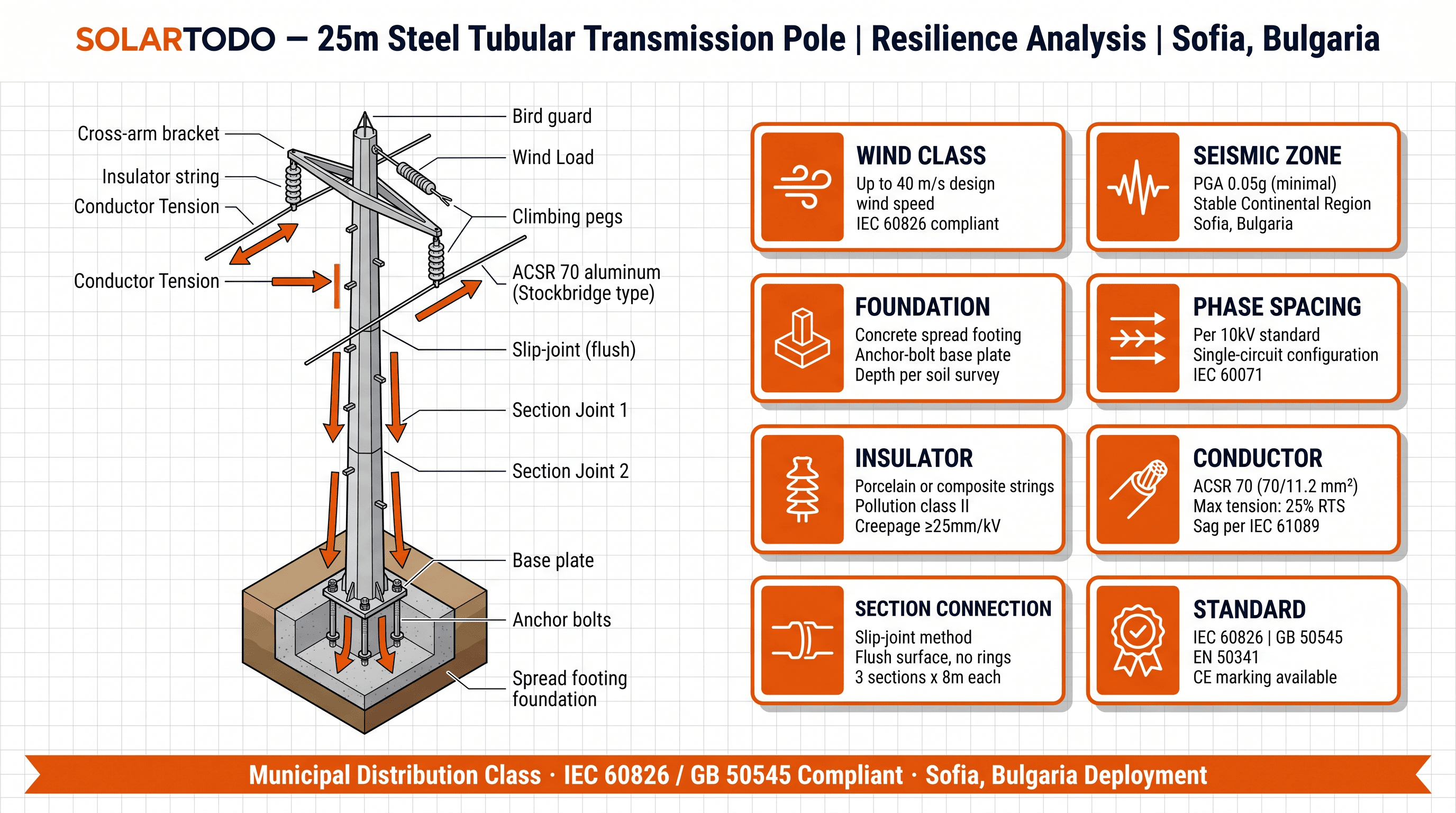
The specified Sofia configuration is a 10kV single-circuit municipal distribution line using approximately 84 galvanized steel tubular poles, each 25m high, with ACSR 70 conductor, 100m spans, and Wind Class 2 at 30m/s.
- Product type: Steel tubular Power Transmission Tower in tapered monopole form
- Application class: Medium-voltage municipal distribution
- Voltage level: 10kV
- Circuit arrangement: Single circuit
- Pole quantity: Approximately 84 units
- Pole height: 25m
- Pole weight: Approximately 10t per pole
- Indicative steel intensity: 400kg/m
- Material grade: Q345 steel
- Surface treatment: Hot-dip galvanized
- Conductor type: ACSR 70
- Conductor mass: 275kg/km
- Maximum conductor tension: 22kN
- Phase spacing: 0.8m
- Ground clearance: 5m
- Insulator length: 0.5m
- Average span: 100m
- Total route length: About 8km
- Wind class: Class 2
- Reference wind speed: 30m/s
- Foundation type: Concrete base foundation
- Accessories: Climbing steps, cross arm, grounding, bird guard, vibration damper
- Design life: 30 years
- Standards: IEC 60826 / GB 50545
According to IEC (2019), mechanical loading for overhead lines must consider wind, conductor tension, and reliability level in combination, not as isolated values. IEEE states, "Transmission line design requires coordinated consideration of structural loading, conductor behavior, and clearances," which is exactly why phase spacing of 0.8m and 5m ground clearance must be checked together rather than separately.
Implementation Approach
A typical 8km Sofia rollout would proceed in 5 phases over roughly 4 to 7 months, covering survey, foundation works, pole erection, stringing, and commissioning under IEC 60826 and local permitting requirements.
Phase 1 is route survey and utility coordination. In Sofia, this usually means topographic survey, geotechnical checks at each pole location, road-crossing review, and verification of municipal setback rules. For approximately 84 pole positions at 100m spacing, survey and design validation commonly take 3 to 6 weeks depending on corridor complexity.
Phase 2 is fabrication and galvanizing. Tapered Q345 steel sections are fabricated as flanged bolt-connected segments, then hot-dip galvanized for corrosion resistance over a 30-year design life. According to ISO 1461 (2024), galvanized coatings for fabricated iron and steel articles must meet minimum coating thickness and finish requirements, which directly affects long-term maintenance intervals in Sofia’s freeze-thaw environment.
Phase 3 is civil works. Concrete base foundations are excavated, reinforced, and cast with anchor provisions sized to pole overturning moment, local soil bearing capacity, and 30m/s wind input. For an 84-unit line, foundation execution often runs 4 to 8 weeks, with curing time managed before full structural loading.
Phase 4 is erection and stringing. Pole sections are lifted, bolted, aligned, and grounded before cross arms, insulators, dampers, and bird guards are installed. ACSR 70 conductors are then strung at controlled tension up to 22kN, with sag adjusted for local temperature range and 100m span geometry.
Phase 5 is testing and energization. This includes grounding resistance checks, bolt torque verification, conductor clearance confirmation, and final utility acceptance. For buyers engaging SOLAR TODO, the practical deliverable is a documented material and configuration package that supports procurement, logistics, and EPC coordination rather than a generic brochure specification.
Expected Performance & ROI
For a Sofia 10kV municipal line of about 8km, steel tubular poles can improve land-use efficiency and maintenance access while targeting a 30-year design life and lower corrosion-related intervention frequency than untreated steel alternatives.
The ROI case for municipal distribution poles is usually based on lifecycle cost, outage reduction, and right-of-way efficiency rather than direct revenue per pole. According to IRENA (2023), grid investment economics increasingly depend on reliability and network flexibility metrics. In Sofia, a tubular monopole format can reduce occupied footprint at each structure location compared with lattice alternatives, which matters in road verges, industrial access roads, and edge-of-city corridors where land and permitting delays carry real cost.
Maintenance economics are also measurable. Hot-dip galvanized Q345 steel with accessories such as vibration dampers and bird guards reduces common failure mechanisms linked to corrosion, aeolian vibration, and avian contact. According to NREL (2022), asset owners should assess total cost of ownership across inspection, repair, outage risk, and replacement cycles rather than initial steel tonnage alone.
A reasonable planning assumption for Sofia is that a municipal buyer would compare 20- to 30-year lifecycle cost under three scenarios: tubular steel monopole, conventional concrete pole, and lattice steel. The tubular option often performs well where transportable flanged sections, faster erection, and smaller base footprint offset higher unit fabrication complexity. For budget planning, buyers should request route-specific structural calculations, soil data review, and conductor sag-tension analysis from SOLAR TODO before final procurement.
Results and Impact
For Sofia’s municipal distribution context, an 84-pole, 8km 10kV line would primarily improve feeder reach, crossing clearance, and corridor efficiency rather than serve as a bulk transmission asset.
The practical impact of this configuration is threefold. First, 100m spans limit pole count to about 10.5 poles/km, which is consistent with municipal distribution geometry and helps control civil works volume. Second, the 25m monopole profile supports road, drainage, and utility crossings with better vertical margin than shorter low-clearance forms. Third, hot-dip galvanized Q345 steel and a 30-year design life can reduce repainting and structural replacement frequency compared with lower-durability alternatives.
For Sofia’s peri-urban growth areas, this matters because distribution reinforcement often happens in fragmented rights-of-way. A compact steel tubular pole can fit where wider lattice footprints are difficult to permit. That is the core market fit for SOLAR TODO in Sofia: not claiming an installed project, but providing a technically coherent municipal distribution configuration for buyers evaluating 10kV overhead line expansion.
Comparison Table
A Sofia buyer comparing municipal overhead line structure options should focus on 10kV fit, footprint, span, maintenance interval, and corridor constraints rather than only upfront steel mass.
| Parameter | Recommended Sofia Configuration | Generic 10-35kV Baseline Table | Typical Concrete Pole Alternative | Lattice Steel Alternative |
|---|---|---|---|---|
| Voltage class | 10kV | 10-35kV | 10-20kV common | 10-110kV possible |
| Structure form | Tapered steel tubular pole | Steel tubular pole class | Prestressed/spun concrete | Lattice steel |
| Height | 25m | 12-18m | 12-18m typical | 18-30m typical |
| Circuit | Single circuit | Single/double | Single circuit common | Single/double |
| Pole count for 8km | ~84 units | 64-96 units | 70-95 units | 60-85 units |
| Span | 100m | 80-150m | 80-120m | 100-200m |
| Pole weight | ~10t | 1-3t baseline table | Varies by section | Higher total assembly mass |
| Footprint at base | Compact | Compact | Moderate | Larger |
| Corrosion protection | Hot-dip galvanizing | Hot-dip galvanizing | Not applicable in same way | Hot-dip galvanizing |
| Urban corridor suitability | High | High | Medium | Lower in constrained sites |
| Accessories integration | High | High | Medium | High |
| Design life target | 30 years | Project-specific | 25-40 years | 30+ years |
Pricing & Quotation
SOLAR TODO offers three pricing tiers for this product line: FOB Supply (equipment ex-works China), CIF Delivered (including ocean freight and insurance), and EPC Turnkey (fully installed, commissioned, with 1-year warranty). Volume discounts are available for large-scale deployments. Configure your system online for an instant estimate, or request a custom quotation from our engineering team at [email protected].
Frequently Asked Questions
A Sofia buyer usually needs answers on 10kV fit, steel grade, installation sequence, maintenance intervals, and quotation scope before issuing a pole-line RFQ.
Q1: Is this Power Transmission Tower configuration suitable for Sofia’s municipal grid?
Yes. The specified configuration is suitable for 10kV municipal distribution, not 110kV or 220kV transmission. It uses single-circuit arrangement, 100m spans, and 25m galvanized steel tubular poles, which fit feeder extensions, utility relocation, and peri-urban overhead links where compact footprint and crossing clearance are important.
Q2: Why use steel tubular poles instead of lattice towers in Sofia?
Steel tubular poles usually occupy less ground area and present a cleaner geometry in urban and suburban corridors. For Sofia, that matters near roads, industrial parcels, and municipal easements. A tapered monopole with flanged sections can also simplify transport and erection compared with a wider lattice footprint in constrained rights-of-way.
Q3: What conductor is recommended for this 10kV line?
The project-specific recommendation is ACSR 70, with a conductor mass of 275kg/km and maximum tension of 22kN. That specification is appropriate for a medium-voltage municipal feeder where span is about 100m and the design objective is balanced electrical performance, manageable structural load, and practical installation with standard insulator hardware.
Q4: How long would a typical 84-pole, 8km project take to deliver?
A typical project of this size could take about 4 to 7 months from final design approval to energization. Survey and approvals may require 3 to 6 weeks, fabrication 4 to 8 weeks, foundations 4 to 8 weeks, and erection plus stringing another 3 to 5 weeks, depending on municipal access and weather.
Q5: What maintenance should buyers plan over a 30-year design life?
Routine maintenance generally includes annual visual inspection, periodic bolt torque checks, grounding resistance tests, and conductor hardware review after severe wind or icing events. With hot-dip galvanized Q345 steel, corrosion-related intervention is typically lower than with painted steel, but buyers should still schedule structured inspections every 1 to 3 years.
Q6: What is the expected ROI for this type of line?
ROI is usually measured through lifecycle cost, outage reduction, and permitting efficiency rather than direct revenue generation. A tubular pole can reduce corridor occupation and speed erection in constrained sites, which lowers indirect project cost. Many utilities assess payback over 10 to 20 years using avoided fault, maintenance, and land-use costs.
Q7: What is included in a typical SOLAR TODO quotation?
A quotation would usually define pole geometry, steel grade, galvanizing scope, conductor and accessory list, foundation assumptions, wind class, applicable standards, packing method, and delivery term such as FOB or CIF. For EPC comparison, buyers should also request exclusions, erection scope, geotechnical assumptions, and utility testing responsibilities.
Q8: Does SOLAR TODO provide warranty support for this product line?
Under the stated pricing structure, EPC Turnkey includes a 1-year warranty. Buyers should also request clarification on coating warranty terms, accessory warranty coverage, and exclusions related to force majeure, soil movement, third-party damage, or utility operating conditions beyond the approved design envelope.
Q9: Can this configuration be modified for double-circuit use?
Yes, but that would require a fresh structural and electrical review. Double-circuit arrangement changes cross-arm loading, conductor swing envelope, insulator arrangement, and foundation demand. For Sofia, the current recommendation is single-circuit 10kV, so any conversion should be recalculated under IEC 60826 and local utility clearance rules.
Q10: What site data should a buyer prepare before requesting a final design?
The minimum data set should include route plan, pole coordinates, topographic survey, soil report, design wind and icing assumptions, crossing inventory, target voltage, conductor type, and utility clearance requirements. Supplying those inputs early allows SOLAR TODO to issue a more accurate material list and structural calculation package.
References
- National Statistical Institute of Bulgaria (2023): Population data for Sofia city and Sofia Municipality, confirming the country’s largest urban load center.
- World Bank (2023): Bulgaria urban population indicators, showing urbanization above 75% and concentration of infrastructure demand in major cities.
- Climate-Data.org (2024): Sofia climate profile, including precipitation near 625mm/year and winter temperature patterns relevant to overhead line loading.
- IEC (2019): IEC 60826, Design criteria of overhead transmission lines, covering wind, temperature, and reliability loading methods.
- GB 50545 (2010): Chinese code for design of 110kV-750kV overhead transmission lines, referenced here for structural design methodology alignment in steel pole projects.
- International Energy Agency (2023): Electricity Grids and Secure Energy Transitions, stating that grid modernization is essential for reliable power delivery and system resilience.
- NREL (2022): Transmission and distribution asset planning guidance emphasizing lifecycle cost, maintenance, and resilience metrics in grid infrastructure decisions.
- ISO (2024): ISO 1461, hot dip galvanized coatings on fabricated iron and steel articles, relevant to corrosion protection and inspection criteria.
- ENTSO-E (2023): European grid development statements on modernization and reinforcement needs across the power network.
- European Commission (2023): EU electricity market and grid modernization policy materials supporting distribution reinforcement and electrification readiness.
Equipment Deployed
- 84 × 25m tapered steel tubular poles, hot-dip galvanized Q345 steel
- Single-circuit 10kV line configuration
- Approx. 10t per pole, 400kg/m steel intensity
- ACSR 70 conductor, 275kg/km, max tension 22kN
- Cross arm brackets for insulator string support
- 0.5m insulator assemblies
- Concrete base foundations with anchor provisions
- Grounding set for each pole location
- Climbing steps for maintenance access
- Bird guards and vibration dampers
- Phase spacing 0.8m, ground clearance 5m
- Wind Class 2 design at 30m/s