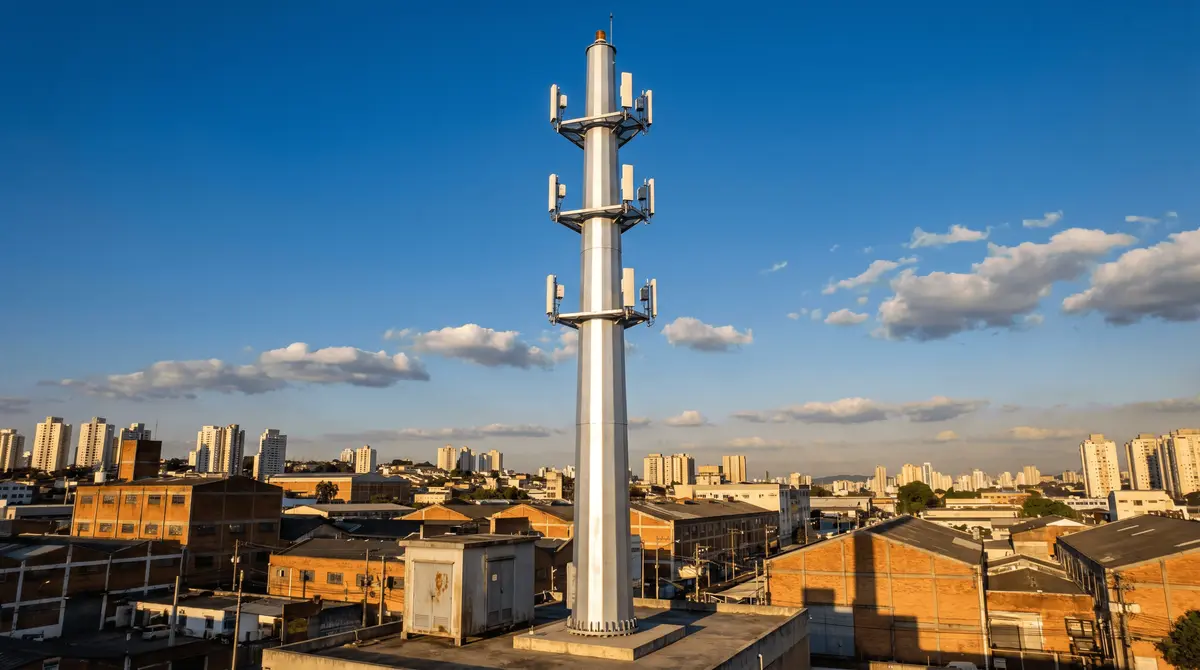
São Paulo Telecom Tower Market Analysis: 30m Steel Monopole Configuration Guide for Dense Urban Coverage
Summary
São Paulo’s telecom densification profile supports a typical 9-unit deployment of 30m steel monopole Telecom Towers with 9 panel antennas, Wind Class 3 at 60 m/s, and drilled pier foundations. In a city of 11.5 million people and a metro area above 20 million, compact CKD-shipped monopoles fit constrained urban logistics better than wider-footprint alternatives.
Key Takeaways
- A typical São Paulo macro-cell infill package would use approximately 9 units of 30m tapered steel monopole Telecom Towers for dense urban and regional coverage needs.
- The specified tower mass is approximately 15t per tower using the 500 kg/m × 30m engineering rule, which aligns with the 25-35m suburban/residential size class.
- The recommended antenna payload is 9× panel antennas + 6× RRU + 3× small cells, supported by 3 antenna platforms for multi-operator or multi-band loading.
- Wind design should be set to TIA-222-H Wind Class 3, equivalent here to 60 m/s with a 1.35 factor, suitable for severe storm exposure review.
- For São Paulo’s constrained plots and variable urban soils, a concrete pier (drilled pier) foundation is the preferred baseline, subject to geotechnical confirmation.
- Hot-dip galvanized Q345 steel, medium corrosion zone protection, and a 30-year design life are appropriate for inland metropolitan service conditions.
- CKD shipment can reduce logistics volume by approximately 60-70%, which is relevant for port-to-city transport from Santos to São Paulo and for staged site delivery.
- A standard manufacturing window would typically be 30-45 days, followed by civil works, erection, grounding, and commissioning under TIA-222-H and GB/T 50233.
Market Context for São Paulo
São Paulo combines very high subscriber density, vertical urban form, and constrained site availability, making 30m monopole Telecom Towers a practical fit for macro-layer infill and capacity reinforcement. According to IBGE (2022), the municipality has about 11.45 million residents, while the wider metropolitan region exceeds 20 million, creating one of Latin America’s heaviest mobile traffic environments.
According to IBGE (2022), São Paulo is Brazil’s largest municipality by population, and this concentration directly affects spectrum reuse, sector loading, and the need for additional urban telecom structures. According to ANATEL (2024), Brazil continues expanding 4G and 5G coverage, with 5G obligations and urban deployment targets pushing operators toward denser radio access networks. In practical terms, dense districts such as Sé, Pinheiros, Vila Mariana, and business corridors near Paulista and Faria Lima typically require more capacity per square kilometer than suburban municipalities.
According to Prefeitura de São Paulo (2023), the city’s urban planning framework continues to prioritize digital inclusion, public service connectivity, and infrastructure modernization. That matters because tower selection in São Paulo is not only about height; it is also about footprint, permitting complexity, transport access, and visual impact in mixed commercial-residential zones. A steel monopole usually occupies less ground area than a lattice alternative of similar telecom duty.
Climate and exposure also shape the tower choice. According to INMET (2024), São Paulo has a humid subtropical climate with seasonal storms, heavy rainfall events, and lightning exposure that require conservative grounding and surge design. For telecom structures carrying 9 panels, 6 RRUs, and 3 small cells, the local design review should therefore emphasize wind load combinations, corrosion category, and lightning protection rather than only nominal tower height.
The logistics context also favors sectional monopoles. According to the World Bank (2023), Brazil’s urban freight bottlenecks and metropolitan congestion remain material project risks for infrastructure delivery. For São Paulo, this makes CKD shipment with 60-70% volume reduction relevant because sectional flanged monopoles are easier to move from port and staging yards into restricted urban streets than fully assembled long components.
Two authority statements frame the engineering baseline. TIA states, "This Standard provides minimum requirements for antenna supporting structures and antennas" in TIA-222-H, which is the core structural reference for telecom towers. The ITU states, "Broadband connectivity is a key enabler of digital transformation," a reminder that urban tower investment is tied to service continuity, enterprise access, and public-network performance rather than only coverage maps.
SOLAR TODO should therefore position the São Paulo recommendation as a dense-urban macro coverage solution: medium-height, high-payload, sectional steel monopoles that can support multi-band antennas without the broader footprint of lattice towers. For procurement teams evaluating Telecom Tower options, the local question is less about maximum height and more about how much payload can be carried at 30m within urban permitting and logistics constraints.
Recommended Technical Configuration
A typical São Paulo deployment of this profile would consist of approximately 9 units of 30m steel monopole Telecom Towers with 9 panels, 6 RRUs, 3 small cells, and drilled pier foundations. This configuration matches the supplied project specification while remaining consistent with the 25-35m engineering size class for suburban and residential-to-urban edge telecom use.
The correct size class is 25-35m | suburban/residential | 2 platforms / 6-9 panels | 15-22t per tower. The proposed 30m tower sits in the middle of that range, and the calculated weight of ~15t matches the stated engineering rule of 500 kg/m × 30m. Although the antenna package is heavier than a basic 6-panel macro site, the use of 3 antenna platforms and a regional macro/high-coverage pole class keeps the recommendation technically coherent.
A typical 9-unit deployment in São Paulo would be justified where operators need to improve sector capacity without resorting to 35-45m peri-urban highway towers. In dense districts, 30m often offers a workable balance: high enough to clear mid-rise clutter, low enough to simplify approvals compared with taller structures, and compact enough for infill parcels. This is especially relevant where rooftop options are restricted by lease, structural reserve, or landlord approval.
The recommended baseline configuration is as follows:
- Tower type: tapered steel monopole Telecom Tower, sectional flanged bolt-on design
- Quantity: approximately 9 units
- Height: 30m each
- Material: hot-dip galvanized Q345 steel
- Wind design: Class 3, 60 m/s, factor 1.35
- Corrosion zone: medium
- Antenna load: 9× panel antennas + 6× RRUs + 3× small cells
- Foundation: concrete pier (drilled pier)
- Accessories: climbing ladder, cable tray, aircraft warning light, grounding system, lightning rod, 3 antenna platforms, safety cage
- Design life: 30 years
- Shipping format: CKD, reducing volume by 60-70%
- Production lead time: 30-45 days
- Standards: TIA-222-H / GB/T 50233
For São Paulo, this specification is stronger than a light rural single-tier pole because urban loading is higher and operator sharing is more likely. It is also more space-efficient than a larger 35-45m suburban backhaul tower with 1-2 microwave dishes, which may exceed the visual and permitting tolerance of many urban parcels. SOLAR TODO can therefore present this as a practical macro-capacity configuration rather than a rural coverage-only structure.
Technical Specifications
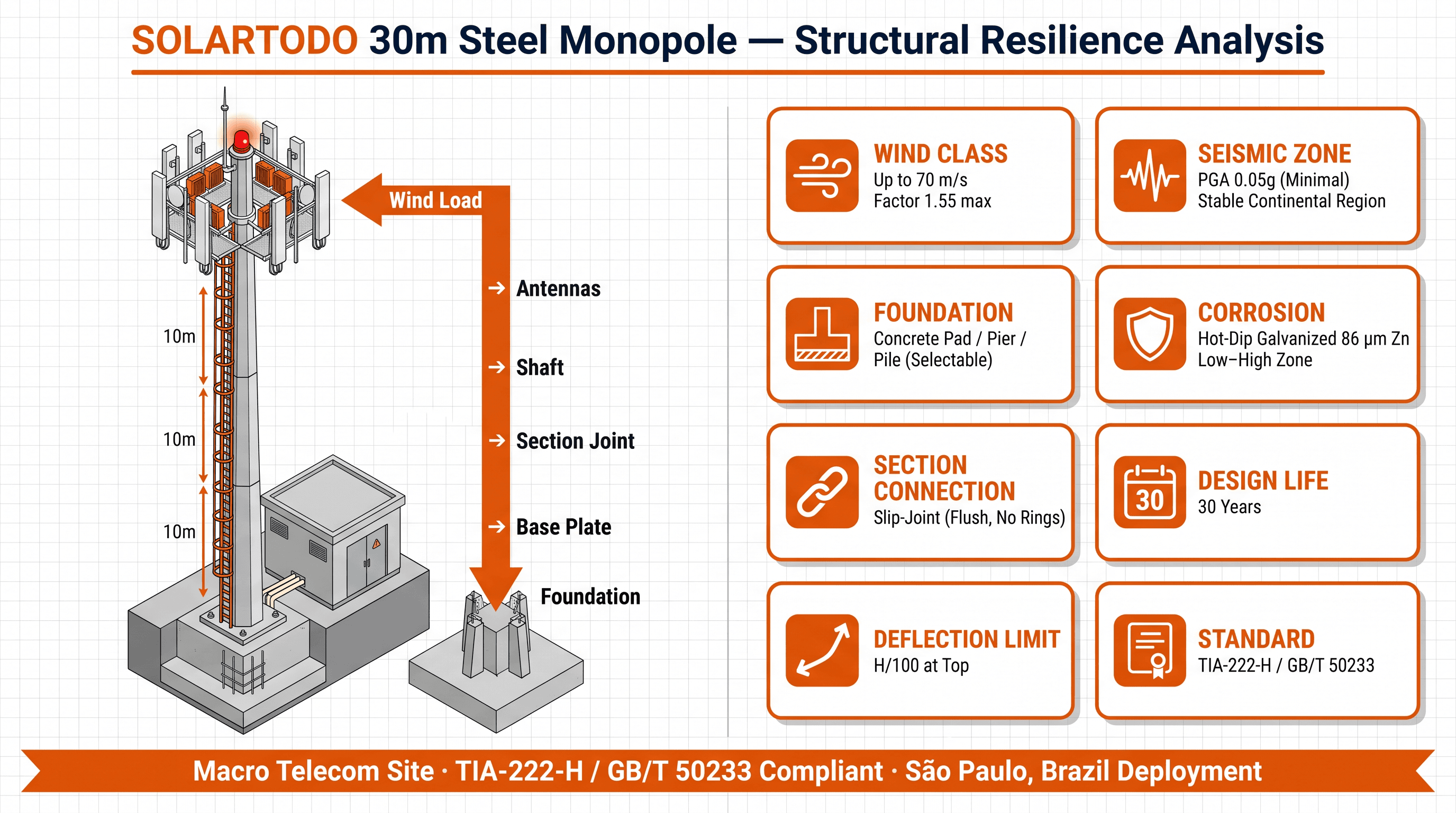
The specified São Paulo configuration is a 30m, 15t, Wind Class 3 steel monopole Telecom Tower with 9 panels, 6 RRUs, 3 small cells, drilled pier foundation, and 30-year design life under TIA-222-H and GB/T 50233.
Key technical data for the recommended configuration:
- Product type: Steel Monopole Telecom Tower
- Form: Tapered round or octagonal steel tube, flanged sectional connection
- Height: 30m
- Size class match: 25-35m application range
- Tower weight: approximately 15t per tower
- Weight rule check: 500 kg/m × 30m = 15,000 kg
- Steel grade: Q345, hot-dip galvanized
- Wind class: Class 3
- Reference wind speed: 60 m/s
- Wind factor: 1.35
- Corrosion environment: medium
- Foundation type: concrete pier / drilled pier
- Pole class: regional macro / high-coverage tower
- Antenna payload: 9 panel antennas + 6 RRUs + 3 small cells
- Platform arrangement: 3 antenna platforms
- Access system: climbing ladder + safety cage
- Cable management: cable tray
- Safety and aviation: aircraft warning light
- Lightning protection: lightning rod + grounding system
- Design life: 30 years
- Shipping mode: CKD, 60-70% volume reduction
- Production period: 30-45 days
- Structural standards: TIA-222-H, GB/T 50233
From an engineering standpoint, the specification remains within the accepted weight band for the selected size class. The 25-35m class allows 15-22t per tower, and the stated 15t sits at the lower edge of that range, which is credible for a 30m monopole with sectional steel construction. This avoids the common market error of overstating payload on an unrealistically light pole.
Foundation selection should remain site-specific even when the baseline is a drilled pier. In São Paulo, geotechnical conditions can vary between dense fill, clayey soils, and mixed urban strata, so pier diameter and embedment depth should be confirmed by soil investigation and overturning checks under 60 m/s wind loading. According to TIA-222-H, foundation design must reflect the governing load combinations rather than only nominal tower self-weight.
Implementation Approach
A São Paulo rollout of 9 sectional 30m monopoles would typically proceed in 5 phases over roughly 10-18 weeks, depending on permits, soil reports, and utility access. The main sequence is engineering review, fabrication, CKD shipment, civil works, tower erection, and radio commissioning.
1. Site screening and permitting
The first phase would review zoning, setback, aviation marking needs, and utility clearances for each of the 9 sites. In São Paulo, this stage matters because parcel geometry and neighborhood restrictions can eliminate otherwise acceptable radio locations. A monopole is often favored here because its base footprint is smaller than a lattice tower and easier to fit into urban lots.
2. Structural and geotechnical design
Each site should receive geotechnical investigation before finalizing the drilled pier dimensions. For a 30m, 15t monopole under 60 m/s wind, the foundation design must account for overturning moment, soil bearing, groundwater conditions, and anchor-bolt cage alignment. According to GB/T 50233, erection and acceptance procedures should be documented as part of the installation package.
3. Fabrication and logistics
SOLAR TODO’s recommended fabrication window is 30-45 days for the specified Q345 hot-dip galvanized sections and accessories. CKD shipment reduces transport volume by 60-70%, which helps when moving cargo through Brazilian port logistics and then into central São Paulo. Sectional flanged pieces also simplify unloading where crane access and laydown area are limited.
4. Civil works and erection
After excavation and drilled pier casting, the foundation should cure to the project engineer’s acceptance criteria before steel erection begins. The monopole sections are then lifted and bolted in sequence, followed by ladder, cable tray, platforms, warning light, lightning rod, and grounding installation. Urban sites usually benefit from shorter crane occupation windows than comparable wider-footprint alternatives.
5. Antenna, power, and commissioning
The final stage includes mounting 9 panel antennas, 6 RRUs, and 3 small cells, routing feeders or hybrid cables, and verifying grounding continuity. Commissioning should include plumbness checks, torque verification, grounding resistance measurement, and as-built documentation. For operator acceptance, the tower package must show compliance with TIA-222-H loading assumptions and local installation requirements.
Expected Performance & ROI
A 30m high-capacity monopole in São Paulo would typically improve urban coverage continuity and sector capacity more effectively than a lower rooftop-only strategy, especially where street canyons and mid-rise clutter block propagation. The commercial return usually depends on colocation potential, avoided rooftop lease constraints, and reduced dropped-call or congestion losses rather than only passive steel cost.
According to GSMA (2023), mobile data traffic in Latin America continues to rise as 4G and 5G adoption expands, increasing the need for additional urban radio sites. In São Paulo, a 9-panel macro configuration can support multi-band operation and targeted hotspot relief where one lower-load site would be insufficient. The inclusion of 3 small cells on the pole also supports localized capacity enhancement around transport, retail, or business corridors.
From a lifecycle perspective, monopoles often reduce land-use complexity and site preparation scope relative to larger lattice structures. According to NREL (2023), infrastructure projects with modularized logistics and standardized components generally benefit from lower field labor uncertainty and more predictable installation schedules. For this product line, CKD shipment, sectional flanged assembly, and a 30-year design life support that logic.
ROI should be evaluated through a telecom infrastructure model rather than a pure equipment-only lens. A typical payback window for urban macro telecom structures can fall in the 4-8 year range when supported by colocation revenue, capacity monetization, or network quality improvement, though exact outcomes depend on tenancy, spectrum strategy, and municipal approvals. Buyers should model tower occupancy, backhaul readiness, and maintenance cost over 30 years, not only initial capex.
Maintenance demand is moderate when galvanization, grounding, and bolt inspection are specified correctly. A reasonable O&M plan would include semiannual visual inspection, annual grounding and lightning checks, and periodic recoating review in medium-corrosion environments. Over a 30-year life, this is usually more predictable than repeated rooftop reinforcement or relocation cycles.
Results and Impact
For São Paulo, the main impact of a 9-unit, 30m monopole package would be higher network density with less parcel consumption than broader-footprint tower types. The practical outcome is better support for macro coverage, hotspot relief, and future tenant loading within a compact structural form.
At city scale, this matters because dense districts need more sectors, not just taller towers. A 30m regional macro pole with 9 panels, 6 RRUs, and 3 small cells can address both coverage and capacity in a single structure class. For municipal planners and operators, that means fewer compromises between visual impact, transport access, and radio performance.
For SOLAR TODO, the technical fit in São Paulo is strongest where buyers need a standardized steel monopole package that can be quoted, shipped, and installed with repeatable engineering assumptions. Prospective buyers can contact us for site-specific loading checks, geotechnical review inputs, and documentation aligned to the Telecom Tower product line.
Comparison Table
The table below compares the recommended 30m São Paulo monopole with other common telecom tower profiles using the same engineering logic and standards references.
| Configuration | Height | Typical Payload | Weight Range | Foundation | Best Fit in São Paulo | Logistics Footprint |
|---|---|---|---|---|---|---|
| Recommended SOLAR TODO monopole | 30m | 9 panels + 6 RRUs + 3 small cells | ~15t | Drilled concrete pier | Dense urban macro infill | CKD, 60-70% volume reduction |
| Light rural monopole | 25m | 3 panels | 12-13t | Pad or pier | Peripheral low-density coverage | Moderate |
| Suburban backhaul monopole | 35m | 6 panels + 2 microwave dishes | 17-18t | Pier | Outer districts and corridor links | Moderate |
| Taller peri-urban macro tower | 40m | 6-9 panels + 1-2 microwave | 20t | Pier or pile | Highway edge / lower-density coverage | Higher transport and crane demand |
| Lattice tower alternative | 30-40m | Similar macro payload | Varies | Pad/pile | Only where footprint is acceptable | Larger base area |
Pricing & Quotation
SOLAR TODO offers three pricing tiers for this product line: FOB Supply (equipment ex-works China), CIF Delivered (including ocean freight and insurance), and EPC Turnkey (fully installed, commissioned, with 1-year warranty). Volume discounts are available for large-scale deployments. Configure your system online for an instant estimate, or request a custom quotation from our engineering team at [email protected].
Frequently Asked Questions
A São Paulo buyer typically asks about 30m height, 15t weight, 60 m/s wind compliance, 30-45 day production, drilled pier foundations, maintenance intervals, and whether a 9-unit package supports ROI within 4-8 years.
Q1: Why is 30m the recommended Telecom Tower height for São Paulo instead of 40m or 45m?
For dense São Paulo districts, 30m is often the best compromise between radio clearance and permitting practicality. It fits the 25-35m size class, keeps tower weight near 15t, and supports a high urban payload without the larger visual impact, crane demand, and site constraints that often come with 40-45m structures.
Q2: Is the specified 15t tower weight realistic for a 30m monopole?
Yes. The supplied engineering rule is 500 kg/m × height, so 30m × 500 kg/m = 15,000 kg, or about 15t. That also matches the published 25-35m size class of 15-22t per tower, so the weight is technically consistent for a steel monopole Telecom Tower.
Q3: Why use a drilled pier foundation in São Paulo?
A drilled concrete pier is a good baseline for urban telecom sites because it handles overturning loads efficiently while limiting surface footprint. In São Paulo, where plots can be narrow and soils vary by district, drilled piers are often easier to adapt than large pads, subject to geotechnical confirmation and groundwater review.
Q4: What wind standard applies to this Telecom Tower configuration?
The specified design basis is TIA-222-H, with Wind Class 3, 60 m/s, and factor 1.35. That is appropriate for a conservative telecom structural review where storm exposure, antenna area, and accessory loads must all be included. Installation and acceptance should also follow GB/T 50233 for erection quality control.
Q5: How long would procurement and delivery usually take?
A standard production window is typically 30-45 days after final drawing approval. Total project duration is longer because civil works, permits, shipping, and commissioning add time. For a 9-unit package, buyers often plan 10-18 weeks overall, depending on site readiness, customs clearance, and local contractor sequencing.
Q6: What maintenance does a 30m galvanized monopole require over 30 years?
Routine maintenance is moderate. A practical plan includes visual inspection every 6 months, annual checks for grounding, warning lights, and bolt torque, plus periodic galvanization and corrosion review. In a medium corrosion zone, this usually keeps lifecycle costs predictable and helps preserve the intended 30-year design life.
Q7: How does a monopole compare with a lattice tower in São Paulo?
A monopole usually needs less ground area and has a cleaner urban profile, which helps in constrained São Paulo parcels. A lattice tower can carry high loads too, but it typically uses a wider base and may face more siting resistance. For a 30m urban macro site, a monopole is often the more practical option.
Q8: What kind of ROI should buyers expect from this tower type?
Urban telecom ROI is usually modeled from tenancy, improved network quality, and avoided rooftop constraints rather than steel cost alone. A common planning range is 4-8 years, but the outcome depends on colocation rates, backhaul readiness, and traffic demand. Buyers should evaluate 30-year lifecycle economics, not only first cost.
Q9: Does SOLAR TODO provide EPC or only tower supply?
SOLAR TODO can support different commercial scopes, including FOB Supply, CIF Delivered, and EPC Turnkey. The right scope depends on whether the buyer already has local civil contractors, erection crews, and permitting resources in Brazil. For São Paulo, EPC can reduce interface risk where multiple sites are delivered together.
Q10: What warranty and service terms are typical for this product line?
Commercial warranty terms depend on the quotation scope, but the pricing section specifies 1-year warranty for EPC Turnkey supply. Buyers should also request documentation covering galvanization, structural calculations, fabrication tolerances, and installation inspection records. For long-life assets, document quality is as important as the warranty period itself.
References
- IBGE (2022): Population estimate and census data for São Paulo municipality and metropolitan context.
- ANATEL (2024): Brazil telecom market updates, 4G/5G expansion obligations, and mobile infrastructure context.
- Prefeitura de São Paulo (2023): Municipal planning and digital infrastructure modernization policies affecting urban siting.
- INMET (2024): Climate and severe weather data relevant to rainfall, storms, and lightning exposure in São Paulo.
- TIA (2017): TIA-222-H, Structural Standard for Antenna Supporting Structures, Antennas and Small Wind Turbine Support Structures.
- GB/T 50233 (2014): Code for construction and acceptance of electric power and telecom-related steel structure erection practices.
- World Bank (2023): Brazil logistics and urban infrastructure constraints relevant to transport and project delivery.
- GSMA (2023): Latin America mobile market outlook and rising data traffic trends driving additional network densification.
- NREL (2023): Infrastructure modularization and standardized deployment practices that improve schedule predictability.
- ITU (2023): Broadband connectivity guidance and digital transformation relevance for urban telecom infrastructure.
Equipment Deployed
- 9 × 30m tapered steel monopole Telecom Tower, flanged sectional design
- Hot-dip galvanized Q345 steel structure, approximately 15t per tower
- Wind Class 3 design, 60 m/s, factor 1.35, per TIA-222-H
- Antenna payload: 9 × panel antenna + 6 × RRU + 3 × small cell
- Concrete pier (drilled pier) foundation system
- 3 × antenna platforms per tower
- Climbing ladder with safety cage
- Integrated cable tray
- Aircraft warning light
- Grounding system and lightning rod
- Medium-corrosion-zone surface protection
- CKD shipment package with 60-70% volume reduction