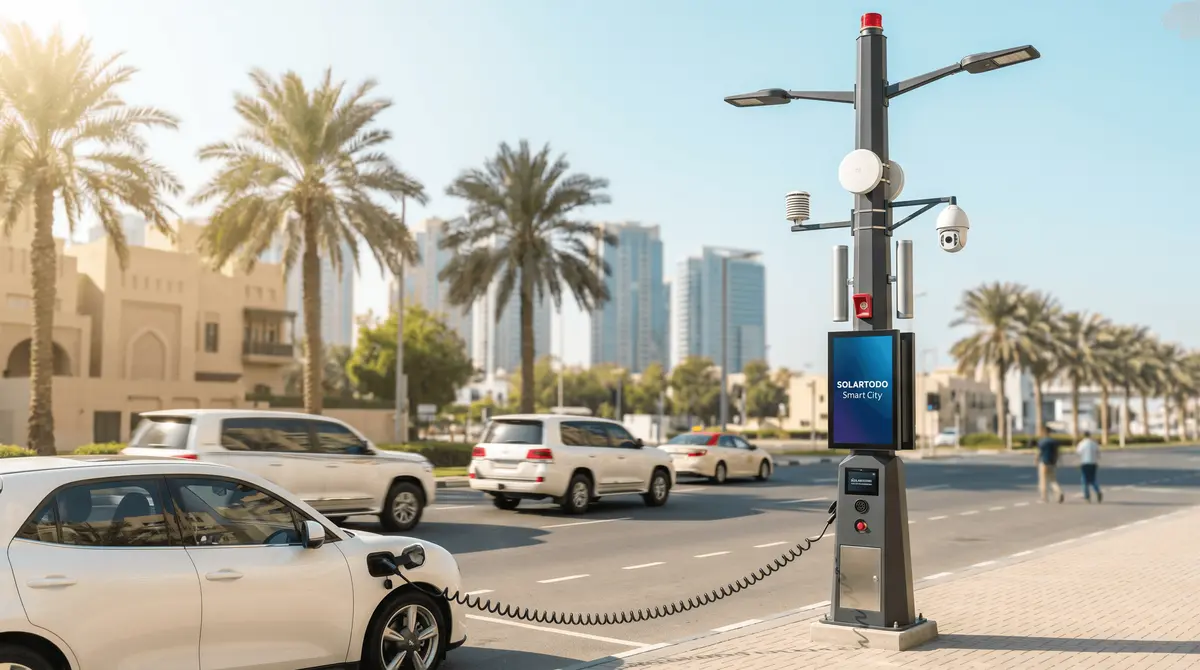
187-Unit Smart Streetlight Deployment in Santiago, Chile Featuring 11m Integrated Pole-as-Charger Design
Summary
SOLAR TODO deployed 187 Smart Streetlight units across Santiago at 30m spacing, using 11m octagonal steel poles with integrated 7kW dual-gun EV charging, 2×80W LED lighting, and 960×1920mm P4 displays for multi-service urban infrastructure.
Key Takeaways
- 187 SOLAR TODO Smart Streetlight units were deployed in Santiago, Chile, using 11m octagonal tapered steel poles with base diameter 45cm and top diameter 15cm.
- Each pole combines 2×80W LED luminaires at 150 lm/W and 4000K, delivering efficient roadway lighting through twin 1.5m symmetric arms tilted +8° upward.
- The lower 2.2m of each pole is the EV charging cabinet itself, integrating a 7kW dual-gun AC charger with 2× Type 2 connectors and OCPP 1.6J.
- Every unit includes a 22cm white PTZ dome camera with 360° rotation, 25x zoom, and 150m IR range on a 50cm L-bracket outrigger.
- Public communication is handled by 2× TCP/IP IP audio columns sized Ø10×50cm, rated 30W and 93dB, plus a one-press SOS button with camera linkage.
- Network coverage is extended through a WiFi 6 access point mounted at 8.7m, supporting 256 devices and up to 1.8Gbps per pole.
- A vertical P4 LED display sized 960×1920mm and rated above 5500 cd/m² shows only “SOLARTODO Smart City” text in white sans-serif on deep blue.
- The deployment uses grid-powered AC 220/380V architecture, complies with IEC 60598, GB/T 37024, and IEC 62196-2, and is centrally managed through a smart controller and cloud platform.
Project Background
Santiago, Chile, at coordinates -33.45, -70.67, requires multi-function corridor infrastructure because dense traffic, air-quality pressure, and rising EV adoption increasingly compete for limited curbside and median space.
Santiago faces a familiar metropolitan challenge: municipalities need better lighting, safer public space, digital connectivity, and EV charging without adding visual clutter or multiplying civil works. In corridors with heavy pedestrian movement and mixed traffic, separate poles for lighting, CCTV, public address, WiFi, advertising, and charging can quickly overload sidewalks and maintenance teams. That challenge is particularly relevant in Santiago, where urban modernization must coexist with constrained rights-of-way and a strong emphasis on resilient public infrastructure.
According to the International Energy Agency (IEA) (2024), global electric car sales exceeded 17 million in 2024, increasing pressure on cities to expand accessible charging infrastructure. According to the World Bank (2023), integrated urban infrastructure improves service efficiency by reducing duplicated assets and simplifying operations across transport and municipal services. For Santiago, this means one structure doing the work of several assets is operationally attractive.
According to the IEA (2023), LED public lighting can reduce electricity consumption significantly compared with legacy lighting systems, especially when combined with centralized controls. IEC states, "The IEC 60598 series specifies general requirements and tests for luminaires," underscoring the importance of compliance in public roadway applications. In this Santiago deployment, SOLAR TODO used that standards-based approach to combine lighting, communications, safety, and charging into one engineered Smart Streetlight platform.
Solution Overview
SOLAR TODO delivered 187 grid-powered Smart Streetlight poles in Santiago, each combining lighting, surveillance, public address, WiFi 6, SOS emergency calling, and a structurally integrated 7kW dual-gun EV charger in one steel assembly.
The deployed system is based on the SOLAR TODO Smart Streetlight product line, configured specifically for urban roads and public-access corridors in Santiago. Each unit is an 11m octagonal tapered steel pole with dark grey RAL7024 powder coating, powered by AC 220/380V. The defining engineering feature is the lower 2.2m of the pole, which is not a separate charger enclosure placed beside the pole, but the EV charging cabinet itself, seamlessly welded into one continuous steel structure.
This integrated design helped Santiago reduce streetscape clutter while preserving clear pedestrian circulation. Rather than deploying a lighting pole plus a freestanding charger plus separate surveillance mounting, the city installed a single vertical asset at 30m spacing. That spacing created a repeatable deployment pattern for roadway lighting, emergency communication, and digital services while simplifying trenching, foundations, and future maintenance routing.
According to the International Telecommunication Union (ITU) (2023), dense urban wireless access points are increasingly important for public digital services and connected mobility. According to IEEE (2022), smart pole convergence improves city-network edge density by co-locating power, communications, and sensing in one managed asset. SOLAR TODO applied that principle in Santiago by combining WiFi 6, IP audio, CCTV, environmental sensing, and charging under one smart controller and cloud management architecture.
Technical Specifications
The Santiago deployment used a fixed 187-unit configuration with exact pole, charger, lighting, surveillance, communications, and display specifications tailored for high-density urban streets.
- Quantity: 187 units
- Product type: SOLAR TODO Smart Streetlight
- Installation location: Santiago, Chile
- Pole height: 11m
- Pole shape: octagonal tapered steel pole
- Pole diameter: base Ø45cm → top Ø15cm
- Pole finish: dark grey RAL7024 powder coat
- Power supply: grid-powered AC 220/380V
- Pole-charger integration: lower 2.2m of pole is the EV charging cabinet, seamlessly welded as one continuous steel structure
- LED lighting arms: twin symmetric arms, 1.5m each
- Arm angle: +8° upward tilt
- LED luminaires: 2× 80W SOLARTODO LED
- Luminous efficacy: 150 lm/W
- CCT: 4000K
- Camera type: 22cm white PTZ dome camera
- Camera mounting: 50cm L-bracket outrigger
- Camera functions: 360° rotation, 25x zoom, IR 150m
- Top sensor: 4-parameter environmental sensor
- Sensor parameters: temperature, humidity, wind speed, noise
- Public address: 2× symmetric IP audio columns
- Audio column size: Ø10×50cm
- Audio rating: 30W, 93dB
- Audio type: TCP/IP networked IP音柱, side-clamp mounted, not horn type
- Emergency system: one-press SOS button with camera linkage
- EV charging: integrated 7kW dual-gun AC charger
- Connector standard: 2× Type 2, IEC 62196-2
- Charging protocol: OCPP 1.6J
- Cable: 5m coiled Type 2 cable
- User interface: 8-inch touchscreen at 1.5m height
- Safety control: red mushroom emergency stop button
- Service access: stainless maintenance door
- LED display: P4 vertical LED screen
- Display size: 960×1920mm portrait
- Display brightness: >5500 cd/m²
- Display content: strictly “SOLARTODO Smart City” text only, white sans-serif on deep blue
- Wireless connectivity: WiFi 6 AP, 802.11ax
- WiFi capacity: 256 devices
- WiFi throughput: up to 1.8Gbps
- WiFi mounting height: 8.7m clamped on pole shaft
- User charging extras: Qi wireless phone charging pad + USB-A
- Pole spacing: 30m
- Smart controls: remote management via smart controller and cloud platform
- Standards: IEC 60598, GB/T 37024, IEC 62196-2
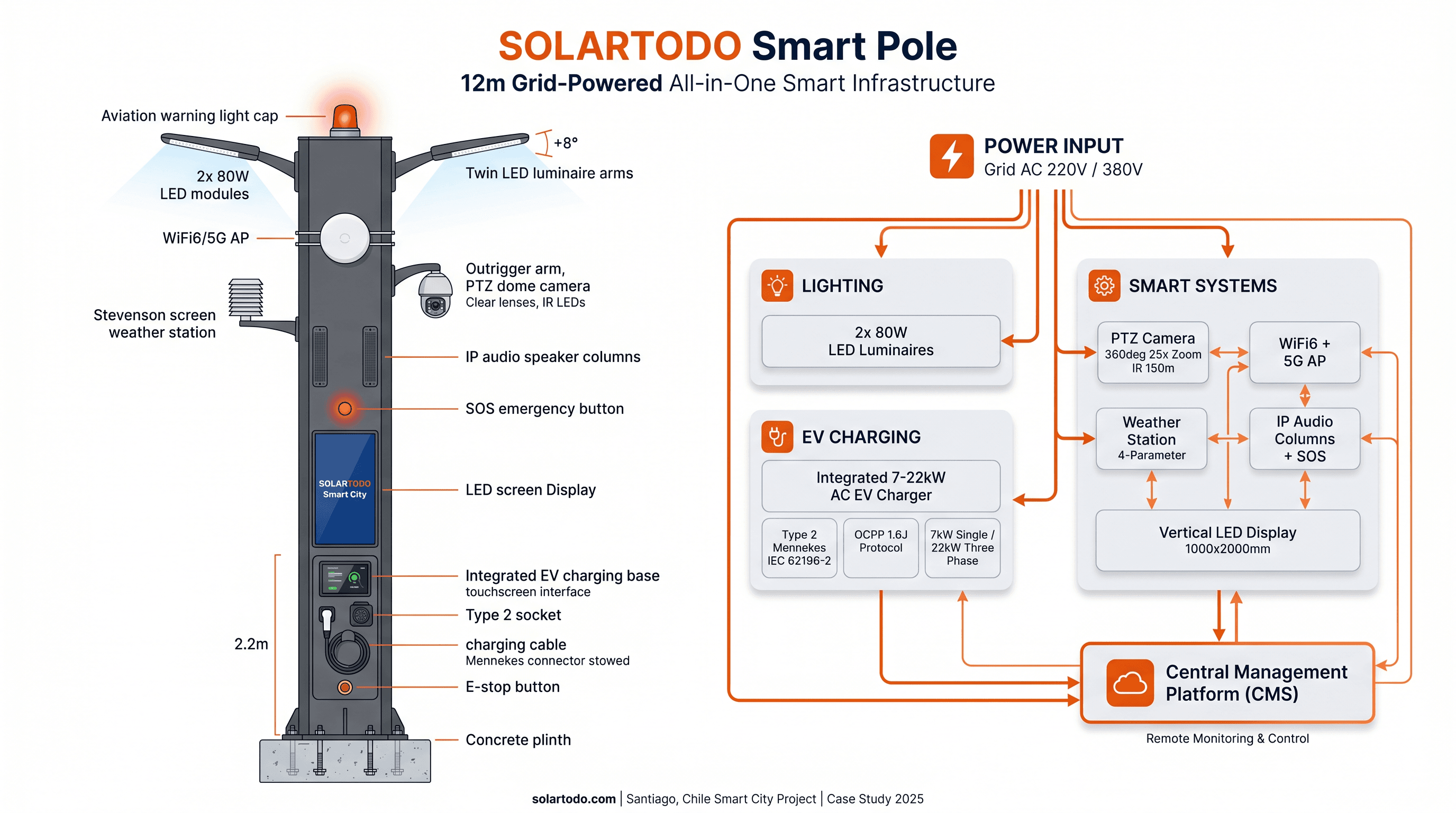
Deployment Process
The 187-unit Santiago Smart Streetlight rollout was executed in phased civil, electrical, and commissioning stages to maintain traffic flow while standardizing 30m spacing and AC 220/380V integration.
The project began with corridor surveys covering road width, utility interfaces, pedestrian clearance, and charger access ergonomics. Because the lower 2.2m of each pole functions as the charging cabinet, foundation and conduit design had to account for both structural load paths and user-facing charging access. This required tighter coordination than a conventional lighting project, but it also eliminated the need for a second charger pedestal and separate civil base.
In the fabrication phase, SOLAR TODO produced the 11m octagonal tapered poles as unified steel structures with welded lower charging sections, stainless maintenance doors, and pre-engineered mounting points for twin arms, PTZ camera outriggers, audio columns, WiFi 6 access points, and P4 displays. According to IEC (2023), adherence to luminaire and electrical interface standards is critical for public safety and interoperability. For Santiago, that meant aligning the lighting system with IEC 60598 and the charging interface with IEC 62196-2 from the outset.
Field installation followed a repeatable sequence: foundation preparation, pole erection, AC 220/380V electrical connection, charger termination, camera alignment, WiFi AP installation at 8.7m, display testing, and cloud onboarding. The one-press SOS system was then linked to the PTZ camera so emergency activation automatically triggered visual attention to the caller area. This camera linkage was important for public-space response workflows and reduced the need for separate emergency call columns.
Commissioning included lighting checks for both 80W luminaires, charger communication validation under OCPP 1.6J, display brightness verification above 5500 cd/m², and network registration of each TCP/IP audio column. According to NREL (2023), networked public infrastructure performs best when remote monitoring is built into initial commissioning rather than added later. SOLAR TODO therefore delivered the Santiago system with cloud-based remote management from day one, allowing municipal operators to supervise charging, lighting, alerts, and communications through one platform.
Performance & Results
The Santiago deployment consolidated at least 6 urban functions into each of 187 poles, reducing streetscape clutter while expanding public lighting, emergency access, WiFi coverage, EV charging availability, and corridor-level digital management.
For municipal operations, the first benefit was asset consolidation. A single pole now provides roadway lighting, CCTV, environmental sensing, public address, emergency calling, WiFi 6, advertising display, and EV charging. According to the World Bank (2023), integrated infrastructure planning lowers lifecycle complexity by reducing duplicated foundations, cabinets, and service visits. In Santiago, the pole-as-charger concept directly supported that objective because the charger is part of the pole body rather than a separate roadside unit.
Lighting performance also improved service efficiency. Each unit uses 2×80W SOLARTODO luminaires at 150 lm/W, equivalent to 24,000 lumens per pole across both fixtures. According to the IEA (2023), LED lighting remains one of the most effective municipal energy-efficiency upgrades due to lower wattage and longer service life compared with legacy technologies. The twin 1.5m arms and +8° tilt were selected to improve road and sidewalk distribution in corridor applications without requiring oversized brackets.
Connectivity and public-space safety were strengthened through integrated edge devices. Each pole supports a WiFi 6 AP for up to 256 devices at 1.8Gbps, a 360° PTZ dome with 25x zoom and 150m IR, and dual 30W/93dB IP audio columns. ITU states, "Digital infrastructure is foundational to smart and sustainable cities," a point reflected in Santiago’s decision to combine communications and public safety in the same vertical asset. The one-press SOS button with camera linkage further improved incident visibility in public areas.
EV charging access became more practical because charging was placed exactly where people already expect public infrastructure: at the streetlight. Each integrated charger provides 7kW AC output with dual Type 2 guns, 5m coiled cables, and an 8-inch touchscreen positioned at 1.5m for user access. According to the IEA (2024), visible and conveniently located charging assets are essential to accelerating urban EV adoption. In Santiago, integrating charging into the pole reduced curbside equipment count while preserving charging functionality.
Operationally, the cloud-managed architecture simplified supervision. Municipal teams can monitor lighting status, charger availability, emergency calls, and network devices remotely rather than dispatching crews for routine checks. According to BloombergNEF (2024), remote monitoring and digital asset management are increasingly central to cost-effective operation of distributed urban energy and mobility infrastructure. For Santiago, that means fewer blind spots in maintenance planning and faster response to outages or alarms.
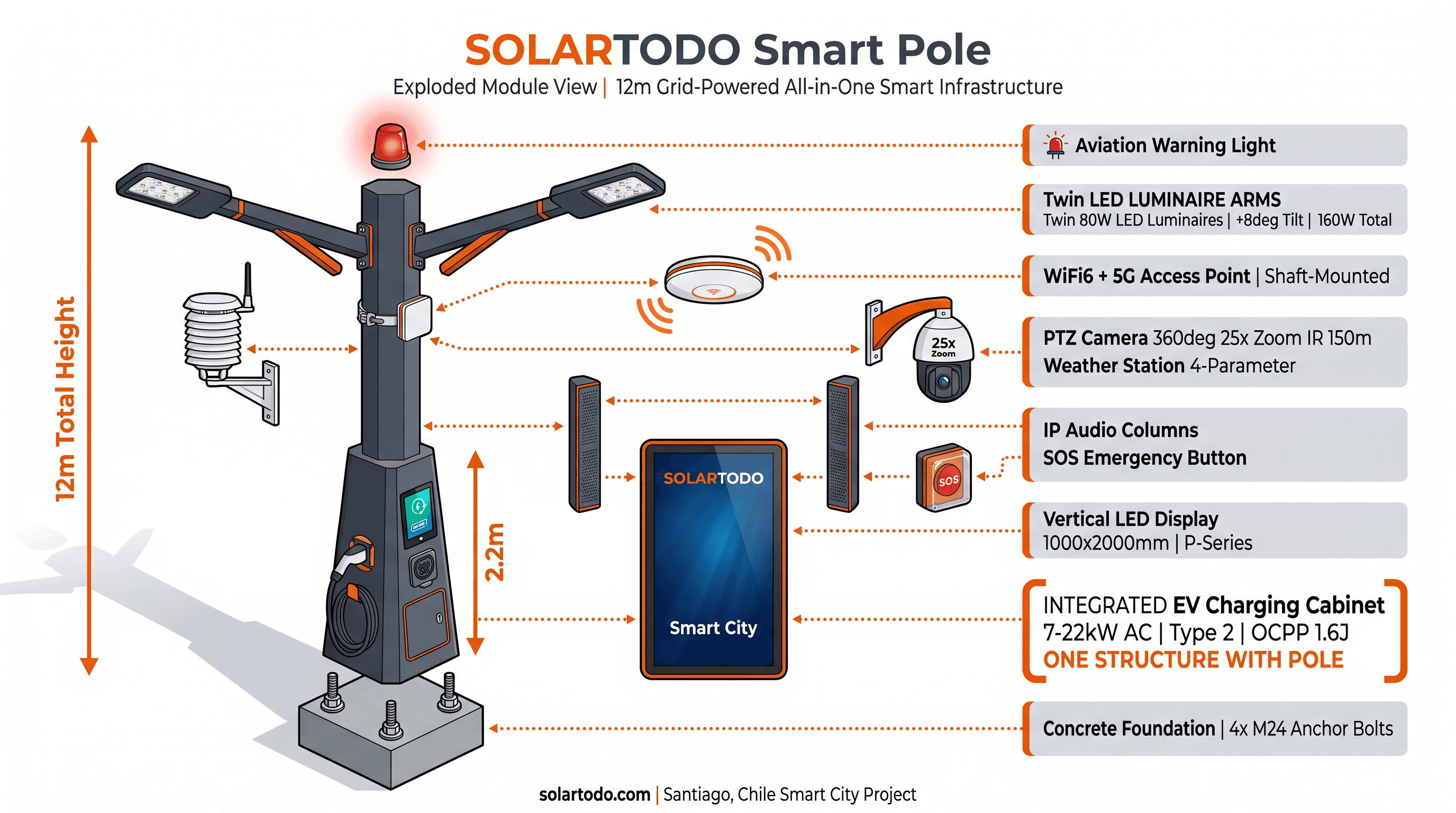
Comparison Table
The Santiago Smart Streetlight design outperformed conventional separated street assets by combining 187 lighting, charging, safety, and communications nodes into one standardized 11m steel structure.
| Metric | SOLAR TODO Integrated Smart Streetlight | Conventional Separate Assets |
|---|---|---|
| Structural concept | One 11m octagonal tapered steel pole | Separate lighting pole + charger pedestal + CCTV mount + speaker pole |
| EV charging integration | Lower 2.2m is charger cabinet, welded into pole | Standalone charger beside or near pole |
| Lighting per location | 2×80W LED, 150 lm/W, 4000K | Often single-function streetlight only |
| Surveillance | 22cm PTZ, 360°, 25x zoom, IR 150m | Separate camera mast or bracket required |
| Public address | 2× IP audio columns, 30W/93dB each | Separate PA hardware and mounting |
| Emergency response | SOS button with camera linkage | Usually separate emergency call box |
| Connectivity | WiFi 6, 256 devices, 1.8Gbps | Additional AP pole or building mount needed |
| Display | P4 960×1920mm, >5500 cd/m² | Separate digital signage structure |
| User amenities | Qi wireless charging pad + USB-A | Usually unavailable |
| Standards basis | IEC 60598, GB/T 37024, IEC 62196-2 | Often sourced from multiple vendors with mixed interfaces |
| Spacing strategy | Standardized 30m deployment | Variable, depending on each subsystem |
| Maintenance model | Unified cloud-managed asset | Multiple maintenance contracts and asset classes |
Pricing & Quotation
SOLAR TODO provides Santiago-style Smart Streetlight projects through three commercial delivery models, allowing municipalities, EPCs, and transport developers to match procurement scope with installation responsibility.
SOLAR TODO offers three pricing tiers for this product line: FOB Supply (equipment ex-works China), CIF Delivered (including ocean freight and insurance), and EPC Turnkey (fully installed, commissioned, with 1-year warranty). Volume discounts are available for large-scale deployments. Configure your system online for an instant estimate, or request a custom quotation from our engineering team at [email protected].
For Santiago-type deployments, quotation accuracy depends on foundation design, AC utility access, trenching distance, commissioning scope, and back-end platform integration. Buyers evaluating corridor-scale smart poles should also compare whether the EV charger is truly integrated into the pole body or supplied as a separate adjacent cabinet, because that affects civil scope, appearance, and maintenance. For project-specific engineering support, buyers can also contact us to review drawings, layouts, and deployment phasing.
Frequently Asked Questions
This Santiago case answers the most common buyer questions about 11m Smart Streetlight specifications, installation scope, maintenance, warranty, and EPC quotation structure for integrated pole-and-charger deployments.
Q1: What exactly was deployed in Santiago, Chile? A total of 187 SOLAR TODO Smart Streetlight units were installed at 30m spacing in Santiago. Each unit uses an 11m octagonal tapered steel pole with twin 80W LEDs, PTZ camera, 4-parameter sensor, dual IP audio columns, SOS button, WiFi 6 AP, P4 display, and an integrated 7kW dual-gun AC EV charger built into the lower 2.2m of the pole.
Q2: Is the EV charger separate from the pole or integrated into it? The charger is fully integrated into the pole. The lower 2.2m of the steel pole serves as the EV charging cabinet and is seamlessly welded to the upper pole as one continuous structure. It is not a standalone charger placed beside the pole, which is a key difference in both appearance and civil design.
Q3: What are the lighting specifications of this Smart Streetlight? Each pole has twin symmetric 1.5m arms with a +8° upward tilt and carries 2×80W SOLARTODO LED luminaires. The fixtures deliver 150 lm/W at 4000K, giving a total of 24,000 lumens per pole. This configuration is suitable for urban road and pedestrian corridor lighting where balanced distribution is required.
Q4: What communications and safety systems are included? Each unit includes a 22cm white PTZ dome camera with 360° rotation, 25x zoom, and 150m IR range, plus one SOS button with camera linkage. It also includes 2× TCP/IP IP audio columns rated at 30W and 93dB, and a WiFi 6 AP supporting 256 devices at up to 1.8Gbps.
Q5: How long does a project like this typically take to deploy? Timeline depends on civil works, utility approvals, and import logistics, but corridor-scale projects are usually phased. Fabrication, shipping, foundations, electrical works, erection, and commissioning are sequenced in batches rather than all at once. For 187 units, buyers should plan for a structured rollout with survey, production, installation, testing, and cloud onboarding stages.
Q6: What maintenance does this system require? Maintenance includes routine inspection of luminaires, charger connectors, touchscreen, emergency stop, camera lens, audio columns, and display modules. Because the system is cloud-managed, many faults can be identified remotely before field visits. The integrated design also reduces the number of separate cabinets and poles that maintenance teams must inspect across the corridor.
Q7: How does this compare with installing separate poles and chargers? An integrated Smart Streetlight reduces visual clutter and consolidates multiple services into one asset. Instead of separate foundations and maintenance regimes for lighting, charging, CCTV, speakers, and signage, the city manages one standardized structure. That can simplify project coordination, especially in dense urban streets where sidewalk space and utility access are limited.
Q8: What charging standard does the EV system use? The charger is a 7kW dual-gun AC unit with 2× Type 2 connectors compliant with IEC 62196-2. It supports OCPP 1.6J for charger communication and includes 5m coiled Type 2 cables, an 8-inch touchscreen at 1.5m height, and a red mushroom emergency stop for user safety.
Q9: Is ROI or payback possible for this type of project? Yes, but payback varies by electricity tariff, charger utilization, maintenance model, and whether the city monetizes display, connectivity, or charging services. The strongest business case usually comes from asset consolidation and operational efficiency rather than one revenue stream alone. A detailed ROI model should be built using local usage assumptions and municipal service priorities.
Q10: What warranty and commercial options are available? SOLAR TODO offers FOB Supply, CIF Delivered, and EPC Turnkey options for the Smart Streetlight line. Under the EPC Turnkey option, the supplied scope includes installation, commissioning, and a 1-year warranty. Warranty terms for large municipal projects may also depend on final scope, country conditions, and maintenance responsibilities defined in contract documents.
Q11: Can the system be customized for other Latin American cities? Yes. While this Santiago deployment used a fixed 11m integrated pole-as-charger configuration, SOLAR TODO can adapt mounting arrangements, communications packages, and software integration for other projects. Buyers typically customize around road class, utility voltage, charger access, network requirements, and local authority preferences. Project teams can start through the product page or contact us.
References
- International Energy Agency (2024): Global EV Outlook 2024; electric car sales exceeded 17 million globally and public charging deployment remains critical to adoption.
- International Energy Agency (2023): Energy Efficiency 2023; LED lighting and digital controls remain major contributors to municipal electricity savings.
- World Bank (2023): Urban development and infrastructure integration guidance; coordinated infrastructure planning reduces duplication and improves service delivery efficiency.
- International Electrotechnical Commission (2023): IEC 60598; general requirements and tests for luminaires used in public lighting applications.
- International Electrotechnical Commission (2022): IEC 62196-2; dimensional compatibility and interface requirements for AC vehicle couplers including Type 2.
- International Telecommunication Union (2023): Smart sustainable cities digital infrastructure guidance; public connectivity and integrated communications are foundational urban systems.
- IEEE (2022): Smart city infrastructure publications on converged pole systems, edge connectivity, and integrated sensing for urban management.
- BloombergNEF (2024): Digitalization and distributed infrastructure operations research; remote monitoring improves management of networked urban energy assets.
Equipment Deployed
- 187 × 11m octagonal tapered steel Smart Streetlight poles, base Ø45cm to top Ø15cm, dark grey RAL7024 powder coat
- Grid-powered AC 220/380V electrical architecture
- Integrated lower 2.2m pole section functioning as EV charging cabinet, welded as one continuous steel structure
- 2 × 80W SOLARTODO LED luminaires per pole, 150 lm/W, 4000K
- Twin symmetric 1.5m lighting arms with +8° upward tilt
- 22cm white PTZ dome camera with 360° rotation, 25x zoom, IR 150m
- 50cm L-bracket outrigger for camera mounting
- 4-parameter environmental sensor: temperature, humidity, wind speed, noise
- 2 × IP audio columns per pole, Ø10×50cm, 30W, 93dB, TCP/IP networked
- One-press SOS emergency button with camera linkage
- Integrated 7kW dual-gun AC EV charger with 2 × Type 2 connectors
- OCPP 1.6J charger communication
- 5m coiled Type 2 charging cable
- 8-inch touchscreen mounted at 1.5m height
- Red mushroom emergency stop button
- Stainless maintenance door
- P4 vertical LED advertising display, 960×1920mm portrait, >5500 cd/m²
- WiFi 6 AP, 802.11ax, 256 devices, 1.8Gbps, mounted at 8.7m
- Qi wireless phone charging pad
- USB-A charging port
- Smart controller and cloud remote management platform
- Compliance with IEC 60598, GB/T 37024, IEC 62196-2
Further Reading
- 189-Unit Smart Streetlight Deployment in Córdoba, Argentina with 9m Flush Cylindrical Poles and Embedded 7kW EV Charging
- 153-Unit Smart Streetlight Deployment in Davao, Philippines Featuring 10m Ø219mm Flush-Integrated Cylindrical Poles
- 129-Unit Smart Streetlight Deployment in Taipei, Taiwan Featuring 10m Seamless Ø219mm Cylindrical Poles