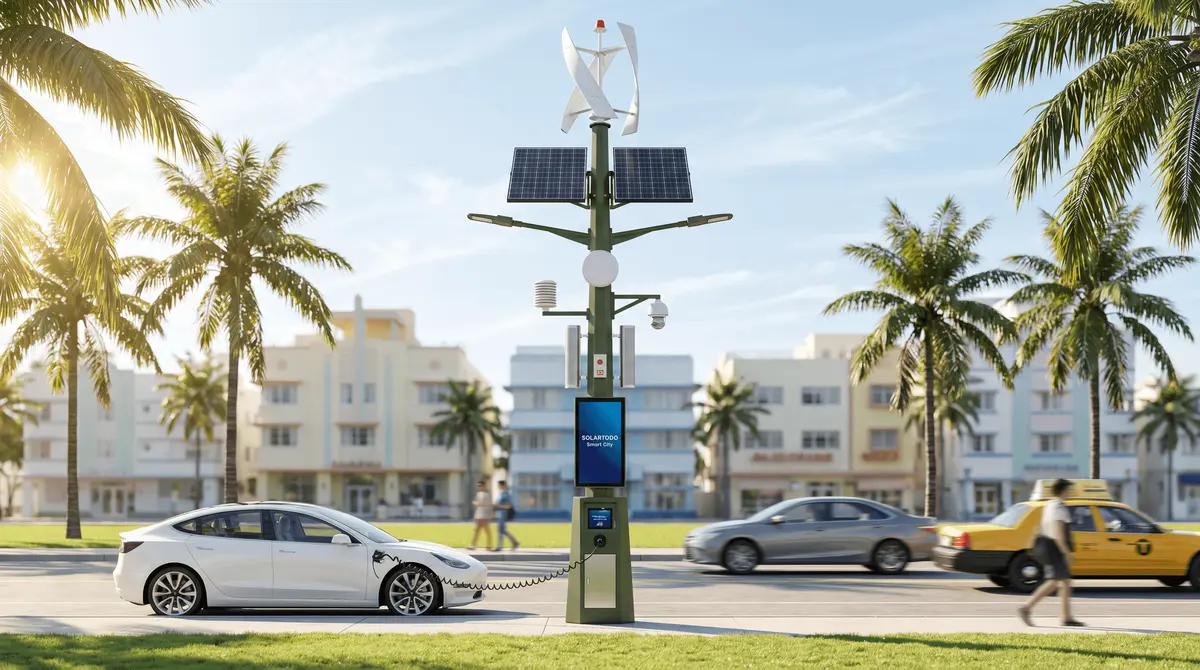
141-Unit Smart Streetlight Deployment in San Salvador, El Salvador Featuring 11m Hybrid Poles with Integrated 7kW EV Charging
Summary
This San Salvador deployment installed 141 SOLAR TODO Smart Streetlight units on 11m hybrid poles spaced 35m apart, combining 2×80W LED lighting, 7kW dual-gun EV charging, and a 1280×2560mm P5 display in one continuous steel structure.
Key Takeaways
- 141 SOLAR TODO Smart Streetlight units were deployed across San Salvador using 11m octagonal tapered steel poles with base diameter 45cm and top diameter 15cm.
- Each pole integrates 2×80W LED luminaires on twin 1.5m arms with +8° tilt, delivering 4000K lighting at 150 lm/W efficacy.
- The lower 2.2m of every pole is the EV charging cabinet itself, housing a 7kW dual-gun AC charger with 2× Type 2 connectors and OCPP 1.6J.
- Hybrid self-power architecture combines a 500W Darrieus H-type VAWT, 2×100W monocrystalline panels at 15° tilt, and a 5kWh LFP battery with MPPT.
- Public safety hardware includes a 360° mini PTZ camera with 20x zoom and 100m IR, plus one-press SOS, dual-way intercom, and a 30W IP audio column.
- Connectivity is built around WiFi 6 access points mounted at 8.7m, supporting 256 devices and up to 1.8Gbps per pole cluster.
- Every unit includes a portrait P5 LED display measuring 1280×2560mm with brightness above 5000 cd/m² and fixed branding content: “SOLARTODO Smart City.”
- The deployment follows IEC 60598, GB/T 37024, and IEC 62196-2, supporting municipal lighting, communications, emergency response, and curbside charging in one asset.
Project Background
San Salvador required a multi-function street infrastructure upgrade across dense urban corridors where lighting, public safety, connectivity, and curbside utility access compete for limited right-of-way, making pole consolidation more practical than adding separate roadside cabinets.
San Salvador faces a familiar Latin American municipal challenge: legacy lighting poles often serve only one purpose, while city operators need surveillance, public communication, internet access, and EV charging in the same streetscape. In central corridors and mixed commercial districts, adding separate charging pedestals, camera poles, PA masts, and digital signage can increase visual clutter and civil works complexity. For this project, the city-side requirement was to reduce roadside hardware count while increasing utility density per pole.
According to the World Bank (2023), cities that invest in integrated urban infrastructure improve service efficiency by consolidating assets and reducing fragmented maintenance responsibilities. According to the IEA (2024), public charging visibility and accessibility remain critical barriers to EV adoption in emerging urban markets. In San Salvador, that challenge is amplified by constrained sidewalks, mixed traffic conditions, and the need for resilient public-space equipment.
Public safety was another driver. According to ITU (2023), smart city platforms increasingly depend on edge-connected devices such as cameras, sensors, and emergency communications to improve municipal responsiveness. San Salvador’s deployment therefore centered on a single Smart Streetlight architecture that could combine lighting, monitoring, emergency assistance, digital information display, and charging without introducing separate steel columns every few meters.
As SOLAR TODO designed the deployment, the emphasis was not on adding more devices to the street, but on making one pole do the work of several. That product-led approach aligned with the city’s practical need for simpler installation interfaces, fewer foundations, and a cleaner streetscape.
Solution Overview
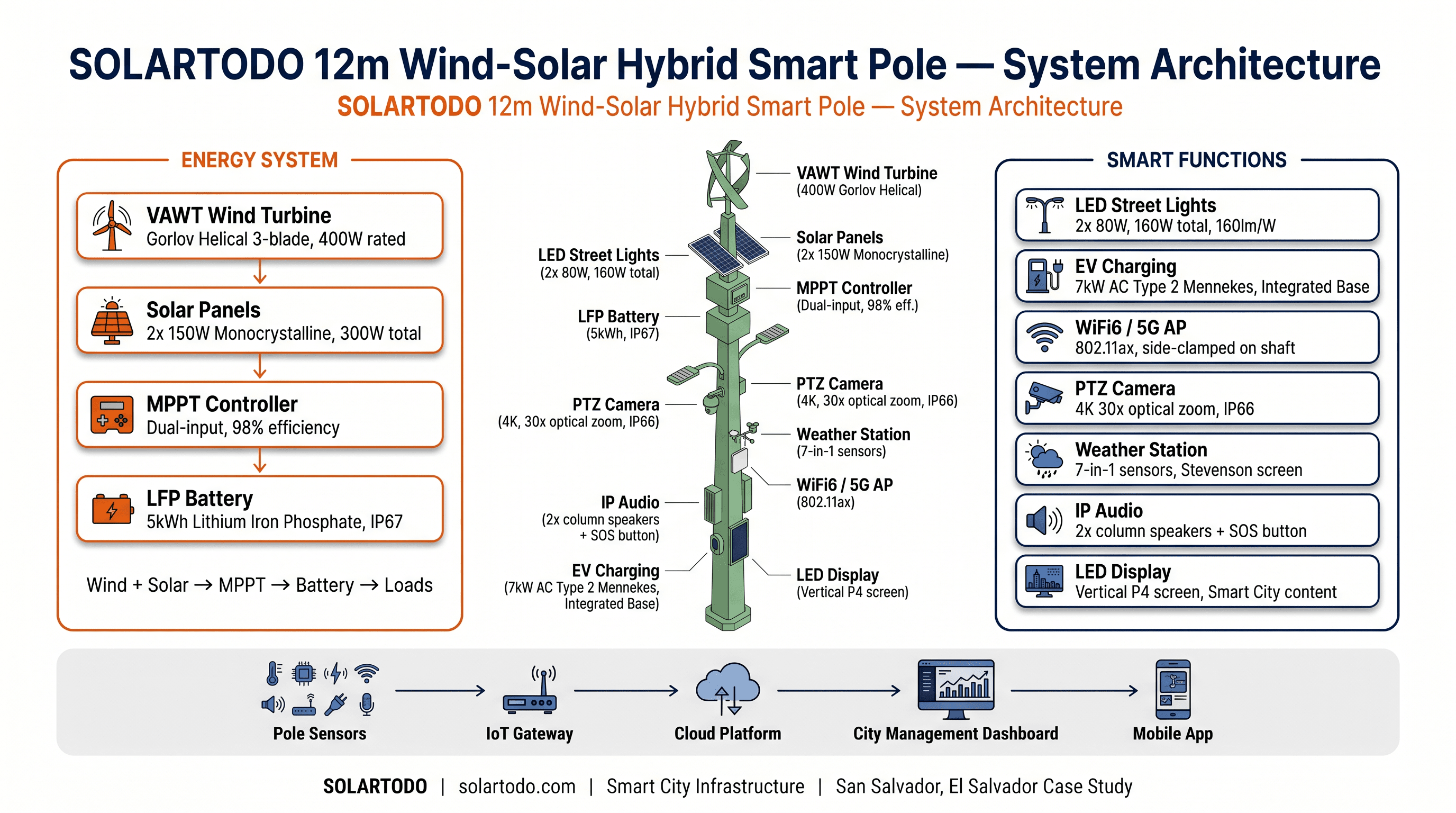
SOLAR TODO delivered 141 hybrid Smart Streetlight units in San Salvador, each built around an 11m octagonal steel pole with integrated 7kW charging, 160W total LED lighting, WiFi 6, PTZ surveillance, SOS intercom, and a P5 LED display.
The deployed configuration used the project-specific SOLAR TODO Smart Streetlight platform with a custom hybrid architecture identified internally as hybrid12. All 141 units were manufactured as silver-grey hot-dip galvanized original steel poles, with an octagonal tapered profile from 45cm at the base to 15cm at the top. Spacing was standardized at 35m to create continuous corridor coverage while preserving access for maintenance and charging operations.
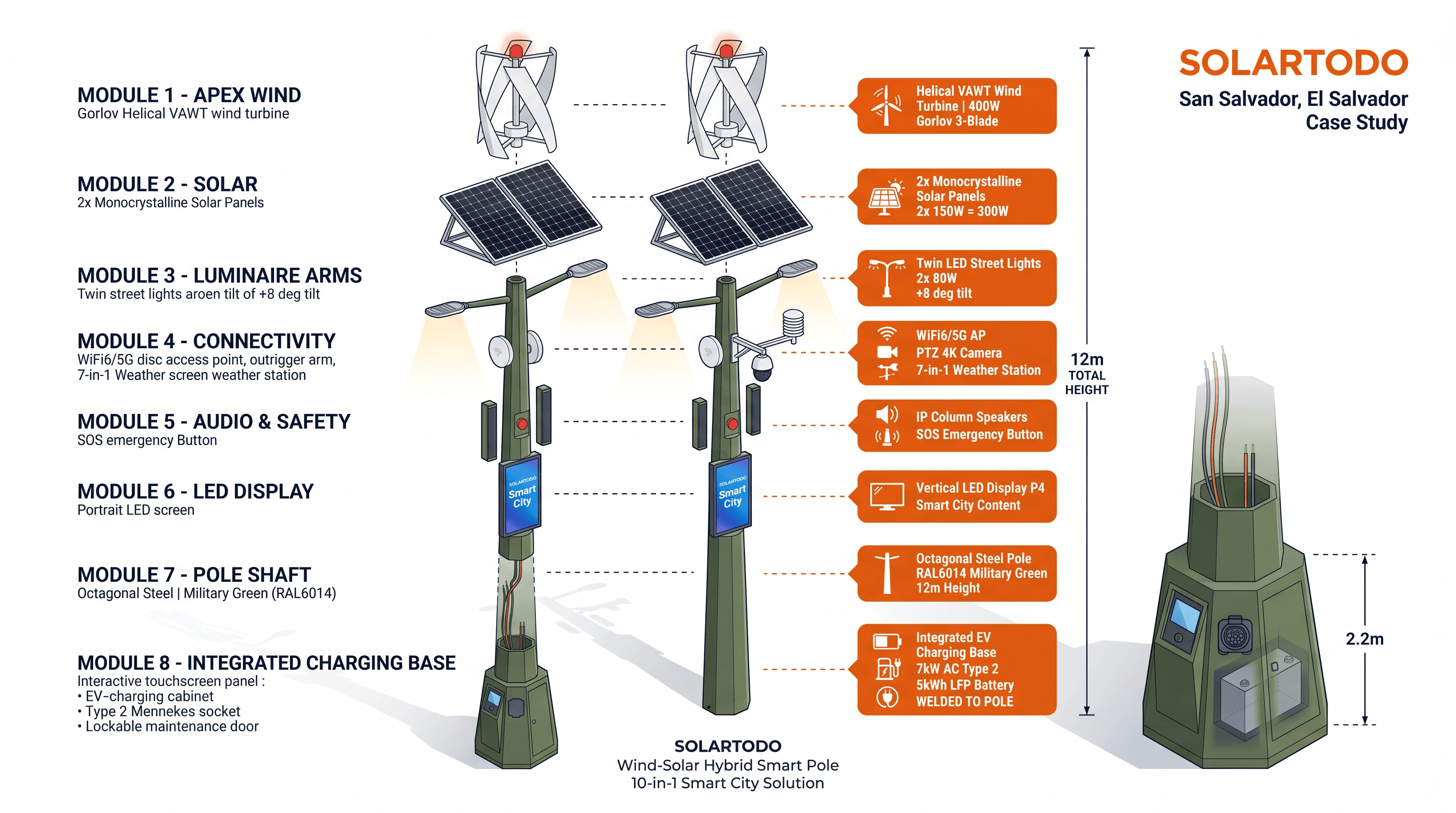
A critical engineering feature of this deployment was the pole-as-charger design. The lower 2.2m of the pole is not a separate cabinet bolted to the structure; it is the EV charging cabinet itself, seamlessly welded into one continuous steel body. This integrated design reduced roadside component count, improved visual uniformity, and avoided the footprint penalty associated with standalone charger pedestals.
Each unit combined a 500W Darrieus H-type vertical-axis wind turbine at the apex, two 100W monocrystalline deep-black solar panels mounted mid-pole on symmetric east-west A-frame brackets at 15° tilt, and a backup grid tie. Energy buffering is handled by a 5kWh LFP battery inside the base section with MPPT control. While the system is hybrid self-powered, the deployment objective remained the performance of the Smart Streetlight product itself: lighting, charging, communications, safety, and digital display in one urban asset.
According to IRENA (2023), modular urban energy systems benefit from combining distributed generation with storage and controllable loads, especially where service continuity matters. According to NREL (2024), integrated curbside charging and streetlight-based infrastructure can lower site complexity compared with separate charging installations. For San Salvador, SOLAR TODO translated that principle into a deployable municipal streetscape format.
Technical Specifications
The San Salvador Smart Streetlight deployment used a fixed 141-unit configuration with 11m hybrid poles, integrated 7kW dual-gun charging, 2×80W LED luminaires, PTZ surveillance, WiFi 6, SOS intercom, and a 1280×2560mm P5 display.
- Quantity: 141 units
- Pole type: 11m octagonal tapered steel smart pole
- Pole diameter: base Ø45cm to top Ø15cm
- Finish: silver-grey hot-dip galvanized original
- Pole structure: lower 2.2m of pole is the EV charging cabinet, seamlessly welded as one continuous steel structure
- Power architecture: wind-solar hybrid self-powered with backup grid tie
- Wind turbine: Darrieus H-type VAWT, 3 straight vertical blades, Ø80×110cm, 500W, red aviation LED
- Solar modules: 2×100W monocrystalline deep-black panels on A-frame brackets
- Solar orientation: symmetric east-west pair
- Panel tilt: 15°
- Battery: LFP 5kWh inside pole base
- Charge control: MPPT controller
- LED luminaire arms: twin symmetric arms, 1.5m each, +8° upward tilt
- LED lighting: 2×80W LED
- Luminous efficacy: 150 lm/W
- CCT: 4000K
- Camera: 15cm mini white PTZ dome camera
- Camera functions: 360° rotation, 20x zoom, IR 100m
- Camera bracket: 40cm L-bracket
- Environmental sensor: 4-parameter top sensor for temperature, humidity, wind speed, and noise
- Public address: 1× IP audio column, Ø10×50cm, 30W, 93dB, TCP/IP networked, side-clamp mounted
- Emergency system: one-press SOS button, dual-way audio intercom, visual LED indicator
- EV charging: integrated 7kW dual-gun AC charger
- Charging connectors: 2× Type 2
- Charging protocol: OCPP 1.6J
- Cable: 5m coiled cable
- Charger interface: touchscreen, E-stop, maintenance door
- LED display: P5 vertical LED screen
- Display size: 1280×2560mm portrait
- Display brightness: >5000 cd/m²
- Display content: strictly “SOLARTODO Smart City” in white sans-serif on deep blue, no other imagery
- Communications: WiFi 6 AP, 802.11ax
- WiFi capacity: 256 devices
- WiFi throughput: 1.8Gbps
- WiFi mounting height: clamped on pole shaft at 8.7m
- USB charging: USB-A ×2, 5V/2.4A on charging cabinet
- Pole spacing: 35m
- Standards: IEC 60598, GB/T 37024, IEC 62196-2
Deployment Process
The 141-unit Smart Streetlight rollout in San Salvador was executed in phased corridor deployment, allowing civil, electrical, networking, and commissioning teams to standardize installation around a 35m spacing template.
The project began with route segmentation and foundation planning based on municipal traffic patterns, pedestrian access, and charger usability. Because the lower 2.2m of each pole is also the charging enclosure, installation sequencing had to account for cable routing, charger access clearances, and maintenance-door orientation from the outset. This reduced the need for later field modifications and kept the streetscape visually consistent.
Factory integration was a major part of deployment efficiency. SOLAR TODO preassembled the twin 1.5m lighting arms, PTZ camera bracket, WiFi 6 clamp location, audio column mounts, top sensor assembly, and display interface points before shipment. That approach reduced the amount of elevated assembly work required on site and simplified final commissioning in urban traffic conditions.
Field installation followed a repeatable sequence:
- Foundation and anchor preparation
- Pole erection and alignment
- Grid tie and internal power verification
- Hybrid subsystem checks for VAWT, solar, battery, and MPPT
- Charger commissioning for dual Type 2 outputs and OCPP 1.6J communication
- Camera, audio, SOS, and LED display activation
- WiFi 6 validation and device registration
- Lighting focus and final safety inspection
According to IEEE (2022), modular smart pole deployments perform best when communications and power subsystems are commissioned in discrete layers rather than all at once. SOLAR TODO used that logic to isolate faults faster and maintain corridor-level progress. According to IEC (2023), EV charging and lighting systems require clear compliance interfaces at both equipment and installation stages, which informed the acceptance process for this project.
A practical advantage in San Salvador was the integrated charger body. Since the charger was part of the pole itself, crews did not need to position and protect a second pedestal adjacent to the lighting structure. That reduced curbside congestion and shortened the number of visible installation elements per site.
Performance & Results
This San Salvador Smart Streetlight project consolidated at least 8 urban functions into each of 141 poles, giving the city corridor-scale lighting, charging, surveillance, WiFi, emergency communication, public address, sensing, and digital signage from one asset class.
Operationally, the project’s main result was infrastructure consolidation. Instead of installing separate poles or cabinets for lighting, surveillance, emergency calling, public audio, public WiFi, digital signage, and EV charging, the city could deploy one engineered structure every 35m. That simplification matters in dense streets where sidewalk width, utility conflicts, and maintenance access are all constrained.
The lighting package alone delivered 160W per pole through two symmetric 80W luminaires at 4000K and 150 lm/W, while the charger added dual 7kW AC outputs with Type 2 connectors. Public safety coverage improved through the 360° PTZ camera with 20x zoom and 100m IR, plus one-touch SOS and dual-way intercom. Communications density increased with WiFi 6 access points supporting up to 256 devices and 1.8Gbps.
According to the IEA (2024), visible public charging availability strongly influences user confidence in urban EV adoption. According to ITU (2023), integrated digital infrastructure improves municipal service delivery when edge devices are co-located and centrally managed. According to NREL (2024), streetlight-based charging and smart pole integration can reduce site fragmentation and improve deployment practicality in built-up corridors.
Two authority statements are especially relevant to this deployment. ITU states, "Smart sustainable cities use ICTs to improve quality of life, efficiency of urban operation and services, and competitiveness." IEC states, "International Standards and conformity assessment underpin safe, efficient and interoperable electrical infrastructure." Both principles are visible in the San Salvador project’s design logic.
For municipal operations, the corridor benefits are straightforward:
- Fewer standalone roadside assets to inspect
- Standardized maintenance around one pole family
- Shared mounting height and access logic for smart devices
- Better use of constrained curbside space
- Cleaner visual identity across commercial and mixed-use streets
Comparison Table
The San Salvador configuration outperformed a conventional single-function lighting pole by combining 141 deployed units of lighting, charging, communications, and safety hardware into one standardized street asset.
| Metric | SOLAR TODO San Salvador Smart Streetlight | Conventional Streetlight Pole |
|---|---|---|
| Pole quantity in project | 141 units | 141 lighting-only poles plus separate device installations |
| Pole height | 11m | Typically single-purpose and site-dependent |
| Lighting per pole | 2×80W LED, 150 lm/W, 4000K | Lighting only |
| EV charging | Integrated 7kW dual-gun AC, 2× Type 2, OCPP 1.6J | Usually not included |
| Pole body design | Lower 2.2m is charger cabinet, one welded steel structure | Separate charger pedestal required |
| Surveillance | 360° PTZ, 20x zoom, IR 100m | Usually separate camera pole |
| Emergency system | SOS button + dual-way intercom + LED indicator | Usually not included |
| Public address | 30W/93dB IP audio column | Usually separate PA hardware |
| Connectivity | WiFi 6, 256 devices, 1.8Gbps | Usually not included |
| Digital display | P5 portrait 1280×2560mm, >5000 cd/m² | Usually not included |
| Environmental sensing | Temperature, humidity, wind speed, noise | Usually not included |
| Standards | IEC 60598, GB/T 37024, IEC 62196-2 | Varies by component |
Pricing & Quotation
SOLAR TODO provides Smart Streetlight projects in San Salvador through three commercial delivery models—FOB Supply, CIF Delivered, and EPC Turnkey—so buyers can match procurement scope to local installation capability and compliance requirements.
SOLAR TODO offers three pricing tiers for this product line: FOB Supply (equipment ex-works China), CIF Delivered (including ocean freight and insurance), and EPC Turnkey (fully installed, commissioned, with 1-year warranty). Volume discounts are available for large-scale deployments. Configure your system online for an instant estimate, or request a custom quotation from our engineering team at [email protected].
For EPC buyers, quotation scope typically depends on civil works, grid interconnection, network integration, traffic management, and local permitting. Because this San Salvador project uses an integrated pole-as-charger structure, engineering review should also confirm charger access clearance, cable routing, and utility interface details. Buyers planning corridor-scale deployments can contact us to review layout drawings and commissioning requirements.
Frequently Asked Questions
This FAQ answers the most common buyer questions about the 141-unit San Salvador Smart Streetlight deployment, including specifications, installation, maintenance, comparison, warranty, EPC scope, and commercial quotation options.
Q1: What exactly was deployed in San Salvador?
SOLAR TODO deployed 141 Smart Streetlight units using 11m octagonal tapered steel poles spaced 35m apart. Each pole combines 2×80W LED lighting, a 7kW dual-gun AC EV charger, PTZ camera, WiFi 6 AP, SOS intercom, IP audio column, 4-parameter sensor, and P5 LED display in one structure.
Q2: What makes this pole different from a standard smart pole with a charger beside it?
The key difference is structural integration. The lower 2.2m of the pole is the EV charging cabinet itself, seamlessly welded into one continuous steel body. It is not a separate charger pedestal attached nearby. That saves curb space, reduces roadside clutter, and simplifies the visual and mechanical layout.
Q3: What are the lighting specifications of each Smart Streetlight?
Each unit uses twin symmetric 1.5m arms with a +8° upward tilt and mounts 2×80W LED luminaires. The LEDs are rated at 150 lm/W with a 4000K color temperature. This gives the city a balanced roadway lighting configuration while preserving the central shaft for communications and safety devices.
Q4: What communications and public safety equipment are included?
Each pole includes a 15cm mini white PTZ dome camera with 360° rotation, 20x zoom, and 100m IR. It also includes a one-press SOS button, dual-way audio intercom, visual LED indicator, a 30W/93dB TCP/IP audio column, and a WiFi 6 AP supporting 256 devices at up to 1.8Gbps.
Q5: How does the EV charging system work?
The charger is a 7kW dual-gun AC system integrated into the pole body. It provides 2× Type 2 connectors, uses OCPP 1.6J for backend compatibility, and includes a 5m coiled cable, touchscreen, emergency stop, maintenance door, and 2 USB-A ports rated at 5V/2.4A.
Q6: How long does installation usually take for a project like this?
The timeline depends on civil readiness, utility approvals, and network integration. In practice, projects like this are usually rolled out in phases: foundations and anchors first, then pole erection, then electrical and smart-device commissioning. Preassembled components from SOLAR TODO reduce field assembly time and help standardize corridor deployment.
Q7: What maintenance is required after commissioning?
Maintenance typically includes periodic inspection of the steel structure, charger interface, cables, camera lens, audio devices, LED modules, battery compartment, and communications hardware. The vertical-axis turbine, solar brackets, and display surface should also be checked on a scheduled basis. Standardized equipment across 141 units simplifies spare-parts planning and service routines.
Q8: How does this compare with separate poles for lighting, cameras, and chargers?
An integrated Smart Streetlight reduces the number of roadside assets required for the same corridor. Instead of installing a light pole, a charger pedestal, a camera mast, a WiFi mount, and an SOS column separately, one 11m structure carries all functions. That usually simplifies layout, access, and streetscape coordination.
Q9: What standards does this deployment comply with?
The equipment configuration follows IEC 60598 for luminaires, GB/T 37024 for smart poles, and IEC 62196-2 for charging connector interfaces. Buyers should still verify local code requirements, utility interconnection rules, and municipal acceptance criteria for the final project site and operating jurisdiction.
Q10: What is the warranty and commercial supply model?
SOLAR TODO offers this product line through FOB Supply, CIF Delivered, and EPC Turnkey models. The EPC Turnkey option includes installation, commissioning, and a 1-year warranty. Final warranty scope can vary by contract, especially where local partners handle civil works, networking, or utility-side interconnection responsibilities.
Q11: Is there an ROI or payback case for this type of deployment?
Yes, but it should be evaluated at project level rather than by one feature alone. The business case usually combines avoided separate pole installations, reduced civil duplication, charger utilization, advertising value, and lower maintenance complexity from asset consolidation. SOLAR TODO typically supports this analysis during quotation and system configuration.
Q12: Can SOLAR TODO customize the configuration for other El Salvador cities?
Yes. The Smart Streetlight platform can be adapted for different road classes, pole spacing, charger requirements, display formats, and communications packages. For municipalities, EPC firms, and developers planning similar deployments, SOLAR TODO can review local layouts, utility conditions, and device combinations through the smart infrastructure team or via contact us.
References
The technical and planning rationale for this San Salvador Smart Streetlight deployment aligns with international guidance on urban infrastructure integration, EV charging, smart city ICT, and electrical equipment standardization.
- NREL (2024): Guidance on integrated EV charging infrastructure and site design considerations for urban deployments.
- IEC (2023): IEC 60598 luminaire safety requirements and IEC 62196-2 charging connector interface standards.
- IEEE (2022): Smart city and intelligent infrastructure deployment practices for modular connected urban systems.
- ITU (2023): Smart sustainable city frameworks for ICT-enabled urban services and public infrastructure.
- IEA (2024): Global EV Outlook findings on the importance of accessible public charging infrastructure.
- IRENA (2023): Urban distributed energy and storage integration guidance relevant to resilient municipal assets.
- World Bank (2023): Urban development and municipal infrastructure efficiency guidance supporting integrated public asset planning.
Equipment Deployed
- 141 × 11m octagonal tapered steel smart poles, base Ø45cm to top Ø15cm, silver-grey hot-dip galvanized original
- Integrated lower 2.2m pole-as-charger cabinet, seamlessly welded as one continuous steel structure
- 500W Darrieus H-type VAWT with 3 straight vertical blades, Ø80×110cm, red aviation LED
- 2 × 100W monocrystalline deep-black solar panels on symmetric east-west A-frame brackets at 15° tilt
- LFP 5kWh battery inside pole base with MPPT controller
- Twin 1.5m symmetric LED arms with +8° upward tilt
- 2 × 80W LED luminaires, 150 lm/W, 4000K
- 15cm mini white PTZ dome camera with 360° rotation, 20x zoom, IR 100m, mounted on 40cm L-bracket
- 4-parameter environmental sensor for temperature, humidity, wind speed, and noise
- 1 × IP audio column, Ø10×50cm, 30W, 93dB, TCP/IP networked, side-clamp mounted
- One-press SOS button with dual-way audio intercom and visual LED indicator
- Integrated 7kW dual-gun AC EV charger with 2 × Type 2 connectors and OCPP 1.6J
- 5m coiled charging cable, touchscreen, E-stop, and maintenance door
- P5 vertical LED display, 1280×2560mm portrait, >5000 cd/m², fixed “SOLARTODO Smart City” content
- WiFi 6 AP, 802.11ax, 256 devices, 1.8Gbps, mounted at 8.7m
- USB-A ×2 ports rated at 5V/2.4A on charging cabinet
- Compliance with IEC 60598, GB/T 37024, and IEC 62196-2