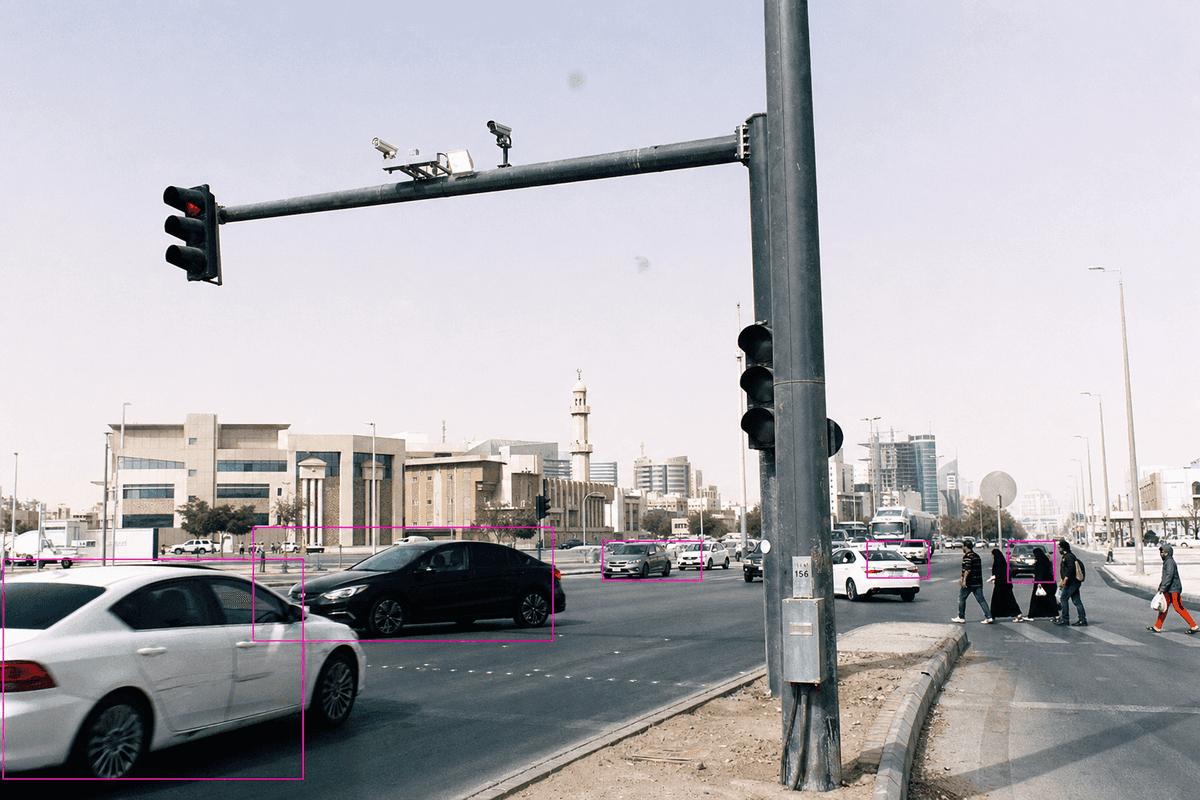
Riyadh Smart Traffic System Market Analysis: 12-Intersection 8m AI Pole Configuration Guide
Summary
Riyadh’s fast urban growth, high private-vehicle dependence, and Vision 2030 digital infrastructure targets make a typical 12-intersection smart traffic upgrade technically suitable. A recommended profile uses approximately 12 sets of 8m 4-in-1 poles, 77GHz radar, 4K AI cameras, and 5G/fiber backhaul under NTCIP and GB 25280.
Key Takeaways
- Riyadh’s population reached about 7.8 million in 2024 according to the Saudi General Authority for Statistics, increasing pressure on arterial intersections and signal timing capacity.
- A typical deployment for this city profile would cover approximately 12 intersections using 8m dark-grey hot-dip galvanized L-arm steel poles with 4-in-1 traffic hardware.
- Each pole configuration includes a 4K AI camera with 98% detection accuracy, support for 45+ object/event types, and response latency below 50ms at the edge.
- The recommended sensing stack pairs video with 77GHz mmWave radar, improving detection continuity during dust, glare, and low-visibility conditions common in Riyadh’s desert climate.
- Edge processing on NVIDIA Jetson reduces upstream bandwidth demand versus cloud-only analytics and supports adaptive signal control plus emergency vehicle priority in near real time.
- Backhaul should use 5G or fiber to a central TrafficGPT platform, allowing natural-language traffic queries, incident review, and corridor-level signal optimization.
- A 12-intersection BOT model can reduce upfront municipal capex to near zero, while expected benefits typically come from delay reduction, lower incident response times, and fewer wrong-way events.
- Compliance should align with NTCIP for signal interoperability and GB 25280 for road traffic signal controller performance, with local civil works adapted to Riyadh heat and dust conditions.
Market Context for Riyadh
Riyadh combines a population of roughly 7.8 million, a hot desert climate, and sustained road-network expansion, making AI-assisted intersection control more relevant than fixed-time signaling on growth corridors. According to the General Authority for Statistics (2024), Riyadh is Saudi Arabia’s largest city by population, and that scale directly increases peak-hour intersection loading.
According to the Royal Commission for Riyadh City (RCRC) (2023), Riyadh’s long-term development strategy targets major transport integration, higher network efficiency, and digital city services under Vision 2030. For traffic technology vendors and municipal planners, that means signal assets are no longer isolated roadside devices; they are expected to connect with urban command platforms, telecom backhaul, and data-led operations.
Climate is a technical factor, not just a background condition. According to the Saudi National Center for Meteorology and World Bank climate summaries, Riyadh regularly faces summer temperatures above 40°C, low annual rainfall, and frequent dust exposure. For a smart traffic system, these conditions favor hot-dip galvanized steel structures, sealed electronics housings, radar-video sensor redundancy, and maintenance plans that account for lens cleaning and filter inspection.
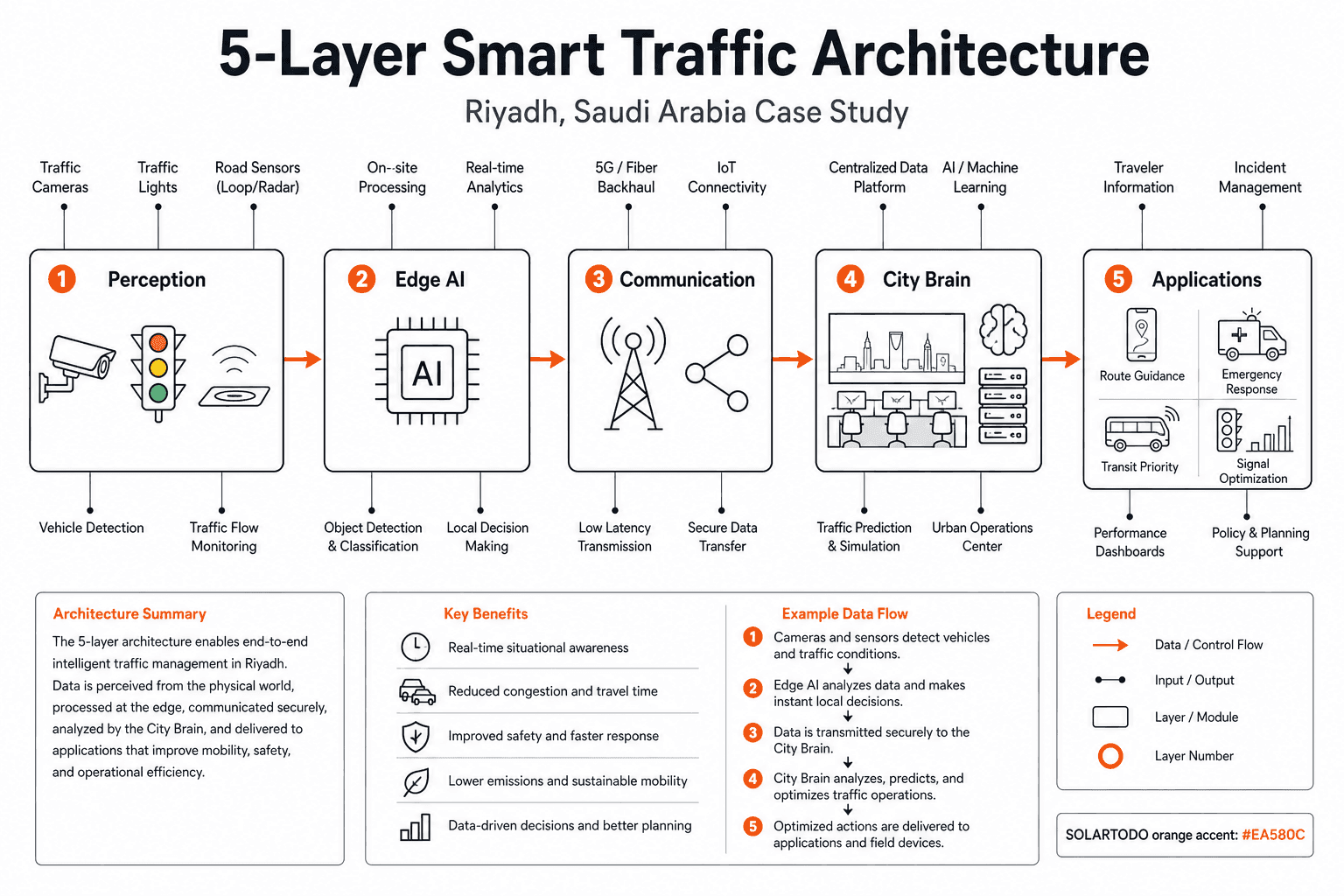
Telecom readiness also supports edge-connected traffic systems. According to the Communications, Space & Technology Commission (CST) (2023), Saudi Arabia maintains high mobile broadband penetration and strong 5G rollout momentum in major cities, including Riyadh. That matters because the specified SOLAR TODO Smart Traffic System relies on a 5-layer architecture: Perception, Edge AI, Communications, City Brain, and Applications. In practice, Riyadh is one of the few MENA cities where 5G and fiber can both be considered realistic backhaul options for a 12-intersection deployment profile.
Road safety and congestion remain strong drivers. According to the World Health Organization (2023), road traffic injury remains a major public-health issue across the region, while urban congestion raises economic losses through travel time, fuel use, and delayed emergency access. AI-based detection is relevant because it can classify turning queues, pedestrian conflicts, stopped vehicles, lane misuse, and wrong-way entry with better consistency than loop-only legacy systems.
The local infrastructure context therefore supports an 8m intersection-pole class rather than a 10-12m highway gantry class. Riyadh’s dense urban intersections typically need signal head mounting, camera elevation for multi-lane approaches, and radar coverage over stop lines and conflict zones, but not expressway gantry geometry. For that reason, SOLAR TODO’s 8m L-arm hot-dip galvanized steel pole is the correct fit for a 12-intersection city deployment profile.
Explore the product page for the full system architecture, or contact us for a site-specific BOQ review.
Recommended Technical Configuration
For Riyadh’s urban arterial intersections, a typical 12-intersection deployment would use approximately 12 sets of 8m L-arm steel poles, each combining 4K AI video, 77GHz radar, LED fill light, and LED signal hardware. This size class matches city intersections better than 6m compact roads or 10-12m highway gantries.
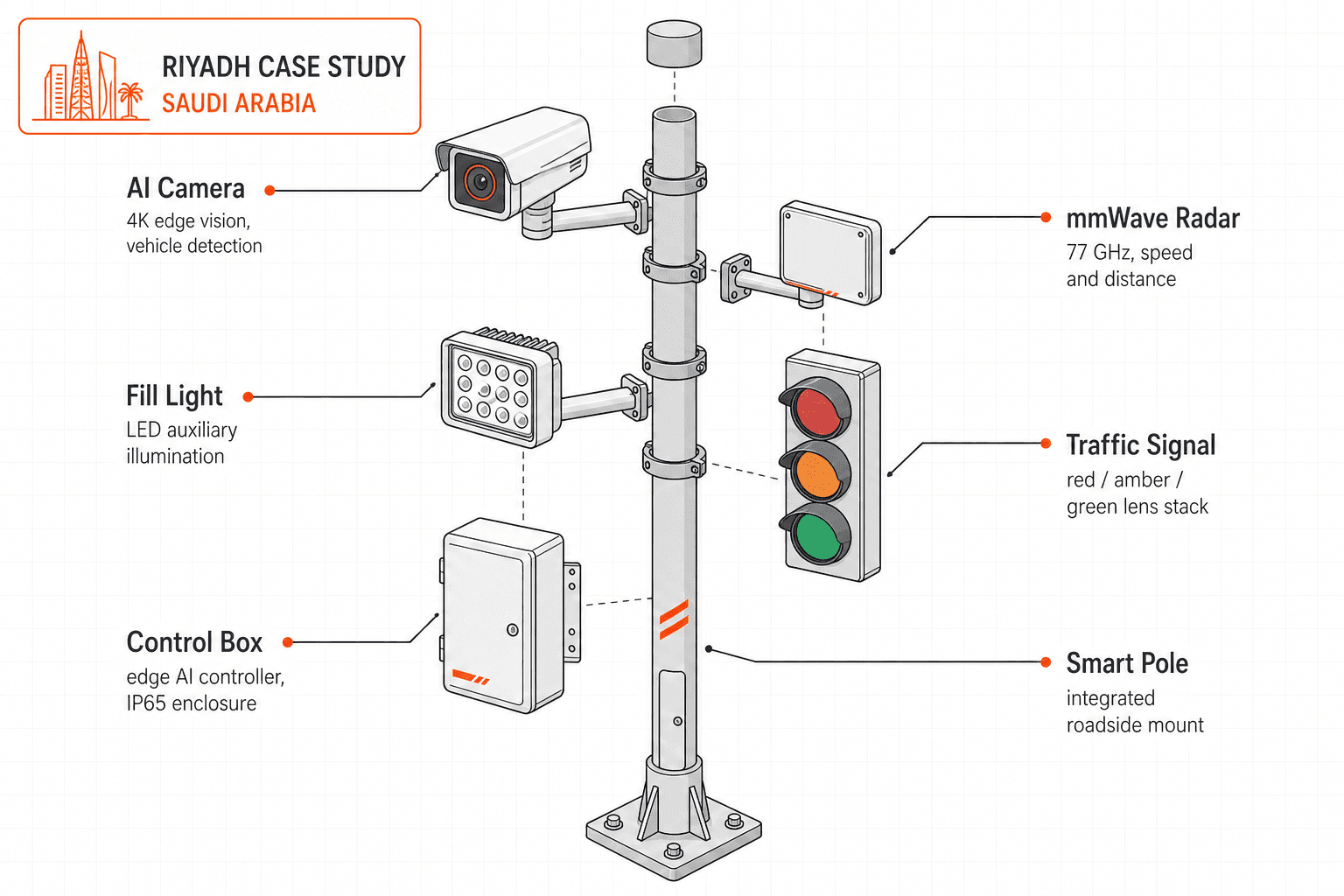
The project-specific configuration is straightforward and technically coherent for Riyadh. A typical 12-unit deployment of this scale would consist of 12 intersections × 8m L-arm steel pole assemblies in dark grey, fabricated from hot-dip galvanized steel. Each pole carries a 4-in-1 smart traffic package: 4K AI camera with 98% accuracy and less than 50ms response, 77GHz mmWave radar, LED fill light, and LED signal head.
The sensing and control stack should enable full 45-type detection, adaptive signal control, emergency vehicle priority, and wrong-way alerting. This matters in Riyadh because wide multilane intersections often need more than simple presence detection. Video alone can struggle under glare or airborne dust, while radar alone lacks the classification depth needed for lane-level policy decisions. The combined stack improves continuity and event confidence.
Edge AI should run on NVIDIA Jetson hardware mounted in the field cabinet or protected pole enclosure. That allows local inference within sub-50ms response windows for priority calls and conflict detection before data is passed to the city platform. The backhaul recommendation is 5G where trenching is difficult and fiber where municipal ducts are available. Both should connect to a TrafficGPT central platform that supports natural-language queries for operators.
The cooperation model that fits this profile is BOT, with zero upfront municipal capital payment at the start of service. In Riyadh, that can be useful for phased corridor upgrades where agencies want measurable operational gains before broadening the program. SOLAR TODO can also support EPC or joint-venture structures in other procurement contexts, but BOT is the specified model for this configuration.
From a quantity perspective, 12 intersections is best treated as a starter network rather than a citywide endpoint. A typical Riyadh intersection would require 4 to 12 poles depending on approach count, turn pockets, medians, and auxiliary pedestrian phases. If the municipality begins with the 12 intersections specified here, the design should still reserve IP addressing, cabinet space, and platform capacity for later corridor expansion.
Technical Specifications
The recommended Riyadh configuration uses 8m hot-dip galvanized L-arm poles, 4K AI cameras with 98% accuracy, 77GHz radar, and NVIDIA Jetson edge processing connected by 5G/fiber under NTCIP and GB 25280. These specifications match urban intersection control rather than expressway gantry use.
- Product type: SOLAR TODO Smart Traffic System, 4-in-1 smart traffic pole
- Deployment profile: approximately 12 intersections
- Pole height: 8m
- Pole form: L-arm steel pole
- Pole finish: dark grey
- Pole material: hot-dip galvanized steel
- Typical pole count per intersection: 4-12 poles depending on approaches and auxiliary signal positions
- Integrated camera: 4K AI camera
- AI detection accuracy: 98%
- Event/object library: 45+ detection types
- Edge response time: less than 50ms
- Radar type: 77GHz mmWave radar
- Lighting module: LED fill light
- Signal module: LED traffic signal head
- Edge computing: NVIDIA Jetson
- Functional stack: Perception → Edge AI → Communication → City Brain → Apps
- Backhaul options: 5G or fiber
- Central software layer: TrafficGPT platform with natural-language query support
- Core functions: adaptive signal control, emergency vehicle priority, wrong-way alert, full 45-type detection
- Cooperation model: BOT (zero upfront)
- Standards: NTCIP, GB 25280
- Recommended use case: urban signalized intersections in multilane Riyadh corridors
- Civil recommendation: foundation and anchor design should be checked against local soil and wind conditions before IFC drawings are issued
According to IEC practice for outdoor control equipment and common municipal signal design standards, enclosure sealing, grounding, and surge protection should be specified at tender stage, especially where summer ambient temperatures exceed 40°C. According to IEEE guidance on roadside electronics reliability, thermal management and power quality are major determinants of field uptime.
Implementation Approach
A 12-intersection Riyadh rollout would typically take 4 to 8 months from design freeze to commissioning, depending on civil permits, duct availability, and telecom provisioning. The most efficient path is a phased program covering survey, fabrication, foundation works, installation, and traffic-system integration.
Phase 1 is corridor survey and concept design. This usually includes traffic counts, lane geometry mapping, mast-arm sightline checks, cabinet location review, and communications planning across 12 intersections. At this stage, the authority should confirm whether each node uses 5G, fiber, or a hybrid topology. In Riyadh, fiber is often preferred on strategic corridors, while 5G can reduce trenching on retrofit sites.
Phase 2 is detailed engineering and procurement. Pole drawings, anchor-bolt layouts, radar aiming angles, camera fields of view, and signal head visibility calculations should be finalized before fabrication. NTCIP interoperability requirements should be written into the controller and platform scope so the traffic authority can avoid vendor lock-in. SOLAR TODO should be evaluated here on hardware compliance, edge AI capability, and API openness.
Phase 3 is civil work and utility coordination. Foundations are cast first, followed by ducting, cabinet pads, and earthing. In Riyadh, dust control and heat scheduling matter because daytime installation windows can be constrained when ambient temperatures move above 42°C. Crews often shift heavy lifting to early morning or night hours to reduce safety risk and traffic disruption.
Phase 4 is pole erection and equipment installation. The 8m L-arm poles are mounted, signal heads aligned, cameras focused, and 77GHz radar units calibrated to lane geometry. Edge AI devices are then provisioned and connected to the backhaul network. This stage should also include fail-safe logic for controller fallback if the communications link drops.
Phase 5 is software commissioning and traffic tuning. The TrafficGPT platform is connected to the field layer, detection classes are verified, emergency priority logic is tested, and wrong-way alerts are validated against real traffic movements. A 2- to 4-week tuning window is typical because adaptive timing performs best after actual demand patterns are observed across weekdays and weekends.
Expected Performance & ROI
A 12-intersection AI traffic upgrade in Riyadh would typically target 10% to 25% delay reduction, faster incident recognition, and stronger emergency response prioritization when compared with fixed-time or low-sensor legacy intersections. Actual savings depend on corridor demand, baseline signal timing, and enforcement integration.
According to the U.S. Federal Highway Administration (FHWA) adaptive signal benchmarks, coordinated adaptive control can reduce travel time by more than 10% and delay by 15% or more on suitable corridors. According to the International Transport Forum (ITF) and World Bank urban mobility analyses, signal optimization and incident detection produce value not only from travel time but also from fuel savings and network reliability.
For Riyadh, the ROI case is strongest on high-volume intersections with recurring peak queues, emergency-service corridors, and known wrong-way risk points near service roads or channelized turns. A 12-intersection network can generate measurable benefits even before citywide scale. Typical value categories include:
- Reduced average delay per vehicle during AM and PM peaks
- Lower secondary incident risk through faster stopped-vehicle or wrong-way detection
- Better emergency vehicle clearance through signal preemption or priority logic
- Reduced field maintenance visits through remote diagnostics and edge analytics
- Better enforcement and planning data via 45-type classification records
According to IEA (2023), digitalization can improve infrastructure utilization without proportional physical expansion, which is important in built-up districts where widening projects are expensive. According to NEMA and ITS practice guidance, remote monitoring also cuts mean time to repair because faults are identified before routine inspection cycles. In a BOT model, these operational improvements can be used to structure service payments around uptime and performance KPIs rather than only hardware ownership.
A practical payback estimate for municipalities or concession structures is often in the 3- to 6-year range when intersections carry heavy daily volumes and the baseline system lacks adaptive control. That estimate is not a guaranteed result; it is a planning benchmark based on reduced delay, lower fuel waste, and fewer manual interventions. High-traffic Riyadh corridors with strong 5G/fiber availability generally sit at the better end of that range.
Results and Impact
For Riyadh, the most likely impact of a 12-intersection smart traffic program is improved corridor efficiency rather than a single headline metric, with benefits distributed across safety, travel time, and control-room visibility. The combination of 4K AI vision, 77GHz radar, and sub-50ms edge response is especially relevant where dust, glare, and multilane turning movements reduce the effectiveness of older loop-based systems.
A city authority evaluating SOLAR TODO should focus on measurable KPIs over a 90- to 180-day operating window. Suitable KPIs include average control delay, queue spillback frequency, emergency vehicle clearance time, wrong-way event detection rate, and maintenance callout frequency. Those indicators are more useful than simple equipment counts because they show whether the 12-intersection configuration fits Riyadh’s traffic conditions.
Comparison Table
This comparison shows why an 8m 4-in-1 AI pole is the preferred Riyadh urban-intersection option versus legacy signal poles or highway-oriented gantry configurations. The 8m class balances sensor sightlines, signal mounting, and urban civil complexity.
| Configuration | Recommended use in Riyadh | Pole height | Sensors | Edge AI | Core functions | Backhaul | Standards |
|---|---|---|---|---|---|---|---|
| SOLAR TODO Smart Traffic System, urban profile | Multilane city intersections, 12-node starter network | 8m | 4K AI camera + 77GHz radar | NVIDIA Jetson | Adaptive signal, emergency priority, wrong-way alert, 45-type detection | 5G/fiber | NTCIP, GB 25280 |
| Conventional signal pole + loop detector | Legacy retrofit where analytics are limited | 6-8m | Inductive loop only or basic video | None or controller-only | Presence detection, fixed/pre-timed control | Copper/fiber | Varies by controller |
| Highway gantry smart system | Expressways and high-speed ramps, not typical urban nodes | 10-12m | Multi-camera + radar arrays | Optional | Speed enforcement, lane control, incident detection | Fiber preferred | Project-specific |
| Camera-only smart pole | Low-cost analytics pilot | 6-8m | 4K camera only | Optional | Classification and monitoring | 4G/5G/fiber | Varies |
Pricing & Quotation
SOLAR TODO offers three pricing tiers for this product line: FOB Supply (equipment ex-works China), CIF Delivered (including ocean freight and insurance), and EPC Turnkey (fully installed, commissioned, with 1-year warranty). Volume discounts are available for large-scale deployments. Configure your system online for an instant estimate, or request a custom quotation from our engineering team at [email protected].
Frequently Asked Questions
This FAQ answers the main Riyadh procurement questions on specifications, deployment time, ROI, maintenance, pricing, and installation using the 12-intersection 8m configuration described above.
Q1: Why is the 8m pole recommended for Riyadh instead of a 6m or 10m option?
An 8m pole fits most Riyadh urban intersections because it gives adequate mounting height for LED signals, 4K camera coverage, and 77GHz radar targeting across multilane approaches. A 6m pole can limit sightlines on wide junctions, while 10m to 12m variants are usually better suited to highway gantries or larger ramp environments.
Q2: What exactly is included in the recommended 4-in-1 Smart Traffic System?
Each recommended node uses an 8m dark-grey hot-dip galvanized L-arm steel pole with a 4K AI camera, 77GHz mmWave radar, LED fill light, and LED signal head. The edge processor is NVIDIA Jetson, and the software stack supports 45-type detection, adaptive signal control, emergency vehicle priority, and wrong-way alerts.
Q3: How many poles are usually needed per intersection?
A typical Riyadh intersection needs 4 to 12 poles depending on the number of approaches, dedicated turn lanes, pedestrian crossings, and auxiliary signal heads. For the project profile in this guide, the planning basis is 12 intersections using 8m poles, but the final quantity should be confirmed after lane-by-lane geometric survey and sightline review.
Q4: How long would a 12-intersection deployment usually take?
A realistic program duration is about 4 to 8 months from survey to final commissioning. The range depends on permit speed, foundation works, utility conflicts, and whether 5G or fiber backhaul is selected. Software tuning often continues for 2 to 4 weeks after energization so adaptive timing can be calibrated with live traffic data.
Q5: What ROI or payback period is typical for this type of system?
For busy corridors, planning-level payback often falls in the 3- to 6-year range. The value comes from delay reduction, lower fuel waste, fewer manual maintenance visits, and better incident handling. Actual payback depends on traffic volume, baseline congestion, telecom costs, and whether the municipality uses BOT service payments or direct capex procurement.
Q6: How does radar help compared with a camera-only traffic system?
The 77GHz radar improves continuity when visibility drops due to dust, glare, night conditions, or partial occlusion by large vehicles. Cameras provide richer classification, while radar provides stable range and speed tracking. In Riyadh’s climate, the combined sensor stack is usually more dependable than camera-only detection for adaptive control and wrong-way alerts.
Q7: What maintenance should Riyadh operators expect?
Routine maintenance usually includes lens cleaning, radar alignment checks, cabinet inspection, surge protection checks, firmware updates, and signal-head verification. In dusty environments, cleaning intervals are often tighter than in coastal or temperate cities. A quarterly preventive schedule is common, with remote diagnostics used to reduce unnecessary field visits and shorten fault isolation time.
Q8: Is fiber required, or can the system run on 5G?
Both are viable. Fiber is preferred for high-capacity strategic corridors and where municipal ducts already exist. 5G is useful for retrofit intersections where trenching would be expensive or disruptive. The specified SOLAR TODO architecture supports either option, provided latency, uptime, and cybersecurity requirements are written into the communications scope.
Q9: What is the difference between BOT and EPC for this system?
BOT is a service-oriented model with zero upfront payment at project start, making it useful when agencies want to preserve capex. EPC is a direct procurement model where the authority pays for supply, installation, and commissioning. For this Riyadh guide, BOT is the specified commercial model, but EPC may suit agencies with approved infrastructure budgets.
Q10: What warranty period should buyers expect?
The standard quotation paragraph in this guide references a 1-year warranty for EPC turnkey supply. In practice, buyers should also ask for separate warranty terms for cameras, radar modules, Jetson hardware, and signal heads, plus uptime commitments, spare-parts lead times, and software support coverage under the BOT or service agreement.
References
- General Authority for Statistics, Saudi Arabia (2024): Riyadh population and regional demographic data used to assess urban traffic demand.
- Royal Commission for Riyadh City (RCRC) (2023): Riyadh development and transport planning framework under Vision 2030.
- Communications, Space & Technology Commission (CST) (2023): Saudi 5G and digital infrastructure indicators relevant to traffic-system backhaul.
- World Health Organization (2023): Global road safety data and regional traffic injury context for intelligent transport investments.
- U.S. Federal Highway Administration (FHWA) (2023): Adaptive Signal Control Technologies benefit ranges for travel time and delay reduction.
- International Energy Agency (IEA) (2023): Digitalization improves infrastructure utilization and operational efficiency in urban systems.
- NTCIP (current applicable editions): Communications standards for interoperable traffic signal and ITS device control.
- GB 25280 (current applicable edition): Road traffic signal controller technical requirements and test methods.
- IEEE (relevant roadside electronics guidance): Reliability, surge protection, and thermal management considerations for outdoor ITS equipment.
- World Bank (2023): Urban mobility and congestion cost context supporting intelligent traffic management investments.
Equipment Deployed
- 12 intersections × 8m L-arm steel pole, dark grey, hot-dip galvanized
- 4-in-1 Smart Traffic System pole assembly
- 4K AI camera, 98% detection accuracy, <50ms response
- 77GHz mmWave radar sensor
- LED fill light module
- LED traffic signal head
- NVIDIA Jetson edge AI processor
- 5G/fiber backhaul communications package
- TrafficGPT central platform with natural-language query support
- Adaptive signal control software
- Emergency vehicle priority logic
- Wrong-way alert function
- NTCIP-compliant control interface
- GB 25280-aligned signal controller configuration