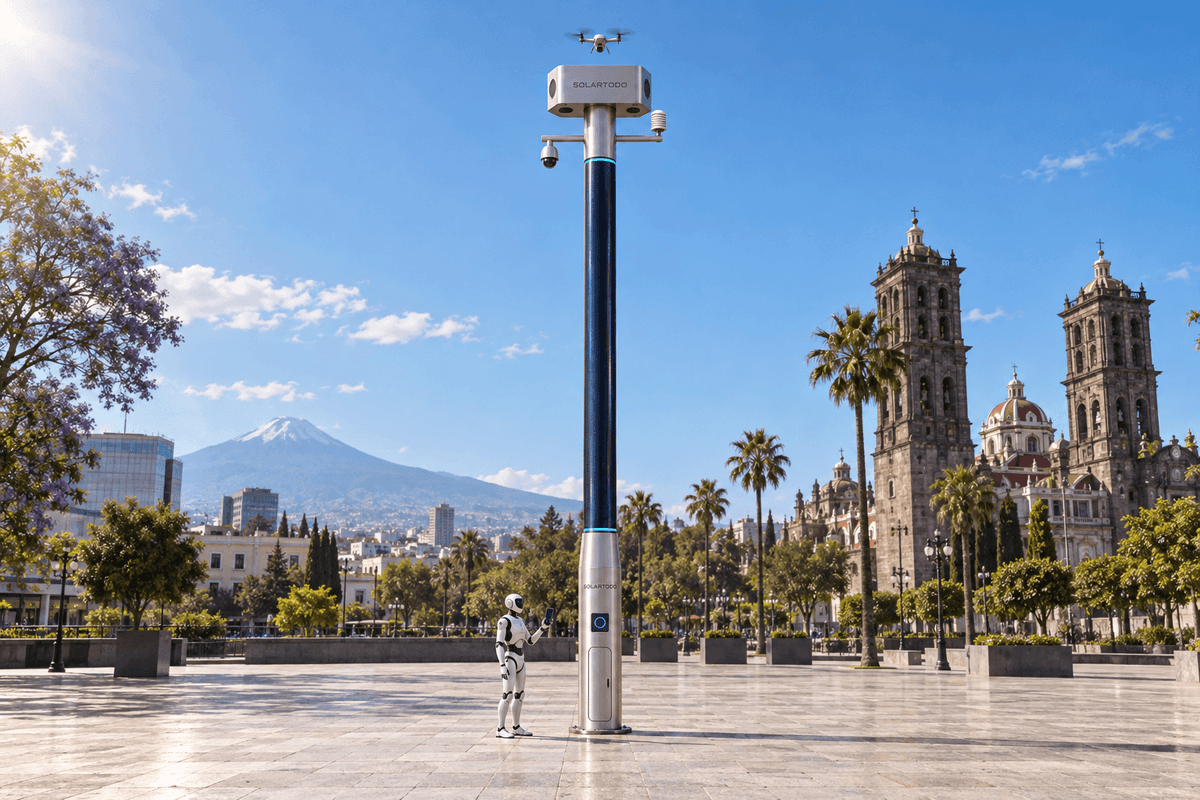
Puebla highland patrol corridors: SOLARTODO Sentinel City AI Pole 32-node off-grid configuration
Summary
Puebla’s inland highland setting at about 2,140 m, 1,270 mm annual rainfall, and 32-node patrol spacing favors a fully off-grid SOLARTODO Sentinel City AI Pole architecture for local sensing and robotic response.
Key Takeaways
Puebla’s 32-node Sentinel configuration should prioritize off-grid storage, edge processing, and heritage-sensitive installation over any grid-tied or lighting-led infrastructure model.
- A typical 32-unit deployment at about 35 m spacing would cover roughly 1.1 km of linear corridor or multiple short security segments.
- Puebla’s state climate baseline is 17.5°C average temperature, 1,270 mm annual rainfall, and April winds near 12.8 km/h, according to ProAire PEACC Puebla.
- Each SOLARTODO Sentinel City AI Pole is a pure smart pole with no lighting system, no site power requirement, and 5-20 kWh-class battery buffering.
- On-pole CIGS replenishment should be modeled as roughly 0.8-1.1 kW DC clear-sky peak and 6-9 kWh/day in high-irradiance conditions.
- Local engineering should consider Mexican 34.5 kV distribution context and NOM-002-SEDE-2010 transformer insulation classes, although Sentinel itself is off-grid.
- Edge AI processing keeps raw video and sensor data on the pole; only de-identified event and status metadata should leave the node.
- Counter-UAS workflows must remain non-lethal, human-authorized, and limited to detection, tracking, coordination, soft net-capture, or close-approach deterrence.
- For Puebla, procurement should define approximately 32 nodes as a project-based custom configuration, subject to civil, heritage, telecom, and aviation review.
Market Context for Puebla
Puebla’s decision point is not basic electrification; it is how to add 32 resilient edge nodes in a dense, inland, heritage-sensitive metropolitan environment.
Puebla is an inland highland city near 19.04°N, -98.21°W, not a coastal corrosion market. According to the Government of Puebla ProAire PEACC program (2021-2030), the state has 6,583,278 inhabitants, 217 municipalities, and 8,029 urban and rural localities. The same program places the annual state temperature average at 17.5°C, with average rainfall of 1,270 mm/year and a rain season mainly from March to October. These conditions favor sealed electronics, drainage-aware foundations, dust management during dry months, and conservative thermal design for battery cabinets.
The city’s historical core creates a second constraint: installation cannot be treated like a generic industrial park. UNESCO (2024) states, “The city is situated in the Valley of Cuetlaxcoapan at the foot of one of Mexico’s highest volcanoes.” UNESCO also notes that Puebla’s Historic Centre retains a Renaissance grid and is protected through multiple Mexican legal instruments. For a SOLARTODO Sentinel City AI Pole program, this means visual siting, foundation excavation, trench avoidance, and municipal heritage review may matter as much as device performance.
Mexico’s power context is relevant even though the Sentinel City AI Pole is fully off-grid. According to Mexico’s NOM-002-SEDE-2010, distribution transformer insulation classes include 15 kV, 18/25 kV, and 34.5 kV classes; a CRE smart-grid report also identifies Mexico distribution lines including 34.5 kV, 23 kV, and 13.8 kV. Sentinel should therefore be procured as an independent edge micro-station, not as a dependent load on CFE distribution feeders. The practical benefit is simpler power-interface risk: the pole carries battery storage and on-pole solar replenishment, while high-power drone and robot tasks are duty-cycle scheduled.
Puebla also has a public environmental monitoring context that makes edge sensing valuable. According to ProAire PEACC Puebla (2021-2030), the Puebla Valley Metropolitan Zone monitoring network has 5 stations measuring PM10, PM2.5, ozone, nitrogen dioxide, carbon monoxide, sulfur dioxide, temperature, wind speed, wind direction, humidity, pressure, precipitation, and solar radiation. A Sentinel node does not replace regulatory-grade stations, but its local PM10, PM2.5, noise, wind, humidity, pressure, temperature, and illuminance channels can add operational awareness at smaller corridor granularity.
For Latin America, the broader procurement signal is urban concentration plus renewable-energy learning. According to the World Bank (2024), Mexico’s urban population share is about 81%, which supports municipal demand for urban monitoring, mobility safety, and resilient perimeter systems. According to IRENA (2025), Latin America added about 20,089 MW of photovoltaic capacity in 2024, showing regional familiarity with solar procurement and maintenance. IRENA states, “Detailed, accurate and timely data and statistics are essential,” which is also the logic behind local event metadata rather than raw-data export.
Recommended Technical Configuration
A Puebla Sentinel package should use approximately 32 Sky Hub pole-form nodes at 35 m spacing, configured for edge AI, drone service, and ground-robot operations.
A typical 32-unit deployment in this profile would consist of SOLARTODO Sentinel physical-AI city edge nodes in Sky Hub pole form. The recommended spacing of about 35 m is suitable for corridor-level coverage, perimeter segmentation, or a distributed campus-style municipal zone. It should be treated as a project-based configuration, not a claim that SOLARTODO has installed a past Puebla project. Engineering confirmation should verify line of sight, foundation capacity, wireless backhaul quality, local permits, and aviation procedures for each node.
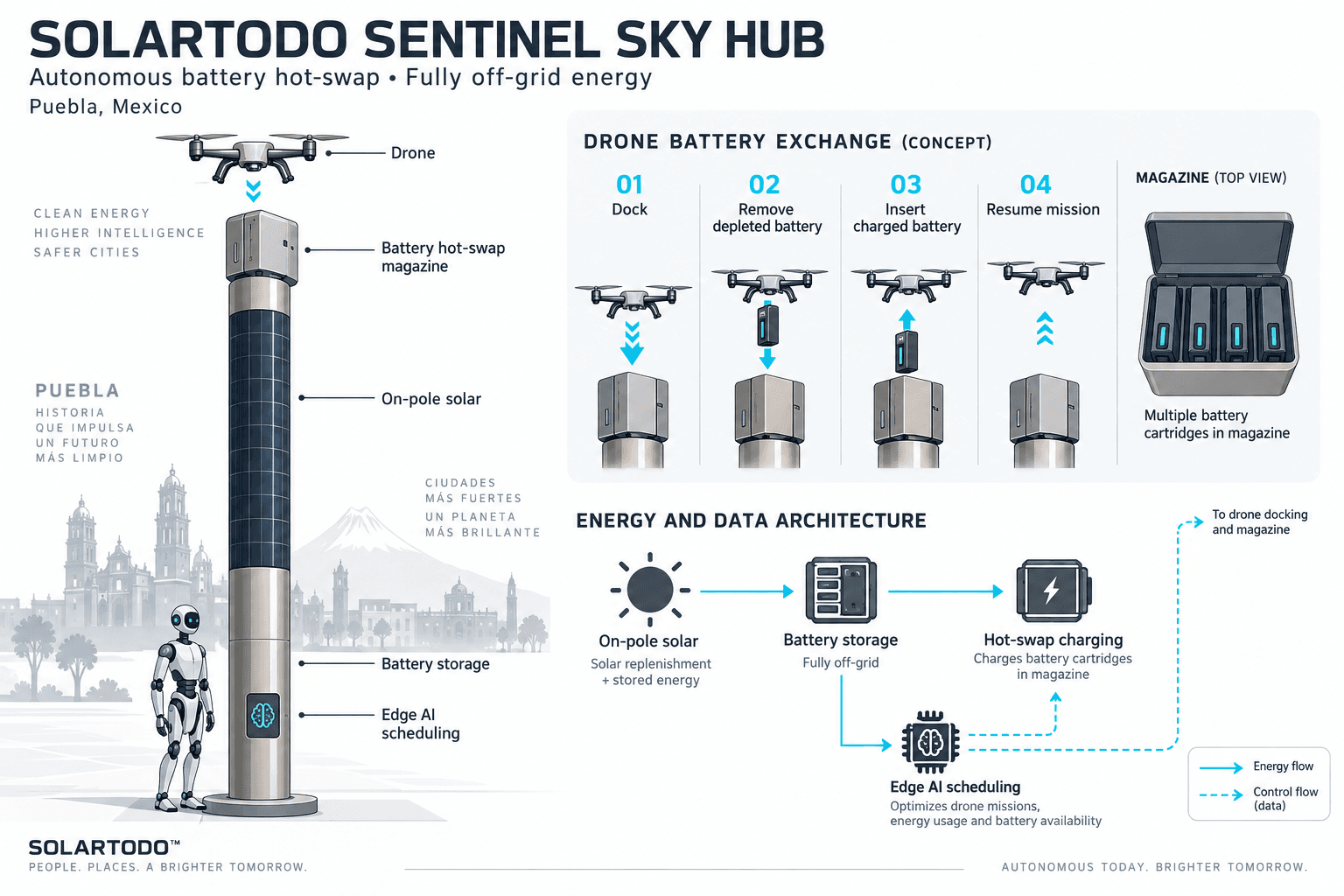
The product fit is strongest where Puebla needs local sensing and field response without adding grid dependency. Each node combines edge compute, anonymous security perception, environmental sensing, autonomous drone operations, automated drone battery exchange, ground-robot support, and a common-operating-picture workflow. The pole is not a smart streetlight and includes no lighting system. Its role is to host sensing, compute, energy buffering, drone service, robot charging, and human-authorized response coordination.
For Puebla’s old-town streets, logistics should be planned in smaller civil packages. Narrow protected corridors and dense façades can restrict crane access, staging space, and excavation windows. For industrial parks, universities, municipal service yards, logistics corridors, and critical-infrastructure perimeters, the same 32 nodes can be installed with fewer heritage constraints. A mixed deployment should therefore classify locations into heritage-sensitive, road-corridor, and controlled-campus types before final bill of materials.
Technical Specifications
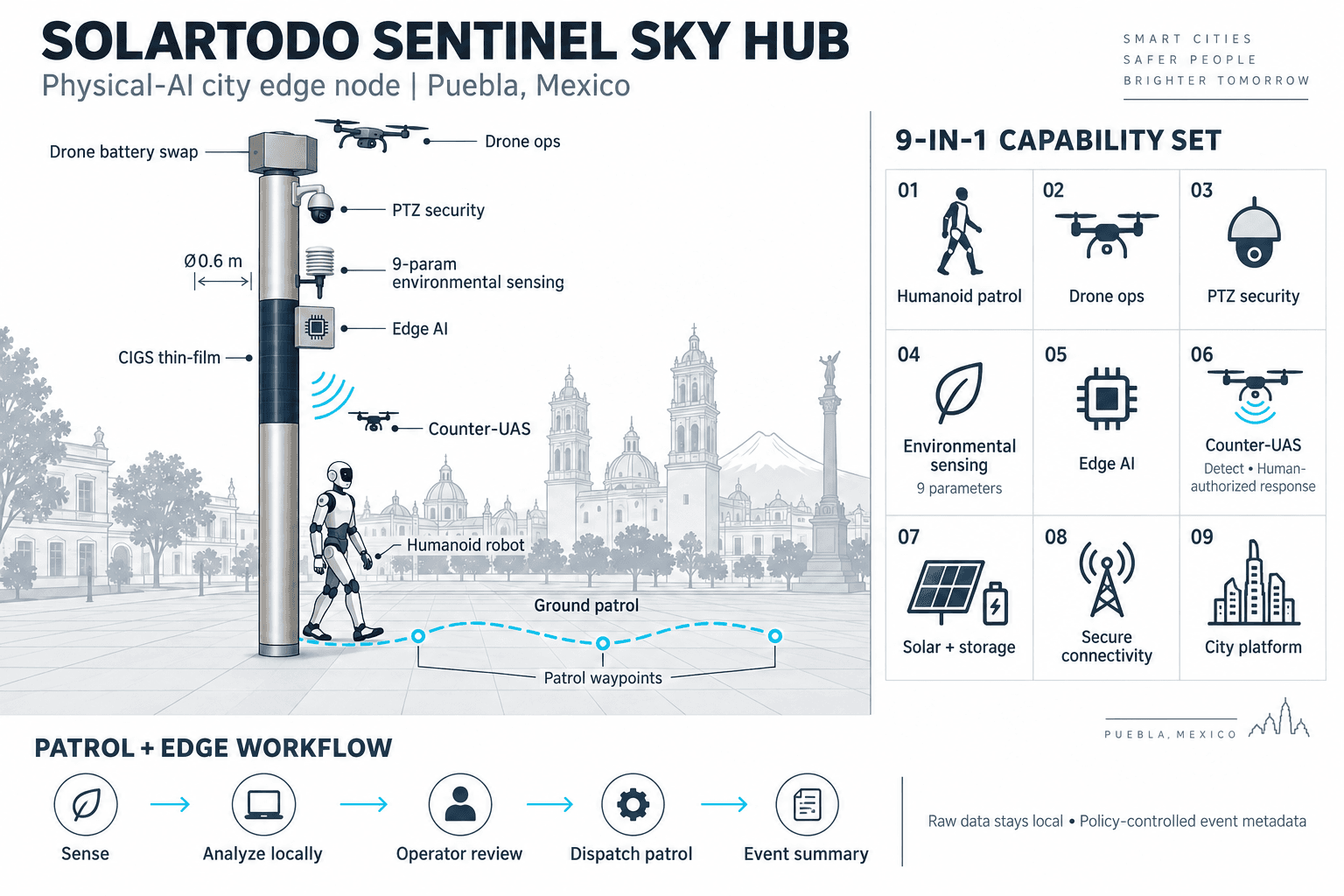
The 32-node Puebla configuration should use battery-backed off-grid poles with local AI compute, 9-channel environmental sensing, drone service, and human-authorized C-UAS coordination.
- Product: SOLARTODO Sentinel City AI Pole, Sky Hub pole-form physical-AI edge node.
- Quantity: approximately 32 units, subject to engineering confirmation.
- Spacing assumption: about 35 m between nodes for a typical corridor profile.
- Energy architecture: fully off-grid micro-station with battery storage and on-pole solar replenishment.
- Solar replenishment: approximately 15 m² of wrapped flexible CIGS thin-film, about 2.4-2.7 kWp nameplate.
- Realistic clear-sky output: approximately 0.8-1.1 kW DC peak and 6-9 kWh/day in high-irradiance conditions.
- Storage buffer: 5-20 kWh-class battery storage sized by mission duty cycle, drone sorties, robot charging, and communications load.
- Edge compute: Jetson-class module for local inference, workload scheduling, event filtering, and mission orchestration.
- Security analytics: PTZ sensing for anonymous vehicle count, crowd density, intrusion, and perimeter awareness; no active face or licence-plate recognition claim.
- Environmental channels: wind speed, wind direction, temperature, humidity, atmospheric pressure, noise, PM10, PM2.5, and illuminance.
- Drone operations: launch, patrol, inspection, return, automated battery hot-swap, route planning, task queueing, health status, and mission logs.
- Ground robot operations: autonomous patrol, alarm response, inspection, air-ground coordination, and wireless charging at the pole base.
- C-UAS coordination: detection and tracking with human-authorized soft net-capture or close-approach deterrence; no jamming, hard-kill, or autonomous attack.
- Data handling: raw video and sensor data stay on the pole; only de-identified event and status metadata may leave the site.
- Standards orientation: IEC 62305 risk-based lightning protection, IEC 62443-style industrial cybersecurity controls, and Mexican NOM review during local engineering.
Implementation Approach
A Puebla rollout should be phased over 6-12 weeks after permits, with surveys, node grouping, foundations, pole erection, commissioning, and operator training.
The first phase is a corridor and asset survey. Engineering teams should map candidate points at about 35 m intervals, then tag each point for foundation type, wireless path, civil-access constraints, drainage exposure, and heritage sensitivity. In Puebla’s protected center, installation drawings should be checked against municipal heritage requirements before any excavation or mounting decision. In industrial or campus zones, the same survey can move faster but still needs geotechnical confirmation.
The second phase is configuration and procurement. A 32-node batch should be divided into installation groups so that batteries, drone service modules, robotic charging points, compute units, and environmental sensors can be tested before shipment. CKD or modular shipping may reduce handling risk and simplify customs documentation. The project dossier should define maintenance access, battery replacement intervals, drone operating windows, and metadata retention rules.
The third phase is civil works and commissioning. Foundations should account for highland rainfall, runoff, and the possibility of localized flooding in older paved corridors. Each pole should be mechanically checked, energized from its storage system, connected to its private command view, and validated with functional tests for environmental sensing, edge inference, drone exchange, robot charging, and metadata export. Final acceptance should use site-specific test logs rather than generic factory claims.
Expected Performance & ROI
For a 32-node Puebla program, ROI should be modeled from avoided patrol trips, faster alarm assessment, and reduced trenching rather than energy resale.
The main performance benefit is operational density. At about 35 m spacing, 32 nodes can create a short, high-resolution patrol corridor or several discrete municipal security zones. Edge inference reduces bandwidth load because raw video stays local; the command center receives events, device health, environmental readings, and mission status. This architecture is especially useful where Puebla wants awareness without continuously streaming raw surveillance data across public networks.
Energy performance should be conservative. The wrapped CIGS layer is a supplemental replenishment source, not an unlimited power claim. Drone sorties, compute bursts, and robot charging should be scheduled against the 5-20 kWh storage buffer, with weather-aware duty cycles during long rainy periods. According to NREL (2024), solar resource modeling depends on location-specific irradiance and system assumptions, so Puebla yield confirmation should use local solar data, shading checks, and actual load profiles.
ROI and payback should be quoted only after engineering and service-scope confirmation. A buyer can compare Sentinel against grid-connected camera masts, fixed environmental stations, and manual patrol expansion. The Sentinel case is strongest when the value of autonomous inspection, local processing, reduced trenching, and faster incident triage exceeds the cost of battery maintenance and robotic operations. For public procurement, SOLARTODO should present total cost of ownership, warranty scope, spares, training, and service-level assumptions rather than a generic unit price.
Results and Impact
The expected impact is a 32-node local-processing network that improves patrol responsiveness while limiting raw-data movement and avoiding new grid power connections.
A Puebla deployment of this scale would not be described as a past case study unless official project records exist. The correct evaluation frame is expected impact: shorter incident verification loops, higher environmental granularity, better perimeter awareness, and fewer truck rolls for routine patrol checks. The system should be measured with commissioning logs, event-to-assessment timing, drone sortie availability, robot charging uptime, and battery state-of-charge stability.
For public-sector stakeholders, the strongest governance result is data minimization. Raw video and sensor streams remain on the pole, while de-identified event and status metadata supports the command view. This PDPL-LGPD-oriented design does not mean automatic certification, but it aligns with privacy-by-design procurement language. For SOLARTODO, the Puebla recommendation is a controlled 32-node technical package, not a national rollout claim.
Comparison Table
A 32-node Sentinel design differs from conventional camera masts by combining off-grid energy buffering, local AI inference, robotic operations, and human-authorized response.
| Criterion | SOLARTODO Sentinel City AI Pole | Grid-connected camera mast | Standalone air-quality station |
|---|---|---|---|
| Typical Puebla quantity | Approximately 32 nodes | 32-64 masts depending on coverage | 5-10 stations for sampling density |
| Power model | Fully off-grid, 5-20 kWh storage, solar replenishment | Grid-fed, civil trenching often required | Grid or cabinet power common |
| Solar contribution | 0.8-1.1 kW DC clear-sky peak; 6-9 kWh/day in high-irradiance regions | Not core architecture | Not core architecture |
| Data handling | Raw data processed on-pole; metadata exported | Often central video backhaul | Environmental telemetry exported |
| Robotics | Drone operations, battery hot-swap, ground robot charging | Usually none | None |
| Environmental sensing | 9 channels: wind, temperature, humidity, pressure, noise, PM10, PM2.5, illuminance | Optional and limited | Stronger regulated measurement focus |
| C-UAS posture | Human-authorized, non-lethal coordination only | Usually detection-only or none | None |
| Best-fit Puebla zones | Campuses, corridors, industrial parks, perimeters | Fixed observation points | Regulatory monitoring locations |
Pricing & Quotation
Pricing for a 32-node Puebla configuration depends on engineering scope, battery sizing, drone duty cycle, robot package, installation class, and warranty terms.
SOLARTODO offers three pricing tiers for this product line: FOB Supply (equipment ex-works China), CIF Delivered (including ocean freight and insurance), and EPC Turnkey (fully installed, commissioned, with 1-year warranty). Volume discounts are available for large-scale deployments. Configure your system online for an instant estimate, or request a custom quotation from our engineering team at [email protected].
For Puebla buyers comparing procurement routes, FOB is appropriate when a qualified local integrator controls civil works and commissioning. CIF is useful when the buyer wants delivered equipment with local installation handled separately. EPC Turnkey is the most complete route when SOLARTODO must coordinate engineering, installation, commissioning, and handover documentation. Product discovery should start from the SOLARTODO solutions page, then move to a project quotation through contact us.
Frequently Asked Questions
A Puebla buyer should evaluate the 32-node SOLARTODO Sentinel package as an off-grid edge-infrastructure system, not as a lighting or camera-only purchase.
Q1: Is the SOLARTODO Sentinel City AI Pole a smart streetlight? No. The SOLARTODO Sentinel City AI Pole is a pure smart pole and includes no lighting system. Its purpose is edge computing, sensing, drone service, ground-robot operations, environmental monitoring, and human-authorized response coordination. For Puebla, this distinction matters because procurement should specify city edge nodes, not luminaires or illumination upgrades.
Q2: Why is Puebla a fit for a 32-node configuration? A 32-node package at about 35 m spacing can cover roughly 1.1 km of corridor or several shorter municipal, campus, or industrial segments. Puebla’s highland climate, dense historic streets, and perimeter-security needs favor distributed nodes that do not depend on new grid feeds. Final placement still requires survey, permits, and civil confirmation.
Q3: How long would implementation normally take? After permits and engineering approval, a typical 32-node rollout can be planned in about 6-12 weeks, depending on foundation conditions, customs, local staging space, and commissioning scope. Historic-center locations may take longer because heritage review and restricted work windows can affect excavation, crane access, and equipment movement.
Q4: What technical specs should be confirmed before ordering? The buyer should confirm node quantity, 35 m spacing assumptions, battery size in the 5-20 kWh class, drone sortie frequency, robot duty cycle, wireless backhaul, foundation design, lightning protection, and metadata retention policy. Solar replenishment should be modeled as 0.8-1.1 kW DC clear-sky peak, not unlimited self-sufficiency.
Q5: What ROI factors matter most in Puebla? ROI should be modeled from avoided trenching, reduced patrol trips, faster incident assessment, lower bandwidth from edge processing, and fewer manual inspections. Payback cannot be responsibly stated without civil scope, service level, staffing baseline, and warranty package. SOLARTODO should quote total cost of ownership rather than a generic price.
Q6: How does Sentinel compare with fixed CCTV poles? A fixed CCTV pole normally observes and transmits video, while Sentinel processes raw data locally and coordinates drone and ground-robot operations. It also adds 9-channel environmental sensing and battery-backed off-grid operation. The tradeoff is greater system complexity, so commissioning, training, and maintenance planning are more important.
Q7: Does raw video leave the pole? No. The recommended architecture keeps raw video and sensor data on the pole for local processing. Only de-identified event and status metadata should leave the node. This is a PDPL-LGPD-oriented design approach, not a claim of automatic certification under every Mexican or international privacy rule.
Q8: What maintenance is required? Maintenance should include battery health checks, solar-surface inspection, sensor calibration, drone battery magazine checks, robot charging tests, firmware updates, weather sealing review, and foundation inspection after heavy rain. For Puebla, dust in dry periods and rainfall from March to October should shape inspection intervals and spare-parts planning.
Q9: How is counter-UAS handled safely? Counter-UAS functions are non-lethal and human-authorized only. The pole may detect and track an unauthorized drone, then coordinate a friendly drone for soft aerial net-capture or close-approach deterrence where permitted. It must not be specified for jamming, shoot-down, autonomous attack, or any hard-kill method.
Q10: What pricing route should EPCs request? EPCs should request FOB Supply when they control local installation, CIF Delivered when logistics support is needed, and EPC Turnkey when SOLARTODO is expected to provide installation, commissioning, and 1-year warranty scope. The quote should separate civil works, battery sizing, drone package, robot package, training, and support terms.
References
A Puebla Sentinel specification should be backed by at least 7 public references covering demographics, climate, heritage, electrical context, solar modeling, and standards.
- INEGI / Government of Puebla (2021-2030): ProAire PEACC Puebla reports 6,583,278 state inhabitants, 217 municipalities, 17.5°C average annual temperature, and 1,270 mm/year rainfall. https://calidaddelaire.puebla.gob.mx/documents/ProAire-PEACC_2021-2030/proaire/Executive%20Summary-ProAire-PEACC-Puebla-2021-2030.pdf
- UNESCO (2024): Historic Centre of Puebla description identifies the city’s Valley of Cuetlaxcoapan location, strategic corridor role, Renaissance grid, and protected heritage context. https://whc.unesco.org/en/list/416
- SENER / DOF (2010): NOM-002-SEDE-2010 defines Mexican distribution transformer classes including 15 kV, 18/25 kV, and 34.5 kV insulation classes. https://dof.gob.mx/normasOficiales/4577/sener/sener.htm
- CRE / Smart Grid Regulatory Framework (2014): Mexico distribution systems include 34.5 kV, 23 kV, 13.8 kV, 6.6 kV, 4.16 kV, and 2.4 kV lines. https://www.cre.gob.mx/documento/3979.pdf
- World Bank (2024): World Development Indicators urban population series places Mexico’s urban share at about 81%, supporting urban infrastructure demand analysis. https://data.worldbank.org/indicator/SP.URB.TOTL.IN.ZS?locations=MX
- IRENA (2025): Renewable capacity statistics show Latin America added about 20,089 MW of solar PV capacity in 2024, indicating regional solar procurement maturity. https://www.irena.org/Data
- IEC (2024): IEC 62305-1:2024 provides general principles for lightning protection of structures, installations, contents, and persons. https://webstore.iec.ch/en/publication/27136
- IEC / ISA (2023): IEC 62443 guidance addresses cybersecurity robustness and resilience across industrial automation and control system lifecycles. https://syc-se.iec.ch/deliveries/cybersecurity-guidelines/security-standards-and-best-practices/iec-62443/
Equipment Deployed
- 32 SOLARTODO Sentinel City AI Pole Sky Hub edge nodes, project-based configuration
- Approximately 35 m node spacing for corridor or segmented perimeter planning
- 5-20 kWh-class battery storage per node, sized by mission duty cycle
- Wrapped flexible CIGS replenishment layer, about 2.4-2.7 kWp nameplate
- Realistic clear-sky replenishment model of about 0.8-1.1 kW DC peak
- Jetson-class edge AI compute for local inference and workload scheduling
- PTZ sensing for anonymous vehicle count, crowd density, intrusion, and perimeter awareness
- 9-channel environmental monitoring: wind speed, wind direction, temperature, humidity, pressure, noise, PM10, PM2.5, illuminance
- Automated drone operations with launch, patrol, return, battery hot-swap, mission logs, and health status
- Ground robot operation support with autonomous patrol, alarm response, inspection, coordination, and wireless charging
- Human-authorized non-lethal C-UAS coordination: detection, tracking, soft net-capture, or close-approach deterrence