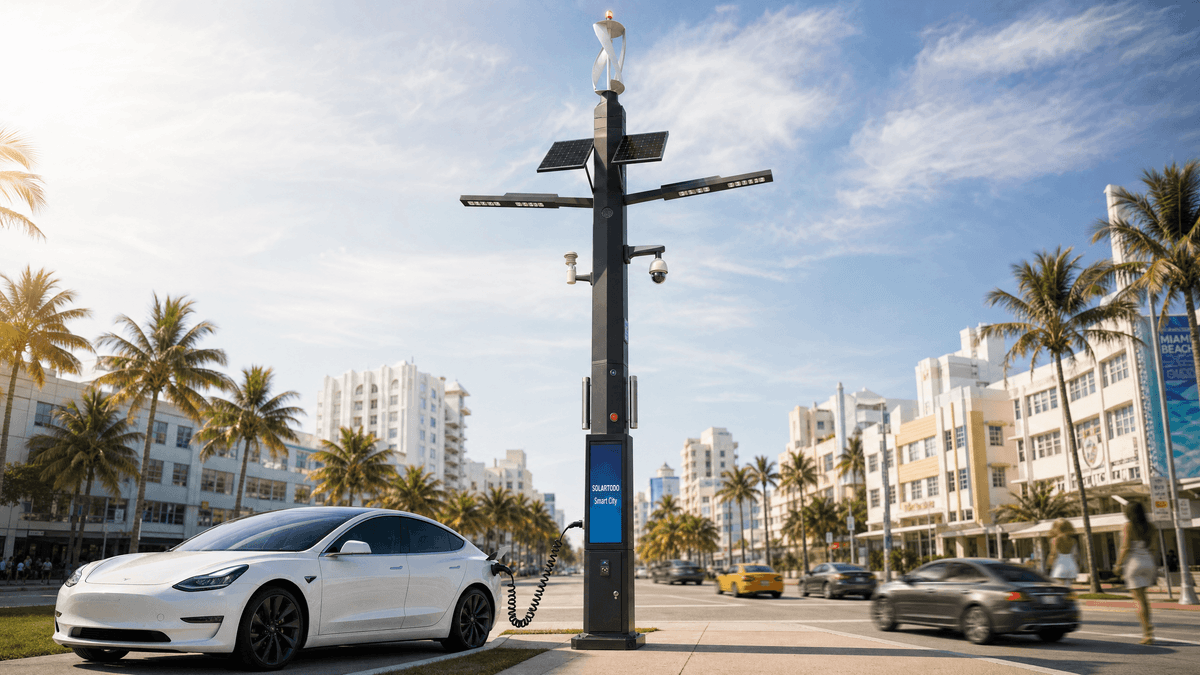
Prague Smart Streetlight Market Analysis: 37-Unit Hybrid 12m Configuration Guide for Urban Corridors
Summary
Prague’s dense inner-city streets, winter irradiance limits, and growing EV/public-safety needs make a hybrid 12m Smart Streetlight profile technically suitable; a typical 37-unit corridor at 30m spacing covers about 1.1km with 15kWh LFP storage and dual 7kW AC charging.
Key Takeaways
- A typical Prague corridor deployment would use approximately 37 units at 30m spacing, covering about 1,110m of urban street frontage with 12m pole height for city-road lighting and device clearance.
- The recommended form factor is the SOLAR TODO hybrid 12m pole with a 500W Darrieus H-type VAWT, 2×100W monocrystalline panels, and 15kWh LFP battery plus grid backup.
- Each pole would carry 2×80W LED luminaires at 150 lm/W and 4000K, giving 160W total connected lighting load per pole before controls-based dimming.
- The lower 2.2m of the pole is the EV charging cabinet itself, supporting a dual-gun 7kW AC charger with 2× Type 2 connectors and OCPP 1.6J compliance.
- Public-safety hardware in the recommended Prague profile includes a 25x PTZ dome with IR 150m, one-press SOS intercom, and 2×30W TCP/IP audio columns mounted flush to the pole faces.
- Connectivity density fits central European smart-city use cases: WiFi 6 at 1.8Gbps for up to 256 devices, plus an 8-parameter environmental sensor package at pole top.
- According to the Czech Statistical Office (2024), Prague has about 1.38 million residents, which supports high pedestrian and mixed-mobility demand on collector streets where 30–50 poles/km is typical.
- According to IEC 62196-2 and IEC 60598, the specified charging and lighting architecture aligns with recognized connector and luminaire standards used in European municipal procurement.
Market Context for Prague
Prague combines a population of roughly 1.38 million with high daily commuting intensity, which makes multifunction street infrastructure more relevant on tram corridors, mixed-use boulevards, and redevelopment streets than single-purpose lighting poles. According to the Czech Statistical Office (2024), Prague is the country’s largest municipality by population. According to the Prague Institute of Planning and Development (IPR Prague) (2023), the city continues to prioritize public-space quality, multimodal mobility, and digital services in metropolitan planning documents.
Climate and daylight conditions matter for equipment selection. According to Climate-Data.org (2024), Prague records cold winters and moderate annual solar availability, with December and January showing materially lower sunshine than summer months. That seasonal profile supports a hybrid architecture rather than a solar-only pole, because winter lighting demand is high while solar harvest is lower. For Prague, a wind-solar hybrid pole with grid backup is a more stable fit than an off-grid-only design.
Electric mobility also affects pole specification. According to the International Energy Agency (IEA) (2024), Europe remains one of the largest EV markets globally, and curbside AC charging continues to be important where private off-street parking is constrained. In Prague’s pre-war blocks and dense mixed-use districts, a 7kW dual-gun AC charger integrated into the pole body would usually fit better than adding a separate pedestal that consumes more sidewalk width.
Telecom and public-safety functions are also relevant. According to the European Commission (2023), urban digital infrastructure and Wi-Fi access remain part of smart-city modernization across EU municipalities. A Prague streetlight specification that combines WiFi 6, PTZ CCTV, SOS intercom, and environmental sensing can therefore support multiple city departments with one civil foundation every 30m instead of separate poles for lighting, surveillance, public address, and charging.
For size class, Prague’s target use case is an urban street, not a highway and not a park path. The product brief specifies 25–50m spacing and 30–50 poles per km for city/urban streets, while highways require a different 12m+ traffic-pole logic and parks typically use 6–8m garden lighting. Based on that classification, the correct recommendation is the 12m hybrid Smart Streetlight variant rather than a shorter garden pole or a highway mast.
[Organization] states, "Public lighting should provide a safe visual environment for road users and pedestrians." That principle from IEC luminaire practice is directly relevant in Prague, where mixed tram, bicycle, pedestrian, and car traffic often shares constrained rights-of-way. IRENA states, "Electrification of transport and digitalization are increasingly linked in urban infrastructure planning," which supports combining EV charging and smart controls in one pole line.
Recommended Technical Configuration
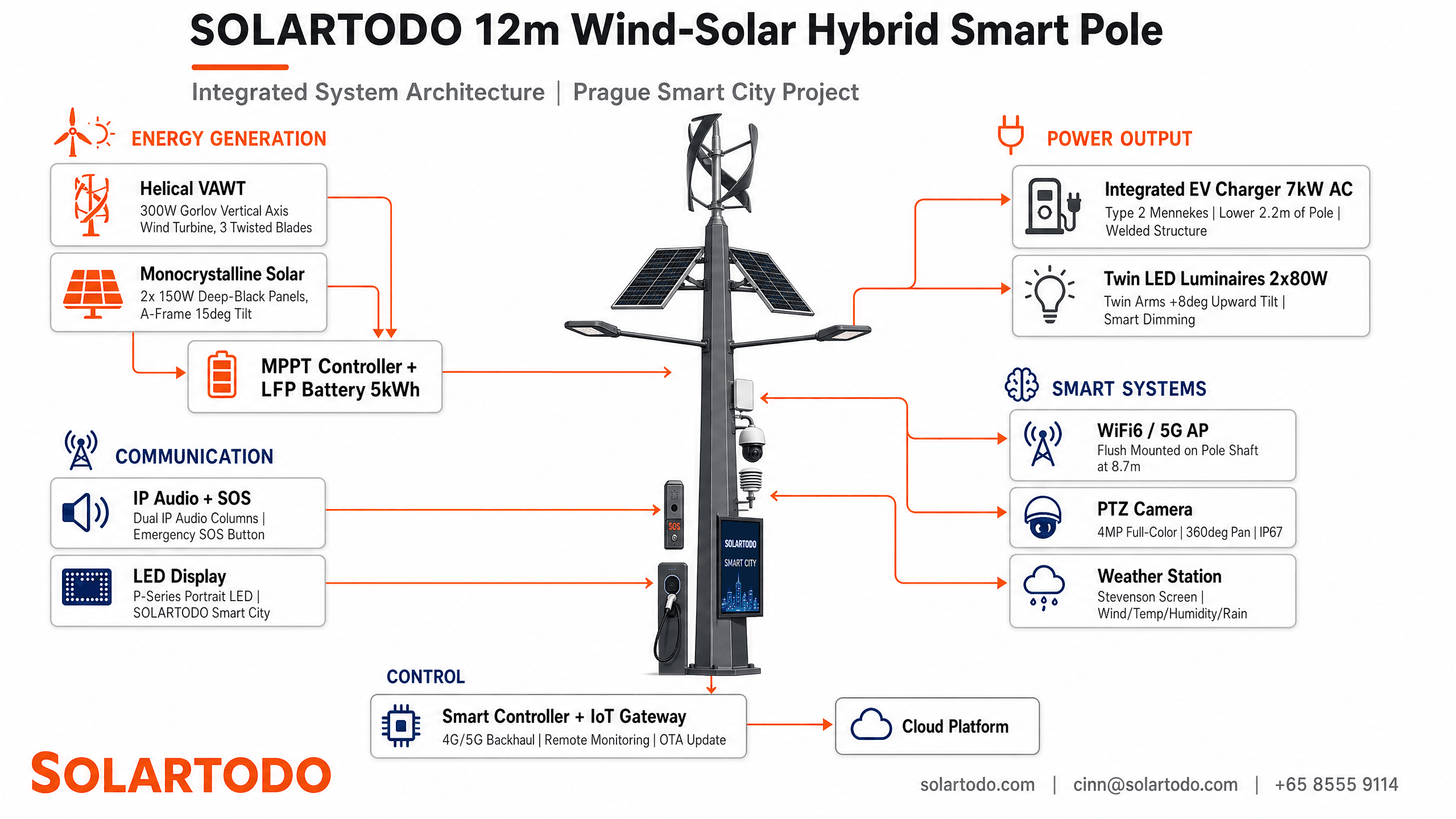
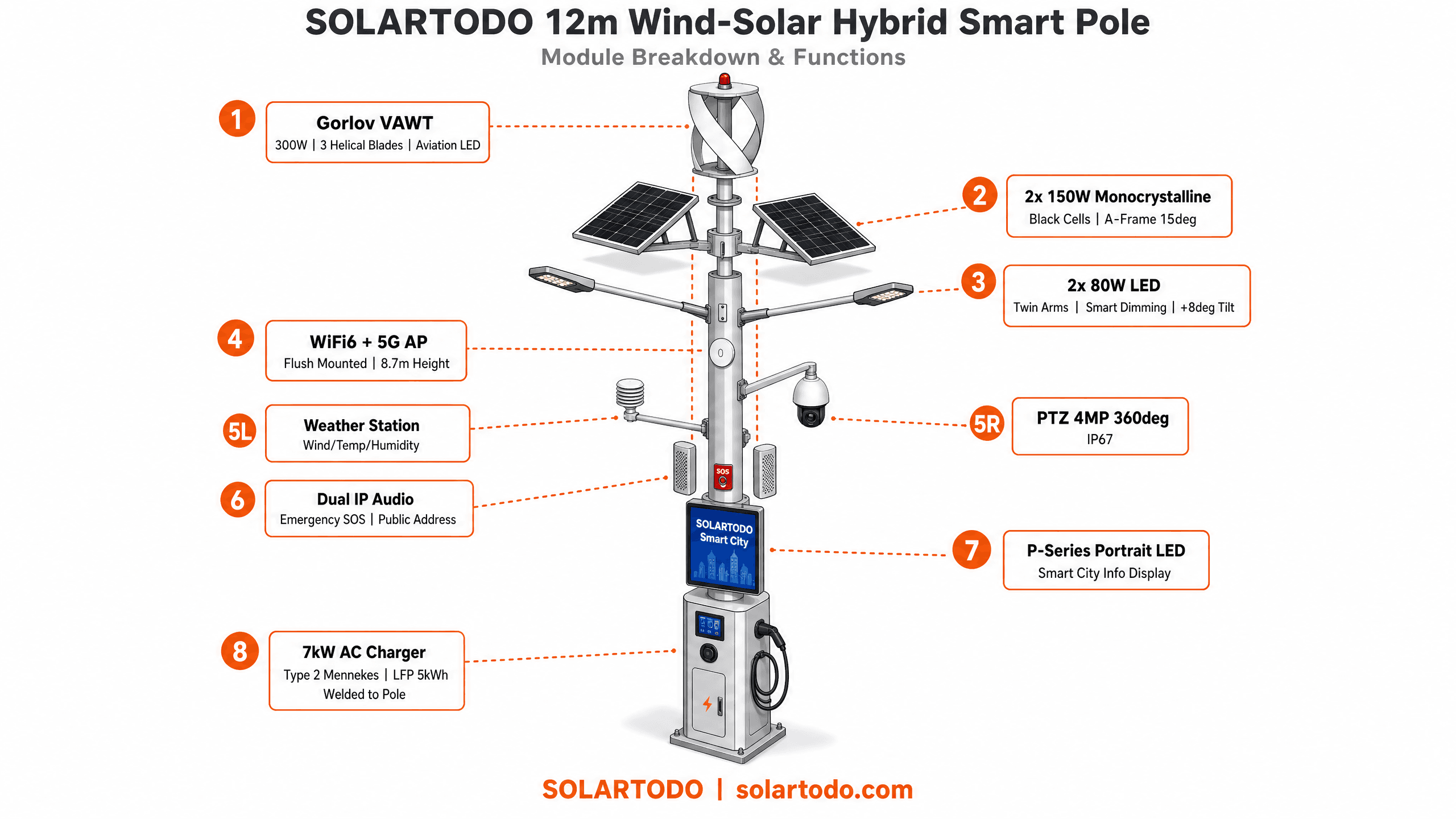
For Prague’s dense urban corridors, a typical 37-unit deployment would use 12m hybrid Smart Streetlight poles at 30m spacing, combining 160W lighting, 15kWh storage, 500W wind generation, and dual 7kW AC charging in one streetscape element.
A suitable Prague specification is the SOLAR TODO hybrid_12m form using the project-defined hybrid12 package. The recommended quantity is approximately 37 units, which corresponds to about 1.1km at 30m spacing. This quantity should be read as a planning benchmark for one urban corridor or district frontage, not as a claim of completed installation.
The reason to select this configuration is straightforward. Prague’s winter load profile favors grid-assisted resilience, while its heritage-sensitive streets benefit from reducing street clutter. The lower 2.2m of the pole serving as the EV charging cabinet avoids adding a second pedestal. That matters on sidewalks where clear pedestrian width can be constrained to 2.0–3.5m after trees, tram furniture, and parking controls are accounted for.
The recommended pole body is a 12m octagonal tapered steel structure with base diameter 45cm and top diameter 15cm, finished in charcoal RAL7021 powder coat. This geometry is suitable for urban lighting, camera sightlines, and display visibility without moving into highway mast scale. SOLAR TODO positions this as a multifunction city-street pole rather than a traffic interchange structure.
For self-generation, the configuration uses a Darrieus H-type VAWT with 3 straight vertical blades, rotor size Ø80×110cm, and rated power 500W, plus a red aviation LED at the top assembly. Solar support comes from 2×100W deep-black monocrystalline panels mounted mid-pole on symmetric east-west A-frame brackets at 15° tilt. In Prague, that east-west orientation is practical for broad daily capture and more balanced streetscape appearance than a single south-facing cantilever.
Energy storage is specified as a 15kWh LFP battery inside the pole base with MPPT controller and backup grid tie. That battery size is large relative to the 160W nominal lighting load, which gives room for overnight lighting support, communications uptime, and emergency subsystem continuity. According to NREL (2023), lithium iron phosphate chemistry remains widely used in stationary and mobility-adjacent systems because of thermal stability and cycle-life characteristics.
The communications and public-safety package is dense but still within urban-pole norms. Each pole would include a 22cm white PTZ dome camera with 360° rotation, 25x zoom, and IR 150m on a 50cm L-bracket outrigger; an 8-parameter environmental sensor at top; 2×30W IP audio columns; one-press SOS with dual-way audio; and a flush-mounted WiFi 6 AP at 8.7m supporting 256 devices and 1.8Gbps. For Prague, this combination suits tram stops, school streets, municipal squares, and mixed-use corridors.
The display element is a P5 vertical LED screen sized 1280×2560mm in portrait format with brightness above 5,000 cd/m². Content in this defined configuration is strictly limited to the text “SOLARTODO Smart City” in white sans-serif on deep blue, with no other imagery. That should be checked against Prague conservation-zone signage rules before procurement if the corridor falls within a heritage-protected district.
For buyers comparing product families, the hybrid 12m option is more suitable for Prague than the MENA-oriented grid_12m integrated-charger pole because Prague’s winter resilience benefits from 15kWh on-pole storage. The cylindrical cyl_219 premium pole is visually cleaner, but the project-specific specification required here is the hybrid 12m package. SOLAR TODO should therefore be evaluated in Prague primarily on corridor function, sidewalk width, and utility interconnection conditions.
Technical Specifications
The Prague-fit specification is a 12m hybrid Smart Streetlight with 37 planned units, 30m spacing, 500W wind, 200W solar, 15kWh LFP storage, and a dual-gun 7kW AC charger integrated into the lower 2.2m of the pole.
- Quantity basis: approximately 37 units for a typical corridor-scale deployment
- Pole height: 12m octagonal tapered steel pole
- Pole geometry: base Ø45cm to top Ø15cm
- Finish: charcoal RAL7021 powder coat
- Spacing: 30m typical center-to-center
- Lighting: twin symmetric arms, each 1.5m long, with +8° upward tilt
- Luminaire load: 2×80W LED, total 160W per pole
- Luminaire efficacy: 150 lm/W
- CCT: 4000K
- Wind generation: Darrieus H-type VAWT, 3 straight vertical blades
- Wind turbine size: Ø80×110cm
- Wind turbine rating: 500W
- Aviation marker: red LED on turbine top section
- Solar generation: 2×100W monocrystalline deep-black panels
- Solar mounting: symmetric east-west A-frame brackets at 15° tilt
- Battery: 15kWh LFP battery inside pole base
- Charge control: MPPT controller with backup grid tie
- Camera: 22cm white PTZ dome, 360° rotation, 25x zoom, IR 150m
- Camera mount: 50cm L-bracket outrigger
- Environmental sensing: 8 parameters — temperature, humidity, wind, pressure, noise, PM2.5, PM10, illuminance
- Public address: 2× IP audio columns, Ø10×50cm, 30W, 93dB
- Speaker format: TCP/IP networked slim perforated aluminum columns mounted flush on opposite flat pole faces
- Emergency system: one-press SOS button, dual-way audio intercom, visual LED indicator
- EV charging: integrated pole-as-charger design, lower 2.2m is the charging cabinet as one welded steel structure
- Charging rating: dual-gun AC 7kW
- Connector standard: 2× Type 2, OCPP 1.6J
- Cable: 5m coiled cable
- Charger interface: touchscreen, emergency stop, maintenance door
- Display: P5 vertical LED screen, 1280×2560mm portrait, >5000 cd/m²
- Display content constraint: “SOLARTODO Smart City” only, white sans-serif on deep blue
- Connectivity: WiFi 6 AP, 802.11ax, up to 256 devices, 1.8Gbps
- WiFi mounting height: 8.7m flush on flat pole face with color-matched housing
- Extra charging port: none
- Applicable standards: IEC 60598, GB/T 37024, IEC 62196-2
Implementation Approach
A Prague rollout of 37 hybrid Smart Streetlights would typically proceed in 4 phases over roughly 16–28 weeks, depending on utility approvals, heritage review, and civil works sequencing.
Phase 1 is corridor selection and design freeze. This usually takes 4–8 weeks and includes photometric checks, sidewalk clearance review, utility mapping, and charger interconnection discussions. In Prague, this phase is especially important where tram catenary, mature trees, and conservation facades create vertical and horizontal constraints. A 12m pole with 1.5m twin arms and a 50cm camera outrigger needs clash detection before foundation drawings are released.
Phase 2 is procurement and factory documentation. This often takes 6–10 weeks for steel fabrication, powder coating, charger integration, cable routing, FAT records, and packaging. For the specified SOLAR TODO design, the integrated charger is not a separate pillar; the lower 2.2m of the pole is the cabinet body itself, welded as one continuous steel structure. That detail affects coating sequence, access-door tolerances, and transport bracing.
Phase 3 is civil works and utility preparation. A municipal buyer would typically sequence foundations, conduits, earthing, and feeder checks in 2–6 weeks depending on permit windows. Because each pole contains a 15kWh LFP battery and dual-gun 7kW AC charger, planners should verify local low-voltage service capacity, protective devices, and OCPP backhaul before erection day. According to IEC 62196-2, Type 2 connector compatibility is standard for AC charging in Europe.
Phase 4 is erection, commissioning, and software onboarding. Pole setting, luminaire aiming, charger testing, camera setup, WiFi configuration, and emergency-call verification can usually be done in 1–3 weeks for a 37-unit line if civil works are complete. Acceptance should include lux measurement, charger handshake tests, speaker intelligibility checks, PTZ preset validation, and battery/MPPT telemetry review. SOLAR TODO or the appointed EPC contractor would usually provide commissioning documents and as-built schedules at this stage.
Expected Performance & ROI
For Prague streets with 37 poles at 160W lighting load each, annual lighting consumption before dimming would be about 32.4MWh at 15 operating hours per day, while hybrid generation and controls can reduce grid dependence and improve service continuity.
A simple baseline helps buyers evaluate value. At 37 poles and 160W each, total lighting load is 5.92kW. If lights operate an average 15 hours per day across the year due to winter-heavy night demand, annual lighting energy is about 32,412kWh. If adaptive dimming trims average lighting power by 25% during low-traffic hours, that portion alone could reduce annual consumption by about 8.1MWh.
The charger business case depends more on utilization than on lighting savings. A dual 7kW AC charger gives 14kW nameplate charging capacity per pole, although actual simultaneous use varies. On a 37-pole corridor, theoretical aggregate charging capacity is 518kW. In practice, municipal buyers should model occupancy, parking turnover, and distribution-connection limits rather than assuming full coincidence.
Operations savings also come from pole consolidation. Instead of separate assets for lighting, CCTV, SOS, PA, Wi-Fi, display, environmental sensing, and EV charging, one foundation and one maintenance access point can support all systems. According to the World Bank (2022), LED public-lighting upgrades commonly reduce electricity use by 50% or more relative to legacy sodium systems, though actual savings depend on baseline lamp wattage and controls strategy. Prague corridors still using older fixtures would therefore see the strongest energy benefit.
Battery-backed continuity is another value factor. With 15kWh LFP per pole, core low-power services such as communications, controller, SOS, and selected lighting circuits can remain available during short grid interruptions, subject to dispatch logic. According to NREL (2023), storage improves resilience where critical loads must ride through outages or power-quality issues. For Prague, that is relevant on tram-adjacent streets and civic spaces where safety systems should not drop immediately during a feeder event.
Payback is site-specific, so it should be expressed as a range rather than a fixed claim. For Prague, a combined lighting-plus-charging-plus-telecom use case would often evaluate on 5–10 year total cost of ownership rather than a simple lamp-only payback. The shortest cases usually depend on three revenue or savings streams: reduced energy use, avoided separate infrastructure, and EV charging/network service income. Buyers seeking a corridor-specific model can contact us or review the product category at /products/smart-streetlight.
Comparison Table
For Prague, the strongest technical fit is the 12m hybrid configuration because it combines 15kWh storage, dual 7kW charging, and city-street spacing at 30m without requiring separate charger pedestals.
| Metric | Recommended Prague Hybrid 12m | Conventional LED Pole + Separate Charger | Short 6–8m Garden/Path Pole |
|---|---|---|---|
| Typical use case | Urban corridor / collector street | Street lighting + curbside charging split assets | Parks / paths / plazas |
| Pole height | 12m | 8–12m lighting pole + separate charger | 6–8m |
| Typical spacing | 30m | 30–40m lighting, charger separate | 20–30m |
| Lighting load per pole | 2×80W = 160W | 80–150W typical | 30–80W typical |
| On-pole storage | 15kWh LFP | Usually none | Usually none |
| Wind generation | 500W VAWT | None | None |
| Solar generation | 2×100W mono | None | Sometimes low-power only |
| EV charging | Integrated 2×7kW AC Type 2 | Separate pedestal, often 1× or 2× AC | Not typical |
| CCTV | PTZ 25x, IR 150m | Optional separate pole/device | Limited |
| Public address / SOS | Included | Usually separate asset | Rare |
| WiFi 6 | 1.8Gbps / 256 devices | Optional separate AP | Rare |
| Civil footprint | One pole foundation | Pole foundation + charger foundation | One smaller foundation |
| Best fit for Prague | High | Medium | Low for roadway corridors |
Pricing & Quotation
SOLAR TODO offers three pricing tiers for this product line: FOB Supply (equipment ex-works China), CIF Delivered (including ocean freight and insurance), and EPC Turnkey (fully installed, commissioned, with 1-year warranty). Volume discounts are available for large-scale deployments. Configure your system online for an instant estimate, or request a custom quotation from our engineering team at [email protected].
Frequently Asked Questions
This Prague Smart Streetlight FAQ answers 10 common buyer questions covering 12m pole specs, 7kW charging, 15kWh storage, installation timing, maintenance, and quotation scope.
Q1: Why is the 12m hybrid Smart Streetlight recommended for Prague instead of a shorter pole?
Prague’s target use case is an urban street corridor, not a park path. The product brief sets city-street spacing at 25–50m, and the specified 12m height supports 2×80W roadway lighting, PTZ camera sightlines, WiFi placement at 8.7m, and display visibility. A 6–8m pole would usually be better for plazas or landscaped paths, not mixed-traffic streets.
Q2: Is this an off-grid system or a grid-connected system?
It is a hybrid system. Each pole combines a 500W VAWT, 2×100W solar panels, and a 15kWh LFP battery with MPPT control, but it also includes backup grid tie. That architecture fits Prague better than a solar-only design because winter irradiance is lower and lighting demand is high during long nights.
Q3: How is the EV charger integrated into the pole?
The charger is not a separate pedestal. The lower 2.2m of the 12m steel pole is the charging cabinet itself, fabricated as one welded continuous structure. The charger specification is dual-gun 7kW AC with 2× Type 2 connectors, OCPP 1.6J, 5m coiled cable, touchscreen, emergency stop, and maintenance door.
Q4: What deployment timeline should Prague buyers expect for about 37 units?
A typical schedule is about 16–28 weeks from design freeze to commissioning. Design and approvals often take 4–8 weeks, fabrication 6–10 weeks, civil works 2–6 weeks, and erection plus software commissioning 1–3 weeks. Heritage review, utility interconnection, and sidewalk permitting can extend the program in central districts.
Q5: What kind of ROI or payback is realistic?
There is no single payback figure for Prague because utilization drives results. Lighting savings come from LED efficiency and dimming, while revenue or avoided cost may come from EV charging, telecom/Wi-Fi functions, and replacing separate CCTV or SOS poles. Most buyers should evaluate a 5–10 year TCO model rather than a simple lamp-only payback.
Q6: What maintenance does this Smart Streetlight require?
Typical maintenance includes annual structural inspection, charger testing, speaker and SOS verification, camera cleaning, and battery/controller diagnostics. The wind turbine should be checked for blade condition, fasteners, and vibration trends at defined intervals. LED luminaires at 150 lm/W generally reduce relamping frequency compared with legacy sodium or metal-halide streetlights.
Q7: How does this compare with a conventional LED streetlight plus separate devices?
The main difference is asset consolidation. This configuration combines lighting, EV charging, PTZ CCTV, environmental sensing, public address, SOS, WiFi 6, and display in one 12m pole. That can reduce street clutter and civil duplication, although the integrated pole is more complex and requires stronger coordination between electrical, ICT, and streetscape teams.
Q8: Does the specification comply with European charging and lighting norms?
The stated standards are IEC 60598 for luminaires, IEC 62196-2 for EV connector compatibility, and GB/T 37024 as listed in the product specification. For Prague procurement, buyers should also confirm any local Czech electrical code, utility interconnection rule, earthing requirement, and municipal street-furniture standard during detailed design and tender review.
Q9: What is included in an EPC quotation versus supply-only?
Supply-only usually covers the fabricated poles, integrated devices, and factory testing. EPC turnkey would normally add foundations, conduits, erection, cabling, commissioning, software setup, and handover documents. The exact boundary should state whether utility applications, parking-bay markings, and traffic management during installation are included or excluded.
Q10: What warranty structure is typical for this product line?
The pricing section states that EPC turnkey includes a 1-year warranty. Buyers should still ask for a component-level matrix covering LED drivers, charger electronics, battery pack, camera, display, WiFi AP, and corrosion finish. For Prague, coating warranty and battery performance retention are usually as important as the basic mechanical warranty.
References
- Czech Statistical Office (2024): Prague population statistics and municipal demographic profile.
- IPR Prague – Prague Institute of Planning and Development (2023): Metropolitan planning and public-space development priorities for Prague.
- International Energy Agency (IEA) (2024): Global EV Outlook and European EV market trends relevant to curbside AC charging.
- NREL (2023): Battery storage performance and resilience applications, including LFP use cases in distributed energy systems.
- IEC (2023): IEC 60598 luminaire safety and performance framework for public lighting equipment.
- IEC (2023): IEC 62196-2 connector standard for AC charging interfaces including Type 2.
- World Bank (2022): Public lighting modernization guidance showing substantial energy savings from LED conversion and controls.
- European Commission (2023): EU smart-city and urban digital infrastructure policy context, including connectivity and public digital services.
- Climate-Data.org (2024): Prague climate profile, seasonal daylight and weather patterns relevant to hybrid renewable street infrastructure.
- IRENA (2023): Urban electrification and digital infrastructure trends linking transport charging and smart-city systems.
Equipment Deployed
- 37 × 12m octagonal tapered steel Smart Streetlight poles, base Ø45cm to top Ø15cm, charcoal RAL7021 powder coat
- Integrated lower 2.2m pole-as-charger cabinet, welded as one continuous steel structure
- 37 × Darrieus H-type VAWT, 3 straight vertical blades, Ø80×110cm, 500W, red aviation LED
- 74 × 100W deep-black monocrystalline solar panels on symmetric east-west A-frame brackets at 15° tilt
- 37 × 15kWh LFP battery packs with MPPT controller and backup grid tie
- 37 × twin 1.5m symmetric lighting arms with +8° upward tilt
- 74 × 80W LED luminaires, 150 lm/W, 4000K
- 37 × 22cm white PTZ dome cameras, 360° rotation, 25x zoom, IR 150m, on 50cm L-bracket outrigger
- 37 × 8-parameter environmental sensor sets: temperature, humidity, wind, pressure, noise, PM2.5, PM10, illuminance
- 74 × IP audio columns, Ø10×50cm, 30W, 93dB, TCP/IP networked
- 37 × one-press SOS button systems with dual-way audio intercom and LED indicator
- 37 × integrated dual-gun 7kW AC chargers, 2× Type 2, OCPP 1.6J, 5m coiled cable, touchscreen, E-stop
- 37 × P5 vertical LED displays, 1280×2560mm portrait, >5000 cd/m²
- 37 × WiFi 6 APs, 802.11ax, 256 devices, 1.8Gbps, flush-mounted at 8.7m