Smart Traffic System Technical Fit for Port of Spain: 22-Intersection 10m L-Arm Configuration Guide
Summary
Port of Spain's 12 km² core and 37,074 residents support a 22-intersection Smart Traffic System using 10m L-arm poles, 4K AI cameras, 77GHz radar, and 5G/fiber backhaul for peak commuter corridors.
Key Takeaways
For a 22-intersection Port of Spain program, SOLARTODO recommends 10m galvanized L-arm poles with 4K AI, 77GHz radar, and NTCIP/GB 25280 compliance.
- A typical 22-intersection deployment would use approximately 88 primary 10m L-arm poles, with auxiliary poles added where turning lanes or pedestrian islands require coverage.
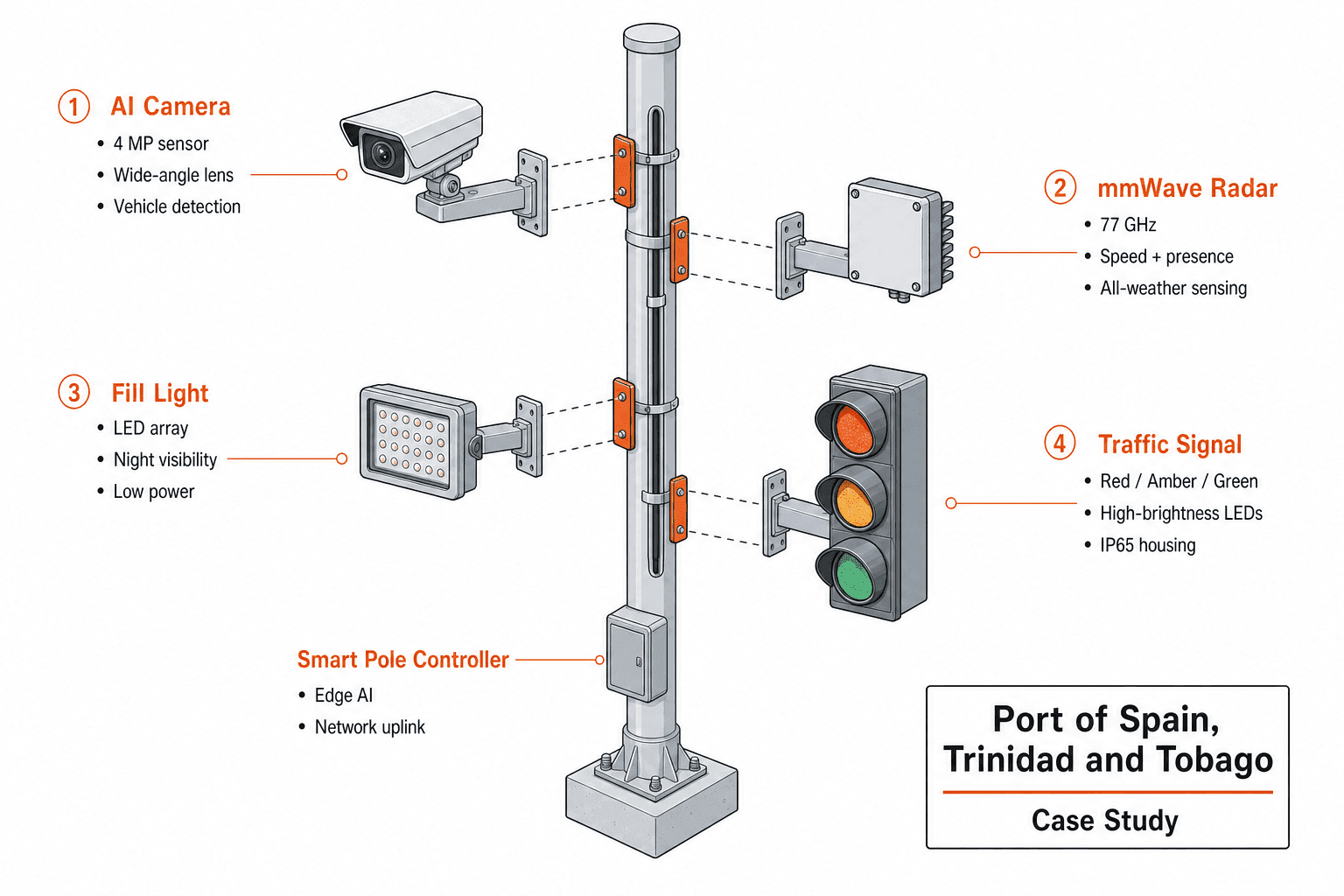
- Each smart pole integrates 4 always-on modules: 4K AI camera, 77GHz mmWave radar, LED fill light, and LED signal head.
- The edge layer uses NVIDIA Jetson processing for pedestrian detection, adaptive signal optimization, and incident auto-alert in under 50ms.
- Port of Spain's 12 km² municipal area and 250,000 daily transient population make corridor-level signal coordination more relevant than isolated intersection upgrades.
- According to TATT (2025), Trinidad and Tobago reached 70.5 mobile Internet subscriptions per 100 inhabitants in 2024, supporting 5G/fiber hybrid backhaul.
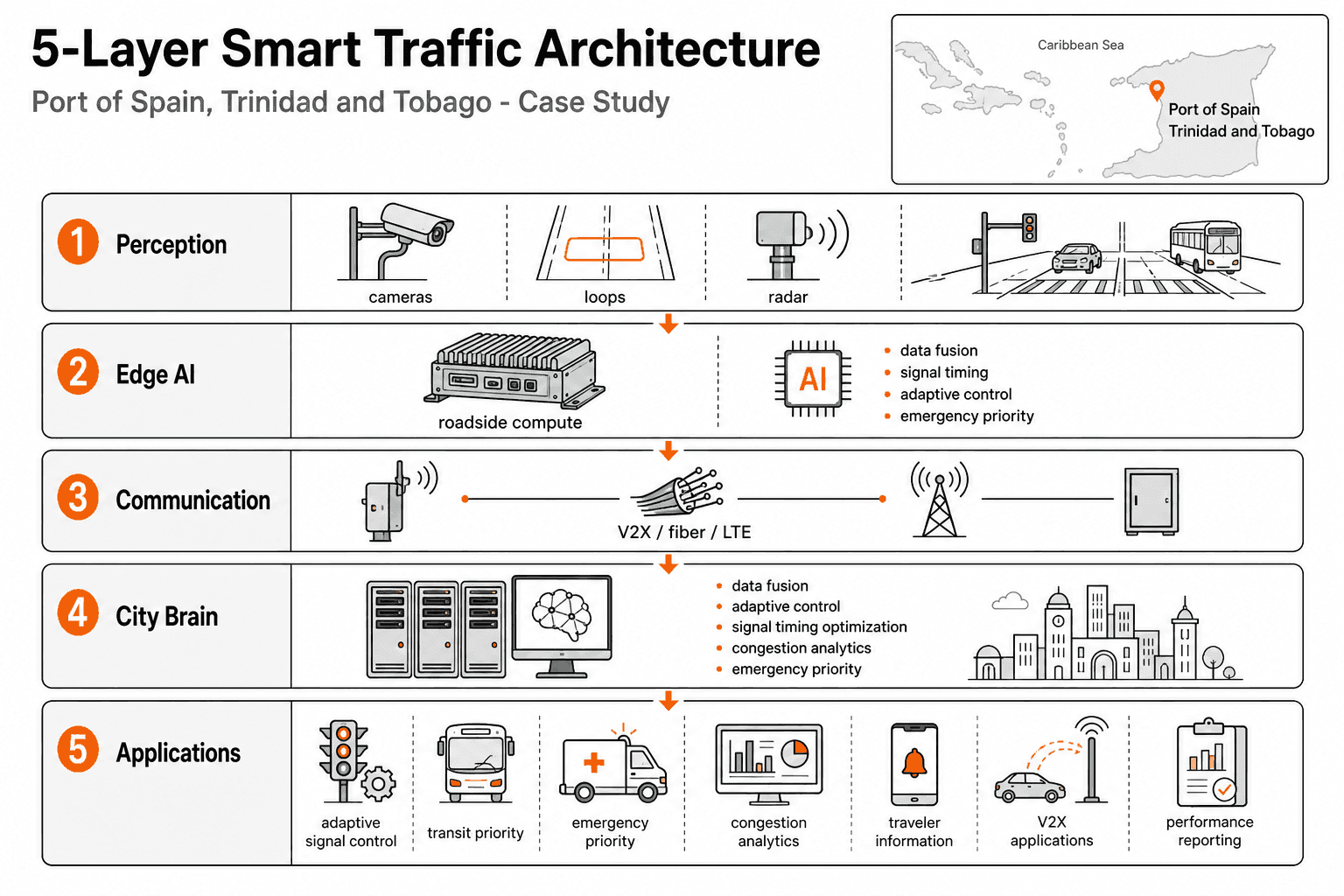
- The recommended architecture uses a 5-layer stack: Perception, Edge AI, 5G/fiber communication, TrafficGPT city platform, and traffic applications.
- A BOT model can reduce upfront municipal capital exposure to 0 while preserving EPC-style engineering, commissioning, and maintenance control.
Market Context for Port of Spain
Port of Spain's 12 km² municipal core, 37,074 census residents, and 250,000 daily transient users make intersection intelligence a commuter-infrastructure priority.
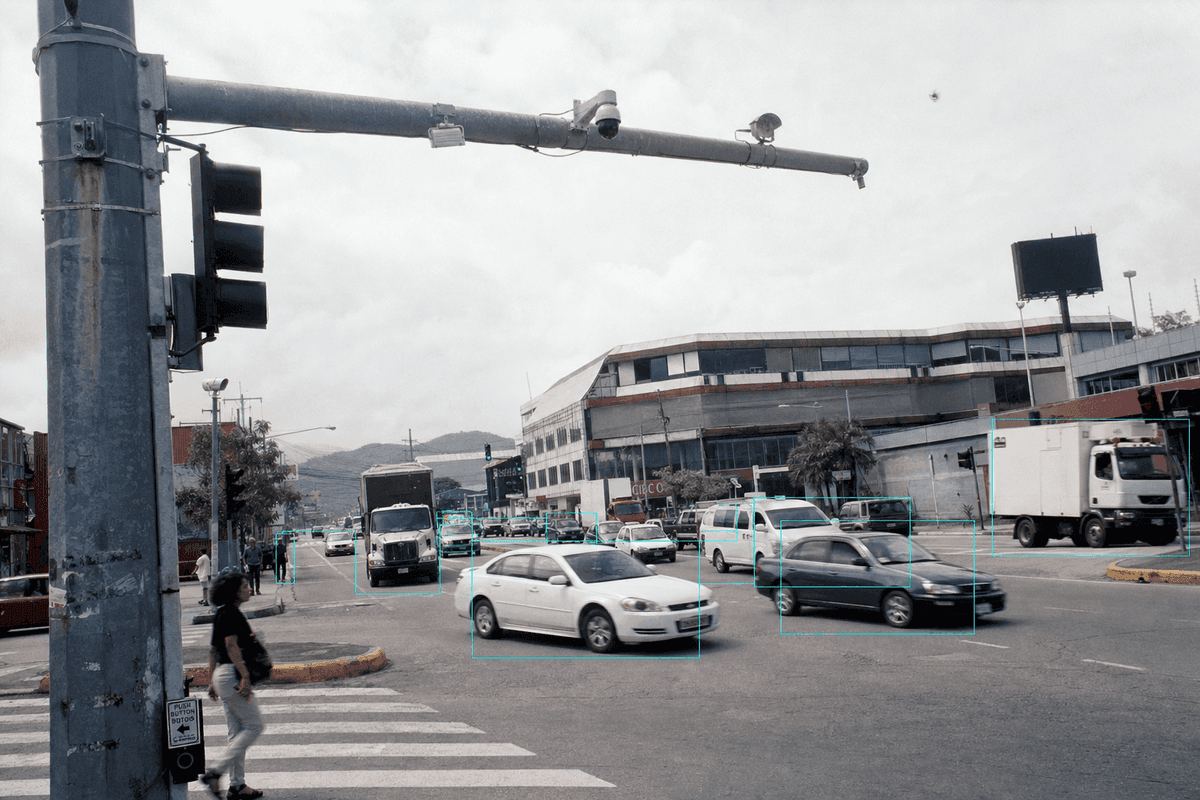
According to the Trinidad and Tobago Central Statistical Office (2011), Port of Spain recorded 37,074 residents in the 2011 census, while the wider East-West Corridor exceeded 546,000 residents. The city is small by land area but functions as the country's administrative, financial, port, and transit hub. That mismatch creates high daytime traffic pressure at entries such as Wrightson Road, Beetham Highway, Independence Square, Ariapita Avenue, and the City Gate area.
According to the Port of Spain City Corporation listing by Trinidad and Tobago's Ministry of Rural Development and Local Government (2025), the city corporation remains the formal municipal authority for Port of Spain. For traffic technology planning, this matters because pole siting, foundations, utility coordination, lane closures, and maintenance access need municipal approval before any installation begins. SOLARTODO's recommendation therefore treats the configuration as an infrastructure fit, not as a claim of a completed local project.
According to TATT (2025), Trinidad and Tobago's mobile Internet penetration increased from 59.1 per 100 inhabitants in 2023 to 70.5 in 2024, and fixed Internet household penetration reached 96.4 per 100 households. TATT states, 'The data collected by concessionaires are used by the Authority for strategic decision-making.' This supports a hybrid backhaul design where fiber is preferred for core intersections and 5G is used for resilience or difficult civil routes.
According to ITU (2015), cities account for over 70% of global greenhouse gas emissions and 60-80% of global energy consumption, making transport efficiency a core smart-city use case. ITU states, 'A smart sustainable city is an innovative city that uses information and communication technologies.' For Port of Spain, that translates into fewer standalone signal controllers and more corridor-aware, data-driven intersections connected to a central TrafficGPT platform.
Recommended Technical Configuration
A 22-intersection Smart Traffic System should use 10m L-arm poles because Port of Spain's arterial entries need camera, radar, signal, and lighting height.
The recommended SOLARTODO configuration is a typical 22-intersection deployment of 10m dark-grey, hot-dip galvanized L-arm steel poles. Each intersection would normally use 4 primary poles, one per approach, with auxiliary poles added for complex pedestrian crossings, bus movements, turning pockets, or median geometry. In planning terms, this means approximately 88 primary poles and a survey-dependent total of 88-264 poles if every approach requires auxiliary signal coverage.
This size class is the best fit because 6m poles are better suited to compact neighborhood junctions, while 8m poles are common for standard urban intersections with fewer signal heads. Port of Spain's commuter corridors, waterfront approaches, and mixed pedestrian-vehicle movements justify the 10m variant because the camera, radar, signal head, and fill light need better clearance above stopped vehicles. The 10m L-arm pole also gives cleaner mounting geometry for lane-level radar alignment.
The recommended 5-layer architecture is Perception, Edge AI, Communication, TrafficGPT City Brain, and Applications. Perception combines 4K video and 77GHz radar, while NVIDIA Jetson edge AI filters events before uplink. Communication uses 5G/fiber backhaul, and TrafficGPT enables natural-language queries such as incident counts, pedestrian conflict zones, and peak-hour queue behavior. See the SOLARTODO Smart Traffic System for product-level configuration options.
Technical Specifications
The recommended SOLARTODO field node is a 10m dark-grey L-arm galvanized pole integrating 4 always-on modules and NVIDIA Jetson edge AI.
- Pole form: 10m L-arm steel pole, dark grey, hot-dip galvanized finish.
- Intersection scope: 22 intersections, typical 4-12 poles per intersection depending on approach count and auxiliary signal needs.
- Camera module: 4K AI camera with 98% accuracy, 45+ detection types, and under 50ms response.
- Radar module: 77GHz mmWave radar for non-visual detection, speed estimation, queue sensing, and poor-weather resilience.
- Lighting and signaling: integrated LED fill light and LED signal head on the same pole family.
- Edge AI: NVIDIA Jetson processor at the intersection for pedestrian detection, adaptive signal optimization, and incident auto-alert.
- Backhaul: 5G/fiber connection to the TrafficGPT central platform for dashboards and natural-language operations.
- Standards: NTCIP for traffic device communications and GB 25280 for road traffic signal control compatibility.
- Cooperation model: BOT with zero upfront municipal payment option, subject to concession terms, service levels, and local approvals.
According to NTCIP (2026), the protocol has served intelligent transportation systems since 1996 and provides implementation documents for field devices. For Port of Spain, NTCIP compatibility is important because it protects the city from vendor lock-in at the controller and central-platform layer. GB 25280 compatibility matters where buyers require a defined traffic-signal controller standard for procurement, factory acceptance, and commissioning records.
Implementation Approach
A 22-intersection rollout would typically move through 5 phases: survey, civil works, pole erection, network integration, and TrafficGPT commissioning.
Phase 1 is a field survey covering lane geometry, pedestrian crossings, existing signal cabinets, power availability, telecom access, drainage constraints, and foundation locations. The output should be an intersection-by-intersection bill of materials, including the final pole count, arm length, conduit route, controller interface, and 5G/fiber selection. This avoids treating all 22 intersections as identical.
Phase 2 covers engineering approval, CKD or modular shipping, foundation design, and traffic management planning. In a Caribbean port-city environment, the corrosion strategy should include hot-dip galvanizing, sealed cable entry, weather-rated cabinets, and surge protection. Foundation work should account for underground utilities, high rainfall events, and pedestrian clear-zone rules.
Phase 3 installs the 10m L-arm poles, camera/radar modules, LED signal heads, fill lights, cabinets, and power interfaces. Phase 4 integrates edge AI, NTCIP communication, 5G/fiber backhaul, and cybersecurity controls. Phase 5 commissions TrafficGPT, verifies detection zones, tests incident auto-alert, calibrates adaptive timing, and trains operators to query the central platform in natural language.
Expected Performance & ROI
For Port of Spain, expected value would come from sub-50ms incident detection, adaptive timing across 22 intersections, and reduced manual monitoring costs.
According to the Federal Highway Administration (2023), real-time adaptive signal management is proven but has historically been deployed on less than 1% of existing traffic signals. That creates a practical opportunity for Port of Spain because the highest-return intersections are likely the busiest approaches rather than every small local street. A 22-intersection first phase can focus on commuter corridors and pedestrian conflict points before expansion.
Expected outcomes should be modeled rather than stated as completed results. A reasonable ROI framework would compare baseline delay, incident response time, manual monitoring labor, maintenance truck rolls, signal downtime, crash-risk locations, and corridor throughput before and after commissioning. For BOT procurement, the city can evaluate payments against availability, detection accuracy, uptime, and verified adaptive-signal performance rather than only equipment delivery.
For SOLARTODO, the technical recommendation is to define performance KPIs at factory acceptance and site acceptance. Suggested KPIs include 98% AI detection accuracy under calibrated conditions, under 50ms edge response, 99% platform availability target after stabilization, and incident auto-alert validation for stopped vehicles, wrong-way movement, pedestrian presence, and abnormal queue formation. Maintenance budgeting should include quarterly lens cleaning, radar calibration checks, firmware management, signal-head inspection, and corrosion inspection.
Results and Impact
A properly commissioned 22-intersection system would give Port of Spain 24/7 multimodal detection, corridor-level alerts, and natural-language operations through TrafficGPT.
The expected impact is operational visibility, not a fabricated claim of completed deployment. Traffic officers and municipal operators would be able to review pedestrian detections, signal phase performance, queue events, and incidents from a central platform instead of relying only on fixed-time plans or manual observation. TrafficGPT would make this more accessible by supporting natural-language questions about congestion, incidents, and pedestrian patterns.
The strongest near-term impact would be at intersections with heavy commuter flows, pedestrian crossings, or bus and taxi movements. Over time, data from the 4K AI camera and 77GHz radar can support retiming, enforcement coordination, emergency response, and capital planning. SOLARTODO recommends using the first 22 intersections as a measurable infrastructure layer, then expanding only after KPI evidence supports the next phase.
Comparison Table
The 10m L-arm class fits medium-to-large urban intersections better than 6m or 8m poles where signal visibility and radar coverage matter.
| Configuration | Best fit | Height | Typical pole count | Core modules | Port of Spain fit |
|---|---|---|---|---|---|
| Compact smart pole | Small neighborhood junction | 6m | 4-8 per intersection | 4K AI, radar, LED fill, LED signal | Limited for arterial approaches |
| Standard urban smart pole | Normal urban signalized intersection | 8m | 4-10 per intersection | 4K AI, radar, LED fill, LED signal | Useful for secondary roads |
| Recommended SOLARTODO L-arm | Medium-to-large city intersection | 10m | 4-12 per intersection | 4K AI, 77GHz radar, LED fill, LED signal, Jetson edge AI | Best fit for 22-intersection program |
| Highway gantry variant | High-speed road or gantry crossing | 10-12m | Site-specific | Camera, radar, signaling, backhaul | Use only where geometry requires gantry coverage |
Pricing & Quotation
For a 22-intersection BOT or EPC quotation, pricing should separate equipment supply, freight, installation, commissioning, warranty, and TrafficGPT platform scope.
SOLARTODO offers three pricing tiers for this product line: FOB Supply (equipment ex-works China), CIF Delivered (including ocean freight and insurance), and EPC Turnkey (fully installed, commissioned, with 1-year warranty). Volume discounts are available for large-scale deployments. Configure your system online for an instant estimate, or request a custom quotation from our engineering team at [email protected].
For Port of Spain, BOT is the recommended cooperation model because it can structure the project as a zero-upfront modernization program with service-level obligations. EPC turnkey is preferable where a public buyer has approved capital funding and wants ownership after commissioning. FOB or CIF supply is suitable for local integrators that already control civil works, installation crews, and traffic-controller integration.
Frequently Asked Questions
The following 10 FAQ items summarize technical, commercial, installation, maintenance, warranty, ROI, and comparison questions for a 22-intersection Port of Spain configuration.
Q1: What Smart Traffic System configuration is recommended for Port of Spain? A typical Port of Spain configuration would cover 22 intersections with 10m dark-grey, hot-dip galvanized L-arm steel poles. Each pole integrates a 4K AI camera, 77GHz mmWave radar, LED fill light, LED signal head, and NVIDIA Jetson edge AI. The system connects through 5G/fiber backhaul to TrafficGPT for central monitoring and natural-language traffic queries.
Q2: How many poles would a 22-intersection deployment require? A typical 22-intersection deployment would require approximately 88 primary poles if each intersection uses 4 approach poles. The final count can rise toward 264 poles where auxiliary signal heads, pedestrian islands, dedicated turn lanes, or complex geometry require additional mounting points. SOLARTODO would finalize pole count after a site survey and signal phasing review.
Q3: How long would installation typically take? A 22-intersection program is usually planned in phases over several months, depending on permitting, utility relocation, foundation curing, traffic management windows, and telecom availability. The practical sequence is survey, engineering approval, procurement, civil works, pole erection, backhaul integration, detection calibration, and TrafficGPT commissioning. Night or weekend lane closures may be needed at high-traffic corridors.
Q4: What ROI or payback period should Port of Spain expect? ROI should be modeled from verified baseline data, not assumed as a fixed percentage. Key inputs include delay reduction, incident response time, manual monitoring cost, signal maintenance savings, and avoided downtime. Under a BOT model, payback is usually evaluated through service availability and performance KPIs rather than a simple equipment purchase calculation.
Q5: How does this compare with conventional traffic signals? A conventional signal pole mainly displays programmed signal phases, while SOLARTODO's 4-in-1 pole detects vehicles, pedestrians, queues, incidents, and lighting conditions. The 4K camera and 77GHz radar add real-time perception, and NVIDIA Jetson edge AI processes events locally. That allows adaptive signal optimization and auto-alerts instead of only fixed-time or manually adjusted signal plans.
Q6: What maintenance is required in a Caribbean coastal city? Maintenance should include quarterly camera lens cleaning, radar alignment checks, signal-head inspection, cabinet sealing inspection, firmware updates, and corrosion checks. Hot-dip galvanized steel helps manage humidity and coastal exposure, but cable glands, grounding, surge protection, and drainage around foundations remain critical. Maintenance contracts should define response time, spare modules, and platform uptime.
Q7: What standards are included in the recommended system? The recommended configuration includes NTCIP for intelligent transportation system communication and GB 25280 for road traffic signal controller compatibility. NTCIP supports interoperability between field devices and central systems, while GB 25280 supports procurement and technical acceptance for signal-control equipment. Local electrical, civil, and road-safety requirements must also be checked before installation.
Q8: What is included in EPC turnkey pricing? EPC turnkey pricing normally includes engineering design, procurement, freight coordination, foundations, pole installation, module mounting, power connection, 5G/fiber integration, TrafficGPT commissioning, training, and a 1-year warranty. It should also define exclusions such as major utility relocation, road reconstruction, police traffic control, recurring telecom fees, and long-term platform subscriptions beyond the quoted scope.
Q9: How does the BOT zero-upfront model work? Under a BOT model, SOLARTODO or a project vehicle finances, builds, operates, and transfers the system under agreed service and concession terms. The city can reduce upfront capital payment to 0, while performance is governed by uptime, detection accuracy, response time, and maintenance KPIs. Legal, procurement, and revenue mechanisms must be defined before contract award.
Q10: Can TrafficGPT answer operational questions in natural language? Yes. TrafficGPT is the City Brain layer that receives structured events from the 22 intersections and allows operators to ask natural-language questions. Example queries can cover peak-hour congestion, pedestrian detections, incident locations, queue duration, and signal performance. The quality of answers depends on calibrated detection zones, stable backhaul, clean metadata, and disciplined commissioning.
References
These 7 references support the Port of Spain market context, telecommunications readiness, traffic-data basis, smart-city standards, and adaptive-control assumptions above.
- Central Statistical Office of Trinidad and Tobago (2011): 2011 Population and Housing Census data for Port of Spain population and municipal demographics. https://cso.gov.tt/census/2011-census-data/
- Ministry of Rural Development and Local Government, Trinidad and Tobago (2025): Port of Spain City Corporation municipal authority listing. https://rdlg.gov.tt/municipal-corporations/port-of-spain-city-corporation/
- Telecommunications Authority of Trinidad and Tobago (2025): Annual Market Report 2024, mobile Internet penetration 70.5 per 100 inhabitants and fixed household Internet penetration 96.4 per 100 households. https://tatt.org.tt/market-information/annual-market-reports/
- Central Statistical Office of Trinidad and Tobago (2026): Traffic Statistics page, quarterly and annual traffic reports through 2023. https://cso.gov.tt/subjects/population-and-vital-statistics/traffic-statistics/
- ITU (2015): Smart Sustainable Cities focus group definition and urban ICT role, including 70% city GHG share and 60-80% city energy-consumption share. https://www.itu.int/en/ITU-T/focusgroups/ssc/Pages/default.aspx
- NTCIP (2026): National Transportation Communications for ITS Protocol implementation and standards library for intelligent transportation field devices. https://www.ntcip.org/
- Federal Highway Administration (2023): Adaptive Signal Control Technology guidance noting real-time traffic management benefits and historically low deployment share. https://ops.fhwa.dot.gov/arterial_mgmt/adaptive_sig.htm
Equipment Deployed
- 22 intersections with 10m dark-grey hot-dip galvanized L-arm steel poles
- 4-in-1 smart traffic pole with 4K AI camera, 77GHz mmWave radar, LED fill light, and LED signal head
- 4K AI camera with 98% accuracy, 45+ detection types, and under 50ms response
- NVIDIA Jetson edge AI processor for local pedestrian detection and incident auto-alert
- 5G/fiber backhaul to TrafficGPT central platform for natural-language traffic queries
- NTCIP and GB 25280 standards compatibility
- BOT zero-upfront cooperation model with EPC turnkey option