155-Unit Solar Streetlight (Split-Type) Deployment in Phnom Penh, Cambodia Featuring 8m Stainless Steel 304 Poles
Summary
This Phnom Penh deployment installed 155 split-type solar streetlights using 8m stainless steel 304 poles, 460W Mono TOPCon panels, and 40W/6000lm LED heads at 24m spacing on 6m roads, with 4G/LoRa monitoring and 3-5 days backup.
Key Takeaways
A 155-unit SOLAR TODO Solar Streetlight (Split-Type) deployment was completed in Phnom Penh using 8m stainless steel 304 poles with 50 m/s wind resistance and 40-year design life.
- Each unit uses a 460W Mono TOPCon solar panel at the very top of the pole, with 23% efficiency, 0.3%/yr degradation, and a 30-year panel warranty.
- The lighting head is a 40W LED rated at 6000lm and 150 lm/W, mounted on a side arm below the panel, with CRI >70 for roadway visibility.
- Energy storage uses a 12V/100Ah NCM lithium battery in a visible grey external pole-mounted box, with 250Wh/kg energy density, 2000 cycles, and 85% DoD.
- All cables run inside the pole, with no visible external wires on the pole surface, and the MPPT controller is housed inside the battery box.
- The layout uses 24m spacing along 6m-wide roads, which suits secondary urban road corridors, access roads, and municipal perimeter routes in Phnom Penh.
- Smart controls include dusk-to-dawn operation, dimming control, and remote monitoring over 4G/LoRa for fault visibility across all 155 units.
- The system is configured for desert-class solar resource conditions at 6.5h sun and provides 3-5 days of cloudy-weather backup under the specified controller strategy.
Project Background
Phnom Penh road lighting projects must balance flood-prone urban conditions, mixed road classes, and limited grid consistency in some expansion zones, making 155 autonomous lighting points practical for municipal corridors and access roads.
Phnom Penh continues to expand road infrastructure around peri-urban districts, industrial access roads, and new residential connectors, where trenching for conventional streetlighting can delay schedules and add civil works scope. For a 6m-wide road, lighting spacing and pole placement must also account for traffic mix, drainage edges, and utility conflicts. In this deployment, SOLAR TODO supplied a split-type configuration to avoid dependence on local feeder availability while keeping the lighting layout uniform across 155 positions.
According to the World Bank (2022), Cambodia's urban development needs continued investment in municipal infrastructure, including resilient public services that can operate despite network limitations and climate stress. According to IEA (2023), public lighting remains one of the most visible municipal electricity end uses, and efficiency upgrades can materially reduce operating demand. In Phnom Penh, that matters because city road extensions often reach areas where utility coordination is slower than road opening schedules.
The site conditions at coordinates 11.56, 104.92 support solar streetlighting deployment with strong solar resource, while the sea-influenced climate still requires corrosion-conscious material selection and sealed electrical assemblies. For that reason, the project used 8m stainless steel 304 poles rather than standard carbon steel. The selected configuration also keeps the battery in an external pole-mounted box for service access, instead of placing it inside the pole base.
Solution Overview
SOLAR TODO deployed 155 split-type solar streetlights in Phnom Penh with 460W top-mounted panels, 40W LED luminaires, 12V/100Ah NCM batteries, and 4G/LoRa monitoring across a 24m pole spacing plan.
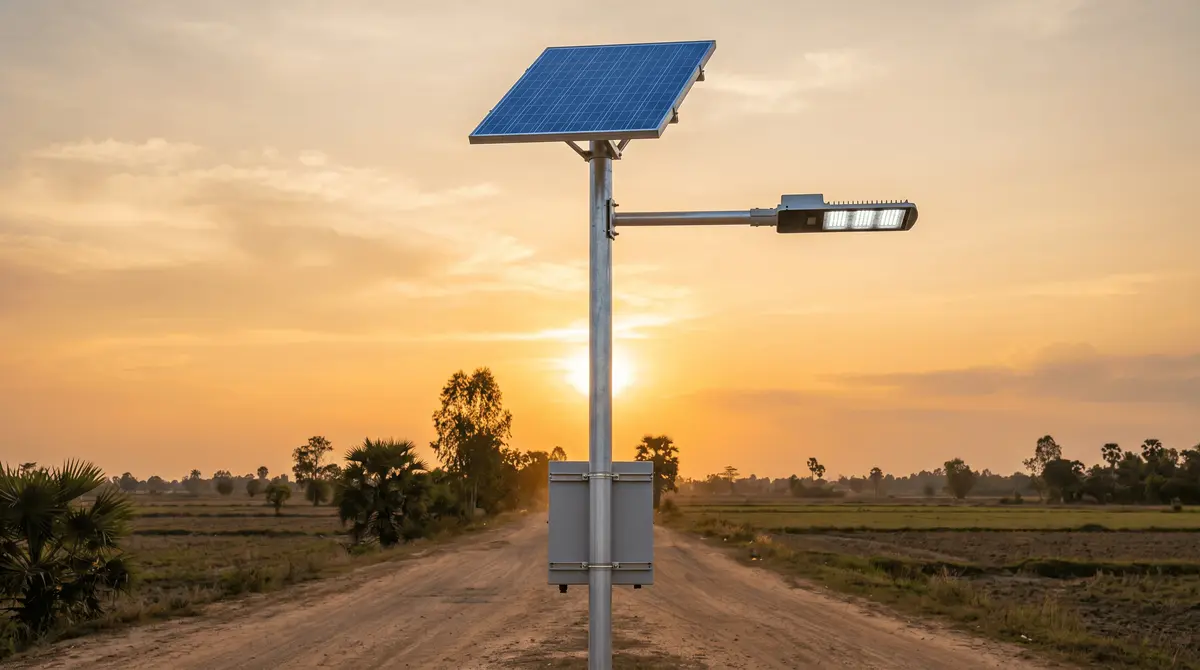
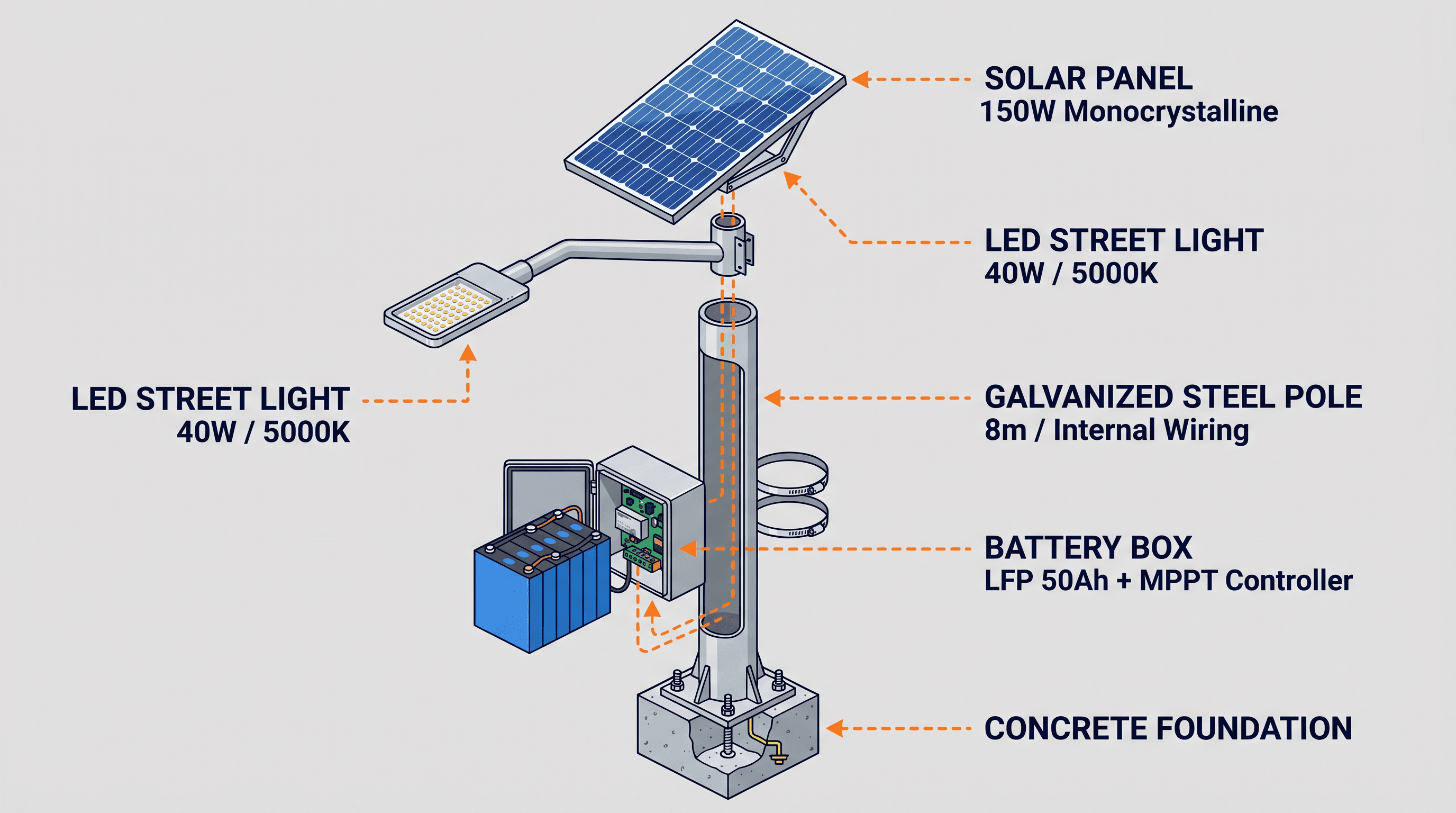
The installed product is the SOLAR TODO Solar Streetlight (Split-Type), not an integrated all-in-one fixture. Each pole is 8m high and fabricated from stainless steel 304, with wind resistance rated to 50 m/s and a 40-year service life target. The solar panel sits at the very top of the pole on a tilted bracket, and the pole does not pass through the center of the panel.
Below the panel, a side arm supports the 40W LED light head rated at 6000 lumens and 150 lm/W. The battery is a 12V/100Ah NCM lithium pack housed in a visible grey external box clamped to the pole body. The MPPT controller is inside that battery box, and all wiring runs inside the pole, so there are no visible external cables on the pole surface.
According to NREL (2021), MPPT-based solar lighting systems improve energy harvest under variable irradiance compared with simpler charge control approaches, which is relevant even in high-sun locations because partial shading, dust loading, and temperature variation still affect daily yield. According to IRENA (2022), module efficiency improvements above 22% support smaller structural footprints or higher energy margin for off-grid applications. That is why the 23% efficient Mono TOPCon module was selected for this 155-unit layout.
IEC states, "IEC 60598 specifies general requirements and tests for luminaires," which is central for municipal outdoor lighting acceptance. IEC also states, "IEC 62124 covers performance of stand-alone photovoltaic systems," which is directly relevant to split-type solar streetlight validation. SOLAR TODO aligned the deployment with CJJ 45-2015, IEC 60598, and IEC 62124 for the delivered configuration.
Technical Specifications
This Phnom Penh configuration uses fixed, documented hardware values: 155 units, 8m poles, 460W panels, 40W LED heads, 12V/100Ah NCM batteries, 24m spacing, and 6m road width.
- Quantity: 155 units
- Product type: SOLAR TODO Solar Streetlight (Split-Type)
- Deployment location: Phnom Penh, Cambodia
- Coordinates: 11.56, 104.92
- Pole height: 8m
- Pole material: Stainless steel 304
- Pole wind resistance: 50 m/s
- Pole service life: 40 years
- Solar panel position: At the very top of the pole on a tilted bracket
- Panel mounting note: Pole does not penetrate through panel center; panel sits on top
- Solar module rating: 460W
- Solar module type: Monocrystalline Mono TOPCon
- Module efficiency: 23%
- Module degradation: 0.3%/yr
- Module warranty: 30 years
- LED luminaire power: 40W
- LED output: 6000 lm
- Luminous efficacy: 150 lm/W
- Color rendering index: CRI >70
- Luminaire mounting: Side arm below the solar panel
- Battery chemistry: NCM lithium
- Battery configuration: 12V/100Ah
- Battery energy density: 250Wh/kg
- Battery cycle life: 2000 cycles
- Depth of discharge: 85%
- Battery warranty: 5 years
- Battery box location: External pole-mounted grey box clamped to pole body
- Battery placement note: Not inside pole base
- Charge controller: MPPT controller inside battery box
- Cable routing: All wiring inside pole
- Cable visibility: No visible external wires/cables on pole surface
- Control mode: Dusk-to-dawn automatic operation
- Smart features: Dimming control and remote monitoring via 4G/LoRa
- Backup autonomy: 3-5 days cloudy-weather backup
- Road width served: 6m
- Pole spacing: 24m
- Applicable standards: CJJ 45-2015 / IEC 60598 / IEC 62124
- Climate basis used for configuration: Desert-class solar resource, 6.5h sun
Deployment Process
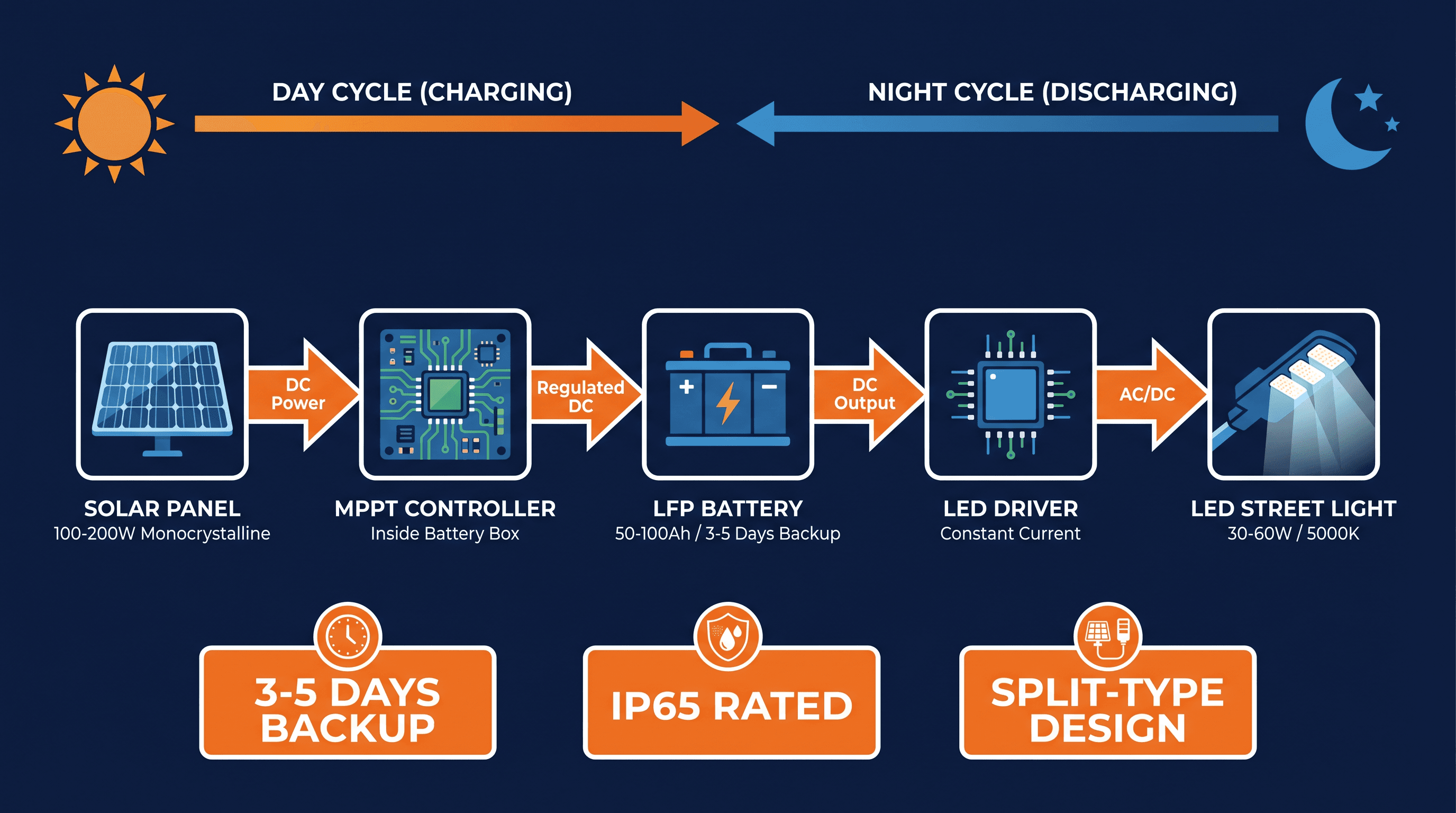
The 155-unit rollout followed a phased installation sequence covering civil positioning, pole erection, internal cabling, battery-box mounting, controller setup, and 4G/LoRa commissioning across 24m intervals.
The first phase was route verification and pole marking along the 6m-wide road sections. At 24m spacing, the layout team checked setbacks from drainage lines, curb edges, and existing utility crossings before foundation work started. Because the system is off-grid, no trenching for AC feeder cable was required, which shortened the civil coordination path compared with conventional streetlighting.
The second phase covered foundation and anchor preparation, followed by erection of the 8m stainless steel 304 poles. The 50 m/s wind resistance rating was important for acceptance because Phnom Penh can experience strong storm events even outside peak monsoon periods. The pole-top bracket was aligned to place the 460W panel above the luminaire, not around the pole centerline, which is a key distinction from some older mounting styles.
The third phase focused on equipment assembly. The 40W LED head was fixed to the side arm below the panel, and the 12V/100Ah NCM battery box was clamped externally to the pole body at service height. All DC wiring was pulled inside the pole, leaving no visible external cables, which improves tamper resistance and gives the installed line a cleaner municipal appearance.
The fourth phase was controller programming and communications setup. Each MPPT controller inside the battery box was configured for dusk-to-dawn operation, dimming logic, and remote monitoring through 4G/LoRa. According to ITU (2022), smart-city field assets benefit from remote monitoring because fault detection time and maintenance dispatch efficiency improve when device-level status is available centrally.
The final phase covered night aiming checks, burn-in observation, and data verification. The 6000-lumen output and CRI >70 level were reviewed against road use conditions typical of urban access roads and secondary municipal corridors. SOLAR TODO then handed over the monitoring structure and maintenance points, with support available through contact us for post-installation technical coordination.
Performance & Results
The installed 155-unit system delivered autonomous dusk-to-dawn lighting with 6000lm per pole, 3-5 days backup, and remote fault visibility, reducing dependence on grid extension for 6m-road municipal corridors.
For Phnom Penh, the main result was deployment speed and reduced utility dependency rather than only wattage reduction. Because each unit is self-powered, the municipality avoided feeder extension, metering points, and cabinet integration across the 155-pole route. On roads where opening dates are linked to civil completion, that can remove a major schedule bottleneck.
From an optical and spacing perspective, the 40W LED at 6000lm combined with 24m spacing is suited to 6m-wide road sections where the goal is functional roadway illumination rather than boulevard-class decorative lighting. According to IEA (2023), LED public lighting can sharply reduce electricity demand compared with legacy sodium systems, and off-grid solar variants add resilience where grid access or reliability is constrained. In this case, the system also adds remote monitoring, which simplifies fault identification across 155 distributed assets.
The 460W Mono TOPCon panel gives a wide generation margin relative to the 40W luminaire load, which is useful in dusty and high-temperature environments. According to NREL (2023), PV module operating temperature and soiling can materially affect field output, making oversizing and MPPT control practical design choices. The specified 23% module efficiency and 0.3%/yr degradation support longer-term energy margin over the 30-year panel warranty period.
Battery access was another operational result. The external grey battery box allows direct servicing without opening the pole base or extracting internal assemblies. According to BloombergNEF (2023), lithium battery service planning depends heavily on cycle count, depth of discharge, and operating temperature; here the battery is specified at 2000 cycles and 85% DoD, with a 5-year warranty, which gives maintenance teams a clear replacement planning baseline.
For municipal asset management, the 4G/LoRa layer is significant. A 155-unit network can report status, dimming state, and fault alarms without manual nightly inspection of every pole. SOLAR TODO used this architecture to support route-level visibility, which is especially useful when installations are spread across multiple road segments in Phnom Penh.
Comparison Table
This table summarizes the deployed Phnom Penh configuration against typical grid-tied streetlighting and integrated solar units, using the actual 155-unit split-type specifications as the reference case.
| Metric | SOLAR TODO Solar Streetlight (Split-Type) Deployed in Phnom Penh | Typical Grid-Tied Streetlight | Typical All-in-One Solar Light |
|---|---|---|---|
| Quantity in this project | 155 units | Project dependent | Project dependent |
| Pole height | 8m stainless steel 304 | Often 8m steel | Often 6-8m steel |
| Wind resistance | 50 m/s | Project dependent | Usually lower structural margin |
| Solar panel | 460W Mono TOPCon, top-mounted | None | Smaller integrated panel |
| Panel efficiency | 23% | Not applicable | Usually lower due to panel size limits |
| LED power | 40W | 40W-100W common | 20W-60W common |
| Luminous output | 6000lm | Depends on luminaire | Depends on integrated design |
| Battery type | 12V/100Ah NCM, external pole box | None | Usually battery integrated in fixture body |
| Battery access | External grey box, easy service | Not applicable | Fixture-level access required |
| Wiring | All internal, no visible external cables | Requires underground AC cabling | Internal to fixture/pole |
| Backup autonomy | 3-5 days | Grid dependent | Usually lower at same lumen package |
| Smart control | Dimming + 4G/LoRa monitoring | Optional with controller network | Optional, model dependent |
| Civil works | No grid trenching | Requires trenching and feeder works | No grid trenching |
| Standards basis | CJJ 45-2015 / IEC 60598 / IEC 62124 | Local electrical + luminaire standards | IEC basis varies by supplier |
Pricing & Quotation
SOLAR TODO provides 3 commercial delivery models for the Phnom Penh Solar Streetlight (Split-Type) configuration, covering equipment-only supply through full installation and commissioning support.
SOLAR TODO offers three pricing tiers for this product line: FOB Supply (equipment ex-works China), CIF Delivered (including ocean freight and insurance), and EPC Turnkey (fully installed, commissioned, with 1-year warranty). Volume discounts are available for large-scale deployments. Configure your system online for an instant estimate, or request a custom quotation from our engineering team at [email protected].
For EPC inquiries, the main quotation inputs are pole quantity, road width, target spacing, wind rating, communication method, and local foundation conditions. For this case, the defining inputs were 155 units, 8m poles, 24m spacing, 6m road width, 50 m/s wind resistance, and 4G/LoRa controls. If your project needs the same architecture, SOLAR TODO can align supply documents to the deployed configuration.
Frequently Asked Questions
This FAQ section answers the most common buyer questions about the 155-unit Phnom Penh deployment, including specifications, timeline, maintenance, quotation scope, and split-type versus integrated system selection.
Q1: What exactly was installed in Phnom Penh? A total of 155 SOLAR TODO Solar Streetlight (Split-Type) units were deployed. Each unit uses an 8m stainless steel 304 pole, a 460W Mono TOPCon panel at the top, a 40W/6000lm LED head on a side arm below the panel, and a 12V/100Ah NCM battery in an external grey pole-mounted box.
Q2: Is this an all-in-one solar streetlight? No. This is a split-type system, not an integrated all-in-one product. The solar panel is mounted at the very top of the pole, the LED head is below it on a side arm, and the battery is housed in a separate external box clamped to the pole body. That layout improves service access and component flexibility.
Q3: How are the cables routed on this product? All wiring runs inside the pole. There are no visible external wires or cables on the pole surface. This matters for appearance, tamper resistance, and cable protection in public-road installations. The MPPT controller is placed inside the battery box, which keeps the control path compact and easier to inspect during maintenance.
Q4: Why was an 8m stainless steel 304 pole selected for Phnom Penh? The project location has sea-influenced climate exposure, so corrosion resistance was a key factor. Stainless steel 304 gives better corrosion performance than standard painted carbon steel in many municipal environments. The pole is also rated for 50 m/s wind resistance and a 40-year service life, which supports long-term roadside use.
Q5: What is the expected backup time during poor weather? The configured system provides 3-5 days of cloudy-weather backup under the specified operating strategy. That autonomy is supported by the 460W solar module, MPPT controller, and 12V/100Ah NCM battery. Actual runtime depends on dimming profile, solar recovery conditions, and whether the lights operate at full output for the entire night.
Q6: How long does deployment usually take for a 155-unit project? The timeline depends on foundations, local permits, and road access, but the field sequence is straightforward: layout marking, civil works, pole erection, top-panel installation, battery-box mounting, controller programming, and monitoring setup. Because no AC trenching is required, split-type solar streetlights can reduce coordination time compared with grid-tied lighting on similar road lengths.
Q7: How does this compare with a grid-tied streetlight project? The main difference is civil and utility scope. A grid-tied system usually needs trenching, feeder cable, protection devices, and utility coordination. This split-type solar system avoids those steps and keeps each lighting point autonomous. For expansion roads or municipal corridors with delayed utility access, that can simplify deployment and reduce schedule risk.
Q8: What maintenance does this system require? Routine maintenance includes panel cleaning, battery health checks, bracket and clamp inspection, luminaire cleaning, and remote alarm review. Because the battery is in an external pole-mounted box, service access is easier than systems with batteries hidden in the pole base or integrated inside the luminaire housing. Monitoring over 4G/LoRa also helps identify faults earlier.
Q9: What warranties apply to the main components? The Mono TOPCon solar panel carries a 30-year warranty, and the NCM lithium battery has a 5-year warranty. The project also uses stainless steel 304 poles with a 40-year design life target. Warranty scope for full supply or EPC packages should be confirmed in the final quotation because logistics and installation terms can vary by delivery model.
Q10: Does SOLAR TODO provide EPC pricing and quotation support? Yes. SOLAR TODO offers FOB Supply, CIF Delivered, and EPC Turnkey quotation models for the Solar Streetlight (Split-Type) product line. For accurate pricing, the engineering team typically reviews quantity, pole height, wind rating, spacing, road width, smart-control requirements, and site conditions. Buyers can use the online configurator or send project details through the contact page.
Q11: What is the ROI or payback logic for this type of project? Payback depends on the avoided cost of trenching, utility connection, metering, and long-term grid electricity, so it varies by site. For municipal buyers, the strongest business case is often total installed infrastructure cost and deployment speed rather than energy savings alone. A project-specific ROI model should use local labor, civil, and utility data.
Q12: What standards does this Phnom Penh deployment follow? The specified standards basis is CJJ 45-2015, IEC 60598, and IEC 62124. CJJ 45-2015 is relevant for urban road lighting design practice, while IEC 60598 covers luminaire safety and IEC 62124 addresses stand-alone photovoltaic system performance. These references are important when preparing technical submittals for municipal review and acceptance.
References
This project summary uses published standards and energy-sector references from 2021-2023 to frame the 155-unit Phnom Penh deployment in terms of lighting efficiency, solar performance, and municipal infrastructure practice.
- NREL (2021): Guidance on photovoltaic system performance and the value of MPPT-based energy harvest under variable field conditions.
- NREL (2023): Field performance factors for PV modules, including temperature and soiling impacts on output.
- IEC (2023): IEC 60598, luminaires general requirements and tests.
- IEC (2021): IEC 62124, performance of stand-alone photovoltaic systems.
- IEA (2023): Energy efficiency and public lighting transition data supporting LED-based demand reduction.
- IRENA (2022): Solar PV technology improvements, including higher module efficiency trends relevant to off-grid applications.
- ITU (2022): Smart sustainable city and connected infrastructure guidance relevant to remote monitoring of municipal field assets.
- World Bank (2022): Cambodia urban infrastructure development needs and resilience considerations for municipal services.
- BloombergNEF (2023): Lithium battery market and performance considerations, including cycle life and operating condition impacts.
- Ministry of Housing and Urban-Rural Development of China (2015): CJJ 45-2015 urban road lighting design standard reference used in project specification context.
Equipment Deployed
- 155 × SOLAR TODO Solar Streetlight (Split-Type)
- 8m stainless steel 304 pole, 50 m/s wind resistance, 40-year service life
- 460W Mono TOPCon solar panel, 23% efficiency, 0.3%/yr degradation, 30-year warranty
- Top-of-pole tilted solar bracket; pole does not penetrate through panel center
- 40W LED light head, 6000lm, 150 lm/W, CRI >70, mounted on side arm below panel
- 12V/100Ah NCM lithium battery, 250Wh/kg, 2000 cycles, 85% DoD, 5-year warranty
- External grey battery box clamped to pole body, not inside pole base
- MPPT charge controller installed inside battery box
- Internal pole wiring with no visible external wires/cables
- Dusk-to-dawn automatic control
- Dimming control and remote monitoring via 4G/LoRa
- System autonomy of 3-5 days during cloudy weather
- Layout based on 24m spacing for 6m road width
- Compliance basis: CJJ 45-2015 / IEC 60598 / IEC 62124