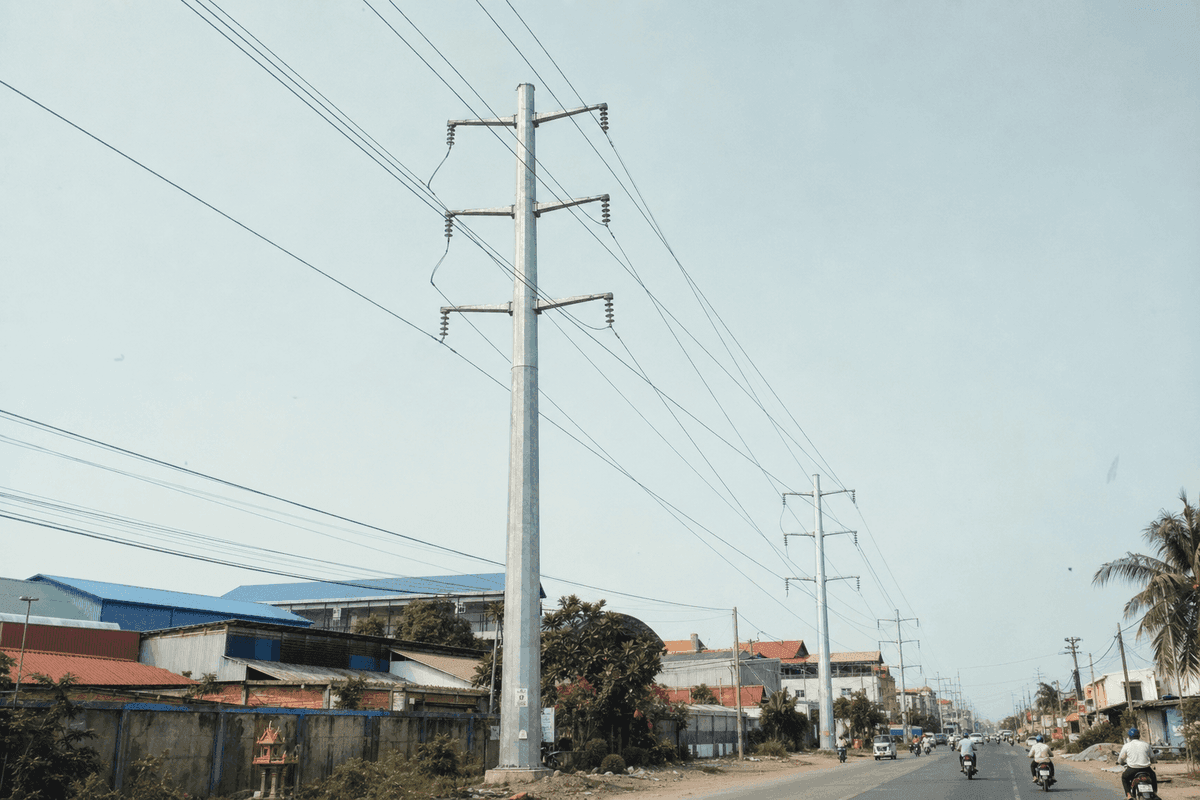
Phnom Penh Power Transmission Tower Market Analysis: 110kV Steel Tubular Pole Configuration Guide
Summary
Phnom Penh’s grid growth and industrial load concentration support a 110kV backbone solution using approximately 57 steel tubular poles over about 9km, with 35m pole height, ACSR 240 conductor, 150m spans, and 30m/s wind-class design to IEC 60826.
Key Takeaways
A Phnom Penh 110kV backbone corridor of about 9km would typically use approximately 57 steel tubular poles, based on the specified 150m average span and urban/suburban routing constraints.
- Phnom Penh’s recommended class for this configuration is 110kV single circuit, matching sub-transmission needs rather than 10-35kV distribution or 220kV transmission.
- The project-specific configuration calls for 35m tapered steel tubular poles, but utility buyers should note this is a special heavy-duty backbone design, above the usual 18-30m range for standard 66-110kV lines.
- Each pole is specified at approximately 21t, fabricated from hot-dip galvanized Q345 steel, with a structural linear mass of 600kg/m.
- The conductor set is ACSR 240, rated here at about 920kg/km with 70kN maximum tension, suitable for medium-span urban transmission corridors.
- Electrical geometry is defined by 4m phase spacing, 1.5m insulator length, and 6m ground clearance, which supports a compact 110kV single-circuit layout.
- Site loading is based on Wind Class 2 at 30m/s, with anchor-bolt cage foundations recommended for Phnom Penh’s alluvial and reclaimed-soil conditions.
- Design basis should follow IEC 60826, GB 50545, and DL/T 5092, with a target service life of 30 years and accessories including bird guards and vibration dampers.
- Buyers comparing alternatives should assess steel tubular poles against lattice towers on right-of-way width, erection speed, urban aesthetics, and maintenance access, not only on steel tonnage.
Market Context for Phnom Penh
Phnom Penh is Cambodia’s largest load center, and its transmission requirements are shaped by fast urban growth, industrial expansion, and a low-lying riverine terrain that affects foundations and corridor planning.
According to the National Institute of Statistics of Cambodia (2019), Phnom Penh had a population of about 2.13 million, making it the country’s largest electricity demand cluster. According to the World Bank (2023), Cambodia has continued improving electricity access and grid connectivity, but urban reliability and industrial-quality supply remain tied to stronger transmission and sub-transmission reinforcement. For a city at approximately 11.56, 104.92, near the Mekong-Tonlé Sap confluence and at low elevation, transmission structures must account for high seasonal rainfall, soft soils, and constrained urban right-of-way.
According to Asian Development Bank (2022), Cambodia’s power demand growth remains linked to manufacturing, services, and urbanization, with Phnom Penh and surrounding provinces carrying a large share of commercial and industrial load. In practice, this means utilities and EPC contractors often need 66kV to 110kV backbone links to connect substations, ring urban load centers, and strengthen supply to industrial zones. A 10-35kV class pole line is often too small for these backbone duties, while 220kV is generally reserved for bulk transmission rather than city-distribution interface corridors.
Climate also matters. According to the World Bank Climate Change Knowledge Portal (2021), Cambodia experiences a tropical monsoon climate with pronounced wet and dry seasons, and Phnom Penh sees heavy rainfall during the monsoon period. For steel monopole or tubular-pole design, that pushes attention toward corrosion protection, drainage control around foundations, and wind loading checks around 30m/s design conditions. IEC states, "IEC 60826 specifies loading and strength requirements of overhead transmission lines," which is directly relevant for wind, conductor tension, and reliability calculations in Phnom Penh.
Local corridor conditions favor compact structures in many sections. Dense roads, mixed commercial frontage, river crossings, and peri-urban development increase the value of a tubular steel profile compared with wider-footprint lattice alternatives. IEA (2023) notes that Southeast Asian cities are seeing sustained electricity demand growth from cooling, commerce, and electrification; in Phnom Penh, that translates into a practical need for compact 110kV sub-transmission assets that can support substation interconnection with fewer land conflicts.
For buyers evaluating options, the useful question is not whether Phnom Penh needs transmission capacity in general, but which voltage class and structure type fit a roughly 9km urban-edge backbone line. Based on the supplied project profile, the answer is a 110kV single-circuit steel tubular pole system fabricated in flanged sections and installed on anchor-bolt cage foundations.
Recommended Technical Configuration
For Phnom Penh, a typical backbone sub-transmission route of about 9km would fit a 110kV single-circuit steel tubular pole configuration using approximately 57 units, ACSR 240 conductor, 150m spans, and anchor-cage foundations for soft-soil urban conditions.
Voltage class should be selected first. Based on the product engineering table, 66-110kV belongs to the sub-transmission category. That class normally uses 18-30m height, 5-15t/pole, and 200-300m spans. However, the supplied project-specific configuration is a defined 110kV single-circuit backbone using 35m tapered steel tubular poles at approximately 21t/pole, which should be treated as a special heavy-duty arrangement for route-specific clearance, crossing, or corridor constraints rather than a generic 110kV default.
A typical deployment of this scale would consist of:
- Approximately 57 tapered steel tubular poles
- 110kV single-circuit line configuration
- Total route length of about 9km
- Average design span of 150m
- Q345 hot-dip galvanized steel pole body
- ACSR 240 conductor at about 920kg/km and 70kN maximum tension
- 1.5m insulator string length
- 4m phase spacing
- 6m ground clearance
- Wind Class 2, 30m/s loading basis
- Anchor-bolt cage concrete foundations
- Accessories including climbing steps, cross arm, grounding, bird guard, and vibration damper
This configuration is suitable where Phnom Penh planners need a narrow-footprint line along arterial roads, industrial access corridors, or substation connectors with tighter visual and land-use requirements than lattice towers. SOLAR TODO would typically position this product line for utility buyers who need a monopole-style transmission structure rather than a broad-base tower. The main technical trade-off is straightforward: steel tubular poles reduce corridor footprint, but they require tighter fabrication tolerances, heavier single-shaft sections, and careful foundation alignment.
According to ENTSO-E guidance on overhead line asset management principles used globally as a benchmark, compact line design often improves route acceptance in developed corridors when electrical clearances and maintenance access are preserved. IEEE states, "Transmission line design must consider mechanical loading, electrical clearances, and long-term maintainability as a combined system." That is exactly the lens Phnom Penh buyers should use when comparing steel tubular poles with lattice options.
For procurement planning, SOLAR TODO’s Power Transmission Tower product page is the logical starting point for reviewing pole form, galvanizing, and accessory scope before issuing a technical inquiry. For route-specific design review, buyers should also contact us with geotechnical data, crossing schedules, and conductor selection.
Technical Specifications
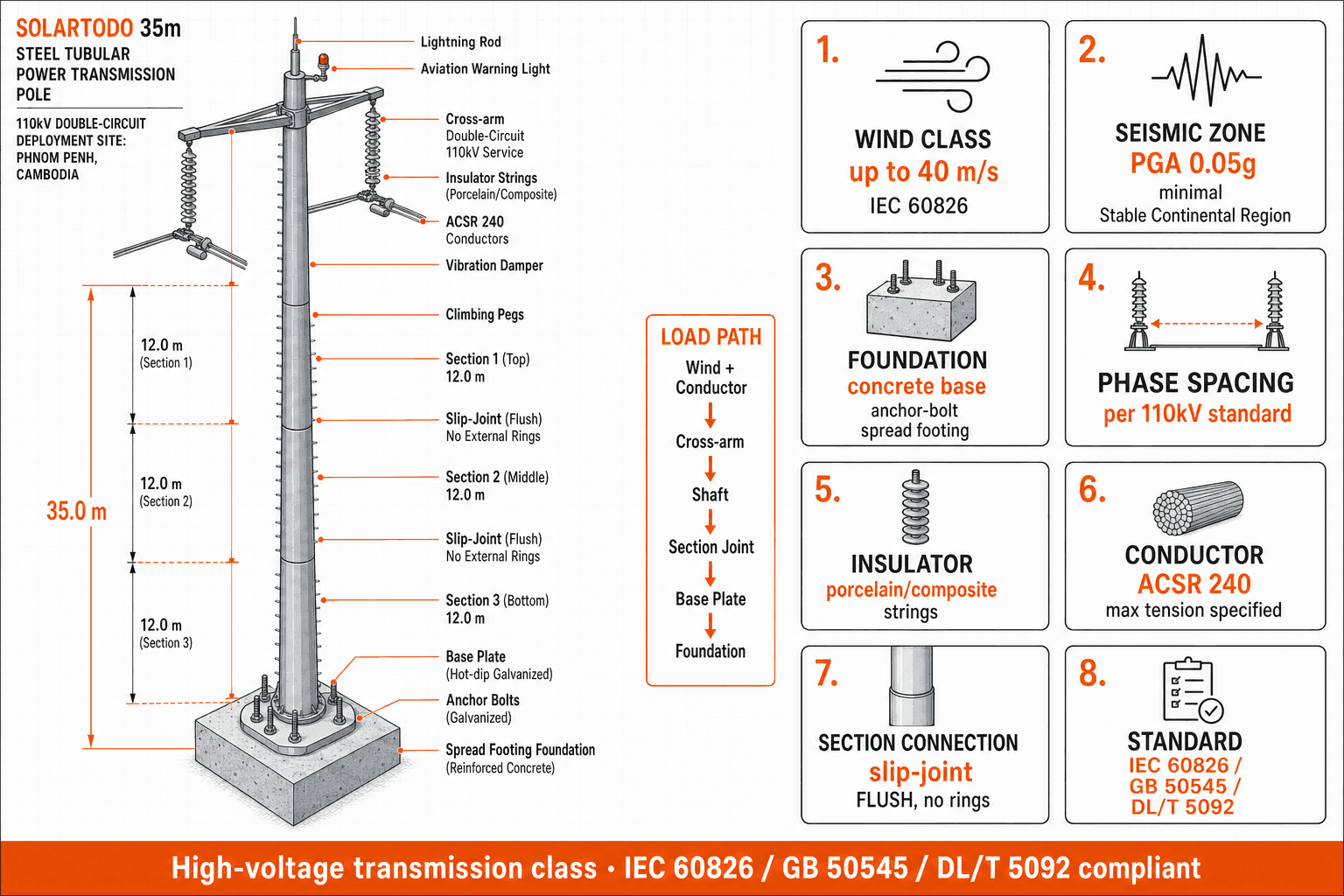
The specified Phnom Penh configuration centers on a 110kV single-circuit heavy-duty steel tubular pole system with 35m height, 21t unit weight, 150m spans, and ACSR 240 conductor under 30m/s wind loading.
Pole and Structural System
- Product type: Steel tubular Power Transmission Tower in tapered monopole form
- Pole geometry: Tapered round steel tubular pole with flanged bolt sections
- Pole height: 35m
- Circuit arrangement: Single circuit
- Approximate pole weight: 21t/pole
- Linear structural mass: 600kg/m
- Steel grade: Q345
- Corrosion protection: Hot-dip galvanizing
- Design life: 30 years
Electrical Configuration
- System voltage: 110kV
- Conductor type: ACSR 240
- Conductor mass: 920kg/km
- Maximum conductor tension: 70kN
- Phase spacing: 4m
- Insulator length: 1.5m
- Ground clearance: 6m
- Typical route length in this scenario: ~9km
- Average span in this scenario: 150m
Foundation and Accessories
- Foundation type: Concrete foundation with anchor-bolt cage
- Wind class: Class 2
- Basic wind speed: 30m/s
- Accessories included: climbing steps, cross arm, grounding set, bird guard, vibration damper
Applicable Standards
- IEC 60826: Design criteria of overhead transmission lines
- GB 50545: Code for design of 110kV-750kV overhead transmission line
- DL/T 5092: Technical code for design of 110kV-750kV overhead transmission line
Engineering Note on Size Class
For general reference, standard 66-110kV lines usually fall in the 18-30m, 5-15t/pole, 200-300m span range. This Phnom Penh recommendation uses a 35m, 21t special configuration because the supplied design basis defines a high-clearance, high-backbone tubular structure for route-specific conditions.
Implementation Approach
A Phnom Penh 110kV tubular-pole project would typically move through 5 phases over about 6-10 months, from route survey and geotechnical checks to foundation curing, pole erection, stringing, and energized commissioning.
1. Route Survey and Utility Interface
The first step is a route survey covering the full ~9km corridor, with chainage, turning angles, road crossings, drainage lines, and adjacent building setbacks. In Phnom Penh, that also means checking flood-prone sections and underground utility congestion near arterial roads. A geotechnical campaign at representative intervals, often every 150m to 300m, is important because alluvial soils can vary sharply across reclaimed or river-adjacent land.
2. Design Verification and Shop Detailing
After survey, the EPC or utility team would verify pole loading to IEC 60826, GB 50545, and DL/T 5092, using the actual conductor, wind speed, and deviation angles. Because each pole is about 35m and 21t, flange design, anchor-bolt geometry, and transport section length need early confirmation. SOLAR TODO would normally advise buyers to lock conductor data, crossing clearances, and foundation reactions before releasing fabrication drawings.
3. Fabrication, Galvanizing, and Shipment
Pole shafts are usually fabricated in flanged sections to fit standard truck and container logistics. Hot-dip galvanizing thickness should be checked against project corrosion requirements and local storage conditions, especially if the site sees standing water during monsoon months. For Cambodia import planning, buyers should allow time for customs, inland haulage, and staging space for sections that can weigh several tonnes each.
4. Civil Works and Foundation Installation
Anchor-bolt cage foundations are cast before pole erection, and alignment tolerance is critical because flange mismatch can delay assembly. In Phnom Penh soils, foundation design should consider groundwater, bearing capacity, and scour or softening around drainage channels. Concrete curing commonly takes 14-28 days, depending on mix design and site controls.
5. Erection, Stringing, and Commissioning
After foundations pass survey and concrete tests, pole sections are erected by crane and bolted in sequence. Cross arms, insulators, grounding, bird guards, and dampers are installed before conductor stringing. Final commissioning includes sag-tension verification for ACSR 240, earthing continuity tests, and clearance checks at the specified 6m minimum ground clearance.
Expected Performance & ROI
For Phnom Penh, a 110kV 9km backbone line would primarily deliver value through lower outage risk, stronger substation interconnection, and reduced right-of-way pressure, with economic return usually assessed over a 20-30 year asset life rather than a short payback cycle.
Transmission structures are not evaluated like rooftop PV systems with a simple 3-year payback. Instead, utilities measure return through avoided energy-not-served, deferred congestion, lower maintenance frequency, and improved network resilience. According to IEA (2023), grid investment is a prerequisite for reliable electrification and industrial growth, and underinvestment in networks can constrain economic output even when generation capacity exists. In Phnom Penh, where commercial and industrial users are sensitive to voltage dips and feeder constraints, a stronger 110kV sub-transmission link can justify itself through system reliability gains.
From an asset-cost perspective, steel tubular poles can reduce several indirect costs versus lattice structures in dense corridors. These include narrower footprint acquisition, fewer visual objections, and faster erection windows where road occupation must be minimized. According to World Bank infrastructure guidance (2022), urban linear infrastructure frequently incurs significant non-equipment costs from land and permitting constraints; compact structures help control those costs even when unit steel tonnage is higher.
Maintenance expectations are also relevant. With hot-dip galvanized Q345 steel and a 30-year design life, inspection is usually focused on coating condition, flange bolts, grounding continuity, insulator contamination, and vibration hardware. NREL (2020) notes that lifecycle value in grid assets depends heavily on scheduled inspection and preventive maintenance rather than reactive repair. For a Phnom Penh buyer, that supports a practical maintenance regime of annual visual checks and periodic detailed structural audits every 3-5 years.
In lifecycle terms, the expected performance benefits of this configuration include:
- Stable support for 110kV single-circuit power transfer over ~9km
- Reduced corridor width versus lattice alternatives
- Better suitability for mixed urban/peri-urban routes
- Lower corrosion risk when galvanizing quality and drainage are controlled
- Easier controlled-access maintenance using built-in climbing steps and standardized accessories
Results and Impact
For Phnom Penh, the likely impact of a 110kV steel tubular pole corridor is improved backbone reliability over about 9km, with approximately 57 structures supporting compact routing, 30-year asset life, and lower urban land conflict than wider-base tower forms.
For city utilities and industrial-zone planners, the main result is not headline megawatts but stronger network topology. A 110kV line of this class can connect substations, reinforce load transfer paths, and reduce dependence on overstretched lower-voltage feeders. In Phnom Penh’s built-up environment, a tubular profile also improves route practicality where road reserves, frontage access, and visual constraints are tighter than in open rural corridors.
The impact on project delivery can also be material. Compared with wider-footprint structures, a monopole-style transmission line often simplifies placement in constrained alignments and can shorten some civil interfaces. That does not remove the need for detailed geotechnical design or utility coordination, but it can reduce corridor friction in sections where every additional meter of right-of-way matters.
For buyers reviewing options with SOLAR TODO, the practical takeaway is clear: this product line fits Phnom Penh when the requirement is a 110kV urban-edge backbone with controlled footprint, galvanized steel durability, and accessory-ready fabrication. It is less suitable where the route is wide-open rural land and the lowest steel cost per circuit-kilometer is the only decision factor.
Comparison Table
This comparison shows why Phnom Penh buyers often shortlist 110kV steel tubular poles for constrained corridors, while standard 110kV poles and lattice towers remain relevant in lower-clearance or lower-land-cost routes.
| Option | Voltage Class | Typical Height | Typical Weight | Span | Footprint | Urban Route Fit | Notes |
|---|---|---|---|---|---|---|---|
| Standard 35kV distribution tubular pole | 10-35kV | 12-18m | 1-3t/pole | 80-150m | Low | Medium | Too small for 110kV backbone duty |
| Standard 110kV tubular pole | 66-110kV | 18-30m | 5-15t/pole | 200-300m | Low | High | Good for many sub-transmission routes |
| Phnom Penh recommended heavy-duty tubular pole | 110kV single circuit | 35m | ~21t/pole | 150m | Low | Very high | Special high-clearance backbone configuration |
| Typical 220kV tubular/tower class | 220kV | 35-55m | 15-35t/pole | 350-450m | Medium | Low-Medium | Over-scaled for most city sub-transmission needs |
| Conventional lattice tower for 110kV | 66-110kV | 20-35m | Varies | 200-350m | Higher | Medium | Lower material cost in open corridors, wider base |
Pricing & Quotation
SOLAR TODO offers three pricing tiers for this product line: FOB Supply (equipment ex-works China), CIF Delivered (including ocean freight and insurance), and EPC Turnkey (fully installed, commissioned, with 1-year warranty). Volume discounts are available for large-scale deployments. Configure your system online for an instant estimate, or request a custom quotation from our engineering team at [email protected].
Frequently Asked Questions
This FAQ answers the main buyer questions on Phnom Penh 110kV tubular-pole projects, including specifications, installation sequence, maintenance, warranty scope, and how SOLAR TODO positions steel tubular towers against lattice alternatives.
Q1: What is the recommended voltage class for Phnom Penh in this guide?
The recommended class is 110kV single circuit because the use case is a backbone or sub-transmission corridor rather than local 10-35kV distribution. For Phnom Penh’s urban and industrial load profile, 110kV is a practical fit for substation interconnection and load transfer over about 9km.
Q2: Why use a 35m pole when standard 110kV lines are often 18-30m?
This guide follows the supplied project-specific configuration, which defines a 35m heavy-duty tubular pole. That is above the usual 18-30m 110kV range, so it should be treated as a route-specific design choice for added clearance, crossing conditions, or corridor constraints rather than a generic default.
Q3: How many poles would a typical 9km Phnom Penh route require?
At the specified 150m span, a corridor of about 9km would use approximately 57 poles after allowing for terminal structures and route geometry. Final quantity depends on deviation angles, dead-end positions, crossing spans, and utility clearance requirements at roads or waterways.
Q4: What conductor is specified for this configuration?
The specified conductor is ACSR 240, with a listed mass of about 920kg/km and maximum tension of 70kN. This conductor size is a common mid-range choice for 110kV applications where buyers need a balance between electrical capacity, mechanical loading, and manageable hardware dimensions.
Q5: What foundation type is suitable for Phnom Penh soils?
The recommended foundation is a concrete anchor-bolt cage foundation. Phnom Penh’s low-lying alluvial conditions mean geotechnical investigation is important before final sizing. Groundwater, bearing capacity, settlement risk, and drainage detail can all change reinforcement, embedment depth, and pedestal arrangement for a 35m, 21t pole.
Q6: How long would installation usually take?
A project of about 57 poles over 9km would typically require 6-10 months from survey to commissioning, depending on permits, shipping, monsoon timing, and foundation curing. Fabrication and galvanizing often run in parallel with civil preparation, while erection and stringing proceed after concrete strength tests are complete.
Q7: How does a steel tubular pole compare with a lattice tower?
A steel tubular pole usually needs less footprint and offers a cleaner corridor profile, which is useful in Phnom Penh’s mixed urban and peri-urban alignments. A lattice tower may reduce steel cost in open land, but it often needs a wider base and can create more right-of-way friction in dense areas.
Q8: What maintenance is normally required over 30 years?
Routine maintenance includes annual visual inspection of galvanizing, bolts, grounding, insulators, bird guards, and dampers. More detailed structural and earthing checks are commonly scheduled every 3-5 years. In flood-prone sections, buyers should also inspect erosion, standing water, and foundation exposure after heavy monsoon events.
Q9: What warranty terms are typical in an EPC quotation?
The exact commercial warranty depends on contract scope, but the required quotation section in this guide refers to 1-year warranty under EPC Turnkey supply. Buyers should still request separate confirmation of coating warranty, fabrication tolerances, bolt package scope, and defects-liability conditions before contract award.
Q10: Is there a simple ROI or payback formula for a transmission tower line?
Not usually. For a 110kV line, ROI is assessed through avoided outages, deferred network reinforcement, reduced corridor cost, and asset life over 20-30 years. Utilities normally evaluate these projects with reliability and network-planning models rather than a short commercial payback calculation.
References
- National Institute of Statistics, Cambodia (2019): Phnom Penh population data from the General Population Census of the Kingdom of Cambodia.
- World Bank (2023): Cambodia energy sector and electricity access updates; grid expansion and reliability remain central to economic development.
- Asian Development Bank (2022): Cambodia energy sector assessments highlighting demand growth, urban load concentration, and network investment needs.
- World Bank Climate Change Knowledge Portal (2021): Cambodia climate profile, including tropical monsoon conditions and seasonal rainfall patterns relevant to line design.
- IEC (2017): IEC 60826 — Design criteria of overhead transmission lines.
- Ministry of Housing, Spatial Planning and Construction / relevant Chinese standard bodies (2010): GB 50545 — Code for design of 110kV-750kV overhead transmission line.
- National Energy Administration of China (2010): DL/T 5092 — Technical code for design of 110kV-750kV overhead transmission line.
- IEA (2023): Electricity grids and secure energy transitions; network investment is required to support demand growth and reliability.
- NREL (2020): Grid asset lifecycle and maintenance planning guidance relevant to long-life transmission infrastructure.
- IEEE (general transmission design guidance): Overhead line design requires coordinated consideration of mechanical loading, electrical clearances, and maintenance access.
Equipment Deployed
- 57 × 35m tapered steel tubular Power Transmission Tower poles
- 110kV single-circuit configuration
- Approx. 21t per pole, 600kg/m structural mass
- Hot-dip galvanized Q345 steel pole sections with flange connections
- ACSR 240 conductor, approx. 920kg/km, max tension 70kN
- 1.5m insulator strings
- 4m phase spacing arrangement
- 6m minimum ground clearance design
- Concrete anchor-bolt cage foundations
- Wind Class 2 design, 30m/s basic wind speed
- Cross arms for insulator and conductor support
- Climbing steps, grounding set, bird guards, vibration dampers