Summary
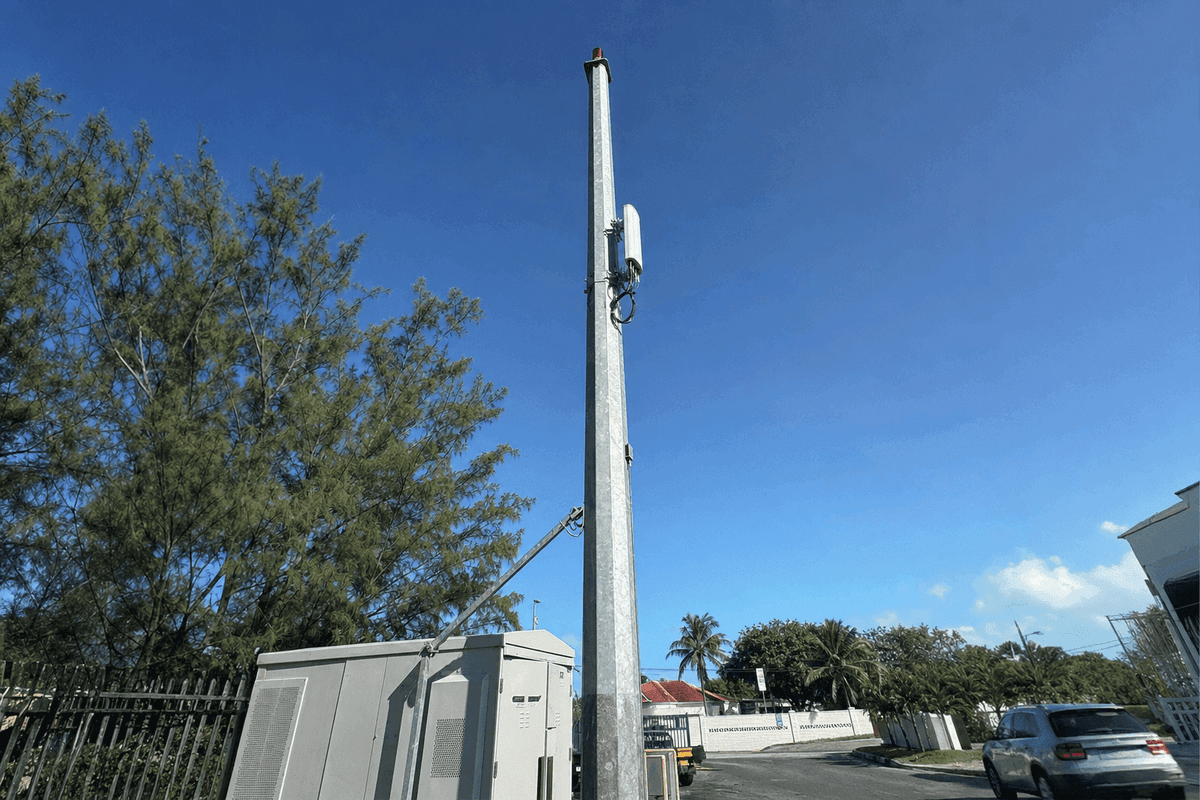
Nassau's 296,521-person New Providence market suits approximately 27 units of 8m Q345 steel Telecom Tower infill poles rated for 50m/s wind, high corrosion, and CKD shipment with 60-70% volume reduction.
Key Takeaways
- A typical 27-unit deployment would use 8m tapered steel monopoles, not lattice, FRP, or joint-use structures.
- Each pole is approximately 2t, using the project-specific 200kg/m small-cell class rather than the 500kg/m macro-tower rule.
- The recommended antenna package is 1 small cell plus 1 RRU per pole for community 5G/WiFi infill.
- Wind class 2 equals 50m/s with a 1.15 factor under TIA-222-H design logic.
- Hot-dip galvanized Q345 steel and a high-corrosion specification fit Nassau's coastal salt-air environment.
- Concrete pad foundations suit 8m small-cell poles where soil bearing and drainage are confirmed by local geotechnical checks.
- CKD shipping can reduce transport volume by 60-70%, which is material for island logistics into Nassau.
- Production planning should allow 15-25 days before ocean freight, customs clearance, civil works, and commissioning.
Market Context for Nassau
Nassau's telecom infill requirement is driven by a 296,521-person island population concentrated on 207km2 of New Providence, creating dense demand pockets for 8m small-cell poles.
According to The Bahamas Department of Statistics (2023), New Providence had 296,521 residents in the 2022 Census, out of 398,916 people nationwide. That means roughly three quarters of the national population is concentrated around Nassau, Paradise Island, Cable Beach, Carmichael Road, South Beach, Fox Hill, and other high-traffic communities. For mobile network planning, this profile favors many low-height infill sites rather than a small number of high macro towers.
According to the Utilities Regulation and Competition Authority of The Bahamas (2024), the electronic communications sector regulates mobile, fixed, internet, and broadcasting services under a national framework. URCA states, "Consumers are entitled to be provided with electronic communications services that satisfy reasonable demands." For Nassau, the practical engineering implication is that network densification must improve coverage quality without creating unnecessary visual obstruction or large civil footprints.
The Bahamas is also an island market with hurricane exposure and marine corrosion risk. According to the World Bank (2024), The Bahamas faces climate vulnerability from hurricanes, sea-level rise, and coastal flooding. For telecom structures near salt air, roads, schools, clinics, marinas, and resort corridors, galvanized steel, grounding, concrete pad foundations, and wind-class verification are not optional details; they are part of the technical fit.
According to ITU (2023), "Universal and meaningful connectivity" requires that people can use the internet every day with adequate devices, data, and connection quality. In Nassau, that objective translates into small-cell densification where street-level capacity is constrained by building shadowing, vegetation, traffic peaks, and tourist demand. SOLARTODO's Telecom Tower recommendation therefore focuses on an 8m community 5G/WiFi infill pole rather than a 25-45m macro monopole.
Recommended Technical Configuration
A recommended Nassau configuration is approximately 27 units of 8m hot-dip galvanized Q345 steel Telecom Tower poles for community 5G/WiFi infill.
This article uses the project-specific configuration supplied for Nassau: 27 units x 8m tapered steel monopole tower, with each tower weighing approximately 2t. The structure is a tapered steel monopole, not lattice, not FRP, and not a joint-use utility pole. Because the poles are only 8m tall, they sit below SOLARTODO's macro telecom size table, whose smallest standard row begins at 15-25m for rooftop or urban infill applications.
For macro telecom planning, the product table defines 15-25m as rooftop or urban infill with 1 platform, 3-6 panel antennas, and 8-15t per tower. Nassau's specified 8m pole class is different: a small-cell/community 5G infill structure carrying 1 small cell and 1 RRU, with 1 antenna mounting bracket. The correct weight basis is the supplied small-cell figure of approximately 200kg/m, not the 500kg/m rule used for larger telecom monopoles.
A typical 27-unit deployment of this scale would be distributed across community coverage gaps, resort-adjacent streets, public service corridors, transit stops, and residential hot spots. SOLARTODO would recommend final pole placement only after RF survey, landlord or right-of-way review, underground utility detection, foundation bearing checks, and operator-side backhaul confirmation. The engineering goal is to reduce localized congestion and improve street-level signal quality without installing oversized towers.
Technical Specifications
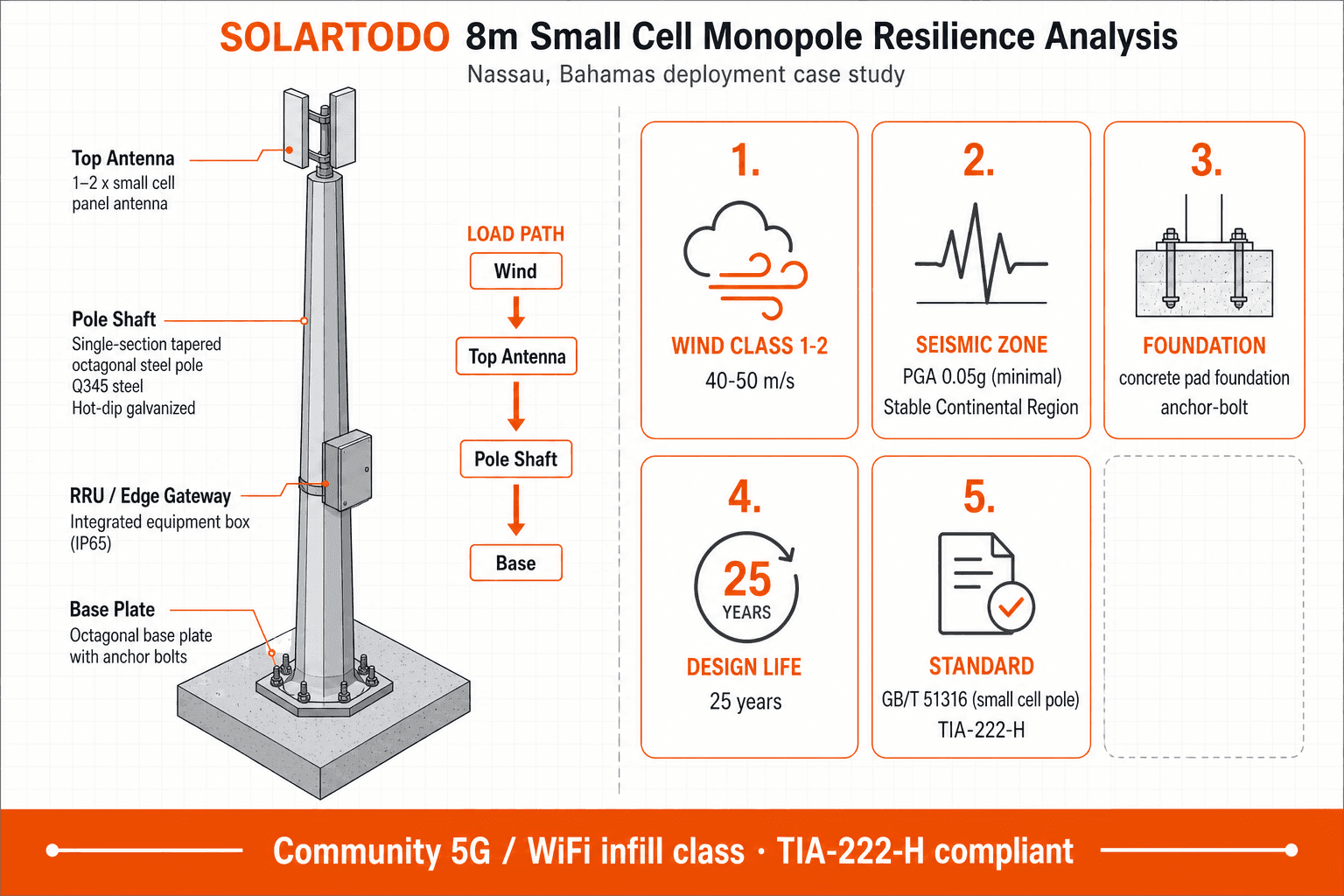
The Nassau Telecom Tower specification is an 8m Q345 steel small-cell monopole, approximately 2t per unit, with 50m/s wind-class design and 25-year design life.
Structure and Materials
- Product: SOLARTODO Telecom Tower, small cell/community 5G infill class.
- Form: tapered steel monopole tower, round or octagonal steel tube; not lattice, FRP, or joint-use.
- Quantity basis: approximately 27 units for this Nassau market configuration.
- Height: 8m per pole.
- Weight: approximately 2t per tower, equal to about 200kg/m for the supplied small-cell class.
- Steel grade: hot-dip galvanized Q345 steel.
- Corrosion zone: high, suitable for coastal salt-air specification with inspection-based maintenance.
- Design life: 25 years.
Antenna and Accessories
- Antenna load: 1 small cell plus 1 RRU per pole.
- Mounting: 1 antenna mounting bracket per pole.
- Cable management: cable tray included.
- Access: climbing pegs included for maintenance access where permitted by local safety rules.
- Grounding: grounding system included for lightning and fault-current protection coordination.
Wind, Foundation, and Standards
- Wind class: class 2, equivalent to 50m/s with a 1.15 factor under TIA-222-H framing.
- Foundation: concrete pad foundation, subject to site-specific soil bearing, drainage, and uplift verification.
- Shipping: CKD sectional shipment, reducing transport volume by 60-70%.
- Production period: 15-25 days before logistics and installation.
- Standards basis: GB/T 51316 for small-cell pole engineering and TIA-222-H for telecom structural loading.
According to the Telecommunications Industry Association (2017), TIA-222-H is the structural standard used for antenna-supporting structures and antennas. For Nassau, the relevant engineering issue is not only ultimate wind pressure but also corrosion control, anchor-bolt protection, foundation drainage, and post-storm inspection access. GB/T 51316 provides a small-cell-pole design reference that is more appropriate for 8m equipment than macro-tower assumptions.
Implementation Approach
A typical Nassau rollout would follow 5 phases: RF survey, civil design, CKD logistics, concrete pad installation, and commissioning of 27 small-cell sites.
The first phase should define candidate locations using RF coverage modeling, pedestrian and vehicle demand, power availability, backhaul options, and local permitting constraints. Nassau's dense districts create a need for compact infrastructure near users, but coastal roads and resort zones may impose stricter visual, access, and corrosion requirements. Each pole location should also be checked for underground utilities before excavation.
Procurement would then lock the 8m pole drawing, bracket orientation, grounding layout, cable-tray position, anchor-bolt cage, galvanizing specification, and packing list. Because the poles ship CKD, SOLARTODO can reduce transport volume by 60-70%, which helps container utilization for island delivery. Production planning should allocate 15-25 days before shipment, then add freight, customs, inland transport, and installation sequencing.
Civil works would normally start with survey control, excavation, rebar and anchor-bolt cage placement, concrete pouring, curing, and grounding electrode installation. The pad foundation is appropriate for the specified 8m height, but final dimensions depend on soil bearing, water table, nearby pavement, and uplift calculations. After curing, erection proceeds with pole assembly, verticality checks, torque control, accessory installation, and telecom equipment mounting.
Commissioning should verify grounding continuity, cable routing, bracket alignment, RRU mounting security, antenna azimuth, power feed, and operator acceptance tests. A post-installation maintenance plan should include a 6-month initial inspection, annual corrosion checks, after-storm inspections, and anchor-bolt retorque where required. This approach keeps the guide analytical and conditional; it does not claim that SOLARTODO has completed any past Nassau deployment.
Expected Performance & ROI
The expected benefit of 27 units is targeted street-level capacity improvement, lower macro-site loading, and a 25-year steel asset life under planned inspection.
Small-cell poles generally improve user experience by moving radio equipment closer to demand. According to GSMA (2024), mobile networks increasingly rely on densification and 5G capacity expansion to handle data growth. In Nassau, that means 8m poles can support localized coverage in commercial corridors, resort districts, school zones, community centers, and dense residential streets where a 25m or 35m macro tower would be excessive.
ROI should be evaluated as avoided churn, added enterprise or public WiFi revenue, improved 5G service quality, and reduced pressure on macro sites rather than direct energy savings. A typical payback model would compare lease costs, civil works, radio equipment, backhaul, maintenance, and incremental revenue or service-retention value over 5-10 years. For public-sector or operator-led projects, the strongest financial case is usually lower cost per covered high-demand location compared with adding a new macro tower.
According to the World Bank (2024), resilient infrastructure investment is important for small island states exposed to climate shocks. For telecom poles, resilience value comes from wind-class design, grounding, corrosion protection, and fast replaceability of standardized parts. A 25-year design life does not remove maintenance obligations, but it supports long-cycle capital planning when the structure is inspected after hurricanes and in high-salt environments.
Results and Impact
A technically appropriate Nassau program would prioritize 27 compact 8m poles to fill coverage gaps without the visual footprint of 25-45m macro towers.
The expected result is not a claimed past deployment; it is a market-fit recommendation for a dense island capital. By selecting 8m small-cell poles, the configuration aligns structure height with community infill use, antenna load, and coastal maintenance realities. It also avoids overstating tower capacity by applying macro-tower weights or platform counts to a small-cell structure.
For SOLARTODO, the product fit is strongest where the buyer needs standardized steel poles, CKD shipping, predictable production lead time, and high-corrosion detailing. For Nassau operators or EPC contractors, the buyer-side value is a repeatable bill of materials that can be adapted across multiple neighborhoods after RF and civil validation. The impact should be measured through coverage maps, throughput testing, dropped-session trends, maintenance records, and post-storm inspection outcomes.
Comparison Table
The 8m Nassau configuration differs from SOLARTODO macro Telecom Tower classes by height, load, weight basis, and community-infill use case.
| Configuration | Typical height | Application | Antenna loading | Weight basis | Nassau fit |
|---|---|---|---|---|---|
| Nassau small-cell pole | 8m | Community 5G/WiFi infill | 1 small cell + 1 RRU | ~2t total; ~200kg/m | Recommended for 27-unit infill |
| Rooftop/urban infill macro | 15-25m | Rooftop or constrained urban | 3-6 panel antennas; 1 platform | 8-15t per tower | Use only where more elevation is required |
| Suburban/residential macro | 25-35m | Residential or suburban | 6-9 panels; 2 platforms | 15-22t per tower | Oversized for the supplied Nassau brief |
| Highway/peri-urban macro | 35-45m | Highway or peri-urban | 6-9 panels + 1-2 microwave; 2-3 platforms | 22-30t per tower | Not suitable for small-cell street infill |
| Rural/wide coverage macro | 45-55m | Rural coverage | 9-12 panels; 3 platforms | 30-40t per tower | Not aligned with Nassau community infill |
Pricing & Quotation
SOLARTODO structures telecom quotations around 3 tiers: FOB Supply, CIF Delivered, and EPC Turnkey, with final pricing dependent on quantity, freight, and scope.
SOLARTODO offers three pricing tiers for this product line: FOB Supply (equipment ex-works China), CIF Delivered (including ocean freight and insurance), and EPC Turnkey (fully installed, commissioned, with 1-year warranty). Volume discounts are available for large-scale deployments. Configure your system online for an instant estimate, or request a custom quotation from our engineering team at [email protected].
Buyers comparing the SOLARTODO Telecom Tower for Nassau should request a quotation package that separates steel pole supply, accessories, foundation materials, installation labor, telecom equipment, backhaul, permitting, and maintenance. That structure prevents confusion between pole cost and full network cost. For engineering review, contact us with the site count, soil notes, RF equipment loads, corrosion requirements, and delivery terms.
Frequently Asked Questions
Q1: What Telecom Tower configuration is recommended for Nassau? The recommended configuration is approximately 27 units of 8m tapered Q345 steel monopole towers for community 5G/WiFi infill. Each pole carries 1 small cell and 1 RRU, includes 1 antenna bracket, cable tray, climbing pegs, and grounding, and weighs about 2t. This is a small-cell pole class, not a 15-55m macro telecom tower.
Q2: Why is an 8m pole suitable instead of a 25m or 35m macro tower? Nassau's New Providence market concentrates 296,521 residents in about 207km2, so many coverage issues are street-level capacity and building-shadow problems. An 8m small-cell pole places equipment near users with less visual impact. A 25-35m macro tower fits suburban coverage, but it is usually excessive for community WiFi or localized 5G infill.
Q3: What standards apply to this small-cell Telecom Tower? The specified standards are GB/T 51316 for small-cell pole design and TIA-222-H for telecom structural loading. The Nassau configuration uses wind class 2, meaning 50m/s with a 1.15 factor. Site engineering should still verify local wind exposure, foundation uplift, soil bearing, corrosion protection, grounding, and any municipal or operator-specific requirements.
Q4: How long would production and deployment typically take? Factory production is specified at 15-25 days for the 8m hot-dip galvanized Q345 steel poles. Total deployment time depends on drawing approval, ocean freight, customs clearance, pad foundation curing, telecom equipment availability, and commissioning. For planning, buyers should separate manufacturing lead time from civil works and network integration schedules.
Q5: What ROI factors should buyers use for Nassau small-cell poles? ROI should be modeled through added capacity, reduced congestion, customer retention, public WiFi value, enterprise service revenue, and avoided macro-site upgrades. The pole itself has a 25-year design life, but revenue depends on the radio network plan. A practical model compares the 27-unit infill program against new macro sites, leases, and maintenance costs.
Q6: How should maintenance be planned in a high-corrosion coastal zone? Maintenance should include a 6-month initial inspection, annual checks, and post-storm inspections after major wind events. Technicians should inspect galvanizing condition, anchor bolts, grounding continuity, cable trays, brackets, RRU mounts, and concrete pad drainage. High salt exposure in Nassau makes corrosion monitoring as important as structural wind compliance.
Q7: How does this compare with lattice or FRP alternatives? The specified product is a tapered steel monopole, not lattice or FRP. Compared with lattice towers, an 8m monopole has a smaller visual footprint and simpler accessory layout. Compared with FRP, Q345 galvanized steel offers familiar structural design, grounding integration, and robust bracket attachment for RRU and small-cell equipment in a coastal telecom environment.
Q8: Does SOLARTODO provide EPC pricing for Nassau? SOLARTODO can quote FOB Supply, CIF Delivered, and EPC Turnkey tiers, but this article intentionally does not publish prices. EPC pricing depends on site access, foundation dimensions, logistics, installation labor, permitting, and commissioning scope. Buyers should request a custom quotation with drawings, location count, antenna loads, corrosion class, and delivery terms.
Q9: What foundation is recommended for the 8m Nassau poles? The project-specific foundation is a concrete pad foundation. That is appropriate for compact 8m small-cell poles when the site has suitable soil bearing and proper drainage. Final pad dimensions, rebar, anchor bolts, and uplift checks should be confirmed by site-specific civil design, especially near coastal roads, utilities, or high-water-table areas.
Q10: What is included with each pole besides the steel structure? Each pole specification includes climbing pegs, cable tray, grounding system, and 1 antenna mounting bracket. The antenna load basis is 1 small cell plus 1 RRU. Telecom radios, fiber or microwave backhaul, power connection, permits, and operator commissioning may be separate scope items depending on whether the buyer selects FOB, CIF, or EPC Turnkey.
References
- The Bahamas Department of Statistics (2023): 2022 Census reported New Providence at 296,521 residents and The Bahamas at 398,916 people; https://www.bahamas.gov.bs/.
- Utilities Regulation and Competition Authority of The Bahamas (2024): Electronic communications sector framework covering mobile, fixed, internet, and broadcasting services; https://www.urcabahamas.bs/.
- World Bank (2024): The Bahamas country overview highlights climate vulnerability, resilience needs, and small-island infrastructure risk; https://www.worldbank.org/en/country/bahamas.
- ITU (2023): Universal and meaningful connectivity framework defines quality, affordability, and daily-use connectivity goals; https://www.itu.int/.
- Telecommunications Industry Association (2017): ANSI/TIA-222-H, Structural Standard for Antenna Supporting Structures and Antennas.
- Ministry of Housing and Urban Renewal, The Bahamas (2020): Bahamas Building Code references hurricane-resilient design considerations for structures in The Bahamas; https://www.bahamas.gov.bs/.
- GSMA (2024): Mobile Economy reports identify 5G densification and capacity expansion as core mobile-network investment drivers; https://www.gsma.com/mobileeconomy/.
Equipment Deployed
- 27 units x 8m tapered Q345 hot-dip galvanized steel monopole Telecom Tower
- Approximately 2t per tower, 200kg/m small-cell pole class
- Wind class 2: 50m/s with 1.15 factor under TIA-222-H framing
- Antenna load per pole: 1 small cell + 1 RRU
- Concrete pad foundation for 8m community infill sites
- Accessories: climbing pegs, cable tray, grounding system, 1 antenna mounting bracket
- High-corrosion coastal specification with 25-year design life
- CKD shipping package with 60-70% volume reduction and 15-25 day production window