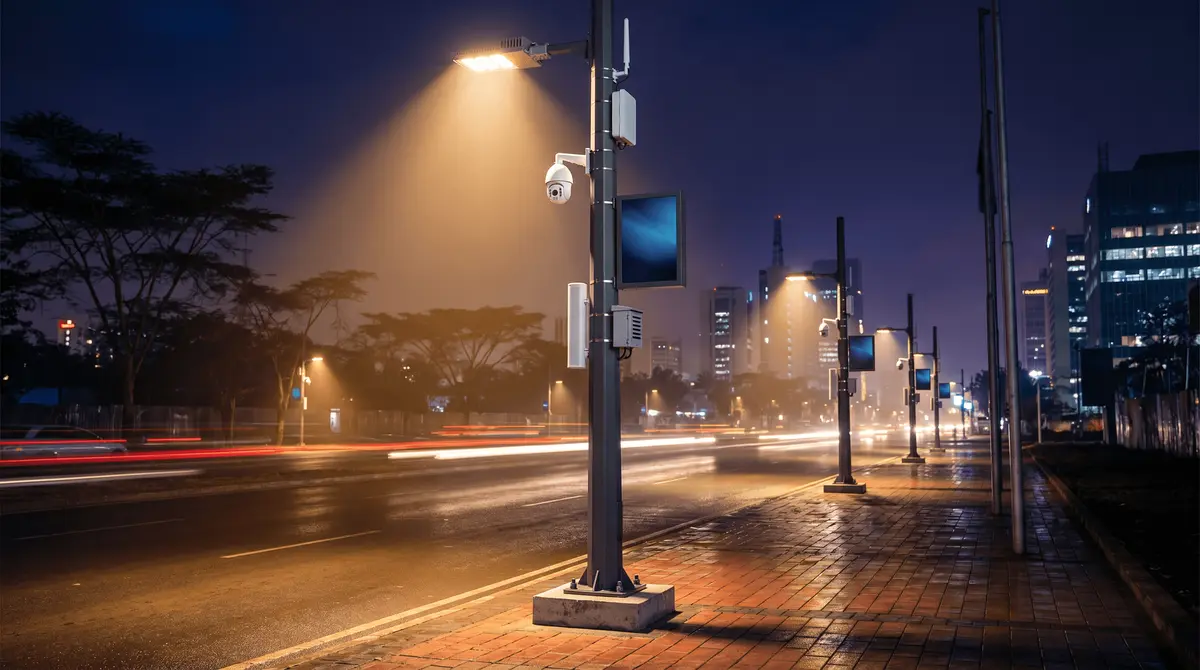
Nairobi Smart Streetlight Deployment: 387-Unit 8m Octagonal Pole Project in Kenya
Summary
This Nairobi deployment installed 387 SOLAR TODO Smart Streetlight units using 8m octagonal poles, 100W LED luminaires, and HD camera plus 8-in-1 environmental sensing. Replacing 250W HPS cut lighting energy use by 60% across 12m roads with 25m pole spacing.
Key Takeaways
- 387 SOLAR TODO Smart Streetlight units were deployed across Nairobi using 8m octagonal hot-dip galvanized steel poles for arterial and collector road coverage.
- Each pole uses a 100W LED luminaire delivering 15,000 lm at 150 lm/W and 4000K, replacing legacy 250W HPS fixtures.
- Standard pole spacing was 25m on 12m-wide roads, balancing illumination uniformity, installation density, and civil works efficiency.
- Every unit integrates an HD camera with 400W IR capability, H.265+, IP67 protection, and 30W power consumption for roadway surveillance.
- Each pole also includes an 8-in-1 environmental sensor measuring wind, temperature, humidity, pressure, noise, PM10, and PM2.5 at 5W load.
- Optional 5G small-cell modules were installed on 10% of poles, using n78 radios with 200m coverage radius and 150W power draw.
- Optional Wi-Fi AP modules provide 802.11ac connectivity at 300Mbps and support up to 100 concurrent devices per equipped pole.
- Grid-powered AC operation with smart_city control and City IoT Platform integration supports 10-hour daily operation and centralized management.
Project Background
Nairobi required a multi-function roadway upgrade that combined safer nighttime lighting, better corridor monitoring, and scalable digital infrastructure across 12m urban roads. The completed 387-unit SOLAR TODO Smart Streetlight project addressed lighting inefficiency, public safety concerns, and limited street-level environmental data in one grid-powered platform.
Nairobi's transport corridors face a familiar set of urban infrastructure pressures: aging high-pressure sodium lighting, rising traffic volumes, public safety requirements, and growing demand for digital connectivity. In many districts, conventional streetlighting systems illuminate roads but do not provide surveillance, air-quality visibility, or communications capacity. That creates separate procurement cycles for lighting, security, telecom, and environmental monitoring, increasing both capex complexity and operating overhead.
According to the World Bank (2023), African cities are under sustained pressure to expand resilient urban infrastructure while improving service delivery efficiency. According to the International Energy Agency, IEA (2022), LEDs remain one of the fastest and most cost-effective ways to reduce electricity demand in public lighting systems. In Nairobi, where municipal operators must balance road safety, maintenance resources, and network modernization, a converged smart pole architecture is more practical than siloed upgrades.
The project was therefore structured as a real corridor-scale deployment of SOLAR TODO Smart Streetlight systems on 8m octagonal poles. The objective was not only to improve visibility, but also to create a field-ready platform for surveillance, environmental sensing, and selective telecom densification. This approach aligned with broader smart-city trends across emerging markets, where municipalities increasingly prefer modular roadside assets that can host multiple services over a single AC-powered pole.
As IRENA states, "Energy efficiency is a critical enabler of affordable and sustainable urban services." That principle directly applies to public lighting retrofits that replace inefficient HPS fixtures with high-efficacy LED systems. IEEE also notes that "smart city platforms depend on interoperable sensing, communications, and control at the edge," which is exactly how this Nairobi deployment was designed.
Solution Overview
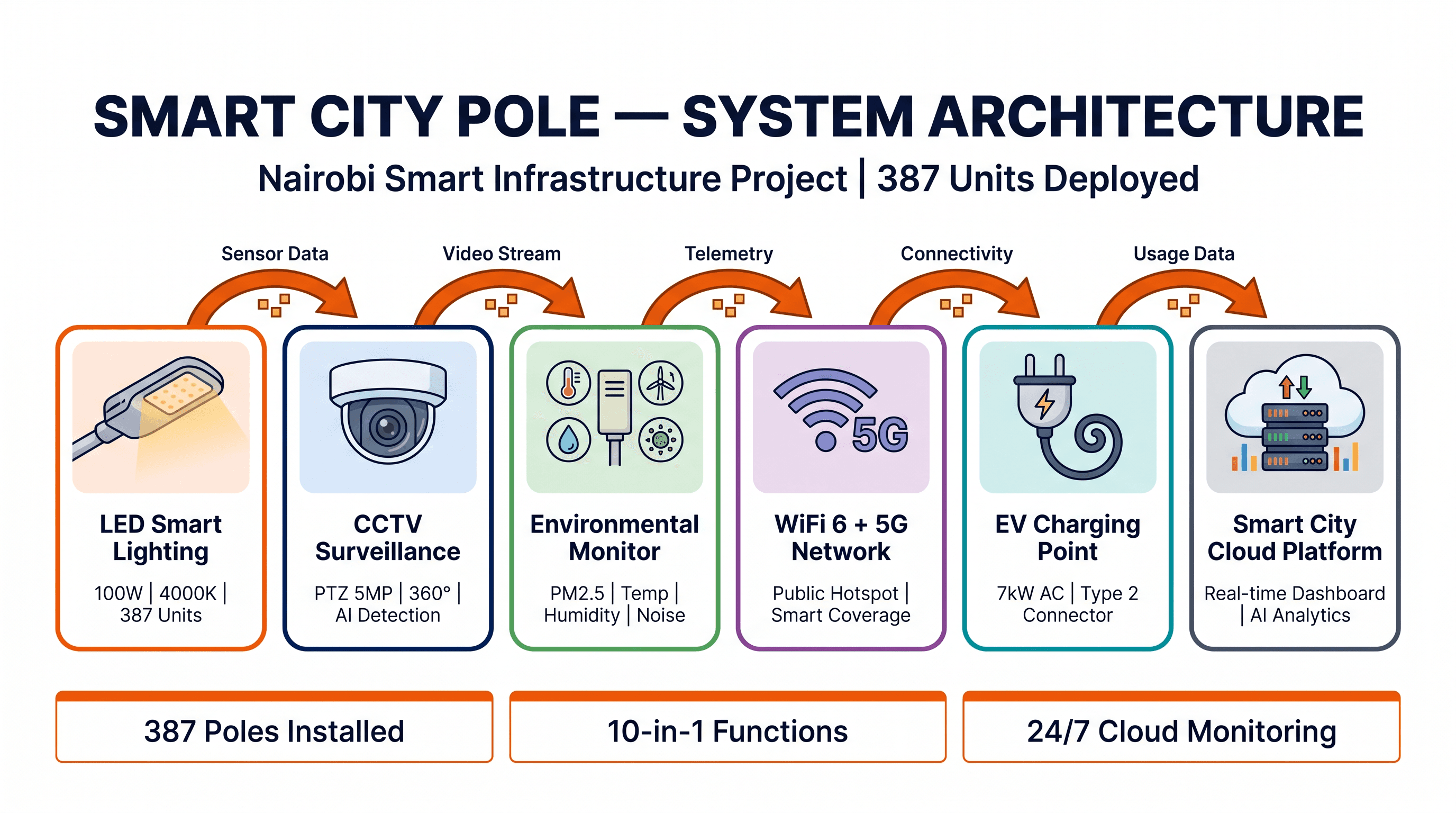
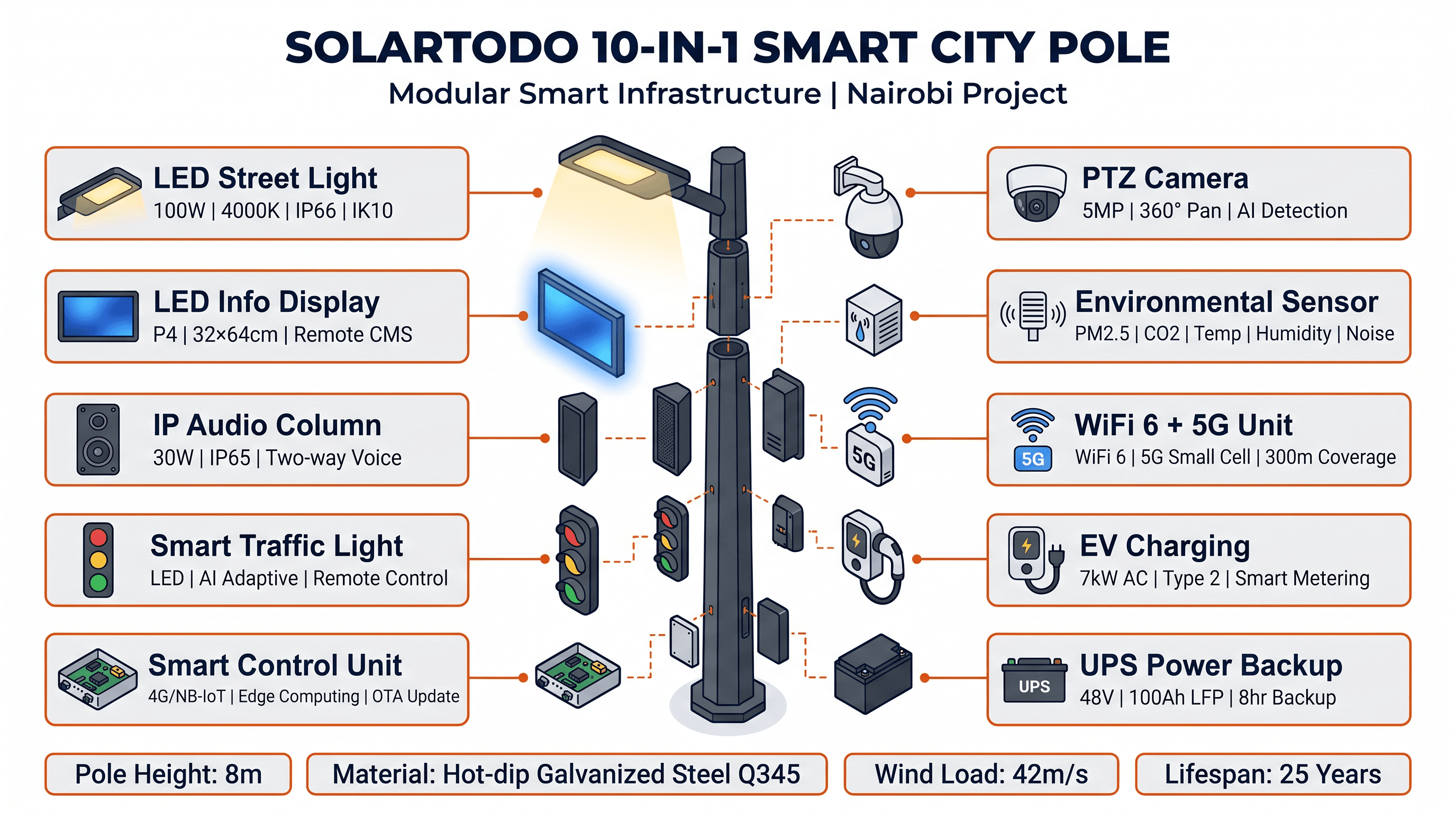
SOLAR TODO deployed 387 Smart Streetlight units in Nairobi with 100W LED heads, HD cameras, 8-in-1 environmental sensors, and optional 5G or Wi-Fi modules under centralized smart_city control. The project converted conventional lighting poles into connected roadside infrastructure without changing the grid-powered AC operating model.
The deployed system used 387 units of SOLAR TODO Smart Streetlight equipment along 12m-wide roads in Nairobi, Kenya at coordinates -1.29, 36.82. Each unit was built around an 8m octagonal hot-dip galvanized steel pole, selected for mechanical durability, corrosion resistance, and compatibility with integrated smart-city modules. The dark-grey finish and octagonal geometry supported a consistent streetscape while keeping the pole suitable for camera and radio mounting.
At the lighting level, each pole used a 100W LED luminaire producing 15,000 lumens at 150 lm/W with a 4000K correlated color temperature. This replaced legacy 250W HPS streetlights and delivered the project's stated 60% energy saving under a 10-hour daily operating profile. According to NREL (2022), LED roadway systems typically reduce energy use substantially while improving controllability and optical performance compared with older discharge lighting technologies.
Beyond illumination, the standard configuration included one HD camera per pole with 400W IR capability, H.265+ compression, IP67 ingress protection, and 30W power consumption. Each pole also carried one 8-in-1 environmental sensor measuring wind, temperature, humidity, pressure, noise, PM10, and PM2.5, with a 5W load. These modules allowed the lighting network to function as an urban sensing layer rather than only a utility asset.
For communications expansion, 10% of poles were equipped with small_cell_5g modules using 5G NR n78 radios with 200m coverage and 150W power draw. Selected poles also carried Wi-Fi AP modules rated at 802.11ac, 300Mbps, and up to 100 users per node. All units were managed through smart_city control integrated with the City IoT Platform, enabling remote status monitoring, fault visibility, and module-level administration. SOLAR TODO used this architecture to help Nairobi consolidate lighting, safety, sensing, and edge communications on one standardized roadside platform.
For product details on the platform family, see the Smart Streetlight product page. For project-specific engineering support, municipalities and EPC contractors can also contact us.
Technical Specifications
This Nairobi Smart Streetlight deployment used 387 grid-powered AC poles with 100W LED lighting, HD cameras, 8-in-1 sensors, and optional 5G on 10% of units. The configuration complied with IEC 60598 and GB/T 37024 for roadway lighting and smart pole deployment requirements.
Deployed pole and lighting configuration
- Quantity: 387 units
- Pole type: 8m octagonal hot-dip galvanized steel pole
- Power supply: Grid-powered AC
- Lighting fixture: LED 100W
- Luminous flux: 15,000 lm
- Luminous efficacy: 150 lm/W
- CCT: 4000K
- Daily operation: 10 hours
- Replaced fixture type: 250W HPS
- Energy saving: 60%
- Pole spacing: 25m
- Applicable road width: 12m
Standard smart modules on each pole
- Camera type: HD camera
- IR specification: 400W IR
- Video compression: H.265+
- Camera protection: IP67
- Camera power: 30W
- Environmental sensor type: 8-in-1 ENV sensor
- Sensor parameters: wind, temperature, humidity, pressure, noise, PM10, PM2.5
- Sensor power: 5W
Optional communications modules
- 5G module: small_cell_5g
- 5G deployment ratio: 10% of poles
- 5G standard: 5G NR n78
- 5G coverage: 200m
- 5G power: 150W
- Wi-Fi module: wifi_ap
- Wi-Fi standard: 802.11ac
- Wi-Fi throughput: 300Mbps
- Concurrent users: 100 devices
Control and standards
- Control system: smart_city
- Platform integration: City IoT Platform
- Applicable standards: IEC 60598, GB/T 37024
Deployment Process
The Nairobi rollout was executed in phased civil, electrical, and commissioning stages, allowing 387 poles to be installed with standardized 25m spacing and minimal corridor disruption. SOLAR TODO used a repeatable deployment model that reduced installation risk while preserving future expandability for 5G and Wi-Fi modules.
1. Corridor survey and engineering design
The project began with a route survey covering road geometry, right-of-way constraints, existing HPS pole conditions, and feeder availability. Because the target roads were 12m wide, the lighting design standardized on 25m pole spacing to maintain roadway coverage while limiting unnecessary pole density. Mounting heights, camera sightlines, and radio placement were reviewed at the design stage so that each pole could support both current and future modules.
According to IEC (2020), compliant outdoor luminaires and roadway installations require attention to electrical safety, environmental protection, and mechanical integration. In practice, that meant cable routing, earthing strategy, and enclosure interfaces were resolved before fabrication. SOLAR TODO also coordinated controller and platform mapping in advance so that each installed pole could be digitally identified during commissioning.
2. Foundation and pole installation
Civil works were sequenced block by block to avoid excessive lane occupation. Existing 250W HPS assets were removed or decommissioned in sections, and new foundations were prepared for the 8m octagonal hot-dip galvanized steel poles. The use of a standardized pole type simplified logistics, reduced SKU complexity, and accelerated installation quality checks.
Because the system remained grid-powered AC, the electrical transition was more straightforward than a full network redesign. Feed connections were inspected, protection devices were checked, and each pole was prepared for luminaire, camera, sensor, and optional communication module integration. This reduced the risk of phased commissioning delays and allowed field teams to energize sections as they were completed.
3. Module integration and network onboarding
Once poles and luminaires were installed, crews mounted the HD cameras and 8-in-1 environmental sensors on each unit. On 10% of poles, the small_cell_5g module was added to provide n78 coverage with a 200m service radius, while selected nodes also received 802.11ac Wi-Fi APs. The modular architecture meant the city did not need identical communications hardware on every pole to gain network-wide value.
Each controller was then onboarded into the smart_city environment and mapped into the City IoT Platform. According to ITU (2022), smart sustainable city systems depend on interoperable digital infrastructure and reliable data flows between edge devices and central platforms. That is why this Nairobi project emphasized controller-level visibility, alarm management, and remote access from the first commissioning stage.
4. Testing, acceptance, and handover
Final acceptance included lighting verification, camera stream validation, environmental sensor checks, and communications testing on equipped poles. Operators confirmed H.265+ video compression, IP67 camera integrity, and live telemetry from the sensor package. The city also verified operating schedules based on the 10-hour daily lighting profile used in the energy-saving model.
SOLAR TODO provided documentation for pole IDs, installed modules, and standards compliance under IEC 60598 and GB/T 37024. The result was a handover package suitable for municipal maintenance teams, systems integrators, and telecom stakeholders that may later expand the optional communications layer.
Performance & Results
The 387-pole Nairobi deployment reduced lighting energy demand by 60%, improved roadway visibility with 15,000-lumen LED output, and added citywide sensing plus selective 5G coverage. The project shows how one AC-powered Smart Streetlight network can replace separate lighting, surveillance, and environmental infrastructure layers.
The most immediate result was the conversion from 250W HPS to 100W LED lighting, delivering the specified 60% energy saving under a 10-hour daily operating schedule. That reduction is consistent with wider market evidence. According to NREL (2022), LED streetlighting retrofits commonly produce major electricity savings while lowering maintenance frequency compared with legacy discharge systems. According to IEA (2022), efficient lighting remains one of the most scalable municipal energy-efficiency actions available globally.
Lighting quality also improved. Each luminaire delivers 15,000 lumens at 150 lm/W and 4000K, giving Nairobi a more modern roadway lighting profile than the replaced HPS fixtures. While HPS systems often suffer from lower visual clarity and limited controllability, the deployed LED fixtures provide a better platform for consistent corridor illumination and digital control integration. On 12m roads with 25m spacing, this standardized geometry simplified both planning and future maintenance.
The second major result was infrastructure convergence. Rather than deploy separate poles for CCTV, air-quality monitoring, and telecom densification, the city used one roadside asset to support all three. Every pole carries an HD camera and 8-in-1 environmental sensor, while 10% of poles host 5G NR n78 small cells with 200m coverage. According to the World Bank (2023), integrated urban infrastructure models can improve service delivery efficiency by reducing fragmented asset deployment.
The environmental data layer is especially relevant in Nairobi, where traffic corridors can experience localized air-quality and noise variation. PM10, PM2.5, noise, wind, temperature, humidity, and pressure data give operators more granular visibility into roadside conditions. According to WHO (2021), urban air pollution remains a significant public-health concern, making street-level sensing increasingly valuable for transport and planning agencies.
Operationally, the smart_city control layer and City IoT Platform reduced the burden of manual inspection. Fault visibility, device status monitoring, and module-level oversight mean maintenance teams can prioritize interventions instead of relying only on nighttime patrols. According to IEEE (2021), remote monitoring and interoperable edge control are central to scalable smart-city operations because they reduce downtime and improve asset utilization.
For SOLAR TODO, this project demonstrates a practical African city deployment model: retain grid-powered AC simplicity, replace inefficient HPS lighting, and add modular digital capabilities where they create measurable value. For Nairobi, the result is not just a lighting upgrade, but a repeatable smart corridor template that can be extended to additional roads with the same 8m pole architecture.
Comparison Table
This comparison shows how Nairobi’s deployed 100W Smart Streetlight configuration outperformed the replaced 250W HPS baseline while adding surveillance, sensing, and communications capacity. The key difference is that one 8m SOLAR TODO pole now carries multiple city functions that previously required separate infrastructure.
| Metric | Legacy System | Nairobi SOLAR TODO Smart Streetlight | Deployment Impact |
|---|---|---|---|
| Pole quantity | Existing mixed stock | 387 units | Standardized corridor asset base |
| Pole type | Conventional lighting pole | 8m octagonal hot-dip galvanized steel pole | Better module integration and corrosion resistance |
| Light source | 250W HPS | 100W LED | 60% lower lighting energy use |
| Luminous output | Not standardized in project brief | 15,000 lm | Higher-efficiency roadway illumination |
| Efficacy | Lower than LED baseline | 150 lm/W | Reduced electricity demand |
| CCT | Typical HPS warm amber | 4000K | Improved visual clarity for roads and cameras |
| Spacing | Site-dependent legacy layout | 25m | Repeatable design on 12m roads |
| Surveillance | Separate or absent | HD camera, H.265+, IP67, 30W | Corridor-level monitoring on every pole |
| Environmental data | Separate or absent | 8-in-1 sensor, 5W | PM10/PM2.5/noise/weather visibility |
| Connectivity | Separate infrastructure | Optional 5G on 10% of poles; Wi-Fi AP optional | Supports smart-city and telecom densification |
| Control | Basic switching | smart_city + City IoT Platform | Remote monitoring and centralized management |
| Standards | Legacy dependent | IEC 60598, GB/T 37024 | Clear compliance framework |
Pricing & Quotation
SOLAR TODO offers three pricing tiers for this product line: FOB Supply (equipment ex-works China), CIF Delivered (including ocean freight and insurance), and EPC Turnkey (fully installed, commissioned, with 1-year warranty). Volume discounts are available for large-scale deployments. Configure your system online for an instant estimate, or request a custom quotation from our engineering team at [email protected].
Frequently Asked Questions
This FAQ answers the most common technical, deployment, maintenance, and quotation questions for Nairobi-style Smart Streetlight projects using 387 units, 8m poles, and 100W LED fixtures. The responses are concise and project-specific so EPCs, municipalities, and consultants can quickly evaluate fit.
Q1: What exactly was deployed in Nairobi, Kenya? A total of 387 SOLAR TODO Smart Streetlight units were installed on 8m octagonal hot-dip galvanized steel poles. Each pole includes a 100W LED luminaire rated at 15,000 lm, one HD camera with H.265+ and IP67 protection, and one 8-in-1 environmental sensor. The system is grid-powered AC and centrally managed through smart_city plus the City IoT Platform.
Q2: How much energy did the project save compared with the old streetlights? The project replaced 250W HPS fixtures with 100W LED luminaires and achieved a stated 60% energy saving. This result is based on a 10-hour daily operating profile across the deployed roadway corridors. The higher 150 lm/W efficacy also improves lighting performance while reducing electricity demand compared with legacy discharge lighting.
Q3: What road geometry was this configuration designed for? This deployment was configured for 12m-wide roads with pole spacing of 25m. That geometry suits many urban arterial and collector corridors where municipalities need a balance between illumination coverage, pole count, and civil works cost. It also provides a repeatable layout that simplifies future maintenance and expansion planning.
Q4: Were all poles equipped with 5G modules? No. The optional small_cell_5g module was installed on 10% of poles rather than across the entire network. Each installed unit uses 5G NR n78, provides about 200m coverage, and draws 150W. This selective strategy is useful where telecom densification is needed only on priority corridors or high-demand zones.
Q5: What communications capability is available besides 5G? Selected poles can also use a Wi-Fi AP module rated at 802.11ac with 300Mbps throughput and support for up to 100 devices. This is useful for public connectivity, municipal operations, or corridor-level digital services. Because the architecture is modular, cities can choose Wi-Fi, 5G, both, or neither depending on the site requirement.
Q6: How long does installation typically take for a project like this? The exact schedule depends on civil permits, feeder readiness, traffic management, and import logistics, but projects of this scale are usually delivered in phases rather than one continuous corridor shutdown. A typical sequence includes survey, foundation works, pole erection, electrical connection, module mounting, and platform commissioning. Standardized 8m poles help accelerate field execution.
Q7: What maintenance does the system require after handover? Routine maintenance focuses on luminaire checks, camera lens cleaning, sensor inspection, electrical connection verification, and platform-based fault review. Because the system is centrally monitored through smart_city and the City IoT Platform, many issues can be identified remotely before site visits are dispatched. That reduces manual night patrols and improves maintenance prioritization.
Q8: How does this compare with a conventional LED-only streetlight project? A conventional LED-only project improves energy efficiency but usually does not include surveillance, environmental sensing, or telecom readiness. This Nairobi configuration adds an HD camera, an 8-in-1 sensor, optional 5G small cells, and optional Wi-Fi on the same pole. That makes the asset more valuable for transport, public safety, and smart-city operations.
Q9: What standards does the deployed system comply with? The project configuration references IEC 60598 and GB/T 37024. IEC 60598 is widely used for luminaire safety and performance requirements in outdoor lighting applications, while GB/T 37024 is relevant to smart city pole system frameworks. Compliance helps EPCs and municipalities align design, procurement, and acceptance criteria more clearly.
Q10: Is ROI or payback mainly driven by energy savings alone? Energy savings are the primary direct return because the project cuts lighting consumption by 60% when replacing 250W HPS with 100W LED. However, the broader value case also includes fewer site visits, integrated surveillance, environmental data collection, and optional 5G or Wi-Fi hosting. In practice, municipalities often evaluate both utility savings and multi-service infrastructure benefits.
Q11: Does SOLAR TODO provide EPC quotations for projects like this? Yes. SOLAR TODO supports supply-only, delivered, and EPC turnkey quotation models for Smart Streetlight deployments. The final quotation depends on quantities, module mix, standards, civil scope, communications options, and destination logistics. The recommended approach is to submit corridor length, road width, desired spacing, and optional 5G or Wi-Fi requirements through the contact page.
Q12: What warranty and after-sales support are available? For the EPC turnkey option, the standard commercial statement includes a 1-year warranty. Support typically covers commissioning documentation, remote platform onboarding, and post-installation technical coordination. For larger municipal projects, SOLAR TODO can also align spare-parts planning and maintenance guidance around the exact installed configuration and module selection.
References
This case study uses recognized international sources and standards alongside the deployed Nairobi project data to support technical claims on lighting efficiency, smart-city integration, and compliance. The references below are the primary authority base for the performance and standards context discussed above.
- NREL (2022): Solid-state and LED lighting guidance showing substantial energy-saving potential for roadway and outdoor lighting retrofits.
- IEC (2020): IEC 60598 luminaire safety and performance framework for indoor and outdoor lighting equipment.
- IEEE (2021): Smart city edge infrastructure guidance emphasizing interoperable sensing, communications, and remote control architectures.
- ITU (2022): Smart sustainable city frameworks covering digital infrastructure integration, connectivity, and data-driven urban services.
- IEA (2022): Energy efficiency analysis identifying efficient lighting as a major opportunity for reducing electricity demand in public infrastructure.
- IRENA (2023): Urban energy transition guidance highlighting efficiency as a core enabler of affordable municipal services.
- World Bank (2023): Urban development and infrastructure modernization publications supporting integrated, resilient city asset deployment models.
- WHO (2021): Air quality guidance and urban pollution evidence underscoring the value of PM10 and PM2.5 monitoring in transport corridors.
Equipment Deployed
- 387 × 8m octagonal hot-dip galvanized steel poles
- LED luminaire, 100W, 15,000 lm, 150 lm/W, 4000K
- HD camera with 400W IR, H.265+, IP67, 30W
- 8-in-1 environmental sensor: wind, temperature, humidity, pressure, noise, PM10, PM2.5, 5W
- small_cell_5g module, 5G NR n78, 200m coverage, 150W, installed on 10% of poles
- wifi_ap module, 802.11ac, 300Mbps, 100 devices
- smart_city controller with City IoT Platform integration
- Grid-powered AC electrical connection and control system
- IEC 60598 and GB/T 37024 compliant deployment framework