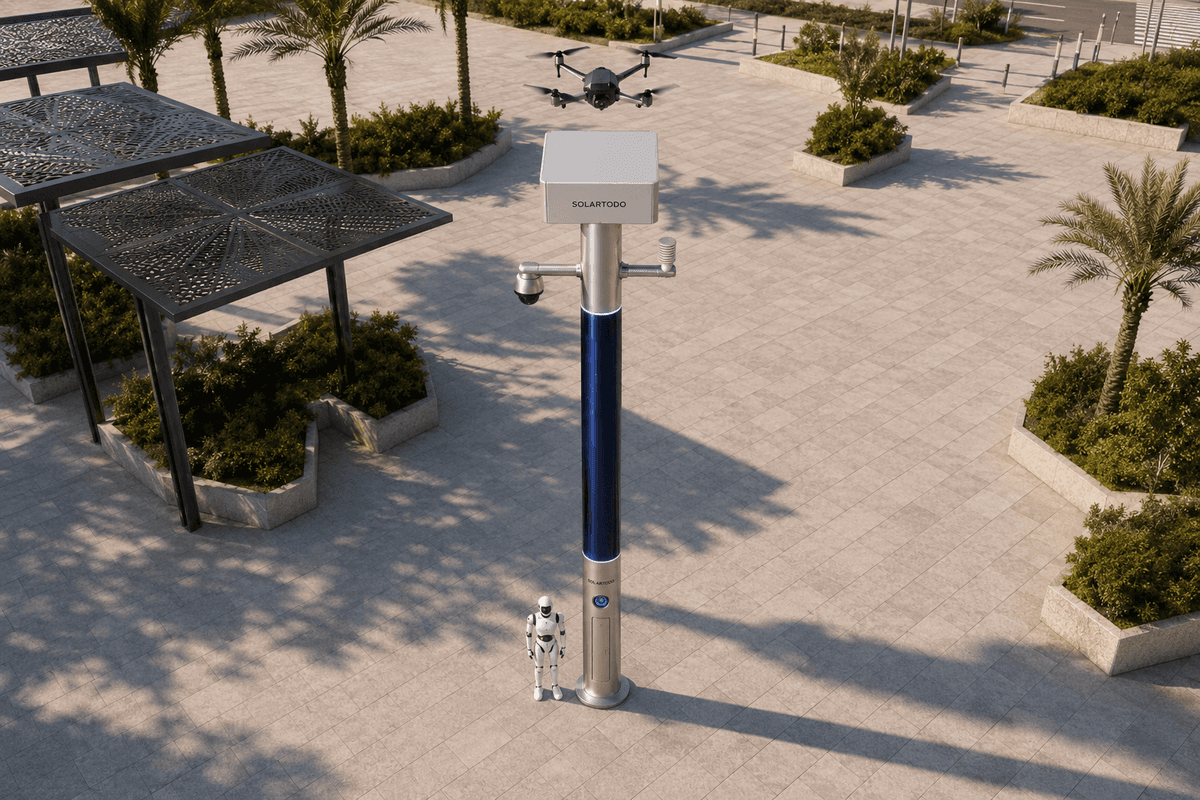
A City AI Pole is a non-lighting physical-AI edge node that combines off-grid energy, local compute, sensing, drone operations, and robot operations in one urban pole. In this proposed Nairobi deployment, SOLARTODO Sentinel Sky Hub supports port-zone flood-season event coverage by processing data locally and coordinating authorized field response.
Procurement Context
Nairobi’s port function is not a seafront quay; it is an inland logistics environment where container yards, bonded warehouses, truck gates, industrial roads, rail-linked freight movement, and city traffic meet. During flood season, a major event adds another layer of pressure: visitor movement, temporary road controls, supply deliveries, and emergency access all have to be coordinated without turning the logistics zone into a patchwork of disconnected command posts.
For city management, the procurement problem is not simply “buy a drone” or “add more cameras.” The harder issue is cross-department silo friction. Transport teams watch road flow, emergency teams monitor flood exposure, port and industrial operators track gates and yards, security teams watch perimeters, and event operations manage crowd and service routes. Each group may have a partial picture, but no single edge-based field node turns local sensing into authorized, recorded action.
This case frames a single-pilot deployment of SOLARTODO Sentinel Sky Hub as a city-ai-pole procurement item for one Nairobi port-zone operating cell. The pilot is proposed for a major-event window during flood season, with coverage as the main KPI family: patrol coverage, route coverage, gate and perimeter observation coverage, and coverage continuity across repeated sorties. All KPI values should be treated as target evaluation inputs, subject to final engineering confirmation after site survey, aviation permissions, local operating procedures, and stakeholder sign-off.
Sky Hub is a pure smart pole with no lighting system. It is a physical-AI urban edge node: fully off-grid, battery-backed, and replenished by 360-degree wrapped flexible CIGS thin-film solar on the pole body. Its role is to host local intelligence, autonomous drone operations, ground robot support, environmental sensing, and a command view that lets city management decide and coordinate across departments from one common operating picture.
Single-Pilot Shape
The proposed deployment mode is deliberately modest: one Sky Hub installed at a high-value logistics observation point inside or adjacent to the Nairobi port-zone operating perimeter. The procurement purpose is to validate whether one physical-AI edge node can reduce coordination gaps before expanding any footprint. It does not claim citywide coverage, national rollout scale, certified compliance, or achieved response improvements.
The site would be selected for three reasons. First, it should see multiple operational interfaces: truck queuing, pedestrian event movement, perimeter approach roads, and drainage-sensitive access lanes. Second, it should allow authorized drone launch and return paths that do not conflict with restricted airspace or public safety rules. Third, it should support a secure pole base where the ground robot can return for wireless charging and where maintenance access can be controlled.
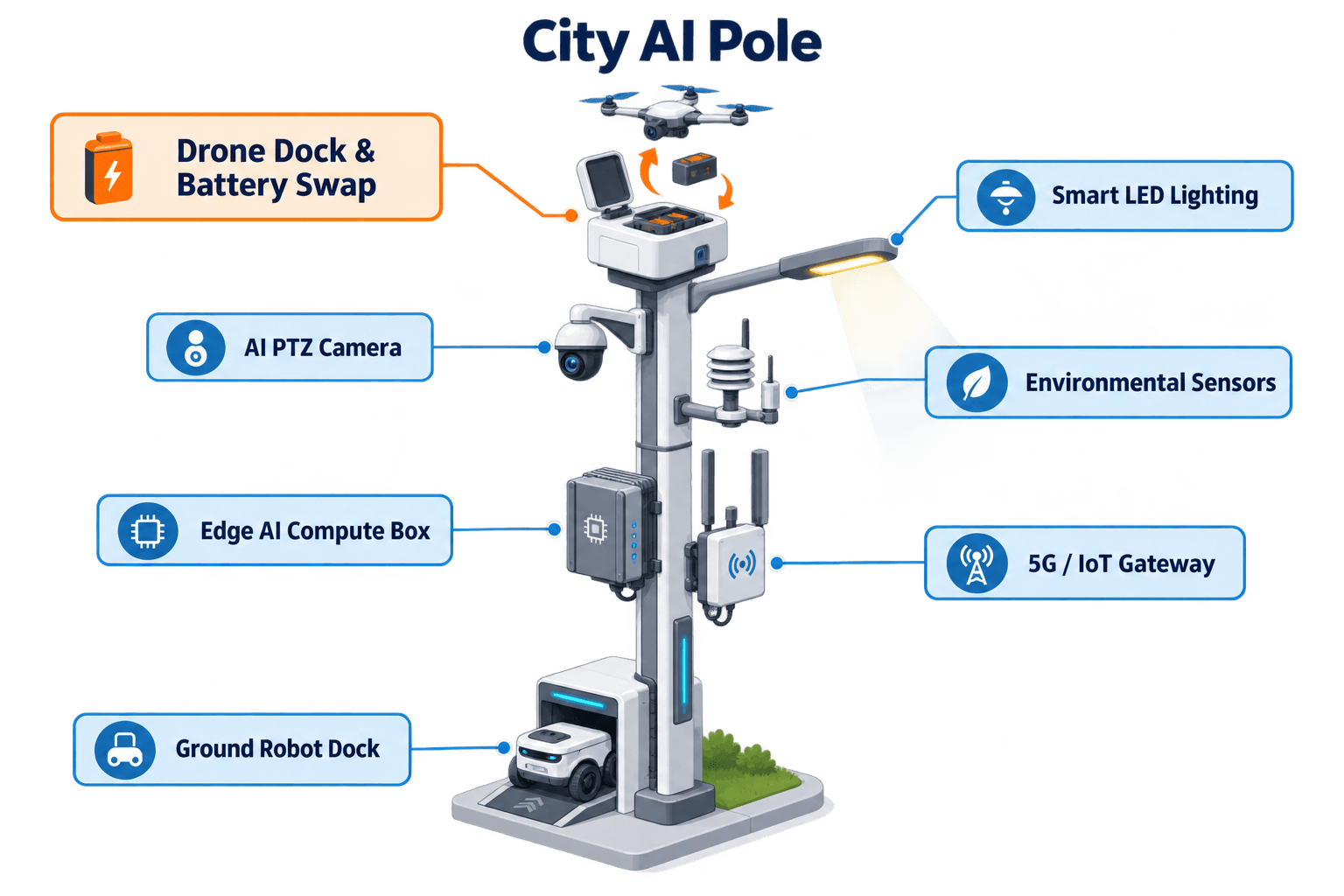
The module focus is the drone nest and battery-swap workflow. A landed drone returns to the Sky Hub, aligns with the rear-service bay, receives an automated charged-pack exchange from a multi-bay battery magazine, and relaunches into the next authorized sortie. The value for Nairobi city management is coverage continuity. Instead of treating each drone flight as a separate manual operation, the pole turns patrols, inspections, returns, battery exchanges, and redeployments into a managed sequence.
The nine-in-one capability set is kept operationally grounded. The PTZ camera supports anonymous vehicle count, crowd density, intrusion, and perimeter awareness. Environmental monitoring captures wind speed, wind direction, temperature, humidity, atmospheric pressure, noise, PM10, PM2.5, and illuminance. Edge AI compute runs local inference and schedules workloads on-pole. Raw video and sensor data stay on the pole; only de-identified event or status metadata may leave the site-facing node.
Major-Event Operations
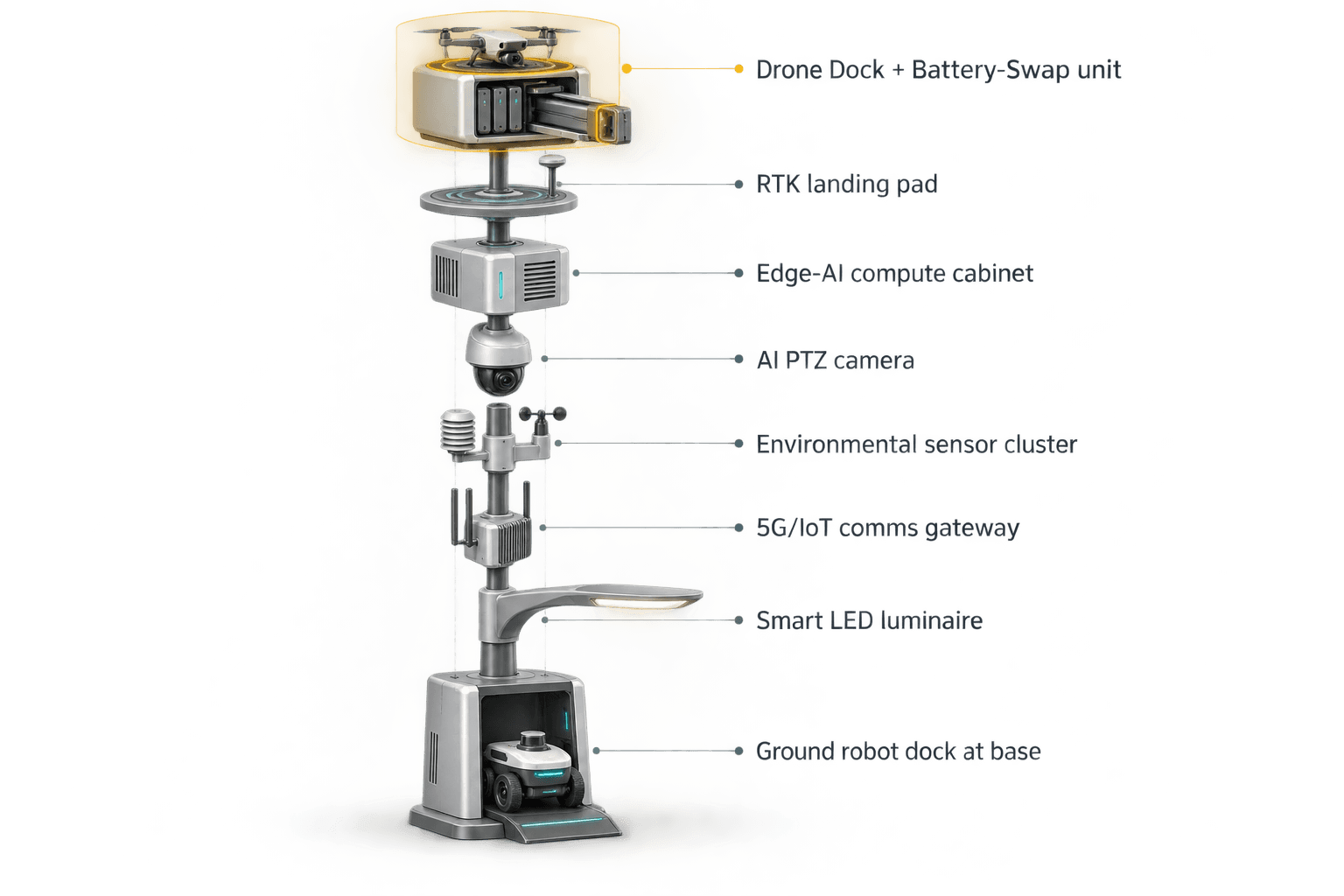
During a major event in flood season, the city task is to keep freight, emergency access, event movement, and perimeter safety visible enough for decisions. The operations loop follows sensing, authorized assessment and response, edge-compute scheduling, and field operations and maintenance. In the COP command view, city management can see the node state, drone task queue, swap status, local alerts, environmental readings, and mission logs as one operational layer.
A typical sequence begins when the on-pole PTZ camera or environmental sensors flag an anomaly: sudden queue buildup near a gate, crowd density rising at an access point, standing-water risk near a service route, or movement in a restricted perimeter zone. The edge module classifies and scores the event locally. The system then presents de-identified status metadata and a recommended response path to the authorized operator.
If aerial verification is approved, the drone nest assigns a sortie from the task queue. The drone launches, checks the route or perimeter segment, returns, and enters the battery hot-swap cycle. The multi-bay magazine is important here because a flood-season event day may require several consecutive patrols, not one isolated flight. The battery-swap mechanism supports repeated coverage cycles while the main storage system buffers high-power activities.
Ground robot operations complement the aerial layer. A humanoid or service robot can perform autonomous patrol, alarm response, close inspection, air-ground coordination, and return to the pole base for wireless charging. The robot does not replace human authority; it extends field presence where sending staff repeatedly into congested or water-affected zones is inefficient.
Counter-UAS coordination is handled with strict boundaries. The pole can detect and track an unauthorized drone through its own sensing and, where available, optional partner-sensor inputs. Radar is not built into the pole. Any mitigation is non-lethal and human-authorized only: the node can command its own friendly drone for soft aerial net-capture or close-approach deterrence after operator approval.
Off-Grid Energy Model
For Nairobi procurement, the fully off-grid architecture matters because the pole should not depend on city, site, or grid power at the deployment point. Sky Hub uses battery storage plus approximately 15 square meters of 360-degree wrapped flexible CIGS thin-film solar replenishment over a vertical cylindrical body around 8 meters tall and 0.6 meters wide. The nameplate range is approximately 2.4 to 2.7 kWp.
The energy claim should be interpreted carefully. A vertical cylinder does not collect direct sunlight across its entire wrapped surface at once. Only the sun-facing projection contributes strongly at a given moment. In high-irradiance regions, realistic clear-sky output is roughly 0.8 to 1.1 kW DC peak, usually peaking in the mid-morning or mid-afternoon rather than exactly at noon, and about 6 to 9 kWh per day. Nairobi engineering should confirm local yield assumptions after shading, rain-season cloud cover, and site orientation analysis.
The CIGS layer is a supplemental replenishment layer for a battery-backed micro-station, not an unlimited pure-solar promise. High-power drone and robot workloads are buffered by 5 to 20 kWh-class storage and managed by duty cycle. The scheduler can prioritize essential coverage, defer non-urgent sorties, and preserve reserve capacity for event peaks or flood alerts.
This is why the procurement KPI should not be phrased as “unlimited autonomy.” A better target is coverage resilience: how many planned inspection windows remain available, how many route segments can be checked per operating period, how many consecutive sorties the battery-swap magazine can support within a safe duty cycle, and how clearly operators can see the remaining energy envelope before authorizing additional tasks.
Evaluation Criteria
The single-pilot should be evaluated as a city-management operating asset, not as a stand-alone gadget. The first evaluation question is coverage: does the Sky Hub create more reliable observation of selected port-zone routes, gates, queue areas, flood-sensitive access points, and temporary event perimeters? The second is coordination: does the COP reduce the time departments spend reconciling separate logs, feeds, and field reports? The third is operating discipline: are drone sorties, battery swaps, robot patrols, alerts, and maintenance actions recorded in a way procurement and operations teams can audit?
The proposed acceptance framework should use target planning metrics, not claimed achieved results. City management can define a coverage map before deployment, mark priority observation segments, assign event operating windows, and set decision thresholds for authorized response. Each sortie, battery swap, and robot dispatch can then be logged against the target map.
Data handling should be described as PDPL/LGPD-oriented by design. Raw video and sensor data stay on the pole and are processed locally. Only de-identified event or status metadata may leave the node, such as alert category, confidence band, timestamp, device health, energy state, or task completion state. This posture supports privacy-minded procurement, but it should not be represented as a certification unless separately verified.
A practical city procurement decision after the pilot would ask whether the single node improved the common operating picture enough to justify further engineering. Expansion, if considered later, should follow documented site surveys, aviation review, stakeholder operating agreements, energy modeling, and acceptance testing. The Nairobi pilot therefore becomes a disciplined procurement case: one off-grid city AI pole, focused on drone-nest battery-swap coverage in a port-zone major-event scenario during flood season.
System Configuration
| Parameter | Configuration |
|---|---|
| Deployment type | Single-pilot SOLARTODO Sentinel Sky Hub for Nairobi inland port-zone city management operations |
| Pole category | Pure non-lighting city AI pole with no lighting system, hosting sensing, compute, energy, drone, and robot operations |
| Drone nest | Launch, return, mission queueing, health logging, and rear-service automated multi-bay battery hot-swap |
| Edge AI compute | Jetson-class on-pole inference module, Orin- or Thor-class, scheduling local perception and task workloads |
| Security sensing | AI PTZ camera for anonymous vehicle count, crowd density, intrusion, and perimeter awareness |
| Environmental sensing | Wind speed, wind direction, temperature, humidity, atmospheric pressure, noise, PM10, PM2.5, and illuminance |
| Energy system | Fully off-grid battery-backed micro-station with ~15 m² wrapped flexible CIGS replenishment and 5-20 kWh-class storage |
How It Works
- On-pole sensing flags a queue, flood-route, crowd-density, or perimeter anomaly.
- Edge AI classifies the event locally and updates the COP with de-identified metadata.
- A human operator authorizes drone, robot, or observation-only response from the command view.
- The drone nest launches, recovers, performs battery hot-swap, and queues the next sortie if approved.
- The system records mission logs, energy state, swap state, sensor summary, and maintenance actions.
Planning Assumptions (Indicative)
Illustrative planning inputs a buyer can recompute — target metrics, not achieved results. Subject to final engineering confirmation.
| Metric | Planning assumption | Indicative value |
|---|---|---|
| Coverage windows | Drone patrols are scheduled around event peaks, flood-watch periods, and gate congestion intervals | ~6-10 planned coverage windows/day targeted |
| Battery-swap continuity | Multi-bay magazine supports repeated sorties before manual service is required | ~3-5 consecutive sortie cycles planned |
| Manual inspection offset | Aerial and robot checks reduce routine walking or vehicle inspections on selected routes | ~5-8 patrol equivalents/week targeted |
| Cross-department visibility | Transport, event, security, emergency, and port-zone operations view one de-identified COP feed | ~5 stakeholder groups aligned |
| Data minimization | Raw video and sensor streams are processed locally, with only de-identified metadata leaving the node | 100% local raw-data processing target |
Deployed Equipment
- SOLARTODO Sentinel Sky Hub pole body with wrapped flexible CIGS thin-film solar
- Battery-backed off-grid power cabinet with 5-20 kWh-class storage
- Drone nest with launch, landing, rear-service battery hot-swap, and multi-bay magazine
- AI PTZ camera for local anonymous perception and perimeter awareness
- Nine-parameter environmental monitoring package
- Jetson-class edge AI compute cabinet running OTATODO
- Ground robot wireless charging interface at pole base
- COP operations console for city-management authorization and logs
Frequently Asked Questions
Is the Nairobi Sky Hub pilot a smart lighting project?
No. The proposed Sky Hub is a pure smart pole and physical-AI edge node with no lighting system. Its purpose is to host local compute, sensing, off-grid energy, drone operations, battery hot-swap, ground robot support, and the command workflow for city-management coverage in a port-zone event setting.
Why is battery hot-swap central to this procurement case?
The Nairobi scenario is a major-event period during flood season, where one isolated drone sortie is less useful than repeated coverage cycles. The multi-bay battery magazine lets a landed drone receive a charged pack through an automated rear-service exchange, then relaunch under the authorized mission queue without relying on an on-site operator for every cycle.
Does the pole upload raw video or raw sensor data to a cloud system?
The proposed data architecture keeps raw video and sensor data on the pole for local processing. Only de-identified event or status metadata may leave the node, such as alert type, timestamp, task state, battery state, or device health. This is PDPL/LGPD-oriented by design, subject to final legal and engineering review.
How should city management evaluate coverage without inventing results?
Before deployment, the buyer should define target route segments, gate areas, perimeter zones, event windows, and flood-sensitive access points. During the pilot, each drone sortie, battery swap, robot dispatch, alert, and maintenance action can be logged against that target map. The case should be evaluated on target coverage, continuity, and coordination quality, not unsupported achieved claims.
How does the fully off-grid energy model affect operations?
The pole is designed to operate without grid, city, or site power. Wrapped CIGS solar replenishes the battery-backed micro-station, but it is not an unlimited pure-solar claim. High-power drone and robot tasks are buffered by 5-20 kWh-class storage and scheduled by duty cycle, with local yield subject to final Nairobi site engineering.
What are the boundaries for Counter-UAS coordination?
The pole may detect and track an unauthorized drone and, after human authorization, coordinate its own friendly drone for soft aerial net-capture or close-approach deterrence. Radar is not built into the pole; it can only be treated as an optional partner-sensor input. The mitigation concept is non-lethal and operator-approved.
Explore Further
- City AI Pole / smart streetlight product line
- More smart-city deployment cases
- Talk to our engineering team
Planning a similar physical-AI deployment for streets, campuses or public spaces? Request an engineering consultation