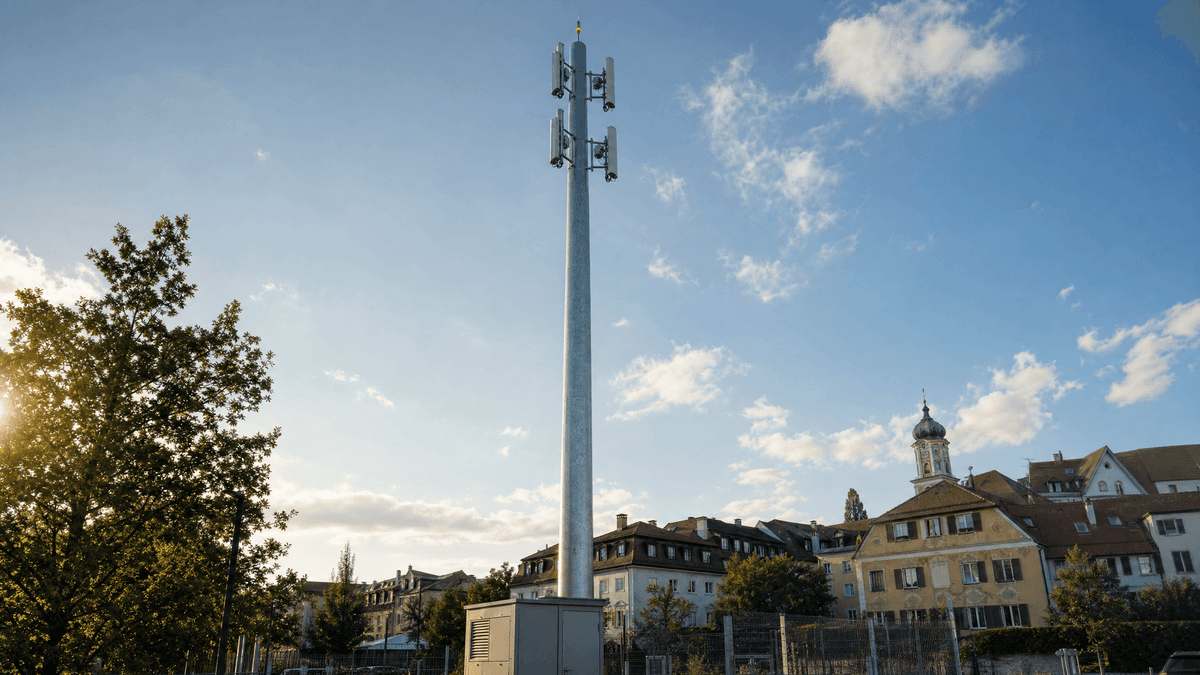
Munich Telecom Tower Market Analysis: 25m Urban Macro Configuration Guide for 35-Unit Network Expansion
Summary
Munich’s dense urban districts, high mobile-data demand, and strict urban siting constraints make a 25m steel monopole a practical macro-cell format. For a typical 35-unit rollout, a Q345 hot-dip galvanized monopole rated to 60 m/s wind and 30-year design life fits urban infill and transport-corridor coverage needs.
Key Takeaways
A 25m Telecom Tower is the correct size class for Munich urban macro coverage because the product table assigns 15-25m towers to rooftop and urban infill applications with 3-6 panel antennas and 8-15t structural mass.
- A typical 35-unit deployment in Munich would use 25m tapered steel monopoles, aligning with the 15-25m urban infill class and an approximate 9t per tower dead weight.
- The specified Q345 hot-dip galvanized steel and high-corrosion-zone treatment suit Munich’s wet winter conditions, where annual precipitation is about 1,000 mm according to Climate-Data.org (2024).
- The required wind class 3 rating at 60 m/s with factor 1.35 provides a conservative design margin above Munich’s normal operating wind climate under TIA-222-H load methodology.
- The antenna fit of 6 panel antennas plus 3 RRUs matches an urban macro site profile for 4G/5G densification in a city with about 1.59 million residents according to the City of Munich (2024).
- A typical package of 35 units shipped in CKD format can reduce transport volume by 60-70%, which matters for inland delivery and constrained storage near Munich construction zones.
- The recommended concrete pad foundation is suitable where geotechnical conditions support shallow foundations, especially for 25m poles in paved or semi-paved urban parcels.
- Typical manufacturing lead time is 30-45 days, while field installation per site is often measured in days rather than weeks once permits, foundations, and utility clearances are complete.
- The specified accessory set—ladder, cable tray, aircraft warning light, grounding system, lightning rod, 3 antenna platforms, and safety cage—supports German urban compliance and maintenance access expectations.
Market Context for Munich
Munich combines high subscriber density, premium office districts, rail corridors, and dense residential neighborhoods, so macro-cell infrastructure must balance coverage, capacity, and visual impact within a compact urban footprint. According to the City of Munich (2024), the municipality has approximately 1.59 million residents, making it Germany’s third-largest city and one of its highest-demand mobile-data markets.
According to the Bavarian State Office for Statistics (2024), the Munich region continues to record strong population and employment concentration, which increases daytime device density in business districts and transport hubs. In telecom terms, that means a single site is rarely planned only for geographic reach; it is usually evaluated for sector loading, street-level clutter, and backhaul access within a radius measured in hundreds of meters to a few kilometers.
Climate also matters for monopole selection. According to Climate-Data.org (2024), Munich records roughly 1,000 mm of annual precipitation and winter temperatures that regularly approach or fall below 0°C, which raises corrosion-management and maintenance-access requirements. For this reason, a hot-dip galvanized steel monopole with a 30-year design life is more suitable than untreated steel systems in exposed urban locations.
Germany’s mobile network strategy also supports densification in major cities. According to the Federal Network Agency, Bundesnetzagentur (2024), Germany continues to expand mobile coverage obligations and site density to improve broadband quality along transport routes and populated areas. For Munich, that favors compact macro poles that can support 6 panel antennas and 3 RRUs without the larger visual envelope of a lattice tower.
Standards alignment is another local requirement. German buyers often expect international structural design methods plus traceable fabrication standards. In this context, TIA-222-H for structural loading and GB/T 50233 for tower construction practice provide a practical baseline for export-oriented procurement, while local permitting, grounding, aviation marking, and EMF compliance would still need confirmation against German and Bavarian rules before final approval.
The practical implication is clear: Munich does not need a rural 45-55m wide-area tower for most urban macro infill. It needs a compact steel monopole class that supports multi-sector antennas, fits constrained parcels, and can be delivered in sectional form for city logistics. That is the technical niche where SOLAR TODO positions its Telecom Tower line.
Recommended Technical Configuration
For Munich urban macro coverage, a typical 35-unit deployment would consist of 25m hot-dip galvanized steel monopoles with 6 panel antennas and 3 RRUs per site, using concrete pad foundations where soil conditions permit.
The correct size class is the 15-25m category from the engineering table because Munich’s need is urban infill rather than peri-urban highway coverage. That class is defined as 1 platform / 3-6 panel antennas / 8-15t per tower, and the project-specific configuration of 25m height and ~9t per tower sits inside that envelope. It would be incorrect to move this profile into the 25-35m suburban class unless the site required larger setback distances or broader overbuilding clearance.
A typical 35-unit deployment of this scale would use the following baseline configuration:
- 35 units of 25m tapered steel monopole tower
- Q345 steel, hot-dip galvanized
- Approx. 9t per tower structural weight
- Wind class 3, rated to 60 m/s with 1.35 factor
- High-corrosion-zone protection system
- 6 panel antennas + 3 RRUs for urban macro loading
- Concrete pad foundation
- 3 antenna platforms
- Climbing ladder, cable tray, aircraft warning light, grounding system, lightning rod, safety cage
- 30-year design life
- CKD shipment with 60-70% volume reduction
- Production lead time: 30-45 days
This configuration suits Munich because a 25m pole is tall enough to clear many street-level obstructions, trees, and mid-rise frontage effects, but still compact enough for urban permitting compared with 35-45m suburban or highway-class poles. According to ITU (2023), urban mobile-capacity planning increasingly depends on denser site grids rather than only taller structures, especially where 4G/5G traffic is concentrated in business and transport zones.
The antenna load in this specification is slightly lighter than the generic rotated load case of 6 panels + 1 microwave dish + 3 RRUs, because the project-specific requirement is 6 panels + 3 RRUs only. That makes sense where fiber or short-distance urban backhaul is available and a microwave dish is not mandatory on every site. In Munich, that can reduce top-head loading, simplify zoning review, and lower erection complexity.
SOLAR TODO should therefore be evaluated in Munich primarily as a supplier of compact urban macro monopoles rather than tall rural coverage towers. The technical fit depends on parcel geometry, utility conflict checks, and geotechnical verification, but the 25m / 9t / 60 m/s profile is the right starting point for feasibility analysis.
Technical Specifications
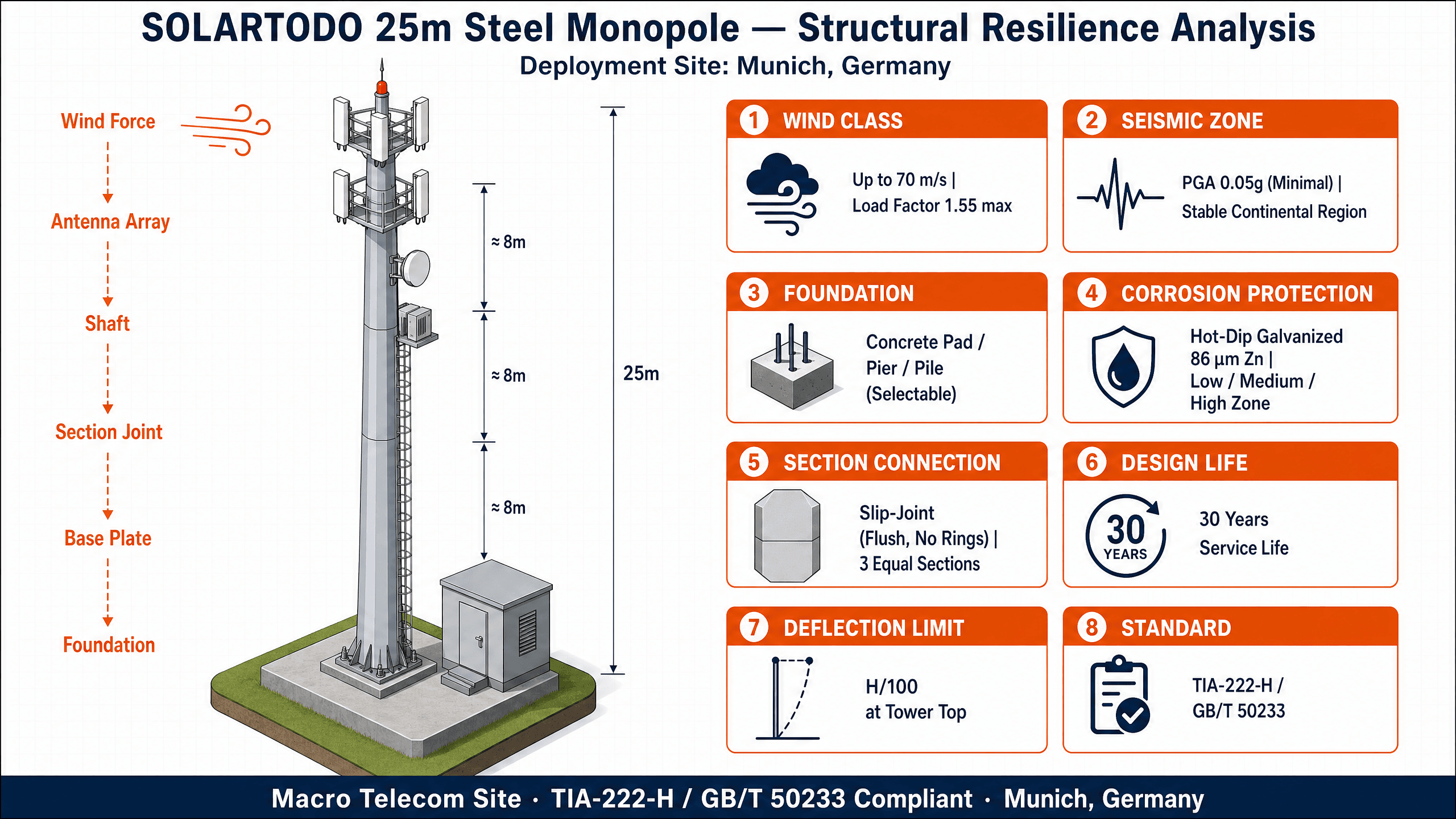
The specified Munich configuration is a 25m Q345 steel monopole at approximately 9t per tower, designed to TIA-222-H and GB/T 50233 with 6 panel antennas, 3 RRUs, and a 30-year service life.
- Product type: Steel Telecom Tower monopole, tapered tubular form
- Application class: Urban macro site
- Height: 25m
- Quantity reference: Approximately 35 units for a typical city-zone rollout of this scale
- Material: Q345 steel
- Surface treatment: Hot-dip galvanizing for high-corrosion environments
- Tower weight: ~9t per tower (about 350 kg/m)
- Size-class compliance: Fits 15-25m urban infill class with 3-6 panel antennas and 8-15t tower mass
- Antenna load: 6× panel antennas + 3× RRUs
- Wind rating: Class 3, 60 m/s, factor 1.35
- Foundation type: Concrete pad foundation
- Connection form: Flanged bolt-on sectional design for transport and erection efficiency
- Platforms: 3 antenna platforms
- Access system: Climbing ladder + safety cage
- Cable management: Integrated cable tray
- Protection systems: Grounding system + lightning rod + aircraft warning light
- Design life: 30 years
- Shipping mode: CKD, reducing logistics volume by 60-70%
- Production window: 30-45 days
- Standards: TIA-222-H / GB/T 50233
According to TIA (2022), tower structures must be checked for wind, ice where applicable, appurtenance loading, and serviceability under the governing load combinations. IEEE states, “Proper grounding and bonding are essential to limit lightning damage and improve personnel safety,” which is directly relevant to the specified grounding system and lightning rod package.
The International Telecommunication Union states, “Infrastructure sharing and efficient site design are key enablers for broadband expansion,” and that supports compact monopole formats in dense cities where land use is constrained. For Munich, that means a sectional flanged monopole is often more practical than a wider-footprint structure for urban permitting and logistics.
Implementation Approach
A typical Munich rollout would proceed in 5 phases over roughly 3 to 6 months, with the 30-45 day fabrication window only one part of the total schedule because permits and civil works usually govern completion.
Phase 1: Site screening and permitting. A developer would normally assess zoning, rooftop or ground-lease rights, utility conflicts, EMF compliance, and aviation-lighting triggers. In Munich, this phase can be the slowest part because urban parcels are constrained and public-realm approvals may require several stakeholder reviews. A 25m monopole is helpful here because it remains within a compact urban form factor.
Phase 2: Geotechnical review and foundation design. The project-specific recommendation is a concrete pad foundation, but that should only be finalized after soil bearing capacity, groundwater, and frost-depth checks. For a 25m pole at ~9t plus antenna and wind loads, a shallow pad can be practical if the site does not show weak fill, buried utilities, or high groundwater complications.
Phase 3: Fabrication and CKD shipping. SOLAR TODO can supply the monopole in flanged bolt-on sections with 60-70% logistics volume reduction under CKD shipping. That matters in Munich because staging yards are expensive and city-center truck access is often time-restricted. Sectional delivery also reduces crane time compared with oversized one-piece transport.
Phase 4: Civil works and erection. Once the pad foundation reaches the required concrete strength, erection generally involves anchor-bolt verification, base-section placement, section-by-section bolting, verticality checks, grounding installation, and accessory mounting. For a 25m monopole, a mobile crane and a compact rigging crew are usually sufficient, though local lift plans and street closures may still be required.
Phase 5: Antenna installation and commissioning. The final stage includes mounting 6 panel antennas and 3 RRUs, routing feeder or fiber/power cables on the cable tray, testing grounding continuity, and verifying obstruction-light operation. Acceptance should include structural bolt-torque records, galvanizing inspection, and as-built documentation against TIA-222-H and local telecom requirements.
Expected Performance & ROI
A 25m urban macro monopole in Munich would typically improve sectorized coverage and capacity in dense districts, while the strongest financial case usually comes from faster network densification, lower logistics cost, and a 30-year structural life rather than from tower height alone.
According to GSMA (2023), mobile data traffic growth in Europe continues to push operators toward denser site grids and capacity-oriented investments. In practical terms, a 25m monopole with 6 panels and 3 RRUs can support multi-sector urban macro service where rooftop rights are limited or inconsistent. The value is not only more signal reach; it is more stable throughput at busy hours.
Lifecycle economics depend on steel durability, maintenance intervals, and installation complexity. Hot-dip galvanizing plus a 30-year design life can reduce repainting and corrosion intervention compared with lower-grade surface systems, especially in wet winter climates. According to NREL (2023), lifecycle cost analysis consistently favors longer-lived infrastructure where maintenance access and replacement events are expensive.
CKD shipping also changes the cost profile. A 60-70% reduction in shipping volume can lower freight, inland handling, and temporary storage requirements, particularly when 35 units are procured in one batch. For buyers comparing monopoles with bulkier alternatives, this logistics factor can materially affect delivered project cost even before installation begins.
Return on investment is usually evaluated through network KPI improvement, co-location potential, and lease efficiency rather than a simple energy-payback model. For Munich, a reasonable planning assumption is that a compact 25m monopole can shorten time-to-service in infill zones and support long-term tenancy or equipment refresh cycles over 30 years. Buyers should model ROI using local lease rates, permitting costs, and operator revenue per added sector capacity.
Results and Impact
For Munich, the most likely impact of a 35-unit 25m monopole program is improved urban macro coverage continuity, better busy-hour capacity distribution, and more predictable deployment logistics within a dense city fabric.
Compared with taller 35-45m highway or peri-urban poles, the 25m class reduces visual mass and foundation demand while still supporting 6 panel antennas and 3 RRUs. That is a better fit for infill districts, rail-adjacent parcels, commercial blocks, and municipal utility sites. When matched to concrete pad foundations and CKD delivery, the format also supports faster repeatability across multiple parcels.
For procurement teams, the practical result is standardization. Using one structural class—25m, ~9t, Q345, 60 m/s—across approximately 35 units can simplify spares planning, erection method statements, and inspection procedures. This is the main reason SOLAR TODO’s Telecom Tower offering is relevant to Munich’s urban expansion profile.
Comparison Table
The table below compares the recommended Munich 25m urban macro monopole with alternative telecom tower classes that buyers may consider during feasibility screening.
| Configuration | Height | Typical Use Case | Antenna Load | Tower Weight | Foundation | Urban Fit in Munich | Logistics |
|---|---|---|---|---|---|---|---|
| Recommended SOLAR TODO Telecom Tower | 25m | Urban macro / infill | 6 panels + 3 RRUs | ~9t | Concrete pad | High | CKD, 60-70% volume reduction |
| Smaller infill monopole | 15-20m | Dense rooftop or narrow parcel | 3-6 panels | 8-12t | Pad / rooftop frame | Medium | Good |
| Suburban monopole | 30-35m | Residential edge / wider spacing | 6-9 panels | 15-22t | Pad / pier | Medium-Low in core city | Moderate |
| Highway/peri-urban monopole | 35-45m | Corridor coverage + microwave | 6-9 panels + 1-2 microwave | 22-30t | Pier / pile | Low in dense districts | Lower |
| Rural wide-area tower | 45-55m | Sparse coverage footprint | 9-12 panels | 30-40t | Pile / large pad | Very low | Lower |
Pricing & Quotation
SOLAR TODO offers three pricing tiers for this product line: FOB Supply (equipment ex-works China), CIF Delivered (including ocean freight and insurance), and EPC Turnkey (fully installed, commissioned, with 1-year warranty). Volume discounts are available for large-scale deployments. Configure your system online for an instant estimate, or request a custom quotation from our engineering team at [email protected].
For Munich buyers, quotation accuracy depends on 4 variables more than any others: foundation scope, galvanizing specification, accessory package, and local installation constraints. A complete RFQ should therefore include geotechnical data, antenna loading by sector, required platforms, grounding detail, and delivery address. SOLAR TODO can then align the Telecom Tower bill of materials with the intended urban macro duty cycle.
Frequently Asked Questions
A Munich buyer usually needs answers on height, wind rating, foundations, lead time, maintenance, warranty scope, and commercial options before issuing an RFQ for a 25m monopole.
Q1: Why is a 25m Telecom Tower recommended for Munich instead of a 35m or 45m tower? A 25m monopole matches the 15-25m urban infill class in the product table and fits Munich’s dense parcel pattern better than taller suburban or highway towers. It supports 6 panel antennas and 3 RRUs without the larger visual envelope, heavier foundations, and more difficult permitting that often come with 35-45m structures.
Q2: Is the specified 9t tower weight realistic for a 25m monopole? Yes. The project-specific mass is ~9t, or roughly 350 kg/m, which is consistent with a compact urban monopole using Q345 steel. It also remains within the size-class envelope of 8-15t for 15-25m urban infill towers. That makes the configuration technically credible for procurement review.
Q3: What antenna loading does this Munich configuration support? The specified load is 6 panel antennas plus 3 RRUs, which is suitable for an urban macro 4G/5G site. This is lighter than a microwave-heavy suburban profile, so it helps keep top-head loading moderate while still supporting multi-sector service. Final structural checks should still use the exact antenna model, projected area, and mounting offsets.
Q4: How long would production and delivery typically take? The stated production window is 30-45 days for the tower package. Total project schedule is longer because permitting, foundation curing, customs, inland transport, and crane booking can add several more weeks. For a 35-unit batch, buyers usually plan procurement in phased releases rather than assume all sites will be erected at the same time.
Q5: Is a concrete pad foundation sufficient for Munich sites? It can be, especially for a 25m monopole where soil bearing capacity is adequate and groundwater conditions are manageable. However, the final foundation must follow a geotechnical report and site-specific load case. If fill material, buried services, or weak soils are present, the design may need revision before fabrication release.
Q6: What maintenance should be expected over a 30-year design life? Typical maintenance includes annual or periodic inspection of bolts, galvanizing condition, grounding continuity, ladder and safety cage integrity, warning light function, and cable tray condition. After major wind events, an extra inspection is advisable. For a galvanized monopole, maintenance cost is generally lower than for structures that need frequent coating repair.
Q7: How does a steel monopole compare with a lattice tower in Munich? A monopole usually occupies less ground area, presents a cleaner urban profile, and is easier to place on constrained parcels. A lattice tower can support heavier loads at greater heights, but for a 25m urban macro application in Munich, the monopole is often the better planning fit. This guide addresses monopoles only, not lattice structures.
Q8: What ROI factors matter most for this type of tower? The main ROI drivers are faster network densification, improved sector capacity, co-location potential, and reduced logistics cost from CKD shipping. The 60-70% volume reduction can lower freight and storage cost, while the 30-year design life spreads structural capital cost over a long service period. Buyers should model ROI with local lease and traffic assumptions.
Q9: What warranty scope is typical under different supply models? Warranty scope depends on whether the buyer selects material supply only or a broader delivery package. The pricing section specifies that EPC Turnkey includes a 1-year warranty. For FOB or CIF supply, buyers typically confirm warranty terms for structural fabrication, galvanizing quality, and missing-item claims in the purchase contract.
Q10: What documents should be included in an RFQ to SOLAR TODO? A strong RFQ should include site coordinates, target height of 25m, antenna count, RRU count, wind requirement of 60 m/s, foundation preference, corrosion category, required accessories, and destination details. Adding geotechnical data and local permit constraints will improve quotation accuracy. Buyers can start from the Telecom Tower product page or contact us.
References
- City of Munich (2024): Population and municipal statistics showing Munich at approximately 1.59 million residents.
- Bavarian State Office for Statistics (2024): Regional demographic and economic concentration data for Munich and Upper Bavaria.
- Bundesnetzagentur (2024): German mobile network coverage obligations and telecommunications infrastructure oversight.
- TIA (2022): TIA-222-H, structural standard for antenna supporting structures and antennas.
- ITU (2023): Guidance on broadband infrastructure expansion, site efficiency, and urban network densification.
- IEEE (2021): Grounding and lightning protection guidance relevant to telecom site safety and equipment protection.
- NREL (2023): Lifecycle cost analysis methods applicable to long-life infrastructure assets and maintenance planning.
- Climate-Data.org (2024): Munich climate profile with annual precipitation near 1,000 mm and winter temperature patterns relevant to corrosion exposure.
Equipment Deployed
- 35 × 25m tapered steel monopole Telecom Tower, urban macro class
- Q345 hot-dip galvanized steel structure, high-corrosion-zone treatment
- Approx. 9t per tower structural mass
- Wind class 3 rating: 60 m/s, factor 1.35
- Antenna load per tower: 6 × panel antennas + 3 × RRUs
- Concrete pad foundation design
- 3 × antenna platforms per tower
- Climbing ladder with safety cage
- Integrated cable tray
- Aircraft warning light
- Grounding system
- Lightning rod
- Flanged bolt-on sectional connection for CKD shipment
- 30-year design life
- Production lead time: 30-45 days
Further Reading
- Lisbon Telecom Tower Market Analysis: 20m Urban Macro Configuration Guide for 62-Unit Infill Coverage
- Sofia Telecom Tower Market Analysis: 35m Steel Monopole Configuration Guide for Urban Macro Coverage
- Ankara Telecom Tower Market Analysis: 30m Steel Monopole Configuration for Urban Macro Coverage
- Monterrey Telecom Tower Market Analysis: 30m Steel Monopole Configuration for Regional Macro Coverage