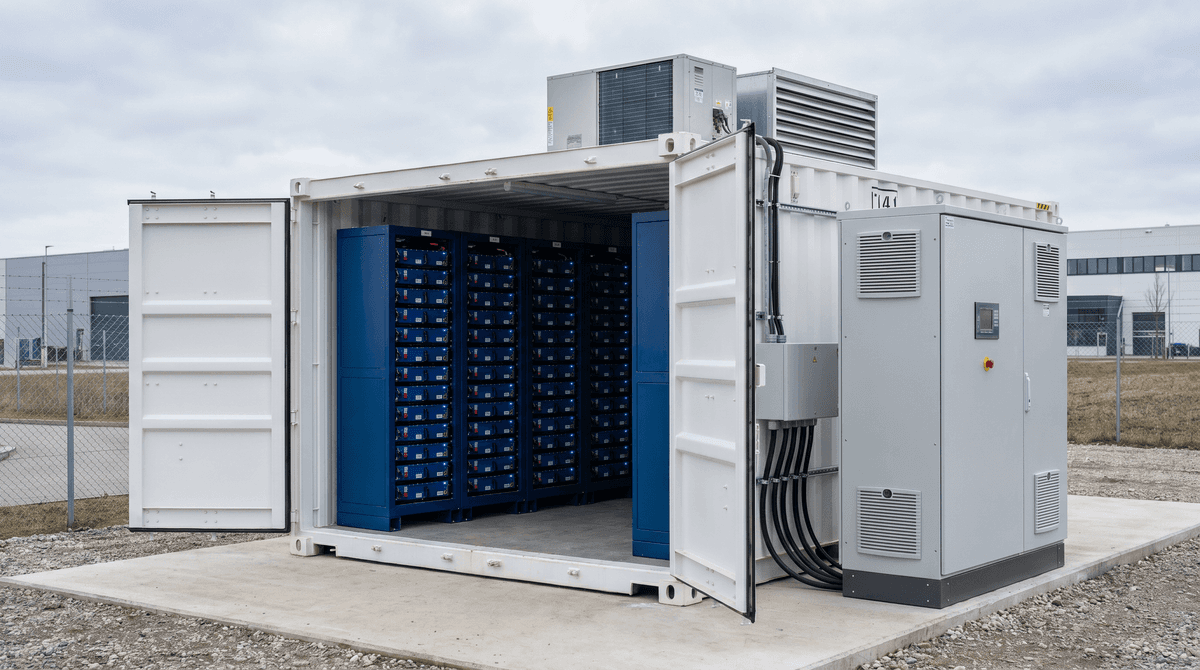
Munich Battery Energy Storage (BESS) Market Analysis: 500kWh / 250kW Peak-Shaving Configuration Guide
Summary
Munich’s 1.59 million residents, Germany’s industrial electricity price pressure, and Bavaria’s distributed-energy growth make a 500kWh / 250kW BESS a practical commercial size. A typical system would cycle about 1.5 times/day at 80% depth to reduce peak demand and shift valley-priced energy to peak periods.
Key Takeaways
- Munich had approximately 1.59 million residents in 2023, according to the City of Munich Statistics Office, which supports dense commercial and light-industrial load clusters suited to 250kW-class peak-shaving systems.
- According to Destatis (2024), Germany’s average industrial electricity price reached about €0.202 per kWh in H2 2024 excluding VAT, strengthening the business case for TOU arbitrage and demand reduction.
- A recommended Munich commercial configuration is 500kWh / 250kW in 1× 20ft container, using LFP Premium cells with 97% round-trip efficiency and 95% DoD.
- At 1.5 cycles/day and 80% operating depth, a typical annual energy throughput is about 219MWh, which is useful for warehouses, food processing, cold storage, and multi-shift manufacturing sites.
- The specified battery design uses 10,000-cycle life, 2% per year degradation, 20-year warranty, liquid cooling with glycol, and water mist fire suppression to align with industrial duty cycles.
- Compliance targets should include IEC 62619, UL 9540, and NFPA 855, with local permitting aligned to German building, fire, and grid-interconnection rules before energization.
- For Munich load profiles with 15-minute demand peaks, approximately 2 units would provide 1MWh / 500kW, while approximately 4 units would provide 2MWh / 1MW for larger industrial campuses.
Market Context for Munich
Munich combines a dense urban load center with high-value commercial and industrial electricity demand, making 250kW-class battery storage relevant for behind-the-meter peak control. According to the City of Munich Statistics Office (2024), Munich’s population was about 1.59 million in 2023, while the Munich metropolitan economy remains one of Germany’s largest concentrations of office, logistics, manufacturing, and research facilities.
This matters because BESS economics in Germany are driven less by raw energy access and more by tariff structure, peak-demand exposure, and grid flexibility value. According to Destatis (2024), the average electricity price for industrial customers in Germany was approximately €0.202/kWh in the second half of 2024 excluding VAT. For Munich businesses with refrigeration, process loads, data handling, or EV fleet charging, a 250kW discharge block can materially reduce 15-minute demand spikes and shift purchased energy away from higher-priced periods.
Bavaria also has a strong distributed-generation and electrification profile that increases the value of local storage. According to the German Federal Network Agency, Germany had more than 3.7 million solar PV systems installed by 2024, and Bavaria remains one of the country’s largest solar regions. Where a Munich site already has rooftop PV, Battery Energy Storage (BESS) can support self-consumption and demand management, but for this guide the primary operating mode is peak-shaving and TOU arbitrage rather than solar coupling.
Grid conditions also support the use of medium-size commercial storage rather than only utility-scale assets. Munich’s distribution environment includes LV and MV networks serving industrial estates, logistics facilities, and mixed-use commercial buildings. A 500kWh / 250kW system fits the common behind-the-meter need to shave short-duration peaks without requiring a dedicated substation class that would be more typical for 10MWh+ grid-scale projects.
Climate is another local design factor. According to Deutscher Wetterdienst (DWD), Munich has winter conditions that regularly fall below 0°C and summer peaks that can exceed 30°C. That makes liquid thermal management more appropriate than passive ventilation for a containerized industrial BESS expected to cycle 1.5 times/day with stable cell temperature control and predictable degradation.
Two authority statements are especially relevant here. The International Energy Agency states, "Battery storage is a key technology for short-term system flexibility," highlighting the value of daily cycling for commercial load management. NFPA states in NFPA 855 that energy storage systems require "the design, construction, installation, commissioning, operation, maintenance, and repair" to follow defined fire-safety practices, which is directly relevant for Munich permitting and insurer review.
SOLAR TODO should therefore position Battery Energy Storage (BESS) in Munich as a commercial and industrial load-management asset first. The most suitable profile is not a small 100kWh cabinet for light retail, and not a multi-container 10MWh farm for transmission support, but a 500kWh / 250kW industrial unit that matches medium-duty behind-the-meter demand control.
Recommended Technical Configuration
A typical Munich commercial-industrial deployment would use 1× 20ft container rated at 500kWh / 250kW, which aligns with the 500kWh–2MWh form class specified for factory and commercial applications.
Based on Munich’s electricity cost profile, urban land constraints, and common commercial demand patterns, the recommended configuration is a single industrial BESS block with these core characteristics:
- Battery capacity: 500kWh
- Power rating: 250kW
- Housing: 1× 20ft container
- Chemistry: LFP Premium
- Round-trip efficiency: 97%
- Depth of discharge: 95%
- Cycle life: 10,000 cycles
- Degradation: 2% per year
- Warranty: 20 years
- Cooling: liquid cooling with glycol
- Fire protection: water mist fire suppression
- Electrical balance: PCS inverter + step-up transformer
- Operating mode: peak-shaving / TOU arbitrage
- Duty profile: 1.5 cycles/day at 80% operating depth
- Compliance targets: IEC 62619, UL 9540, NFPA 855
A typical 1-unit deployment in Munich would suit:
- Warehouses with 200kW to 500kW daytime peaks
- Food and beverage facilities with refrigeration spikes above 250kW
- Commercial campuses with EV charging overlap
- Light manufacturing plants with batch-process peaks in 15-minute intervals
- Mixed-use buildings with HVAC and chiller peaks in summer above 300kW
For larger sites, scaling should stay modular. A typical 2-unit deployment would provide approximately 1MWh / 500kW using 2× 20ft containers. A typical 4-unit deployment would provide approximately 2MWh / 1MW. This is the practical expansion path for Munich logistics parks and industrial estates where demand charges are influenced by repeated short peaks rather than continuous base load.
SOLAR TODO can present this as a standard commercial block on the Battery Energy Storage (BESS) product page and then adapt transformer ratio, PCS settings, and EMS logic to the site’s utility meter structure. In Munich, the technical fit depends on the customer’s 15-minute interval load data, contracted capacity, and any rooftop PV or EV charging load that changes peak coincidence.
Technical Specifications
The specified Munich-fit configuration is a 500kWh / 250kW industrial LFP system in 1× 20ft container, using 97% round-trip efficiency, 95% DoD, 10,000 cycles, glycol liquid cooling, and water mist suppression.
Core System Specification
- Product type: Battery Energy Storage (BESS)
- Use case: Peak-shaving and TOU arbitrage
- Rated energy: 500kWh
- Rated power: 250kW
- Power-to-energy ratio: 0.5C
- Container format: 1× 20ft container
- Battery chemistry: LFP Premium
- Round-trip efficiency: 97%
- Maximum depth of discharge: 95%
- Operating duty assumption: 1.5 cycles/day
- Operating depth for economics model: 80%
- Cycle life: 10,000 cycles
- Annual degradation assumption: 2% per year
- Warranty term: 20 years
Integrated Subsystems
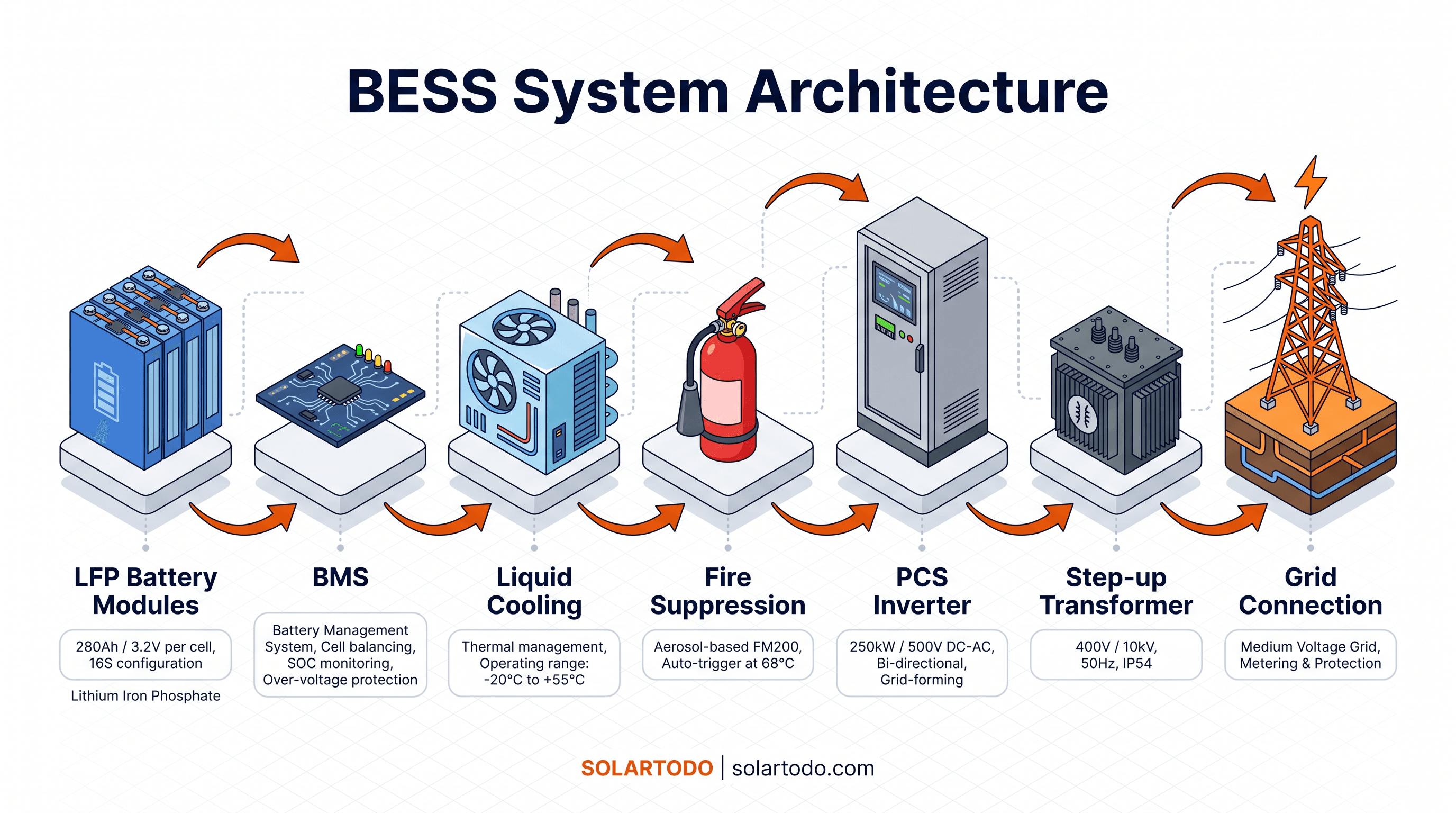
- Battery management system: multi-level BMS for cell, module, and rack monitoring
- Thermal management: liquid cooling with glycol loop
- Fire safety: water mist fire suppression
- Power conversion: integrated PCS inverter
- Grid interface: step-up transformer
- Monitoring: EMS/SCADA-ready architecture for meter, PCS, and battery controls
Compliance and Safety Targets
- IEC 62619: safety requirements for secondary lithium cells and batteries for industrial use
- UL 9540: energy storage system safety certification framework
- NFPA 855: installation standard for stationary energy storage systems
- Local compliance: German grid interconnection, municipal fire review, and site-specific building approval
Expected Operating Envelope for Munich Sites
- Typical discharge event: up to 250kW during tariff peak or demand spike
- Typical usable daily throughput at 80% depth and 1.5 cycles/day: about 600kWh/day
- Typical annual throughput: about 219,000kWh/year
- Best-fit site load: recurring 15-minute peaks above 250kW
- Best-fit tariff profile: measurable spread between valley and peak import cost
Implementation Approach
A typical Munich BESS project would require 12 to 24 weeks from detailed engineering to commissioning, depending on grid approval, fire review, and transformer integration complexity.
The first step is interval-data analysis. A site should provide at least 12 months of 15-minute load data, utility bills, transformer rating, and single-line diagrams. This allows SOLAR TODO or the EPC partner to determine whether 250kW discharge power is sufficient, or whether approximately 2 units are needed to address stacked peaks from HVAC, process loads, and EV charging.
The second step is site engineering and permitting. For Munich, this usually includes container placement, cable routing, transformer tie-in, emergency access clearances, and fire authority consultation under NFPA 855-aligned design principles plus local German requirements. Because the system is containerized, civil scope is often limited to foundation pads, trenching, earthing, drainage, and access control rather than a full building enclosure.
The third step is procurement and factory integration. The 20ft container should arrive with battery racks, PCS, BMS, liquid cooling skid, and water mist fire system pre-integrated to reduce field labor. Factory acceptance testing should verify insulation resistance, communications, PCS response, cooling performance, alarm logic, and emergency stop behavior before shipment.
The fourth step is installation and energization. Typical field work includes crane placement, MV/LV cable terminations, transformer connection, commissioning tests, and EMS setup with the customer meter. According to NREL (2023), commissioning quality directly affects storage safety and long-term performance, so sequence testing, thermal checks, and protective relay verification should not be compressed.
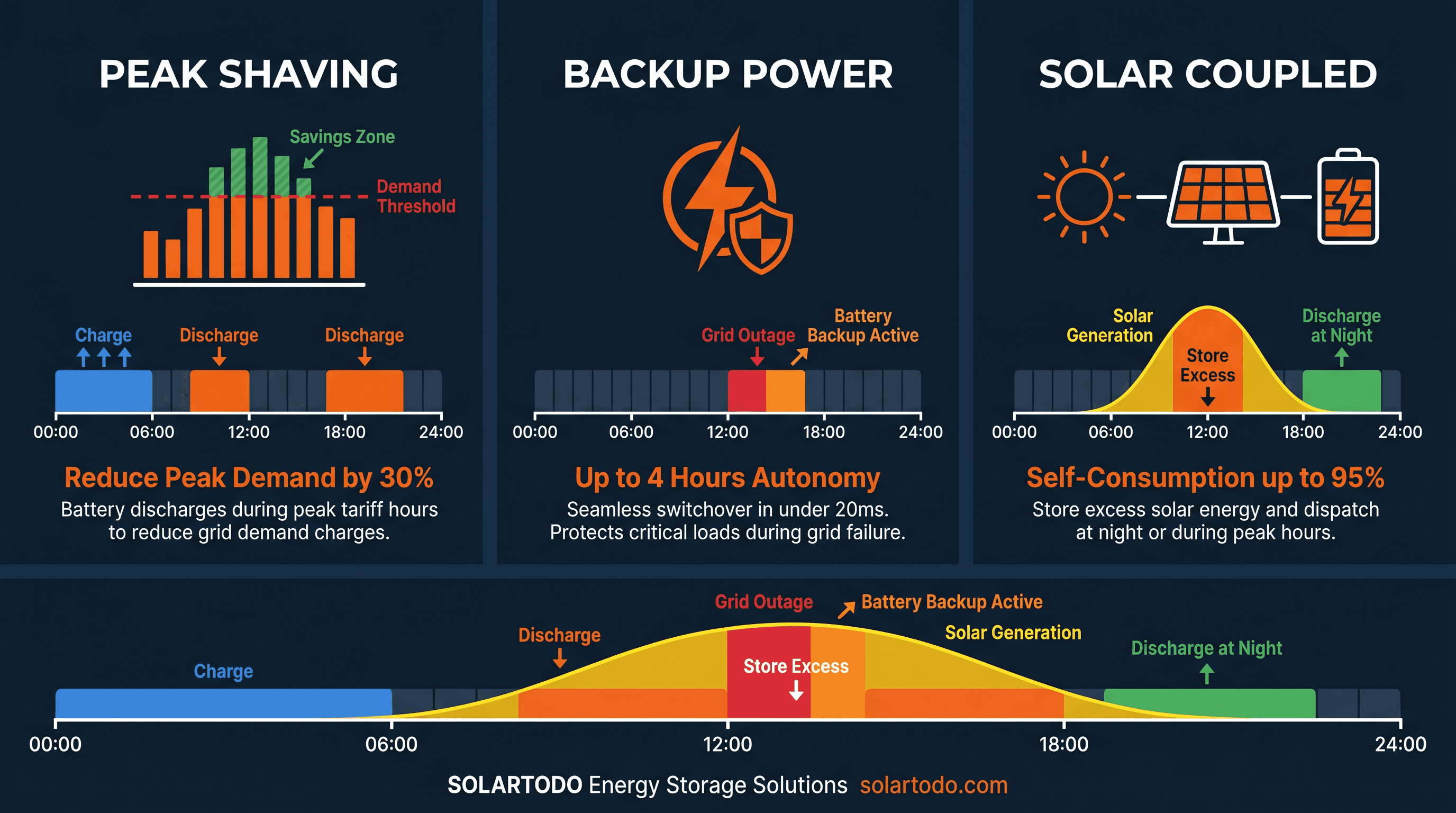
The fifth step is operational tuning. In Munich, the most useful control strategy is often a hybrid of fixed peak cap and tariff-based dispatch. That means the BESS can hold site import below a defined kW threshold while also charging during low-price windows and discharging during high-price periods. SOLAR TODO should recommend at least 30 days of monitored optimization after startup to refine dispatch thresholds.
Expected Performance & ROI
For Munich commercial users facing about €0.202/kWh industrial electricity pricing, a 500kWh / 250kW BESS can deliver roughly 219MWh/year of shifted energy and reduce recurring peak charges when dispatch is matched to 15-minute demand intervals.
Using the required operating profile of 1.5 cycles/day at 80% depth, the energy moved each day is approximately 500kWh × 80% × 1.5 = 600kWh/day. Over 365 days, that equals about 219,000kWh/year. With 97% round-trip efficiency, conversion losses remain relatively low for a commercial system cycling daily.
The ROI case in Munich depends on two revenue or savings streams: tariff arbitrage and peak-demand reduction. If a site repeatedly exceeds a demand threshold by 150kW to 250kW for short intervals, a 250kW PCS can clip those peaks. If the tariff spread between valley and peak periods is meaningful, the same battery can add energy-cost savings by charging off-peak and discharging on-peak.
Cycle life supports long duty. At 1.5 cycles/day, annual cycling is about 548 cycles. A 10,000-cycle battery therefore supports more than 18 years of cycling on a pure cycle-count basis, which aligns reasonably with the 20-year warranty when combined with the stated 2% annual degradation and controlled thermal conditions.
Industry payback ranges vary by tariff design, grid fees, and dispatch quality. According to IRENA (2023), battery economics improve materially when multiple value streams are stacked rather than relying on a single arbitrage margin. In Munich, a practical commercial payback estimate would often fall in the medium-term range if the site has both strong demand spikes and a measurable time-of-use spread; the exact figure requires tariff and load-data review rather than a generic citywide claim.
Battery maintenance is moderate but not zero. Annual tasks generally include coolant inspection, fire-system checks, insulation testing, PCS firmware review, HVAC or pump service intervals, and alarm-log analysis. According to NFPA 855 and UL 9540 practice guidance, documented inspection and emergency procedures are part of the operating model, not optional extras.
Results and Impact
For Munich facilities with recurring 200kW to 400kW short-duration peaks, a 500kWh / 250kW BESS would typically improve demand control, reduce tariff exposure, and add resilience to load management without requiring a multi-container utility-scale footprint.
The main impact is operational rather than symbolic. A 1-unit system can cap import power for short windows, move about 219MWh/year of energy under the stated duty cycle, and support cleaner load profiles for the site transformer. For landlords, industrial operators, and logistics tenants, that can simplify electrical planning where new EV chargers or heat pumps would otherwise raise peak import above comfortable limits.
A second impact is asset flexibility. Because the system is modular, Munich sites can start with approximately 1 unit and expand to approximately 2 or 4 units if the load grows. This is often more practical than over-sizing the first installation, especially where land, switchgear space, or approval timelines are constrained.
A third impact is compliance and insurer confidence. The specified combination of LFP chemistry, liquid cooling, water mist suppression, IEC 62619, UL 9540, and NFPA 855 gives a stronger technical basis for fire review and long-term O&M planning. For project-specific guidance, buyers can contact us with interval data and site diagrams.
Comparison Table
A Munich buyer comparing commercial storage options should prioritize power rating, cycle life, thermal control, and standards compliance rather than only headline kWh.
| Configuration | Recommended Munich Use Case | Housing | Rated Energy | Rated Power | Efficiency | Cycle Life | Cooling | Fire Suppression | Standards |
|---|---|---|---|---|---|---|---|---|---|
| 500kWh / 250kW SOLAR TODO BESS | Warehouse, light industry, EV charging peak control | 1× 20ft container | 500kWh | 250kW | 97% | 10,000 | Liquid glycol | Water mist | IEC 62619, UL 9540, NFPA 855 |
| Approx. 1MWh / 500kW modular array | Larger logistics or multi-tenant commercial campus | 2× 20ft containers | 1,000kWh | 500kW | 97%* | 10,000* | Liquid glycol | Water mist | IEC 62619, UL 9540, NFPA 855 |
| Approx. 2MWh / 1MW modular array | Industrial estate or high-coincidence charging site | 4× 20ft containers | 2,000kWh | 1,000kW | 97%* | 10,000* | Liquid glycol | Water mist | IEC 62619, UL 9540, NFPA 855 |
*Assumes the same module and PCS family across the modular expansion.
Pricing & Quotation
SOLAR TODO offers three pricing tiers for this product line: FOB Supply (equipment ex-works China), CIF Delivered (including ocean freight and insurance), and EPC Turnkey (fully installed, commissioned, with 1-year warranty). Volume discounts are available for large-scale deployments. Configure your system online for an instant estimate, or request a custom quotation from our engineering team at [email protected].
Frequently Asked Questions
A Munich buyer usually needs answers on sizing, timeline, standards, maintenance, ROI, and EPC scope before moving from concept to grid application.
Q1: Why is 500kWh / 250kW a suitable BESS size for Munich commercial sites?
This size fits many Munich warehouses, mixed-use buildings, and light industrial sites where peaks rise above 250kW for short intervals. It is large enough to shave demand and support TOU arbitrage, but still compact as a 1× 20ft container. For sites with larger simultaneous peaks, approximately 2 or 4 units can be combined.
Q2: Is this system intended for backup power or peak-shaving?
In this guide, the primary use case is peak-shaving and TOU arbitrage. The battery charges during lower-cost periods and discharges during peak-cost windows or short demand spikes. Backup functionality can be considered in a project-specific design, but the economics here are based on 1.5 cycles/day and 80% operating depth for commercial energy management.
Q3: How much energy can the system shift each year?
At 500kWh capacity, 80% operating depth, and 1.5 cycles/day, the system shifts about 600kWh/day. Over 365 days, that equals roughly 219,000kWh/year. Actual annual throughput may be lower if the site dispatches only on workdays, or higher if the battery is used consistently across all tariff windows.
Q4: What standards should a Munich BESS project meet?
The core standards in this configuration are IEC 62619, UL 9540, and NFPA 855. In practice, a Munich project also needs alignment with local German electrical, fire, and building approval requirements. The EPC scope should include grid interconnection review, emergency shutdown logic, earthing, access clearance, and site-specific fire authority coordination.
Q5: How long would installation typically take?
A typical project takes about 12 to 24 weeks from engineering kickoff to commissioning. The shorter end applies when civil works are simple and utility approval is straightforward. The longer end is more realistic if the project needs transformer upgrades, municipal fire review, or coordination with an operating industrial facility that limits shutdown windows.
Q6: What maintenance does a 500kWh BESS require?
Routine maintenance usually includes coolant checks, pump and valve inspection, water mist system testing, PCS diagnostics, insulation-resistance testing, and review of BMS alarms and event logs. Most owners plan quarterly remote monitoring and annual on-site inspection. A battery container is not maintenance-free; it needs documented service intervals and emergency procedures.
Q7: How does LFP compare with other battery chemistries for Munich industry?
LFP is commonly selected for commercial storage because it offers good thermal stability, long cycle life, and strong daily-cycling economics. In this specification, the battery is rated for 10,000 cycles and 95% DoD, which suits 1.5 cycles/day operation. For Munich’s mixed winter and summer temperatures, liquid-cooled LFP is a practical industrial choice.
Q8: What is the expected payback period?
There is no single Munich-wide payback number because savings depend on tariff spread, demand charges, annual cycling, and dispatch discipline. Sites with repeated 15-minute peaks and meaningful off-peak/peak price differences usually see better returns. A proper estimate needs 12 months of load data, tariff terms, and any planned EV charging or electrification growth.
Q9: Does EPC pricing include grid connection and transformer work?
It depends on the quotation boundary. Some EPC offers include the BESS, transformer, civil works, cable routing, commissioning, and protection settings, while others exclude utility-side upgrades or customer switchgear modifications. Buyers in Munich should ask for a battery-limit and grid-limit scope matrix so responsibilities are clear before contract signature.
Q10: Can the system be expanded later?
Yes. A common path is to start with approximately 1 unit at 500kWh / 250kW and expand to approximately 2 units for 1MWh / 500kW or approximately 4 units for 2MWh / 1MW. Modular expansion is often useful where Munich sites add EV charging, heat pumps, or new production lines after the first installation.
Q11: What warranty is specified for this configuration?
The project-specific configuration states a 20-year warranty for the LFP Premium battery system. Buyers should still review the exact warranty basis, including throughput limits, capacity retention conditions, ambient operating range, and maintenance obligations. Warranty value depends on how clearly the contract defines degradation, exclusions, and response time.
Q12: What information should be prepared before requesting a quotation?
The minimum package should include 12 months of 15-minute interval load data, utility tariffs, site layout, single-line diagram, transformer rating, and any PV or EV charging plans. That information allows SOLAR TODO to recommend whether 250kW is enough or whether a larger modular configuration is needed for Munich operating conditions.
References
- City of Munich Statistics Office (2024): Population data showing Munich at approximately 1.59 million residents in 2023.
- Destatis (2024): Electricity prices for industrial customers in Germany, including approximately €0.202/kWh in H2 2024 excluding VAT.
- International Energy Agency (IEA) (2024): Battery storage identified as a key technology for short-term power-system flexibility.
- Deutscher Wetterdienst (DWD) (2024): Munich climate normals and temperature ranges relevant to thermal management design.
- IEC (2024): IEC 62619 safety requirements for secondary lithium cells and batteries for industrial applications.
- UL (2024): UL 9540 energy storage system safety standard for ESS equipment and integration.
- NFPA (2023): NFPA 855 standard covering installation, fire safety, operation, and maintenance requirements for stationary energy storage systems.
- IRENA (2023): Battery storage economics improve when multiple value streams such as arbitrage and demand management are stacked.
- NREL (2023): Energy storage commissioning and safety practices materially affect long-term system performance and risk control.
Equipment Deployed
- 500kWh Battery Energy Storage (BESS) container, 1× 20ft format
- 250kW PCS inverter with grid-interactive peak-shaving / TOU arbitrage control
- LFP Premium battery system, 97% round-trip efficiency, 95% DoD
- Battery racks rated for 10,000 cycles with 2%/year degradation assumption
- 20-year battery warranty package
- Multi-level BMS for cell, module, and rack monitoring
- Liquid cooling system with glycol thermal loop
- Water mist fire suppression system
- Step-up transformer for site interconnection
- EMS/SCADA-ready monitoring and dispatch controls
- Compliance package targeting IEC 62619, UL 9540, and NFPA 855