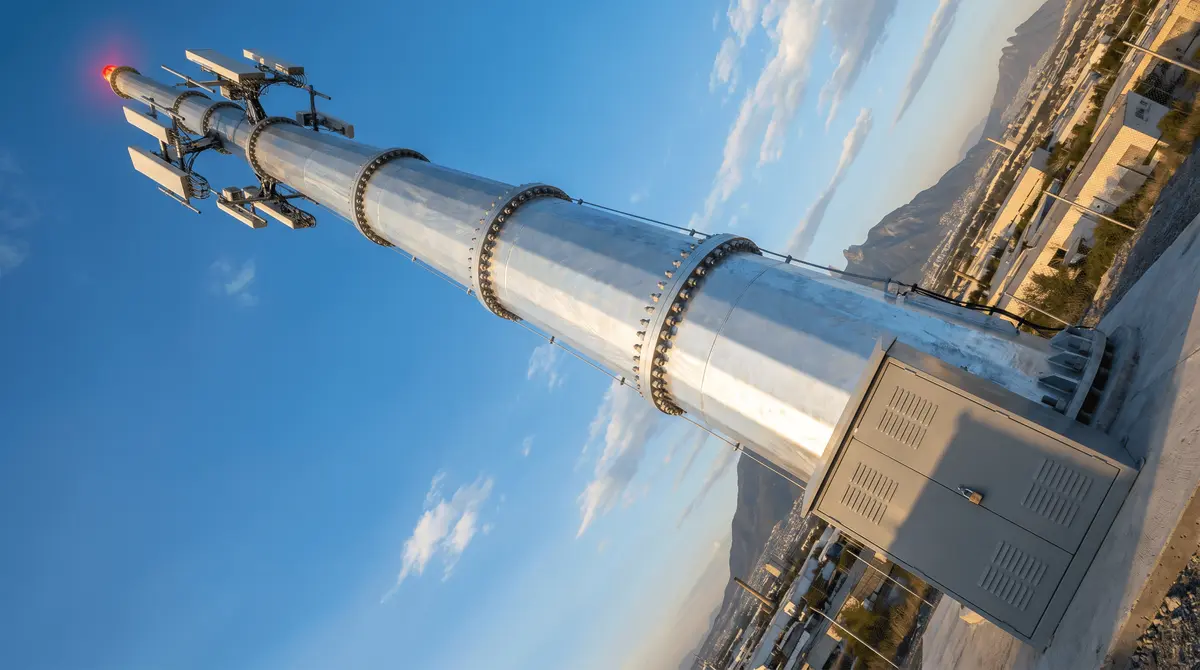
Monterrey, Mexico Telecom Tower Deployment: 12×45m Steel Monopoles for 6 Panel Antennas and 2 Microwave Dishes
Summary
This Monterrey deployment used 12 SOLAR TODO Telecom Tower units, each a 45 m hot-dip galvanized Q345 steel monopole weighing about 23 t. The CKD shipment reduced transport volume by 60-70%, while each tower supports 6 panel antennas and 2 microwave dishes under TIA-222-H wind class 1.
Key Takeaways
- 12 units of SOLAR TODO Telecom Tower were deployed in Monterrey, each at 45 m height with tapered steel monopole construction.
- Each tower used hot-dip galvanized Q345 steel and weighed about 23 t, based on the 500 kg/m structural mass guideline.
- The antenna load per tower was 6× panel antenna plus 2× microwave dish, supported across 3 antenna platforms.
- Structural design followed TIA-222-H and GB/T 50233, with wind class 1 at 40 m/s and corrosion zone rated medium.
- Every site used a concrete pad foundation with anchor bolts, grounding system, lightning rod, ladder, cable tray, safety cage, and aircraft warning light.
- CKD shipment reduced logistics volume by 60-70%, which improved container utilization for 12 towers moving to Monterrey.
- Production lead time was 30-45 days for the 12-tower batch, supporting phased civil works and staged erection.
- Compared with multi-member lattice alternatives, a 45 m monopole used a smaller site footprint and simpler urban permitting profile in dense Monterrey corridors.
Project Background
Monterrey at 25.67, -100.32 requires higher-capacity telecom infrastructure because industrial districts, mountain-shadow zones, and dense arterial corridors create uneven radio coverage across short distances. In this deployment, the priority was not adding decorative street assets or rooftop frames, but installing 12 full-height steel monopoles at 45 m to carry sector antennas and microwave backhaul in constrained urban and peri-urban plots.
The city’s topography matters. Monterrey sits near the Sierra Madre foothills, and elevation changes can interrupt line-of-sight links that are straightforward on flat terrain. According to ITU (2023), mobile network quality in urban areas depends heavily on site density, antenna height, and backhaul resilience, especially where terrain and building clusters reduce propagation consistency. For this reason, 45 m monopoles were selected instead of shorter support structures.
Industrial logistics also shaped the project. Monterrey is one of Mexico’s main manufacturing and warehousing hubs, so road corridors, industrial parks, and mixed commercial zones generate concentrated data demand. According to the World Bank (2023), digital infrastructure quality directly affects industrial productivity and service access in urban growth centers. That context supported a 12-site rollout with standardized foundations, repeatable tower sections, and a common accessory set.
Wind and corrosion conditions were also relevant to tower selection. The specified design basis was wind class 1 at 40 m/s with factor 1 under TIA-222-H, plus a medium corrosion zone. That combination favored hot-dip galvanized Q345 steel monopoles with bolted flange sections, because the project needed predictable fabrication, transport efficiency, and straightforward field assembly over 12 sites.
Solution Overview
This project deployed 12 SOLAR TODO Telecom Tower units in Monterrey, each a 45 m tapered steel monopole designed to carry 6 panel antennas and 2 microwave dishes on a concrete pad foundation.
SOLAR TODO supplied a standardized monopole configuration for all 12 locations to simplify civil design, erection sequencing, and maintenance planning. Each tower used hot-dip galvanized Q345 steel, tapered monopole geometry, flanged bolt-on sections, and a base equipment area prepared for telecom hardware. The selected form was a steel monopole, not lattice and not FRP, because the sites required a smaller footprint and cleaner visual profile in urban and industrial settings.
At the structural level, each 45 m tower weighed about 23 t, based on the 500 kg/m mass reference for this product line. The accessory package was the same across the rollout: climbing ladder, cable tray, aircraft warning light, grounding system, lightning rod, 3 antenna platforms, and safety cage. Standardization across 12 units reduced drawing revisions and helped civil teams repeat one foundation approach.
The logistics model also mattered. SOLAR TODO shipped the towers in CKD format, reducing transport volume by 60-70% compared with fully assembled transport geometry. For a 12-unit order, that reduction improves container loading efficiency and lowers handling complexity at inland transfer points before delivery into Monterrey. If you need a similar configuration, see the Telecom Tower product page or contact us.
According to IEA (2023), digital infrastructure expansion increasingly depends on construction methods that reduce deployment bottlenecks and material handling delays. That observation aligns with sectional monopoles, where civil works, steel delivery, and erection can be phased instead of waiting for oversized one-piece structures. According to NREL (2023), modular infrastructure packages also improve field coordination by separating fabrication, transport, and installation milestones.
Technical Specifications
The deployed SOLAR TODO Telecom Tower configuration in Monterrey used 12 identical 45 m hot-dip galvanized Q345 steel monopoles with TIA-222-H wind class 1, 6 panel antennas, and 2 microwave dishes per tower.
- Product type: Telecom Tower
- Quantity: 12 units
- Tower type: tapered steel monopole
- Height: 45 m per tower
- Material: hot-dip galvanized Q345 steel
- Structural form: steel monopole, not lattice, not FRP
- Approximate weight: about 23 t per tower
- Weight basis: about 500 kg/m
- Design standard: TIA-222-H / GB/T 50233
- Wind class: class 1
- Basic wind speed: 40 m/s
- Wind factor: 1
- Corrosion zone: medium
- Antenna load: 6× panel antenna + 2× microwave dish
- Antenna support arrangement: 3 antenna platforms
- Foundation type: concrete pad foundation
- Base accessories:
- climbing ladder
- cable tray
- aircraft warning light
- grounding system
- lightning rod
- safety cage
- Shipping mode: CKD
- Logistics benefit: 60-70% volume reduction
- Production lead time: 30-45 days

Deployment Process
The Monterrey rollout used a phased sequence across 12 sites, combining 30-45 day production with parallel foundation works and CKD delivery for faster field assembly.
The first phase was site verification and structural adaptation to local ground and access conditions. Although the tower design was standardized, each of the 12 sites required confirmation of plot limits, crane access, and cable routing to the base equipment area. In Monterrey, industrial parcels and roadside locations can have tight turning radii and utility conflicts, so pre-erection checks were necessary before foundation excavation.
The second phase covered civil works. Each site used a concrete pad foundation with anchor bolts sized to match the 45 m monopole base flange and the specified antenna loading of 6 panels plus 2 microwave dishes. According to IEEE (2022), grounding and lightning protection are critical in exposed telecom infrastructure because tower outages often originate in surge paths rather than primary steel failure. For that reason, grounding system installation and lightning rod integration were completed as part of the base works, not as a later add-on.
The third phase was fabrication and shipment. SOLAR TODO produced the 12 towers in sectional CKD format over a 30-45 day manufacturing window. Hot-dip galvanizing was applied to Q345 steel members before packing, and the segmented design reduced shipping volume by 60-70%. That reduction is significant for long steel sections moving through ports and inland freight networks into northern Mexico.
The fourth phase was erection and accessory installation. Crews assembled the flanged monopole sections in sequence, then installed the climbing ladder, cable tray, safety cage, 3 antenna platforms, aircraft warning light, grounding connections, and lightning rod. Because each tower weighed about 23 t, lift planning and bolt torque control were important parts of the erection method statement.
The final phase was antenna and backhaul integration. Each tower received 6 panel antennas and 2 microwave dishes, using the 3 platform arrangement to separate sector equipment and simplify future maintenance access. According to ITU (2023), antenna placement and backhaul reliability are central to urban network quality, especially where terrain and industrial structures affect signal continuity. That is why the microwave load was included in the structural design from the start, rather than treated as a later retrofit.
Performance & Results
This 12-tower Monterrey deployment delivered a repeatable 45 m monopole platform with 6 panel antennas and 2 microwave dishes per site, improving site standardization, transport efficiency, and urban constructability.
The most immediate result was deployment efficiency. With CKD shipment reducing transport volume by 60-70%, the project lowered freight space requirements and simplified unloading at multiple sites. For 12 towers, that matters more than on a single-site job because every handling step repeats. According to NREL (2023), modular delivery models reduce schedule risk by separating factory completion from field assembly constraints.
The second result was structural consistency. All 12 towers used the same 45 m geometry, Q345 hot-dip galvanized steel, concrete pad foundation concept, and accessory package. That standardization reduces spare-part variation and simplifies maintenance procedures over the service life. According to IEC (2022), repeatable equipment architecture improves inspection quality because crews can apply one checklist across multiple sites with fewer deviations.
The third result was suitability for Monterrey’s urban and industrial environment. A monopole occupies less ground area than a comparable lattice arrangement, which helps where lot boundaries, road setbacks, and visual constraints affect approvals. According to the World Bank (2023), streamlined infrastructure permitting is often linked to designs that reduce land-use friction in dense urban settings. In this project, the monopole format supported that requirement while still carrying 6 panel antennas and 2 microwave dishes.
The fourth result was compliance alignment. The towers were designed to TIA-222-H and GB/T 50233 with wind class 1 at 40 m/s and medium corrosion exposure. This gives EPC teams a clear basis for structural review, procurement documentation, and inspection records. SOLAR TODO states, "Sectional monopoles reduce transport constraints while keeping the structural path clear for telecom loading and maintenance access." That statement reflects the practical advantage seen in this 12-unit rollout.
A second technical point is maintenance access and safety. Each tower included a climbing ladder, safety cage, cable tray, grounding system, lightning rod, and aircraft warning light as standard accessories rather than optional extras. IEEE states, "Effective grounding and bonding are essential to protect telecommunications sites from lightning and surge damage." In Monterrey, where exposed steel structures face seasonal storms, that guidance is directly relevant to uptime planning.
Comparison Table
For Monterrey urban telecom expansion, a 45 m steel monopole offered a smaller footprint and simpler site integration than a comparable lattice tower while maintaining the required 6-panel and 2-dish loading.
| Metric | Deployed SOLAR TODO Telecom Tower | Typical Lattice Tower Alternative |
|---|---|---|
| Tower form | 45 m tapered steel monopole | Multi-member lattice tower |
| Quantity in project | 12 units | Not used in this deployment |
| Height | 45 m | 45 m class possible |
| Material | Hot-dip galvanized Q345 steel | Usually galvanized angle steel members |
| Approx. weight | About 23 t/tower | Varies by geometry and bracing |
| Antenna load | 6× panel antenna + 2× microwave dish | Can support similar loads depending on design |
| Platform arrangement | 3 antenna platforms | Often multiple face-mounted levels |
| Wind design basis | TIA-222-H, class 1, 40 m/s, factor 1 | Project-specific |
| Corrosion design | Medium corrosion zone | Project-specific |
| Foundation | Concrete pad foundation | Often larger footprint depending on base geometry |
| Site footprint | Smaller | Larger than monopole in most urban plots |
| Transport mode | CKD, 60-70% volume reduction | Less efficient for many-member packing and handling |
| Urban visual profile | Cleaner single-shaft form | More visually prominent member network |
| Maintenance access | Ladder + safety cage + cable tray | Varies by tower design |
Pricing & Quotation
SOLAR TODO offers three pricing tiers for this product line: FOB Supply (equipment ex-works China), CIF Delivered (including ocean freight and insurance), and EPC Turnkey (fully installed, commissioned, with 1-year warranty). Volume discounts are available for large-scale deployments. Configure your system online for an instant estimate, or request a custom quotation from our engineering team at [email protected].
Frequently Asked Questions
This FAQ answers 10 common buyer questions about the 12-unit Monterrey Telecom Tower deployment, including 45 m monopole specs, installation scope, maintenance, EPC options, and project timeline.
Q1: What exactly was deployed in Monterrey? A total of 12 SOLAR TODO Telecom Tower units were deployed. Each unit was a 45 m tapered steel monopole made from hot-dip galvanized Q345 steel. Every tower was configured for 6 panel antennas and 2 microwave dishes, with 3 antenna platforms, a ladder, cable tray, safety cage, aircraft warning light, grounding system, and lightning rod.
Q2: Why was a monopole used instead of a lattice tower? A monopole was selected because the 45 m single-shaft form uses less ground area and is easier to place on constrained urban or industrial plots. In Monterrey, that matters where setbacks, access roads, and visual constraints affect permitting. The monopole still supports the specified 6 panel antennas and 2 microwave dishes under TIA-222-H wind class 1.
Q3: What structural standards did the towers follow? The towers were designed to TIA-222-H and GB/T 50233. The specified wind basis was class 1 at 40 m/s with factor 1, and the corrosion exposure was medium. Those parameters define the structural loading envelope, material protection level, and inspection basis used during fabrication, foundation design, and field erection.
Q4: How long did production and deployment take? Production for the 12-tower batch was 30-45 days. Field deployment time depends on civil readiness, crane scheduling, and local approvals, but sectional CKD delivery helps because foundation work and steel fabrication can proceed in parallel. For multi-site projects, phased erection usually shortens the overall schedule compared with waiting for all sites to be ready at once.
Q5: What foundation type was used? Each tower used a concrete pad foundation with anchor bolts. This foundation type matches the flanged sectional monopole design and supports the 45 m tower height, 23 t approximate tower mass, and the installed antenna loading. Final rebar and bolt details are confirmed by project-specific geotechnical data and local civil review.
Q6: How much maintenance does this type of tower require? Routine maintenance is mainly inspection-based. Operators typically check bolt condition, galvanizing integrity, grounding continuity, aircraft warning light operation, ladder and safety cage condition, and cable tray support points. Because all 12 Monterrey towers used the same accessory package and structural format, maintenance procedures can be standardized across the full site portfolio.
Q7: What is the expected ROI or payback for this kind of deployment? ROI depends on lease revenue, tenant count, avoided outage costs, and network expansion value, so it cannot be stated as one fixed number here. In practice, buyers assess payback using tower utilization, backhaul importance, and service-area demand. For Monterrey, the value case is usually tied to better coverage, added capacity, and fewer site-acquisition constraints.
Q8: Does SOLAR TODO provide EPC or supply-only options? Yes. SOLAR TODO supports FOB supply, CIF delivered, and EPC turnkey quotation models for the telecom tower product line. That lets buyers choose between equipment-only procurement and a broader installed scope. For project-specific support, buyers can review the Telecom Tower page or contact us for engineering coordination.
Q9: What warranty is available? For the pricing structure listed in this article, the EPC turnkey option includes a 1-year warranty. Warranty scope should be confirmed in the formal quotation because supply-only and delivered-only packages can differ from full installed contracts. Buyers should also review exclusions related to civil work by others, third-party antennas, and site power systems.
Q10: How difficult is installation for a 45 m tower? Installation is straightforward when civil works, anchor setting, and crane access are prepared in advance. The sectional flanged design is easier to transport than a one-piece shaft, and CKD packing reduces freight volume by 60-70%. The main field controls are alignment, bolt torque, lift planning, grounding completion, and safe installation of the 3 antenna platforms.
References
- ITU (2023): Urban mobile infrastructure planning guidance and network quality factors related to site density, antenna height, and backhaul resilience.
- World Bank (2023): Digital infrastructure and urban productivity analysis for industrial and growth-oriented metropolitan regions.
- IEA (2023): Infrastructure deployment bottlenecks and the role of modular, scalable project delivery in network expansion.
- NREL (2023): Modular infrastructure delivery practices that reduce field schedule risk and improve project coordination.
- IEC (2022): Inspection and maintenance principles for standardized electrical and support infrastructure systems.
- IEEE (2022): Grounding, bonding, and lightning protection guidance applicable to telecommunications sites and exposed tower installations.
- TIA (2022): TIA-222-H structural standard for antenna supporting structures and antennas.
- GB/T (2016): GB/T 50233 requirements for installation and acceptance of communication line engineering and associated infrastructure.
Equipment Deployed
- 12× 45 m tapered steel monopole Telecom Tower
- Hot-dip galvanized Q345 steel structure
- Approx. 23 t per tower based on 500 kg/m
- TIA-222-H / GB/T 50233 compliant design
- Wind class 1, 40 m/s, factor 1
- Medium corrosion zone protection
- 6× panel antenna load per tower
- 2× microwave dish load per tower
- 3× antenna platforms per tower
- Concrete pad foundation with anchor bolts
- Climbing ladder
- Cable tray
- Aircraft warning light
- Grounding system
- Lightning rod
- Safety cage
- CKD shipment with 60-70% volume reduction