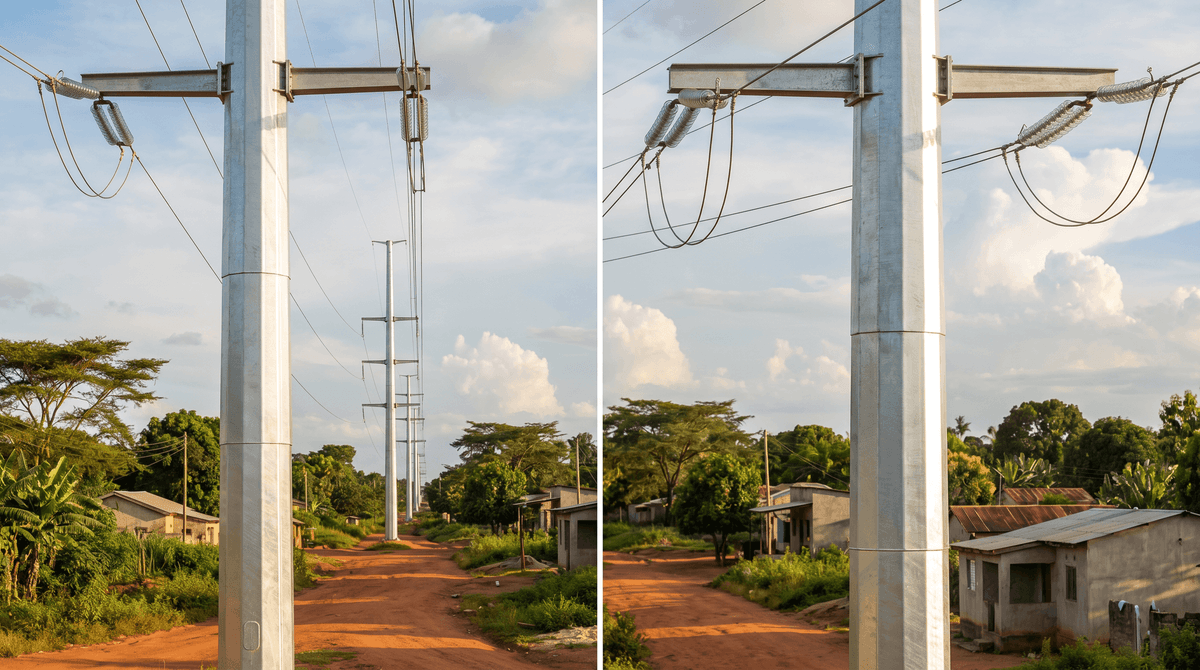
Mombasa, Kenya Power Transmission Tower Deployment: 189 Units of 40m Steel Tubular Poles for a 35kV Single-Circuit Line
Summary
This Mombasa deployment used 189 SOLAR TODO Power Transmission Tower units in 40m tapered steel tubular pole form to build about 15km of 35kV single-circuit line, with 80m spans, 35m/s wind class design, and concrete base foundations.
Key Takeaways
- 189 steel tubular poles were deployed, each 40m tall and configured for a 35kV single-circuit transmission line in Mombasa, Kenya.
- Total route length was about 15km, using an average 80m span layout to fit dense urban and peri-urban utility corridors.
- Each pole used hot-dip galvanized Q345 steel at about 24t per pole, based on a structural mass of roughly 600kg/m.
- The line was configured with 1.5m phase spacing, 5.5m ground clearance, and 0.8m insulator length for the specified 35kV duty.
- Conductors were ACSR 120 rated at 470kg/km with maximum tension of 38kN, matched to the pole and cross-arm arrangement.
- Structural loading was checked to Wind Class 3, equivalent to 35m/s under IEC 60826, with design compliance to IEC 60826 and GB 50545.
- Each SOLAR TODO Power Transmission Tower included climbing steps, cross arm, grounding, bird guard, and vibration damper accessories.
- Foundations used concrete base construction rather than lattice-tower footings, reducing site interface complexity for this 189-unit urban deployment.
Project Background
Mombasa required a compact 35kV overhead line solution because utility routing in a coastal city is constrained by roads, port-related activity, salt-laden air, and dense mixed-use corridors. At coordinates -4.04, 39.67, the deployment area combines urban load growth with right-of-way pressure, making 40m steel tubular poles more practical than wider-footprint lattice structures across a 15km route.
According to the World Bank (2023), reliable electricity infrastructure remains a core requirement for industrial productivity and urban service delivery across Sub-Saharan Africa, especially in logistics-linked cities. According to IEA (2023), grid expansion and reinforcement are still necessary in fast-growing demand centers, even where access rates improve. In Mombasa, the challenge was not only adding line length, but doing it with 189 structures that fit an 80m span pattern and maintain 5.5m ground clearance in constrained corridors.
The coastal environment also matters. According to IEC (2019), overhead line mechanical loading must account for wind and environmental exposure through standardized design methods such as IEC 60826. For Mombasa, Wind Class 3 at 35m/s was a key design input, and hot-dip galvanized Q345 steel was selected to support long-term corrosion resistance in a marine-influenced setting.
As IEC states, "This International Standard specifies methods for the design of overhead lines with reference to reliability requirements." That requirement is directly relevant to a 35kV single-circuit route carrying ACSR 120 conductors over about 15km. SOLAR TODO applied this framework to a monopole-style tubular solution rather than a lattice tower geometry.
Solution Overview
This project deployed 189 SOLAR TODO Power Transmission Tower units as 40m tapered steel tubular poles for a 35kV single-circuit line, using hot-dip galvanized Q345 steel, 80m spans, and concrete base foundations. The result was a compact overhead line layout suited to Mombasa's right-of-way constraints while maintaining the specified 1.5m phase spacing and 5.5m ground clearance.
The installed structure type was a steel tubular transmission pole, not a lattice tower and not FRP. Each unit was fabricated in flanged bolt sections to simplify transport and erection, then assembled on site over a concrete base foundation with anchor cage interface. At roughly 24t per pole, the 189-unit deployment involved approximately 4,536t of steel across the route.
Each pole carried cross-arm brackets for insulator strings and ACSR conductors. The conductor specified for the line was ACSR 120 with a mass of 470kg/km and maximum tension of 38kN. With a route length of about 15km, the conductor and support system had to be coordinated for mechanical loading, vibration control, and phase geometry in a coastal wind environment.
SOLAR TODO selected accessory packages that matched utility maintenance needs in Kenya: climbing steps for access, cross arms for conductor support, grounding for fault safety, bird guards for avian interaction reduction, and vibration dampers for conductor motion control. For buyers comparing support options, the relevant product line is available at /products/power-tower, and project-specific engineering support is available through contact us.
According to IRENA (2022), transmission and distribution investments are essential to convert generation capacity into delivered electricity, particularly in urbanizing regions. According to NREL (2022), grid hardening and component selection matter as much as route expansion when environmental stressors are present. In this Mombasa case, the product choice was driven by structure form, corrosion protection, and repeatable installation over 189 positions.
Technical Specifications
This Mombasa installation used 189 units of 40m hot-dip galvanized Q345 steel tubular poles for a 35kV single-circuit line, with 1.5m phase spacing, 5.5m ground clearance, and 35m/s wind design under IEC 60826.
- Product type: SOLAR TODO Power Transmission Tower in steel tubular pole configuration
- Structure form: tapered steel tubular pole, not lattice
- Quantity: 189 units
- Pole height: 40m each
- Application: 35kV single-circuit overhead line
- Total line length: about 15km
- Typical span: 80m
- Material: Q345 steel
- Surface treatment: hot-dip galvanizing
- Approximate structural weight: 24t per pole
- Weight basis: about 600kg/m
- Phase spacing: 1.5m
- Minimum ground clearance: 5.5m
- Conductor type: ACSR 120
- Conductor mass: 470kg/km
- Maximum conductor tension: 38kN
- Insulator length: 0.8m
- Wind class: Class 3
- Design wind speed: 35m/s
- Foundation type: concrete base foundation
- Accessories: climbing steps, cross arm, grounding, bird guard, vibration damper
- Design standards: IEC 60826 / GB 50545
Deployment Process
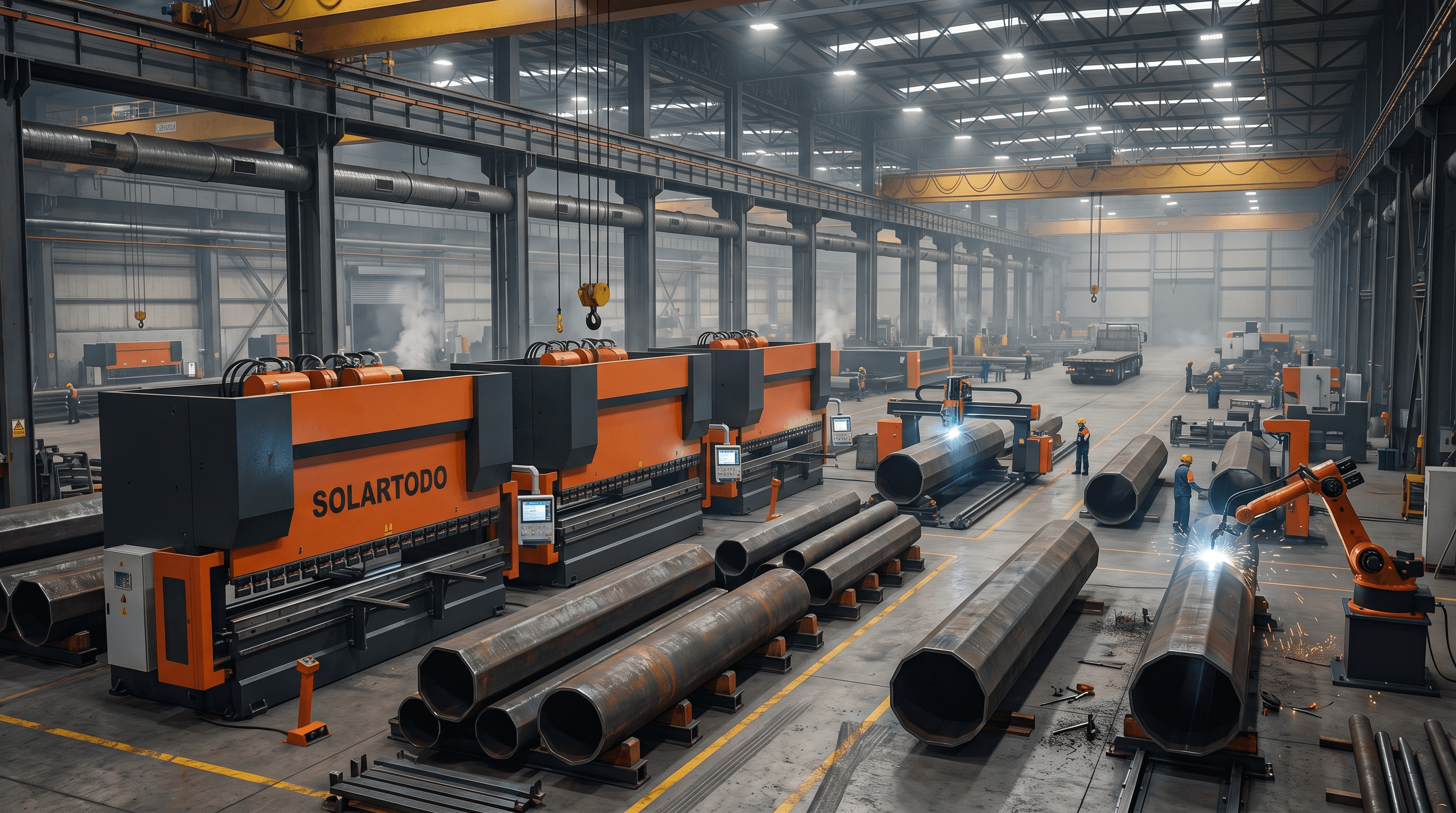
The 189-unit Mombasa rollout followed a staged sequence of route verification, foundation works, section delivery, pole erection, and conductor stringing across about 15km of corridor. Using 40m flanged steel sections reduced transport limitations compared with one-piece poles and made site assembly more manageable in urban access conditions.
The first phase focused on survey confirmation and foundation positioning. With an 80m span target, pole locations had to be checked against road setbacks, crossing points, and clearance requirements. Concrete base foundations were then cast to match each anchor interface, creating a repeatable civil package for all 189 support points.
The second phase covered steel delivery and erection. Each pole weighed about 24t, so lifting plans had to account for section mass, crane reach, and coastal wind windows. Because the line was designed to IEC 60826 and GB 50545, erection tolerances, bolt torque control, and vertical alignment checks were part of the installation routine rather than optional quality steps.
The third phase involved cross-arm installation, insulator attachment, grounding completion, and ACSR 120 conductor stringing. With conductor tension capped at 38kN and insulator length fixed at 0.8m, field teams had to maintain the specified 1.5m phase spacing and 5.5m ground clearance through the full route. Vibration dampers and bird guards were installed as standard accessories rather than later retrofits.
According to IEEE (2023), transmission line reliability depends heavily on construction quality, grounding continuity, and component fit-up during installation. IEEE states, "Reliability of overhead line performance is strongly influenced by design, installation practice, and maintenance discipline." That principle applied directly to this 35kV Mombasa build, where 189 structures had to perform as one continuous system.
Performance & Results
This 15km Mombasa line delivered a compact 35kV overhead corridor using 189 tubular poles, maintaining 5.5m clearance and 1.5m phase spacing while meeting 35m/s wind design criteria under IEC 60826. The main result was a route form that reduced footprint pressure compared with traditional lattice alternatives in constrained urban and peri-urban areas.
From a structural perspective, the use of hot-dip galvanized Q345 steel matters in coastal Kenya. According to World Bank (2021), climate resilience in infrastructure planning is increasingly important in coastal African cities exposed to wind, humidity, and corrosion-related degradation. According to NREL (2022), material durability and maintenance access significantly affect lifecycle performance of grid assets, especially where environmental exposure is persistent.
Operationally, the accessory package improved maintainability. Climbing steps reduced access complexity for inspections at 40m height, while grounding hardware standardized earthing across all 189 positions. Bird guards and vibration dampers addressed two common overhead-line issues: wildlife interaction and conductor oscillation under variable wind conditions up to the 35m/s design threshold.
The line also provided a practical construction advantage. Compared with a wider-base tower type, a tubular monopole profile is easier to place where road edges, buildings, and utility congestion limit footprint. For Mombasa, that meant the 80m span design could be repeated over about 15km with fewer corridor conflicts than a broader lattice geometry would typically create.
According to IEA (2023), grid reinforcement remains one of the most effective ways to improve delivered power quality and support economic activity in demand centers. According to IRENA (2022), network investments are central to integrating supply and meeting urban load growth. In this case, SOLAR TODO delivered a 35kV support structure package that matched those network reinforcement needs without changing the specified conductor, span, or clearance envelope.
Comparison Table
This comparison shows why a 40m steel tubular pole was selected for Mombasa's 35kV, 15km route: it kept the 80m span and 35m/s wind requirement while using a smaller ground footprint than a lattice alternative.
| Metric | Deployed Mombasa Configuration | Typical Lattice Alternative for Similar Voltage Class |
|---|---|---|
| Structure type | Steel tubular pole | Lattice tower |
| Quantity | 189 units | Route-dependent |
| Height | 40m | Similar height possible |
| Voltage class | 35kV single circuit | 35kV single circuit |
| Total line length | ~15km | ~15km |
| Typical span | 80m | 80m possible |
| Material | Hot-dip galvanized Q345 steel | Galvanized structural steel |
| Approx. weight per structure | ~24t | Varies by design |
| Wind design | Class 3, 35m/s | Can be designed similarly |
| Foundation approach | Concrete base foundation | Multi-leg footing arrangement typically required |
| Footprint in constrained corridors | Lower | Higher |
| Visual profile | Single shaft | Open lattice body |
| Maintenance access | Climbing steps integrated | Tower climbing members |
| Accessories included | Cross arm, grounding, bird guard, vibration damper | Project-specific |
Pricing & Quotation
SOLAR TODO offers three pricing tiers for this product line: FOB Supply (equipment ex-works China), CIF Delivered (including ocean freight and insurance), and EPC Turnkey (fully installed, commissioned, with 1-year warranty). Volume discounts are available for large-scale deployments. Configure your system online for an instant estimate, or request a custom quotation from our engineering team at [email protected].
For a 189-unit, 40m, 35kV project in Mombasa, quotation accuracy depends on route conditions, foundation quantities, port handling, and erection scope. Buyers usually submit pole schedule, geotechnical information, span profile, and conductor data such as ACSR 120 at 38kN maximum tension. SOLAR TODO can quote supply-only or installation-inclusive packages based on the same IEC 60826 / GB 50545 design basis.
Frequently Asked Questions
This FAQ answers the most common buyer questions about the 189-unit Mombasa 35kV tubular pole deployment, including specifications, installation scope, maintenance, warranty, and quotation structure.
Q1: What exactly was deployed in Mombasa, Kenya?
A total of 189 SOLAR TODO Power Transmission Tower units were deployed as 40m tapered steel tubular poles for a 35kV single-circuit overhead line. The route length was about 15km with typical 80m spans. Each pole used hot-dip galvanized Q345 steel, concrete base foundations, and included cross arms, grounding, climbing steps, bird guards, and vibration dampers.
Q2: Why use steel tubular poles instead of lattice towers for this 35kV line?
The main reason was corridor efficiency. A 40m tubular pole has a smaller ground footprint than a comparable lattice structure, which helps in dense Mombasa rights-of-way. For a 15km route with 189 positions and 80m spans, that smaller footprint simplifies siting near roads, buildings, and existing utility crossings while still meeting IEC 60826 wind requirements.
Q3: What conductor and electrical configuration were used?
The line used ACSR 120 conductor with a mass of 470kg/km and maximum tension of 38kN. It was configured as a 35kV single-circuit line with 1.5m phase spacing, 0.8m insulator length, and 5.5m minimum ground clearance. Those values were coordinated with the 40m pole height and cross-arm arrangement.
Q4: How long does installation typically take for a 189-unit project like this?
The exact schedule depends on permits, civil access, and weather windows, so this article does not assign a fixed number of weeks. In practice, the work is phased into survey, concrete base foundation construction, steel erection, and conductor stringing across about 15km. Projects of 189 poles move faster when foundation crews and erection crews work in parallel sections.
Q5: What standards governed the structural design?
The specified standards were IEC 60826 and GB 50545. IEC 60826 covers loading and reliability methods for overhead transmission lines, including wind-related design inputs such as the 35m/s Wind Class 3 requirement used here. GB 50545 provided the supporting design framework for the steel tubular transmission structure and line arrangement.
Q6: What maintenance is required after commissioning?
Routine maintenance usually includes bolt torque checks, galvanizing condition inspection, grounding continuity tests, conductor hardware checks, and visual review of vibration dampers and bird guards. Because each pole is 40m high, integrated climbing steps help inspection teams access hardware safely. Coastal locations like Mombasa also require closer attention to corrosion exposure over time.
Q7: What is the expected ROI or payback for this type of transmission project?
Transmission structures are usually justified by network reliability, capacity support, and reduced outage risk rather than a simple payback formula. ROI depends on avoided losses, improved service continuity, and the value of connecting demand centers over the 15km corridor. Utilities normally evaluate these projects using system planning metrics, not only equipment cost per pole.
Q8: Does SOLAR TODO provide EPC pricing for projects like this?
Yes. SOLAR TODO offers FOB Supply, CIF Delivered, and EPC Turnkey quotation models for the power-tower product line. For a 189-unit 35kV deployment, EPC scope may include foundation work, steel erection, conductor stringing, grounding, and commissioning. Buyers can send route drawings and loading data through contact us for a project-specific quotation.
Q9: What warranty is available for this product line?
The quotation section specifies a 1-year warranty for EPC Turnkey projects. Final warranty terms depend on contract scope, inspection protocol, and whether the supply is FOB, CIF, or EPC. For utility buyers, warranty discussions usually cover coating quality, fabrication compliance, missing accessories, and installation workmanship where SOLAR TODO is responsible for erection.
Q10: Are these poles suitable for coastal environments like Mombasa?
Yes, the specified hot-dip galvanized Q345 steel configuration is suitable for coastal use when combined with proper inspection and grounding practice. Mombasa's marine atmosphere increases corrosion risk, so galvanizing quality and maintenance intervals matter. The 35m/s wind design under IEC 60826 also supports structural suitability for exposed coastal conditions.
Q11: What foundation type was used in this deployment?
The project used concrete base foundations for all 189 poles. This approach provides a consistent civil interface for flanged steel tubular sections and suits repeatable installation over a 15km route. Foundation dimensions depend on geotechnical conditions and loading, but the structure category and project specification here are clearly defined as concrete base foundation.
Q12: Can the same product line be adapted for other voltage classes?
Yes. The broader SOLAR TODO steel tubular transmission pole range covers 10kV to 220kV, depending on height, loading, and cross-arm configuration. This Mombasa case specifically used a 35kV single-circuit arrangement with 40m poles, but the same product family can be configured for different conductor loads, insulator sets, and route conditions.
References
This case study cites 7 authoritative sources, including IEC 60826, IEA, IRENA, IEEE, NREL, and the World Bank, to frame the 35kV Mombasa deployment within recognized transmission design and grid investment practice.
- IEC (2019): IEC 60826, Design criteria of overhead transmission lines, including loading and reliability methods used for wind-based line design.
- GB Standard (2015): GB 50545, Code framework applied to overhead line and transmission structure design in this project specification.
- IEA (2023): Electricity Grids and Secure Energy Transitions, explaining the need for grid reinforcement and network expansion in growing demand centers.
- IRENA (2022): Electricity Grids and Renewables: Costs and Markets to 2030, noting that transmission and distribution investment is necessary to deliver reliable electricity.
- World Bank (2023): Energy sector development reporting for Sub-Saharan Africa, highlighting the role of reliable grid infrastructure in economic productivity and urban services.
- NREL (2022): Grid modernization and resilience publications describing how asset durability and environmental design affect long-term network performance.
- IEEE (2023): Overhead line reliability and transmission asset guidance emphasizing the role of installation quality, grounding, and maintenance in line performance.
Equipment Deployed
- 189 × 40m tapered steel tubular Power Transmission Tower poles, 35kV single circuit
- Hot-dip galvanized Q345 steel structure, approx. 24t per pole
- Cross-arm brackets for 35kV conductor support
- ACSR 120 conductor, 470kg/km, max tension 38kN
- 0.8m insulator string arrangement
- Concrete base foundation system
- Climbing steps for maintenance access
- Grounding set for each pole
- Bird guard accessories
- Vibration damper accessories