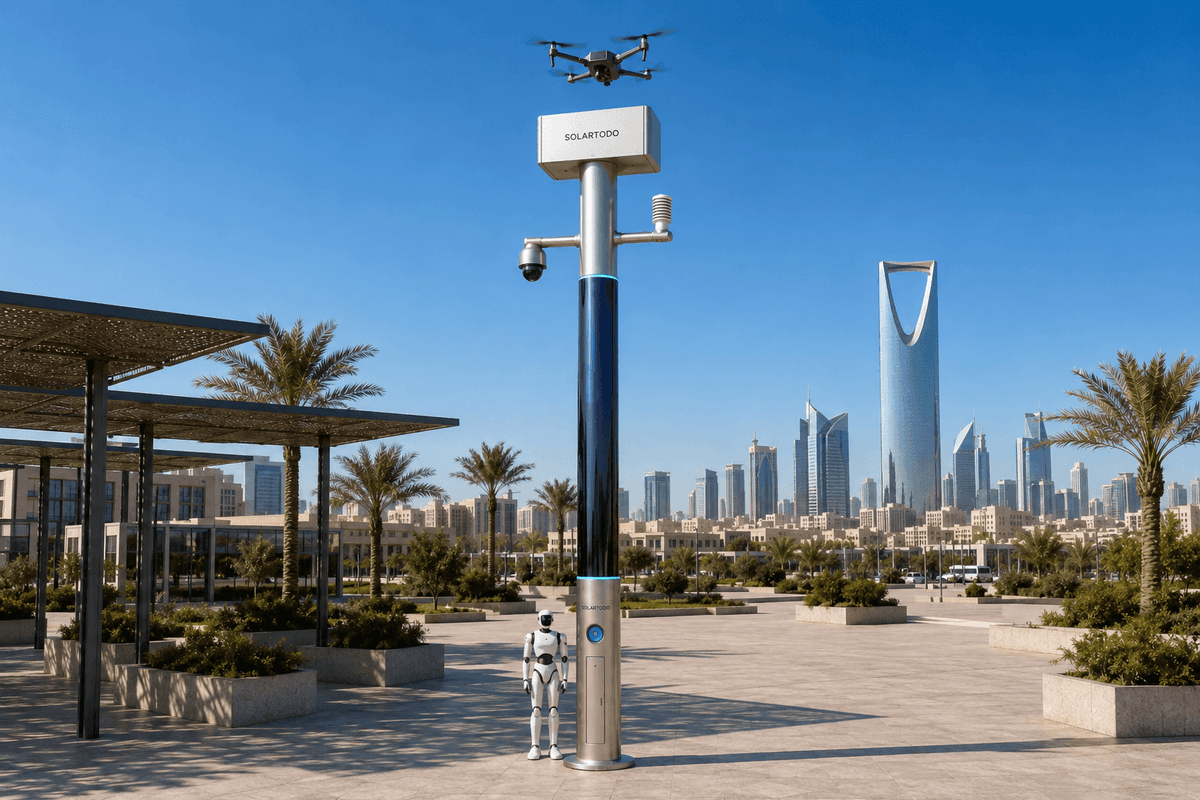
A City AI Pole is a non-lighting physical-AI edge node that combines off-grid energy, sensing, edge compute, drone operations and ground robot operations in one pole-form urban station. In this Mexico City case, SOLARTODO Sentinel Sky Hub is proposed for a transport-hub campus perimeter, keeping raw data local while coordinating authorized field response.
City Task
Mexico City’s emergency-management teams face a difficult operating pattern around transport hubs: normal commuter volume, event surges, informal curb activity, drainage-channel crossings, service roads, pedestrian bridges and periodic cellular congestion can all occur in the same corridor. For a seasonal sports event, the stress is sharper. A stadium or arena zone may push late-night passengers toward a Metro, Metrobús, taxi, ride-hail and shuttle interchange while temporary vendors, buses and emergency vehicles compress the available perimeter space. The proposed Sentinel Sky Hub deployment is framed for that task, not as a general urban furniture upgrade. The city objective is to keep a transport-hub campus perimeter observable and actionable when the main pain point is a network outage or degraded communications window.
The deployment mode is a river-cross-section layout: nodes are positioned on both sides of a canalized river, drainage channel or depressed mobility corridor, with attention to bridges, underpasses, maintenance ramps and pedestrian crossings. In Mexico City this matters because many high-traffic corridors follow or cross engineered water and roadway sections. A perimeter incident may not respect the administrative edge of a station, depot or event campus; it may move from a plaza to a bridge landing, then to a service road or drainage edge where fixed fiber, site power and patrol coverage are weaker. Sky Hub is proposed as a fully off-grid physical-AI node to hold a local common-operating picture across those gaps. It is a pure smart pole with no lighting system. Its role is sensing, edge computing, energy, drone operations and robot operations, not illumination.
Procurement Fit
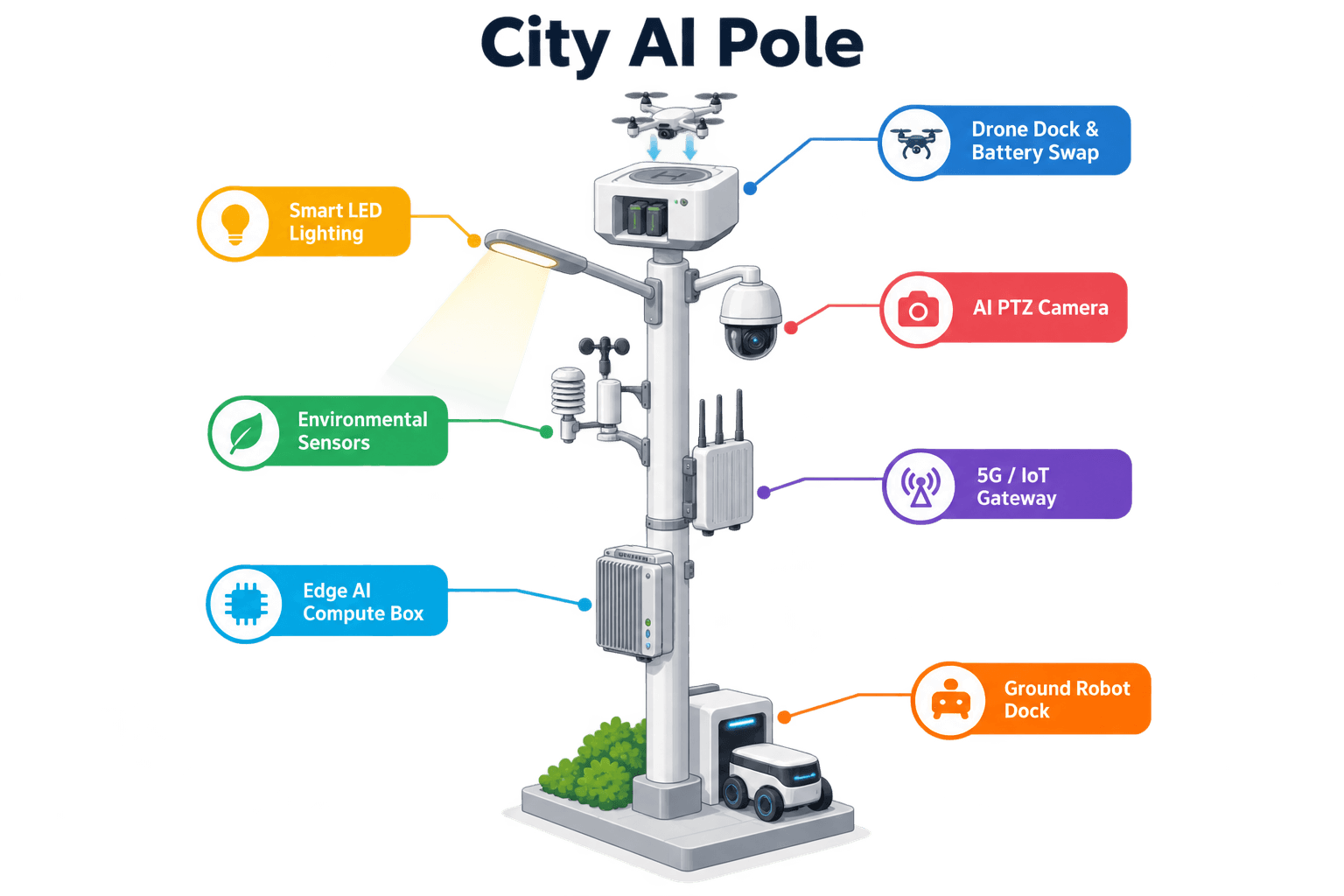
For an emergency-management buyer, the procurement question is not simply whether another camera can be installed. The harder question is whether the city can preserve operational continuity when the network is degraded, the event clock is running, and field teams are already saturated. In this proposed configuration, each Sky Hub functions as a self-contained edge micro-station. Battery storage carries the duty cycle, while approximately 15 m2 of 360-degree wrapped flexible CIGS thin-film solar replenishes the system. The CIGS layer is treated honestly as supplemental replenishment, not unlimited solar self-sufficiency. The vertical cylindrical body has roughly 2.4-2.7 kWp nameplate solar capacity, but because only the sun-facing projection receives direct sun at a given moment, realistic clear-sky output in a high-irradiance region is about 0.8-1.1 kW DC peak and about 6-9 kWh per day. Mexico City engineering confirmation would adjust those planning values for local shading, air quality, season, rainfall and node orientation.
The procurement case therefore centers on opex control. A Sky Hub does not remove the need for authorized personnel, emergency procedures or radio discipline. It reduces unnecessary truck rolls and manual confirmation trips by doing first-pass sensing, classification, mission scheduling and record creation on the pole. Raw video and sensor data stay on the node for local processing; only de-identified event and status metadata may leave the pole. This PDPL/LGPD-oriented data posture is designed to support local processing and auditability, not to claim certification. During a network outage, the node can continue to detect perimeter anomalies, maintain mission logs, schedule local workloads and prepare evidence packets for later synchronization. The buyer can evaluate it as a resilient operating node for campus-perimeter continuity rather than as a bandwidth-heavy remote camera endpoint.
Battery-Swap Operations
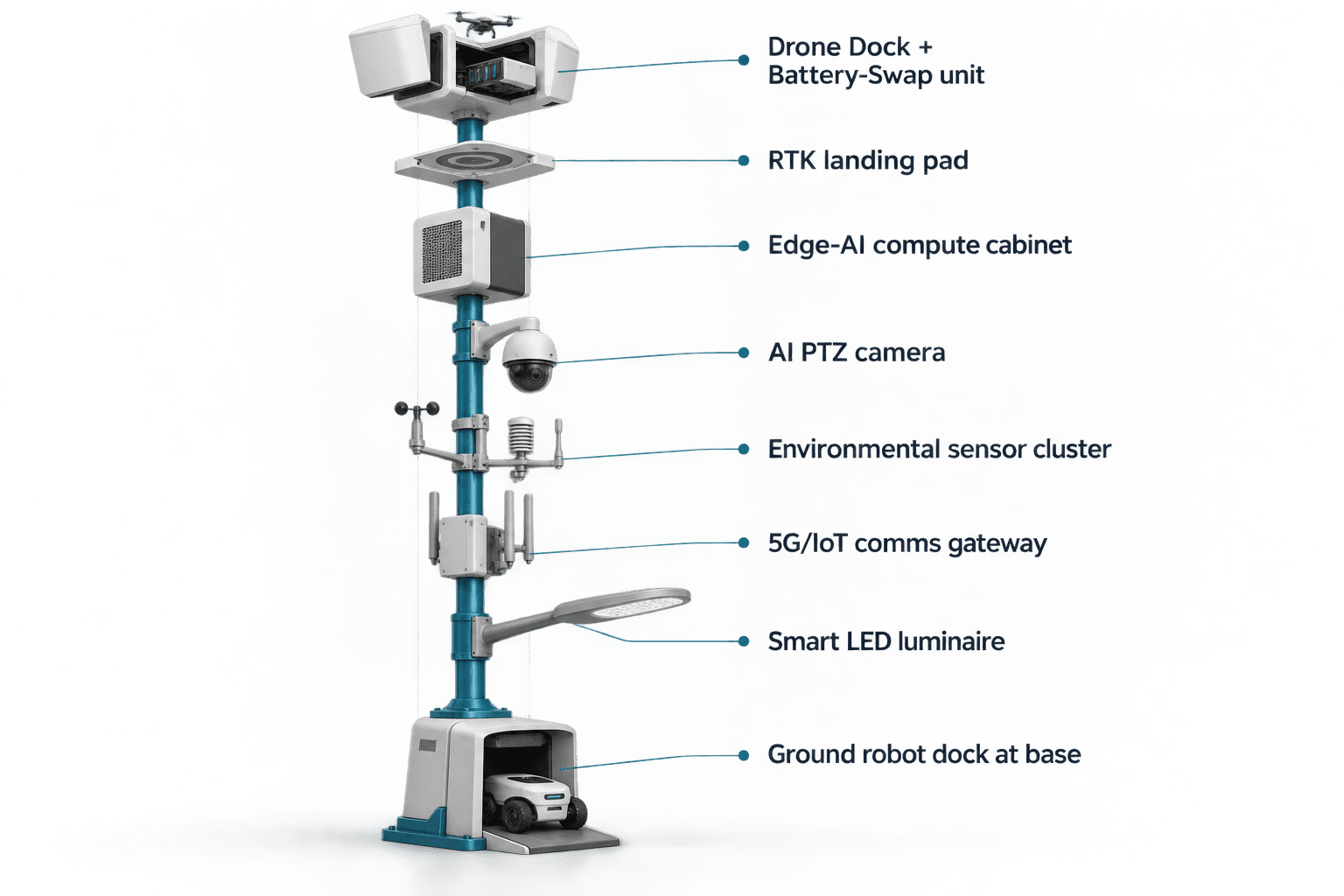
The module focus for this Mexico City case is drone battery hot-swap. The transport-hub perimeter may need repeated short sorties during a sports-event surge: checking a bridge approach, looking over a blocked service road, inspecting a drainage-channel crossing, confirming a crowd build-up outside a gate, then returning to the pole. A conventional drone workflow can quickly become labor-heavy because every battery cycle pulls staff into recovery, charging and relaunch. Sky Hub changes that opex profile by placing the battery workflow inside the pole-top drone operations station.
A landed drone returns to the Sky Hub, aligns on the landing bay and receives an automated rear-service battery exchange from a multi-bay magazine. A depleted pack is removed, a charged pack is inserted, the state machine validates the exchange, and the drone can relaunch for the next authorized mission. Multiple bays support several consecutive sorties, subject to duty cycle, weather, airspace authorization, storage level and operator rules. The value is not a claim of continuous flight; it is a controlled method to turn battery change from an on-site manual interruption into a managed edge operation.
The same node also manages routes, task queues, charge and swap state, fleet health and mission logs. If the communications link is degraded, the pole can continue local scheduling and recordkeeping, then share only de-identified status and event metadata when connectivity returns. Ground robot operations complement the aerial loop. A service or humanoid robot can patrol the base perimeter, respond to local alarms, inspect accessible ground-level assets, coordinate with the aerial view, and return to the pole base for wireless charging. Together, the air-ground workflow supports the operations loop of sensing, authorized assessment and response, edge-compute scheduling, and field operations and maintenance in one COP command view.
Control Boundaries
Security sensing in the proposed Mexico City configuration uses a PTZ camera with local perception for anonymous vehicle count, crowd density, intrusion and perimeter awareness. It does not claim active face recognition or licence-plate recognition. Environmental monitoring supports operational context with wind speed, wind direction, temperature, humidity, atmospheric pressure, noise, PM10, PM2.5 and illuminance. This is useful around transport hubs because weather, dust, noise, crowd load and visibility affect both drone dispatch and emergency response decisions.
Edge AI compute is specified as a Jetson-class on-pole module, Orin- or Thor-class depending on final engineering confirmation. The module runs local inference, schedules workloads and manages when to prioritize camera perception, drone mission planning, environmental sensing, robot charging or low-power operation. It is not positioned as a cloud camera. Raw video and raw sensor streams stay on the pole by default; event summaries, health status, audit entries and de-identified alerts are the normal outputs.
Counter-UAS coordination is deliberately bounded. If an unauthorized drone is detected and tracked, the node can coordinate the friendly drone for a human-authorized soft aerial net-capture or close-approach deterrence workflow. This is non-lethal and authority-bound. The system is not a shoot-down tool, not an RF or GNSS denial system, and not an autonomous attack system. Radar is not built into the pole; where the procurement package needs radar-like awareness, it should be treated as an optional partner-sensor input that feeds the COP, subject to local approvals and rules of engagement.
Opex Evaluation
The proposed evaluation should be written as a procurement case with target planning inputs rather than claimed results. The city can compare baseline perimeter operations during a sports-event week against a Sky Hub-assisted model. The baseline may include manual rounds, supervisor callouts, temporary camera trailers, battery handling for drones, radio checks, incident note consolidation and post-event report writing. The Sky Hub model replaces some of those repetitions with on-pole detection, automated battery exchange, local evidence packaging, robot check-ins and a shared COP queue.
Useful opex questions include: how many night perimeter checks can shift from manual first-look to drone or robot confirmation; how many incidents can be triaged locally before dispatching a vehicle; how many drone sorties can be supported without stationing a battery technician at the node; and how much post-event reconciliation can be shortened because mission logs, sensor states and authorization records are created at the edge. These are target metrics for buyer recomputation, not achieved outcomes.
Final engineering confirmation should validate foundations, wind exposure, solar yield in local shading, battery capacity, airspace procedures, communication fallback, bridge and drainage-channel sightlines, maintenance access, privacy review and emergency command integration. The strength of the proposed Sky Hub approach is that it treats the transport-hub perimeter as a physical-AI operations problem: off-grid energy, edge compute, autonomous drone support, robot charging, sensing and human-authorized response are procured as one node architecture.
System Configuration
| Parameter | Configuration |
|---|---|
| Pole form | Pure non-lighting smart pole, approximately 8 m cylindrical body for this proposed campus-perimeter node, subject to structural confirmation |
| Energy system | Fully off-grid battery-backed micro-station with 360-degree wrapped flexible CIGS solar replenishment and duty-cycle scheduling |
| Drone module | Pole-top autonomous launch, landing, multi-bay rear-service battery hot-swap, route queueing and mission logs |
| Edge AI compute | On-pole Jetson-class inference module, local workload scheduling and local encrypted event storage |
| Security sensing | AI PTZ perception for anonymous vehicle count, crowd density, intrusion and perimeter awareness |
| Environmental module | Wind speed, wind direction, temperature, humidity, atmospheric pressure, noise, PM10, PM2.5 and illuminance |
| Ground robot interface | Base-side wireless charging and task coordination for patrol, inspection, alarm response and air-ground handoff |
How It Works
- On-pole PTZ and environmental sensors flag an anomaly along the river-cross-section campus perimeter.
- Edge AI classifies the event locally and scores it for emergency-management review.
- The COP presents a de-identified alert, energy status and recommended drone or robot task.
- An authorized operator approves the response before field action is executed.
- The drone launches, returns for automated battery hot-swap if needed, and redeploys to the next task.
- The node stores raw data locally and exports only de-identified event, status and audit metadata.
Planning Assumptions (Indicative)
Illustrative planning inputs a buyer can recompute — target metrics, not achieved results. Subject to final engineering confirmation.
| Metric | Planning assumption | Indicative value |
|---|---|---|
| Inspection labor | Drone and robot first-look checks replace selected manual perimeter rounds during sports-event operating windows | ~10-20 patrol checks/week automated |
| Battery handling | Automated drone battery hot-swap reduces the need for on-site battery exchange staff during repeated short sorties | ~4-8 consecutive sortie cycles planned per event window |
| Truck rolls | Local triage and edge health reporting reduce non-critical dispatches during network degradation | ~20-30% target reduction in avoidable checks |
| Report preparation | Mission logs, sensor state and human authorization records are captured at the node for post-event review | ~1 shared incident timeline per event shift |
| Connectivity resilience | Local processing continues during network outages and uploads de-identified metadata after restoration | ~24-72 hours local record buffer target |
Deployed Equipment
- SOLARTODO Sentinel Sky Hub off-grid pole node
- Battery storage cabinet with BMS and duty-cycle controller
- 360-degree wrapped flexible CIGS thin-film solar layer
- Autonomous drone landing and battery hot-swap module
- Multi-bay drone battery magazine
- AI PTZ camera and local perception pipeline
- Nine-parameter environmental monitoring package
- Ground robot wireless charging and coordination interface
Frequently Asked Questions
Is Sky Hub a smart streetlight or a lighting upgrade for Mexico City?
No. In this procurement case, Sky Hub is specified as a pure smart pole and physical-AI edge node with no lighting system. Its functions are edge compute, sensing, off-grid energy, autonomous drone operations, ground robot coordination and emergency-management workflow support around a transport-hub campus perimeter.
How does the fully off-grid energy design affect operations during a network outage?
The energy design is separate from the communications network. Battery storage supports the local duty cycle, and the wrapped CIGS layer replenishes the node when solar conditions permit. During a network outage, the pole can continue local inference, event logging, workload scheduling and authorized field task preparation without relying on city or site power.
Why is drone battery hot-swap important for a seasonal sports-event scenario?
Sports-event surges create many short inspection needs across gates, bridge approaches, service roads and drainage-channel crossings. Automated battery hot-swap allows a landed drone to receive a charged pack and relaunch without placing an operator at the pole for every cycle. This supports repeated sorties while keeping staffing assumptions lower and easier to plan.
What data leaves the pole in the proposed configuration?
Raw video and raw sensor streams are processed and retained locally on the pole by default. The normal external data flow is de-identified event metadata, device status, mission logs and audit summaries. This is a PDPL/LGPD-oriented design posture for local processing and data minimization, not a claim of formal certification.
Does the deployment include face recognition or licence-plate recognition?
No. The security sensing scope in this case is anonymous vehicle count, crowd density, intrusion and perimeter awareness. The article does not position face recognition or licence-plate recognition as active deployed capabilities. Any future regulated identity workflow would require separate legal basis, governance and explicit authorization.
How is Counter-UAS handled without overstepping legal boundaries?
The node may detect and track an unauthorized drone and present the situation to the COP for human review. Any mitigation is non-lethal and human-authorized, such as commanding the friendly drone to perform a soft aerial net-capture or close-approach deterrence where permitted. The pole is not a hard-kill or jamming system.
Explore Further
- City AI Pole / smart streetlight product line
- More smart-city deployment cases
- Talk to our engineering team
Planning a similar physical-AI deployment for streets, campuses or public spaces? Request an engineering consultation