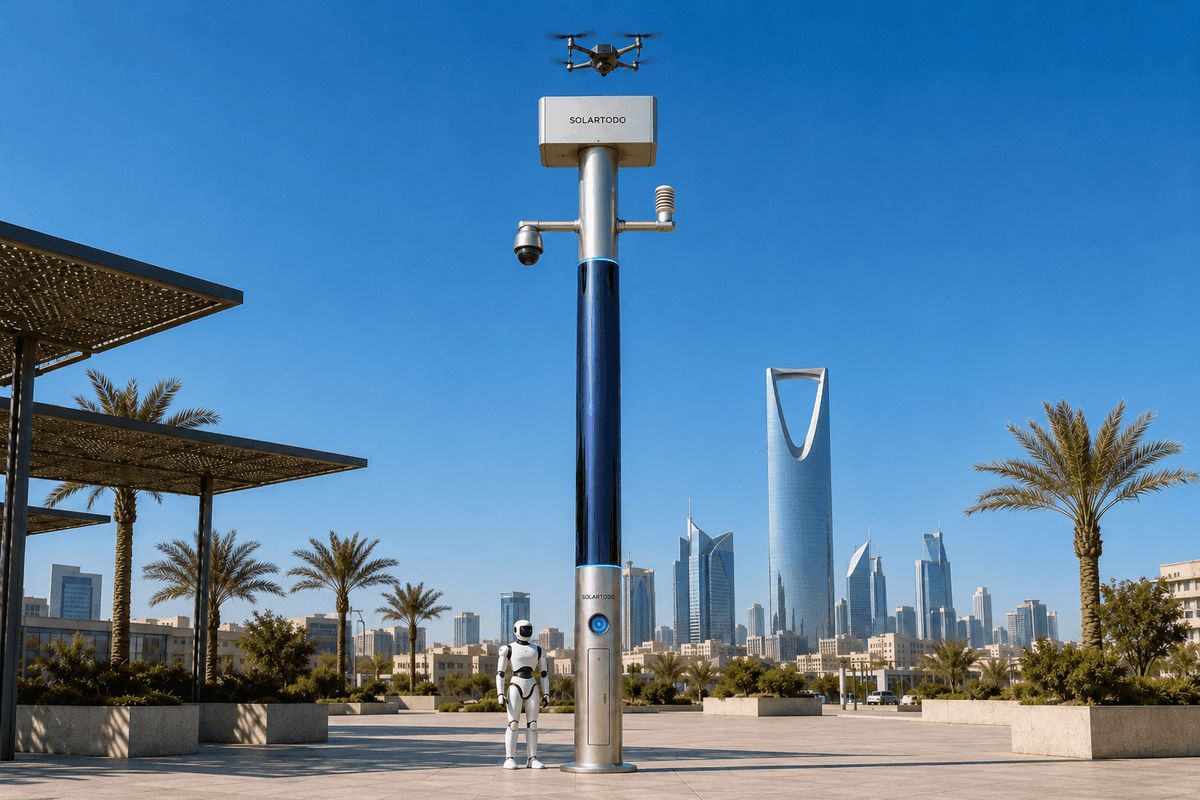
A City AI Pole / SOLARTODO Sentinel Sky Hub is a non-lighting, fully off-grid physical-AI edge node that combines on-pole energy storage, wrapped CIGS solar replenishment, edge compute, sensing, autonomous drone operations, ground-robot charging and C-UAS coordination. In this Mexico City configuration, it supports heatwave-period campus-perimeter night patrol and PDPL/LGPD-oriented evidence collection.
City Task and Deployment Context
Mexico City’s dense CBD environment creates a difficult operating window for eco-environment teams responsible for campus perimeters, mixed-use compounds, business districts and critical-site boundaries. Heatwave periods intensify the task. Higher night-time temperatures can extend outdoor activity, strain field teams, increase environmental complaints, and make manual evidence collection less consistent across long perimeter lines. The proposed SOLARTODO Sentinel Sky Hub deployment is framed around that city task rather than around a product showcase: keep a campus-perimeter zone observable at night, collect defensible environmental and security evidence, and maintain operational availability without drawing power from city, grid or site infrastructure.
The configuration is proposed for a Mexico City CBD campus-perimeter archetype: entrances, service roads, loading edges, internal courtyards, utility-adjacent zones and exterior setback lines where eco-environment operators need a common view of what happened, when it happened, and which response was authorized. The pole is a PURE smart pole and physical-AI edge node, not a public illumination asset. Its role is to host sensing, compute, energy, drone operations and ground robot operations in one off-grid micro-station.
The seasonal trigger is a heatwave operating period. During these windows, a site may need more frequent night patrols for perimeter intrusion, crowd density near gates, abnormal vehicle movements, noise spikes, particulate changes and localized safety concerns. The deployment goal is not to claim a finished public rollout or achieved results. It is to define an illustrative, subject-to-final-engineering-confirmation configuration that a buyer can evaluate against target availability, evidence completeness, duty cycle and local data-handling requirements.
Operational Concept: Droneport and Ground-Robot Loop
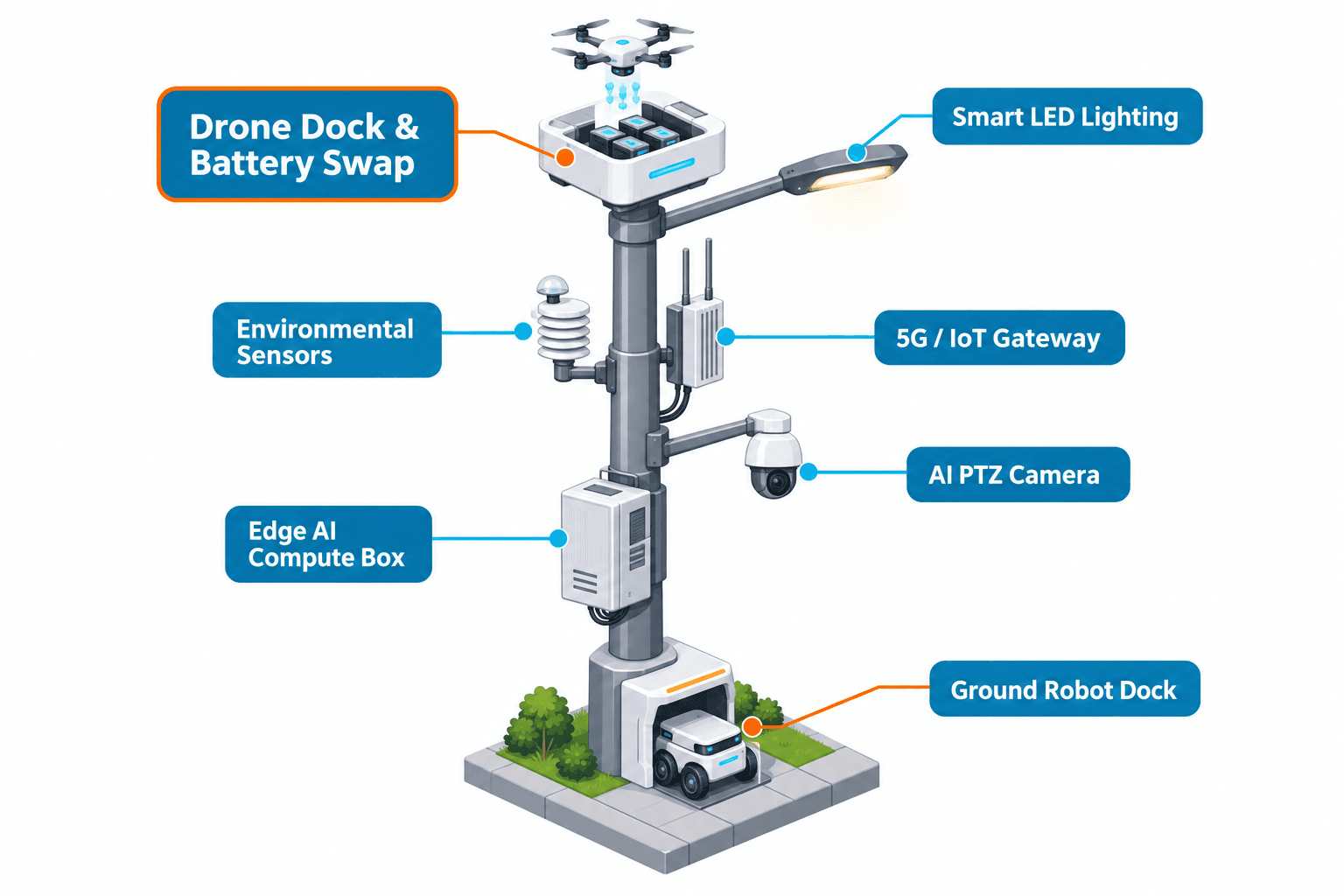
The Sky Hub is positioned as a compact droneport and robot-ready edge node for campus-perimeter night patrol. In a normal patrol cycle, the on-pole PTZ camera and environmental sensor set watch the perimeter from the pole location. Local perception flags a change in the scene, such as an unusual vehicle count, rising crowd density, intrusion into a restricted edge, or an environmental anomaly such as noise and particulate movement during a heatwave night.
The edge compute cabinet processes the raw video and sensor data on the pole. Raw streams stay on the pole. The common-operating-picture view receives only de-identified event and status metadata: time, location zone, event class, confidence band, sensor status, drone readiness, robot charge state and mission log state. This is important for a PDPL/LGPD-oriented operating posture because it reduces the need to move sensitive raw material away from the field device while still giving supervisors enough context to authorize action.
For drone operations, the pole manages route planning, launch readiness, autonomous sortie dispatch, return, hot-swap battery exchange, fleet health and mission logs. When a night patrol requires an aerial view, an authorized operator can release a route from the COP. The drone launches, inspects the perimeter segment, returns to the pole and enters a rear-service automated battery exchange. A multi-bay magazine can support several consecutive sorties by exchanging a depleted pack for a charged one, subject to the configured duty cycle and energy budget.
The module focus in this case is the ground robot. The robot handles the slower, closer inspection layer that aerial patrol cannot replace: moving along the campus edge, approaching an alarm location, checking a gate area, confirming whether an environmental complaint has a visible source, coordinating with the drone’s overhead view, and returning to the pole base for wireless charging. The result is not an autonomous enforcement claim. It is a structured operations loop: sensing, authorized assessment and response, edge-compute scheduling, then field operations and maintenance, all visible in one COP command view with human-in-the-loop authorization.
Evidence Collection and Data Handling
The core pain point is evidence collection. Eco-environment stakeholders often need material that is timely, organized and explainable: a patrol log, sensor context, local event classification, operator authorization, robot response record, drone sortie record and maintenance state. Manual night patrols can produce gaps when heatwave conditions change staffing patterns, when perimeter areas are far apart, or when an incident spans multiple sensors and field actions.
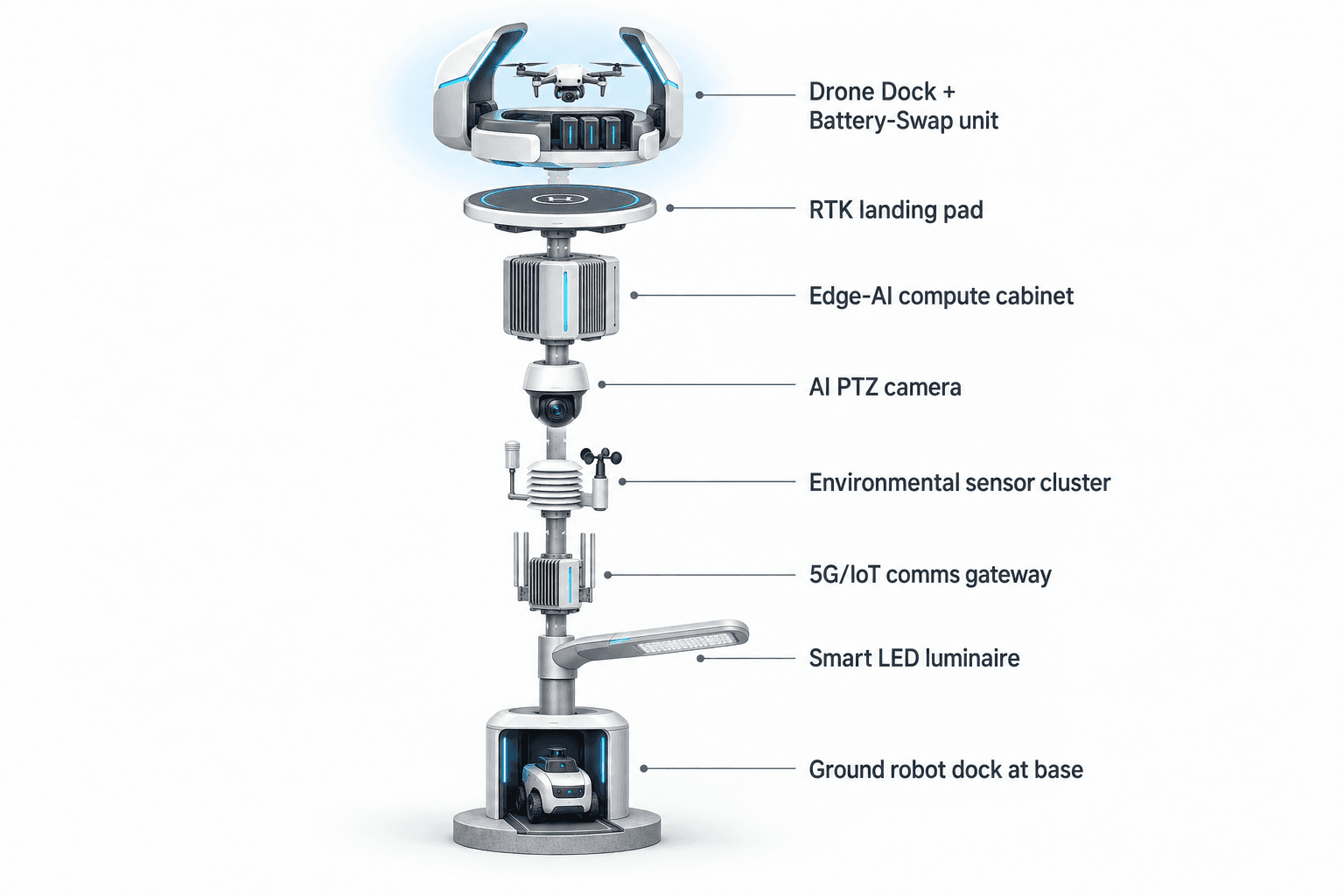
In the proposed configuration, evidence is built as an event package rather than as a raw data export. The Sky Hub records event metadata from the PTZ perception layer, the nine environmental channels, the drone mission state, the ground robot status and the authorization trail. The pole can classify anonymous vehicle count, crowd density, intrusion and perimeter awareness locally. It does not claim active face recognition or licence-plate recognition. This distinction matters for procurement because the evidence objective is operational accountability and situational reconstruction, not broad identity collection.
For a heatwave night-patrol case, the COP might show a time-linked sequence: noise and PM2.5 rise near a service entrance, the camera flags an unusual movement pattern, the ground robot is assigned to inspect the boundary at low speed, and a drone sortie is authorized for a short overhead view. The edge node schedules compute and power across those tasks, logs the state transitions, and pushes only de-identified event and status metadata to the command view.
C-UAS coordination is also framed as a controlled evidence and response workflow. The pole can detect and track an unauthorized drone using its own perception stack and, where available, optional partner-sensor inputs. Radar is not treated as built-in pole hardware. With human authorization, the node can command its friendly drone to perform a soft aerial net-capture or close-approach deterrence. The deployment language remains non-kinetic and human-authorized; the case study does not position the node as an autonomous weapon or as a spectrum-denial system.
Off-Grid Energy and Availability Planning
Availability is the KPI framing for this Mexico City proposal. The buyer should evaluate the Sky Hub not by a claim of unlimited solar autonomy, but by whether its battery-backed off-grid micro-station can keep the priority patrol functions available during the agreed night windows. The pole carries approximately 15 m² of 360-degree wrapped flexible CIGS thin-film over a vertical body around 8 m tall and 0.6 m wide, with about 2.4-2.7 kWp nameplate. Because a vertical cylinder collects direct sun mainly on the sun-facing projection rather than across the full wrap at once, realistic clear-sky output in a high-irradiance region is roughly 0.8-1.1 kW DC peak, usually peaking mid-morning or mid-afternoon rather than at noon, and about 6-9 kWh per day.
For Mexico City, final yield must be confirmed by site engineering, shading analysis, seasonal irradiance, air quality, mounting finish, cleaning interval and duty-cycle modeling. The CIGS layer should be treated as supplemental replenishment for a fully off-grid station, not as a guarantee of continuous high-power operation. The main energy buffer is a 5-20 kWh-class battery system. Drone relaunch frequency, robot patrol duration, sensor recording windows, edge-inference workload and communications duty cycles should be scheduled against that storage envelope.
The ROI analysis should therefore start with availability targets. A buyer can define the required night-patrol coverage window, target node uptime, minimum consecutive drone sorties, robot patrol cycles per shift, evidence-package completion rate and acceptable maintenance interval. The value is created when the pole reduces gaps in night evidence collection, standardizes response logs, and keeps patrol capacity available during heatwave periods without asking for site power works. Any final business case should be recomputed using local labor models, incident volume, security rules, environmental reporting needs and final engineering confirmation.
Buyer Evaluation and ROI Logic
For an eco-environment buyer, the strongest evaluation lens is not gadget count. It is whether the campus perimeter becomes easier to operate with fewer blind spots and clearer records. The Sky Hub combines the edge camera, environmental channels, droneport, hot-swap magazine, ground robot charge base, edge AI scheduling and C-UAS coordination into one off-grid node. That gives the buyer a practical test structure: compare current manual patrol coverage and evidence quality with a target operating model that automates repeatable patrol legs while keeping authorization and exception handling with people.
An illustrative ROI model can assign planning inputs to each operational layer. Drone patrol replaces some repeat perimeter walks with scheduled sorties. The ground robot handles close inspection and alarm response routes that would otherwise require staff to cross the site at night. Edge processing reduces the need to transmit raw material outside the pole. The COP reduces time spent assembling scattered patrol notes, sensor readings and incident records after the fact. Availability becomes the governing metric because every benefit depends on the node being ready when the night patrol window opens.
The proposed Mexico City deployment should be accepted only after final site design confirms pole placement, solar exposure, storage size, drone operating envelope, robot route safety, wireless coverage, environmental sensor calibration, maintenance access and local operating rules. The case does not claim achieved results, named customers, certified compliance, fixed detection rates or city-scale coverage. It defines a credible configuration for a heatwave-sensitive CBD campus perimeter where evidence collection, droneport readiness, ground-robot response and off-grid availability are the main procurement questions.
System Configuration
| Parameter | Configuration |
|---|---|
| Deployment shape | SOLARTODO Sentinel Sky Hub, non-lighting physical-AI edge-node pole for CBD campus-perimeter operations |
| Energy system | Fully off-grid battery-backed micro-station with 360-degree wrapped flexible CIGS thin-film solar replenishment and 5-20 kWh-class storage |
| Edge AI compute | Jetson-class on-pole inference and workload scheduling cabinet, Orin- or Thor-class, with raw video and sensor data processed locally |
| Droneport operations | Autonomous launch, patrol, inspection, return, rear-service battery hot-swap, task queueing, fleet health and mission logs |
| Ground robot module | Humanoid or service robot patrol, alarm response, close inspection, air-ground coordination and wireless return-to-base charging |
| Sensing package | PTZ perception for anonymous vehicle count, crowd density, intrusion and perimeter awareness, plus nine environmental channels |
| C-UAS coordination | Detection and tracking with human-authorized friendly-drone soft net-capture or close-approach deterrence; optional partner-sensor inputs only |
How It Works
- On-pole PTZ perception or environmental sensors flag a perimeter anomaly during the heatwave night window.
- Edge AI classifies the event locally and creates de-identified metadata for the COP command view.
- A human supervisor reviews the event score, patrol context and available drone or robot state before authorizing action.
- The Sky Hub dispatches a drone sortie, ground robot route or coordinated air-ground response according to the approved task.
- The node records the event timeline, sensor context, authorization step, mission state and maintenance status as an evidence package.
- Field operations review the package, close the event, and adjust future patrol duty cycles or maintenance tasks.
Planning Assumptions (Indicative)
Illustrative planning inputs a buyer can recompute — target metrics, not achieved results. Subject to final engineering confirmation.
| Metric | Planning assumption | Indicative value |
|---|---|---|
| Night patrol automation | Drone and robot patrols replace a portion of repeat manual perimeter walks during heatwave night windows | ~10-20 automated patrol cycles per week targeted |
| Evidence package completeness | Each qualified event should include timestamp, zone, sensor context, authorization record, drone or robot action and mission log | Target 90-95% complete event packages for reviewed incidents |
| Node availability | Battery storage, solar replenishment and duty-cycle scheduling are sized for the agreed patrol window | Target 95-98% availability during defined night-patrol hours |
| Drone sortie continuity | Multi-bay hot-swap magazine supports consecutive short patrol missions before manual service is required | ~3-6 consecutive sortie opportunities per configured patrol block |
| Ground robot utilization | Robot handles close inspection and alarm-response routes that are high-friction for night staff | ~1-3 response routes per night shift targeted |
Deployed Equipment
- SOLARTODO Sentinel Sky Hub pole body with 360-degree wrapped flexible CIGS thin-film layer
- Battery-backed off-grid power cabinet, 5-20 kWh-class depending on final site design
- On-pole edge AI compute cabinet for local inference and task scheduling
- PTZ perception camera for perimeter awareness and anonymous counting use cases
- Nine-channel environmental sensor set: wind speed, wind direction, temperature, humidity, atmospheric pressure, noise, PM10, PM2.5 and illuminance
- Autonomous droneport module with rear-service multi-bay battery hot-swap magazine
- Ground robot wireless charging base integrated at the pole base
- Common-operating-picture command dashboard for human-in-the-loop authorization and mission logs
Frequently Asked Questions
Is the Sky Hub configuration intended to replace existing city power or site electrical work?
Yes for this proposed perimeter use case, the Sky Hub is specified as a fully off-grid node using battery storage and on-pole CIGS solar replenishment. The solar layer is supplemental and should not be interpreted as unlimited self-sufficiency. Final storage sizing, patrol frequency and maintenance intervals must be confirmed through site-specific energy modeling.
How does this help an eco-environment stakeholder rather than only a security team?
The deployment is organized around evidence collection for heatwave night operations. Environmental channels, local perception, drone patrol logs and ground robot inspection records are joined into event packages. This helps eco-environment teams correlate noise, particulate, temperature, humidity and perimeter activity without moving raw video or sensor streams away from the pole.
What makes the ground robot important in this Mexico City campus-perimeter scenario?
The drone provides rapid aerial inspection, but the ground robot handles close, slower verification along gates, service roads, setback edges and alarm points. It can approach a flagged area, coordinate with the drone’s overhead view, document local conditions, and return to the pole base for wireless charging within a controlled patrol workflow.
Does the pole identify people or vehicles by face or licence plate?
No active identity capability is claimed in this proposed configuration. The PTZ perception layer is framed for anonymous vehicle count, crowd density, intrusion and perimeter awareness. Raw video and sensor data stay on the pole for local processing, while only de-identified event and status metadata are intended to leave for the command view.
How should availability be evaluated for procurement?
Availability should be measured against the agreed night-patrol window, not as a broad claim of continuous high-power activity. Buyers can test whether the battery, solar replenishment, drone hot-swap cycle, robot charging cycle and edge compute workload keep the node ready for the required patrol schedule during heatwave operating periods.
How is counter-UAS handled in this case study?
C-UAS is treated as coordinated, non-kinetic and human-authorized response. The pole detects and tracks an unauthorized drone using its perception stack and optional partner-sensor inputs where available. A supervisor can authorize the friendly drone to perform a soft aerial net-capture or close-approach deterrence, with the event recorded in the mission log.
Explore Further
- City AI Pole / smart streetlight product line
- More smart-city deployment cases
- Talk to our engineering team
Planning a similar physical-AI deployment for streets, campuses or public spaces? Request an engineering consultation