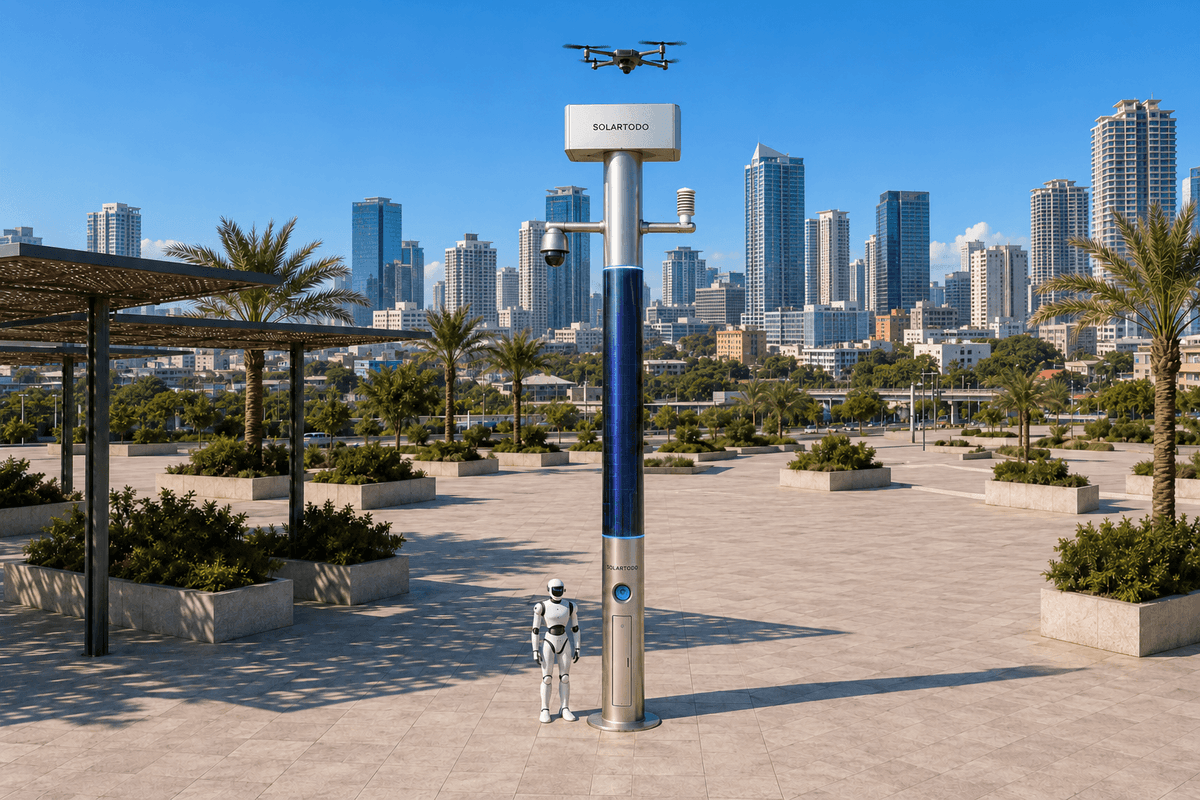
A City AI Pole is a non-lighting physical-AI edge node integrating local sensing, computing, communications, energy storage and drone and ground-robot operations. SOLARTODO Sentinel’s Sky Hub form runs OTATODO at the edge. This proposed Manila campus-perimeter deployment supports environmental night patrol for a transport authority, using fully off-grid energy and human-authorized operations while keeping raw data on the pole.
1. Evaluation brief: environmental continuity around an event campus
For a Manila transport authority, a sports-event season creates a specific operational question: can environmental awareness remain available around a campus perimeter throughout evening arrivals, event dispersal and the quieter hours afterward? This proposed deployment addresses campus gates, shuttle approaches, pedestrian boundaries and service access points. Its purpose is to help transport supervisors assess conditions affecting safe movement while maintaining a reliable night-patrol service.
This is a proposed deployment case study presented in pilot-report format. The evaluation concerns site suitability and operating performance; it does not characterize Sentinel’s mature, in-service capabilities as experimental. No campus, authority contract, installation quantity or achieved result is asserted. Configuration, operating permissions and acceptance criteria remain subject to final engineering confirmation.
The mountain-city archetype is applied as an operational lens for a Manila-serving campus with sloping approaches or connections toward an upland catchment. It does not describe central Manila as mountainous. Site selection would establish whether terrain, vegetation and buildings create radio shadows, difficult patrol access or changing wind exposure. Those conditions matter because communications interruptions can consume a drone’s useful endurance through waiting, repeat tasking or unnecessary returns.
Environmental monitoring leads the brief. Wind, airborne particles, noise and temperature provide context for patrol decisions during the event season. PAGASA identifies June–November as the Philippines’ general rainy season, making weather-sensitive scheduling relevant if event dates overlap that period. Actual operating conditions require site observations rather than seasonal assumptions. Source: PAGASA, Climate of the Philippines.
2. Proposed configuration: communications that preserve useful endurance
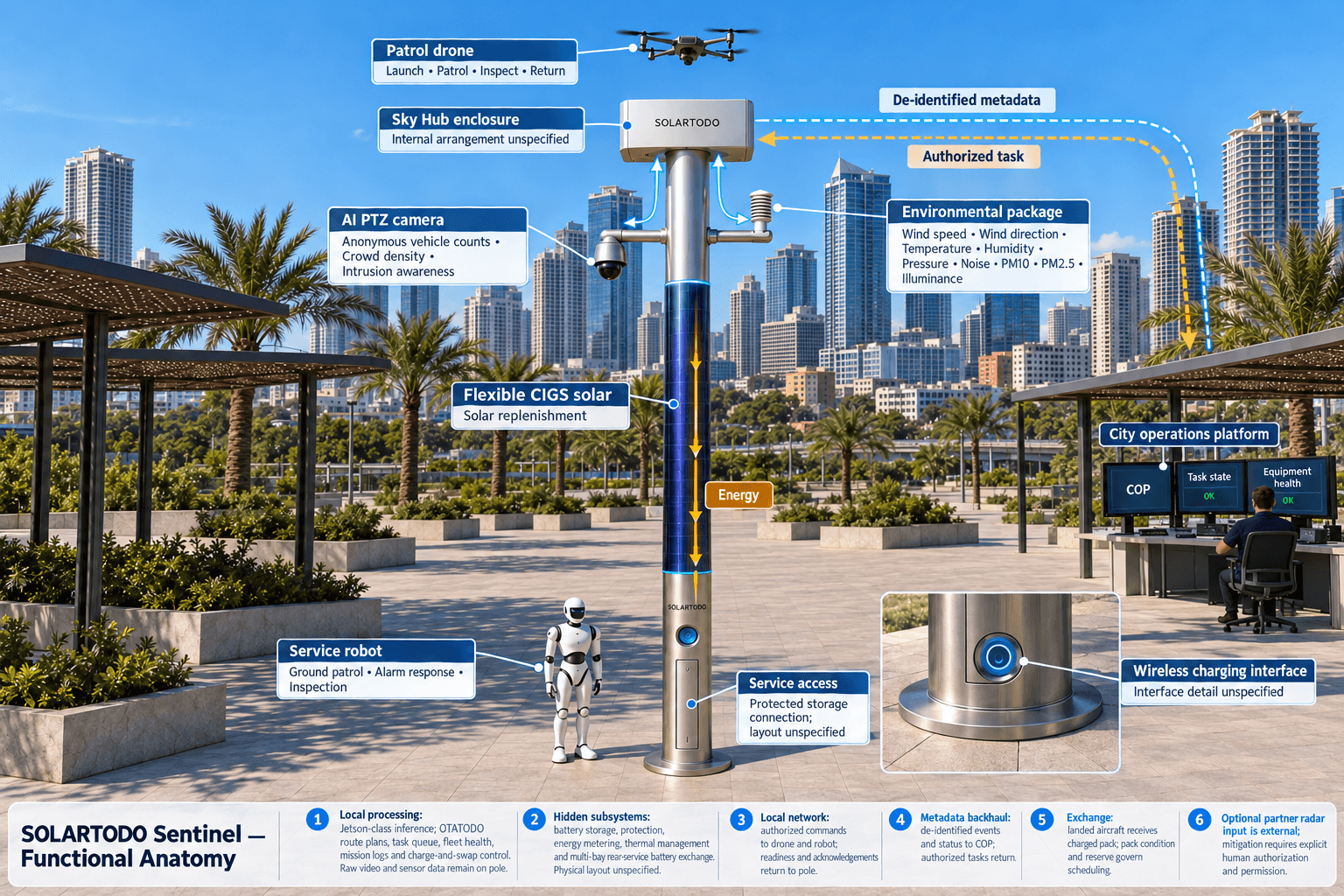
Sky Hub is a PURE smart pole with no lighting system. Its proposed campus-perimeter configuration combines environmental sensing, an AI PTZ camera, on-pole computing, communications, autonomous drone support and ground-robot support. The physical form brings those functions to the operating boundary, where the authority needs dependable status and actionable environmental context.
Communications are the principal integration focus. The proposed design uses a local operational network for node, aircraft and robot coordination, plus separately managed backhaul for de-identified event and status metadata. Link selection, antenna placement and failover behavior require a perimeter survey. Diversity is useful only where the selected paths avoid common coverage gaps and shared failure points; it is not an assumed guarantee of continuous connectivity.
OTATODO manages route plans, the charge-and-swap state machine, task queues, fleet health and mission logs on the pole. A Jetson-class edge module runs local inference and schedules workloads. Commands carry authorization context and task identifiers so a delayed acknowledgement does not produce an unintended duplicate sortie. The evaluation should test link loss, reconnection, stale messages and acknowledgement handling before event-night operations.
Drone endurance is addressed through useful mission scheduling and automated turnaround. After a sortie, the landed aircraft receives a charged pack through an automated rear-service exchange from a multi-bay battery magazine. Several ready bays support consecutive sorties, subject to pack condition, replenishment and energy reserves. No operator is required on site for that exchange.
The mechanism does not extend a battery’s flight time. It reduces dependence on manual pack handling between missions. Communications make that benefit operationally usable by keeping pack readiness, landing state, task priority and return instructions synchronized, while local control preserves defined behavior when backhaul is unavailable.
3. Night-patrol sequence: environmental sensing to authorized action
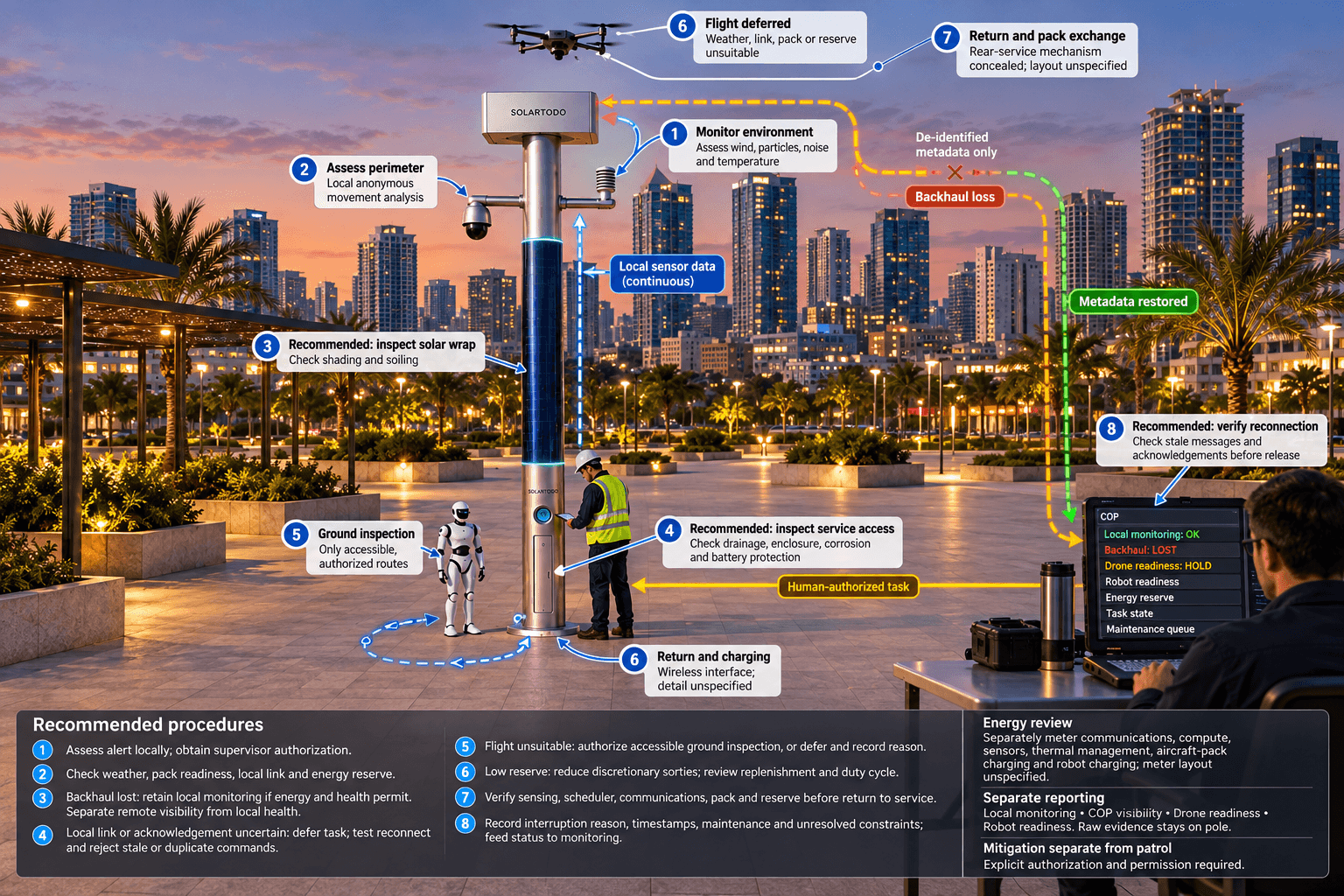
The proposed event-night sequence begins with local environmental observations and perimeter awareness. The nine-in-one environmental package measures wind speed, wind direction, temperature, humidity, atmospheric pressure, noise, PM10, PM2.5 and illuminance. These readings contextualize conditions at the pole; they do not establish a campus-wide exposure map or replace specialist instruments where regulatory-grade measurement is required.
The PTZ camera supports anonymous vehicle counting, crowd-density assessment, intrusion detection and perimeter awareness through local perception. For example, an environmental alert near a shuttle approach can be assessed alongside anonymous movement trends and current aircraft readiness. The authority defines escalation thresholds and inspection priorities before operations. An alert initiates assessment; it does not automatically establish a hazard or justify intervention.
The common-operating-picture command view connects sensing, authorized assessment and response, edge-compute scheduling, and field operations and maintenance. A supervisor can authorize an inspection task, while local scheduling checks weather suitability, available packs, communications state and energy reserve. Autonomous sorties cover launch, regional patrol, inspection, return and task redeployment within approved operating boundaries. Human oversight does not require a person beside the pole.
A service robot supports ground patrol, alarm response, inspection and air-ground coordination, returning to the pole base for wireless charging. Ground tasks provide another inspection option when flight is unsuitable, provided the route itself remains accessible and authorized. Neither aircraft nor robot should be dispatched merely to keep an activity counter high.
Sentinel also supports unauthorized-drone detection and tracking, with command coordination of its own friendly drone for soft aerial net-capture or close-approach deterrence. Any such mitigation is non-lethal and requires explicit human authorization and applicable permission. It is separate from routine environmental patrol. Radar is not pole hardware; any radar information would come only from an optional partner-sensor input.
4. Off-grid engineering: reserve energy governs overnight availability
The proposed node is fully off-grid, using on-pole solar replenishment and battery storage, with no grid, city or site power. Its approximately 8 m tall, 0.6 m wide cylindrical body carries about 15 m² of 360°-wrapped flexible CIGS thin-film solar, with roughly 2.4–2.7 kWp nameplate capacity. That nameplate figure must not be treated as continuously available operating power.
A vertical cylinder receives direct sunlight on its sun-facing projection rather than across the entire wrapped area simultaneously. In a high-irradiance region such as Saudi Arabia, realistic clear-sky production is approximately 0.8–1.1 kW DC peak and 6–9 kWh per day, with peaks toward mid-morning and afternoon rather than necessarily at noon. These are reference conditions, not a Manila production forecast. Local shading, cloud cover, orientation, soiling and conversion losses require separate assessment.
For Manila night patrol, solar is a supplemental replenishment layer for a battery-backed micro-station. Proposed storage is in the 5–20 kWh class, with final capacity selected from measured loads, usable battery capacity and the required operating reserve. Storage buffers energy across time; it does not replace energy consumed over successive nights. Poor replenishment can therefore require fewer discretionary sorties or a revised service schedule.
The evaluation should meter communications, compute, sensors, thermal management, aircraft-pack charging and robot charging separately. OTATODO then schedules high-power tasks by duty cycle while preserving the agreed monitoring and control reserve. A charged aircraft pack alone is insufficient reason to launch if replenishing it would compromise the next required patrol window.
Mechanical and electrical review should address wind loading, drainage, enclosure protection, corrosion exposure, battery protection and maintenance access. These are engineering confirmation items rather than implied certifications. Availability depends on the complete energy balance and maintainable installation, not the solar wrap’s visual area.
5. Evaluation method: report availability without hiding interruptions
The primary KPI is service availability during agreed night-patrol windows. The authority should define a service-ready minute before evaluation begins: required environmental sensing is operational, local scheduling is healthy, essential communications meet the agreed operating state, and sufficient reserve exists for the assigned service. Availability is service-ready minutes divided by scheduled service minutes. No achieved percentage is claimed here.
Reporting should distinguish local monitoring availability, remote COP visibility, drone mission readiness and ground-robot readiness. Otherwise, healthy sensors can conceal an aircraft-pack shortage, or a backhaul outage can be mistaken for total node failure. Local continuity during disconnection and remote visibility are different properties and should retain separate timestamps and interruption reasons.
Illustrative planning arithmetic can establish the review workload. Four nights at six hours each create a 24-hour observation window. A hypothetical 30-minute interruption within that window would calculate to 97.9% availability. This is a calculation example, not a product promise, measured result or recommended acceptance threshold. The buyer should replace every input with the actual event timetable and approved service definition.
Raw video and sensor data stay on the pole and are processed locally. Only de-identified event and status metadata may leave it. The COP receives operational summaries; authorized detailed evidence review occurs locally. The design is oriented toward local processing and PDPL/LGPD principles, without asserting certification or established Philippine legal compliance. Retention, access controls and local privacy obligations require a separate buyer review.
The final evaluation report should explain each unavailable interval, whether communications affected useful drone endurance, how pack exchange supported consecutive assignments, and whether reserves survived the scheduled window. It should also record maintenance actions and unresolved site constraints. A transport authority can then judge the proposed campus deployment against evidence from its sports-event operating conditions, rather than extrapolating a rollout claim.
System Configuration
| Parameter | Configuration |
|---|---|
| Pole and energy | Non-lighting cylindrical body, approximately 8 m tall and 0.6 m wide; approximately 15 m² wrapped flexible CIGS, 2.4–2.7 kWp nameplate; fully off-grid. |
| Battery storage | Proposed 5–20 kWh-class storage with protected operating reserve and duty-cycle scheduling; final usable capacity subject to engineering confirmation. |
| Edge computing and communications | On-pole inference and OTATODO scheduling; local operational network and separately managed metadata backhaul, with surveyed antenna placement. |
| Environmental sensing | Wind speed and direction, temperature, humidity, atmospheric pressure, noise, PM10, PM2.5 and illuminance. |
| Security sensing | AI PTZ camera with local anonymous vehicle counts, crowd-density assessment, intrusion detection and perimeter awareness. |
| Drone operations | Autonomous launch, patrol, inspection and return; automated rear-service battery exchange using a multi-bay magazine. |
| Ground operations | Service robot for patrol, inspection, alarm response and air-ground coordination, with wireless charging at the pole base. |
How It Works
- On-pole environmental sensors flag a threshold crossing during campus-perimeter night patrol.
- Local inference correlates conditions with anonymous movement and equipment-readiness status.
- The COP presents de-identified event metadata for an authorized supervisor's assessment.
- OTATODO schedules an approved drone or robot inspection after communications, weather and energy checks.
- The field asset returns for battery exchange or wireless charging, and maintenance exceptions enter the queue.
- Raw evidence remains on the pole while de-identified task outcomes and availability timestamps update the COP.
Planning Assumptions (Indicative)
Illustrative planning inputs a buyer can recompute — target metrics, not achieved results. Subject to final engineering confirmation.
| Metric | Planning assumption | Indicative value |
|---|---|---|
| Scheduled evaluation window | ILLUSTRATIVE ONLY: observe 4 nights for 6 hours per night; replace with the authority's event timetable. | 4 × 6 = 24 scheduled hours, equivalent to 1,440 minutes. |
| Availability calculation | ILLUSTRATIVE ONLY: assume 30 unavailable minutes within a 1,440-minute window; this is neither a target nor a measured result. | (1,440 − 30) ÷ 1,440 × 100 = approximately 97.9% hypothetical availability. |
| Reserved baseline energy | ILLUSTRATIVE ONLY: assume a 100 W combined monitoring, compute and communications load for 6 hours; excludes propulsion, charging and additional thermal loads. | 100 W × 6 h ÷ 1,000 = 0.6 kWh of baseline energy. |
| Aircraft battery demand | ILLUSTRATIVE ONLY: schedule 6 sorties using 0.2 kWh per sortie and assume 80% overall replenishment efficiency; confirm actual aircraft consumption. | 6 × 0.2 kWh ÷ 0.80 = 1.5 kWh of station energy. |
| Report review effort | ILLUSTRATIVE ONLY: arrange 2 review sessions per week for 4 weeks, each lasting 30 minutes. | 2 × 4 × 30 = 240 minutes, or 4 hours of planned review effort. |
Deployed Equipment
- Proposed non-lighting Sky Hub pole with wrapped flexible CIGS solar
- Battery storage cabinet with protection and energy metering
- On-pole edge-compute and communications cabinet
- PTZ camera and nine-in-one environmental sensor assembly
- Autonomous patrol drone with rear-service battery interface
- Multi-bay automated drone battery-exchange magazine
- Service robot and pole-base wireless charging interface
Frequently Asked Questions
Is this a verified Manila deployment report?
This article describes a proposed, illustrative Manila configuration and evaluation method. It does not assert a customer contract, installed quantity or achieved operational result. Sentinel's in-service capabilities form the product basis; the campus layout, communications design, permissions, energy budget and acceptance criteria require site-specific confirmation.
How does the communications module address drone endurance?
Communications connect task priority, aircraft state, pack readiness and return instructions so available flight energy can serve useful inspections. Local scheduling and defined reconnection behavior reduce avoidable waiting or duplicate dispatch. Automated battery exchange supports subsequent sorties, but neither communications nor swapping increases the endurance of an individual battery pack.
Can the pole operate through the night without an external power connection?
The system is fully off-grid, combining on-pole solar replenishment with battery storage. Overnight operation depends on usable stored energy, measured loads and scheduled drone and robot activity. The 5–20 kWh-class storage range requires site-specific sizing; repeated low-solar days can require reduced duty cycles to preserve essential monitoring and control.
Why use a mountain-city operating archetype for Manila?
The archetype guides evaluation of a Manila-serving campus with sloping access or an upland catchment connection; it does not label central Manila mountainous. A site survey must establish actual terrain, radio shadows and patrol constraints. Those findings determine whether diverse communications paths and revised inspection routes improve operational availability.
What information reaches the transport authority's command view?
Only de-identified event and status metadata may leave the pole, including task state, equipment health and availability timestamps. Raw video and sensor data remain on the pole for local processing and authorized local review. Local-processing and PDPL/LGPD-oriented design does not itself establish certification or compliance with applicable Philippine requirements.
What happens when weather or connectivity prevents an aerial patrol?
The scheduler follows the approved operating envelope and records why a sortie is deferred. Local monitoring can continue while backhaul is unavailable, subject to energy and equipment health. A service robot may inspect an accessible, authorized ground route. Weather restrictions, communications interruptions and asset readiness remain separately visible in the availability report.
Does counter-UAS coordination allow autonomous intervention?
Unauthorized-drone detection and tracking can support assessment, but mitigation requires explicit human authorization and applicable operational permission. The node can coordinate its friendly drone for soft aerial net-capture or close-approach deterrence. This non-lethal workflow is separate from environmental patrol, and radar is available only through an optional partner-sensor input.
Explore Further
- City AI Pole / smart streetlight product line
- More smart-city deployment cases
- Talk to our engineering team
Planning a similar physical-AI deployment for streets, campuses or public spaces? Request an engineering consultation