Lisbon Solar Streetlight (Split-Type) Market Analysis: 8m Hybrid Configuration Guide for 15m Roads
Summary
Lisbon’s mild temperate climate, about 4.0 peak-sun-hours for this design basis, and dense urban road network support a typical 137-unit Solar Streetlight (Split-Type) scheme using 8m poles, 120W LED heads, and 24m spacing on 15m-wide roads.
Key Takeaways
- A typical 137-unit deployment in Lisbon would suit 15m-wide urban roads with 24m pole spacing, using 8m stainless steel 304 poles rated for 50 m/s wind.
- The specified hybrid layout combines a 100W vertical-axis wind turbine with a 1360W Mono TOPCon panel, adding generation resilience during winter cloud cover and Atlantic wind events.
- The lighting package uses a 120W LED head delivering 18,000 lm at 150 lm/W, which aligns with arterial-road brightness needs better than 30W or 60W walkway classes.
- Energy storage in this configuration uses a 12V/300Ah NCM lithium battery with 85% DoD, 2,000 cycles, and 3-5 days of cloudy-weather backup.
- According to IEC 60598 and IEC 62124 design practice, split-type architecture with an external battery box and internal pole wiring improves service access while keeping cables protected.
- Smart controls in this profile include motion sensing, timer control, and 4G/LoRa remote monitoring, which can reduce unnecessary burn hours by about 15%-30% depending on dimming logic.
- Lisbon’s municipality reports a resident population above 545,000, while the wider metro exceeds 2.8 million, supporting demand for efficient public lighting on secondary and main urban corridors.
- For buyers comparing options, SOLAR TODO should be evaluated as a split-type streetlighting platform rather than an all-in-one unit, because the pole-top generation and external battery form factor materially affect maintenance and autonomy.
Market Context for Lisbon
Lisbon combines a dense municipal road environment, Atlantic wind exposure, and decarbonization pressure, making 8m hybrid Solar Streetlight (Split-Type) systems technically suitable for selected 15m road corridors and public-space upgrades.
Lisbon is Portugal’s capital and largest city, with 545,796 residents in the municipality according to PORDATA (2023), while the metropolitan area exceeds 2.8 million people according to the OECD (2024). That scale matters because urban lighting demand in Lisbon is not limited to tourist districts; it includes residential connectors, parking edges, waterfront routes, and municipal roads that require reliable dusk-to-dawn operation. According to the European Commission Covenant of Mayors framework (2023), municipalities across Europe continue to prioritize public-lighting efficiency because lighting remains one of the most addressable electricity loads in city infrastructure.
Climate also supports hybrid off-grid lighting logic. According to the European Commission PVGIS tool (2024), Lisbon has one of the strongest solar resources among major European capitals, with annual solar yield conditions materially better than northern Europe. At the same time, Atlantic weather patterns create variable winter irradiance and periodic wind exposure, which is relevant for a wind-solar hybrid pole design with 3-5 days of backup. For procurement teams, that means a hybrid pole can be justified not only by annual energy yield but by resilience during lower-sun intervals.
Road geometry is another factor. Lisbon includes many 12-18m urban corridors, sloped streets, and mixed-use boulevards where trenching for conventional cabling can be disruptive and expensive. According to the World Bank (2022), urban infrastructure retrofits often face higher lifecycle cost when civil works dominate project budgets rather than equipment. In older districts, a split-type solar streetlight reduces dependence on cable trenching, feeder coordination, and utility connection lead times.
Portugal’s standards environment also favors formal compliance. Public lighting equipment sold into EU markets typically needs alignment with luminaire safety, electrical protection, and environmental durability requirements. IEC 60598 remains the core luminaire safety reference, while IEC 62124 is relevant to PV system performance assessment methods. In municipal tender language, these codes support apples-to-apples technical comparison and reduce ambiguity in acceptance testing.
Two authority statements are worth noting. The International Energy Agency states, "Lighting is one of the largest and most cost-effective end uses for efficiency improvements," which is directly relevant to municipal replacement planning. IRENA states, "Renewable-based distributed solutions can improve energy access, resilience and long-term cost stability," a point that applies to off-grid and hybrid public-lighting assets where grid extension is costly or slow.
For Lisbon specifically, the practical market fit is not every street. The stronger fit is for seafront roads, municipal expansion zones, parkside access roads, parking perimeters, and retrofit corridors where trenching, permitting, or heritage constraints raise the cost of conventional lighting. In those segments, SOLAR TODO can be specified as a split-type platform with visible serviceable components rather than as a compact integrated fixture.
Recommended Technical Configuration
For Lisbon’s 15m road width and 24m spacing profile, a typical 137-unit deployment would use an arterial-road lighting class centered on 120W LED heads, hybrid generation, and 8m corrosion-resistant poles.
The base engineering table for this product family pairs 120W LED with a 200W panel and a 10-12m pole for main-road duty. However, the project-specific configuration supplied here calls for an 8m stainless steel 304 pole with a 120W LED head, a 100W VAWT, and a 1360W solar panel mounted below the turbine. Because the generation package is far larger than the standard minimum and the battery is also enlarged to 12V/300Ah, this should be treated as a special high-autonomy configuration for Lisbon rather than a standard catalog size-class row.
A typical 137-unit deployment of this scale would consist of the following layout:
- Approximately 137 units of Solar Streetlight (Split-Type)
- 8m stainless steel 304 poles
- Wind resistance rating of 50 m/s
- Pole service life target of about 40 years
- 100W vertical-axis wind turbine at the pole top
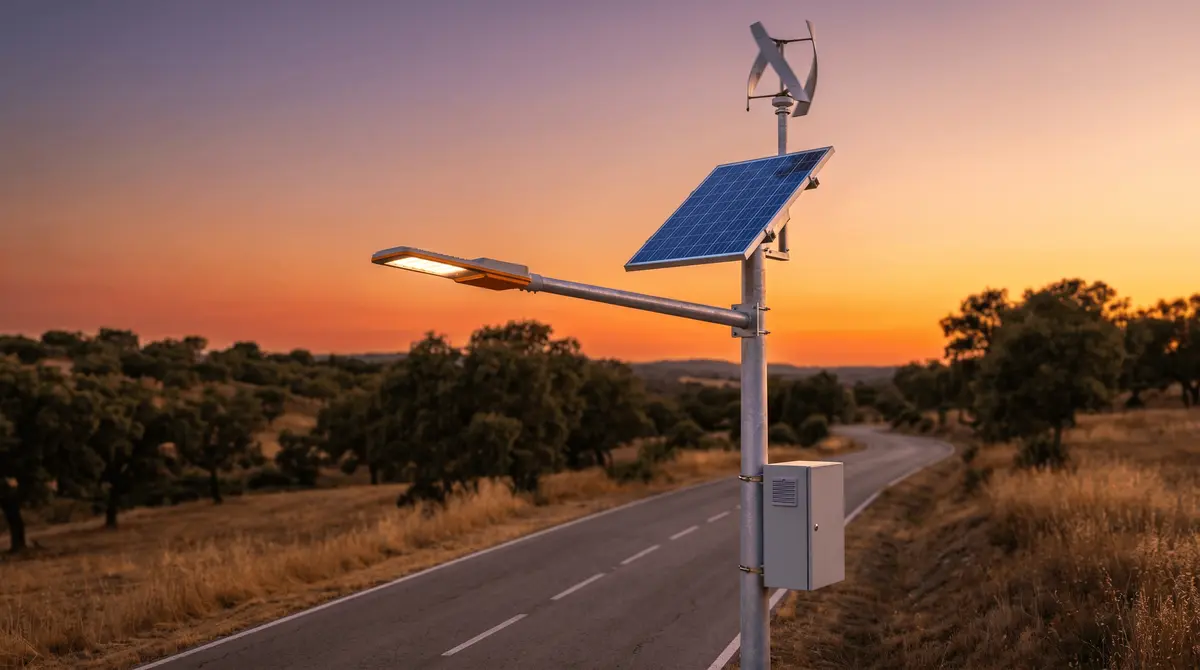
- 1360W Mono TOPCon solar panel mounted below the turbine on a tilted bracket
- 120W LED luminaire producing 18,000 lm
- 12V/300Ah NCM lithium battery in an external pole-mounted box
- MPPT controller mounted inside the battery box
- Internal pole wiring only, with no exposed external cable runs
- Smart controls: motion sensor, timer, and 4G/LoRa remote monitoring
- Dusk-to-dawn automatic operation with 3-5 days of backup
Why does this fit Lisbon? First, the 15m road width and 24m spacing indicate a road class above walkway or garden-path duty. A 30W or 60W configuration would be underpowered for that geometry. Second, Lisbon’s coastal air increases corrosion risk, which makes stainless steel 304 a rational material choice for visible street assets. Third, the hybrid generation package helps maintain battery state of charge during winter cloud cover and windy weather along exposed corridors.
From a procurement perspective, this is a high-autonomy specification rather than a lowest-capex design. According to NREL (2023), battery-supported solar lighting performance depends heavily on correct autonomy sizing, seasonal irradiance assumptions, and controller logic. In Lisbon, a buyer evaluating SOLAR TODO should therefore compare autonomy days, corrosion resistance, internal wiring protection, and service access—not only nominal LED wattage.
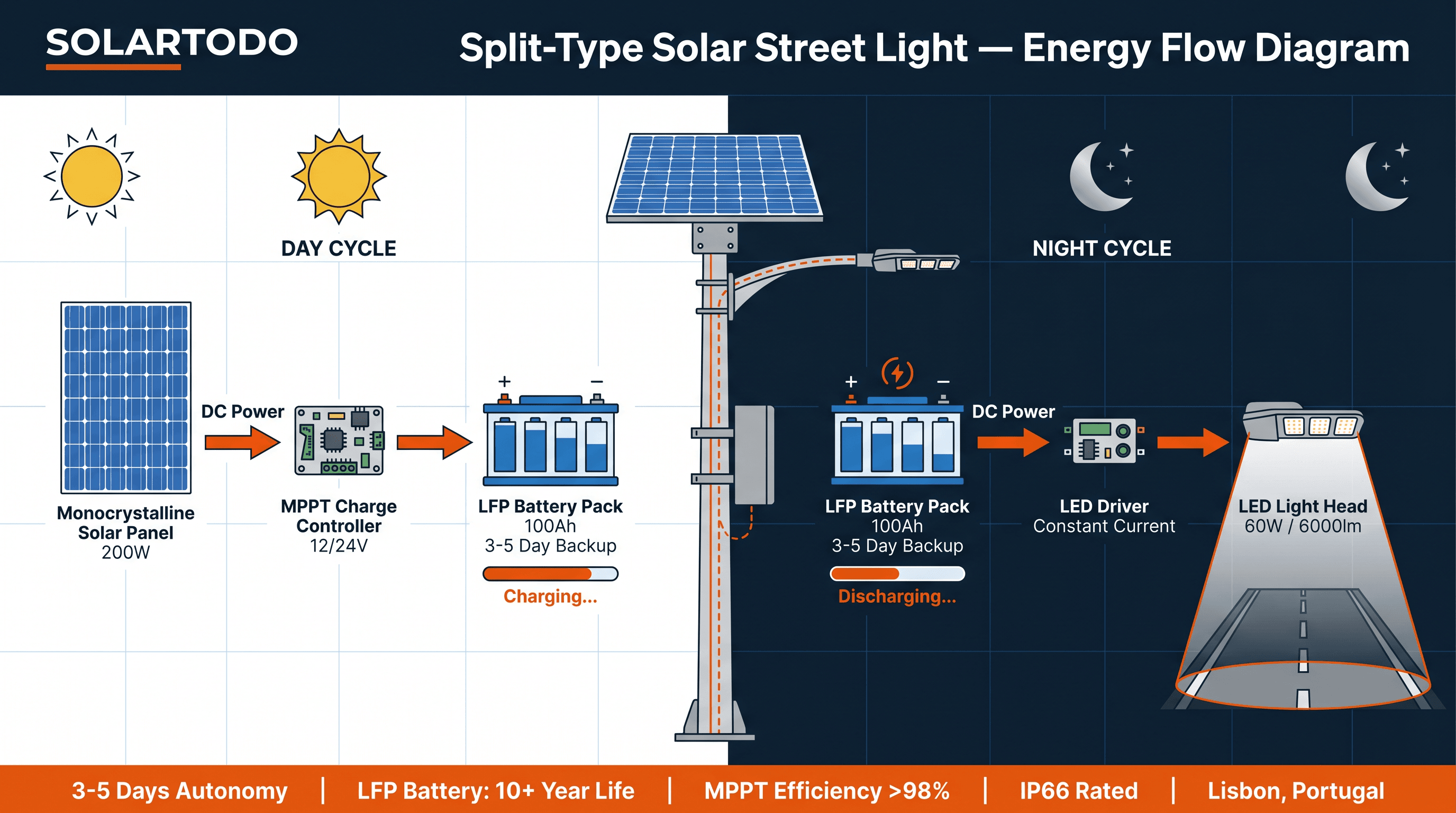
For municipal and EPC teams, the most important form-factor point is that this is not an all-in-one streetlight. The panel sits on a tilted bracket near the top, the LED head is mounted on a side arm below the panel, and the battery box is externally mounted on the pole body. That visible battery enclosure changes maintenance workflow, spare-parts planning, and vandal-resistance requirements.
Technical Specifications
This Lisbon configuration is a special 137-unit hybrid split-type specification using 8m poles, 120W LED heads, 1360W TOPCon panels, and 12V/300Ah external NCM battery boxes with internal wiring.
- Product type: Solar Streetlight (Split-Type), not integrated/all-in-one
- Quantity reference: approximately 137 units for a typical corridor package of this scale
- Pole height: 8m
- Pole material: stainless steel 304
- Wind resistance: 50 m/s
- Pole lifetime: 40 years
- Generation type: wind-solar hybrid
- Wind turbine: 100W vertical-axis wind turbine at pole top
- Solar module: 1360W Mono TOPCon, 23% efficiency
- Panel degradation: 0.3% per year
- Panel warranty: 30 years
- Panel mounting: tilted bracket below wind turbine, panel on top of bracket, pole does not penetrate panel center
- LED luminaire power: 120W
- Luminous flux: 18,000 lm
- Luminous efficacy: 150 lm/W
- CRI: >70
- LED mounting: side arm below panel
- Battery chemistry: NCM lithium
- Battery capacity: 12V/300Ah
- Battery energy density: 250Wh/kg
- Cycle life: 2,000 cycles
- Depth of discharge: 85%
- Battery warranty: 5 years
- Battery box: externally mounted on pole body, visible grey box clamped to pole, not inside base
- Controller: MPPT controller inside battery box
- Wiring: all wiring inside pole, no visible external cables
- Backup autonomy: 3-5 days cloudy-weather support
- Operating mode: dusk-to-dawn automatic control
- Smart features: motion sensor, timer control, 4G/LoRa remote monitoring
- Road profile basis: 15m road width
- Pole spacing basis: 24m
- Climate design basis: temperate, 4.0h sun
- Standards basis: CJJ 45-2015, IEC 60598, IEC 62124
According to IEC 60598 (2024), luminaires for public lighting must address electrical safety, insulation, ingress protection, and mechanical integrity. According to IEC 62124 (2017), PV system performance verification should use repeatable test and monitoring methods, which is relevant for acceptance testing on hybrid solar streetlights. For Lisbon tenders, these codes help define measurable compliance rather than broad marketing claims.
Implementation Approach
A typical Lisbon rollout would be delivered in 4 phases over roughly 10-18 weeks, covering site survey, fabrication, civil works, pole erection, and commissioning.
Phase 1 is site assessment and lighting design. This usually takes 2-4 weeks and includes lux target review, road-width verification, pole-spacing checks at 24m, and shading analysis around trees, façades, and tram or utility corridors. In Lisbon’s older neighborhoods, slope and narrow right-of-way conditions can affect bracket orientation and maintenance access. At this stage, EPC teams should also confirm whether 4G or LoRa is the better communications path for remote monitoring.
Phase 2 is procurement and fabrication. For a package of approximately 137 units, production planning typically runs 3-6 weeks depending on pole finishing, battery-box fabrication, and control-system configuration. Stainless steel 304 poles are slower to source than standard galvanized steel, but they can reduce corrosion risk in marine-influenced environments. SOLAR TODO buyers should request a component list that clearly identifies panel technology, battery chemistry, controller rating, and sensor package.
Phase 3 is civil and mechanical installation. This often requires 3-5 weeks for foundation preparation, anchor setting, pole erection, battery-box mounting, luminaire mounting, and turbine-panel assembly. Because this is a split-type system, the sequence matters: foundation alignment first, then pole erection, then upper-assembly installation, then internal cable termination. Internal wiring should be continuity-tested before controller energization to confirm there are no insulation or routing faults.
Phase 4 is commissioning and acceptance. This usually takes 1-3 weeks and should include charge-state verification, dusk-to-dawn switching tests, motion-sensor validation, remote platform onboarding, and a 72-hour operational observation window. According to IEC testing practice, acceptance should verify not only illumination but charging behavior and backup autonomy assumptions. For municipal handover, spare-parts lists and maintenance intervals should be defined before final sign-off.
Expected Performance & ROI
For Lisbon road segments with 24m spacing, this 137-unit hybrid configuration would prioritize autonomy and reduced trenching cost, with lifecycle economics typically improving when grid extension or cable civil works are expensive.
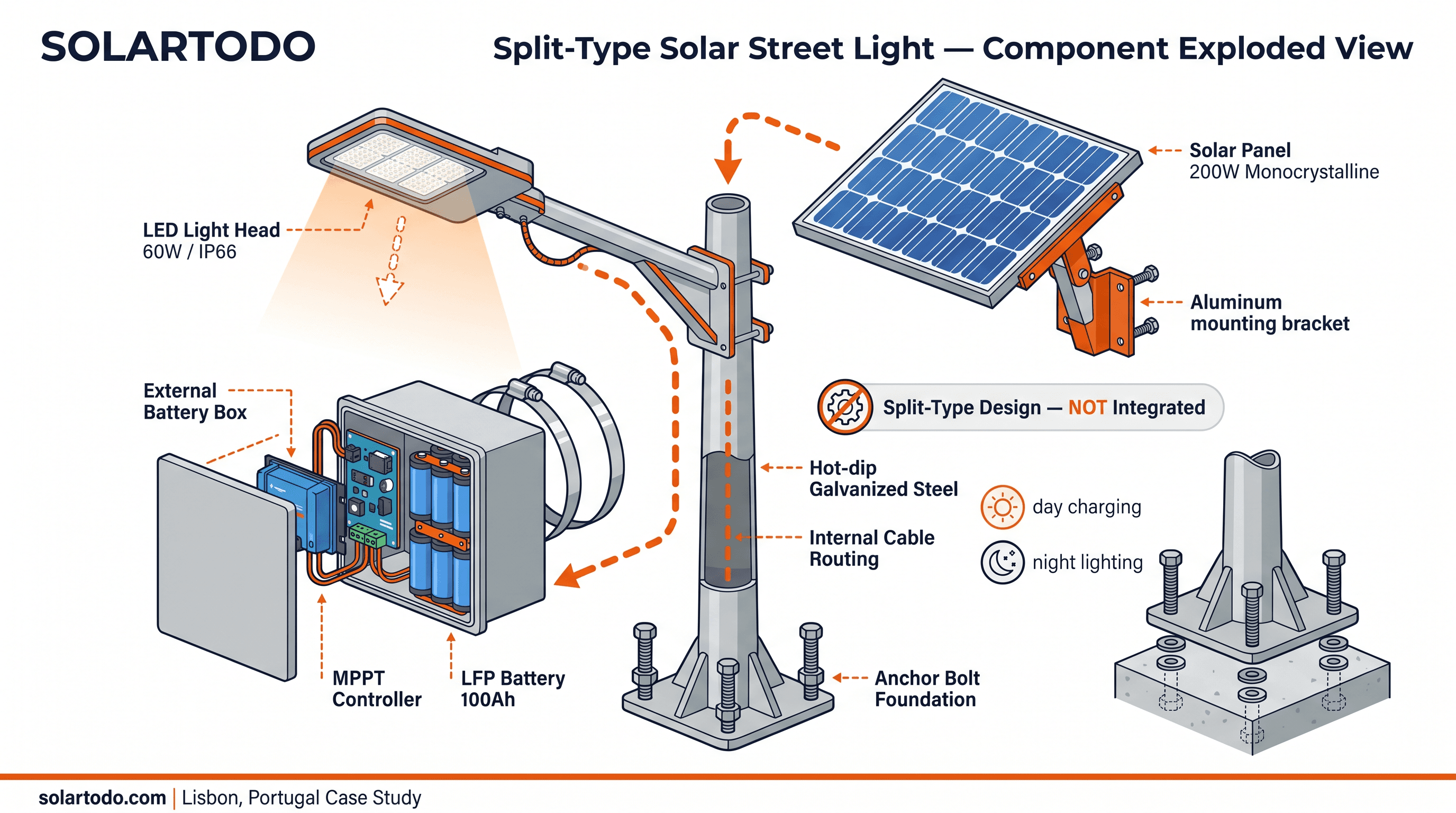
The direct energy outcome is straightforward: each pole is designed to operate independently with solar and wind input, backed by a 12V/300Ah NCM battery and MPPT control. According to the IEA (2023), efficient LED public lighting can cut electricity demand substantially compared with legacy sodium or metal-halide systems. In an off-grid or avoided-grid-extension scenario, the savings case is less about kWh tariff reduction alone and more about avoiding feeder installation, trench reinstatement, and utility interconnection delays.
A simple ROI framework for Lisbon should include 5 variables:
- avoided trenching and cabling cost per pole,
- avoided utility connection charges,
- annual maintenance labor,
- battery replacement interval at about 2,000 cycles,
- and control-driven energy savings from motion and timer logic.
According to NREL (2023), lifecycle economics for standalone solar lighting improve when autonomy is correctly sized and when maintenance access is simple. That is relevant here because the external battery box is easier to service than a buried or base-integrated battery compartment. According to IRENA (2023), distributed renewable assets can provide better long-term cost predictability because energy input is not exposed to retail electricity price volatility.
For payback, municipal buyers should avoid generic claims. In Lisbon, a reasonable planning assumption is that payback would be shorter where trenching is difficult, road closures are costly, or heritage constraints increase civil-work expense. In open new-build areas with cheap grid access, grid-tied LED poles may still show lower initial cost. The hybrid split-type option is therefore strongest where resilience, autonomy, and avoided civil works matter more than minimum upfront spend.
Maintenance expectations are moderate. LED modules at 150 lm/W reduce fixture wattage for a given lumen output, while remote monitoring can cut inspection trips by flagging battery or controller issues early. Motion sensing can also reduce unnecessary operating intensity during low-traffic windows, with savings commonly modeled at about 15%-30% depending on dimming profile and traffic pattern.
Results and Impact
For Lisbon buyers, the main impact of this 137-unit hybrid split-type configuration would be lower dependence on trenching, 3-5 days of lighting autonomy, and better suitability for coastal or difficult-access corridors.
The operational result is not just illumination. It is a package of independent poles with internal wiring, visible serviceable battery boxes, and remote diagnostics that can support municipal maintenance planning. On roads where cable faults, utility approvals, or excavation permits slow conventional projects, this form factor can shorten the path from procurement to commissioning. That is why SOLAR TODO should be assessed on total infrastructure fit rather than on panel wattage alone.
A second impact is resilience. Lisbon does not face the same winter solar deficit as northern Europe, but seasonal cloud cover still affects charging consistency. The combination of 1360W TOPCon solar input, a 100W VAWT, and 12V/300Ah storage is therefore aimed at continuity of service, not only annual generation yield. For public-safety lighting, continuity often matters more than nominal efficiency.
Finally, the specification supports asset management. Remote monitoring over 4G or LoRa allows fault visibility at the controller level, while the external battery enclosure simplifies replacement planning. For B2B buyers comparing suppliers, SOLAR TODO should provide value when the decision criteria include autonomy days, corrosion resistance, serviceability, and standards alignment.
Comparison Table
This table compares Lisbon’s recommended 8m hybrid specification against smaller split-type classes and a conventional grid-tied streetlight baseline for procurement screening.
| Configuration | Typical Use Case | Pole Height | LED Power | Generation Package | Battery | Spacing Basis | Backup | Key Fit for Lisbon |
|---|---|---|---|---|---|---|---|---|
| Walkway split-type | Garden path / walkway | 6m | 30W | 60W solar only | 12V/60Ah | 12-18m | 3 nights typical | Too small for 15m roads |
| Community-road split-type | Parking / community road | 7-8m | 50-60W | 100W solar only | 12V/100Ah | 18-22m | 3 nights typical | Marginal on wider corridors |
| Secondary-road split-type | Plaza / secondary road | 8-10m | 80W | 150W solar only | 24V/100Ah | 20-24m | 3-4 nights typical | Better for medium traffic areas |
| Lisbon recommended hybrid | 15m road / higher autonomy | 8m | 120W / 18,000 lm | 100W VAWT + 1360W TOPCon | 12V/300Ah NCM | 24m | 3-5 days | Strong fit where trenching is difficult |
| Conventional grid-tied LED pole | Utility-fed urban road | 8-10m | 90-120W | Grid only | None local | 24-30m | Utility dependent | Lower capex where grid is easy |
Pricing & Quotation
SOLAR TODO offers three pricing tiers for this product line: FOB Supply (equipment ex-works China), CIF Delivered (including ocean freight and insurance), and EPC Turnkey (fully installed, commissioned, with 1-year warranty). Volume discounts are available for large-scale deployments. Configure your system online for an instant estimate, or request a custom quotation from our engineering team at [email protected].
For Lisbon tenders, quotation quality depends on whether the scope includes only supply, delivered hardware, or full installation and commissioning. Buyers should ask SOLAR TODO to separate pole, luminaire, battery, controller, turbine, panel, foundation, and communications scope in the bill of materials. A clear line-by-line quotation reduces disputes during FAT, shipping, and site acceptance.
Procurement teams should also confirm whether monitoring software licenses, SIM connectivity, spare batteries, and extra sensors are included. On a 137-unit package, these details can materially change lifecycle cost even when equipment pricing appears similar. For technical clarification, buyers can review the Solar Streetlight (Split-Type) product page or contact us.
Frequently Asked Questions
This FAQ answers 10 common Lisbon procurement questions covering sizing, installation, maintenance, ROI, warranty, and the difference between split-type and integrated streetlights.
Q1: Why is an 8m, 120W configuration suitable for Lisbon roads with 15m width?
For a 15m-wide road and 24m spacing, a 120W luminaire at 18,000 lm is more appropriate than 30W or 60W classes intended for paths or parking edges. The 8m mounting height supports wider beam spread while keeping pole scale manageable for urban streets. Final lux levels should still be checked against the project’s road-lighting standard.
Q2: Is this a pure solar streetlight or a hybrid system?
This Lisbon configuration is a wind-solar hybrid. Each pole uses a 100W vertical-axis wind turbine at the top and a 1360W Mono TOPCon solar panel below it. That combination is intended to improve charging resilience during cloudy periods and coastal wind conditions rather than relying on solar input alone.
Q3: Why use a split-type streetlight instead of an all-in-one unit?
A split-type design separates the panel, LED head, controller, and battery box. That makes higher-capacity systems easier to service and allows larger batteries and panels than most integrated units can support. For Lisbon roads needing 120W lighting and 3-5 days of backup, the split-type form is usually more practical.
Q4: How long would a 137-unit deployment typically take?
A project of about 137 units would typically require around 10-18 weeks from survey to commissioning. Site complexity, foundation curing time, shipping method, and local permits can shift that range. Urban streets with traffic management constraints or heritage-area approvals usually take longer than open new-build zones.
Q5: What maintenance does the external battery box require?
The external battery box should be inspected for seal condition, mounting tightness, corrosion, and connector integrity at scheduled intervals, often every 6-12 months. Because the box is visible and accessible on the pole body, replacement and troubleshooting are simpler than with buried or base-hidden battery designs. Internal wiring should also be checked during periodic service.
Q6: What is the expected battery life for the 12V/300Ah NCM pack?
The specified NCM battery is rated at 2,000 cycles with 85% depth of discharge and a 5-year warranty. Actual service life depends on ambient temperature, charging profile, and how often the system reaches deep discharge. In Lisbon’s temperate climate, correct MPPT settings and remote monitoring can help preserve battery health.
Q7: How should buyers think about ROI or payback?
Payback depends mainly on avoided trenching, avoided utility connection cost, maintenance labor, and replacement intervals. The economics are usually strongest where conventional cabling is disruptive or expensive. Buyers should model lifecycle cost over at least 5-10 years rather than comparing only initial equipment cost between solar, hybrid, and grid-fed poles.
Q8: What standards should be requested in tender documents?
For this product class, the key references in the supplied specification are CJJ 45-2015, IEC 60598, and IEC 62124. Buyers may also request documentation for wind loading, corrosion protection, battery test data, and controller settings. Clear standards language helps verify compliance during factory inspection and site acceptance.
Q9: Can remote monitoring use either 4G or LoRa in Lisbon?
Yes. The specified smart package supports 4G or LoRa remote monitoring. 4G is often simpler where cellular coverage is strong and per-node data cost is acceptable. LoRa can be attractive for large municipal estates if a gateway architecture is already planned. The better choice depends on network ownership and maintenance strategy.
Q10: What warranties are included in this specification?
The supplied technical configuration states a 30-year warranty for the Mono TOPCon panel and a 5-year warranty for the NCM battery. The pricing section also notes that EPC Turnkey includes a 1-year installed-system warranty. Buyers should confirm whether luminaires, controllers, sensors, and communications modules carry separate warranty terms.
References
- PORDATA (2023): Lisbon resident population data for municipal demographic baseline.
- OECD (2024): Metropolitan database indicating Lisbon metro population above 2.8 million.
- European Commission PVGIS (2024): Solar resource and PV performance data for Lisbon, Portugal.
- World Bank (2022): Urban infrastructure investment guidance showing civil works and retrofit constraints materially affect project economics.
- International Energy Agency (IEA) (2023): Public-lighting efficiency remains a major opportunity for electricity demand reduction.
- International Renewable Energy Agency (IRENA) (2023): Distributed renewable systems improve resilience and long-term cost predictability.
- IEC (2024): IEC 60598 luminaire safety requirements for lighting equipment.
- IEC (2017): IEC 62124 performance monitoring guidance relevant to PV-powered lighting systems.
- NREL (2023): Off-grid and standalone solar lighting performance depends on correct autonomy sizing, battery selection, and controller settings.
- CJJ (2015): CJJ 45-2015 technical code reference for urban road lighting design and installation context.
Equipment Deployed
- 137 × Solar Streetlight (Split-Type), hybrid wind-solar configuration
- 8m stainless steel 304 pole, 50 m/s wind resistance, 40-year design life
- 100W vertical-axis wind turbine mounted at pole top
- 1360W Mono TOPCon solar panel, 23% efficiency, 0.3%/yr degradation, 30-year warranty
- 120W LED luminaire, 18,000 lm, 150 lm/W, CRI>70
- 12V/300Ah NCM lithium battery, 250Wh/kg, 2,000 cycles, 85% DoD, 5-year warranty
- External pole-mounted grey battery box with internal MPPT controller
- Internal pole wiring with no visible external cables
- Motion sensor + timer control + 4G/LoRa remote monitoring
- 24m pole spacing design for 15m road width
- 3-5 days cloudy-weather backup, dusk-to-dawn automatic operation
- Standards basis: CJJ 45-2015 / IEC 60598 / IEC 62124