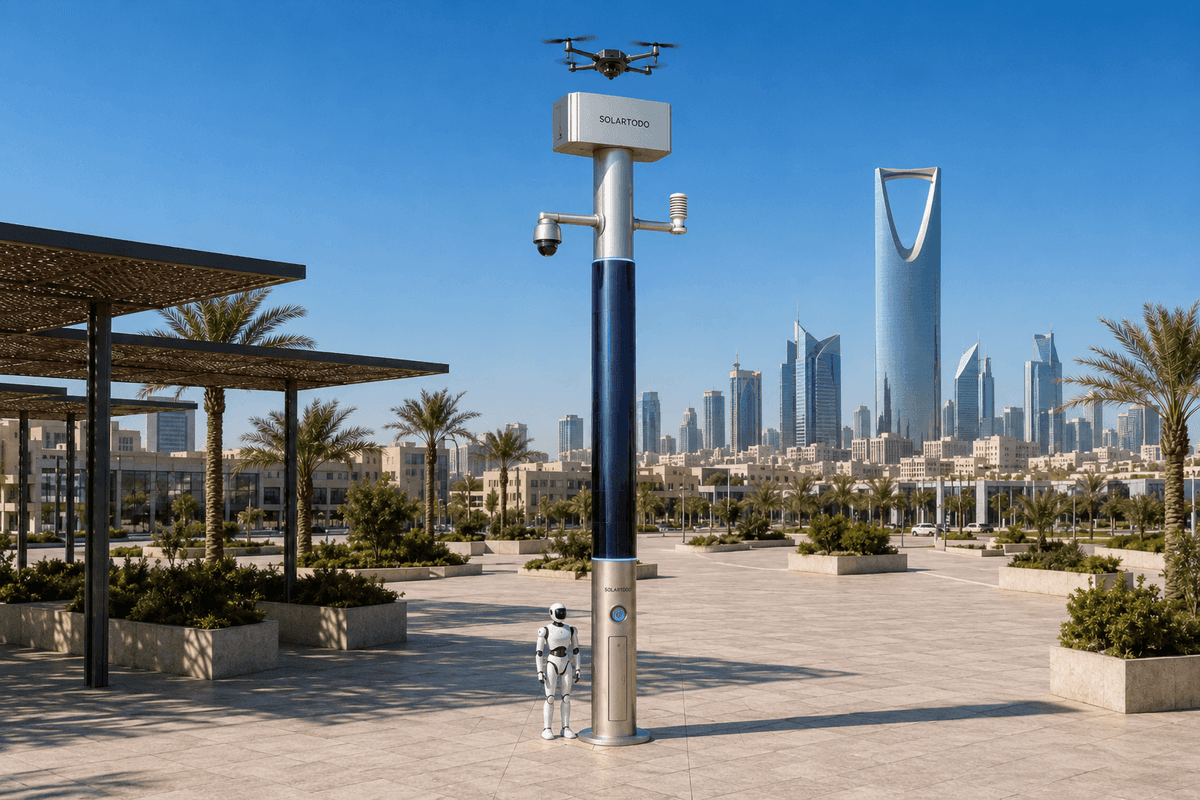
A City AI Pole is a non-lighting physical-AI edge node that combines off-grid energy, on-pole sensing, edge compute, drone operations, ground robot operations and command-view coordination. In this proposed Lisbon deployment, SOLARTODO Sentinel Sky Hub supports emergency-management night patrol around old-town campus perimeters while processing raw data locally and sharing only de-identified event or status metadata.
Lisbon Task: Old-Town Heatwave Night Patrol
Lisbon’s old-town operating environment is unusually demanding for emergency management. Historic quarters such as Alfama, Baixa and adjacent civic or university campus edges combine narrow approaches, changing night-time pedestrian density, waterfront wind exposure, stone surfaces that retain heat, tourist movement after dark and constrained vehicle access. During heatwave periods, the city task is not simply to “watch” an area. It is to understand whether a perimeter remains safe, whether a crowd is building in a heat-stressed location, whether an intrusion or medical-risk pattern is emerging, and whether staff should be sent before a minor incident becomes a cross-department callout.
This case study frames a proposed SOLARTODO Sentinel Sky Hub configuration for a campus-perimeter deployment in Lisbon’s old-town context. The buyer is the emergency-management stakeholder, but the workflow is deliberately cross-department: civil protection, campus security, municipal operations, facilities, mobility coordination and contracted maintenance all need the same common-operating picture. The pain point is slow manual patrol. A guard or municipal patrol team walking a historic perimeter can only be in one lane, gate or service yard at a time, and night checks often become repetitive, delayed and labor-heavy.
Sky Hub is positioned here as a city-ai-pole / physical-AI urban edge node, not a conventional public-realm utility pole and not a lighting product. It is a pure smart pole with no lighting system. The role of the pole is to host sensing, compute, energy, drone and robot operations at the edge, so emergency-management teams can move from patrol-by-routine to patrol-by-exception. Subject to final engineering confirmation, the proposed deployment would use each node as an off-grid micro-station around sensitive campus-perimeter points where slow manual巡查 currently creates OPEX pressure.
Edge Computing As The Operating Center
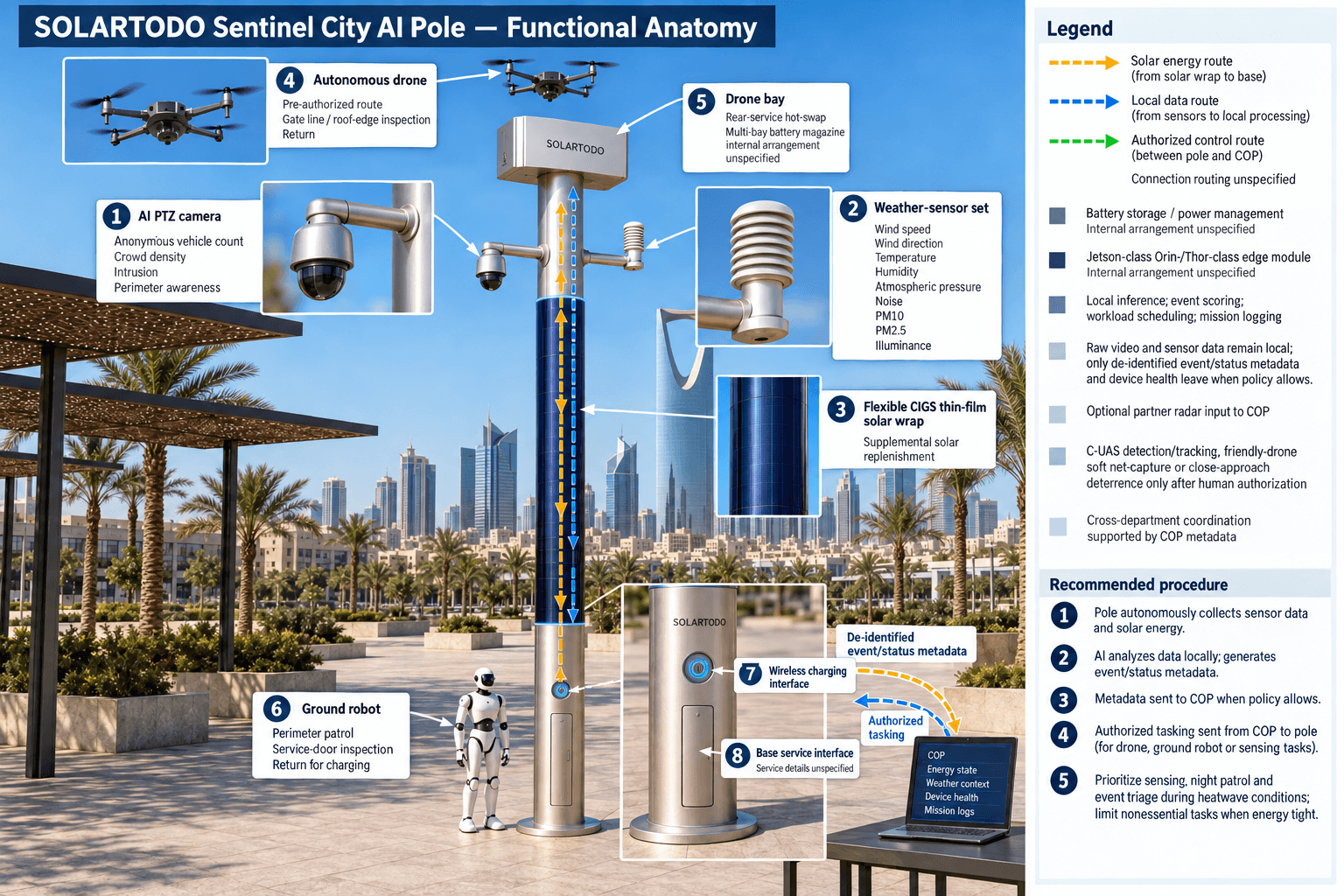
The primary design choice is edge computing. In a dense old-town setting, streaming raw video or continuous environmental data to a remote platform is operationally expensive, privacy-sensitive and fragile during network congestion. The Sky Hub configuration keeps raw video and sensor data on the pole. Local inference, event scoring, workload scheduling and mission logging run on an on-pole Jetson-class edge module, with only de-identified event metadata, device health and status summaries leaving the node when policy allows.
For Lisbon emergency management, this creates a practical COP command view rather than another camera feed. The pole fuses PTZ camera events, anonymous vehicle count, crowd-density estimates, intrusion and perimeter awareness, and the nine-in-one weather-sensor set: wind speed, wind direction, temperature, humidity, atmospheric pressure, noise, PM10, PM2.5 and illuminance. During a heatwave night, that weather set becomes a decision layer. High retained temperature, low wind, elevated noise, reduced illuminance or changing pedestrian density can shift patrol priority without dispatching staff to check every point manually.
The operations loop follows “sensing → authorized assessment/response → edge-compute scheduling → field operations and maintenance.” Detection and assessment are separated from action. The pole can classify a perimeter anomaly, recommend a drone or ground robot task, and present the event in the COP. Emergency-management staff remain in the authorization path for regulated or escalated response. This is important for credibility: a mature edge node can compress time-to-awareness, but it does not replace legal authority, field command judgement or local rules of engagement.
Air-Ground Response Without On-Site Operators
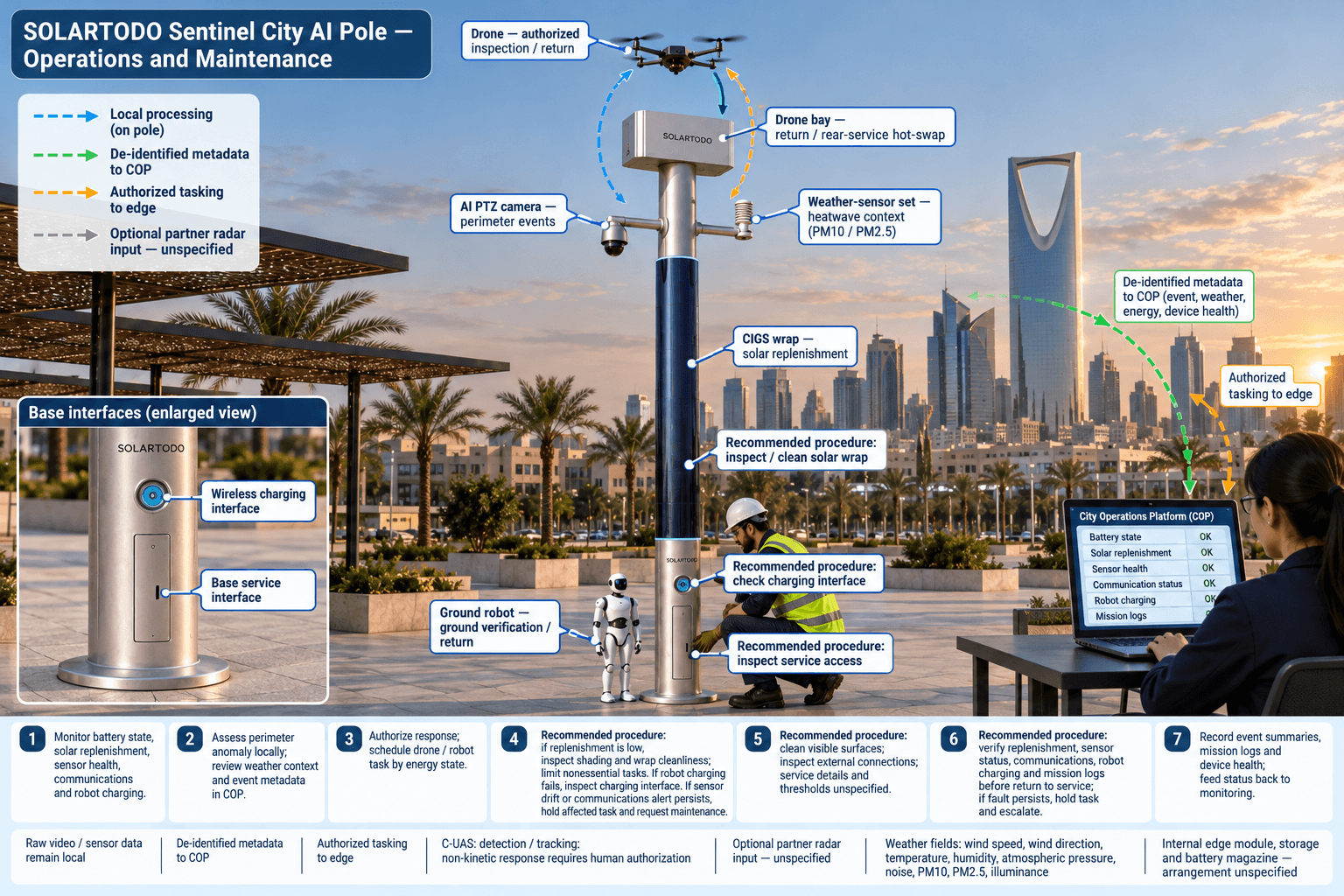
Night-patrol automation is valuable only if it reduces the slow, repetitive part of manual patrol while preserving human control over meaningful decisions. In the proposed Lisbon configuration, Sky Hub supports autonomous drone sorties, ground robot patrol and coordinated air-ground tasking from the pole. A drone can launch from the node, follow a pre-authorized regional patrol route, inspect a gate line or roof-edge approach, return to the pole and enter a rear-service battery hot-swap process. The multi-bay battery magazine exchanges a landed drone’s depleted pack for a charged pack so consecutive sorties can be scheduled without an operator standing at the site.
The ground robot role is complementary. A humanoid or service robot patrols the immediate perimeter, responds to alarms, checks service doors, inspects areas where aerial view is insufficient, coordinates with the aerial asset and returns to the pole base for wireless charging. The drone gives fast context across alleys, courtyards and rooflines; the robot provides closer ground-level verification and presence where foot patrol would otherwise be dispatched first.
For C-UAS coordination, the pole detects and tracks an unauthorized drone and can command its own friendly drone for a soft aerial net-capture or close-approach deterrence only after human authorization. The mitigation posture is non-kinetic and authority-bound. Radar is not treated as built-in pole hardware; where needed, radar can be an optional or partner-sensor input to the COP. This distinction matters for Lisbon procurement teams because it keeps the configuration honest: the node supports detection, tracking, command coordination and authorized response, without claiming autonomous enforcement or prohibited denial methods.
Off-Grid Energy And Heatwave Duty Cycle
The deployment is designed as fully off-grid: on-pole solar replenishment plus battery storage, with no grid, city or site power dependency. The Lisbon proposal uses a cylindrical Sky Hub body carrying about 15 square meters of 360-degree wrapped flexible CIGS thin-film over a vertical body of roughly 8 meters height and about 0.6 meters width, giving approximately 2.4–2.7 kWp nameplate. That nameplate should not be confused with field output. A vertical cylinder only presents a sun-facing projection to direct sun at any moment, not the full wrapped surface.
For planning honesty, SOLARTODO treats this CIGS layer as supplemental replenishment for a battery-backed micro-station, not as unlimited solar self-sufficiency. In a high-irradiance region such as Saudi Arabia, a comparable vertical cylindrical wrap would realistically produce roughly 0.8–1.1 kW DC clear-sky peak, often peaking mid-morning or mid-afternoon rather than exactly at noon, and about 6–9 kWh per day. Lisbon-specific yield, shading, salt exposure, historic-street canyon effects and seasonal angle must be confirmed during engineering.
This matters for OPEX. High-power drone sorties, robot patrols and edge-AI workloads are buffered by 5–20 kWh-class storage and scheduled by duty cycle. During a heatwave, the node may prioritize night patrol, environmental sensing and event triage while limiting nonessential tasks when the energy budget is tight. The goal is not to claim perpetual operation under every possible workload; it is to reduce truck rolls, manual patrol frequency and site-power works by using local energy, local compute and scheduled autonomy together.
Cross-Department KPI Framing
For an emergency-management buyer, the KPI conversation should be framed as OPEX planning rather than a claimed achieved result. The proposed Lisbon deployment gives departments a shared way to evaluate patrol efficiency before procurement: how many repetitive perimeter checks can be automated, how many alarm verifications can be handled by drone or robot before dispatch, how many manual weather checks can be replaced by local measurement, and how often maintenance can be scheduled from device health rather than reactive site visits.
Civil protection sees heatwave and crowd-risk metadata. Campus security sees perimeter events and authorized patrol tasks. Facilities sees battery, solar replenishment, sensor health and robot charging status. Mobility or municipal operations sees anonymous vehicle count and density cues without receiving raw continuous video. Maintenance sees alerts for cleaning, battery condition, communication status and weather-sensor drift. The COP becomes the shared operational layer, while raw data remains local on the pole.
A realistic evaluation should begin with a small, engineered perimeter plan rather than a citywide rollout claim. Candidate locations would be chosen for manual-patrol burden, night-risk profile, solar exposure, radio coverage, heritage constraints, drone-operating permissions and robot route feasibility. Success metrics would be measured as target planning inputs: patrols automated, human dispatches avoided through remote verification, weather-triggered task changes, energy autonomy under defined duty cycles and maintenance visits reduced. Final quantities, coverage and acceptance criteria should be confirmed only after site survey, safety review, aviation authorization review and local engineering validation.
System Configuration
| Parameter | Configuration |
|---|---|
| Pole category | SOLARTODO Sentinel Sky Hub city-ai-pole / physical-AI urban edge node; pure non-lighting smart pole |
| Energy system | Fully off-grid battery-backed micro-station with ~15 m² 360° wrapped flexible CIGS thin-film replenishment |
| Edge AI compute | On-pole Jetson-class Orin-/Thor-class edge module for local inference, workload scheduling and event metadata generation |
| Security sensing | AI PTZ camera for anonymous vehicle count, crowd density, intrusion and perimeter awareness |
| Weather-sensor set | Wind speed, wind direction, temperature, humidity, atmospheric pressure, noise, PM10, PM2.5 and illuminance |
| Air-ground operations | Autonomous drone launch/return, multi-bay battery hot-swap, route planning, mission logs and ground robot wireless charging |
| Data handling | Raw video and sensor data processed locally on the pole; only de-identified event/status metadata may leave the site |
How It Works
- On-pole PTZ and weather sensors flag a night-time perimeter anomaly during heatwave conditions.
- Edge AI classifies the event locally and scores urgency without exporting raw video or sensor streams.
- The COP presents de-identified event metadata, energy state, weather context and recommended drone or robot tasking.
- Emergency-management staff authorize the response level and any regulated C-UAS coordination if applicable.
- The drone or ground robot performs the assigned inspection, returns to the pole, and recharges or swaps battery.
- Mission logs, event summaries, device health and OPEX evaluation data are recorded for cross-department review.
Planning Assumptions (Indicative)
Illustrative planning inputs a buyer can recompute — target metrics, not achieved results. Subject to final engineering confirmation.
| Metric | Planning assumption | Indicative value |
|---|---|---|
| Manual night patrol | Target automation replaces routine perimeter walks with exception-led checks under human supervision | ~10–20 routine checks/week automated |
| Alarm verification | Drone or robot performs first-look verification before staff dispatch when rules permit | ~30–50% of low-severity alarms remotely triaged |
| Weather-triggered operations | Heatwave patrol priority uses local temperature, wind, humidity, noise, PM and illuminance readings | ~3–5 dynamic patrol-priority updates/night |
| Energy OPEX | Off-grid battery plus CIGS replenishment avoids trenching or site-power connection for selected perimeter points | 0 grid-power connections targeted per node |
| Maintenance planning | Device health, battery state and sensor status are reviewed before dispatching technicians | ~1 planned maintenance window/month per node |
Deployed Equipment
- SOLARTODO Sentinel Sky Hub non-lighting pole body
- Flexible CIGS thin-film solar wrap
- 5–20 kWh-class battery storage and power-management cabinet
- AI PTZ camera assembly
- Nine-in-one environmental monitoring package
- On-pole edge AI compute cabinet
- Autonomous drone bay with multi-bay battery hot-swap magazine
- Ground robot wireless charging base at pole level
Frequently Asked Questions
Is Sky Hub a smart streetlight replacement for Lisbon?
No. In this case study, Sky Hub is a pure non-lighting smart pole and physical-AI edge node. Its purpose is to host edge compute, sensing, off-grid power, drone operations, robot operations and command-view coordination for city tasks such as campus-perimeter night patrol, not to provide a lighting service.
How does the deployment protect privacy in a historic urban area?
The proposed architecture is designed for local processing. Raw video and sensor data stay on the pole and are processed by the on-pole edge module. The command view may receive de-identified event metadata, status data and mission logs, but continuous raw feeds are not the default operating model. The posture is PDPL/LGPD-oriented and subject to local legal review.
Can the pole operate without grid or site power?
Yes, the proposed Sky Hub configuration is designed as fully off-grid, using battery storage plus 360-degree wrapped flexible CIGS thin-film solar replenishment. The solar layer is supplemental, not an unlimited energy claim. Drone and robot workloads are buffered by storage and scheduled according to weather, battery state and duty cycle.
What does the weather-sensor module add beyond ordinary security monitoring?
For a heatwave night-patrol scenario, local weather is operational context. Wind, temperature, humidity, pressure, noise, PM10, PM2.5 and illuminance help emergency-management teams prioritize patrols, understand crowd comfort risk, adjust drone or robot tasks, and distinguish environmental stress from ordinary perimeter movement.
Does the C-UAS workflow act autonomously against unauthorized drones?
No. The pole can detect and track an unauthorized drone and coordinate its own friendly drone for soft aerial net-capture or close-approach deterrence only with human authorization and applicable authority rules. The posture is non-kinetic and controlled; the case study does not assume autonomous enforcement or prohibited denial methods.
What should Lisbon evaluate before procurement?
The buyer should confirm solar exposure, heritage constraints, communications coverage, drone operating permissions, robot route feasibility, heatwave operating policy, data-handling requirements and maintenance access. OPEX targets should be recomputed from local patrol schedules, labor model, incident volume and approved duty cycle rather than treated as achieved results.
Explore Further
- City AI Pole / smart streetlight product line
- More smart-city deployment cases
- Talk to our engineering team
Planning a similar physical-AI deployment for streets, campuses or public spaces? Request an engineering consultation