Kinshasa Smart Streetlight Market Analysis: Ø219mm Flush-Integrated Pole Configuration Guide for Dense Urban Corridors
Summary
Kinshasa’s population exceeds 17 million, while electricity access and public-lighting reliability remain uneven across major corridors. For premium urban streets, a typical 22 m spacing plan would use approximately 126 flush-integrated 9 m smart poles with 80 W LED, 7 kW EV charging, and 2.4 kWh LFP storage.
Key Takeaways
- Kinshasa’s urban population is above 17 million according to UN estimates, which supports demand for higher-density street assets at roughly 45 poles/km when spacing is 22 m.
- A recommended premium-city format is approximately 126 units of 9 m seamless cylindrical Ø219 mm poles, each with 5 mm wall thickness and hot-dip galvanized steel.
- Each pole would carry an 80 W internal COB top luminaire delivering 12,000 lm at 4000 K, aligned with IEC 60598 lighting equipment requirements.
- The specified solar package is about 180 W of 360° wrapped CIGS thin-film from 6.5 m to 8.3 m, paired with a 2,400 Wh LFP battery and MPPT.
- Embedded charging is 7 kW dual-outlet AC with Type 2 + Type 1 interfaces, a flush touchscreen at 1.5 m, and no widened base or external bollard.
- Communications and safety functions remain fully flush: 4 MP IR 30 m camera, WiFi 6 internal antenna, 8-parameter sensor pod, and 12 × 12 cm SOS panel.
- For a 2.75 km urban corridor, 126 poles at 22 m spacing would create a continuous smart-lighting and data layer without side arms, brackets, or external boxes.
- According to IEA (2023), sub-Saharan Africa still has major electricity-access and reliability gaps, so hybridized pole-level storage can reduce outage-related service interruptions on critical streets.
Market Context for Kinshasa
Kinshasa is a high-density capital region with more than 17 million residents, and that scale directly affects street-lighting load, traffic management, and public-safety infrastructure requirements. According to the United Nations Department of Economic and Social Affairs (2018), Kinshasa is among Africa’s fastest-growing megacities and is projected to remain one of the continent’s largest urban agglomerations. According to the World Bank (2024), the Democratic Republic of the Congo continues to face major infrastructure deficits in electricity access, transport services, and urban service delivery, which makes multifunction poles relevant on priority corridors rather than only as lighting assets.
Kinshasa’s climate also matters for product selection because the city has a tropical wet-and-dry profile with high humidity and strong seasonal rainfall. According to Climate-Data.org (2024), annual precipitation in Kinshasa is roughly 1,300-1,400 mm, with a pronounced rainy season that increases the need for corrosion protection, sealed electronics, and low-maintenance optical assemblies. A cylindrical hot-dip galvanized steel pole with flush-mounted equipment is better suited to this environment than a design with multiple external boxes, side arms, and exposed accessory brackets.
Electricity reliability remains a planning constraint for any connected street asset in DR Congo. According to the International Energy Agency (2023), sub-Saharan Africa still accounts for the majority of the global population without electricity access, and reliability issues persist even in electrified urban areas. The World Bank states, "Access to electricity is among the lowest in the world," and this affects municipal lighting uptime, EV charging confidence, and digital-service continuity. For Kinshasa, that means a smart pole should not rely only on grid continuity if it also carries cameras, emergency communications, and public WiFi.
Urban corridor form also supports a compact pole geometry. Kinshasa’s dense arterials and mixed-use commercial streets often have constrained sidewalks, informal edge activity, and visual clutter from conventional utility furniture. According to ITU (2020), smart sustainable city infrastructure should support integrated digital services while limiting unnecessary physical obstruction in public space. That planning logic favors a monolithic Ø219 mm pole with no outriggers, no speaker columns, and no external cabinets.
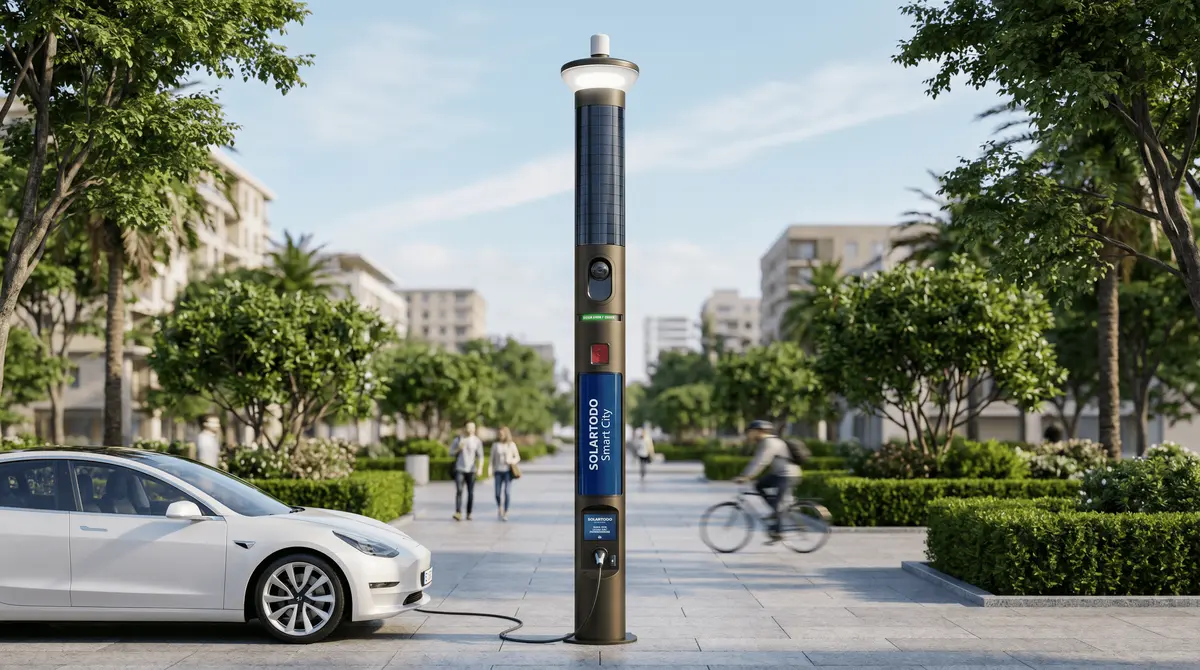
For this reason, the correct size class for central Kinshasa is not a park pole and not a highway mast. The recommended fit is an urban street-class smart streetlight around 9 m height, deployed at approximately 22 m spacing on premium corridors, transport frontage roads, civic districts, and mixed commercial streets. SOLAR TODO’s flush-integrated cylindrical Smart Streetlight configuration matches this requirement because it keeps all systems inside a constant-diameter body while still supporting lighting, sensing, security, communications, emergency call, and AC charging.
Recommended Technical Configuration
A practical Kinshasa corridor configuration would use approximately 126 units over about 2.75 km at 22 m spacing, based on dense urban frontage, pedestrian activity, and the need for continuous lighting coverage. This format suits premium streets where visual control, anti-vandal performance, and reduced sidewalk clutter are more important than maximum pole height. For buyers reviewing the full product family, the relevant product page is Smart Streetlight.
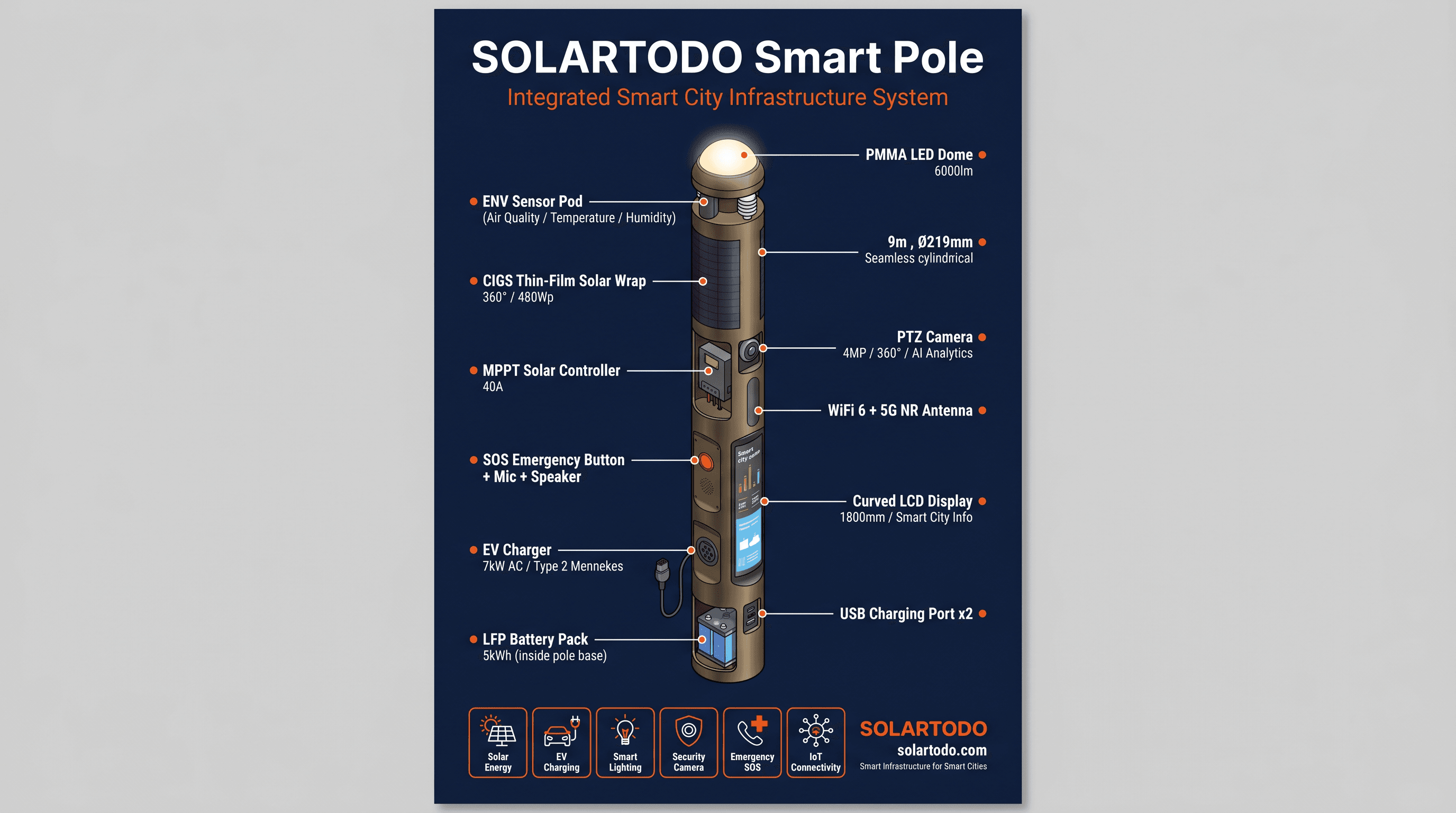
The recommended pole is the project-specific [V:cyl219] format: a 9 m seamless cylindrical pole with constant Ø219 mm diameter from top to bottom, 5 mm wall thickness, and hot-dip galvanized steel finished in antique bronze RAL8011. This geometry is important because Kinshasa’s dense streets benefit from a monolithic form that avoids side arms, external charger plinths, speaker columns, or widened bases. The result is a cleaner right-of-way footprint and fewer exposed components at pedestrian level.
A typical 126-unit deployment of this scale would include one 80 W internal COB flood luminaire per pole, installed behind a PMMA top window segment rather than on an external arm. Output is 12,000 lm at 4000 K, which gives a nominal efficacy of 150 lm/W and aligns with the common hardware envelope defined for SOLAR TODO Smart Streetlight systems. Because the luminaire is integrated into the pole head, the optical chamber remains less exposed to impact and weather than a protruding streetlight fixture.
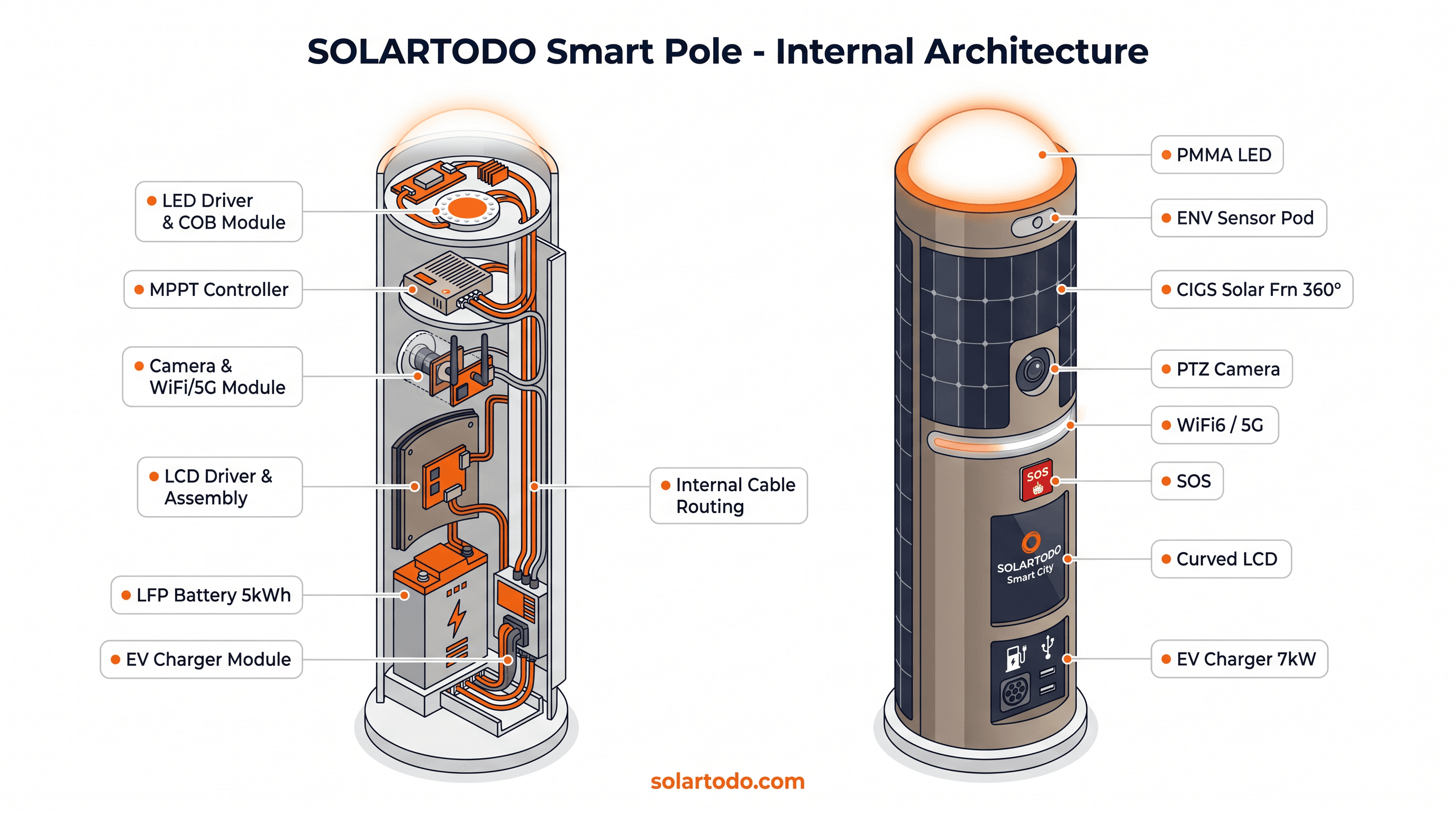
The power architecture is hybrid at the pole level. Each unit carries approximately 180 W of dark blue-black semi-transparent CIGS flexible thin-film cells wrapped 360° around the pole mid-section from 6.5 m to 8.3 m, plus a 2,400 Wh LFP battery with MPPT inside the base. In Kinshasa, this arrangement would support sensor loads, communications, standby functions, and partial resilience during grid outages, while the main AC interface still supports normal urban operation and 7 kW charging service.
Security and public-service functions are also selected to fit Kinshasa’s corridor profile. The recommended set is one flush turret camera behind a Ø10 cm anti-vandal dark glass window, 4 MP resolution, IR range 30 m, one top-mounted 8-parameter environmental sensor pod, one internal-antenna WiFi 6 access point, and one 12 × 12 cm flush SOS panel with integrated micro-camera, microphone, and speakerphone grille. This keeps the pole surface smooth and reduces tampering points compared with accessory-heavy modular poles.
For EV service, the specified arrangement is an embedded 7 kW dual-outlet AC charger with Type 2 and Type 1 interfaces, two flush flip-caps, one 5 m coiled Type 2 cable, and a flush touchscreen at 1.5 m height. This is a practical choice for pilot urban charging in Kinshasa because the city’s EV base is still small, but institutional fleets, donor-funded mobility pilots, and private mixed-use developments increasingly require low-power AC charging rather than DC fast charging. SOLAR TODO’s embedded charger format avoids the sidewalk obstruction of a separate charger pedestal.
Technical Specifications
The Kinshasa-recommended premium configuration is a 9 m Ø219 mm monolithic Smart Streetlight with 80 W LED, 180 W wrapped CIGS solar film, 2,400 Wh LFP battery, and 7 kW flush AC charging. According to IEC (2020), luminaires for road and street lighting should comply with IEC 60598 safety requirements, and according to GB/T 37024 (2018), multifunction smart poles should meet integrated structural and system criteria.
- Pole type: seamless cylindrical smart pole, constant diameter top-to-bottom, no widened base
- Pole dimensions: 9 m height, Ø219 mm diameter, 5 mm wall thickness
- Material and finish: hot-dip galvanized steel, antique bronze RAL8011
- Structural form: one monolithic cylinder; no side arms, no luminaire outriggers, no external boxes
- Luminaire: internal COB flood behind PMMA top window segment
- Lighting output: 80 W, 12,000 lm, 4000 K
- Solar section: 360° wrapped CIGS flexible thin-film, 6.5 m-8.3 m height band
- Solar capacity: approximately 180 W total, flush laminated to pole skin, no rigid panels or brackets
- Battery: LFP 2,400 Wh inside pole base with MPPT controller
- Camera: flush turret behind Ø10 cm anti-vandal dark glass, 4 MP, IR 30 m
- Environmental sensing: 8 parameters: temperature, humidity, wind, pressure, noise, PM2.5, PM10, illuminance
- Communications: embedded WiFi 6 with internal antenna, no external disc antenna
- Emergency interface: flush 12 × 12 cm SOS panel with integrated micro-camera, microphone, and speakerphone grille
- EV charging: embedded 7 kW dual-outlet AC charger, Type 2 + Type 1, two flush flip-caps
- Cable provision: 5 m coiled Type 2 cable
- User interface: flush touchscreen at 1.5 m mounting height
- Display: vertical curved LCD, 1,800 mm tall × approximately 170 mm wide, bent to Ø219 mm radius
- Display content: strictly “SOLARTODO Smart City” stacked vertically, white sans-serif on deep blue, no ads or video
- Pole spacing: 22 m typical for dense urban corridor deployment
- Applicable standards: IEC 60598, GB/T 37024
Implementation Approach
A 126-unit Kinshasa rollout would typically be delivered in 4 phases over roughly 20-28 weeks, depending on civil permits, customs clearance, and local utility coordination. The first phase is corridor survey and pole indexing, usually 2-4 weeks, covering geotechnical spot checks, setback verification, feeder access, and telecom backhaul planning. This stage should also confirm whether each location can support the 7 kW AC charging load or whether selected poles should operate with charging disabled until feeder reinforcement is available.
The second phase is detailed engineering and procurement, usually 6-8 weeks. That includes shop drawings for anchor cages, access doors, wiring layout, touchscreen position at 1.5 m, and the curved LCD inset geometry on the Ø219 mm cylinder. According to IEC (2020), electrical safety compliance and luminaire certification should be verified before shipment, while anti-corrosion treatment and weld quality should be documented for humid tropical service conditions.
The third phase is civil works and installation, usually 8-12 weeks for a 2.75 km corridor if foundations are sequenced by block. Typical work includes excavation, rebar cage placement, concrete pour, conduit routing, grounding, pole erection, and charger energization tests. Because this design has no side arms and no external cabinets, installation crews handle fewer exposed subassemblies than with conventional modular smart poles.
The fourth phase is commissioning and systems integration, usually 2-4 weeks. This covers lighting control groups, WiFi provisioning, camera stream validation, sensor calibration, SOS call routing, charger authentication, and LCD content lock to the specified “SOLARTODO Smart City” format. For municipal acceptance, a practical test matrix would include 72-hour burn-in, insulation resistance checks, charger fault simulation, and network uptime monitoring.
Expected Performance & ROI
For Kinshasa, the expected value is not only lighting; it is a combined street asset that concentrates 6 core functions into one 9 m pole and reduces separate street furniture counts across a 2.75 km corridor. According to IRENA (2023), energy efficiency and digitalization together can materially reduce municipal operating cost where legacy infrastructure is fragmented. In this configuration, the 80 W LED load is far lower than legacy sodium or metal-halide streetlights often rated in the 150-250 W range for similar corridor use.
If a corridor previously used 150 W conventional luminaires, shifting to 80 W LED would reduce luminaire power demand by about 46.7% before controls are considered. According to the U.S. Department of Energy (2022), LED roadway lighting commonly cuts energy use by 40-60% relative to older technologies, depending on optics and controls. In Kinshasa, additional savings may come from fewer standalone devices because camera mounts, WiFi nodes, emergency call points, and public displays are consolidated into the same pole.
Battery-backed resilience is also important to ROI, even though the 2,400 Wh LFP pack is not sized for full-night off-grid operation of all loads. The battery and 180 W CIGS wrap can support essential low-power functions during short outages, including communications, sensors, and emergency interface continuity. According to NREL (2023), distributed storage improves service continuity for critical edge devices where grid reliability is inconsistent and outage duration is uncertain.
Payback depends on the value model used by the city or concessionaire. If the decision is based only on lighting electricity, payback is longer than a basic LED replacement because this is a premium multifunction asset. If the model includes avoided separate hardware procurement, reduced civil works for multiple devices, public-WiFi value, data services, and AC charging revenue, a typical blended payback could fall in the 6-10 year range on high-traffic urban corridors, subject to energy tariffs, charger utilization, and maintenance contracts.
As the IEA states, "Energy efficiency is often the first fuel," and that quote applies here because the first financial gain is usually from reduced wattage and consolidated infrastructure. The ITU also states that smart sustainable city infrastructure should improve service delivery while optimizing urban resources. For Kinshasa, that means the strongest business case is on civic boulevards, airport links, business districts, and redevelopment corridors where 22 m spacing and multifunction use are justified.
Results and Impact
A 126-pole Kinshasa corridor would typically create approximately 2.75 km of continuous smart-lighting coverage with integrated sensing, security, emergency contact, and low-power EV charging. The main impact is a reduction in street clutter because cameras, WiFi, SOS, display, and charging are absorbed into one Ø219 mm cylinder rather than spread across 4-6 separate roadside assets.
For municipal operators, the operational result is better asset visibility and fewer isolated maintenance points. A single cloud-managed node can report lighting status, charger alarms, sensor data, and communication uptime from one structure. SOLAR TODO’s flush-integrated Smart Streetlight format is especially relevant where premium streetscapes require tighter control of form factor, vandal resistance, and pedestrian clearance.
Comparison Table
The table below compares the recommended Kinshasa cylindrical Smart Streetlight against a conventional modular smart pole for dense urban corridors.
| Metric | Recommended SOLAR TODO cylindrical Smart Streetlight | Conventional modular smart pole |
|---|---|---|
| Pole height | 9 m | 8-10 m |
| Pole body | Ø219 mm constant-diameter seamless cylinder | Octagonal or tubular with accessory mounts |
| Wall thickness | 5 mm | 3-5 mm typical |
| Luminaire | Internal COB top light | External fixture on arm or bracket |
| Light output | 80 W / 12,000 lm / 4000 K | 80-150 W typical |
| Solar format | 180 W wrapped CIGS, flush, 360° | Often none or rigid panel add-on |
| Battery | 2,400 Wh LFP with MPPT | Optional, often external cabinet |
| Camera | Flush 4 MP IR 30 m behind dark glass | Protruding dome or bullet camera |
| WiFi antenna | Internal | External disc or stick antenna |
| EV charging | 7 kW dual outlet embedded in pole | Separate pedestal or external box |
| Display | 1,800 mm curved flush LCD | Flat screen add-on bracket |
| Street clutter | Low | Medium to high |
| Typical spacing | 22 m | 25-35 m |
| Best use | Premium urban corridors | General-purpose streets |
Pricing & Quotation
SOLAR TODO offers three pricing tiers for this product line: FOB Supply (equipment ex-works China), CIF Delivered (including ocean freight and insurance), and EPC Turnkey (fully installed, commissioned, with 1-year warranty). Volume discounts are available for large-scale deployments. Configure your system online for an instant estimate, or request a custom quotation from our engineering team at [email protected].
Frequently Asked Questions
This FAQ answers 10 common procurement and engineering questions for a 9 m, 126-unit Kinshasa Smart Streetlight deployment with 22 m spacing and 7 kW embedded charging.
Q1: What pole type is recommended for Kinshasa’s premium urban streets?
The recommended type is a 9 m seamless cylindrical pole with constant Ø219 mm diameter and 5 mm wall thickness. It suits dense corridors because all devices remain flush within one monolithic body. That reduces sidewalk clutter, protects electronics better in high-rainfall conditions, and avoids separate charger pedestals or protruding camera mounts.
Q2: Why use the cylindrical flush-integrated version instead of a standard octagonal smart pole?
The Ø219 mm cylindrical version is better where visual control and anti-vandal performance matter. Kinshasa’s busy mixed-use streets often have limited pedestrian space, so eliminating side arms, external boxes, and speaker columns is useful. It also keeps the charger, display, camera, and WiFi hardware inside the pole skin rather than exposing them on brackets.
Q3: How many poles would a typical Kinshasa corridor require?
At 22 m spacing, a 1 km corridor would need about 45-46 poles. A 2.75 km premium corridor would therefore use approximately 126 units. Final quantity depends on junction offsets, driveway conflicts, utility crossings, and whether both sides of the carriageway need coverage or only one side with staggered placement.
Q4: What are the main electrical and lighting specifications?
Each pole uses an 80 W internal COB luminaire producing 12,000 lm at 4000 K. The embedded charger is 7 kW AC with Type 2 and Type 1 outlets. The pole also includes about 180 W of wrapped CIGS thin-film solar and a 2,400 Wh LFP battery with MPPT for backup and auxiliary load support.
Q5: Can the pole operate during grid outages in Kinshasa?
Yes, partially. The 2,400 Wh LFP battery and 180 W CIGS wrap are useful for maintaining lower-power functions such as communications, sensing, and emergency interface continuity during short outages. However, buyers should not treat this as a full off-grid streetlight for all-night operation of every load, especially when EV charging is active.
Q6: What installation timeline is typical for 126 units?
A realistic program is about 20-28 weeks. Corridor survey and engineering usually take 8-12 weeks combined, while civil works, erection, and commissioning add another 10-16 weeks. Customs handling, utility approvals, and local trenching conditions in Kinshasa can shift the schedule, so a phased block-by-block rollout is usually safer than a single-front installation.
Q7: What payback period should buyers expect?
For a multifunction premium pole, payback is usually not judged on lighting electricity alone. A blended model that includes lower wattage, reduced separate street furniture, WiFi and data-service value, and charger revenue can land in the 6-10 year range. Exact payback depends on tariff structure, charger utilization, maintenance terms, and corridor traffic intensity.
Q8: How does maintenance compare with conventional smart poles?
Maintenance can be lower on exposed accessories because this design removes side arms, external antennas, and separate charger cabinets. The tradeoff is that service access must be planned carefully through the embedded interfaces and internal layout. A practical O&M plan should include quarterly cleaning, semiannual electrical checks, and annual battery-health and charger-function testing.
Q9: Is this configuration compliant with recognized standards?
The specified configuration is aligned with IEC 60598 for luminaire safety and GB/T 37024 for multifunction smart poles. For procurement, buyers should also request documentation covering galvanization, electrical insulation, grounding, and charger safety. Local utility interconnection and civil approvals in Kinshasa still need to be checked separately before final execution.
Q10: What information is needed for an EPC quotation?
A useful quotation package needs corridor length, target spacing, foundation assumptions, grid availability, charger activation scope, communications preference, and any local civil constraints. For Kinshasa, it also helps to specify whether the display remains fixed to “SOLARTODO Smart City,” whether all 126 poles need charging enabled, and whether installation includes trenching and feeder upgrades. For project discussions, buyers can contact us.
References
- United Nations DESA (2018): World Urbanization Prospects; identifies Kinshasa as one of Africa’s fastest-growing and largest urban agglomerations.
- World Bank (2024): Democratic Republic of Congo country data and infrastructure indicators; notes major deficits in electricity access and urban service delivery.
- International Energy Agency (2023): Africa Energy Outlook / electricity access tracking; documents persistent access and reliability gaps in sub-Saharan Africa.
- Climate-Data.org (2024): Kinshasa climate profile; shows annual rainfall around 1,300-1,400 mm and strong wet-season conditions relevant to corrosion and sealing.
- IEC (2020): IEC 60598 Luminaires standard; safety and performance framework for road and street lighting equipment.
- Standardization Administration of China (2018): GB/T 37024 smart city multifunction pole system guidance; integration framework for smart-pole structures and subsystems.
- IRENA (2023): Renewable energy and urban efficiency publications; supports the role of distributed energy and efficient end-use systems in municipal infrastructure.
- NREL (2023): Distributed energy resilience research; explains how local storage improves continuity for critical edge devices during grid interruptions.
- U.S. Department of Energy (2022): LED roadway lighting guidance; reports typical 40-60% energy savings versus legacy lighting technologies.
- ITU (2020): Smart Sustainable Cities guidance; supports integrated digital urban infrastructure with efficient use of public space.
Equipment Deployed
- 9 m seamless cylindrical smart pole, constant Ø219 mm diameter, 5 mm wall thickness, hot-dip galvanized steel, antique bronze RAL8011
- Internal COB top luminaire behind PMMA window, 80 W, 12,000 lm, 4000 K
- 360° wrapped CIGS flexible thin-film solar, 6.5 m-8.3 m mounting band, approximately 180 W total
- LFP battery pack, 2,400 Wh, internal base-mounted with MPPT
- Flush turret camera behind Ø10 cm dark anti-vandal glass, 4 MP, IR 30 m
- 8-parameter environmental sensor pod: temperature, humidity, wind, pressure, noise, PM2.5, PM10, illuminance
- Embedded WiFi 6 module with internal antenna
- Flush SOS panel 12 × 12 cm with integrated micro-camera, microphone, and speakerphone grille
- Embedded 7 kW dual-outlet AC EV charger with Type 2 + Type 1 interfaces and two flush flip-caps
- 5 m coiled Type 2 charging cable
- Flush touchscreen at 1.5 m height
- Vertical curved LCD display, 1,800 mm × approximately 170 mm, fixed 'SOLARTODO Smart City' content
- Typical deployment quantity: approximately 126 units at 22 m spacing
- Applicable standards: IEC 60598, GB/T 37024