Kathmandu Smart Traffic System Market Analysis: 30-Intersection 10m L-Arm Configuration Guide
Summary
Kathmandu’s dense urban traffic profile and valley road geometry support a typical 30-intersection Smart Traffic System plan using 10m hot-dip galvanized L-arm poles, 4K AI vision, 77GHz radar, and 5G/fiber backhaul. According to World Bank (2023) and Kathmandu Valley Traffic Police data, congestion pressure and mixed traffic volumes justify adaptive control and emergency-priority functions.
Key Takeaways
- A typical Kathmandu deployment at this scale would cover approximately 30 intersections using 10m dark-grey hot-dip galvanized L-arm steel poles with 4-in-1 integrated devices.
- Each pole configuration combines a 4K AI camera with 98% detection accuracy, 77GHz mmWave radar, LED fill light, and LED signal head, with edge processing on NVIDIA Jetson.
- A standard junction would typically use 4-12 poles per intersection; for 30 intersections, procurement planning should assume approximately 120-360 poles depending on approach count and auxiliary lanes.
- The specified feature set supports full 45-type detection, adaptive signal control, emergency vehicle priority, and wrong-way alert with sub-50ms response at the edge layer.
- According to Nepal Telecommunications Authority (2023), expanding urban mobile broadband coverage improves feasibility for 5G-ready communications, while fiber remains the preferred primary backhaul for high-availability intersections.
- Kathmandu’s elevation of about 1,400m and monsoon climate require corrosion protection, sealed electronics, and stable pole foundations sized for saturated soil conditions during peak rainfall months.
- The recommended commercial model for this profile is EPC turnkey, with NTCIP and GB 25280 compliance used as the baseline for signal interoperability and traffic-light performance.
- SOLAR TODO positions this Smart Traffic System for municipal corridors that need measurable gains in signal timing efficiency, incident detection speed, and centralized TrafficGPT query capability.
Market Context for Kathmandu
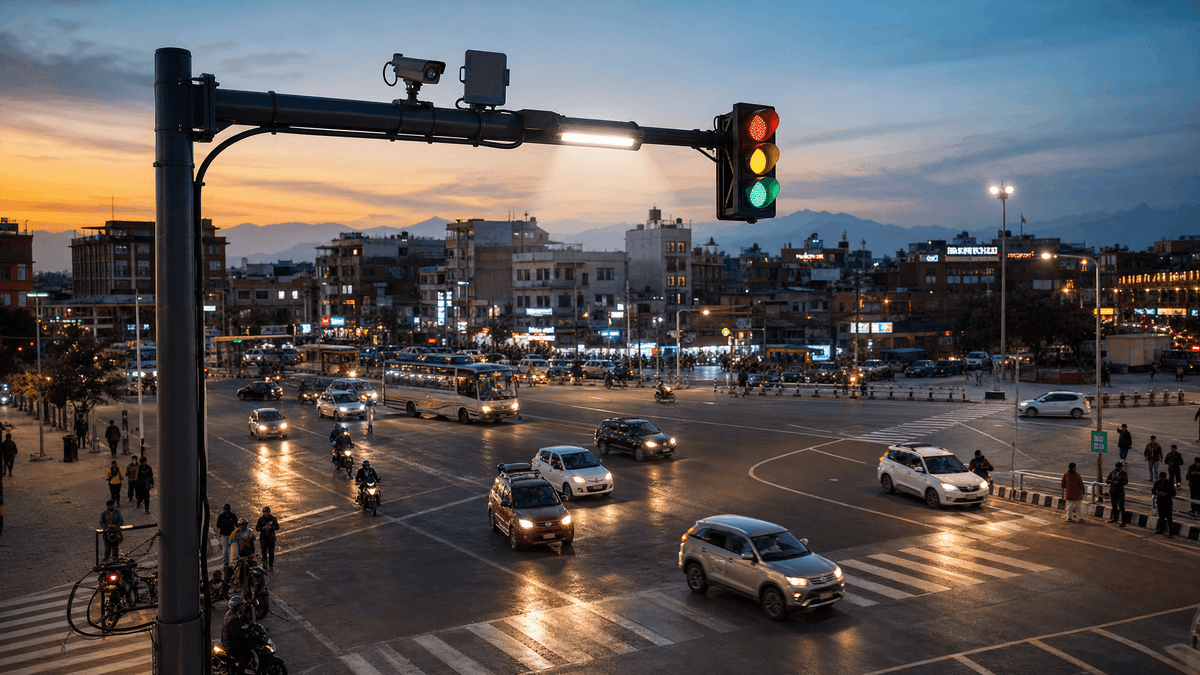
Kathmandu’s transport conditions support adaptive traffic control because the city combines high intersection density, mixed vehicle types, and limited road-widening options within a compact valley footprint of roughly 50 square kilometers for the metropolitan core. According to the World Bank (2023), Nepal’s urban mobility constraints are increasingly concentrated in the Kathmandu Valley, where congestion has direct economic and air-quality costs. According to Kathmandu Metropolitan City (2024), the city population exceeds 800,000 within the metropolitan boundary, while the wider valley carries a much larger daily travel load from commuters entering from Lalitpur, Bhaktapur, and surrounding municipalities.
According to the Department of Hydrology and Meteorology, Nepal (2023), Kathmandu records strong seasonal rainfall concentration during the monsoon, with annual precipitation around 1,400mm in the valley zone. That matters for Smart Traffic System design because signal poles, camera housings, and edge cabinets must maintain stable operation during prolonged wet periods and reduced visibility. A 10m pole class is a practical fit for multilane urban intersections where signal visibility and camera field of view must clear buses, trucks, and overhead clutter without moving into gantry-scale structures.
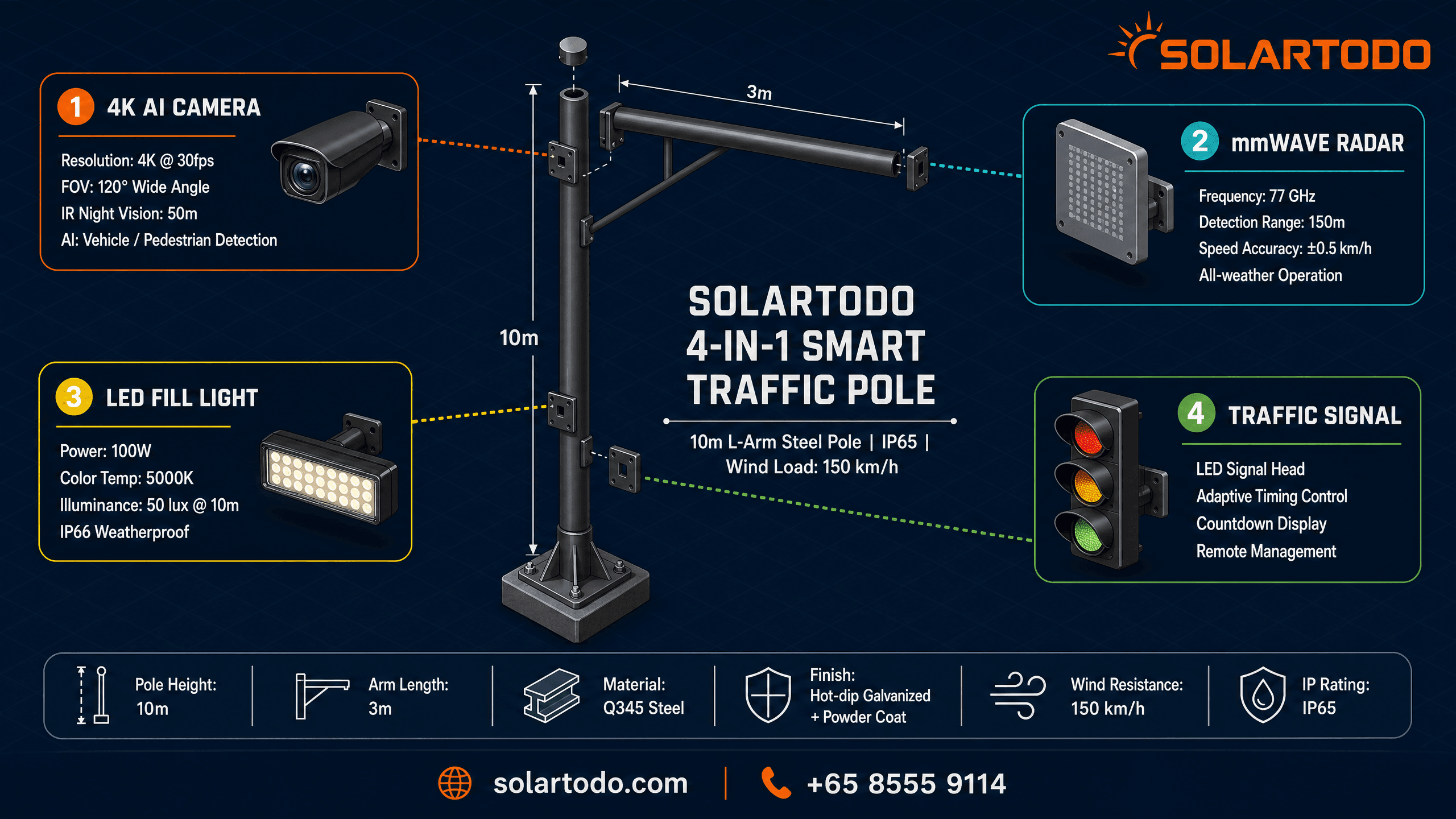
According to Nepal Telecommunications Authority (2023), mobile broadband subscriptions in Nepal continue to rise, and urban centers have the strongest data-network availability. For a Smart Traffic System, this means fiber should be treated as the primary backhaul where ducts are available, while 5G-ready or 4G/LTE fallback can support temporary links, pilot corridors, or resilience planning. SOLAR TODO’s 5-layer stack fits this requirement because it separates perception, edge AI, communications, central platform logic, and user applications into maintainable layers.
Traffic enforcement and signal management in Kathmandu also face a mixed-traffic problem that standard loop detectors handle poorly. Motorcycles, minibuses, pedestrians, handcarts, and irregular lane discipline reduce the accuracy of single-sensor systems. According to the International Transport Forum (2022), mixed urban traffic environments benefit from multi-sensor detection because radar and video together improve incident recognition and queue measurement under rain, glare, and partial occlusion. That is why a 4-in-1 pole with both 4K AI vision and 77GHz radar is a better fit than camera-only traffic monitoring.
The local policy direction also supports centralized digital traffic management. According to the Government of Nepal’s Digital Nepal Framework (updated implementation references used through 2023), public-service digitization and urban monitoring are priority areas for municipal modernization. In practical terms, Kathmandu’s road agencies and traffic police need intersection data that can be queried quickly, not only archived. SOLAR TODO’s TrafficGPT layer matches this need by allowing natural-language access to alarms, flow trends, and event records across approximately 30 intersections.
Recommended Technical Configuration
A typical 30-intersection Kathmandu deployment would use approximately 30 primary junction packages built around 10m L-arm hot-dip galvanized steel poles, with 4-12 poles per intersection depending on lane geometry and pedestrian phases.
Kathmandu’s arterial intersections are generally too complex for 6m poles and do not usually require 12m highway gantries inside the urban core. The 10m variant is the correct size class because it gives enough mounting height for signal heads, camera coverage, and radar cone alignment across multilane approaches while remaining suitable for dense roadside utility environments. For intersections with four standard approaches, a common arrangement would be 4 primary poles plus 2-6 auxiliary poles for turn pockets, pedestrian crossings, or offset stop lines.
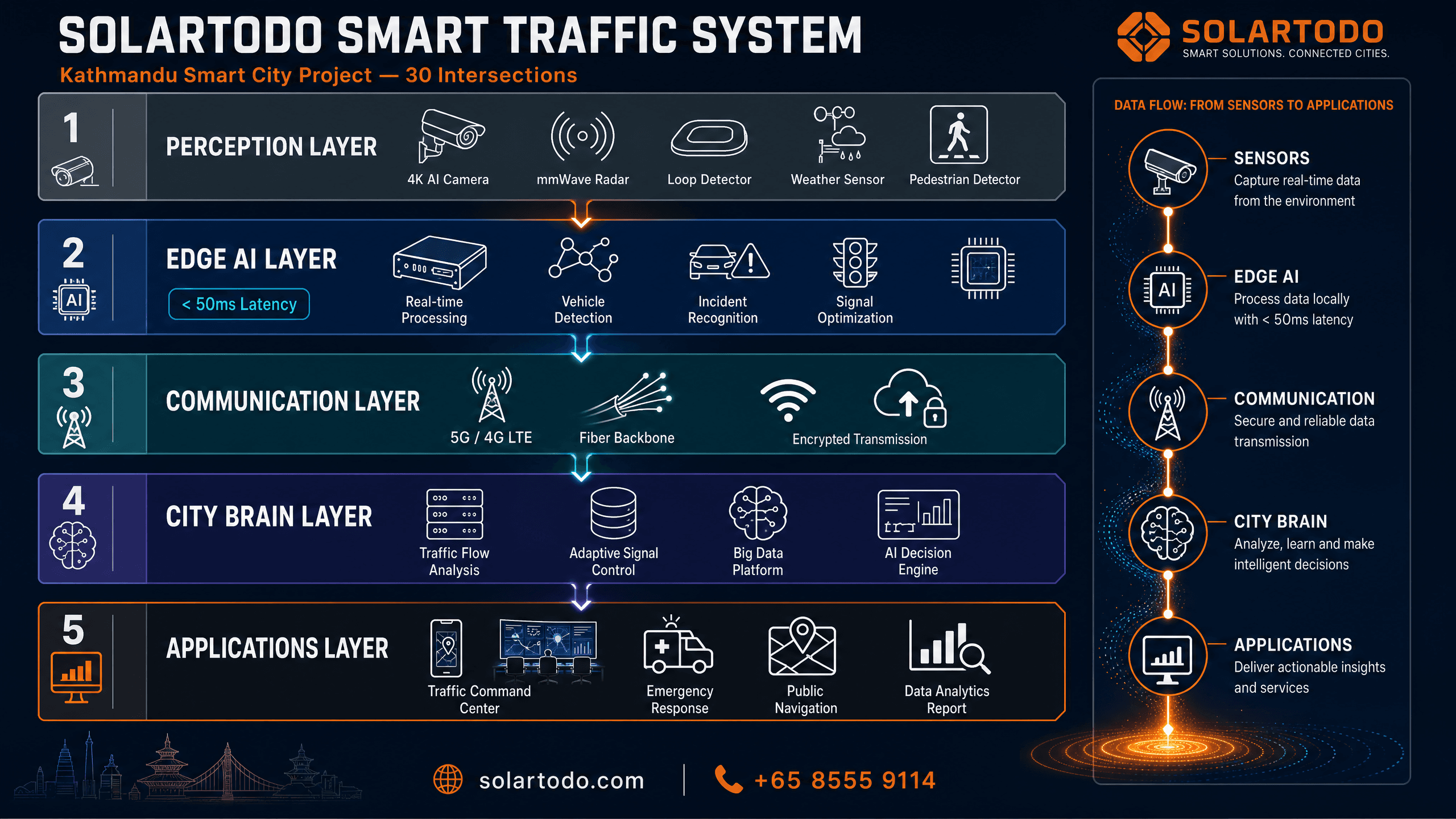
The project-specific configuration requested here is an EPC turnkey plan for 30 intersections using 10m dark-grey hot-dip galvanized L-arm steel poles. Each 4-in-1 smart traffic pole includes a 4K AI camera with 98% accuracy and less than 50ms response, a 77GHz mmWave radar, LED fill light, and LED signal head. Edge AI is handled by NVIDIA Jetson, and the functional package includes 45-type detection, adaptive signal control, emergency vehicle priority, and wrong-way alert.
A typical network design in Kathmandu would connect high-priority intersections to the central platform over fiber, with 5G-capable wireless as redundancy or as an interim link where trenching is delayed. This reduces the risk of single-link failure at critical junctions near hospitals, government corridors, or high-bus-volume roads. According to ITU (2023), transport digitalization performs best when edge processing handles low-latency decisions locally and only sends summarized data, alarms, and control instructions upstream.
For power and civil design, the poles should be installed on reinforced concrete foundations sized to local geotechnical conditions, especially in monsoon-affected soils. Kathmandu’s utility congestion means the pre-construction survey should include underground cable mapping, line-of-sight checks, and signal visibility simulation. SOLAR TODO should be evaluated in this context as a technical supplier for a standards-based Smart Traffic System rather than as a generic camera vendor.
Technical Specifications
The recommended Kathmandu specification is a 30-intersection EPC turnkey Smart Traffic System using 10m L-arm poles, NVIDIA Jetson edge AI, 45-type detection, and NTCIP/GB 25280 compliance for signal and platform interoperability.
- Product line: SOLAR TODO Smart Traffic System
- Deployment profile: approximately 30 intersections in Kathmandu urban corridors
- Pole type: L-arm steel pole
- Pole finish: dark grey
- Corrosion protection: hot-dip galvanized steel
- Pole height: 10m
- Typical pole count per intersection: 4-12 poles
- Estimated total pole range for 30 intersections: approximately 120-360 poles
- Integrated devices per pole: 4K AI camera + 77GHz mmWave radar + LED fill light + LED signal head
- Camera performance: 98% detection accuracy
- Detection library: 45+ object/event types
- Edge response time: less than 50ms
- Edge AI hardware: NVIDIA Jetson
- Core functions: adaptive signal control, emergency vehicle priority, wrong-way alert, full 45-type detection
- Communications layer: 5G/fiber backhaul to central platform
- Platform layer: TrafficGPT with natural-language queries
- Standards baseline: NTCIP, GB 25280
- Recommended use case: multilane urban intersections, bus corridors, hospital access routes, and mixed-traffic signalized junctions
- Preferred cooperation model for this profile: EPC turnkey
According to IEC traffic-signal and low-voltage equipment practices used internationally, enclosure sealing, grounding continuity, and surge protection should be specified at the tender stage rather than left to field substitution. According to IEEE guidance on roadside electronics protection, transient protection and proper earthing are essential where long cable runs and lightning exposure can affect sensor uptime.
Implementation Approach
A 30-intersection Smart Traffic System in Kathmandu would typically be delivered in 4 phases over roughly 6-12 months, depending on civil permits, utility conflicts, and fiber access.
Phase 1 is survey and design. This usually takes 4-8 weeks and includes traffic counts, turning-movement analysis, mast-arm visibility checks, utility mapping, and communications planning. At this stage, each junction should be classified by lane count, pedestrian demand, emergency-route relevance, and whether 4, 6, 8, or up to 12 poles are needed.
Phase 2 is manufacturing and procurement. For 10m hot-dip galvanized L-arm poles, fabrication lead time commonly falls in the 6-10 week range after approved-for-production drawings. Electronics integration, controller logic, and factory acceptance testing should verify the 4K AI camera, 77GHz radar, LED signal, and Jetson edge computer before shipment. SOLAR TODO’s EPC turnkey model is appropriate here because it keeps pole, sensor, software, and commissioning responsibility under one contract structure.
Phase 3 is civil and electrical installation. A typical sequence is foundation excavation, anchor cage placement, conduit routing, pole erection, signal head mounting, sensor alignment, and cabinet energization. In Kathmandu, trenching windows should avoid peak monsoon periods where possible, because saturated ground can slow foundation curing and increase reinstatement costs by 10-20% versus dry-season work.
Phase 4 is commissioning and optimization. This usually requires 2-6 weeks for detector calibration, signal timing validation, emergency-priority rules, and wrong-way alert tuning. According to NTCIP practice, interoperability testing is important when central software, controllers, and field devices come from multiple procurement lots. A practical acceptance plan should include day, night, rain, and mixed-traffic validation runs.
Expected Performance & ROI
A properly configured 30-intersection Smart Traffic System in Kathmandu could reasonably target 10-25% delay reduction, faster incident detection within seconds rather than manual reporting cycles, and lower field-maintenance visits through remote diagnostics.
According to the U.S. Department of Transportation FHWA (2023), adaptive signal control can reduce travel time by more than 10% in suitable corridors and lower stops and delay where traffic patterns vary by time of day. According to the International Transport Forum (2022), multi-sensor traffic monitoring improves reliability in dense mixed-use urban roads because radar continues to detect motion where camera-only systems are degraded by fog, glare, or rain. These benchmarks make the Kathmandu use case commercially credible, even though exact gains depend on baseline signal timing and enforcement quality.
The ROI case in Kathmandu is usually based on four value streams. First, reduced delay lowers fuel waste and lost labor time. Second, emergency vehicle priority can cut response delays on hospital routes. Third, wrong-way and incident alerts reduce secondary crash risk. Fourth, centralized monitoring can reduce manual intersection audits and shorten maintenance dispatch time. According to the World Bank (2023), urban congestion costs in developing cities are material enough that even modest percentage improvements can justify digital traffic investments on strategic corridors.
For municipal budgeting, payback is often modeled over 3-7 years rather than a single fiscal cycle. The shorter end of that range applies when the corridor has high bus volumes, frequent congestion, and expensive police-based manual control. The longer end applies where civil works are complex or fiber extension is required. SOLAR TODO should therefore be compared on total lifecycle cost, software capability, and maintenance structure, not only on pole hardware price.
Results and Impact
For Kathmandu, the main expected impact is better control quality at 30 high-pressure intersections through sub-50ms edge decisions, 45-type detection, and centralized TrafficGPT visibility across the network.
The operational result is not only signal automation. It is also a stronger data layer for corridor planning, bus-priority analysis, and enforcement support. A city traffic center could query queue growth, near-miss events, wrong-way alarms, or emergency-priority activations in natural language instead of exporting raw logs from separate systems. For agencies with limited analytics staff, that changes how quickly traffic data can be turned into signal timing action.
A second impact is standardization. Using the same 10m pole class, the same 4-in-1 sensor package, and the same EPC delivery logic across approximately 30 intersections simplifies spare parts, training, and maintenance contracts. That matters in Kathmandu, where mixed legacy signal assets can otherwise increase downtime and procurement fragmentation.
Comparison Table
The 10m 4-in-1 Smart Traffic System is the best fit for Kathmandu’s multilane urban intersections because it balances field of view, signal visibility, and civil complexity better than 6m compact poles or 12m highway-style structures.
| Configuration Option | Typical Use Case | Pole Height | Sensors per Pole | Edge AI | Backhaul | Main Advantages | Main Limits |
|---|---|---|---|---|---|---|---|
| 6m compact smart pole | Small junctions, low-speed local roads | 6m | Camera + basic signal package | Optional | 4G/fiber | Lower civil cost, simpler siting | Limited field of view for multilane approaches |
| 10m SOLAR TODO Smart Traffic System | Kathmandu arterial intersections | 10m | 4K AI camera + 77GHz radar + LED fill light + LED signal | NVIDIA Jetson | 5G/fiber | 98% detection accuracy, <50ms response, 45-type detection, adaptive control | Requires stronger foundation and detailed utility survey |
| 12m gantry-style urban/highway edge | Expressway ramps, large channelized junctions | 10-12m | Multi-sensor extended coverage | Jetson or higher | Fiber preferred | Wider coverage, good for high-speed approaches | Higher steel and installation cost |
Pricing & Quotation
SOLAR TODO offers three pricing tiers for this product line: FOB Supply (equipment ex-works China), CIF Delivered (including ocean freight and insurance), and EPC Turnkey (fully installed, commissioned, with 1-year warranty). Volume discounts are available for large-scale deployments. Configure your system online for an instant estimate, or request a custom quotation from our engineering team at [email protected].
In Kathmandu, EPC pricing will usually vary with 4 variables: pole count per intersection, fiber trench length, foundation complexity, and controller-room integration. A 30-intersection package with approximately 120-360 poles has a wide commercial range because some junctions need only one pole per approach, while others require auxiliary poles for turn lanes and pedestrian phases. For procurement, SOLAR TODO should be asked to separate equipment cost, civil works, communications, software licensing, and annual O&M.
Frequently Asked Questions
A Kathmandu Smart Traffic System procurement typically focuses on 10m pole height, 4K plus 77GHz sensing, 30-intersection rollout logic, EPC pricing structure, and 3-7 year payback assumptions.
Q1: Why is a 10m pole recommended for Kathmandu instead of 6m or 12m?
A 10m L-arm pole suits most Kathmandu arterial intersections because it clears buses, overhead clutter, and multilane stop lines better than 6m poles. A 12m structure is usually reserved for larger channelized junctions or highway edges. For mixed urban roads, 10m gives a practical balance of coverage, signal visibility, and civil cost.
Q2: What exactly is included in the 4-in-1 Smart Traffic System pole?
Each pole includes a 4K AI camera, 77GHz mmWave radar, LED fill light, and LED signal head. The edge processor is NVIDIA Jetson, which supports 45-type detection, adaptive signal logic, emergency vehicle priority, and wrong-way alert. The specified edge response time is less than 50ms, which is suitable for real-time junction control.
Q3: How many poles would 30 intersections typically require?
The standard planning range is 4-12 poles per intersection, depending on approach count, turn pockets, pedestrian crossings, and auxiliary signal needs. For 30 intersections, that means approximately 120-360 poles. A four-approach junction with straightforward geometry may need 4-6 poles, while complex layouts may require 8-12.
Q4: What backhaul is better in Kathmandu: fiber or wireless?
Fiber is usually the primary choice because it offers higher stability, lower latency, and better support for video-rich traffic systems. Wireless 5G-ready links are useful as backup or for interim operation where trenching is delayed. A hybrid design is common: fiber for critical intersections and wireless resilience for failover or temporary phases.
Q5: How long would a 30-intersection deployment usually take?
A realistic schedule is about 6-12 months. Survey and design often take 4-8 weeks, manufacturing 6-10 weeks, civil works 8-16 weeks, and commissioning 2-6 weeks. The biggest schedule risks in Kathmandu are utility conflicts, permit timing, monsoon-season excavation, and delayed fiber access at older road corridors.
Q6: What ROI or payback period is realistic for this system?
Many municipal buyers model payback over 3-7 years. The shorter end applies where intersections have high congestion, high bus volumes, and frequent police-managed control. Savings usually come from reduced delay, lower fuel waste, fewer manual traffic interventions, and faster incident response. Exact payback depends on corridor importance and civil-work cost.
Q7: How does radar help compared with camera-only traffic detection?
The 77GHz radar improves detection in rain, glare, nighttime conditions, and partial visual blockage. In Kathmandu’s monsoon season, that matters because camera-only systems can lose reliability when visibility drops. Radar also supports speed and motion tracking, which strengthens wrong-way alerts and adaptive signal decisions when lane discipline is inconsistent.
Q8: What maintenance plan is typical after commissioning?
A practical plan includes quarterly inspection of pole coatings, signal heads, cable glands, earthing, and enclosure seals, plus software health checks and sensor recalibration as needed. Annual preventive maintenance should also verify radar alignment, camera cleanliness, and surge protection status. Remote diagnostics can reduce unnecessary site visits and improve spare-parts planning.
Q9: What standards should municipal buyers ask for in the tender?
At minimum, buyers should request NTCIP interoperability for traffic communications and GB 25280 compliance for traffic signal performance, as specified in this configuration. Tender documents should also define grounding, surge protection, enclosure sealing, and acceptance testing. Clear standards reduce integration risk when controllers, software, and field devices come from multiple vendors.
Q10: Is EPC turnkey the right commercial model for Kathmandu?
For a 30-intersection package, EPC turnkey is usually the most practical model because one contractor coordinates pole fabrication, electronics, civil works, installation, and commissioning. That reduces interface disputes across suppliers. It also makes performance acceptance easier, since the municipality can evaluate one integrated Smart Traffic System instead of separate hardware lots.
References
- World Bank (2023): Urban development and mobility assessments for Nepal identify congestion and infrastructure management pressure in the Kathmandu Valley.
- Kathmandu Metropolitan City (2024): Metropolitan population and urban management data used for city context and transport planning relevance.
- Department of Hydrology and Meteorology, Nepal (2023): Kathmandu climate and rainfall patterns relevant to monsoon-season civil and electronics protection design.
- Nepal Telecommunications Authority (2023): Telecom sector indicators and mobile broadband growth relevant to 5G/fiber backhaul feasibility.
- International Transport Forum (2022): Urban mobility and mixed-traffic management findings supporting multi-sensor monitoring approaches.
- ITU (2023): Digital infrastructure and intelligent transport guidance supporting edge processing plus central platform architectures.
- U.S. Department of Transportation FHWA (2023): Adaptive Signal Control Technologies guidance and benchmark performance ranges for delay and travel-time improvement.
Equipment Deployed
- 10m L-arm steel pole, dark grey, hot-dip galvanized
- 4K AI camera with 98% detection accuracy and <50ms response
- 77GHz mmWave radar
- LED fill light
- LED signal head
- NVIDIA Jetson edge AI unit
- 5G/fiber backhaul communications package
- TrafficGPT central platform with natural-language query support
- Adaptive signal control software
- Emergency vehicle priority module
- Wrong-way alert module
- NTCIP and GB 25280 compliance package