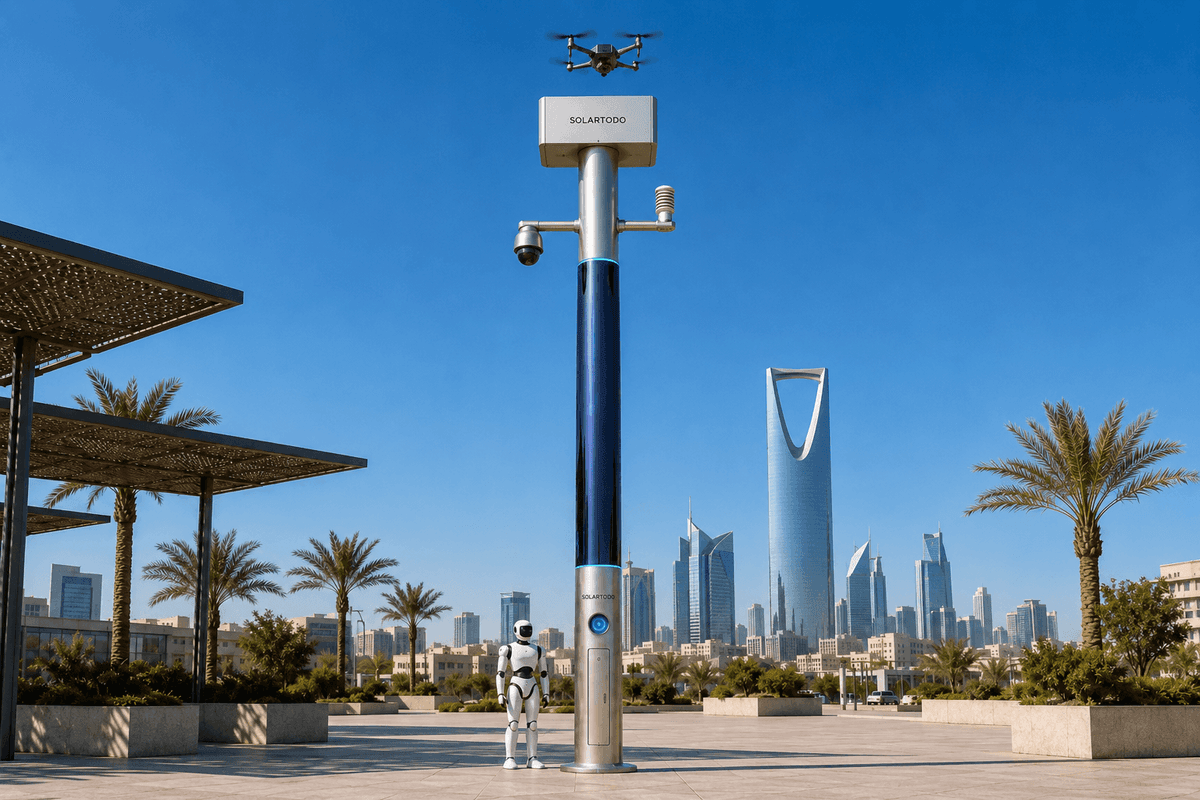
A City AI Pole is a non-lighting physical-AI urban edge node that combines off-grid energy, local compute, sensing, drone operations, ground robot operations and command coordination. In Jakarta, SOLARTODO Sentinel Sky Hub is proposed as a grid-mesh night-patrol layer for old-town eco-environment monitoring, keeping raw data on-pole while sharing de-identified status and event metadata.
Incident Context
Jakarta’s old-town districts place unusual pressure on night operations. Historic streets, mixed tourism activity, informal commerce, canals, older utility corridors and narrow service access can make conventional patrol models uneven, especially during heatwave periods when public-space stress, equipment heat load, waste-odor complaints, crowding and nighttime environmental risk all rise together. For an eco-environment stakeholder, the central operating problem is not simply visibility. It is continuity: can the city maintain enough patrol frequency and environmental awareness when the network is degraded, staff are stretched, and nighttime field conditions change faster than a central room can interpret?
This incident-review case study frames a proposed SOLARTODO Sentinel Sky Hub deployment for an old-town Jakarta operating zone. It is intentionally presented as an illustrative configuration subject to final engineering confirmation, site survey, civil works review, aviation authorization, local operating rules and environmental permitting. It does not claim achieved results, named agency adoption, certified compliance, nation-scale rollout, fixed coverage area or measured detection rates.
The trigger scenario is a heatwave week with intermittent network outage across parts of the old-town grid. The buyer lens is eco-environment operations: monitoring heat-related public-space conditions, nighttime crowd density, noise, particulate conditions, perimeter intrusion near protected assets and abnormal activity around canals, depots or service lanes. The KPI framing is patrol frequency. The planning question is whether a mesh of off-grid physical-AI nodes can preserve scheduled night patrol cycles when backhaul is unavailable or unstable.
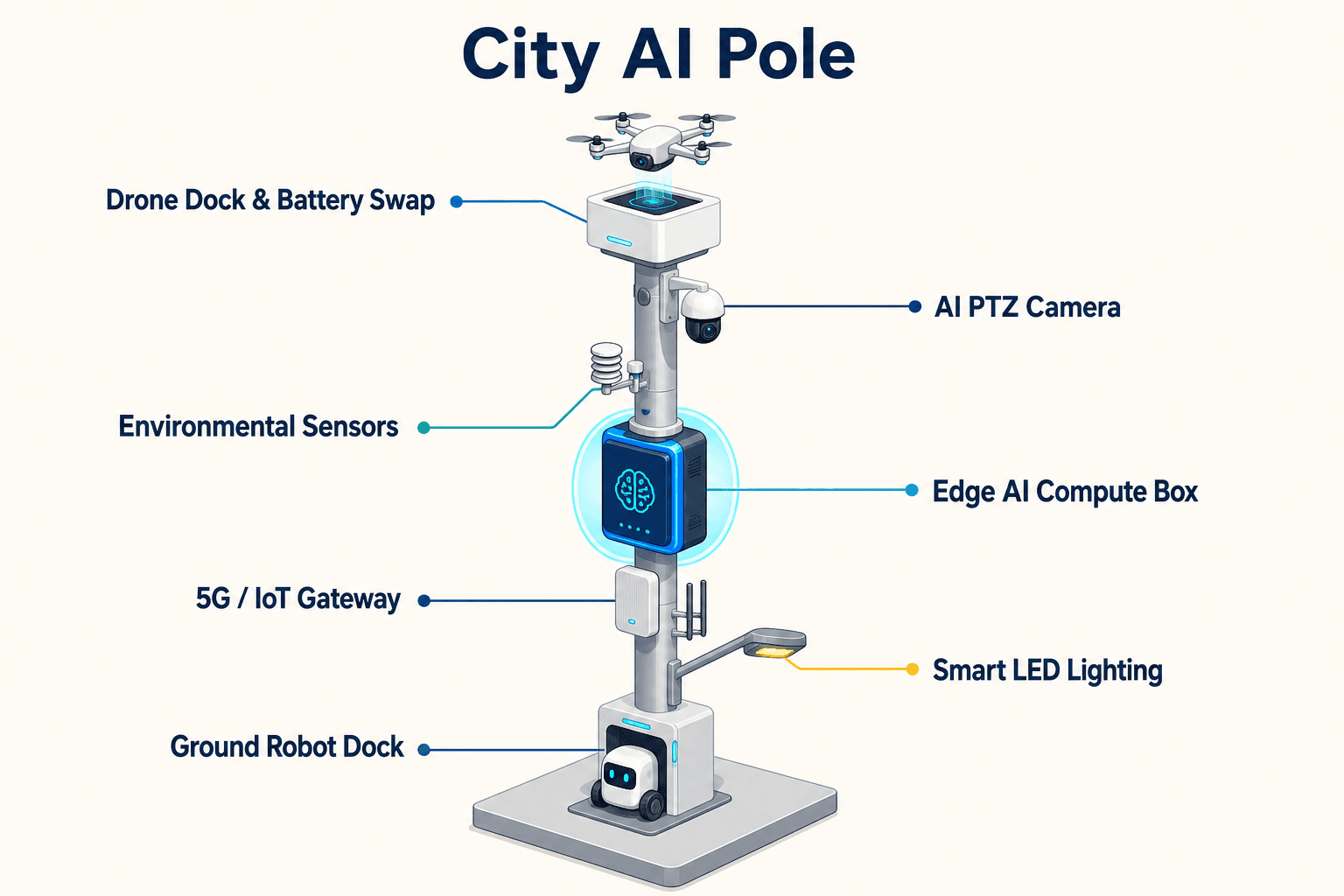
Sky Hub is used here as a pure smart pole: a non-lighting intelligent pole with no lighting system. It is not a streetlight replacement. It is a fully off-grid edge micro-station with battery storage, 360-degree wrapped flexible CIGS thin-film solar replenishment, on-pole edge AI compute, PTZ security sensing, environmental monitoring, drone operations, drone battery hot-swap, ground robot operations and human-authorized counter-UAS coordination.
Root Cause Review
The operational failure mode in this scenario is network dependency. In many city command models, cameras and sensors become less useful when a site cannot reliably upload raw streams or when staff must manually reconcile delayed alerts from multiple subsystems. During a heatwave night, that weakness becomes sharper: higher public activity after sunset, thermal stress on equipment, elevated noise complaints, more frequent environmental exceptions and harder manual patrol scheduling.
For Jakarta old-town operations, the proposed Sky Hub mesh changes the incident posture by moving assessment closer to the event. Each pole runs local inference and workload scheduling on an Orin- or Thor-class edge module, with raw video and sensor data processed locally and retained on the pole according to site policy. Only de-identified event and status metadata may leave the node. If backhaul is down, the pole continues local sensing, patrol scheduling, mission logging and field-device coordination. When connectivity returns, metadata and operational logs can be synchronized to the common-operating-picture command view.
The power module is central, not peripheral. A network outage often coincides with site-power assumptions, backup-power uncertainty or limited access for maintenance crews. Sky Hub is designed as a fully off-grid system, using a battery-backed micro-station and on-pole solar replenishment rather than grid, city or site power. The pole carries about 15 square meters of 360-degree wrapped flexible CIGS thin-film over a vertical body approximately 8 meters tall and 0.6 meters wide, with about 2.4 to 2.7 kWp nameplate. Because the vertical cylinder collects direct sun mainly on its sun-facing projection, not the full wrap, planning should treat clear-sky output in a high-irradiance region as roughly 0.8 to 1.1 kW DC peak and about 6 to 9 kWh per day. Jakarta engineering assumptions must be confirmed locally for shade, cloud cover, monsoon season, urban canyon effects and heat derating.
That honesty matters. The CIGS layer is a supplemental replenishment layer for a fully off-grid, battery-backed station, not an unlimited pure-solar claim. High-power drone and robot tasks are buffered by 5 to 20 kWh-class storage and scheduled by duty cycle. For the eco-environment buyer, the value is a controllable night-patrol budget: patrol frequency can be planned against battery state, replenishment forecast, heat load and mission priority instead of assuming every task can run continuously.
Response Architecture
The proposed deployment mode is a grid-mesh of Sky Hub nodes placed at operationally useful points rather than evenly spread for lighting geometry. Candidate positions would include entries to old-town pedestrian areas, canal-side inspection points, public-space edges, depot perimeters, heritage-asset approaches and service-lane intersections. Each node acts as an edge participant in a shared command view, while retaining the ability to continue local operations during connectivity loss.
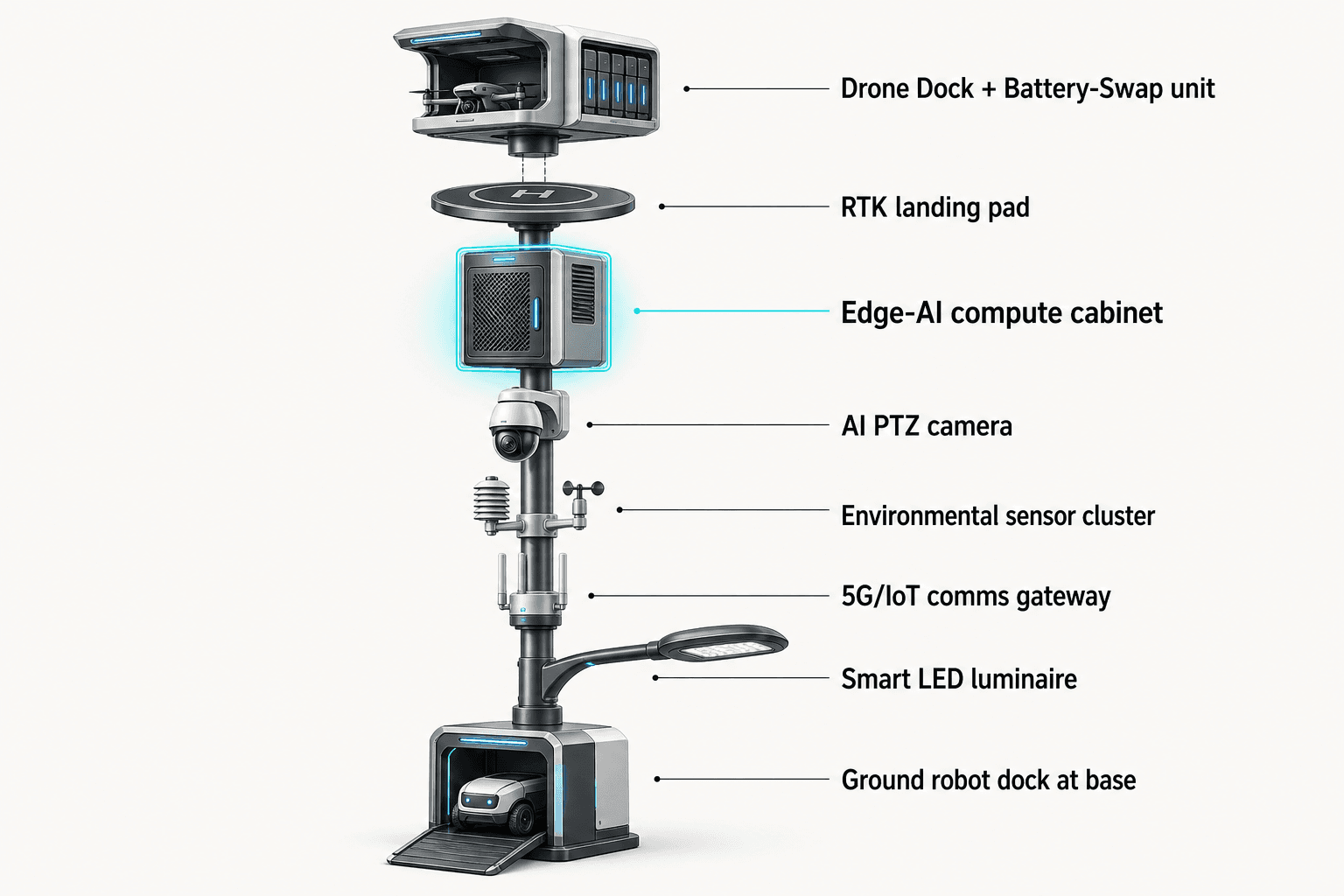
The operations loop follows sensing, authorized assessment and response, edge-compute scheduling, field operations and maintenance. On-pole environmental monitoring provides wind speed, wind direction, temperature, humidity, atmospheric pressure, noise, PM10, PM2.5 and illuminance. The PTZ camera supports local perception for anonymous vehicle count, crowd density, intrusion and perimeter awareness. Face recognition and licence-plate recognition are not active deployed capabilities in this configuration.
Drone operations support launch, regional patrol, inspection, return and task redeployment without an operator on site. The drone battery hot-swap module uses a multi-bay battery magazine for automated rear-service exchange, allowing a landed drone to receive a charged pack and relaunch. Multiple bays support several consecutive sorties, subject to battery inventory, weather, aviation rules, site permissions and mission scheduling. Drone operations management handles route planning, charge and swap state, task queues, fleet health and mission logs.
Ground robot operations extend the night-patrol loop to sidewalks, courtyards, depot areas and low-speed service corridors where aerial inspection is insufficient. A humanoid or service robot can conduct autonomous patrol, alarm response, inspection and air-ground coordination, then return to the pole base for wireless charging. The pole becomes the local energy, compute and tasking anchor for both air and ground assets.
Counter-UAS coordination is included as a non-lethal, human-authorized workflow. The pole can detect and track an unauthorized drone through its own sensing and optional partner-sensor inputs, then command the node’s friendly drone to perform soft aerial net-capture or close-approach deterrence after authorization. Radar is not built into the pole; if used, it is treated only as an optional or partner-sensor input. The workflow excludes shoot-down, jamming, denial and autonomous attack.
Night-Patrol Workflow
During the heatwave night scenario, the command objective is to keep patrol frequency predictable while reducing dependence on live raw-stream transmission. A typical cycle begins with each pole performing local environmental and security sensing. If noise, PM levels, crowd density, intrusion patterns or perimeter movement cross planning thresholds, the edge module classifies the event and assigns a priority. The node then checks battery state, solar forecast, drone battery magazine state, robot charging state and current task queue.
When backhaul is available, the common-operating-picture view receives de-identified event and status metadata: location identifier, event category, severity score, mission state, device health and operator decision status. When the network is interrupted, local mission logic continues. The node can hold raw data on-pole, preserve logs and queue metadata for later synchronization. Human-in-the-loop authorization remains required for response tasks that affect people, property or airspace.
For an eco-environment team, this creates a practical distinction between monitoring and intervention. Routine environmental sweeps can run on a schedule. Drone sorties can inspect canal edges, thermal-stress hotspots, depot perimeters or access corridors. Ground robots can inspect localized conditions and coordinate with aerial views. Higher-power tasks are scheduled according to duty cycle, not treated as continuously available. The KPI is not a claimed reduction in incidents. It is a target planning measure: how many patrol cycles per night, per node cluster, can be scheduled and verified under realistic energy and network constraints.
The incident-review view also supports maintenance planning. If one pole has low storage, high thermal load or a depleted battery magazine, nearby nodes in the mesh can shift non-critical patrol tasks. The COP shows the operator which nodes are sensing, which are ready for drone launch, which robots are charging, which missions require authorization and which logs are pending sync. That makes the mesh useful even when the city cannot rely on continuous connectivity.
Planning Takeaways
The proposed Jakarta configuration is strongest where the city task is local, repeated and time-sensitive. Old-town eco-environment patrol is a fit because it combines environmental sensing, perimeter awareness, human-authorized response and evidence logging, while also needing resilience during network outage. The Sky Hub pole is not a general street fixture and should not be evaluated as lighting infrastructure. It is a physical-AI edge node with off-grid power, local compute and field-operations modules.
The most important planning discipline is energy realism. The wrapped CIGS surface replenishes storage, but it does not remove the need for duty-cycle design. Drone launches, hot-swap operations, PTZ activity, robot charging, compute workloads and communications all draw from a bounded battery budget. Jakarta site engineering should evaluate shading from shophouses and trees, salt-air exposure near waterways, rain and wind conditions, thermal load during heatwaves, service access, aviation corridors and where a mesh node can most improve night-patrol frequency.
For procurement, the recommended evaluation model is a controlled district configuration with target metrics, not a claim of achieved citywide transformation. The buyer can compare baseline manual night patrol frequency against planned automated patrol cycles, metadata availability during outages, mission completion logs, battery reserve, environmental exception handling and maintenance response time. SOLARTODO Sentinel Sky Hub should be assessed as an in-service product category applied through final local engineering confirmation, with PDPL/LGPD-oriented local processing principles and raw data remaining on the pole.
System Configuration
| Parameter | Configuration |
|---|---|
| Node form | SOLARTODO Sentinel Sky Hub pure smart pole; non-lighting physical-AI edge node with no lighting system |
| Power system | Fully off-grid battery-backed micro-station with 5-20 kWh-class storage and 360-degree wrapped flexible CIGS replenishment |
| Solar layer | About 15 m2 vertical CIGS wrap, about 2.4-2.7 kWp nameplate; realistic output subject to sun-facing projection, shade and weather |
| Edge AI compute | On-pole Jetson-class inference cabinet, Orin- or Thor-class, scheduling local perception and mission workloads |
| Security sensing | AI PTZ for anonymous vehicle count, crowd density, intrusion and perimeter awareness; raw video processed locally |
| Environmental monitoring | Wind speed, wind direction, temperature, humidity, atmospheric pressure, noise, PM10, PM2.5 and illuminance |
| Air-ground operations | Autonomous drone launch, return, rear-service battery hot-swap, mission management and ground robot wireless charging at pole base |
How It Works
- On-pole PTZ and environmental sensors flag a heatwave night anomaly in the old-town patrol zone.
- Edge AI classifies the event locally, scores priority and keeps raw video and sensor data on the pole.
- The COP presents de-identified metadata, battery state, network state and recommended response options for human authorization.
- After authorization, the node schedules a drone sortie or ground robot patrol according to task queue and power reserve.
- The field asset completes inspection, returns for hot-swap or wireless charging, and the pole records mission status.
- When connectivity is available, de-identified event and mission metadata sync to the command view for incident review.
Planning Assumptions (Indicative)
Illustrative planning inputs a buyer can recompute — target metrics, not achieved results. Subject to final engineering confirmation.
| Metric | Planning assumption | Indicative value |
|---|---|---|
| Night patrol frequency | Target comparison between manual patrol rounds and scheduled air-ground patrol cycles during a heatwave week | ~2-4 automated patrol cycles per node cluster per night |
| Inspection labor | Drone and ground robot patrols offset repeat visual checks while human teams retain authorization and exception handling | ~10-20 routine checks per week shifted to autonomous tasking |
| Network-outage continuity | Local inference and mission logging continue when backhaul is unavailable; metadata sync resumes later | ~6-12 hours outage-tolerant operating window to evaluate |
| Energy reserve | Battery-backed duty cycle preserves critical sensing and selected patrol tasks during cloudy or high-load periods | ~30-50 percent minimum reserve target |
| Environmental exception review | Eco-environment team reviews de-identified event metadata instead of continuous raw feeds | ~20-40 prioritized event records per week for planning tests |
Deployed Equipment
- SOLARTODO Sentinel Sky Hub pure smart pole body
- 360-degree wrapped flexible CIGS thin-film solar layer
- 5-20 kWh-class battery storage cabinet
- On-pole Jetson-class edge AI compute module
- AI PTZ sensing unit
- Nine-parameter environmental sensor set
- Multi-bay drone battery hot-swap magazine
- Ground robot wireless charging base
Frequently Asked Questions
Is Sky Hub a smart streetlight for Jakarta old-town roads?
No. Sky Hub is a pure smart pole with no lighting system. It is positioned as a physical-AI urban edge node for sensing, edge computing, drone operations, ground robot operations and command coordination. It should be planned around patrol and environmental operations, not street lighting replacement or illumination coverage.
How does the proposed mesh help during a network outage?
Each node performs local inference, mission scheduling and event logging on the pole. Raw video and sensor data stay on the pole, while only de-identified event and status metadata may leave the node. If backhaul is interrupted, local patrol logic can continue and queued metadata can synchronize after connectivity returns.
Can the wrapped solar surface power unlimited drone and robot operations?
No. The flexible CIGS wrap is a supplemental replenishment layer for a fully off-grid, battery-backed micro-station. The pole should be planned with realistic solar output, battery reserve and duty-cycle scheduling. High-power drone sorties, hot-swaps and robot charging are buffered by storage and prioritized by mission need.
What makes this relevant to an eco-environment stakeholder?
The configuration combines environmental monitoring, anonymous crowd and vehicle awareness, intrusion and perimeter awareness, and repeatable air-ground inspection. During heatwave nights, the eco-environment team can prioritize noise, particulate, crowd-density and canal-side inspection events without depending on continuous raw video transmission to a central system.
Does the configuration use face recognition or licence-plate recognition?
No. This proposed configuration is limited to anonymous vehicle count, crowd density, intrusion and perimeter awareness. It is designed around local processing and PDPL/LGPD-oriented data minimization. Any expansion into identity-related analytics would require separate legal, policy, procurement and technical review.
How is counter-UAS handled in this case study?
Counter-UAS is framed only as non-lethal, human-authorized coordination. The pole can detect and track an unauthorized drone and command a friendly drone for soft aerial net-capture or close-approach deterrence after authorization. The configuration excludes shoot-down, jamming, denial, weapons and autonomous attack. Radar is not built into the pole.
What should Jakarta validate before procurement?
Final engineering confirmation should review old-town mounting locations, solar exposure, shade, battery autonomy, heat load, monsoon conditions, corrosion risk, aviation permissions, robot travel paths, maintenance access and data governance. KPI evaluation should use target patrol frequency, outage continuity and mission-log completeness rather than unsupported claims of achieved results.
Explore Further
- City AI Pole / smart streetlight product line
- More smart-city deployment cases
- Talk to our engineering team
Planning a similar physical-AI deployment for streets, campuses or public spaces? Request an engineering consultation