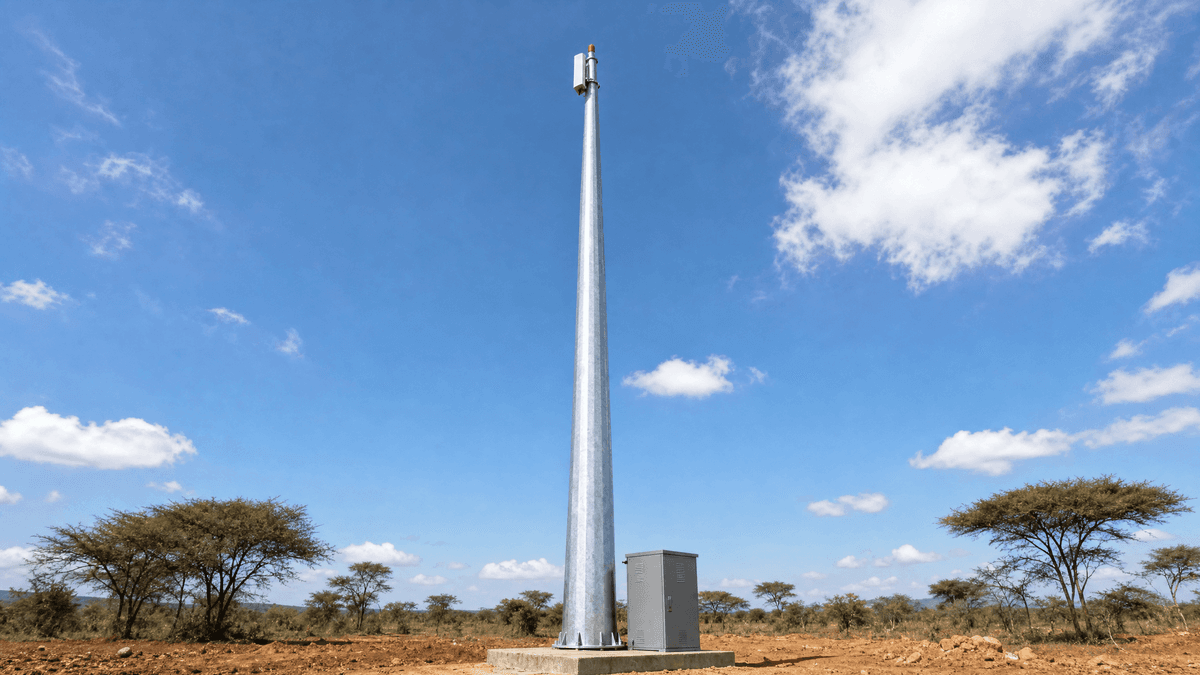
Harare Telecom Tower Market Analysis: 8m Community 5G Infill Configuration Guide
Summary
Harare’s dense urban corridors and neighborhood-level broadband demand make 8m small-cell Telecom Tower deployment a practical infill option. A typical program would use approximately 43 hot-dip galvanized Q345 steel poles, Wind Class 1 at 40 m/s, with CKD shipping reducing logistics volume by 60-70%.
Key Takeaways
- Harare sits at approximately 1,483 m elevation and has a subtropical highland climate, which supports standard hot-dip galvanized steel pole selection with medium corrosion protection rather than marine-grade treatment in most districts.
- According to ZIMSTAT (2022), Harare Metropolitan Province has a population above 2.4 million, which supports the case for 8m community 5G infill poles in high-footfall residential and mixed-use areas.
- A typical infill cluster of this scale would use approximately 43 units of 8m tapered steel monopole Telecom Tower, each weighing about 2t and carrying 1× small cell + 1× RRU.
- The specified wind design is TIA-222-H Wind Class 1, 40 m/s, factor 1.0, which fits many sheltered urban and suburban community sites in Harare when verified by local structural assessment.
- The recommended foundation is an anchor-bolt cage foundation, appropriate for short 8m poles where geotechnical conditions allow standard shallow civil works and rapid repeatable installation.
- According to the World Bank (2023), Zimbabwe’s mobile broadband expansion remains important for digital inclusion; short-pole infill improves street-level coverage where macro towers at 25-45m leave local shadow zones.
- CKD shipping can reduce transport volume by 60-70%, and a standard production window of 15-25 days supports phased procurement for municipal, operator, campus, or estate-wide rollout.
- SOLAR TODO positions this Telecom Tower class as a 25-year design life asset built to GB/T 51316 and TIA-222-H, with climbing pegs, cable tray, grounding, and 1 antenna mounting bracket included in the recommended configuration.
Market Context for Harare
Harare’s telecom access challenge is less about long-range rural coverage and more about street-level capacity, neighborhood dead zones, and infill support for 4G, 5G, and public WiFi. According to ZIMSTAT (2022), Harare Metropolitan Province has more than 2.4 million residents, making it Zimbabwe’s largest urban concentration. In a city of that scale, macro sites alone typically do not resolve signal obstruction from dense housing blocks, commercial strips, schools, clinics, and tree-lined suburban roads.
According to the World Bank (2023), digital connectivity remains a core enabler of economic participation across Sub-Saharan Africa, and urban broadband quality depends not only on spectrum but also on site density. For Harare, this means low-height infill structures can be more relevant than adding only 30-45m macro towers. An 8m Telecom Tower class is suited to community-level coverage enhancement where operators need localized capacity and lower visual impact.
Climate and terrain also matter. According to Climate-Data.org (2024), Harare receives roughly 800-900 mm of annual rainfall and has a mild highland climate rather than a coastal salt-laden environment. That supports the use of hot-dip galvanized Q345 steel in a medium corrosion zone for many inland sites, provided drainage, grounding, and base detailing are properly designed. The city’s elevation of about 1,483 m also reduces some corrosion pressure compared with marine environments, though UV exposure and wet-dry cycles still require coating quality control.
Zimbabwe’s telecom market structure further supports small-cell and community infill. According to POTRAZ (2023), mobile network usage remains the dominant communications channel in Zimbabwe, with data traffic continuing to rise as smartphone adoption expands. This is the practical reason a buyer in Harare may prioritize a short monopole Telecom Tower: it fills local coverage gaps in estates, transport nodes, campuses, and municipal service corridors without the land take or visual profile of a 25-45m macro site.
The relevant engineering distinction is important. The standard telecom monopole size-class table for macro applications starts at 15-25m for rooftop and urban infill and extends to 45-55m for rural wide coverage. Harare’s requirement in this brief is different: a small cell / community 5G infill pole at 8m, carrying 1× small cell + 1× RRU, built under GB/T 51316 and TIA-222-H rather than a conventional macro-only tower arrangement. SOLAR TODO should therefore be evaluated here as a small-cell Telecom Tower supplier, not as a macro lattice or high-rise monopole vendor.
As the ITU states, "Infrastructure sharing and densification are both important tools for extending broadband access efficiently." That statement aligns with Harare’s urban topology, where shorter poles can be inserted into constrained rights-of-way. IEEE also notes that "proper grounding and bonding are essential to communications site reliability," which is directly relevant in Harare’s thunderstorm season and should shape grounding design even for 8m poles.
Recommended Technical Configuration
For Harare’s neighborhood broadband infill, the recommended SOLAR TODO Telecom Tower configuration is an 8m tapered steel monopole with 1× small cell + 1× RRU, approximately 43 units in a typical district-scale deployment. This is a small-cell pole class, not a 25-45m macro tower, and it fits community 5G and public WiFi densification better than a larger suburban or highway mast.
A typical 43-unit deployment of this scale would consist of tapered steel monopoles fabricated from hot-dip galvanized Q345 steel, each with a unit weight of approximately 2t or 200 kg/m. That weight is consistent with a short, accessory-equipped small-cell pole and should not be confused with the macro monopole engineering rule of about 500 kg/m × height used for 25-55m telecom tower classes. Because the height here is only 8m, the project-specific specification correctly falls outside the macro size-class table.
The wind design basis is TIA-222-H Wind Class 1, equivalent here to 40 m/s with a 1.0 factor. In Harare, this is typically suitable for sheltered urban neighborhoods, campuses, gated communities, and municipal streets where exposure is lower than open rural terrain. Final structural checks should still review topography, shielding, and local gust behavior before procurement release.
The recommended accessory set includes:
- Climbing pegs for maintenance access
- Cable tray for protected feeder and power routing
- Grounding system sized to local soil resistivity and lightning exposure
- 1 antenna mounting bracket for the small-cell radio package
The recommended foundation is an anchor-bolt cage foundation. For an 8m pole, this foundation type usually supports repeatable installation, shorter civil cycles, and easier template control than more complex deep foundations, assuming geotechnical conditions are stable and underground utility conflicts are managed. In Harare’s built-up districts, this matters because civil disruption often drives schedule risk more than steel fabrication.
From a network planning perspective, approximately 43 units would typically be distributed across residential clusters, market streets, transit stops, schools, clinics, and municipal buildings. The exact spacing would depend on spectrum band, clutter, target RSRP/RSRQ, and backhaul availability. SOLAR TODO’s CKD shipping model is relevant here because a 43-pole lot can reduce shipping volume by 60-70%, which helps when inland freight to Zimbabwe is routed via regional ports and long-haul trucking.
For buyers comparing options, the main technical advantage of this configuration is fit-for-purpose sizing. A 25m or 30m monopole is appropriate for broader suburban cell radius, but it is often oversized for estate roads, apartment clusters, and public WiFi overlay. An 8m Telecom Tower keeps antenna height closer to the user plane, which can improve localized service quality when radio planning supports dense reuse.
SOLAR TODO should therefore be specified in Harare as a supplier for short-form steel monopole infill structures under GB/T 51316 and TIA-222-H, with procurement documents clearly separating this pole class from conventional macro tower packages. Buyers can review product details on the Telecom Tower product page or request site-specific engineering through the contact page.
Technical Specifications
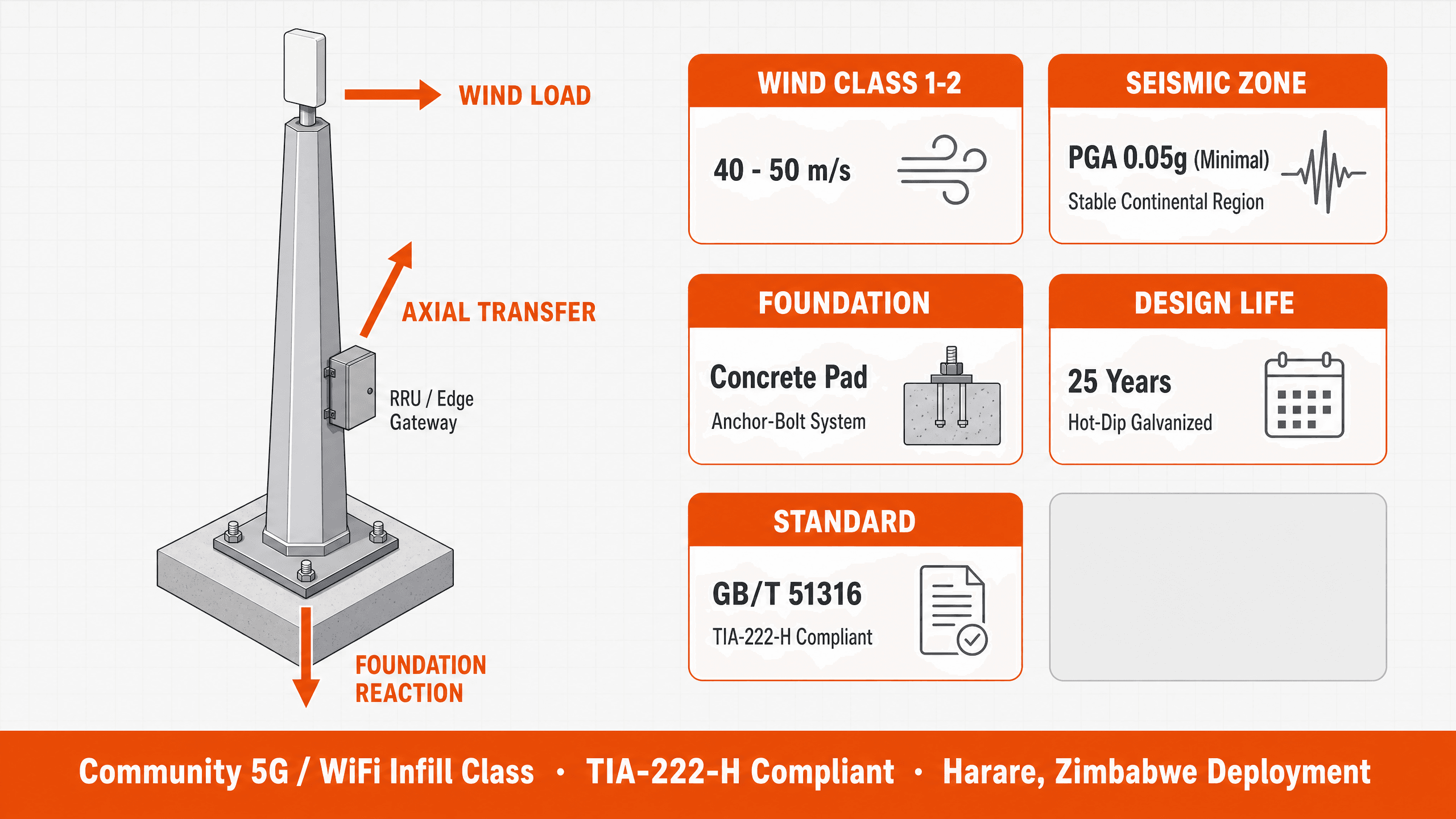
The specified Harare configuration is an 8m Q345 hot-dip galvanized small-cell Telecom Tower, approximately 2t per pole, designed to GB/T 51316 and TIA-222-H with 40 m/s wind rating and 25-year design life.
- Product type: Tapered steel monopole Telecom Tower
- Pole class: Small cell / community 5G infill
- Height: 8m
- Quantity reference: Typical district-scale requirement of approximately 43 units
- Material: Q345 steel
- Surface treatment: Hot-dip galvanized
- Tower weight: Approximately 2t per tower (200 kg/m)
- Wind class: Class 1
- Basic wind speed: 40 m/s
- Wind factor: 1.0
- Corrosion zone: Medium
- Antenna load: 1× small cell + 1× RRU
- Foundation type: Anchor-bolt cage foundation
- Accessories: Climbing pegs + cable tray + grounding system + 1 antenna mounting bracket
- Design life: 25 years
- Shipping format: CKD, with 60-70% volume reduction versus fully assembled shipment
- Production lead time: 15-25 days
- Standards: GB/T 51316 for small-cell pole applications and TIA-222-H for structural loading
For specification control, buyers should note that this 8m pole is outside the macro monopole size-class table of 15-55m. It is a short-form telecom support structure for localized radio equipment, not a highway or peri-urban macro tower carrying 6-9 panels and 1-2 microwave dishes. That distinction affects weight, foundation scope, erection method, and permitting.
Implementation Approach
A practical Harare rollout would typically be executed in 5 phases over one procurement cycle, beginning with radio planning and ending with acceptance testing on all 43 poles. For an 8m community infill program, schedule control usually depends more on civil approvals, utility clearance, and logistics than on steel fabrication itself.
Phase 1: Site screening and permitting
The first step is to screen candidate sites across neighborhoods, campuses, municipal corridors, and commercial strips. At 8m, line-of-sight, setback, and visual-impact review are simpler than for a 25-45m tower, but utility conflicts, road reserve permissions, and landlord approvals still need formal tracking. A GIS-based shortlist should also confirm power access and fiber or wireless backhaul options.
Phase 2: Geotechnical and structural verification
Each site should receive a basic soil and utility assessment before foundation release. Although the recommended solution is an anchor-bolt cage foundation, actual footing dimensions depend on soil bearing, groundwater, and buried services. TIA-222-H load checks should confirm the 40 m/s wind basis, accessory drag area, and local exposure category.
Phase 3: Fabrication and CKD logistics
Production for this pole class is typically 15-25 days, depending on galvanizing queue and accessory packaging. CKD shipment reduces cargo volume by 60-70%, which is useful for inland delivery into Zimbabwe because container efficiency affects total logistics cost and customs handling. SOLAR TODO should package anchor bolts, brackets, grounding components, and cable management kits by site number to reduce field sorting errors.
Phase 4: Civil works and erection
Civil crews normally install the anchor-bolt cage first, then cast the foundation and verify bolt projection, verticality, and template accuracy. After concrete curing, the 8m pole can be erected with light lifting equipment compared with macro towers above 25m. This shortens street occupation time and reduces crane access constraints in dense Harare neighborhoods.
Phase 5: Equipment mounting and commissioning
The final step is mounting the 1× small cell + 1× RRU, routing cables through the tray system, and testing grounding continuity. Commissioning should include structural inspection, galvanizing damage touch-up, RF acceptance, and earthing verification. For municipal or operator buyers, a punch-list closeout process should document every pole, bracket, and foundation as-built.
Expected Performance & ROI
An 8m community infill Telecom Tower improves localized coverage and capacity by placing radios closer to users, which can reduce shadow zones that macro sites at 25-45m often leave behind in dense streetscapes. According to the World Bank (2023), better broadband access contributes directly to productivity and service inclusion, so ROI should be assessed through network quality improvement, subscriber retention, and reduced congestion rather than tower height alone.
For Harare, the expected performance case is strongest in three scenarios: residential estates, public WiFi zones, and mixed-use corridors with high pedestrian density. A 43-unit infill layer can support more even street-level signal distribution than relying only on distant macro sectors. Where spectrum and backhaul are properly dimensioned, operators may see lower dropped-session rates and improved user throughput in local hotspots.
Maintenance economics are also favorable for an 8m pole. A 25-year design life, hot-dip galvanizing, and simpler access arrangement reduce inspection complexity versus taller monopoles with multi-platform antenna frames. According to NREL (2023), lifecycle cost analysis generally favors designs that reduce field labor frequency and simplify replacement of active equipment without major lifting operations.
From a capital planning standpoint, buyers usually compare this pole class against rooftop leasing, wall mounts, or larger macro towers. The payback period is not universal because it depends on tenancy, traffic growth, and service monetization. In many operator and neutral-host models, the business case is justified when a short-pole network avoids customer churn, improves data monetization, or supports municipal WiFi and smart-city applications over 5-10 years.
A realistic ROI model for Harare should therefore include:
- 25-year structural life
- Routine inspection intervals of 6-12 months
- Lower erection complexity than 25m+ towers
- Reduced logistics volume by 60-70% under CKD shipping
- Faster production window of 15-25 days for phased expansion
Results and Impact
For Harare, the practical impact of an approximately 43-unit 8m Telecom Tower program would be better neighborhood-level coverage, faster densification, and lower visual intrusion than a macro-only strategy. The main result is not broader rural radius; it is more consistent user experience in estates, campuses, markets, and municipal service corridors.
This configuration also improves deployment flexibility. Because each pole is about 2t, uses an anchor-bolt cage foundation, and supports 1× small cell + 1× RRU, network planners can add capacity in smaller increments instead of waiting for major macro-site approvals. For buyers working with SOLAR TODO, that makes the product suitable for phased urban rollout where demand is concentrated but parcel availability is limited.
Comparison Table
The table below compares Harare’s recommended 8m small-cell Telecom Tower with larger macro monopole classes often considered during early planning.
| Configuration | Typical Use in Harare | Height | Antenna Load | Approx. Weight | Foundation | Wind Basis | Best Fit |
|---|---|---|---|---|---|---|---|
| Recommended small-cell pole | Community 5G / public WiFi infill | 8m | 1× small cell + 1× RRU | ~2t | Anchor-bolt cage | 40 m/s, Class 1 | Estates, campuses, streets |
| Urban infill macro monopole | Rooftop/urban infill | 15-25m | 3-6 panel antennas | 8-15t | Pad or pier | TIA-222-H project basis | Wider urban sector coverage |
| Suburban monopole | Residential/suburban | 25-35m | 6-9 panels | 15-22t | Pier or pile | TIA-222-H project basis | Broader suburban cells |
| Highway/peri-urban monopole | Roads and edge zones | 35-45m | 6-9 panels + 1-2 microwave | 22-30t | Pier or pile | TIA-222-H project basis | Long corridors and backhaul |
Pricing & Quotation
SOLAR TODO offers three pricing tiers for this product line: FOB Supply (equipment ex-works China), CIF Delivered (including ocean freight and insurance), and EPC Turnkey (fully installed, commissioned, with 1-year warranty). Volume discounts are available for large-scale deployments. Configure your system online for an instant estimate, or request a custom quotation from our engineering team at [email protected].
Frequently Asked Questions
This FAQ answers 10 common buyer questions about Harare’s 8m Telecom Tower specification, covering wind design, installation, maintenance, warranty, EPC scope, and expected commercial fit.
Q1: Why is an 8m Telecom Tower recommended for Harare instead of a 25m macro pole?
An 8m pole fits community 5G and public WiFi infill where street-level coverage matters more than long-range radius. In Harare’s dense estates and mixed-use corridors, a taller 25m macro pole may overshoot the target area and face more visual and permitting constraints. The 1× small cell + 1× RRU load is also much lighter.
Q2: What material and corrosion protection are specified?
The recommended pole uses Q345 steel with hot-dip galvanizing for a medium corrosion zone. Harare is inland at about 1,483 m elevation, so standard telecom galvanizing is generally suitable outside highly contaminated industrial micro-environments. Buyers should still specify coating thickness, repair procedures, and inspection criteria in procurement documents.
Q3: What wind rating applies to this Harare configuration?
The project-specific basis is TIA-222-H Wind Class 1, with 40 m/s basic wind speed and a 1.0 factor. This is appropriate for many urban and suburban infill sites, but final structural approval should confirm local exposure, shielding, and topography. Wind verification is still required even for an 8m pole.
Q4: How long would production and delivery usually take?
The standard production window is 15-25 days for this pole class, subject to galvanizing capacity and accessory packaging. Delivery time to Zimbabwe depends on shipping route, customs clearance, and inland trucking. CKD shipment helps because it reduces cargo volume by 60-70%, improving container utilization and transport planning.
Q5: What foundation is normally used for this Telecom Tower?
The specified solution is an anchor-bolt cage foundation. For an 8m pole, this is often the most practical option because it supports repeatable civil works and straightforward bolt-template control. Final footing size still depends on geotechnical conditions, groundwater, and buried utility conflicts at each site.
Q6: What maintenance should buyers plan over 25 years?
A normal plan includes visual inspections every 6-12 months, grounding checks, bolt torque review, galvanizing touch-up where needed, and accessory inspection for cable tray and brackets. Because the pole is only 8m, maintenance access is simpler than on 25m+ monopoles. Active radio equipment may require more frequent service than the steel structure itself.
Q7: How does this compare with rooftop mounting in Harare?
Rooftop mounting can reduce civil work, but it depends on landlord agreements, building rights, and structural verification. An 8m ground-based Telecom Tower gives more predictable ownership, easier maintenance access, and clearer grounding control. It also avoids some rooftop loading and waterproofing disputes that can delay urban telecom projects.
Q8: Is there a typical ROI or payback period?
There is no single payback figure because ROI depends on tenancy, traffic growth, tariff structure, and whether the pole supports operator service, neutral host, or municipal WiFi. Many buyers model value over 5-10 years using churn reduction, higher data usage, and lower congestion as the primary return drivers, while the steel structure itself is designed for 25 years.
Q9: Does SOLAR TODO provide EPC or supply-only options?
Yes. SOLAR TODO offers FOB Supply, CIF Delivered, and EPC Turnkey options for the Telecom Tower product line. The right model depends on whether the buyer already has local civil contractors, rigging teams, and RF integrators in Zimbabwe. Supply-only is common for experienced operators; EPC suits buyers needing a single execution scope.
Q10: What warranty and documentation should be requested?
Buyers should request material certificates for Q345 steel, galvanizing records, foundation drawings, loading calculations to TIA-222-H, and installation manuals. Under the standard quotation structure, EPC Turnkey includes a 1-year warranty. For supply-only contracts, warranty terms should clearly separate steel structure, coating, and third-party radio equipment.
References
- ZIMSTAT (2022): Population and Housing Census results for Harare Metropolitan Province, showing population above 2.4 million and confirming the city’s dense urban demand profile.
- POTRAZ (2023): Postal and Telecommunications Sector Performance Report, describing Zimbabwe mobile and data market trends relevant to urban network densification.
- World Bank (2023): Digital development and connectivity indicators for Sub-Saharan Africa, supporting the economic case for broadband expansion and urban access quality.
- ITU (2020): Broadband infrastructure guidance noting that "Infrastructure sharing and densification are both important tools for extending broadband access efficiently."
- IEEE (2022): Communications site grounding and bonding guidance stating that "proper grounding and bonding are essential to communications site reliability."
- TIA (2022): TIA-222-H, structural standard for antenna supporting structures and antennas, applicable to wind loading and structural verification.
- GB/T 51316 (2018): Chinese technical standard for small-cell and communications support structures, relevant to short telecom pole applications.
- Climate-Data.org (2024): Harare climate profile, indicating annual rainfall around 800-900 mm and supporting medium-corrosion inland specification assumptions.
SOLAR TODO uses these standards and market inputs to frame a fit-for-purpose Harare Telecom Tower recommendation. For specification review, buyers can compare options on the Telecom Tower product page or contact us for site-specific engineering support.
Equipment Deployed
- 43 × 8m tapered steel monopole Telecom Tower, small-cell/community 5G infill class
- Hot-dip galvanized Q345 steel pole, approximately 2t per tower
- Wind Class 1 structural design, 40 m/s basic wind speed, factor 1.0
- Medium corrosion zone specification
- Antenna load: 1 × small cell + 1 × RRU
- Anchor-bolt cage foundation assembly
- Climbing pegs set
- Cable tray system
- Grounding system
- 1 × antenna mounting bracket per pole
- CKD shipping configuration with 60-70% volume reduction
- Design life: 25 years
- Standards compliance: GB/T 51316 and TIA-222-H