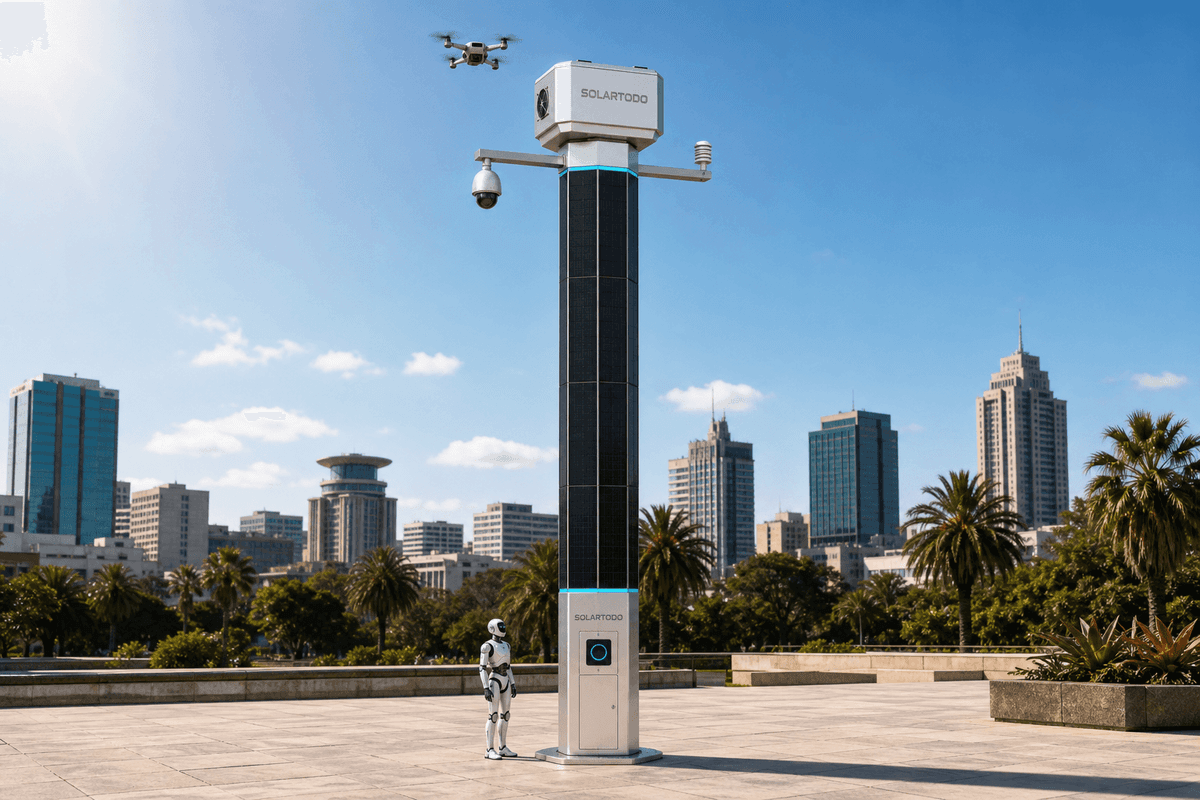
Harare Highveld Off-Grid Patrol Corridors: SOLARTODO Sentinel City AI Pole 59-Node Configuration Guide
Summary
Harare’s 1,479 m inland highveld setting, 16% national population share, and Zimbabwe’s 33 kV distribution context make a typical 59-node SOLARTODO Sentinel City AI Pole layout suitable for off-grid corridor sensing, drone service, and local event processing.
Key Takeaways
A Harare-ready Sentinel configuration should treat 59 poles, 30 m spacing, and local-only data handling as the minimum technical baseline.
- A typical 59-unit deployment at approximately 30 m spacing would cover about 1.77 km of priority perimeter, campus, industrial, or municipal corridor.
- Harare sits near 1,479 m elevation, so foundations and drone operating envelopes should be checked for highveld wind, storm runoff, and altitude-adjusted lift margin.
- According to ZESA Holdings (2026), Zimbabwe’s grid includes 400 kV transmission, 33 kV distribution networks, 50,000+ km of power lines, and 2.5M+ connected customers.
- The Sentinel pole is fully off-grid, using 2.8-3.2 kWp PV nameplate, realistic clear-sky DC peak of about 1.0-1.3 kW, and 5-20 kWh-class storage.
- Each node should process raw video and sensor streams locally; only de-identified event/status metadata should leave the pole.
- Environmental telemetry should include 9 channels: wind speed, wind direction, temperature, humidity, pressure, noise, PM10, PM2.5, and illuminance.
- Counter-UAS coordination must remain non-lethal and human-authorized, with detection, tracking, command coordination, soft net-capture, or close-approach deterrence only.
Market Context for Harare
Harare’s best-fit smart-pole opportunity is inland highveld resilience, not grid-powered roadside hardware, because Zimbabwe faces power reliability costs and city infrastructure renewal at the same time.
Harare is Zimbabwe’s capital and largest urban province. According to ZIMSTAT via UNFPA (2022), Zimbabwe had 15,178,979 people in April 2022, and Harare province accounted for 16% of the national population. That concentration means a limited number of well-positioned edge nodes can support dense public-space monitoring, municipal works depots, industrial estates, airport approaches, campuses, and controlled perimeters without requiring a nation-scale rollout claim.
The city is inland, elevated, and seasonally dry rather than coastal. According to the Japan Meteorological Agency ClimatView (2026), Harare Kutsaga is at 1,479 m elevation, with normal mean temperatures from about 14.0°C in July to 22.0°C in November. A technical configuration should therefore prioritise dust management in the dry months, thunderstorm drainage in the wet season, and altitude-aware drone payload planning rather than salt-air corrosion mitigation.
Grid and public procurement context also matter. According to ZESA Holdings (2026), Zimbabwe’s network includes 400 kV transmission lines, 33 kV distribution networks, more than 50,000 km of power lines, and more than 2.5 million connected customers. According to the World Bank (2024), Zimbabwe’s power shortages are estimated to cost 6.1% of GDP per year, and 2020 available generation was 1,585 MW against 1,900 MW peak demand. World Bank states, “Power shortages have a significant adverse impact,” which is why off-grid edge nodes are useful for priority sites where monitoring cannot depend on stable utility supply.
Municipal procurement is formal and competitive. Zimbabwe’s electronic Government Procurement System listed a 2026 City of Harare competitive-bidding road works tender for 6 km of asphalt overlay, with City of Harare as procuring entity. This does not imply a SOLARTODO deployment; it shows that Harare public works are handled through structured tendering, delivery periods, bid securities, and documented works packages. A Sentinel proposal should align with that procurement style: clear bill of materials, phased installation, local standards review, and acceptance tests.
Standards should be treated locally, not imported blindly. According to the Standards Association of Zimbabwe (2026), SAZ is Zimbabwe’s national standards body, is affiliated to IEC, and operates the WTO/TBT enquiry point for standards and conformity assessment. For electrical interfaces, Zimbabwe commonly uses 220-240 V, 50 Hz low-voltage practice, while the Sentinel pole itself remains an off-grid micro-station and does not require grid feed as its operating assumption.
Recommended Technical Configuration
A Harare priority-corridor package would use approximately 59 SOLARTODO Sentinel City AI Pole nodes across 1.77 km, configured as off-grid edge stations rather than utility-powered poles.
A typical 59-unit deployment in this profile would consist of SOLARTODO Sentinel City AI Pole nodes in the Sky Hub pole form, spaced at approximately 30 m for overlapping perimeter awareness, environmental sampling, and drone/robot service coverage. The spacing is appropriate for a controlled route, an industrial park boundary, a civic operations corridor, or a critical-facility perimeter; it should not be presented as a completed Harare project. Final pole count, exact spacing, foundation type, and battery size would remain subject to survey, line-of-sight modelling, civil design, and local authority approval.
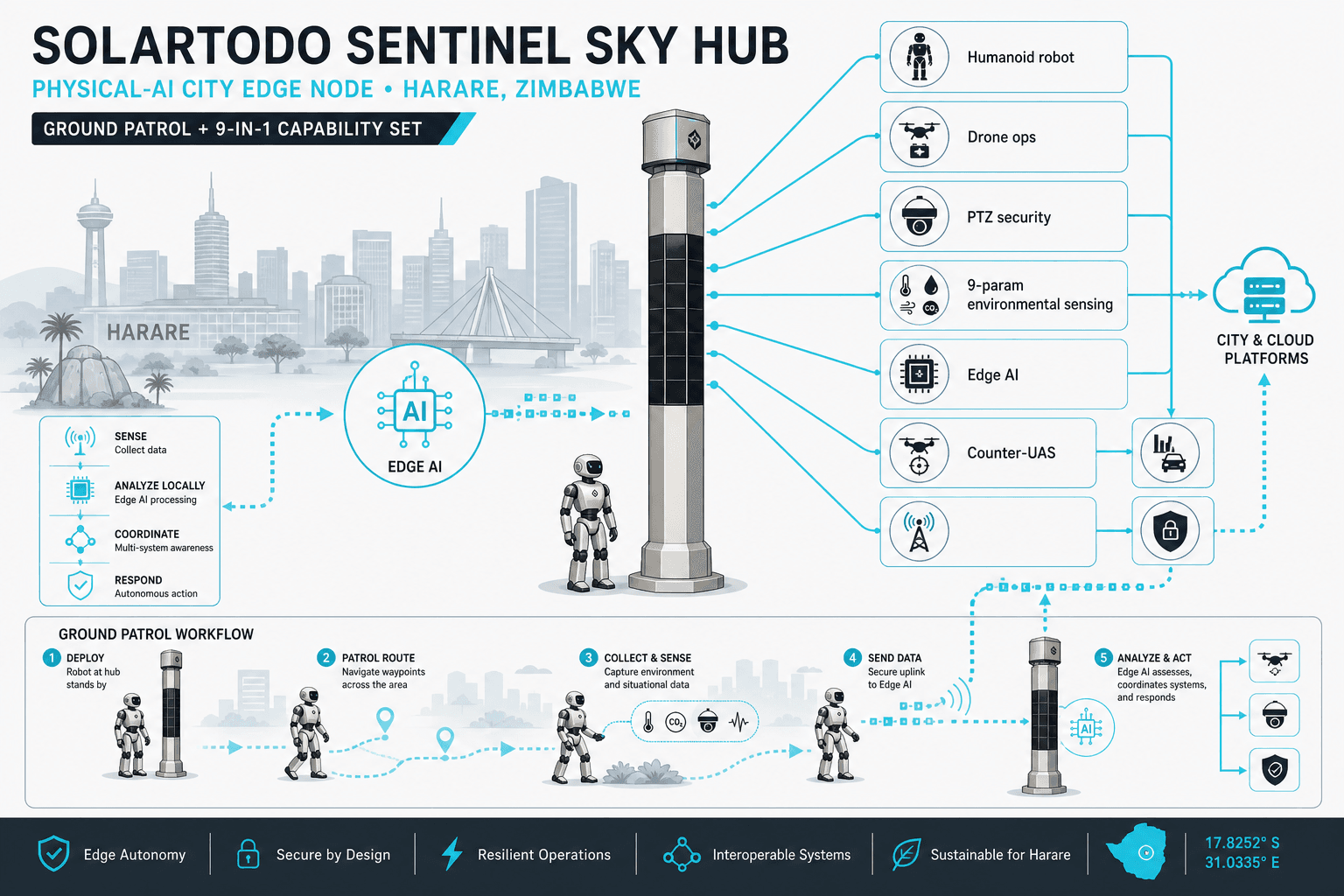
The recommended configuration is a pure smart-pole network: sensing, edge compute, battery-buffered energy, drone operations, ground robot support, and command-view integration. SOLARTODO should position this as a physical-AI city edge node line at /solutions, not as a conventional road asset. Raw video and sensor inputs stay on the pole for local inference; the command layer receives event summaries, health metrics, environmental readings, mission logs, and authorization requests.
For Harare, the main engineering choices are dust-resistant service access, seasonal stormwater clearance at the foundation, stable cellular/private-network backhaul, and route-by-route autonomy rules. Drone sorties should be scheduled around battery state, wind, precipitation, restricted airspace, and human authorization. Ground robot operations should focus on patrol, inspection, alarm approach, and return-to-base charging at the pole base.
Technical Specifications
The Harare specification should standardise every node around 2.8-3.2 kWp PV nameplate, 5-20 kWh storage, local AI inference, and 9-channel environmental monitoring.
- Product: SOLARTODO Sentinel City AI Pole, Sky Hub pole-form physical-AI city edge node.
- Quantity basis: approximately 59 units, project-based custom configuration, subject to engineering confirmation.
- Spacing basis: approximately 30 m between nodes, equivalent to about 1.77 km before site-specific offsets.
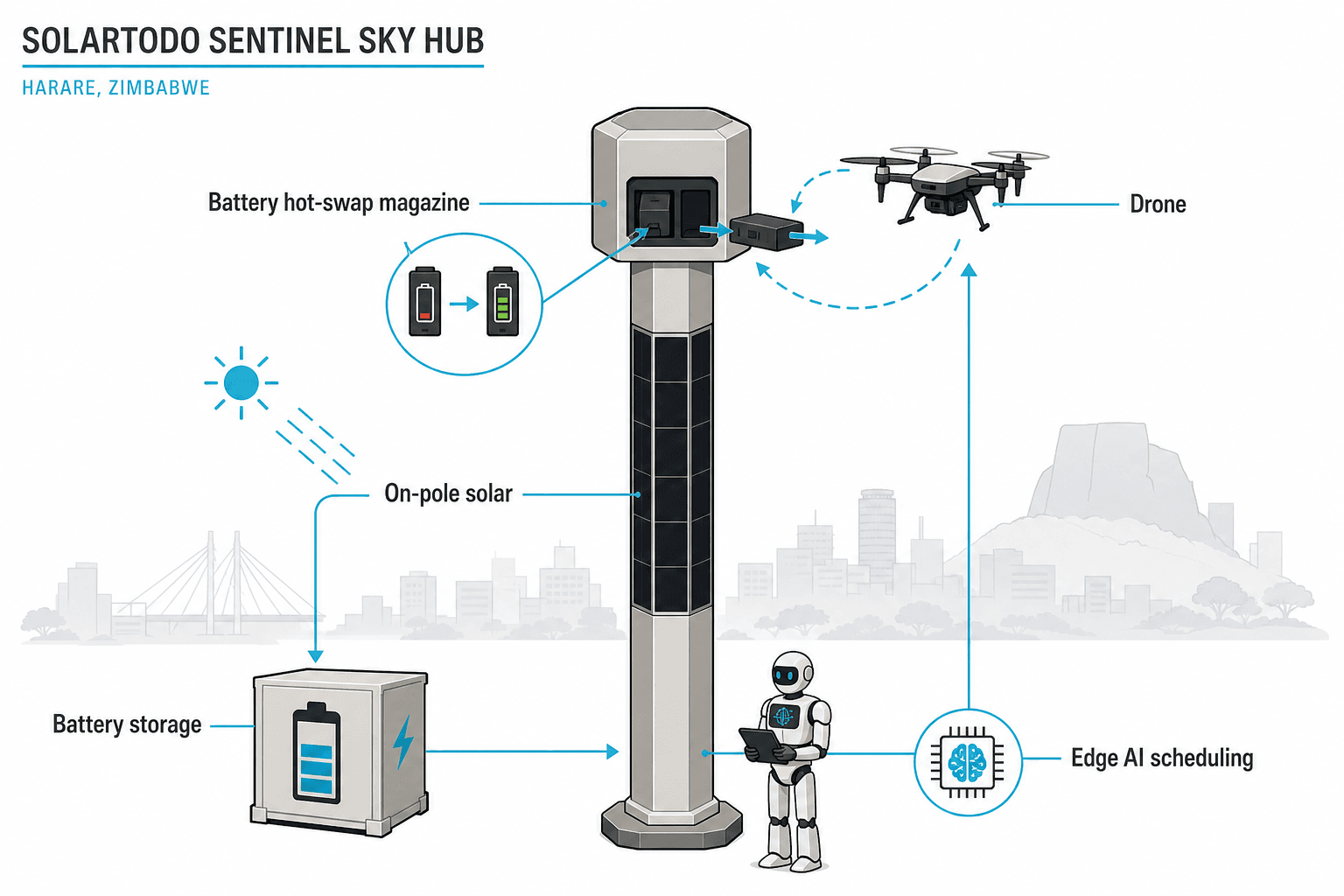
- Power architecture: fully off-grid, with on-pole solar replenishment and battery storage; no site utility feed is assumed.
- Solar replenishment: 2.8-3.2 kWp nameplate, realistic clear-sky DC peak around 1.0-1.3 kW, and about 7-10 kWh/day in high-irradiance conditions.
- Storage: 5-20 kWh-class battery buffer, selected by drone sortie frequency, robot charging duty cycle, compute load, and autonomy target.
- Edge compute: Jetson-class module for local inference, workload scheduling, event filtering, and mission orchestration.
- Drone functions: autonomous launch, route patrol, inspection, return, battery hot-swap, task queueing, fleet health, and mission logs.
- Ground robot functions: patrol, alarm response, inspection, air-ground coordination, and wireless return charging at the pole base.
- Sensing: PTZ-based local perception for anonymous vehicle count, crowd density, intrusion, and perimeter awareness.
- Environmental channels: wind speed, wind direction, temperature, humidity, atmospheric pressure, noise, PM10, PM2.5, and illuminance.
- Counter-UAS coordination: detection, tracking, operator-authorized response coordination, soft aerial net-capture, or close-approach deterrence; optional radar can be integrated only as a partner-sensor input.
- Data handling: designed for local processing and PDPL-LGPD-oriented workflows; raw video and sensor data remain on the pole by default.
According to IEC (2016), photovoltaic module safety qualification is handled under IEC 61730, while IEC 61215 covers terrestrial PV design qualification and type approval. According to SAZ (2026), Zimbabwe adopts and develops standards through national technical committees and is affiliated to IEC, so a Harare submission should map product declarations to local conformity review rather than relying only on overseas datasheets.
Implementation Approach
A 59-node Harare package would typically run through 5 phases: survey, engineering approval, CKD logistics, civil installation, and monitored commissioning.
Phase 1 should combine route survey, RF study, drone operating-envelope review, soil/foundation checks, stormwater observations, and authority consultation. Harare’s dense older commercial streets, industrial roads in Workington and Willowvale-type areas, and newer suburban corridors create different foundation and access conditions. The output should be a pole schedule, civil drawing pack, backhaul map, battery-duty model, and acceptance test plan.
Phase 2 should finalise engineering and procurement documents. Zimbabwe’s procurement environment favours clear lot descriptions, bid validity, delivery periods, and acceptance criteria; a Sentinel tender package should therefore define node count, spacing tolerance, autonomy days, communication SLA, event metadata format, safety boundaries, and maintenance response times. The City of Harare Master Plan 2025-2045 public-exhibition process also indicates that spatial proposals and municipal documents are reviewed through formal channels.
Phase 3 should ship in CKD or modular assemblies where practical, with batteries, compute modules, drone-service components, and sensor assemblies tracked by serial number. Phase 4 should cover foundations, pole erection, grounding/bonding where applicable, enclosure sealing, battery installation, communication commissioning, and route safety barriers. Phase 5 should verify local inference, environmental telemetry, drone dispatch, robot return charging, metadata-only reporting, authorization workflow, and fail-safe behavior under network outage.
Expected Performance & ROI
Expected ROI should be modelled over 5-8 years, using avoided trenching, reduced patrol labor, and outage-independent uptime as the main value drivers.
Because the Sentinel pole is fully off-grid, its ROI is not primarily a utility-bill saving story. The largest savings usually come from avoiding grid trenching, reducing manual patrol miles, shortening incident verification time, and consolidating multiple city-edge functions into one maintained node. According to IEA (2022), Africa is home to 60% of the world’s best solar resources but only 1% of installed solar PV capacity; IEA states, “Africa is home to 60% of the best solar resources globally.” That context supports solar replenishment, but the Harare design should still size batteries around duty cycle rather than promise unlimited self-sufficiency.
For a 59-node corridor, EPC modelling should compare three costs: civil works and installation, recurring patrol/security operations, and replacement/maintenance cycles. A practical payback screen is whether the combined value of 24/7 local event detection, drone inspection, robot patrol, and avoided utility dependency offsets capital expenditure within 5-8 years. According to the World Bank (2024), Zimbabwe’s electricity demand is projected to grow from 1,950 MW in 2022 to 5,177 MW by 2030, making off-grid resilience a material planning variable for critical sites.
Results and Impact
A properly engineered 59-node Harare corridor would prioritise 24/7 autonomous monitoring, metadata-only reporting, and fewer manual inspection trips without claiming completed deployment results.
Expected impact should be measured with operational KPIs, not marketing claims. Useful metrics include event verification time, drone sortie completion rate, robot return-charge success rate, local inference uptime, battery state-of-health, environmental data completeness, and false-alarm review rate. SOLARTODO should also track maintenance visits per node per year and compare them with the previous manual patrol baseline.
The strongest Harare fit is continuity under grid stress. According to the World Bank (2024), Zimbabwe’s historical outages reached 12-14 hours per day in 2020 during supply deficits, so a battery-backed off-grid pole can keep perimeter sensing and event reporting active when nearby loads are disrupted. That is a technical planning advantage, not a claim that every drone or robot mission can run continuously without energy scheduling.
Comparison Table
This comparison shows 3 deployment options for Harare, with the 59-node Sentinel configuration best suited to edge autonomy and off-grid operation.
| Option | Power Model | Core Functions | Harare Fit | Key Limitation |
|---|---|---|---|---|
| Conventional CCTV mast | Usually grid-fed | Camera backhaul and recording | Useful at fixed gates or buildings | Exposed to outages and often sends raw streams upstream |
| Standalone environmental station | Battery or small PV | Weather and air-quality telemetry | Good for PM10/PM2.5 sampling | Does not provide drone, robot, or C-UAS coordination |
| SOLARTODO Sentinel City AI Pole | Off-grid, 2.8-3.2 kWp PV nameplate plus 5-20 kWh storage | Local AI, drone service, robot support, 9-channel environmental sensing, metadata reporting | Strong for 59-node highveld corridors at ~30 m spacing | Requires civil survey, authorization workflow, and duty-cycle engineering |
Pricing & Quotation
A 59-node Harare quotation should be scoped by FOB, CIF, or EPC tier, with no unit price published before engineering confirmation.
SOLARTODO offers three pricing tiers for this product line: FOB Supply (equipment ex-works China), CIF Delivered (including ocean freight and insurance), and EPC Turnkey (fully installed, commissioned, with 1-year warranty). Volume discounts are available for large-scale deployments. Configure your system online for an instant estimate, or request a custom quotation from our engineering team at [email protected].
For Harare, the quotation should separate equipment, shipping, insurance, local civil works, route permits, commissioning, training, spare batteries, drone/robot maintenance, and optional partner-sensor integration. EPC pricing should also state assumptions for soil class, foundation depth, mobile-network availability, customs handling, site security during installation, and acceptance testing.
Frequently Asked Questions
These 10 questions cover the 59-node Harare configuration, expected timeline, EPC pricing route, maintenance, warranty, and technical limits.
Q1: Is the SOLARTODO Sentinel City AI Pole a smart streetlight? No. It is a pure smart pole for edge sensing, compute, drone service, robot operations, environmental monitoring, and command coordination. It should not be specified as a light fixture or municipal illumination replacement. For Harare, the correct use case is priority corridor autonomy, controlled perimeter monitoring, and metadata-based operations.
Q2: Why is approximately 59 units appropriate for Harare? Approximately 59 units at 30 m spacing cover about 1.77 km before site-specific offsets, which suits a focused corridor, campus edge, industrial perimeter, or civic operations route. The count should be treated as a configuration basis, not a completed deployment record. Final spacing depends on survey, access, sightlines, and foundations.
Q3: What power supply does each pole require? Each pole is designed as a fully off-grid micro-station with on-pole PV replenishment and battery storage. The PV surface has 2.8-3.2 kWp nameplate, while realistic clear-sky DC output is about 1.0-1.3 kW. High-power drone and robot tasks are scheduled against a 5-20 kWh-class battery buffer.
Q4: How long would installation normally take? A 59-node project would usually be planned in phases: survey and permits, engineering approval, CKD logistics, foundations, pole erection, commissioning, and operational training. A practical timeline depends on customs, civil works, weather, and local authority review. For planning, buyers should treat civil survey and foundation work as the schedule drivers.
Q5: What ROI model should Harare buyers use? ROI should compare capital cost against avoided trenching, reduced patrol labor, faster incident verification, consolidated sensing, and outage-independent operation over a 5-8 year planning horizon. The model should not depend only on solar energy savings. Harare’s grid-reliability context makes continuity value a major input.
Q6: What maintenance is required? Maintenance should include PV surface cleaning during dusty dry months, battery health checks, enclosure inspection after storms, drone hot-swap mechanism service, robot charging checks, firmware updates, sensor calibration, and event-log review. For a 59-node corridor, SOLARTODO should define spare-part kits, service intervals, and local technician training before shipment.
Q7: Can raw video leave the pole? By default, no. The architecture is designed for local processing, with raw video and sensor data retained on the pole. Only de-identified event metadata, status messages, health data, and operator-approved alerts should leave the node. This supports PDPL-LGPD-oriented design language without claiming certification.
Q8: Does the system include counter-UAS capability? Yes, but only within non-lethal and human-authorized boundaries. The pole can detect and track unauthorized drones, coordinate assessment, and command a friendly drone for soft aerial net-capture or close-approach deterrence. It must not be described as hard-kill, jamming, autonomous attack, or weapons-based technology.
Q9: How does Sentinel compare with a conventional camera mast? A conventional mast usually focuses on mounting a camera and sending video to a control room. The Sentinel pole adds local AI inference, environmental telemetry, drone operations, robot charging support, mission logs, battery-buffered off-grid operation, and metadata-only reporting. That broader architecture is stronger for Harare corridors where power and patrol continuity matter.
Q10: What warranty and EPC support should be requested? The required SOLARTODO pricing paragraph specifies EPC Turnkey with a 1-year warranty. Harare buyers should also request battery warranty terms, drone-service mechanism coverage, spare-part lead times, training scope, acceptance tests, and response-time commitments. Warranty validity should be tied to approved installation, maintenance schedule, and environmental operating limits.
References
The references below include 8 authoritative sources covering Zimbabwe population, Harare climate, grid context, standards, procurement, and Africa energy statistics.
- ZIMSTAT / UNFPA (2022): Zimbabwe 2022 Population and Housing Census preliminary results; national population 15,178,979 and Harare province 16% share. https://zimbabwe.unfpa.org/en/publications/2022-population-and-housing-census-preliminary-results
- Japan Meteorological Agency ClimatView (2026): Harare Kutsaga climate normals, coordinates, and 1,479 m station elevation. https://www.data.jma.go.jp/tcc/tcc/products/climate/climatview/
- World Bank (2024): Zimbabwe Economic Update on power shortages, 6.1% GDP cost, 1,585 MW available capacity, 1,900 MW peak demand, and demand growth to 5,177 MW by 2030. https://www.worldbank.org/en/country/zimbabwe/publication/country-economic-update-electrifying-zimbabwe-s-growth-through-reliable-and-universal-energy-access
- ZESA Holdings / ZETDC (2026): Zimbabwe grid infrastructure with 400 kV transmission, 33 kV distribution networks, 50,000+ km of lines, and 2.5M+ connected customers. https://www.zesaholdings.co.zw/ZETDC
- Standards Association of Zimbabwe (2026): SAZ as Zimbabwe’s national standards body, IEC-affiliated and WTO/TBT enquiry point. https://www.saz.org.zw/about-us/
- City of Harare (2025): Draft City of Harare Master Plan 2025-2045 public exhibition notice under the Regional, Town and Country Planning Act. https://www.hararecity.co.zw/news/read/notice-of-the-draft-city-of-harare-master-pla
- Zimbabwe Electronic Government Procurement System / PRAZ (2026): City of Harare competitive-bidding road works tender, 6 km asphalt overlay and commissioning package. https://egp.praz.org.zw/Indexes/viewLiveTenderDetails/78468
- IEA (2022): Africa Energy Outlook 2022; 600 million Africans without electricity and Africa holding 60% of the world’s best solar resources but 1% of installed solar PV capacity. https://www.iea.org/reports/africa-energy-outlook-2022/key-findings
Equipment Deployed
- 59 x SOLARTODO Sentinel City AI Pole Sky Hub pole-form edge nodes
- Approx. 30 m node spacing for about 1.77 km priority-corridor coverage
- 2.8-3.2 kWp on-pole PV nameplate per node
- 5-20 kWh-class battery storage per node, duty-cycle selected
- Jetson-class edge compute module for local inference and scheduling
- PTZ sensing package for anonymous vehicle count, crowd density, intrusion, and perimeter awareness
- 9-channel environmental monitoring: wind speed, wind direction, temperature, humidity, pressure, noise, PM10, PM2.5, illuminance
- Drone operations package with launch, route patrol, return, battery hot-swap, task queueing, and mission logs
- Ground robot operations support with patrol, alarm response, inspection, coordination, and wireless return charging
- Human-authorized non-lethal C-UAS coordination with optional partner-sensor input