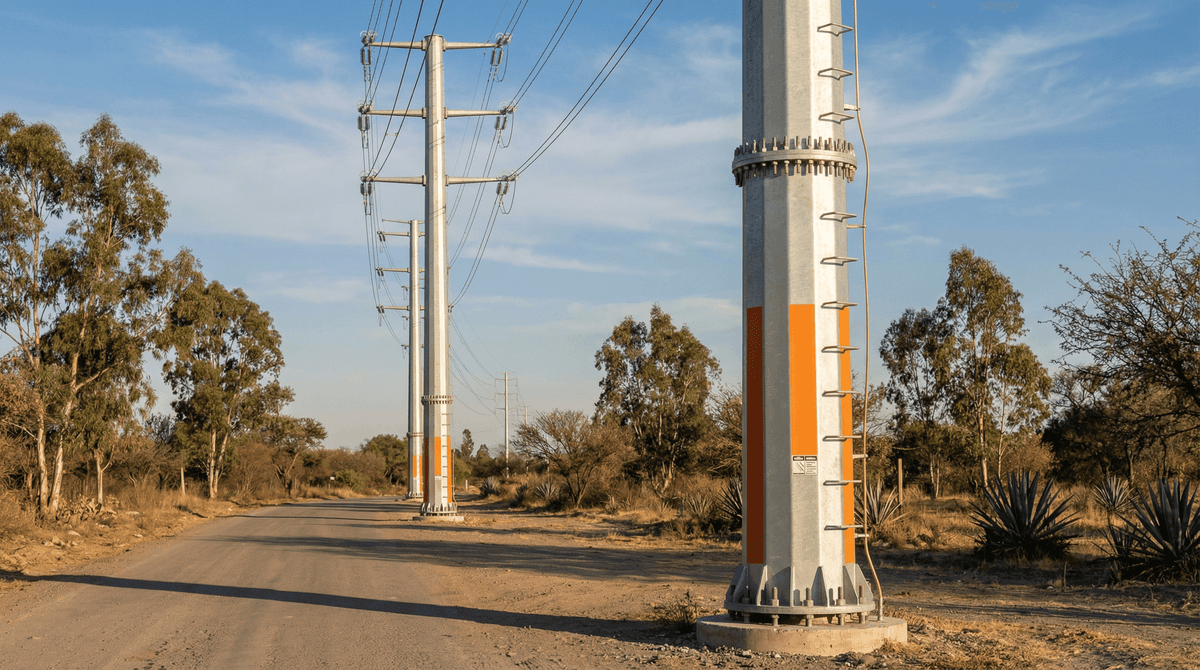
166-Unit 110kV Double-Circuit Transmission Line Project in Guadalajara: 30 m Tapered Steel Monopoles for Fast, Reliable Grid Expansion
Summary: SOLAR TODO supplied 166 tapered steel tubular monopoles, each 30 m high, for a 110 kV double-circuit transmission line in Guadalajara, Mexico. The line covered approximately 25 km with typical 150 m spans and ACSR 120 conductors. The structures were engineered to IEC 60826 Wind Class 2 at 30 m/s to support reliable performance, efficient installation, and reduced right-of-way impact.
Key Takeaways
- 166 transmission monopoles supplied: The project used 166 tapered steel tubular monopoles for a 110 kV double-circuit overhead line.
- 30 m structure height: Each pole was designed to meet clearance, loading, and routing needs for utility-grade transmission service.
- 25 km line with 150 m spans: The route configuration balanced structural efficiency, conductor sag control, and construction practicality.
- Designed to IEC 60826: Wind loading followed IEC 60826 Wind Class 2 with a basic wind speed of 30 m/s.
- Configured for ACSR 120: The pole system was matched to the electrical and mechanical demands of a 110 kV double-circuit application.
- Lower footprint than lattice towers: Tapered monopoles supported easier corridor planning in urban and peri-urban environments.
Project Overview
For this 110 kV double-circuit transmission line project in Guadalajara, Mexico, SOLAR TODO delivered a full package of 166 tapered steel tubular monopoles. Each structure was 30 m high and designed to support a route of approximately 25 km. The line used typical 150 m spans and ACSR 120 conductors, creating a practical configuration for medium-to-high voltage grid expansion.
This project reflects the increasing use of monopole transmission structures in corridors where land use, visual impact, and installation speed are critical. Compared with conventional lattice towers, tapered steel monopoles require a smaller base footprint and present a cleaner structural profile. These advantages are especially relevant in industrial corridors, suburban growth zones, and infrastructure upgrades near existing roads or utilities.
The structural design followed IEC 60826 using Wind Class 2 criteria at 30 m/s. This standards-based approach supported consistent loading verification and efficient use of steel without compromising reliability. The result was a transmission structure package focused on durability, constructability, and long-term network performance.
Technical Data and Main Specifications
Core Project Specifications
| Parameter | Project Value |
|---|---|
| Project Location | Guadalajara, Mexico |
| Transmission Voltage | 110 kV |
| Line Type | Double-circuit overhead transmission line |
| Structure Type | Tapered steel tubular monopole |
| Quantity Supplied | 166 units |
| Pole Height | 30 m |
| Approximate Line Length | 25 km |
| Typical Span Length | 150 m |
| Conductor Type | ACSR 120 |
| Circuit Configuration | Double circuit |
| Application | Utility transmission grid expansion |
| Wind Design Standard | IEC 60826 |
| Wind Class | Class 2 |
| Basic Wind Speed | 30 m/s |
Why Tapered Steel Tubular Monopoles Were Selected
Tapered steel tubular monopoles are increasingly preferred where corridor width and construction speed matter. Their single-shaft geometry reduces the land area required at each structure location, which can simplify right-of-way planning and reduce interference with nearby infrastructure. In dense or semi-urban routes, this can create measurable commercial and permitting advantages.
From a fabrication and logistics perspective, monopoles also support more standardized production and erection workflows. Compared with lattice towers, they involve fewer individual members, fewer field connections, and more predictable assembly sequencing. That can help EPC contractors improve schedule control and reduce site complexity across repeated installations.
Monopoles also offer a cleaner visual profile than multi-member lattice structures. This can be important where utilities must balance technical performance with public acceptance and municipal planning concerns. In the Guadalajara project, the 30 m tapered format delivered a strong balance between electrical clearance, structural capacity, and route-level aesthetics.
Engineering Design Considerations
Wind Loading and Structural Reliability
Wind is one of the primary design drivers for overhead transmission structures, especially on exposed routes and long linear corridors. IEC 60826 provides a recognized framework for evaluating meteorological loads and their interaction with conductors, insulators, and support structures. For this project, Wind Class 2 at 30 m/s established the basis for shell thickness, taper geometry, connection detailing, and foundation interface loading.
Because this was a double-circuit line, the poles had to resist more complex load combinations than a single-circuit arrangement. These included simultaneous wind action on multiple phases, longitudinal loads from conductor tension, and unbalanced conditions such as broken-wire scenarios. Proper structural modeling is essential in these cases to verify both serviceability and ultimate limit state performance.
Standards-based design also improves procurement confidence for utilities, consultants, and EPC firms. It creates a common technical basis for design review, bid comparison, and quality verification. By aligning with IEC methodology, the project supported stronger engineering transparency and long-term mechanical reliability.
Conductor, Span, and Clearance Coordination
The use of ACSR 120 conductors with 150 m spans required careful coordination between conductor behavior and structural capacity. Span length directly affects sag, tension, and electrical clearance under changing temperature and wind conditions. A well-matched pole-and-conductor system helps avoid both underdesign and unnecessary steel overuse.
For a 110 kV double-circuit line, conductor arrangement must also account for phase spacing, insulator swing, and structure envelope limitations. These factors become more demanding when two circuits are carried on the same support. The 30 m pole height provided the geometry needed to maintain clearances while keeping construction and maintenance practical.
Utilities increasingly expect suppliers to provide more than fabricated steel. They expect coordinated engineering around attachment points, load paths, hardware interfaces, and installation conditions. This project demonstrates that value by delivering a complete transmission support solution rather than a simple component supply package.
Foundation and Site Practicality
Although final foundation design depends on local geotechnical conditions, monopoles often simplify site layout because of their compact footprint. This can reduce excavation conflicts, improve access planning, and support installation in narrow corridors. Across a 166-unit project, even small efficiencies at each site can produce major schedule and cost benefits.
Repetitive structure geometry also helps construction teams standardize lifting methods, erection sequencing, and hardware installation procedures. This improves crew productivity and reduces the risk of field errors on long linear projects. For EPC contractors working under tight milestones, repeatability is a major operational advantage.
In Mexico and similar fast-moving infrastructure markets, constructability is a core procurement criterion rather than a secondary preference. Utilities and developers need structures that are technically compliant and practical to install. The Guadalajara project shows how steel monopoles can satisfy both requirements at scale.
Monopoles vs. Lattice Towers
Comparison for Utility Decision-Makers
| Criteria | Tapered Steel Monopoles | Conventional Lattice Towers |
|---|---|---|
| Footprint | Smaller base area, better for constrained corridors | Larger base footprint |
| Visual Profile | Cleaner and more compact appearance | More visually complex |
| Field Assembly | Fewer parts and connections | Higher component count and bolting work |
| Installation Speed | Often faster with standardized erection methods | Can require more field labor and assembly time |
| Right-of-Way Efficiency | Generally better in urban and peri-urban routes | Less efficient in constrained spaces |
| Typical Use Case | Compact corridors, upgrades, industrial zones | Long-established use in broad transmission networks |
Manufacturing and Quality Assurance
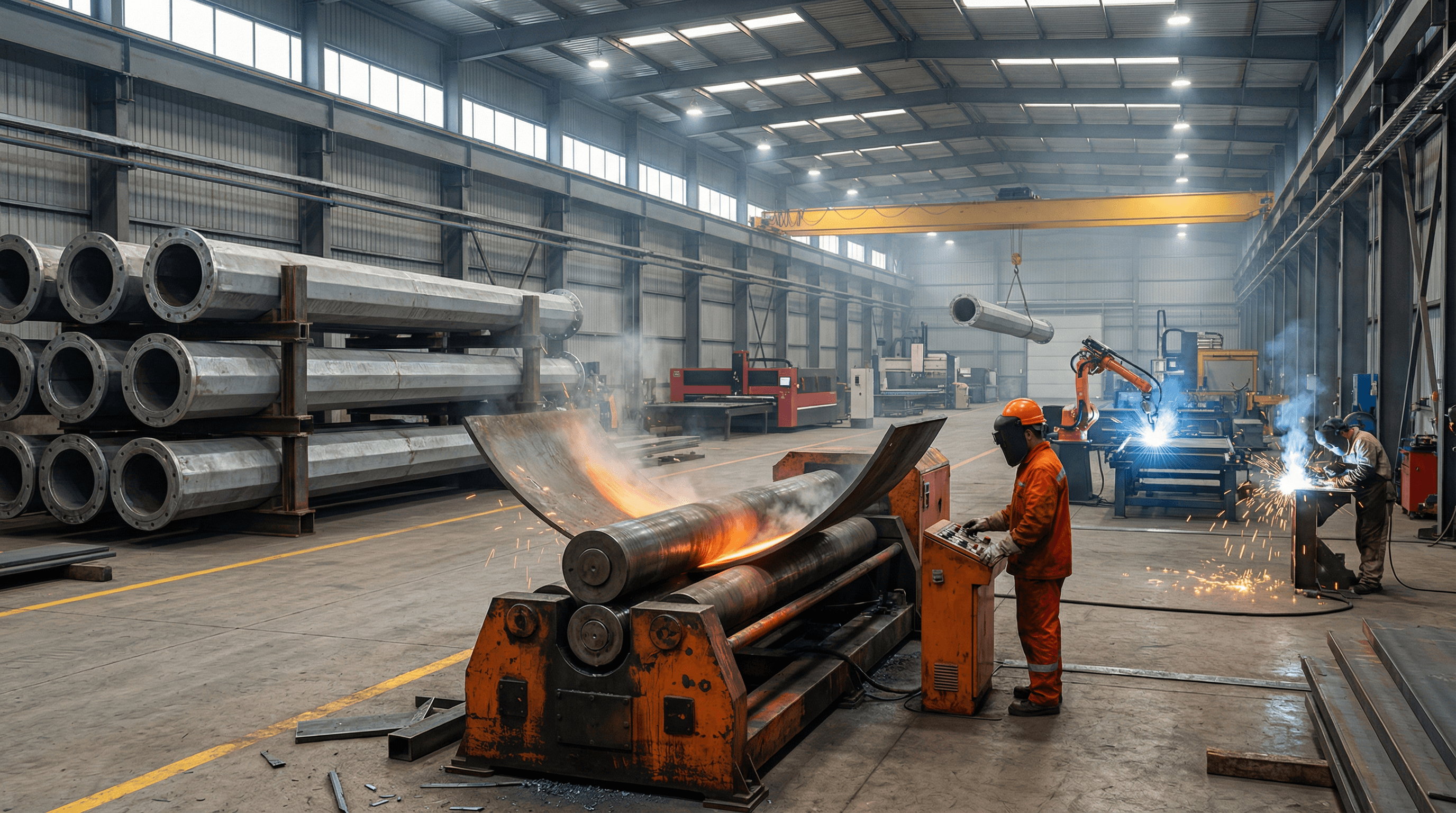
For transmission monopoles, manufacturing quality directly affects structural reliability, fit-up accuracy, and long-term coating performance. Tapered steel tubular poles require controlled forming, seam processing, dimensional verification, and connection precision. Any significant deviation can create erection difficulties or reduce confidence in long-term performance under cyclic loading.
In utility procurement, quality assurance is strongest when products are supplied against recognized standards and documented inspection procedures. Buyers typically evaluate not only material compliance, but also fabrication traceability, weld quality, dimensional tolerances, and protective coating consistency. This is especially important for projects with repeated structure counts, where small defects can scale into major field issues.
Industry references such as IEEE engineering guidance support broader expectations around power system reliability, line performance, and asset management. Organizations such as NREL also provide widely used research on infrastructure durability, resilience, and deployment best practices across grid and renewable energy sectors. Together, these references help frame the level of engineering rigor expected in modern utility supply chains.
Business Value for Utilities, EPCs, and Developers
Reduced Right-of-Way Impact
One of the strongest commercial advantages of monopoles is footprint reduction. A single tubular shaft generally requires less ground area than a conventional lattice base, which helps in constrained routes and reduces land-use disruption. This is particularly useful near roads, industrial facilities, and expanding suburban infrastructure corridors.
For developers and utilities, smaller footprints can support smoother stakeholder engagement and may simplify parts of the permitting process. They can also reduce restoration work after installation. Across 166 structures, these incremental benefits can become significant at the project level.
Faster Installation and Lower Field Complexity
Transmission projects are highly sensitive to schedule risk because weather, access, and labor availability can all affect delivery timelines. Tapered steel monopoles support more standardized erection workflows and reduce the number of members crews must handle in the field. That simplification can improve installation speed and reduce exposure to assembly errors.
For EPC contractors working under milestone-based contracts, this is a meaningful advantage. It also supports more predictable crane utilization and repeatable site safety procedures. In large linear projects, improved field efficiency can directly protect project margins.
Long-Term Asset Durability
Utility owners are focused not only on initial capex, but also on lifecycle performance and maintenance risk. Steel monopoles designed to recognized loading standards and produced under controlled quality systems can provide reliable long-term service. Their simpler geometry can also support straightforward inspection practices in many operating environments.
For a 110 kV line, structural durability has direct operational value because network continuity is critical. Avoiding emergency reinforcement, premature replacement, or outage-related repairs protects both asset economics and service reliability. This makes standards-based monopole solutions attractive for long-horizon infrastructure planning.
Relevant Standards and Industry References
IEC 60826 was the primary structural design reference for this project. It defines loading and strength criteria for overhead transmission lines and is widely used in international transmission engineering. For utilities and consultants, compliance with IEC-based design methodology is a strong indicator of engineering maturity and consistency.
IEEE publications remain highly influential in transmission line engineering, insulation coordination, grounding, reliability assessment, and utility asset management. While project-specific requirements vary by jurisdiction, IEEE guidance often informs technical review and acceptance practices in B2B procurement. It is especially relevant where owners seek alignment with established power system engineering methods.
NREL is not a transmission structure standards body, but its research is widely respected across grid modernization and renewable energy infrastructure. NREL publications are often used by developers and investors to benchmark resilience, lifecycle performance, and deployment strategies. In integrated grid and renewable development pipelines, this broader institutional credibility matters.
References
- IEC 60826, Design criteria of overhead transmission lines, International Electrotechnical Commission.
- IEEE Power & Energy Society, technical guidance and recommended practices related to transmission line design, reliability, grounding, and insulation coordination.
- ASTM A123/A123M, Standard Specification for Zinc (Hot-Dip Galvanized) Coatings on Iron and Steel Products, ASTM International.
- ASTM A572/A572M, Standard Specification for High-Strength Low-Alloy Columbium-Vanadium Structural Steel, ASTM International.
- ISO 1461, Hot dip galvanized coatings on fabricated iron and steel articles — Specifications and test methods, International Organization for Standardization.
- NREL, grid modernization and energy infrastructure research publications, National Renewable Energy Laboratory, https://www.nrel.gov/.
- IEC, International Electrotechnical Commission standards catalog, https://www.iec.ch/.
- IEEE, Institute of Electrical and Electronics Engineers standards and publications, https://www.ieee.org/.
Why This Guadalajara Project Matters
The Guadalajara 110 kV line is a strong example of how modern steel monopole systems can support real-world transmission expansion. With 166 units, 30 m pole height, a 25 km route, 150 m spans, and ACSR 120 conductors, the project combines the main variables that matter in utility delivery. It also demonstrates the practical value of designing to IEC 60826 Wind Class 2 at 30 m/s.
For utilities and EPC firms evaluating transmission support options, the case highlights a clear trend. Tapered steel tubular monopoles are not simply an alternative to lattice towers; in many applications, they are the preferred technical and commercial solution. They can reduce footprint, accelerate installation, and align with modern expectations around infrastructure aesthetics and project control.
As grid networks expand to serve industrial growth, urban load centers, and renewable energy interconnection, demand for efficient transmission structure systems will continue to rise. Projects like this one show how a well-engineered monopole package can help meet that demand with confidence. For buyers focused on reliability, constructability, and standards-based design, this is a relevant benchmark project.
FAQ
What was supplied for the Guadalajara 110 kV transmission project?
SOLAR TODO supplied 166 tapered steel tubular monopoles for a 110 kV double-circuit transmission line in Guadalajara, Mexico. Each pole was 30 m high and designed for utility-grade overhead line service. The structures supported an approximately 25 km route.
Why were tapered steel monopoles chosen instead of lattice towers?
Tapered steel monopoles offer a smaller footprint, a cleaner visual profile, and often faster installation than traditional lattice structures. These benefits are especially important in constrained corridors and industrial or peri-urban areas. They also help simplify site logistics and corridor planning.
What design standard was used for wind loading?
The project was engineered according to IEC 60826 with Wind Class 2 criteria at 30 m/s. This standard is widely recognized for overhead transmission line design. It helps ensure consistent structural verification under environmental loading conditions.
What conductor and span configuration were used?
The line used ACSR 120 conductors with typical 150 m spans. This combination was selected to support the electrical and mechanical requirements of a 110 kV double-circuit overhead transmission system. It also provided a practical balance between sag performance and structural loading.
How does a double-circuit line affect pole design?
A double-circuit line places more phases and hardware on each support structure than a single-circuit line. This increases vertical, transverse, and longitudinal loading demands, especially under wind and broken-wire conditions. As a result, the pole design must account for more complex load combinations and clearances.
What foundation considerations apply to this type of monopole project?
Final foundation design depends on geotechnical conditions, groundwater, uplift demands, and site access constraints. Monopoles typically benefit from a compact foundation footprint, which can simplify excavation and reduce corridor disruption. However, each location still requires site-specific verification of soil capacity and anchorage performance.
What corrosion protection methods are typically used for transmission monopoles?
Transmission monopoles commonly use hot-dip galvanizing as the primary corrosion protection system, often aligned with ASTM or ISO coating standards. In more aggressive environments, utilities may also specify duplex systems or additional protective treatments. Proper coating quality is essential for long-term durability and reduced maintenance frequency.
How do monopoles support faster installation?
Compared with lattice towers, monopoles generally involve fewer individual components, fewer field connections, and more repeatable erection procedures. This can reduce assembly time, simplify crane planning, and improve crew productivity. On multi-unit line projects, these efficiencies can materially improve schedule control.
What maintenance advantages do steel monopoles provide over time?
Steel monopoles have a simpler geometry that can make visual inspection and condition assessment more straightforward in many operating environments. Utilities can more easily review coating condition, connection integrity, and overall structural alignment. This supports practical asset management over the service life of the line.
How should utilities evaluate lifecycle cost for monopole transmission structures?
Lifecycle cost should include not only initial fabrication and installation, but also right-of-way impact, foundation complexity, erection time, coating durability, inspection needs, and long-term maintenance risk. In constrained corridors, monopoles can deliver commercial value beyond direct material cost. For many B2B buyers, total installed and operating value is more important than unit steel price alone.