Gaborone Solar Streetlight (Split-Type) Market Analysis: 8m Roadway Configuration Guide for 12m Corridors
Summary
Gaborone’s high solar resource, low-density road expansion pattern, and dry-season dust profile support split-type solar streetlighting for selected 12m road corridors. A typical 427-unit layout at 24m spacing with 8m poles and 100W LED heads suits tropical 5.5h sun conditions and 3-5 day backup design.
Key Takeaways
A practical answer for Gaborone is an approximately 427-unit split-type layout using 8m poles, 100W LED fixtures, 24m spacing, and 12m road width assumptions.
- Gaborone’s solar resource is strong enough for solar lighting design, with Botswana averaging about 3,200 hours of sunshine annually according to the World Bank Group (2020).
- For a 12m-wide urban road, a typical 427-unit deployment would use 8m hot-dip galvanized steel poles spaced at 24m intervals to balance uniformity and pole count.
- The specified configuration uses a 100W LED at 15,000 lm, paired with a 1140W Mono TOPCon panel and 12V/250Ah LiFePO4 battery box mounted externally on the pole body.
- The battery design targets 3-5 cloudy days of autonomy, with LiFePO4 rated at 3,500 cycles, 90% DoD, and an 8-year warranty.
- Smart controls matter in Gaborone because motion sensing can reduce energy use by about 30%, while dimming control can add about 15% savings in lower-traffic periods.
- The pole structure is specified for 45 m/s wind resistance, which is relevant for convective storm events and open-road exposure in Botswana’s semi-arid urban fringe.
- Applicable compliance references include CJJ 45-2015, IEC 60598, and IEC 62124, which frame luminaire safety, solar performance, and outdoor lighting practice.
- For municipal buyers comparing options, SOLAR TODO should be evaluated against grid-extension capex, trenching complexity, battery replacement cycles, and corridor-specific lux requirements rather than headline wattage alone.
Market Context for Gaborone
Gaborone’s streetlighting demand is shaped by a growing urban population, expanding peri-urban road network, and strong solar irradiance that supports off-grid lighting on selected corridors where trenching costs are high.
Gaborone is Botswana’s capital and largest urban center, with the city-region acting as the country’s main administrative and commercial node. According to Statistics Botswana (2022), the Greater Gaborone area continues to absorb population growth and commuting demand, which increases pressure on connector roads, parking areas, and mixed-use corridors. That matters for lighting because road safety needs often expand faster than medium-voltage distribution extensions.
Solar resource is a major advantage. According to the World Bank Group’s Global Solar Atlas (2020), Botswana has high photovoltaic potential, and much of the country records strong annual irradiation with roughly 3,200 sunshine hours per year. According to IRENA (2022), Botswana remains well positioned for distributed solar applications because high insolation improves energy yield and reduces seasonal charging risk compared with cloudier equatorial markets.
Grid economics also matter. According to the World Bank (2023), infrastructure expansion in African cities is often constrained by upfront capital for distribution extensions, trenching, and maintenance. For Gaborone, that means Solar Streetlight (Split-Type) systems make the most sense on roads where the cost of cable laying, transformer access, and fault repair is disproportionate to the lighting load.
Climate conditions in Gaborone support solar but also influence hardware selection. The city sits near latitude 24.65°S and experiences a semi-arid to tropical highland climate pattern with strong sun, seasonal rain, and dry-season dust. According to the Botswana Department of Meteorological Services (2023), summer thunderstorms and wind gusts require conservative structural design, while dust accumulation supports the case for top-mounted panels with cleaning access and internal cable routing.
For this reason, SOLAR TODO’s split-type architecture is a better technical fit than all-in-one products for arterial and collector roads. The separated panel, luminaire, and external battery box allow larger storage capacity, easier battery servicing, and clearer thermal management. In Gaborone, those factors matter more than compact appearance when the target is 3-5 days of backup and stable dusk-to-dawn operation.
Recommended Technical Configuration
For Gaborone’s 12m road corridors, the recommended fit is an approximately 427-unit split-type configuration using 8m poles, 100W LED heads, 24m spacing, and LiFePO4 storage sized for 3-5 cloudy days.
The standard size-class table normally places 50-60W LED on 7-8m poles and 80W LED on 8-10m poles, while 120W LED typically sits on 10-12m poles with 24V storage. However, the project-specific configuration provided here should be treated as a special roadway package for Gaborone’s corridor profile rather than a generic catalog bundle. In other words, this is a city-fit recommendation based on the supplied engineering brief, not a claim that all 8m roads should use the same electrical package.
A typical 427-unit deployment of this scale in Gaborone would consist of split-type solar streetlights arranged along a 12m-wide road with 24m spacing. That spacing is suitable for urban corridors where municipalities need fewer foundations than a 20m layout but still want acceptable uniformity from a 100W, 15,000 lm fixture mounted at 8m. For roundabouts, intersections, bus stops, and pedestrian conflict points, local photometric review would usually tighten spacing or increase overlap.
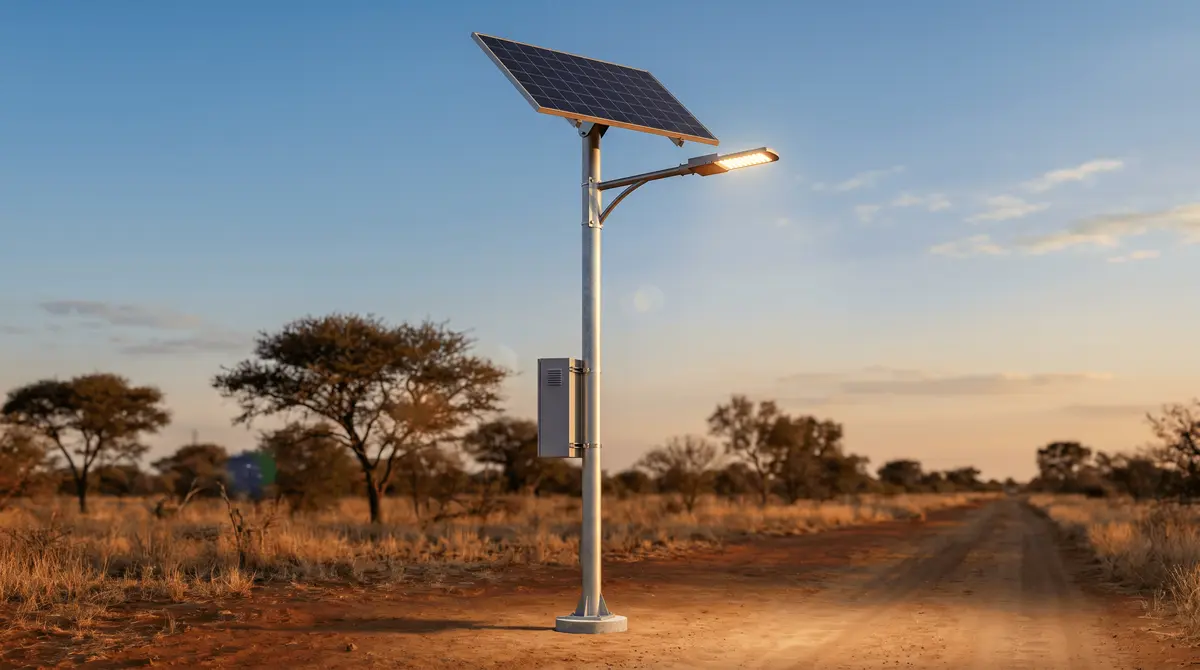
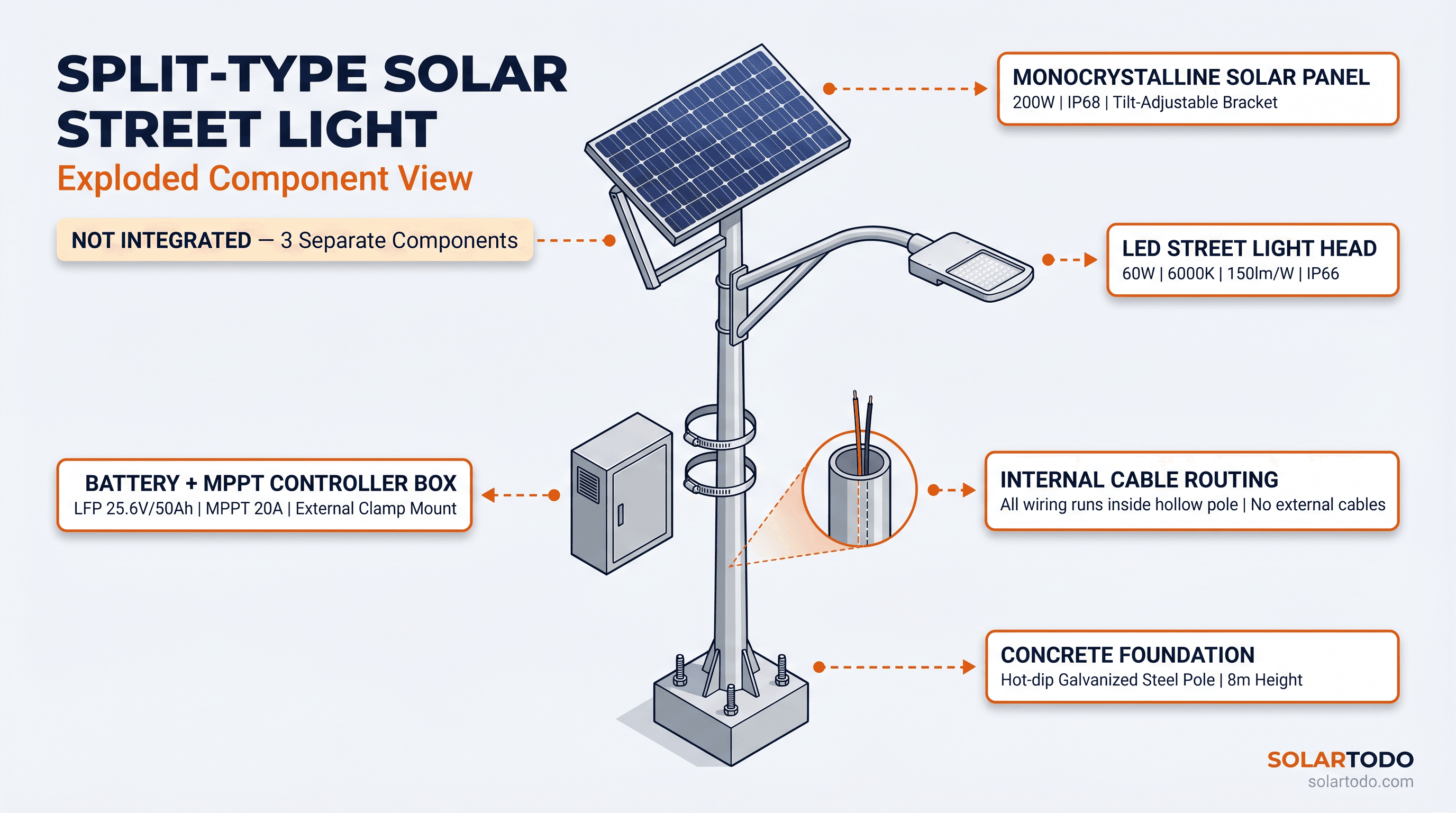
The recommended hardware set is the exact supplied configuration: 8m hot-dip galvanized steel pole, 45 m/s wind resistance, 25-year structural life, top-mounted 1140W Mono TOPCon panel on a tilted bracket, 100W LED head on side arm below the panel, and a visible external grey battery box clamped to the pole body. The battery is LiFePO4 12V/250Ah, with the MPPT controller inside the battery box and all wiring routed inside the pole. This arrangement is important because exposed surface cabling degrades faster under UV, dust abrasion, and tampering risk.
From a procurement perspective, SOLAR TODO should position this as a corridor-grade split-type system rather than a decorative solar garden light. The 100W luminaire output of 15,000 lm and 150 lm/W efficacy is appropriate where vehicle visibility, shoulder definition, and junction recognition are more important than ornamental lighting. In Gaborone, that typically includes distributor roads, access roads to public facilities, logistics yards, and municipal parking edges.
For buyers comparing pure solar and hybrid options, the supplied configuration is pure solar. That is consistent with Gaborone’s strong sun profile and avoids turbine maintenance. A wind-solar hybrid may still be considered for exposed ridges or open institutional sites, but for most urban roads in Gaborone, pure solar remains the simpler and lower-maintenance recommendation.
Technical Specifications
The specified Gaborone corridor package is an 8m split-type solar streetlight with 100W LED, 1140W TOPCon panel, 12V/250Ah LiFePO4 battery, 24m spacing, and compliance references including IEC 60598 and IEC 62124.
- Product type: Solar Streetlight (Split-Type), not integrated/all-in-one
- Recommended application: 12m-wide urban road corridors, parking edges, secondary distributor roads
- Typical deployment scale: approximately 427 units
- Pole height: 8m
- Pole material: hot-dip galvanized steel
- Structural wind resistance: 45 m/s
- Structural design life: 25 years
- Solar module placement: at the very top of pole on tilted bracket
- Panel mounting rule: panel sits on top; pole does not penetrate through panel center
- Solar module rating: 1140W
- Solar cell technology: Mono TOPCon
- Module efficiency: 23%
- Module degradation: 0.3% per year
- Module warranty: 30 years
- LED luminaire power: 100W
- Luminous flux: 15,000 lm
- Luminous efficacy: 150 lm/W
- CRI: >70
- Lamp position: side arm below solar panel
- Battery chemistry: LiFePO4 / LFP
- Battery capacity: 12V/250Ah
- Battery energy density: 160 Wh/kg
- Battery cycle life: 3,500 cycles
- Depth of discharge: 90%
- Battery warranty: 8 years
- Battery box position: externally mounted on pole body
- Battery box appearance: visible grey box clamped to pole, not inside base
- Controller type: MPPT
- Controller location: inside battery box
- Cable routing: all wiring inside pole, no visible external wires
- Backup autonomy: 3-5 cloudy days
- Operating mode: dusk-to-dawn automatic control
- Smart features: motion sensor plus dimming control
- Expected control savings: motion sensor about 30%; dimming about 15%
- Climate basis: tropical design assumption with 5.5 peak sun hours
- Spacing: 24m
- Road width basis: 12m
- Standards basis: CJJ 45-2015 / IEC 60598 / IEC 62124
Implementation Approach
A municipal rollout in Gaborone would typically proceed in 5 phases over about 12-20 weeks, from corridor survey to commissioning, depending on customs lead time and civil access conditions.
Phase 1 is corridor assessment and lighting design. This usually includes road width confirmation at 12m, pole spacing verification at 24m, traffic classification, and a photometric check for intersections and pedestrian crossings. According to IEC 60598 practice, fixture safety and mounting integrity should be reviewed together with local foundation loading and maintenance access.
Phase 2 is engineering and procurement. For a 427-unit package, buyers normally lock pole drawings, battery-box dimensions, anchor-bolt templates, and cable routing details before production starts. SOLAR TODO should also confirm that the top-mounted 1140W panel bracket does not interfere with side-arm geometry or maintenance reach at 8m.
Phase 3 is logistics and site preparation. Split-type systems are often shipped in component form to reduce container inefficiency, then assembled near site. Foundations, anchor cages, and curing schedules typically take 2-4 weeks, and dry-season installation is preferable in Gaborone to reduce excavation delays from storm runoff.
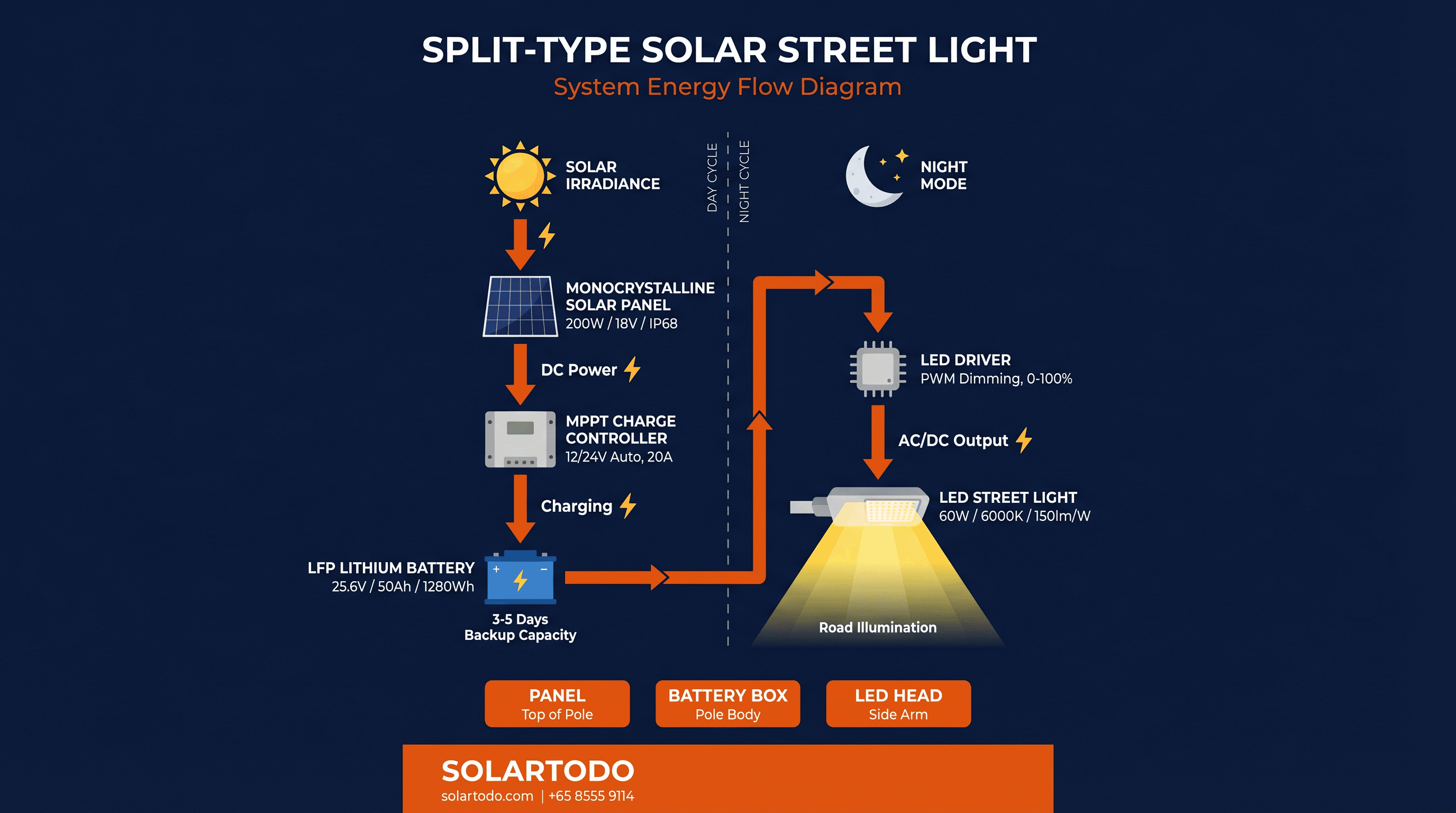
Phase 4 is erection and electrical assembly. The correct sequence is foundation check, pole lifting, side-arm and luminaire mounting, top-bracket and panel installation, battery-box clamping, internal cable termination, and MPPT parameter setup. Because all wiring remains inside the pole, the installation team should inspect grommets, gland sealing, and anti-abrasion protection before energization.
Phase 5 is commissioning and acceptance. This includes dusk-to-dawn verification, motion sensor response, dimming schedule validation, battery charging confirmation, and sample lux measurement on representative spans. A practical acceptance plan in Gaborone would also include a dust-cleaning protocol and a battery health inspection interval at 6-12 months.
Expected Performance & ROI
In Gaborone, split-type solar streetlights can reduce trenching-dependent lighting capex and avoid grid energy charges, while payback commonly depends on civil works offset, battery replacement timing, and annual maintenance discipline.
According to IEA (2023), public lighting remains one of the most visible municipal electricity loads, and efficient LED systems materially reduce lifecycle cost compared with legacy sodium fixtures. According to NREL (2021), LED efficacy improvements and control strategies such as dimming and occupancy-based response are central to lowering operating energy in outdoor lighting. In this configuration, the 100W LED at 150 lm/W starts from an efficient luminaire baseline before control savings are applied.
The smart-control package improves the economics. Motion sensing is specified to save about 30%, and dimming control adds about 15% in low-demand periods. These savings are not additive in a simple straight line, but they do reduce daily battery discharge and can extend useful battery life by lowering average cycling stress.
Battery chemistry is also important for ROI. LiFePO4 at 3,500 cycles and 90% DoD is generally better suited to municipal assets than NCM at 2,000 cycles for this duty pattern. According to IRENA (2023), lithium iron phosphate is widely favored in stationary applications because cycle life and thermal behavior are often more important than maximum energy density.
For Gaborone, expected payback versus grid-connected streetlighting is usually strongest where trenching distances are long, reinstatement costs are high, or utility connection timelines are uncertain. In those cases, a solar streetlight can avoid cable theft exposure and recurring electricity bills. In dense central roads with existing ducts and nearby feeders, grid-tied LED poles may still remain competitive, so corridor-level screening is necessary.
A realistic municipal evaluation should use a 10-year total-cost-of-ownership model. That model should include pole life at 25 years, module warranty at 30 years, battery warranty at 8 years, cleaning frequency tied to dust conditions, and component replacement labor. SOLAR TODO should therefore be compared not just on initial supply scope but on expected lumen retention, battery replacement interval, and maintenance access time per pole.
Results and Impact
For Gaborone, the main expected impact is improved roadway visibility on 12m corridors without trenching, using approximately 427 autonomous poles with 3-5 day backup and internal cable protection.
The first operational result is resilience. Each pole operates independently, so a feeder fault does not black out an entire corridor. That matters on urban-edge roads and municipal expansions where utility outages or delayed service connections can otherwise postpone lighting availability.
The second result is lower recurring energy cost. Because the system is off-grid and dusk-to-dawn automatic, municipalities avoid monthly electricity charges for the lighting load. According to the World Bank (2023), reducing dependence on grid extension can improve service delivery speed in rapidly growing urban areas.
The third result is maintenance visibility. The external battery box makes inspection faster than concealed-base designs, while internal wiring reduces tampering and weather exposure. In Gaborone’s dusty environment, that combination can shorten routine inspection time and simplify fault isolation compared with compact all-in-one units where battery access is more restrictive.
Comparison Table
For Gaborone buyers, the best comparison is between the specified 8m split-type package, a smaller 60W class solar unit, and conventional grid-fed LED poles on roads of similar 12m width.
| Parameter | Specified Gaborone Split-Type | Smaller Solar Unit | Grid-Fed LED Pole |
|---|---|---|---|
| Typical use case | 12m road / distributor corridor | Walkway / minor lane | Existing electrified road |
| Pole height | 8m | 6-7m | 8-10m |
| LED power | 100W | 30-60W | 90-120W |
| Luminous flux | 15,000 lm | ~4,500-9,000 lm | ~12,000-18,000 lm |
| Energy source | Solar only | Solar only | Utility grid |
| Solar module | 1140W TOPCon | 60-100W typical | N/A |
| Battery | 12V/250Ah LiFePO4 | 12V/60-100Ah typical | N/A or backup only |
| Backup autonomy | 3-5 days | 2-3 days typical | Grid-dependent |
| Civil works | Foundation only | Foundation only | Foundation + trenching + cabling |
| Cable theft risk | Low | Low | Higher where copper is exposed |
| Maintenance focus | Cleaning + battery health | Cleaning + battery health | Driver, cable, feeder faults |
| Best fit in Gaborone | Expansion corridors, parking edges | Parks, paths, compounds | Dense roads with nearby feeder access |
Pricing & Quotation
SOLAR TODO offers three pricing tiers for this product line: FOB Supply (equipment ex-works China), CIF Delivered (including ocean freight and insurance), and EPC Turnkey (fully installed, commissioned, with 1-year warranty). Volume discounts are available for large-scale deployments. Configure your system online for an instant estimate, or request a custom quotation from our engineering team at [email protected].
For specification review, buyers can also compare this corridor package with the standard Solar Streetlight (Split-Type) line and then contact us for pole drawings, foundation loads, and battery-box dimensions.
Frequently Asked Questions
Direct answers for Gaborone buyers usually center on pole spacing, battery life, ROI, maintenance, and whether split-type solar is better than grid extension on a 12m road.
Q1: Is this a split-type system or an all-in-one solar streetlight? This is a split-type system. The solar panel sits at the top of the pole on a tilted bracket, the LED head is mounted on a side arm below it, and the LiFePO4 battery is housed in an external box on the pole body. That layout supports larger storage and easier maintenance than compact all-in-one units.
Q2: Why is split-type recommended for Gaborone instead of integrated solar lights? Gaborone has strong sun, but it also has dust, summer storms, and corridor lighting needs that often exceed walkway-class products. Split-type systems allow a larger battery, a larger panel, internal cable routing, and easier service access. For 8m roadway poles and 3-5 days of backup, that architecture is usually the safer municipal choice.
Q3: What configuration is recommended for a 12m-wide road in Gaborone? The supplied recommendation is approximately 427 units using 8m hot-dip galvanized poles, 100W LED fixtures, 1140W TOPCon panels, and 12V/250Ah LiFePO4 batteries at 24m spacing. This is a corridor-grade package intended for road sections where trenching or utility connection is costly or slow.
Q4: How long would a project like this typically take to deliver and install? A typical program of this scale would often take about 12-20 weeks, depending on production queue, ocean freight, customs clearance, foundation curing, and site access. The installation sequence usually includes survey, civil works, pole erection, internal wiring checks, controller setup, and dusk-to-dawn commissioning across sample sections before full handover.
Q5: What payback period should municipalities expect? Payback varies by corridor. It is usually shortest where grid extension requires trenching, reinstatement, feeder upgrades, or long service connections. In those cases, solar can avoid both utility capex and recurring electricity bills. A 10-year total-cost-of-ownership model is the right method, with battery replacement, cleaning, and labor included rather than relying on a simple equipment-only comparison.
Q6: How much maintenance does this type of solar streetlight require? Maintenance is moderate and predictable. In Gaborone, the main tasks are panel cleaning for dust, battery health checks, bracket and fastener inspection, and sensor/controller verification. A 6-12 month inspection cycle is common, with extra cleaning after dusty periods. Internal wiring reduces exposure, and the external battery box makes service faster than hidden-base layouts.
Q7: Why use LiFePO4 instead of NCM lithium in this design? LiFePO4 is generally preferred for municipal solar lighting because cycle life and thermal stability matter more than compact size. Here the battery is rated at 3,500 cycles and 90% DoD, with an 8-year warranty. That is typically better aligned with dusk-to-dawn streetlight duty than NCM packs with shorter cycle life.
Q8: Does the system work during cloudy weather? Yes, the design target is 3-5 days of cloudy-weather backup. That autonomy depends on battery health, control settings, actual nightly runtime, and local irradiance. Gaborone’s strong annual solar resource helps recharge performance, but municipalities should still use dimming schedules and cleaning plans to protect winter and storm-season reliability.
Q9: Are there visible wires on the pole? No. The specified configuration requires all wiring to run inside the pole, with no visible external cables on the pole surface. This improves appearance, reduces tampering risk, and limits UV and weather exposure. It also makes the system more suitable for public roads than low-cost solar lights with external cable loops.
Q10: What standards should buyers ask suppliers to comply with? For this configuration, the key references are CJJ 45-2015, IEC 60598, and IEC 62124. Buyers should also request structural calculations for 45 m/s wind loading, luminaire photometric data, battery cycle documentation, and galvanization details. Those documents matter more in procurement than broad claims about brightness or battery life.
Q11: Can this system be customized for parking lots or lower-traffic roads? Yes. The same split-type platform can be adjusted by changing pole height, optics, spacing, and control logic. For lower-traffic zones, buyers often lower wattage or use more aggressive dimming. For parking lots, the same 8m class can work, but spacing and beam distribution should be checked against stall layout and pedestrian movement.
Q12: How should buyers request a quotation from SOLAR TODO? The most efficient approach is to send road width, target spacing, pole height, climate assumptions, and whether the corridor is municipal, industrial, or residential. Buyers can review the Solar Streetlight (Split-Type) page first, then contact us for a quotation package including drawings, compliance documents, and shipping options.
References
A practical Gaborone recommendation should be grounded in public solar-resource data, municipal lighting standards, and internationally recognized electrical and PV references.
- World Bank Group (2020): Global Solar Atlas, Botswana resource mapping showing high photovoltaic potential and strong annual solar yield.
- Statistics Botswana (2022): Population and Housing Census reports covering Gaborone and Greater Gaborone urban growth patterns relevant to road and public-lighting demand.
- Botswana Department of Meteorological Services (2023): National climate information on seasonal rainfall, temperature, and storm conditions relevant to solar streetlight design.
- IEC (2020): IEC 60598, luminaire safety requirements for lighting equipment used in outdoor applications.
- IEC (2021): IEC 62124, photovoltaic stand-alone system design verification and performance considerations relevant to off-grid solar lighting.
- IEA (2023): Energy Efficiency reports discussing LED lighting performance and public-sector electricity savings potential.
- IRENA (2023): Battery storage and distributed renewable guidance noting the suitability of LiFePO4 chemistry for stationary energy storage applications.
- CJJ (2015): CJJ 45-2015, urban road lighting design and application reference used in municipal streetlighting practice.
According to World Bank Group (2020), Botswana has strong solar resource conditions suitable for distributed PV applications. According to Statistics Botswana (2022), Gaborone’s urban growth continues to shape infrastructure demand. IEC states, "Luminaires shall be so designed and constructed that in normal use they function safely," underscoring the relevance of IEC 60598. IEA states, "Lighting is one of the largest and most visible uses of electricity in buildings and public infrastructure," which is why control strategy and efficacy matter in municipal procurement.
SOLAR TODO should therefore be assessed on documented compliance, maintainability, and corridor-level performance rather than generic solar-light marketing claims.
Equipment Deployed
- 427 × Solar Streetlight (Split-Type), roadway configuration
- 8m hot-dip galvanized steel pole, 45 m/s wind resistance, 25-year design life
- 1140W Mono TOPCon solar panel, 23% efficiency, 0.3%/yr degradation, 30-year warranty
- 100W LED luminaire, 15,000 lm, 150 lm/W, CRI >70
- Side arm mounting below top solar panel bracket
- 12V/250Ah LiFePO4 (LFP) battery, 160 Wh/kg, 3,500 cycles, 90% DoD, 8-year warranty
- External grey battery box clamped to pole body
- MPPT controller installed inside battery box
- Internal pole wiring with no visible external cables
- Motion sensor control, approx. 30% energy saving
- Dimming control, approx. 15% energy saving
- Dusk-to-dawn automatic switching
- 24m pole spacing for 12m road width
- Compliance basis: CJJ 45-2015 / IEC 60598 / IEC 62124