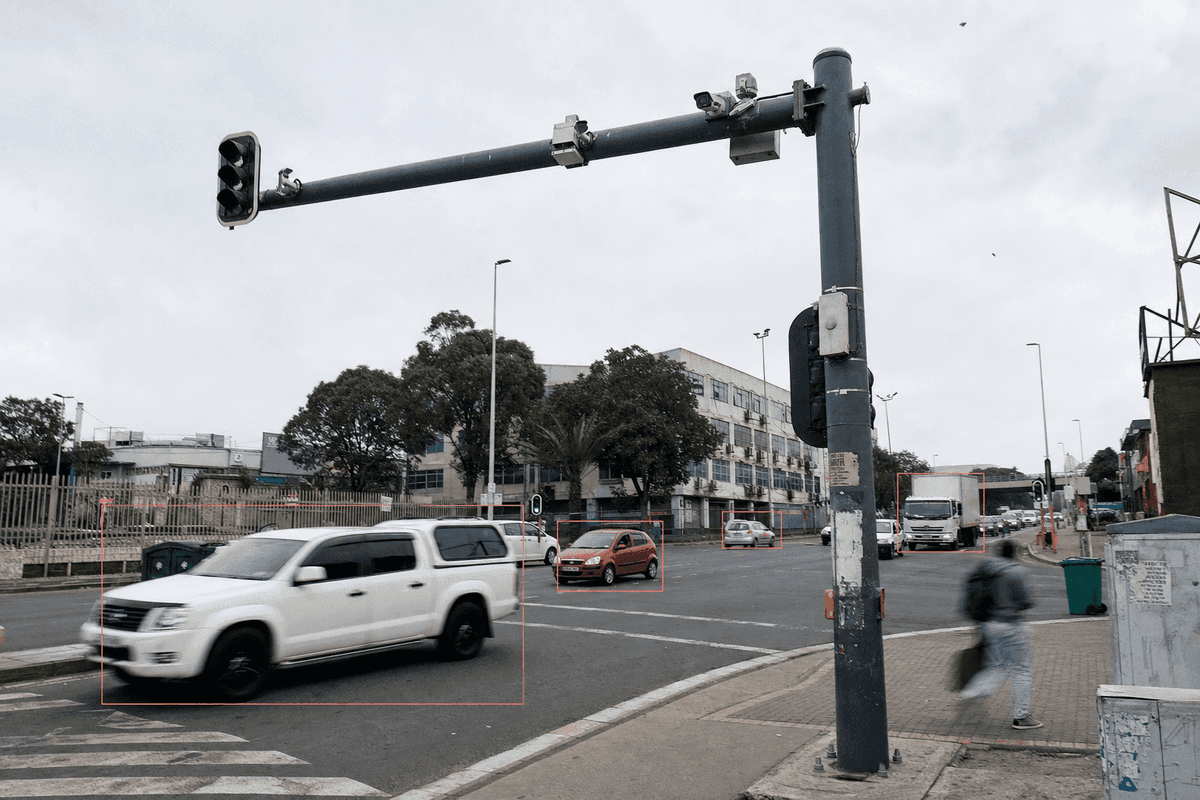
Durban Smart Traffic System Market Analysis: 16-Intersection 8m Pole Configuration Guide
Summary
Durban’s urban traffic profile, port logistics pressure, and rainfall-heavy coastal climate make a 16-intersection Smart Traffic System configuration technically suitable, using approximately 8m hot-dip galvanized poles, 4K AI vision, 77GHz radar, and 5G/fiber backhaul under NTCIP and GB 25280.
Key Takeaways
- Durban’s municipal population is approximately 3.9 million, which supports a strong need for corridor-level adaptive traffic control at major junction clusters rather than isolated signal upgrades alone.
- According to Statistics South Africa (2022), eThekwini remains one of South Africa’s largest metropolitan economies, so a typical 16-intersection deployment would target freight, commuter, and pedestrian conflict points.
- The recommended hardware class for Durban is 16 intersections × 8m L-arm dark-grey hot-dip galvanized steel poles, with approximately 4-12 poles per intersection depending on approach geometry.
- Each pole combines 4K AI camera analytics with 98% detection accuracy, 77GHz mmWave radar, LED fill light, and LED signal head, with edge processing on NVIDIA Jetson and response under 50ms.
- A practical communications design would use dual-path 5G/fiber backhaul to a TrafficGPT central platform, allowing natural-language traffic queries and centralized incident review across all 16 intersections.
- Durban’s humid subtropical climate and coastal corrosion exposure make hot-dip galvanizing and dark-grey industrial coating important for lifecycle protection over a typical 10-15 year municipal asset horizon.
- A phased implementation for 16 intersections would typically run about 4-8 months, including survey, civil works, pole erection, controller integration, and adaptive signal tuning under NTCIP and GB 25280.
- Based on international intelligent transport benchmarks, a properly tuned adaptive system in Durban could reasonably target 10-25% delay reduction, faster incident alerting, and lower manual enforcement workload at high-conflict junctions.
Market Context for Durban
Durban is a strong fit for smart intersection control because the city combines high commuter volumes, major freight movement, and dense pedestrian activity within one metropolitan road network. According to the eThekwini Municipality Integrated Development Plan (2024), the municipality serves roughly 3.9 million residents across a large urban area, while the Port of Durban remains a strategic logistics node that adds heavy vehicle pressure to arterial corridors. That mix matters because signal timing problems in freight cities are not only commuter issues; they also affect port access, bus reliability, and emergency response times.
According to Statistics South Africa (2022), eThekwini is among the country’s largest metro economies, with substantial daily travel demand linked to employment and trade. According to the South African National Roads Agency SOC Limited, Durban’s regional road environment includes national and metropolitan links that carry both passenger vehicles and commercial traffic into the port and industrial zones. For a Smart Traffic System, this usually means intersection technology must detect mixed traffic classes, including pedestrians, minibuses, trucks, motorcycles, and turning vehicles, rather than relying only on inductive loops or fixed-time plans.
Climate also affects the hardware choice. According to the South African Weather Service, Durban has a humid subtropical climate with high summer rainfall and coastal humidity. Those conditions increase the value of hot-dip galvanized steel, sealed electronics housings, and radar-assisted detection that remains useful during rain, spray, and low-visibility periods. A coastal city also benefits from minimizing field equipment complexity, because corrosion and moisture can raise maintenance frequency if the pole and enclosure materials are underspecified.
Telecom availability supports centralized traffic intelligence. According to ICASA and major operator coverage maps, Durban has broad 4G and 5G urban coverage in core municipal zones, while fiber access is available in many business and transport corridors. That supports the recommended 5G/fiber architecture for SOLAR TODO Smart Traffic System deployments, where edge devices process video and radar locally on NVIDIA Jetson, then send events, metadata, and control data to a central TrafficGPT platform.
The policy direction also aligns with adaptive traffic systems. The National Department of Transport in South Africa has consistently emphasized road safety, congestion reduction, and intelligent transport modernization in urban corridors. As the International Telecommunication Union states, "Intelligent transport systems can improve safety, mobility and environmental performance through data-driven traffic management." That statement applies directly to Durban, where a 16-intersection cluster can function as a corridor optimization unit rather than a set of disconnected junction upgrades.
Recommended Technical Configuration
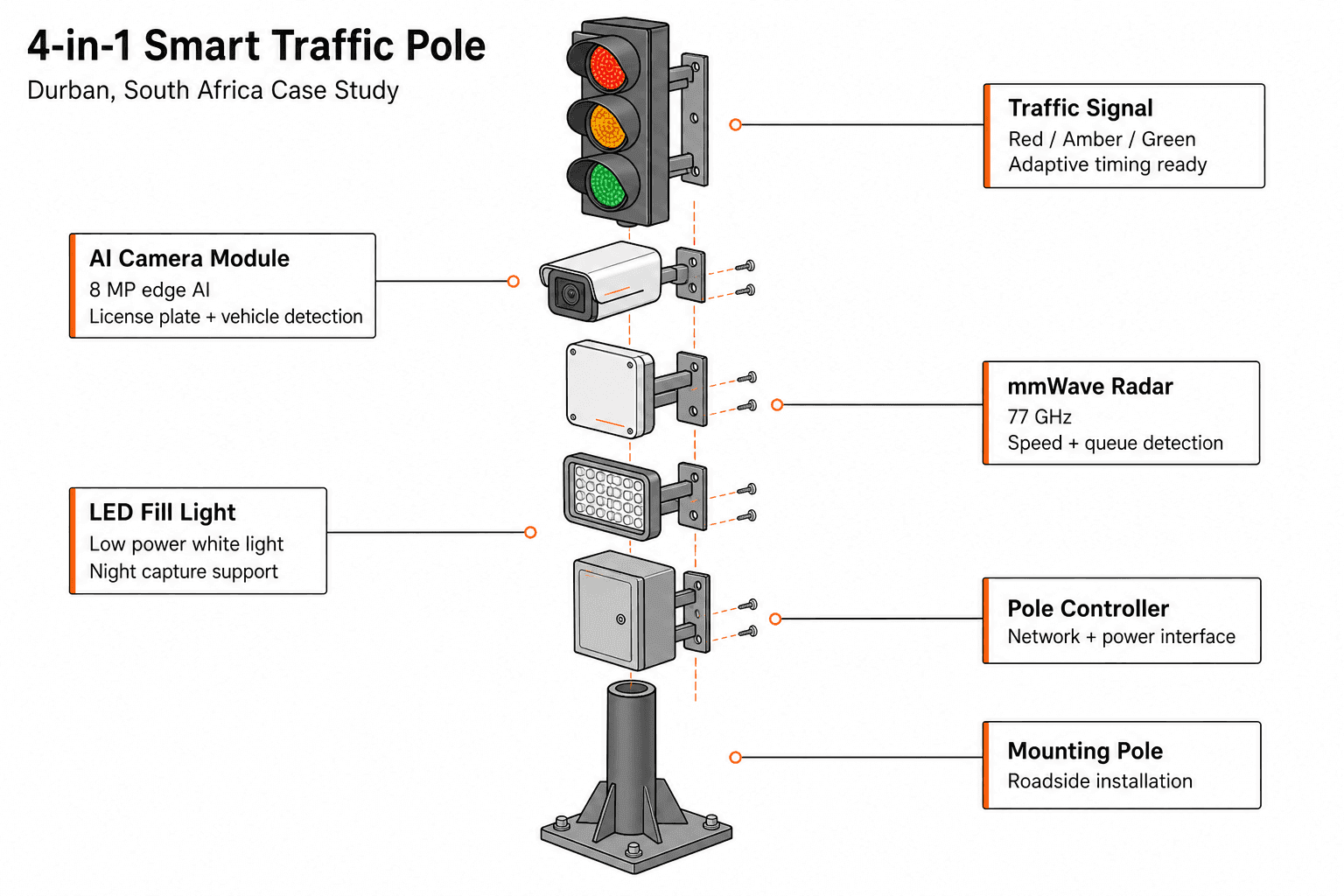
A 16-intersection Smart Traffic System in Durban would typically use 8m L-arm poles because this height balances camera field of view, signal visibility, and urban mounting constraints at medium-to-large junctions. Based on the product specification provided, the recommended configuration is 16 intersections × 8m dark-grey hot-dip galvanized steel poles, each integrating a 4-in-1 module set: 4K AI camera, 77GHz mmWave radar, LED fill light, and LED signal head. This is the correct size class for urban arterial intersections rather than highway gantries, which would normally shift to 10-12m variants.
A typical 16-intersection deployment of this scale would consist of approximately 64-192 poles in total, because each intersection generally needs 4-12 poles depending on the number of approaches, slip lanes, pedestrian crossings, and auxiliary mounting positions. For Durban, the lower end suits compact four-leg junctions, while the upper end suits freight corridors with channelized turns, bus priority movements, and wide pedestrian phases. The exact pole count should follow a swept-path review, signal head visibility study, and line-of-sight check for camera and radar placement.
The sensing stack is suitable for Durban’s traffic mix. The 4K AI camera supports about 45+ detection types with stated 98% accuracy and sub-50ms response, while 77GHz mmWave radar adds resilience in rain and partial occlusion. In practical terms, this combination is useful for pedestrian detection, queue estimation, turning conflict monitoring, red-light approach analysis, and incident auto-alert generation. According to the U.S. Department of Transportation ITS guidance, multimodal detection is generally more reliable than single-sensor intersection control in variable urban conditions.
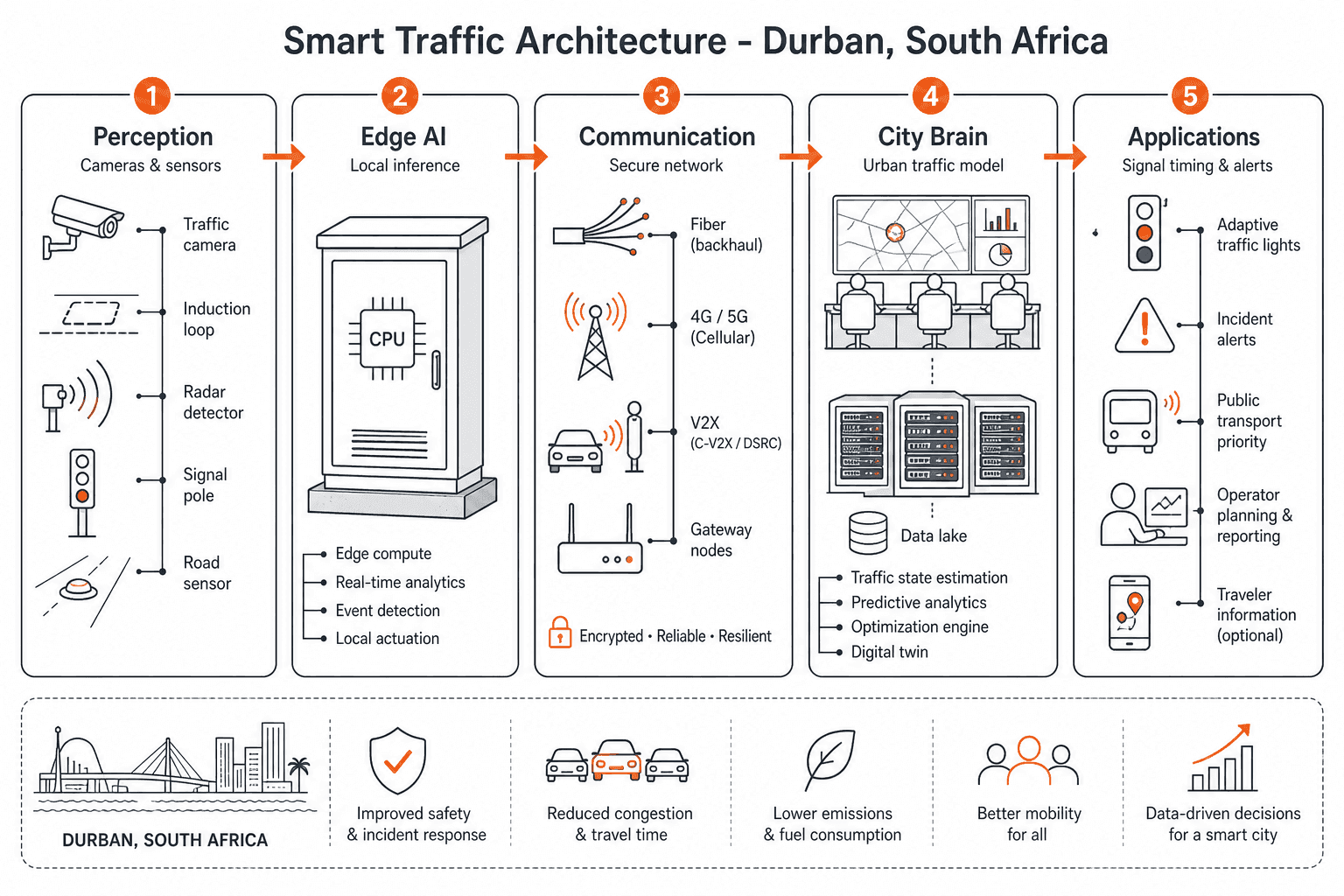
Backhaul should be designed as fiber-first with 5G redundancy where possible. Durban’s denser commercial corridors can support fiber links to cabinet or roadside switch level, while 5G can provide backup communications or primary service for harder-to-cable intersections. SOLAR TODO’s Smart Traffic System architecture uses a 5-layer stack: Perception, Edge AI, Communications, City Brain, and Applications. For municipal buyers, that means detection and first-pass analytics remain local, while corridor optimization and natural-language reporting sit at the TrafficGPT platform layer.
The recommended cooperation model for this Durban profile is Joint Venture. That model is relevant when a city, concessionaire, or traffic technology partner wants shared implementation responsibility across civil works, communications, software integration, and operations. It also fits staged procurement, where a 16-intersection package may begin with a priority corridor and expand after measured performance review. For Durban, a Joint Venture structure can reduce integration risk where multiple stakeholders control roads, signals, fiber, and enforcement workflows.
SOLAR TODO should be evaluated here as a technical supplier and system integration option, not as a claimed past installer in Durban. The decision criteria should focus on corrosion protection, AI detection accuracy, controller compatibility, NTCIP compliance, and the practicality of scaling from 16 intersections to a wider metro corridor program. Buyers comparing vendors should also check whether the central platform can support natural-language queries without compromising event traceability and audit logs.
Technical Specifications
The recommended Durban configuration is a 16-intersection package using 8m L-arm galvanized poles, 4K AI vision, 77GHz radar, NVIDIA Jetson edge processing, and NTCIP/GB 25280 compliance. The specification below matches the provided product line and avoids mixing in highway or non-urban pole classes.
- Deployment scope: 16 intersections
- Pole form: L-arm steel pole
- Pole height: 8m
- Pole finish: dark grey
- Corrosion protection: hot-dip galvanized steel
- Pole quantity logic: approximately 4-12 poles per intersection, depending on approaches and auxiliary positions
- Integrated module set per pole: 4-in-1 Smart Traffic System
- Camera: 4K AI camera
- Detection accuracy: 98%
- Detection classes: 45+ object and traffic-event types
- Response time: less than 50ms
- Radar: 77GHz mmWave radar
- Lighting: integrated LED fill light
- Signal hardware: integrated LED signal head
- Edge computing: NVIDIA Jetson
- Core features: pedestrian detection, adaptive signal optimization, incident auto-alert
- Network architecture: 5G/fiber backhaul to TrafficGPT central platform
- Platform function: natural-language traffic queries and centralized analytics
- Cooperation model: Joint Venture
- Standards named in scope: NTCIP, GB 25280
- Typical use case: urban arterial and collector intersections, not highway gantry applications
- Recommended mounting logic: one pole per approach plus auxiliary poles where visibility or pedestrian coverage requires it
Implementation Approach
A 16-intersection Durban rollout would typically be delivered in 4-8 months, depending on permitting, utility conflicts, and fiber availability. The practical sequence starts with traffic counts, topographic survey, controller audit, and intersection geometry review for all 16 sites. At this stage, designers should confirm whether each junction needs 4, 6, 8, or up to 12 poles, because pole count drives civil scope, communications ports, and cabinet sizing.
The second phase is detailed design and procurement. This includes foundation drawings, pole loading checks, cable routing, signal head placement, and AI sensor sightline verification. According to NTCIP guidance, interoperability planning should happen before equipment ordering, not after installation. For Durban, that means checking compatibility with existing signal controllers, cabinet interfaces, and municipal traffic management software before the first foundation is cast.
The third phase is civil and structural work. Foundations, anchor bolts, ducts, cabinets, and earthing are installed first, followed by pole erection and wiring. In coastal cities, galvanizing quality and bolt protection matter because chloride exposure can shorten asset life if coatings are poor. This is one reason SOLAR TODO’s dark-grey hot-dip galvanized pole specification is technically appropriate for Durban’s environment.
The fourth phase is systems integration. Each pole’s 4K camera, 77GHz radar, LED fill light, and LED signal head is connected to local edge compute and then to the central platform over fiber or 5G. The TrafficGPT layer is then configured for event ingestion, natural-language querying, and rule-based alerts. According to the IEEE, effective intelligent transport deployment depends on both sensing quality and communications reliability; one without the other limits adaptive control value.
The final phase is commissioning and tuning. This includes pedestrian detection validation, phase timing optimization, incident alert thresholds, and fail-safe behavior under link loss or power disturbance. A realistic acceptance process should run for several weeks, because adaptive signal optimization needs live traffic observations across peak and off-peak periods. Durban buyers should also require maintenance documentation, spare parts lists, and KPI definitions before final handover.
Expected Performance & ROI
A properly configured 16-intersection Smart Traffic System in Durban could reasonably target measurable gains in delay reduction, safety response, and maintenance efficiency within the first 12 months. According to the U.S. Department of Transportation Federal Highway Administration, adaptive signal control can reduce travel time by more than 10% in suitable corridors, while some deployments report delay reductions in the 10-25% range. Durban’s benefit potential would depend on corridor saturation, pedestrian volume, and the quality of existing signal timing.
Safety and incident management are often the strongest early returns. The combination of 4K AI video and 77GHz radar improves detection of pedestrians, stopped vehicles, queue spillback, and abnormal movements. According to the World Bank (2023), road safety interventions in middle-income urban environments generate high economic value when they reduce conflict exposure at dense intersections. In Durban, that matters around public transport stops, school routes, and freight corridors where vulnerable road users and heavy vehicles mix.
Operational savings also matter. Legacy intersections often require repeated manual visits to diagnose detector failures, signal visibility issues, or timing complaints. With edge AI and central event logs, maintenance teams can prioritize intersections based on actual alarms instead of routine inspections alone. According to the International Energy Agency (2023), digitalization in infrastructure management improves asset utilization by enabling condition-based intervention rather than fixed inspection cycles.
For ROI, municipal buyers usually assess a 3-7 year payback window, depending on labor savings, congestion cost assumptions, and whether the project includes communications trenching. A 16-intersection package with fiber reuse and existing controller compatibility will usually have a better payback than one requiring full cabinet replacement. SOLAR TODO should therefore be evaluated not only on hardware pricing, but also on integration effort, software licensing structure, and expected maintenance hours per intersection per year.
Results and Impact
For Durban, the main expected impact is corridor-level traffic management rather than isolated signal modernization, with approximately 16 intersections acting as one data-linked operational unit. If the selected corridor includes freight access roads and pedestrian-heavy junctions, the system would likely improve queue visibility, shorten response to incidents, and support more consistent progression during peak periods.
The second impact area is governance and reporting. Because TrafficGPT supports natural-language queries, municipal operators can ask for congestion trends, pedestrian conflict alerts, or signal performance summaries without manually exporting raw logs from each site. That does not replace engineering analysis, but it can reduce reporting time and make 16-intersection oversight more practical for transport departments with limited staffing.
A third impact area is procurement scalability. Once 16 intersections are standardized on one 8m pole class, one edge compute platform, and one communications architecture, the city can extend the same template to adjacent corridors with less design variation. For Durban, that standardization is useful because maintenance, spare parts, and training become easier when one technical baseline is repeated across multiple junction groups.
Comparison Table
The table below compares the recommended Durban Smart Traffic System profile against a basic fixed-time intersection upgrade and a camera-only smart intersection approach.
| Metric | Recommended Durban Configuration | Basic Fixed-Time Upgrade | Camera-Only Smart Intersection |
|---|---|---|---|
| Deployment scope | 16 intersections | 16 intersections | 16 intersections |
| Pole class | 8m L-arm hot-dip galvanized | Existing poles reused where possible | Mixed reuse/new poles |
| Sensors | 4K AI camera + 77GHz radar | Minimal or none | 4K AI camera only |
| Detection accuracy | 98% stated camera accuracy + radar redundancy | Low situational awareness | Good in clear conditions, weaker in rain/occlusion |
| Response time | <50ms | Controller-dependent | Typically low-latency, but sensor redundancy absent |
| Pedestrian detection | Yes | Often limited | Yes |
| Adaptive signal optimization | Yes | Usually no | Yes, but sensor robustness lower |
| Incident auto-alert | Yes | Usually no | Yes |
| Backhaul | 5G/fiber to TrafficGPT | Limited central visibility | 5G/fiber |
| Standards | NTCIP, GB 25280 | Varies | Varies |
| Durban climate fit | Strong due to galvanizing + radar | Depends on legacy assets | Moderate |
| Expansion readiness | High for corridor scaling | Low | Medium |
Pricing & Quotation
SOLAR TODO offers three pricing tiers for this product line: FOB Supply (equipment ex-works China), CIF Delivered (including ocean freight and insurance), and EPC Turnkey (fully installed, commissioned, with 1-year warranty). Volume discounts are available for large-scale deployments. Configure your system online for an instant estimate, or request a custom quotation from our engineering team at [email protected].
Frequently Asked Questions
This FAQ answers the main Durban procurement questions, including technical fit, timeline, ROI, maintenance, EPC scope, and standards for a 16-intersection Smart Traffic System.
Q1: What is the recommended pole height for Durban intersections?
For the specified urban profile, 8m L-arm poles are the recommended class. That height suits medium-to-large city intersections where signal visibility, camera angle, and radar coverage must balance with urban clearances. Durban would typically reserve 10-12m variants for highway-style gantries or wider high-speed approaches rather than standard municipal junctions.
Q2: How many poles would a 16-intersection deployment usually require?
A typical 16-intersection deployment would require approximately 64-192 poles in total, based on 4-12 poles per intersection. The actual count depends on the number of approaches, pedestrian crossings, slip lanes, medians, and whether auxiliary poles are needed for signal visibility or blind-spot detection.
Q3: What sensing hardware is included on each pole?
Each pole includes a 4K AI camera, 77GHz mmWave radar, LED fill light, and LED signal head. The edge computing platform is NVIDIA Jetson. The camera is specified at 98% detection accuracy with response under 50ms, while radar adds reliability during rain, glare, and partial visual obstruction.
Q4: How long would installation typically take in Durban?
For 16 intersections, a realistic program is about 4-8 months. That includes survey, design, approvals, foundation works, pole erection, communications setup, controller integration, and commissioning. The timeline shortens if fiber and cabinets already exist, and lengthens if trenching, utility relocation, or major controller replacement is required.
Q5: What performance improvement is realistic for adaptive traffic control?
A reasonable planning assumption is a 10-25% reduction in delay on suitable corridors, based on international adaptive signal benchmarks. Actual improvement depends on baseline congestion, intersection spacing, pedestrian phase demand, and whether the corridor already has coordinated timing. Incident response and maintenance visibility may improve even when travel-time gains are modest.
Q6: Is radar necessary if the system already has 4K AI cameras?
In Durban, radar is useful because coastal rain, humidity, spray, and headlight glare can reduce camera-only reliability. A 77GHz mmWave radar helps maintain detection during poor visibility and supports speed, presence, and movement validation. For municipal buyers, the extra sensor layer usually improves confidence in adaptive control decisions.
Q7: What maintenance model is typical for this type of system?
Most operators use a preventive schedule with quarterly inspections and event-driven maintenance between visits. Typical tasks include lens cleaning, signal head checks, cabinet inspection, communications diagnostics, and software updates. Hot-dip galvanized poles reduce corrosion risk, but coastal environments still require regular checks on fasteners, seals, and cable entries.
Q8: How does this compare with a normal signal upgrade?
A normal signal upgrade often improves visibility and controller reliability but does not provide corridor intelligence. The recommended SOLAR TODO Smart Traffic System adds AI detection, radar confirmation, central analytics, and incident alerts. That means the city gains operational data and adaptive timing capability, not just replacement hardware.
Q9: What is included in EPC turnkey pricing versus supply-only pricing?
Supply-only pricing usually covers poles, sensors, signals, edge devices, and standard accessories. EPC turnkey generally adds civil works, installation, integration, testing, commissioning, and a 1-year warranty. Durban buyers should confirm whether trenching, fiber extension, traffic accommodation, and controller replacement are included or priced separately.
Q10: What standards should buyers ask vendors to confirm?
For this product scope, NTCIP and GB 25280 should be confirmed in writing. Buyers should also request documentation for galvanizing, electrical safety, controller interoperability, and communications architecture. In practice, compliance documents, drawings, and interface lists are as important as the headline hardware specification during municipal procurement.
Q11: What warranty period is typical for a system like this?
A common commercial structure is a 1-year warranty for EPC turnkey scope, with longer support available through service agreements. Durban buyers should ask for separate warranty terms for poles, signal heads, cameras, radar units, and edge computing hardware, because component coverage periods may differ from the installation warranty.
Q12: Why mention SOLAR TODO specifically for Durban procurement review?
SOLAR TODO is relevant here because the company’s specified product architecture matches a practical urban intersection package: 8m galvanized poles, 4-in-1 sensing and signaling, NVIDIA Jetson edge AI, and 5G/fiber backhaul. Durban buyers should compare SOLAR TODO against alternatives on corrosion resistance, interoperability, and corridor-scale manageability.
References
- eThekwini Municipality (2024): Integrated Development Plan; municipal population, transport planning context, and infrastructure priorities for Durban.
- Statistics South Africa (2022): Census and metropolitan demographic/economic data relevant to eThekwini travel demand and urban scale.
- South African Weather Service (2024): Durban climate profile, including humid subtropical conditions and rainfall patterns affecting outdoor equipment selection.
- ICASA (2024): South African communications regulatory framework and telecom market context relevant to 4G/5G urban backhaul availability.
- U.S. Department of Transportation Federal Highway Administration (2023): Adaptive Signal Control Technologies guidance and corridor performance benchmarks.
- International Telecommunication Union (2023): Intelligent transport systems guidance; digital traffic management improves safety and mobility outcomes.
- International Energy Agency (2023): Digitalization of infrastructure and operations; data-driven maintenance and asset utilization benefits.
- World Bank (2023): Road safety and urban transport management analysis for middle-income cities, including economic value of safer intersections.
- NTCIP (current framework): National Transportation Communications for Intelligent Transportation System Protocol, used for traffic equipment interoperability.
- GB 25280 (China standard reference): Traffic signal controller and related traffic equipment compliance framework referenced for system compatibility.
Equipment Deployed
- 16 intersections × 8m L-arm steel pole, dark grey, hot-dip galvanized
- 4-in-1 Smart Traffic System per pole
- 4K AI camera with 98% detection accuracy and <50ms response
- 77GHz mmWave radar sensor
- Integrated LED fill light
- Integrated LED signal head
- NVIDIA Jetson edge AI computing platform
- 5G/fiber backhaul connection to TrafficGPT central platform
- Pedestrian detection module and adaptive signal optimization software
- Incident auto-alert functionality
- Joint Venture cooperation model
- NTCIP and GB 25280 compliance framework