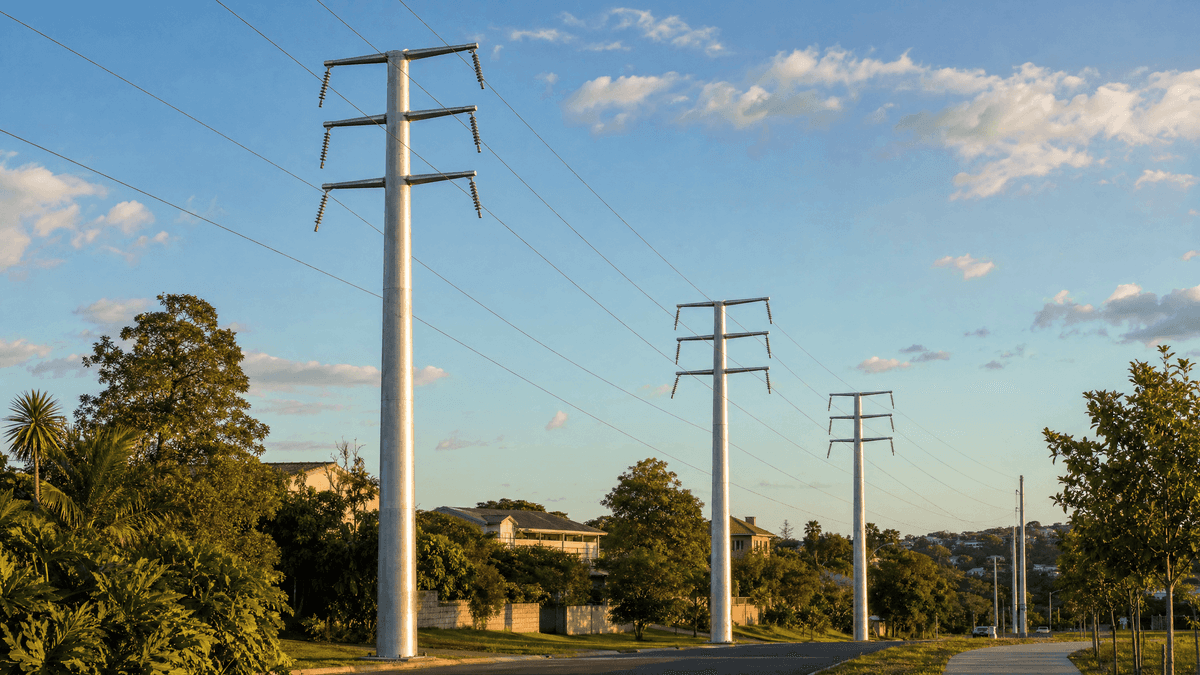
Durban Power Transmission Tower Market Analysis: 10kV Double-Circuit Steel Tubular Pole Configuration Guide
Summary
Durban’s coastal distribution environment typically suits a 10kV medium-voltage steel tubular pole solution with approximately 102 units over 10km, 100m spans, and 25m/s wind design. For municipal feeders, a 10kV double-circuit Q345 galvanized configuration is a practical fit where corridor control and corrosion resistance matter.
Key Takeaways
- A typical Durban municipal distribution corridor of about 10km would use approximately 102 steel tubular poles, each configured for 10kV double circuit service.
- The project-specific configuration points to 25m tapered hot-dip galvanized Q345 steel poles, with a nominal structural mass of about 10t per pole and 400kg/m reference weight.
- Line geometry in this profile uses 100m spans, 0.8m phase spacing, 5m ground clearance, and 0.5m insulator length for medium-voltage urban routing.
- The specified conductor is ACSR-70, rated here at 275kg/km with maximum tension 22kN, which aligns with moderate municipal distribution loading.
- Wind loading should be checked to Wind Class 1, 25m/s, which is relevant for Durban’s coastal weather exposure and corrosion-sensitive environment.
- Foundations in this profile are concrete base foundations with grounding, bird guards, vibration dampers, cross arms, and climbing steps included as standard accessories.
- The design basis references IEC 60826 and GB 50545, with a stated 30-year design life for a medium-voltage municipal distribution application.
- For procurement planning, SOLAR TODO should be evaluated as a power-tower supplier for steel monopole distribution lines, with quotation paths through FOB, CIF, and EPC turnkey options.
Market Context for Durban
Durban’s electricity distribution profile supports medium-voltage line reinforcement, and a 10kV double-circuit steel tubular pole layout is technically suitable for dense urban corridors, coastal corrosion exposure, and approximately 100m municipal spans.
Durban, within the eThekwini Metropolitan Municipality, is one of South Africa’s largest urban economies and port cities. According to Statistics South Africa (2022), eThekwini has a population of roughly 4.0 million, creating sustained pressure on municipal distribution networks, industrial feeders, and peri-urban service expansion. A city of this scale does not rely only on bulk transmission; it also requires resilient medium-voltage corridors that can pass through constrained road reserves, mixed land use, and transport-adjacent rights-of-way.
Climate and corrosion are central design variables in Durban. According to the South African Weather Service and municipal climate planning documents, Durban has a humid subtropical coastal climate with high salt exposure, seasonal storm activity, and strong onshore winds. In practical line design terms, that makes hot-dip galvanizing, controlled hardware detailing, and conservative wind checks important for any 10kV steel pole recommendation. For steel monopoles near the coast, corrosion protection often drives lifecycle value more than first-cost alone.
Grid context also matters. Eskom and municipal distribution systems in South Africa commonly operate across 11kV, 22kV, 33kV, 66kV, and 132kV classes depending on area and network function. For local municipal distribution in built-up corridors, a 10kV-class line profile is a reasonable medium-voltage planning case when the objective is feeder reinforcement, network sectionalizing, or urban load transfer. According to the International Energy Agency (2023), South Africa continues to face grid reliability pressure, making distribution upgrades and feeder redundancy important at city level, not only at generation level.
A steel tubular pole format is especially relevant where Durban’s road network, industrial frontage, and port-linked logistics leave limited room for wider structures. Compared with lattice towers, monopole-type steel tubular poles reduce corridor width and simplify roadside placement. According to IEC 60826, overhead line design must account for wind, conductor load, and reliability level; in a coastal city, those variables support a compact galvanized steel solution with controlled hardware interfaces.
The market implication for buyers is clear: Durban does not need an oversized transmission-class structure for a municipal feeder corridor. It needs a medium-voltage power-tower configuration that balances corrosion resistance, manageable foundations, and urban constructability. That is where SOLAR TODO’s Power Transmission Tower offering fits best when specified as a steel tubular pole, not lattice and not concrete.
[IEC] states, "This International Standard specifies procedures for the design of overhead lines." That matters directly for Durban because wind, conductor tension, and reliability assumptions must be documented at the design stage.
[IRENA] states, "Transmission and distribution infrastructure expansion is essential to integrate new supply and improve electricity access and reliability." In Durban’s case, that principle applies equally to municipal distribution reinforcement and feeder modernization.
Recommended Technical Configuration
For Durban’s municipal feeder conditions, a typical 10km deployment would consist of approximately 102 units of 10kV double-circuit steel tubular poles using 100m spans, ACSR-70 conductor, and concrete base foundations.
The user-specified project configuration should be treated as a recommended municipal distribution reference design for Durban rather than a past installation claim. In that profile, the line uses 102 units × 25m tapered steel tubular pole for a 10kV double-circuit route over about 10km. The material is hot-dip galvanized Q345 steel, which is appropriate where corrosion resistance and repeatable fabrication quality are required.
From a market-fit standpoint, the 10kV double-circuit arrangement makes sense for Durban where municipalities may want feeder redundancy or parallel circuits on one pole line to reduce corridor occupation. The specified 100m span is consistent with urban or peri-urban routing where road crossings, property boundaries, and service access points limit longer spans. The selected ACSR-70 conductor is also aligned with moderate current duty and manageable mechanical loading for municipal distribution.
There is one engineering caveat worth stating clearly. The generic voltage-height table for 10–35kV distribution typically points to 12–18m height and 1–3t/pole as the standard range. The project-specific configuration supplied here uses 25m poles and about 10t/pole, which is above the usual municipal distribution envelope. In practice, Durban buyers should treat this as a special-profile recommendation only where route constraints, crossing clearances, shared-corridor requirements, or municipal standardization justify a taller and heavier pole than the baseline distribution range.
That distinction is important for procurement reviews. If the line is a routine 10kV suburban feeder with no unusual crossing or clearance conditions, a shorter pole class may be more economical. If the corridor passes arterial roads, industrial entrances, rail interfaces, flood-prone zones, or requires future circuit flexibility, the supplied 25m tapered pole profile can still be technically justified subject to route survey and utility approval.
For Durban, SOLAR TODO would therefore position this configuration as a conditional recommendation: use the 102-unit, 25m, 10kV double-circuit layout where corridor constraints and municipal clearance requirements support the taller structure; otherwise, optimize down to the standard 12–18m distribution class. This is the correct market-analysis framing for a B2B buyer comparing design options on /products/power-tower.
Technical Specifications
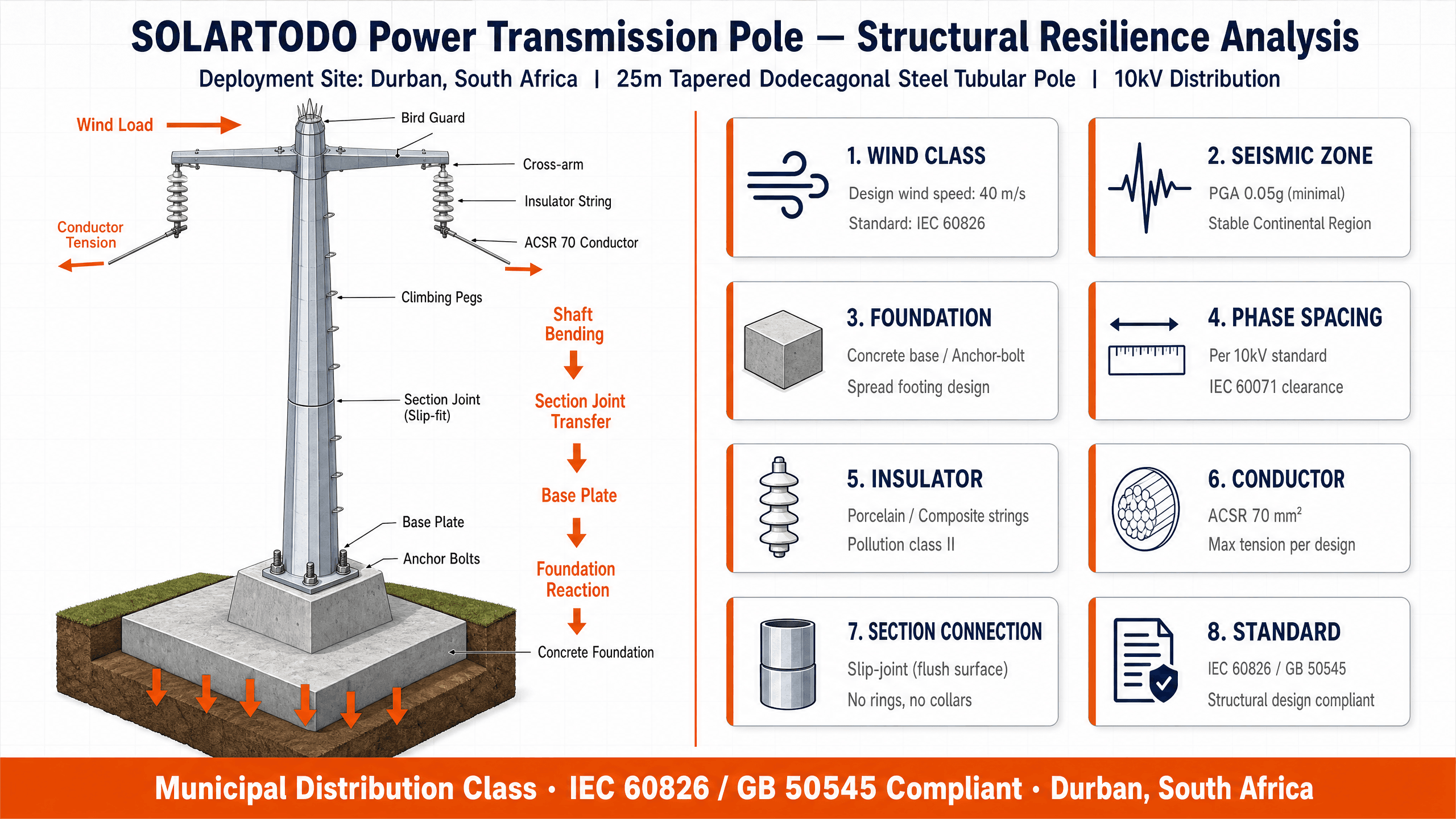
The recommended Durban reference configuration is a 10kV double-circuit steel tubular pole line with 102 units, 25m/s wind design, 100m spans, and IEC 60826 / GB 50545 compliance targets.
- Product type: Steel tubular Power Transmission Tower for municipal distribution, tapered monopole form
- Application: 10kV double-circuit medium-voltage municipal distribution line
- Quantity basis: Approximately 102 units for about 10km of route
- Pole height: 25m tapered steel tubular pole
- Pole material: Q345 steel, hot-dip galvanized
- Nominal pole weight: About 10t per pole
- Reference linear weight: 400kg/m
- Circuit arrangement: Double circuit
- Conductor type: ACSR-70
- Conductor mass: 275kg/km
- Maximum conductor tension: 22kN
- Typical span: 100m
- Phase spacing: 0.8m
- Ground clearance: 5m
- Insulator length: 0.5m
- Wind class: Class 1, 25m/s
- Foundation type: Concrete base foundation
- Accessories: Climbing steps, cross arm, grounding set, bird guard, vibration damper
- Design life: 30 years
- Standards basis: IEC 60826 / GB 50545
For comparison against standard line-class planning, typical 10–35kV distribution networks usually use 12–18m structures, 80–150m spans, and around 8–12 poles/km. The supplied Durban reference remains within the span-density logic at roughly 10.2 poles/km, but its 25m height should be treated as a special route condition rather than a generic 10kV default.
Implementation Approach
A Durban distribution project of about 10km would typically move through survey, geotechnical checks, shop detailing, foundation casting, pole erection, stringing, and commissioning over roughly 4 to 8 months depending on permits and outage windows.
The first step is corridor definition. A buyer would normally confirm route length, road reserve access, statutory setbacks, and crossing points over the full 10km alignment. In Durban, this stage should also identify salt-exposure zones, drainage channels, and any flood-prone sections near low-lying transport or industrial land. According to World Bank infrastructure guidance, early route-risk screening reduces downstream variation orders and schedule slippage.
The second step is structural and geotechnical validation. Even though the reference design specifies concrete base foundations, actual footing dimensions depend on soil bearing capacity, groundwater level, and overturning loads from a 25m pole under 25m/s wind. IEC 60826 requires that mechanical actions and reliability assumptions be translated into verifiable design loads. For Durban’s coastal conditions, buyers should request galvanizing thickness data, anchor detailing, and corrosion assumptions in the design package.
The third step is fabrication and logistics. Steel poles in flanged sections are typically fabricated, galvanized, trial-fitted, and shipped as bolted assemblies. For imported supply, buyers often evaluate container packing efficiency, port clearance timing, and inland transport from Durban Port to the line corridor. SOLAR TODO can be assessed here on section segmentation, bolt-pack traceability, and drawing control rather than generic brochure claims.
The fourth step is site construction. A typical sequence is excavation, reinforcement placement, foundation casting, curing, pole erection by crane, cross-arm installation, insulator fixing, conductor stringing, sagging, grounding, and final inspection. For a 102-unit line, productivity depends heavily on access conditions and municipal traffic management. Urban works may proceed in blocks of 10 to 20 poles to reduce road occupation and simplify outage coordination.
The final step is energization and handover. Before energization, the owner would normally verify bolt torque, galvanizing condition, earthing continuity, conductor sag, phase spacing, and ground clearance at all critical crossings. A practical acceptance file should include as-built drawings, foundation records, material certificates, and inspection logs. For Durban buyers, this documentation is essential if the line will be transferred to a municipal utility or integrated into an audited asset register.
Expected Performance & ROI
For Durban, the main value case is lower corridor occupation, corrosion-resistant steel construction, and a 30-year design life, with lifecycle savings typically driven by maintenance reduction rather than by energy generation metrics.
Because this is a line-structure product, ROI should be assessed through network reliability, land-use efficiency, and maintenance burden. According to IEA (2023), distribution bottlenecks and aging infrastructure contribute materially to reliability constraints in many power systems, including South Africa. A double-circuit 10kV line can improve feeder flexibility by allowing load transfer, sectionalizing support, or future network reconfiguration on the same route.
Maintenance economics are also relevant. Hot-dip galvanized steel poles generally reduce recurrent painting and localized corrosion repair compared with unprotected steel in coastal environments. According to NACE corrosion studies and utility asset-management benchmarks, corrosion control can materially lower whole-life cost in marine or salt-laden climates. For Durban, where humidity and salt exposure are persistent, galvanizing quality is not a detail; it is a core cost variable over the 30-year design life.
A second ROI factor is right-of-way efficiency. Tubular poles require a narrower footprint than many lattice alternatives, which can reduce land conflict, simplify roadside placement, and lower the civil complexity of constrained urban corridors. For municipalities, that can shorten approval cycles and reduce social interface costs even when the pole itself is heavier. In a 10km route, those indirect savings can be more important than a small difference in steel tonnage.
Expected performance should therefore be measured in practical terms:
- Stable support for 10kV double-circuit operation
- Approximate route density of 10.2 poles/km
- Design resistance aligned to 25m/s wind class assumptions
- Mechanical compatibility with ACSR-70 at 22kN maximum tension
- Asset life target of 30 years with scheduled inspection and grounding checks
For Durban buyers comparing alternatives, SOLAR TODO’s value proposition is strongest where corrosion resistance, compact footprint, and predictable factory fabrication matter more than minimizing initial pole height. For standard suburban feeders without special clearance constraints, a shorter 12–18m distribution pole may offer a faster payback. For constrained crossings and future circuit flexibility, the supplied 25m profile can justify its higher structural mass.
Results and Impact
For Durban’s municipal network planning, a 10kV double-circuit steel tubular pole line can improve feeder routing flexibility over 10km while keeping structure count near 102 units and supporting a 30-year asset strategy.
The practical impact of this configuration is not framed as a completed project result, but as an expected infrastructure outcome for the city’s network profile. A double-circuit line can support redundancy on constrained corridors, especially where separate parallel routes are difficult to secure. In Durban, that matters near industrial districts, logistics roads, and mixed residential-commercial growth zones.
The other expected impact is maintenance discipline. A galvanized steel tubular pole system gives utilities a straightforward inspection regime focused on bolt torque, coating condition, earthing continuity, and conductor hardware. That is simpler than managing a larger number of members and connection points on lattice structures in corrosion-prone air. For municipal asset owners, fewer exposed interfaces often translate into clearer maintenance planning.
A final impact area is visual and spatial control. Tubular poles are often preferred in urban corridors because they occupy less lateral space and present a cleaner streetscape than wider structures. In Durban, where public roads, port access, and dense service corridors compete for space, that can be a meaningful planning advantage. Buyers needing route-specific advice can contact us for design review and quotation support.
Comparison Table
The table below compares Durban’s supplied reference configuration against a standard 10–35kV distribution baseline and a higher-voltage 66–110kV class to clarify where this Power Transmission Tower profile fits.
| Parameter | Durban reference configuration | Standard 10–35kV distribution class | 66–110kV sub-transmission class |
|---|---|---|---|
| Voltage class | 10kV | 10–35kV | 66–110kV |
| Pole form | Tapered steel tubular pole | Steel tubular pole | Steel tubular pole |
| Circuit | Double circuit | Single or double | Single or double |
| Height | 25m | 12–18m typical | 18–30m |
| Weight per pole | ~10t | 1–3t typical | 5–15t |
| Span | 100m | 80–150m | 200–300m |
| Poles per km | ~10.2 | 8–12 | 4–5 |
| Conductor example | ACSR-70 | ACSR-70 / 120 | ACSR-120 / 240 |
| Wind basis | 25m/s | Project-specific | Project-specific |
| Foundation | Concrete base | Concrete | Concrete |
| Best-fit use case | Constrained municipal corridor | Routine MV feeder | Longer regional feeder |
Pricing & Quotation
SOLAR TODO offers three pricing tiers for this product line: FOB Supply (equipment ex-works China), CIF Delivered (including ocean freight and insurance), and EPC Turnkey (fully installed, commissioned, with 1-year warranty). Volume discounts are available for large-scale deployments. Configure your system online for an instant estimate, or request a custom quotation from our engineering team at [email protected].
Frequently Asked Questions
A Durban buyer evaluating a 10kV steel tubular Power Transmission Tower typically asks about height, corrosion, installation time, maintenance intervals, EPC scope, and whether the 25m profile is justified for municipal distribution.
Q1: Is a 25m pole normal for a 10kV distribution line in Durban? A 25m pole is higher than the usual 12–18m range for standard 10–35kV distribution lines. It can still be justified where Durban routes need extra clearance at road crossings, industrial entrances, flood-prone sections, or future circuit flexibility. Buyers should confirm route constraints before locking this height into procurement.
Q2: What conductor is specified for this recommended configuration? The supplied configuration uses ACSR-70 conductor with a stated mass of 275kg/km and 22kN maximum tension. That is suitable for moderate municipal distribution loading where the goal is dependable mechanical performance and manageable pole loading rather than long-span high-capacity transmission duty.
Q3: How many poles are typically required for a 10km route? At a 100m design span, a 10km route would typically require approximately 102 poles, allowing for terminal structures, section points, and route geometry. The exact quantity depends on angle locations, dead-end requirements, crossing constraints, and whether the utility wants additional reserve structures for maintenance stock.
Q4: What standards should Durban utilities request in the design package? At minimum, buyers should request compliance documentation to IEC 60826 for overhead line loading and GB 50545 for relevant structural design references in the supplied package. Material certificates for Q345 steel, galvanizing records, bolt specifications, and foundation calculations should also be included in the approval set.
Q5: How long would installation usually take? For about 102 poles over 10km, a typical schedule is 4 to 8 months, depending on permits, geotechnical conditions, traffic control, and outage windows. Urban corridors in Durban can extend schedules because road occupation, utility crossings, and municipal approvals often control progress more than fabrication lead time.
Q6: What maintenance is required over a 30-year life? Routine maintenance usually includes annual or periodic checks on galvanizing condition, bolt torque, grounding continuity, insulator condition, and conductor hardware. In Durban’s coastal air, coating inspection is important because salt exposure accelerates corrosion risk. A documented inspection cycle helps preserve the intended 30-year asset life.
Q7: How does a steel tubular pole compare with a lattice tower? A steel tubular pole generally uses a narrower footprint and suits urban or roadside corridors better than a lattice structure. For Durban, that can reduce land conflict and improve visual control. Lattice towers may still be useful on longer, less constrained routes, but they usually occupy more lateral space.
Q8: Does SOLAR TODO provide EPC or supply-only options? Yes. SOLAR TODO lists FOB Supply, CIF Delivered, and EPC Turnkey quotation paths for this product line. Buyers should compare them based on who carries design responsibility, inland logistics, civil works scope, erection supervision, and commissioning requirements for the Durban utility or contractor environment.
Q9: What foundation type is recommended for this Durban configuration? The supplied reference uses a concrete base foundation. Final dimensions should be confirmed by soil bearing capacity, groundwater level, and overturning loads from the 25m pole and 22kN conductor tension. Geotechnical review is important in coastal and low-lying Durban areas where soil variability can be significant.
Q10: What warranty terms should buyers expect? The quotation section states that the EPC Turnkey option includes a 1-year warranty. Buyers should still clarify coating warranty terms, material traceability, excluded conditions, and whether post-energization inspections are included. Warranty language should match the final contract, not only the proposal summary.
References
- Statistics South Africa (2022): Census 2022 municipal population data showing eThekwini Metropolitan Municipality at roughly 4 million residents.
- International Energy Agency (2023): South Africa energy system analysis highlighting grid reliability constraints and the importance of transmission and distribution investment.
- IEC (2019): IEC 60826 overhead transmission line design standard specifying procedures for loading and reliability-based design.
- IRENA (2023): Grid infrastructure and power system transition reports noting that transmission and distribution expansion is necessary for reliability and integration of new supply.
- eThekwini Municipality (2021): Municipal development and climate planning documents describing Durban’s coastal urban growth, infrastructure pressure, and environmental exposure conditions.
- South African Weather Service (2023): Climate and coastal weather data relevant to Durban’s humid subtropical conditions, wind exposure, and storm-related design considerations.
- World Bank (2020): Infrastructure planning guidance emphasizing early route-risk screening, permitting coordination, and lifecycle asset management for utility networks.
Equipment Deployed
- 102 × 25m tapered steel tubular poles for 10kV double-circuit municipal distribution
- Hot-dip galvanized Q345 steel pole body, approximately 10t per pole, 400kg/m reference weight
- ACSR-70 conductor, 275kg/km, maximum tension 22kN
- Cross arm brackets for double-circuit conductor support
- 0.5m insulator assemblies for medium-voltage line configuration
- Concrete base foundations for each pole location
- Climbing steps for maintenance access
- Grounding system for each pole
- Bird guards for avian protection and outage reduction
- Vibration dampers for conductor motion control under wind loading