Dubai SOLARTODO Sentinel City AI Pole Market Analysis: 23-Node Off-Grid Edge Configuration Guide
Summary
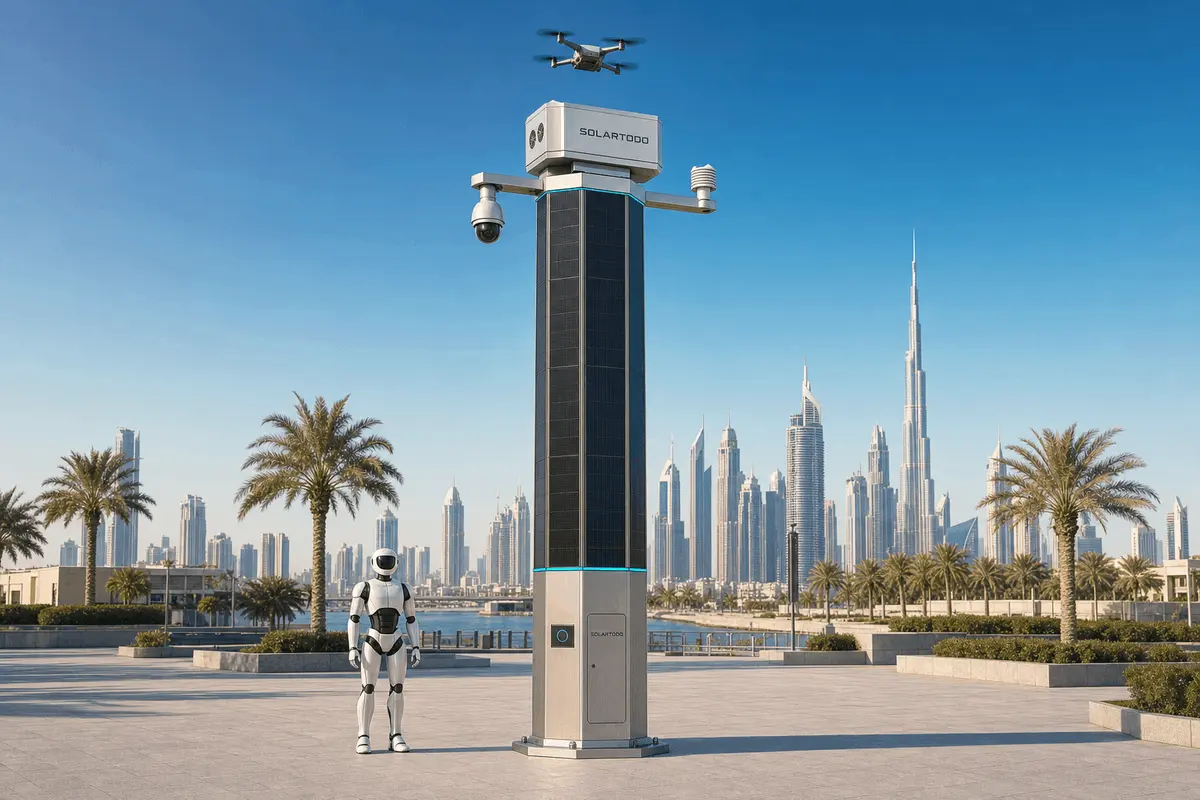
Dubai's 2040 plan targets 5.8 million residents, while a typical SOLARTODO Sentinel City AI Pole configuration would use approximately 23 off-grid edge nodes at 30m spacing across a 660m operating zone.
Key Takeaways
- A typical 23-unit deployment at 30m spacing would cover approximately 660m of perimeter, district frontage, or industrial access corridor.
- Each SOLARTODO Sentinel City AI Pole should be configured as a pure smart pole with 0 lighting load, on-pole solar replenishment, and 5-20kWh battery storage.
- On-pole PV replenishment should be modeled at about 2.8-3.2kWp nameplate, 1.0-1.3kW clear-sky DC peak, and 7-10kWh/day in high-irradiance conditions.
- Dubai's 2040 Urban Master Plan anticipates 5.8 million residents, creating higher demand for autonomous inspection, perimeter awareness, and distributed sensing.
- Edge compute should use Jetson-class local inference so raw video and sensor data remain on the pole, with only de-identified event and health metadata transmitted.
- A 23-node cluster can support drone dispatch, battery hot-swap, robot charging, 9-parameter environmental monitoring, and human-authorized non-lethal C-UAS coordination.
- Engineering confirmation should verify wind exposure, solar access, wireless backhaul, flight permissions, foundation loads, and battery autonomy before procurement.
Market Context for Dubai
Dubai's 2040 growth profile supports approximately 23 off-grid AI pole nodes for high-value corridors, industrial zones, campuses, and critical-infrastructure perimeters. The UAE Government's Dubai 2040 Urban Master Plan sets a planning horizon of 5.8 million residents by 2040, with a stated emphasis on integrated urban centers and improved quality of life. According to the UAE Government (2021), Dubai 2040 is intended to guide residential, economic, mobility, and public-space development through 2040.
Dubai's operating environment is also energy- and climate-intensive. According to the World Bank and ESMAP (2020), many Middle East and North Africa countries exceed 4.5kWh/kWp/day of average solar PV output, placing Dubai in a region where off-grid replenishment is technically meaningful but still subject to duty-cycle limits. World Bank states, "Around 70 countries boast excellent conditions for solar PV," which supports a solar-assisted, battery-backed architecture for unmanned edge nodes.
Digital infrastructure readiness is a second driver. According to ITU (2025), about 6 billion people, or 74% of the global population, use the Internet, and ITU states, "ITU is the official source for global ICT statistics." For Dubai buyers, the practical implication is not generic connectivity; it is the need to control what data leaves an urban sensing asset. SOLARTODO therefore recommends local processing, de-identified event export, and PDPL-LGPD-oriented data workflows rather than continuous raw-video uplink.
The relevant local use cases are smart districts, ports, logistics zones, airport-adjacent perimeters, campuses, and utility or industrial assets. A SOLARTODO Sentinel City AI Pole cluster is not a lighting upgrade and should not be scoped as a streetlight replacement. It is a city edge node line for autonomous inspection, security sensing, environmental telemetry, drone operations, robot operations, and command coordination.
Recommended Technical Configuration
A recommended Dubai configuration is approximately 23 SOLARTODO Sentinel City AI Pole units at 30m spacing, subject to engineering confirmation and authority approvals. This gives a nominal monitored line of about 660m when calculated as 22 intervals between 23 nodes. The layout is suitable for a controlled perimeter, district access spine, quay-side logistics frontage, or campus service road where autonomous inspection and rapid event verification are more valuable than simple fixed-camera coverage.
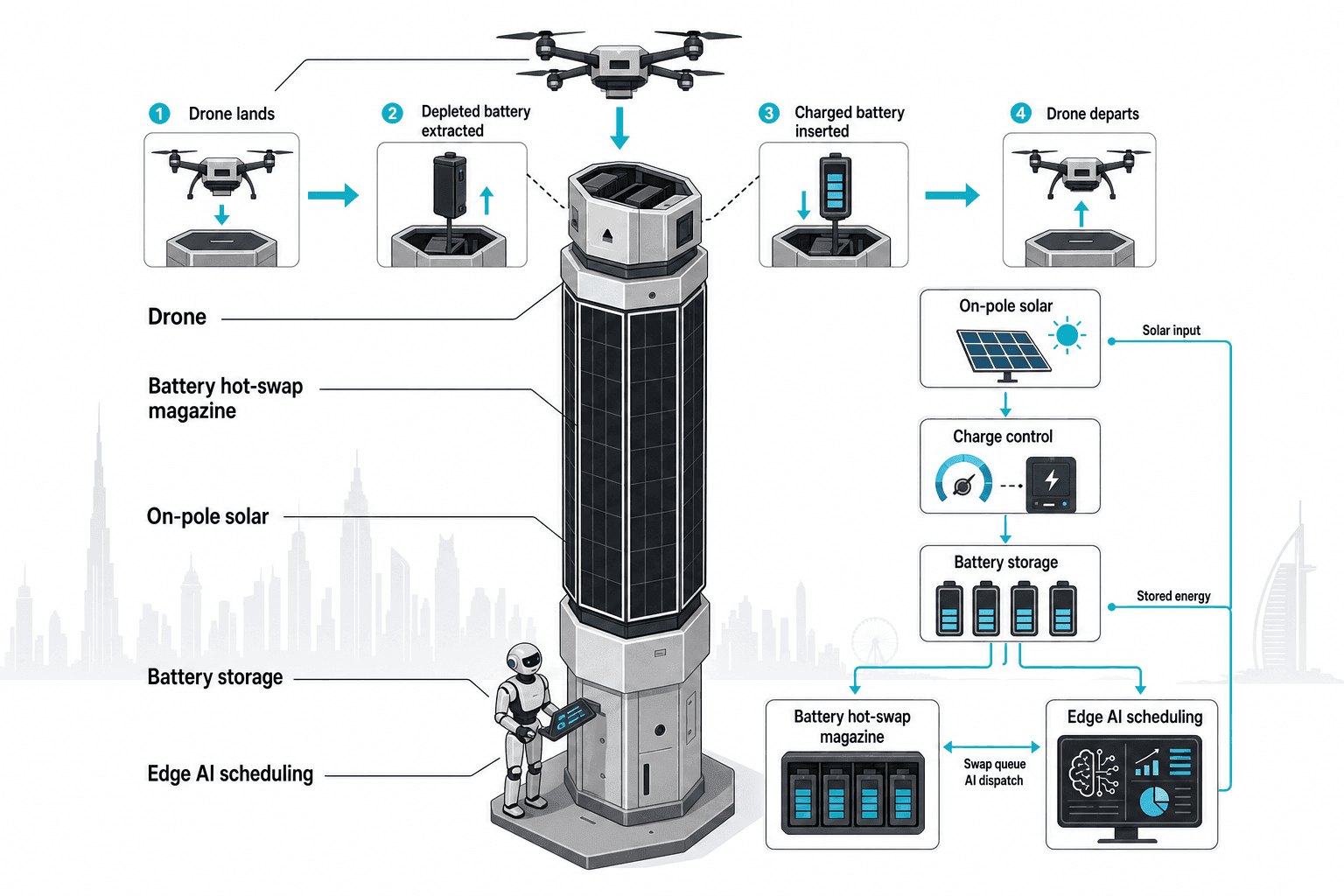
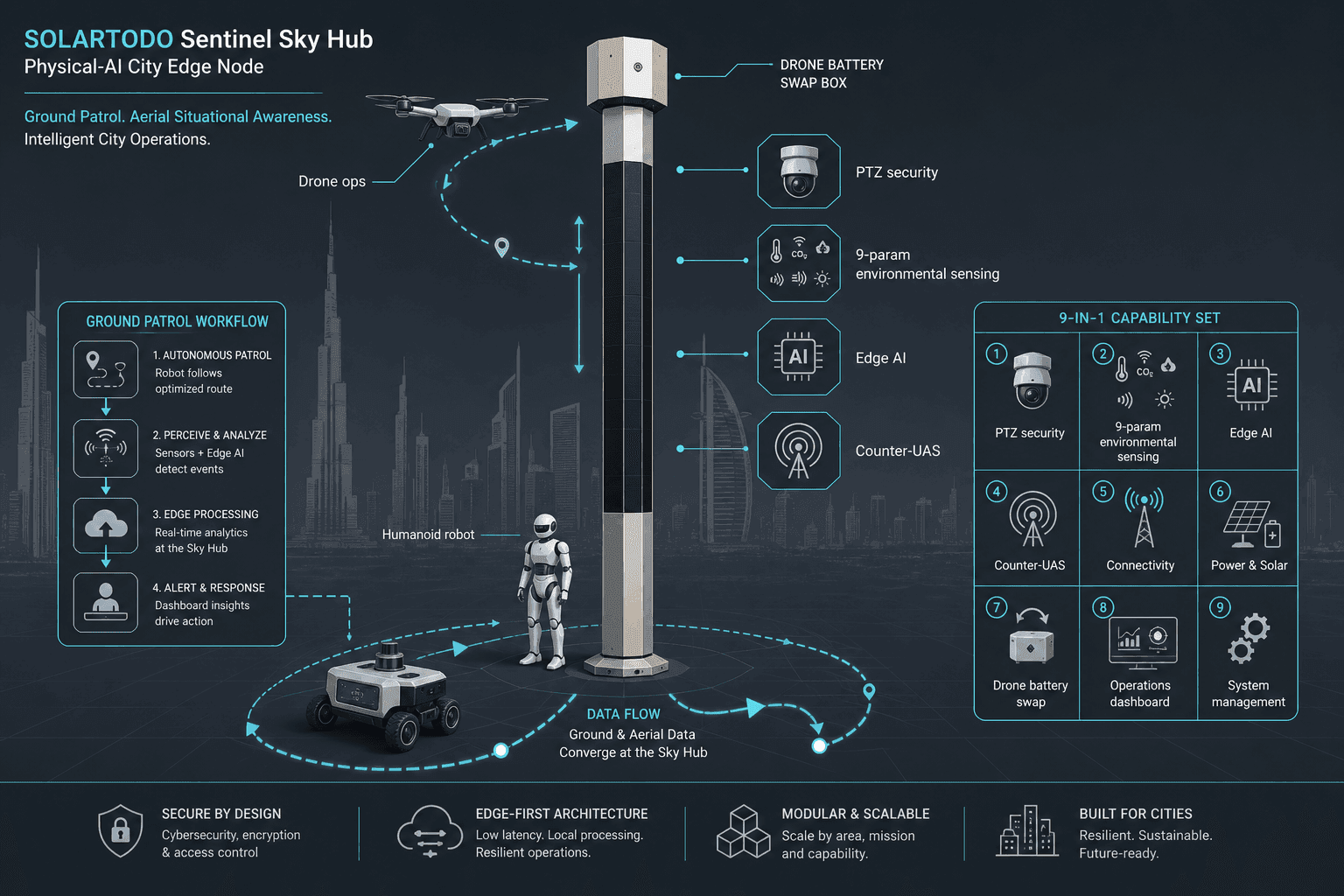
A typical N-unit deployment of this scale would consist of 23 Sky Hub pole-form edge nodes, each configured as a fully off-grid micro-station. Each node should include battery storage, on-pole solar replenishment, local AI compute, a PTZ sensing package, environmental monitoring, a drone service bay with automated battery exchange, and a robot charging interface at the base. The operating concept is sensing, authorized assessment and response, edge workload scheduling, and field operations in one common operating picture.
The drone workflow should be configured for launch, assigned patrol, inspection, return, automated battery exchange, and redeployment. Multi-bay battery service enables several consecutive sorties, but sortie frequency must be governed by heat, wind, airspace approvals, battery state, and mission priority. The ground robot workflow should cover patrol, alarm response, inspection, air-ground coordination, and return-to-charge without implying that a human is removed from authorization decisions.
Counter-UAS scope should remain narrow and defensible. The pole can detect and track unauthorized drones through its own sensing stack and optional partner-sensor inputs; radar, if used, is not pole hardware. Mitigation should be human-authorized and non-lethal only, using command coordination, soft aerial net-capture by a friendly drone, or close-approach deterrence where legally permitted.
For SOLARTODO project planning, the safest buyer-facing statement is conditional: a typical 23-unit deployment in Dubai would require site survey, radio planning, flight-risk assessment, authority review, foundation design, thermal validation, and privacy-impact review. For detailed configuration options, see the SOLARTODO city AI pole solutions page or contact us for engineering review.
Technical Specifications
A Dubai Sentinel node should combine 23 off-grid poles, 5-20kWh storage per node, 9 environmental channels, and local event-only metadata export. The following specification set is the recommended project-based configuration for Dubai and must be finalized by structural, electrical, aviation, and data-governance engineers.
- Product line: SOLARTODO Sentinel City AI Pole, Sky Hub pole form, pure smart pole with no lighting system.
- Quantity: approximately 23 units for the reference Dubai configuration.
- Spacing: approximately 30m between nodes, creating about 660m of nominal linear operating coverage.
- Energy architecture: fully off-grid, battery-backed micro-station with on-pole solar replenishment.
- Solar replenishment model: about 2.8-3.2kWp nameplate, about 1.0-1.3kW clear-sky DC peak, and about 7-10kWh/day in high-irradiance conditions.
- Storage class: 5-20kWh battery storage per node, selected by drone sortie frequency, robot duty cycle, thermal margin, and communications load.
- Edge compute: Jetson-class module for local inference, workload scheduling, sensor fusion, mission logs, and health monitoring.
- Data handling: raw video and sensor data stay on the pole; only de-identified event metadata, system status, alerts, and maintenance records may leave the node.
- Security sensing: PTZ camera with local perception for anonymous vehicle count, crowd density, intrusion, and perimeter awareness.
- Environmental monitoring: wind speed, wind direction, temperature, humidity, atmospheric pressure, noise, PM10, PM2.5, and illuminance.
- Drone operations: launch, route assignment, patrol, inspection, return, battery hot-swap, charge-state management, and task redeployment.
- Ground robot operations: patrol, alarm response, inspection, air-ground coordination, and wireless charging at the pole base.
- C-UAS coordination: detection, tracking, command coordination, and human-authorized non-lethal response only.
- Compliance orientation: designed for local processing and PDPL-LGPD-oriented privacy controls; certification status must be verified project by project.
- Standards alignment: IEC 62443 for industrial cybersecurity principles, IEC 60529 for enclosure ingress-protection classification, and IEEE 2030.5-style device communications concepts where applicable.
Implementation Approach
A 23-node Dubai rollout would typically proceed through 6 controlled phases from survey to commissioning rather than a single installation event. Phase 1 is site qualification: confirm coordinates, access rights, airspace constraints, solar exposure, wind exposure, foundation conditions, and backhaul availability. This stage should also identify whether the corridor is best treated as a perimeter, inspection route, logistics frontage, or campus operating zone.
Phase 2 is engineering confirmation. The project team should validate battery autonomy against expected drone sorties, robot patrol cycles, sensor processing loads, and communications intervals. Dubai's heat profile makes thermal modeling essential, especially for batteries, compute modules, and drone service components exposed to sustained high ambient temperatures.
Phase 3 is procurement and logistics. For a project-based custom configuration, SOLARTODO would define the pole bill of materials, edge compute package, drone service module, robot interface, battery storage class, sensor package, and command software configuration. CKD or modular shipping can reduce site assembly complexity, but final packaging depends on import, installer capability, and local certification requirements.
Phase 4 is civil and mechanical installation. Foundations should be designed against local soil conditions, wind exposure, pole load, maintenance access, and cable-free off-grid operation. Because the Sentinel is not a grid-powered asset, the installation workflow focuses on foundation works, pole erection, battery commissioning, sensor alignment, communications validation, and safety-zone setup rather than utility interconnection.
Phase 5 is systems commissioning. Each node should pass battery state checks, solar replenishment checks, compute health checks, environmental sensor calibration, PTZ field-of-view validation, drone bay state-machine testing, robot charging verification, and event metadata routing. Human-in-the-loop authorization should be tested before any C-UAS coordination workflow is made operational.
Phase 6 is operational acceptance. The buyer should review mission logs, anonymized alert records, false-alarm rates, sortie readiness, maintenance intervals, and command-view usability. According to IEC (2018), IEC 62443 is organized around industrial automation and control system security, so role-based access, patch discipline, segmentation, and audit trails should be included in acceptance criteria.
Expected Performance & ROI
Expected performance for a Dubai 23-node configuration should be measured by uptime, inspection coverage, response time, truck-roll reduction, and privacy-preserving event quality. The primary economic value is operational consolidation: one off-grid pole can host sensing, compute, drone support, robot charging, environmental telemetry, and event coordination. That reduces the number of separate cabinets, camera poles, charging points, sensor masts, and manually serviced inspection routes.
According to IEA (2023), digitalization can improve power-system monitoring and flexibility when paired with secure data handling and operational discipline. For a Sentinel deployment, the analogous principle is local intelligence at the field edge. The business case improves when the poles reduce routine patrol labor, accelerate incident verification, and cut avoidable site visits without exporting raw video.
ROI should be modeled as a range rather than a fixed promise. Inputs include security staffing cost, inspection frequency, drone sorties per day, robot patrol hours, maintenance callout cost, incident-response value, battery replacement assumptions, and communications fees. A conservative buyer model should compare the 23-node system against separate fixed cameras, environmental stations, drone docks, robot chargers, solar-battery cabinets, and manual patrol contracts.
The off-grid energy model should also be presented accurately. The on-pole solar layer can replenish roughly 7-10kWh/day under high-irradiance clear-sky conditions, but high-power drone and robot workflows are buffered by 5-20kWh storage and scheduled by duty cycle. This is fully off-grid, but it is not unlimited solar self-sufficiency.
Results and Impact
For planning purposes, a 23-node Dubai cluster can consolidate at least 6 infrastructure functions into one off-grid edge-node network. The expected impact is clearer situational awareness, fewer separate field assets, and faster verification of perimeter, crowd-density, vehicle-count, environmental, and drone-related events. These outcomes remain conditional until the site survey, authority approvals, and operating procedures are complete.
A practical Dubai success metric is not simply the number of poles installed. It is the number of routine inspections converted to autonomous patrols, the percentage of alerts verified locally, the reduction in raw-data movement, and the maintenance interval achieved under heat and dust exposure. SOLARTODO recommends acceptance testing against uptime, event latency, battery reserve, sortie readiness, false-alarm rate, and operator authorization logs.
Comparison Table
The 23-node Sentinel configuration differs from separate camera, drone, robot, and sensor systems by combining 6 functions in one off-grid pole platform. The table below compares typical infrastructure approaches for Dubai buyers evaluating the SOLARTODO Sentinel City AI Pole line.
| Evaluation factor | SOLARTODO Sentinel City AI Pole | Conventional fixed camera pole | Separate drone dock plus cameras | Manual patrol model |
|---|---|---|---|---|
| Reference Dubai scale | 23 nodes | 23-46 camera points | 1-3 dock zones plus cameras | Multiple patrol shifts |
| Typical spacing | 30m node spacing | 15-40m camera spacing | Dock coverage depends on route | Route-dependent |
| Power model | Fully off-grid battery plus solar replenishment | Usually grid or site power | Usually site power | Vehicle or foot patrol |
| Lighting system | 0 lighting load | May share lighting infrastructure | Not applicable | Not applicable |
| Edge AI processing | Local inference on each pole | Often recorder or cloud dependent | Split across dock/camera systems | Human observation |
| Drone operations | Launch, return, hot-swap, redeploy | None | Dedicated dock only | Manual dispatch |
| Ground robot support | Charging and coordination at pole base | None | Usually separate charger | Not applicable |
| Environmental channels | 9 parameters | Usually none | Optional separate station | Manual spot checks |
| C-UAS coordination | Human-authorized, non-lethal only | Detection only if integrated | Depends on sensors | Human reporting |
| Data governance | Raw data stays on pole | Often central recording | Mixed architecture | Patrol reports |
| Quotation path | FOB, CIF, or EPC tier | Equipment plus installer | Multi-vendor integration | Service contract |
Pricing & Quotation
SOLARTODO provides 3 quotation paths for Dubai buyers, but final pricing depends on engineering confirmation and selected delivery scope. SOLARTODO offers three pricing tiers for this product line: FOB Supply (equipment ex-works China), CIF Delivered (including ocean freight and insurance), and EPC Turnkey (fully installed, commissioned, with 1-year warranty). Volume discounts are available for large-scale deployments. Configure your system online for an instant estimate, or request a custom quotation from our engineering team at [email protected].
Frequently Asked Questions
A Dubai buyer should evaluate 10 practical questions covering specifications, installation, ROI, maintenance, EPC scope, warranty, and regulatory readiness.
Q1: What is the recommended configuration for Dubai? A typical Dubai configuration would use approximately 23 SOLARTODO Sentinel City AI Pole units at 30m spacing, covering about 660m of nominal linear operating zone. Each node should include off-grid battery storage, solar replenishment, edge AI compute, PTZ security sensing, 9-parameter environmental monitoring, drone service, robot charging, and human-authorized non-lethal C-UAS coordination.
Q2: Is the SOLARTODO Sentinel City AI Pole a smart streetlight? No. The SOLARTODO Sentinel City AI Pole is a pure smart pole with no lighting system and no lighting load. It is designed for sensing, edge computing, autonomous drone operations, robot operations, environmental telemetry, and command coordination. Buyers should scope it as an off-grid city edge node, not as a streetlight replacement or lighting retrofit.
Q3: How long would deployment typically take? A 23-node Dubai project would commonly require several phases: survey, engineering confirmation, procurement, civil works, pole erection, commissioning, and operational acceptance. The timeline depends on authority approvals, foundation design, shipping method, drone permissions, integration scope, and site access. A reliable schedule should be issued only after survey data and configuration drawings are reviewed.
Q4: What ROI or payback period should buyers expect? ROI should be modeled from avoided patrol labor, reduced truck rolls, faster event verification, fewer separate systems, and better inspection coverage. SOLARTODO should not promise a universal payback period without site data. A conservative model compares 23 integrated nodes against separate cameras, drone docks, robot chargers, environmental stations, battery cabinets, software platforms, and manual patrol contracts.
Q5: How is maintenance handled in Dubai's heat and dust? Maintenance should include battery health checks, solar replenishment inspection, sensor cleaning, drone bay checks, robot charging validation, software patching, and mission-log review. Dubai's heat and dust require planned inspection intervals and thermal monitoring. The exact schedule should be based on site exposure, sortie frequency, battery reserve, communications uptime, and environmental sensor drift.
Q6: Does raw video leave the pole? No. The recommended data architecture keeps raw video and sensor data on the pole for local processing. Only de-identified event metadata, status data, alarms, and maintenance records should leave the node. This approach is designed for local processing and PDPL-LGPD-oriented governance, but project-specific legal review is still required before commissioning.
Q7: What does EPC Turnkey include? EPC Turnkey typically covers engineering coordination, equipment delivery, foundations, installation, commissioning, and a 1-year warranty, subject to final contract scope. For Dubai, EPC assumptions should also clarify authority approvals, drone operating permissions, civil access, backhaul responsibility, operator training, spare parts, and acceptance testing. Pricing must be quoted after engineering confirmation.
Q8: How does Sentinel compare with a conventional camera pole? A conventional camera pole mainly supports fixed or PTZ surveillance and often depends on grid or site power. A SOLARTODO Sentinel City AI Pole adds off-grid energy buffering, edge AI, drone service, robot charging, environmental monitoring, mission management, and human-authorized non-lethal C-UAS coordination. The comparison is therefore platform consolidation, not camera resolution alone.
Q9: What warranty assumptions are reasonable? The required paragraph for this product line references EPC Turnkey with a 1-year warranty. Final warranty terms should identify covered components, exclusions, response time, spare parts, battery conditions, software support, and preventive maintenance obligations. Dubai buyers should align warranty start with commissioning acceptance, not shipment date, when the contract scope includes installation.
Q10: Are drones and C-UAS functions autonomous? Drone patrol, return, hot-swap, redeployment, route management, and health logging can operate as mature automated workflows, but response authorization remains controlled. Counter-UAS mitigation must be non-lethal and human-authorized only. The permitted scope is detection, tracking, command coordination, soft aerial net-capture, or close-approach deterrence, with no jamming, destructive action, or autonomous attack.
References
The analysis uses 7 public standards and institutional sources to ground Dubai demand, solar conditions, cybersecurity, data, and communications assumptions.
- UAE Government (2021): Dubai 2040 Urban Master Plan; establishes a 2040 planning horizon and 5.8 million resident target for Dubai.
- World Bank / ESMAP (2020): Solar Photovoltaic Power Potential by Country; states that countries above 4.5kWh/kWp/day have excellent PV conditions and provides Global Solar Atlas context.
- ITU (2025): ICT Statistics; reports about 6 billion Internet users globally, equal to 74% of the world's population, and identifies ITU as the official ICT statistics source.
- IEC (2018): IEC 62443 industrial automation and control system cybersecurity series; relevant to role-based access, segmentation, patching, and audit trails.
- IEC (2013): IEC 60529 ingress-protection classification; relevant to enclosure protection planning for outdoor electronic systems.
- IEEE (2018): IEEE 2030.5 smart energy profile; relevant as a reference model for device communications and distributed energy-resource messaging concepts.
- IEA (2023): Digitalisation and Energy; supports the role of secure digital monitoring, automation, and data handling in energy and infrastructure operations.
Equipment Deployed
- Approximately 23 SOLARTODO Sentinel City AI Pole units in Sky Hub pole form
- 30m node spacing for about 660m nominal linear operating coverage
- Fully off-grid battery-backed micro-station per node with on-pole solar replenishment
- 2.8-3.2kWp solar replenishment nameplate with about 1.0-1.3kW clear-sky DC peak
- 5-20kWh battery storage class per node, subject to duty-cycle engineering
- Jetson-class edge AI compute for local inference and workload scheduling
- PTZ sensing package for anonymous vehicle count, crowd density, intrusion, and perimeter awareness
- 9-parameter environmental monitoring: wind speed, wind direction, temperature, humidity, pressure, noise, PM10, PM2.5, illuminance
- Automated drone launch, return, battery hot-swap, route planning, task queueing, and mission logging
- Ground robot patrol coordination and wireless charging interface at pole base
- Human-authorized non-lethal C-UAS coordination with optional partner-sensor input