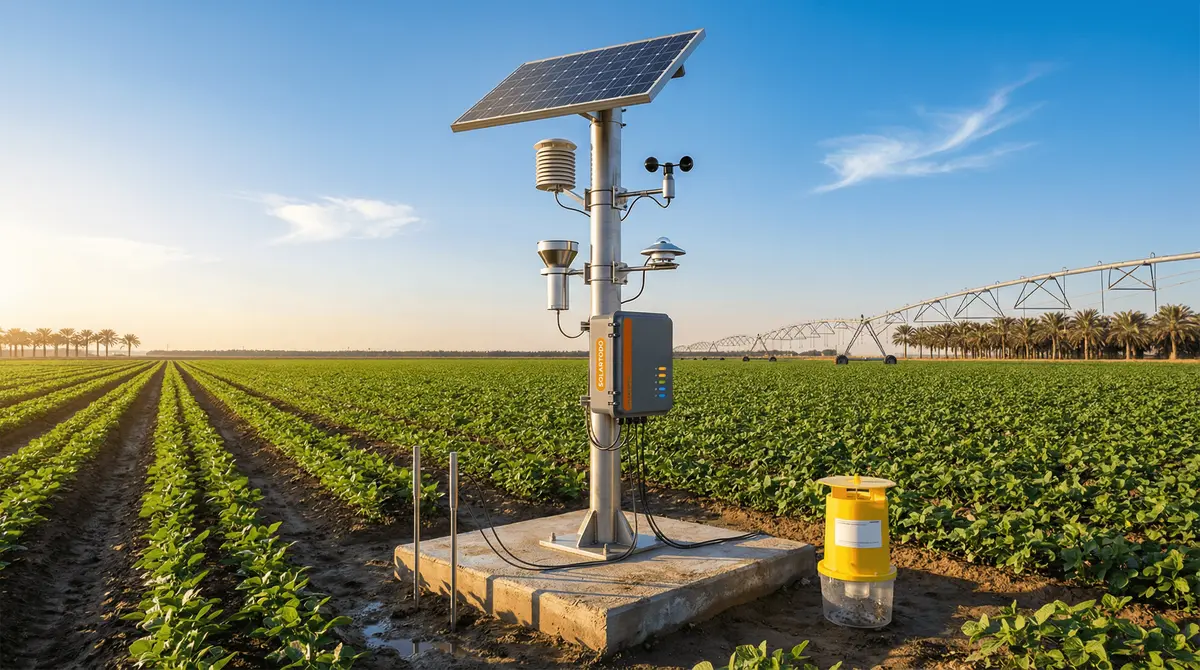
Dubai Smart Agriculture Monitoring Project: 49-Hectare Solar IoT Deployment by SOLAR TODO
Dubai, UAE presents one of the most demanding environments for precision agriculture. Farms must operate under high heat, rapid microclimate shifts, dust exposure, uneven connectivity, and long-distance field logistics across desert-adjacent land. For this 49-hectare project, SOLAR TODO deployed a solar-powered, off-grid-capable Smart Agriculture Monitoring system to convert scattered field observations into continuous, decision-ready data.
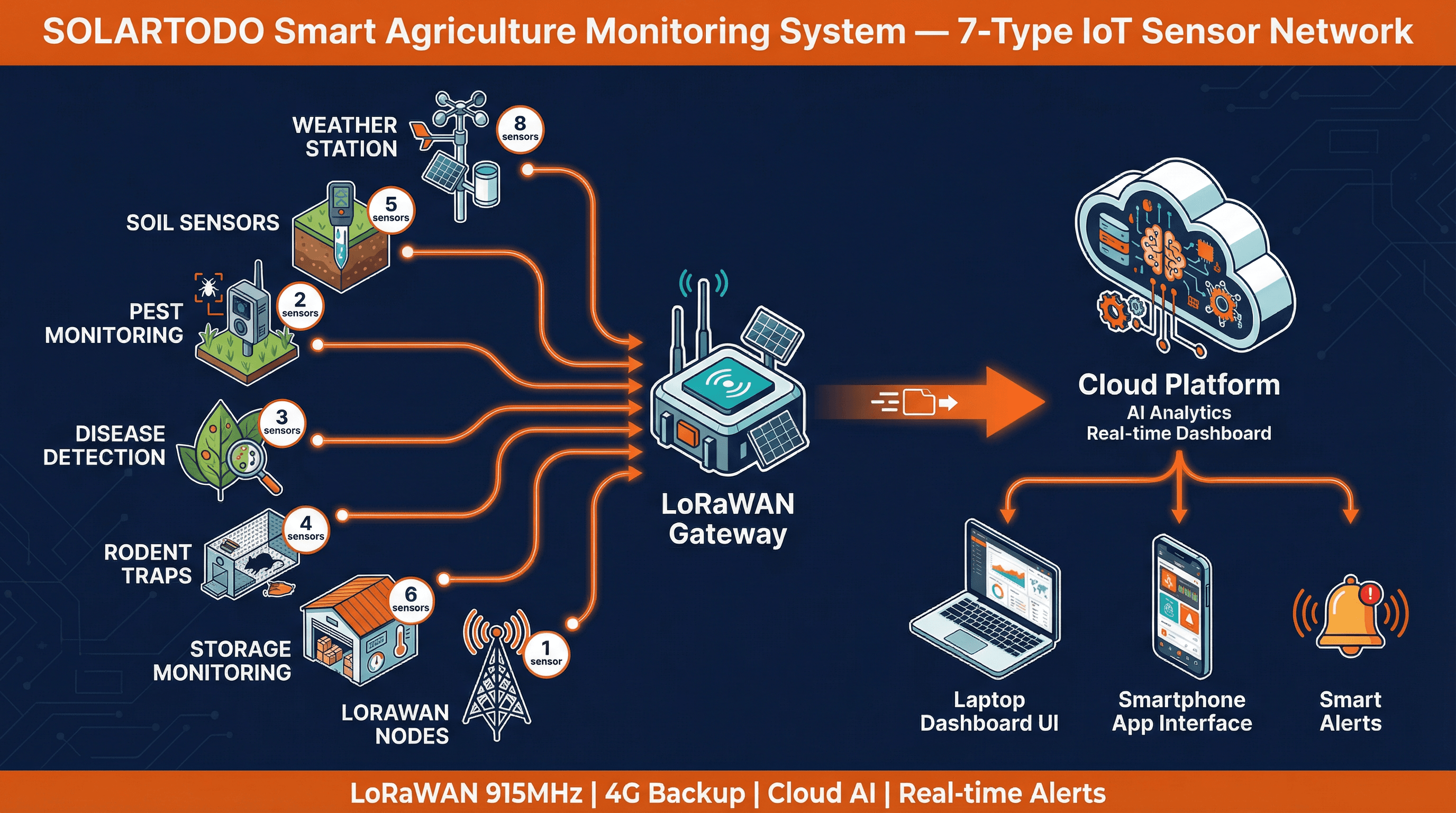
The deployment combined weather sensing, root-zone soil chemistry monitoring, AI-assisted pest and disease detection, rodent alerts, storage condition tracking, and 4G LTE communications into one integrated platform. Instead of relying on isolated manual checks, the farm team gained a cloud-based system with AI prediction, 3-year historical records, and API access for irrigation scheduling, fertilizer mapping, pest warnings, and harvest timing. The result was a monitoring architecture designed for practical field use in Dubai’s harsh operating conditions.
Answer Capsule: In Dubai’s harsh climate, SOLAR TODO deployed a 49-hectare solar IoT monitoring network with weather sensing, root-zone EC/pH probes, AI pest and disease detection, rodent alerts, storage monitoring, and 4G video-capable nodes to improve yield predictability and response speed.
Key Takeaways
- A 49-hectare farm in Dubai was equipped with a solar-powered, off-grid-capable IoT monitoring network.
- The system combined 1 weather station, 5 root-zone EC/pH sensors, 4 AI pest camera units, 1 airborne spore capture unit, and 1 smart rodent trap.
- Soil sensors were installed at 15–30 cm depth to monitor nutrient conditions where crop roots actively absorb inputs.
- Pest monitoring used pheromone traps with AI camera identification and counting, rather than insect-killing lamps.
- 4G LTE video-capable nodes supported image and metadata transmission across a site with variable connectivity conditions.
- The cloud platform included AI prediction, 3-year history, and API access for operational integration and trend analysis.
- Expected yield gains were linked to weather optimization (+3%), soil optimization (+8%), pest reduction (+5%), and disease mitigation (+7%).
Project Overview
This project focused on four major decision points in the production cycle: microclimate control, fertilizer optimization, pest and disease intelligence, and loss prevention. In Dubai, these decisions must often be made quickly because evapotranspiration, heat stress, and biological pressure can change within short time windows. A monitoring system therefore had to deliver not only accurate sensing, but also stable field operation under real infrastructure constraints.
Operational Challenge in Dubai
Dubai agriculture operates under a combination of high daytime temperatures, strong solar load, dust exposure, and uneven field connectivity. These conditions increase the difficulty of maintaining reliable instrumentation and make manual scouting less efficient across larger sites. The project therefore required a system that could remain dependable in outdoor conditions while still producing data suitable for daily agronomic decisions.
System Design Objective
SOLAR TODO designed the system around solar-powered sensor nodes, 4G LTE communications, and cloud analytics that support trend-based agronomy decisions. This architecture reduced dependence on fixed power infrastructure and helped maintain data continuity even when site connectivity fluctuated. According to NREL guidance on remote renewable-powered systems, properly sized solar-plus-battery architectures can significantly improve uptime in distributed field monitoring applications, especially where grid extension is impractical.
Monitoring Scope and Decision Logic
Operationally, the sensing plan balanced coverage density, agronomic relevance, and deployment practicality. Weather instrumentation established environmental context, while soil probes were placed at root-zone depth for actionable fertilizer decisions. AI-enabled pest and disease tools were added to detect biological threats earlier than manual scouting alone, and rodent monitoring was included to protect both field edges and storage zones.
System Architecture
1. Weather Station for Dubai Microclimate Control
SOLAR TODO deployed 1 weather station with a 7-sensor configuration to measure temperature, humidity, wind, rain, UV, and pressure, with support for wind direction and solar radiation. The station was specified for ±0.3°C temperature accuracy and ±2%RH humidity accuracy, which is suitable for irrigation scheduling and plant stress monitoring. In arid agriculture, weather data is not just descriptive; it directly affects evapotranspiration estimates, irrigation timing, and heat-risk interpretation.
This matters especially in Dubai, where wind, solar radiation, and humidity can shift rapidly during the day. Those changes influence evaporation rates, leaf temperature, and the timing of irrigation events. WMO guidance emphasizes that consistent meteorological observation quality is essential when weather data is used for operational planning rather than simple reporting.
2. Root-Zone Soil Chemistry Mapping
To support fertilizer optimization, SOLAR TODO installed 5 EC + pH soil sensors at 15–30 cm depth. This depth range was selected because it represents the active root zone for many crop types and provides more actionable information than shallow surface readings. By measuring salinity-related conductivity and pH where roots actually absorb nutrients, the system supports more precise fertilizer mapping and irrigation adjustment.
In hot climates, salts can accumulate unevenly and nutrient availability can change quickly with irrigation cycles. Root-zone monitoring helps agronomy teams identify where corrective action is needed before visible crop stress appears. This approach aligns with the practical intent of soil monitoring standards such as ISO 11461, which support repeatable and comparable environmental measurement workflows.
3. Pest Monitoring with Pheromone Traps and AI Cameras
For pest intelligence, SOLAR TODO deployed 4 HD camera units with AI species identification, each covering approximately 3 hectares per unit. The system uses pheromone traps plus AI image-based identification and counting, allowing the farm team to monitor pest presence with better species-level visibility. This is an observation and decision-support method, not an insect-killing lamp system.
That distinction is important for both agronomic accuracy and operational compliance. Pheromone-guided capture improves target specificity, while AI image analysis reduces manual counting effort and speeds up warning generation. IEEE and IEC instrumentation best practices both support the use of automated sensing and repeatable electronic measurement workflows where consistency and auditability are required in field monitoring systems.
4. Disease Monitoring with Airborne Spore Capture
SOLAR TODO deployed 1 volumetric air sampling spore capture unit connected to AI-based cloud identification. Instead of waiting for visible symptoms in the field, the system measures airborne biological pressure earlier in the disease cycle. This gives agronomists more time to assess risk and coordinate preventive action.
Warm environments can accelerate disease development, especially when irrigation, humidity, and crop canopy conditions align. Air sampling is valuable because it captures a signal before many infections become visually obvious. Earlier detection can improve spray timing, reduce unnecessary interventions, and lower the chance of widespread disease establishment.
5. Rodent Detection and Response
Rodent activity can damage crops, contaminate storage areas, and create hidden losses around field edges and infrastructure zones. To address this, SOLAR TODO installed 1 smart trap with an activity sensor to detect and report rodent presence patterns. The goal was not only capture, but also earlier alerting so field teams could respond before damage escalated.
This type of monitoring is especially useful near vulnerable storage areas, irrigation equipment points, and perimeter zones. By digitizing rodent activity data, the farm can move from reactive inspection to targeted intervention. In a broader integrated pest management strategy, this improves labor efficiency and helps reduce avoidable product loss.
6. Storage Monitoring for Quality Protection
In addition to field sensing, the project included storage monitoring components to track conditions related to product integrity and loss prevention. Storage environments can deteriorate quickly when temperature, humidity, pests, or airflow are not properly controlled. Monitoring these conditions is essential when post-harvest quality affects saleability and margin.
By linking storage data with field and harvest records, the platform gives operators a more complete view of crop condition across the production chain. This is particularly useful when diagnosing whether quality issues originated in the field, during handling, or in storage. A unified monitoring approach supports faster corrective action and more reliable traceability.
7. Communications and Power Architecture
The deployment used 4G LTE video-capable nodes rated for approximately 10–100 Mbps to support image and metadata transmission from camera-based pest monitoring devices. This was critical because field connectivity in Dubai can vary by perimeter layout, construction density, and local network conditions. The architecture was designed so edge devices could continue collecting data while synchronization resumed when communication stabilized.
All sensor nodes were built around a solar-powered, off-grid-capable approach using a 30W solar panel and 150Wh battery supporting a 10W load. This configuration reduces trenching and cabling requirements while improving deployment flexibility when field layouts change. NREL and IRENA both identify correctly sized renewable-powered remote systems as a practical solution for distributed monitoring in agriculture and infrastructure-light environments.
Deployment in Dubai: Practical Field Execution
Coverage Strategy Across 49 Hectares
The sensing plan was designed to provide usable coverage without overcomplicating field maintenance. One weather station established a reliable environmental baseline, while five soil probes created root-zone chemistry checkpoints across the estate. Four AI pest camera units delivered field-level warning granularity, and dedicated disease and rodent devices covered additional biological risks.
This mix allowed the farm to monitor both broad environmental trends and localized risk patterns. Rather than overinvesting in one sensor category, the deployment distributed sensing across the decisions that most directly affect yield and crop protection. That balance is often more valuable than raw device count in commercial farm operations.
Installation Logic and Field Placement
Device placement was guided by agronomic relevance and maintenance practicality. The weather station was positioned to represent field-wide atmospheric conditions with minimal obstruction, while soil probes were distributed to reflect different irrigation and nutrient-management zones. Pest camera units were assigned to areas where species pressure and crop sensitivity justified closer observation.
The disease monitoring unit and rodent detection point were installed where biological risk could be captured early without creating unnecessary service complexity. This deployment logic helped the farm maintain a manageable inspection routine while still generating data that was spatially relevant to operational decisions.
Standards Alignment for Data Reliability
SOLAR TODO aligned this project with recognized guidance for measurement consistency and operational reliability. Meteorological workflows were informed by WMO principles, while environmental monitoring repeatability referenced ISO 11461. Electrical and instrumentation reliability were also supported by baseline practices commonly associated with IEC and IEEE frameworks for field electronics and data systems.
These references matter because agronomy decisions depend on comparable data over time, not just one-time readings. If weather, soil, and biological data are not collected consistently, trend analysis becomes less reliable. Standards-based workflows improve confidence in alerts, historical comparisons, and AI-driven recommendations.
Cloud Platform and Decision Support
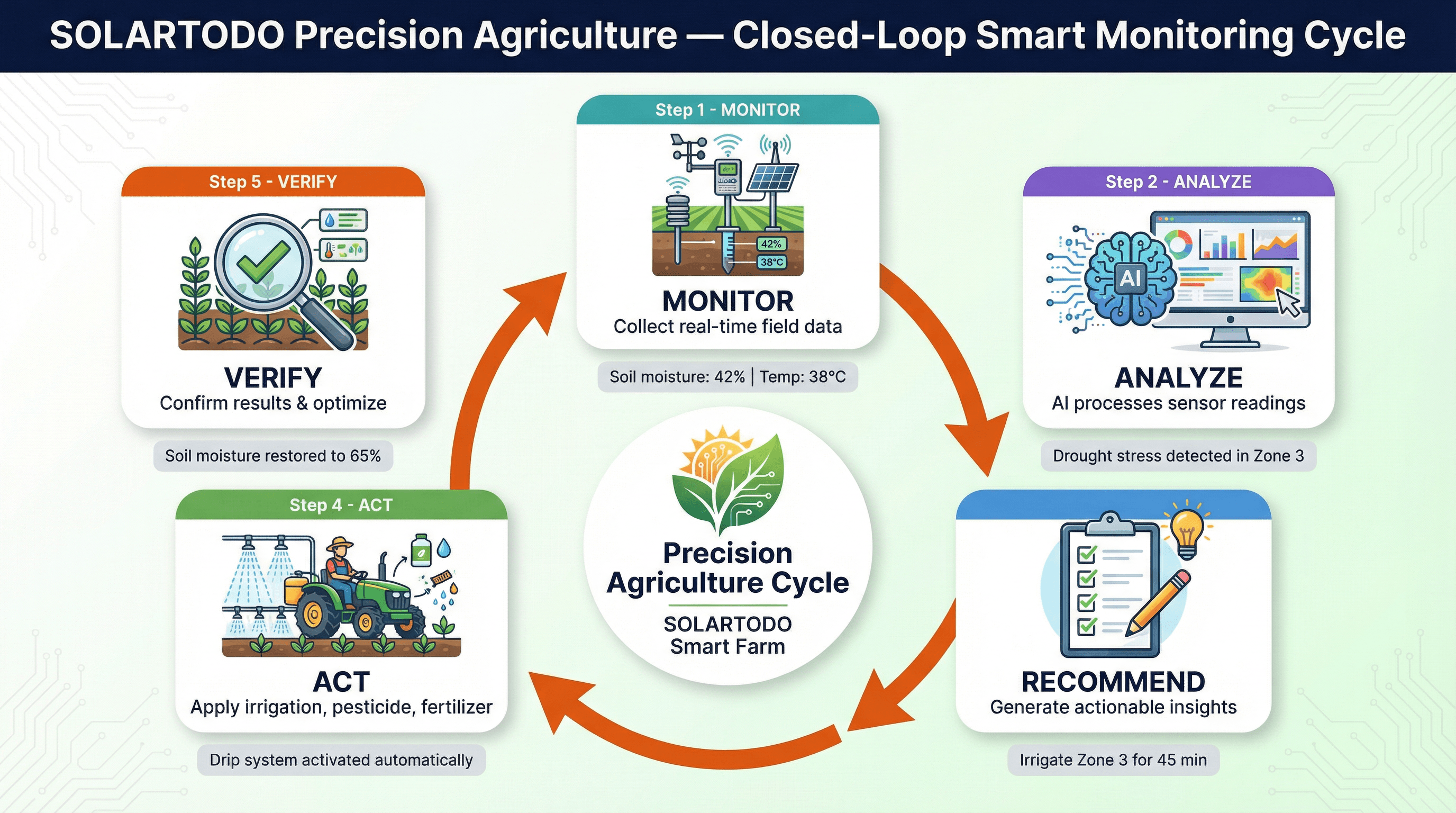
The cloud platform delivered with this project included AI prediction, 3-year historical storage, and API access. This allowed agronomy teams to compare current conditions with prior patterns and integrate outputs into internal dashboards or reporting systems. In practice, that means irrigation, fertilization, and crop protection decisions can be based on trajectories and thresholds rather than isolated field notes.
For Dubai operations, historical context is particularly valuable because seasonal patterns can still produce highly variable short-term field conditions. AI prediction helps convert raw sensor streams into practical recommendations, while API access supports enterprise integration. This makes the system suitable not only for monitoring, but also for digital farm management workflows.
Technical Specifications
- Site scale: 49-hectare smart agriculture monitoring system
- Weather: 1 × 7-sensor station measuring temperature, humidity, wind, rain, UV, and pressure, with wind direction and solar radiation support
- Weather accuracy: ±0.3°C temperature, ±2%RH humidity
- Soil sensors: 5 × EC + pH sensors installed at 15–30 cm depth
- Pest monitoring: 4 × HD cameras with AI species identification, using pheromone traps plus AI counting, 3 ha coverage per unit
- Disease monitoring: 1 × volumetric air sampling spore capture unit with AI identification
- Rodent detection: 1 × smart trap + activity sensor
- Storage monitoring: integrated quality and loss-prevention monitoring components
- Communications: 4G LTE video-capable nodes, 10–100 Mbps
- Power system: solar-powered, off-grid-capable; 30W panel + 150Wh battery supporting 10W load
- Cloud platform: AI prediction + 3-year history + API access
- Standards references: WMO / ISO 11461 / IEC / IEEE / NREL-aligned design logic
Deployment Summary Table
| System Component | Quantity | Primary Function | Field Value |
|---|---|---|---|
| Weather station | 1 | Microclimate monitoring | Irrigation scheduling, evapotranspiration context, heat-risk tracking |
| EC + pH soil sensors | 5 | Root-zone chemistry measurement | Fertilizer mapping and salinity/pH correction at 15–30 cm depth |
| AI pest camera units | 4 | Pheromone trap imaging and pest identification | Species-level alerts and field-scale pest counting |
| Spore capture unit | 1 | Airborne disease pressure detection | Earlier disease warning than visual scouting alone |
| Smart rodent trap | 1 | Rodent activity detection | Loss prevention in vulnerable field and storage zones |
| 4G LTE nodes | Multiple | Data and image transmission | Supports cloud sync and AI-enabled monitoring workflows |
| Solar power kits | All nodes | Off-grid energy supply | Reduced cabling, flexible deployment, field resilience |
Results and Impact
Expected Yield Improvements
The project’s value was measured through expected agronomic gains linked to better monitoring coverage and earlier intervention. With improved visibility into weather, root-zone chemistry, pest pressure, and disease risk, the deployment targeted measurable production benefits. These gains reflect the practical impact of acting earlier and with more location-specific data.
- Weather-related optimization: +3% yield
- Soil optimization (EC/pH mapping): +8% yield
- Pest pressure reduction: +5% yield
- Disease risk mitigation: +7% yield
Operational Benefits in Dubai Conditions
In Dubai, agronomy teams often work under narrow response windows because temperature, wind, and biological pressure can shift quickly. This system improved responsiveness by generating earlier warnings and consolidating multiple risk signals into one platform. Instead of waiting for visible crop decline, teams could act on weather trends, root-zone chemistry changes, pest counts, and spore detection data.
The use of 4G LTE video-capable nodes also improved the practicality of AI-based monitoring in the field. Camera telemetry, metadata transmission, and cloud synchronization were all supported within one communications framework. That reduced fragmentation and made the monitoring outputs easier to use in daily operations.
Long-Term Data Quality and Comparability
One of the project’s long-term advantages is data consistency. By aligning workflows with WMO principles and ISO 11461-oriented reliability logic, the farm can compare current readings with historical records more confidently. This is essential when using 3-year trend history to refine irrigation strategy, nutrient management, and biological risk thresholds.
Reliable historical data also improves AI performance over time. As the platform accumulates more site-specific records, recommendations can become more context-aware and operationally useful. This turns the system from a monitoring tool into a progressively smarter decision-support asset.
Pricing and Quotation
SOLAR TODO offers three pricing tiers for this product line: FOB Supply, CIF Delivered, and EPC Turnkey. FOB Supply covers equipment ex-works China, CIF includes freight and insurance, and EPC Turnkey includes installation, commissioning, and a 1-year warranty. Volume discounts are available for larger deployments.
You can configure your system online for an instant estimate or request a custom quotation from our engineering team. For direct project inquiries, contact [email protected].
Frequently Asked Questions
1. What is the deployment scope of this 49-hectare project?
This deployment covers a 49-hectare agricultural site in Dubai with an integrated monitoring architecture rather than a single-purpose sensor package. The installed system includes one weather station, five root-zone EC and pH sensors, four AI pest camera units, one airborne spore capture device, one smart rodent trap, storage monitoring components, 4G LTE communications, and solar power kits for field autonomy. The scope was designed to support operational decisions across irrigation, fertilization, crop protection, and post-harvest quality management without relying on dense fixed infrastructure.
2. Why were the soil sensors installed at 15–30 cm depth?
The 15–30 cm depth range was selected because it better represents the active root zone for many commercial crops than shallow surface measurements. In practical terms, this means the readings are more relevant to nutrient uptake, salinity exposure, and irrigation effectiveness. Surface soil can fluctuate rapidly due to sun, wind, and evaporation, which may distort decision-making. By placing sensors deeper, the farm team receives data that is more stable and more directly tied to fertilizer correction and irrigation scheduling.
3. How accurate is the weather monitoring system?
The weather station in this deployment is specified for ±0.3°C temperature accuracy and ±2%RH humidity accuracy. This level of performance is suitable for operational irrigation planning, plant stress interpretation, and local weather trend analysis. In Dubai conditions, the practical value of this accuracy is that agronomy teams can make better timing decisions around irrigation windows, heat-risk periods, and microclimate shifts without relying on distant public weather sources.
4. How reliable is 4G LTE communication for agricultural monitoring in Dubai?
4G LTE is a practical choice for this type of deployment because it provides sufficient bandwidth for image transfer, metadata synchronization, and cloud-based monitoring workflows without requiring extensive wired infrastructure. In Dubai, signal quality can vary depending on field layout, nearby construction, and network load, so the system was designed with edge data continuity in mind. Devices continue collecting data locally when connectivity weakens, and synchronization resumes when the network stabilizes. This architecture improves operational resilience in real field conditions.
5. How does AI pest identification work in this system?
The pest monitoring workflow combines pheromone traps with HD imaging and cloud-based AI analysis. Pheromone lures attract target pest species into a controlled observation point, and the camera captures images for identification and counting. The AI model then classifies the captured insects and generates monitoring outputs that are more consistent than manual counting alone. This approach is intended for surveillance and decision support, not direct insect elimination. It gives agronomy teams earlier visibility into pest pressure and helps prioritize scouting and intervention resources.
6. How does airborne spore capture improve disease management compared with visual scouting?
Visual scouting typically identifies disease after symptoms become visible on leaves, stems, or fruit, which can mean the infection cycle is already underway. Airborne spore capture detects biological pressure earlier by sampling the air for pathogen-related signals before visible symptoms are widespread. When paired with AI-based identification and weather context, this gives agronomy teams more time to assess risk and plan preventive action. Earlier detection can improve treatment timing, reduce unnecessary blanket spraying, and lower the probability of large-scale disease establishment across the site.
7. How much solar autonomy does the system provide?
Each field node is based on a solar-powered, off-grid-capable design using a 30W solar panel and a 150Wh battery supporting an approximately 10W load. Actual autonomy depends on duty cycle, transmission frequency, camera usage, and seasonal solar conditions, but the configuration is intended to maintain stable operation for distributed monitoring without trenching power lines across the farm. For B2B deployments, the key advantage is not only energy independence but also installation flexibility, faster rollout, and easier relocation when field layouts or crop zones change.
8. Can the platform integrate with existing farm management software?
Yes. The platform includes API access, allowing monitoring outputs to be connected with existing farm dashboards, ERP tools, irrigation control logic, reporting systems, or third-party analytics environments. This is important in B2B operations where sensor data must fit into broader workflows rather than remain isolated in a standalone interface. API connectivity supports automated reporting, threshold-based alert routing, and historical data export for agronomic analysis. It also makes the system more scalable for multi-site operators that need standardized data structures across multiple farms.
9. What maintenance does the system typically require?
Routine maintenance generally includes sensor inspection, cleaning of exposed surfaces, verification of solar charging performance, battery health checks, communication diagnostics, and periodic validation of camera and trap positioning. In Dubai, dust accumulation and heat exposure make scheduled cleaning and enclosure inspection especially important. The objective is not high service intensity, but predictable preventive maintenance that protects data continuity and long-term measurement reliability.
10. What kind of ROI should a farm expect from this deployment model?
ROI depends on crop value, baseline management quality, biological pressure, and how consistently the farm acts on the monitoring outputs. In this project, expected gains were linked to weather optimization (+3%), soil optimization (+8%), pest reduction (+5%), and disease mitigation (+7%). These figures should be interpreted as operational improvement targets rather than a universal guarantee. In practice, ROI often comes from a combination of yield protection, reduced input waste, earlier intervention, lower scouting labor, and better post-harvest quality retention. Higher-value crops typically see faster payback.
11. Is the system suitable for farms with intermittent connectivity?
Yes. The architecture was designed specifically for field conditions where connectivity may vary by location or time of day. Edge devices continue collecting data locally even when the network is unstable, which helps prevent data gaps during temporary outages. Once communication quality improves, the system resumes synchronization with the cloud platform. This design is particularly useful for large agricultural sites where signal conditions differ between perimeter zones, interior blocks, and storage areas. It supports operational continuity without requiring perfect network coverage at all times.
12. Why use a combined platform instead of separate monitoring tools?
A combined platform improves decision speed and data comparability. Weather, soil chemistry, pest counts, disease indicators, rodent activity, and storage conditions all influence crop outcomes, but they are more useful when reviewed together rather than in isolated systems. A unified platform reduces fragmentation, simplifies training, and allows teams to correlate multiple signals before acting. For example, pest pressure may be interpreted differently when combined with humidity trends or storage alerts. This integrated approach is generally more effective for commercial operations than managing disconnected tools and spreadsheets.
References
- WMO (World Meteorological Organization) — guidance on meteorological observation quality, siting, and consistency for operational environmental monitoring.
- ISO 11461 — reference framework relevant to environmental measurement reliability and repeatable monitoring workflows.
- NREL (National Renewable Energy Laboratory) — best-practice guidance on remote renewable-powered systems, solar resource use, and field power reliability.
- IEC (International Electrotechnical Commission) — baseline principles for electrical safety, instrumentation reliability, and field device performance.
- IEEE — engineering guidance relevant to sensor networks, communications reliability, and electronic system design consistency.
- ITU (International Telecommunication Union) — telecommunications performance guidance relevant to LTE-based field connectivity.
- IRENA (International Renewable Energy Agency) — renewable deployment references for distributed, off-grid, and hybrid energy systems.
Related Links
- Product page: Smart Agriculture Monitoring
- Talk to our team: Contact us
Equipment Deployed
- 1 × Weather station with 7 sensors: temperature, humidity, wind, rain, UV, and pressure, with wind direction and solar radiation support; ±0.3°C and ±2%RH accuracy
- 5 × Soil sensors measuring EC + pH, installed at 15–30 cm depth
- 4 × HD camera units for pest monitoring with AI species identification, using pheromone traps plus AI counting and identification; 3 ha coverage per unit
- 1 × Volumetric air sampling spore capture unit for disease monitoring with AI identification
- 1 × Smart trap + activity sensor for rodent detection
- Integrated storage monitoring components for quality and loss prevention
- 4G LTE video-capable sensor nodes rated at 10–100 Mbps for communications
- Solar power kit with 30W panel + 150Wh battery supporting 10W load; solar-powered and off-grid capable
- Professional cloud platform with AI prediction, 3-year history, and API access for irrigation scheduling, fertilizer maps, pest warnings, and harvest timing