Douala Smart Streetlight Market Analysis: 138-Unit Hybrid 9m Configuration Guide for Urban Corridors
Summary
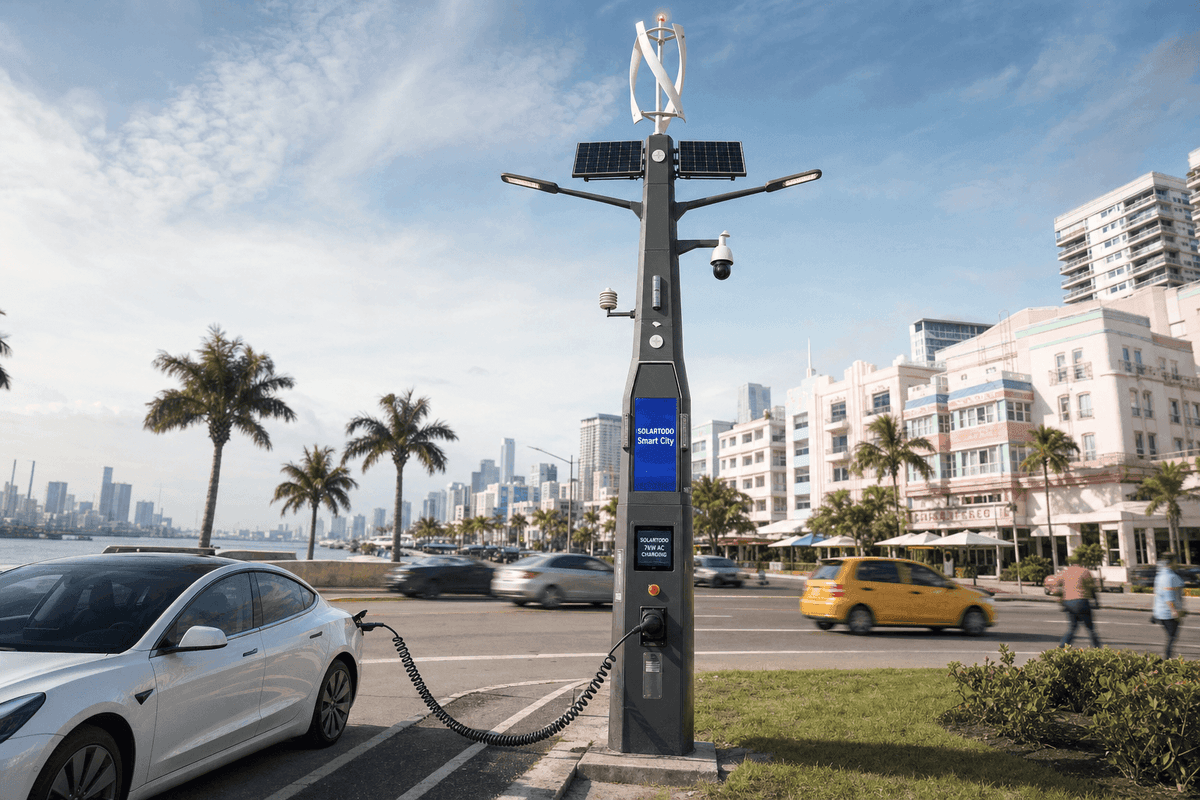
Douala’s dense urban corridors, high rainfall, and mixed grid reliability support a recommended smart-streetlight profile of approximately 138 hybrid 9 m poles at 35 m spacing, each with 11 kW EV charging, 5 kWh LFP storage, and 2×80 W LED lighting for city-road applications.
Key Takeaways
- A typical 4.8 km urban-corridor deployment in Douala would use approximately 138 smart poles at 35 m spacing, equal to about 28.8 poles/km.
- The recommended form factor is a 9 m octagonal tapered steel pole with base Ø45 cm and top Ø15 cm, suited to city streets rather than highways or park paths.
- Each pole would combine 2×80 W LED luminaires, delivering 24,000 lm total at 150 lm/W and 4000 K neutral white output.
- The hybrid energy package uses 1× 400 W Gorlov-type helical VAWT, 2×100 W monocrystalline PV panels, and 1× 5 kWh LFP battery with MPPT control plus grid backup.
- The lower 2.2 m of the pole is the integrated 11 kW AC EV charger itself, with Type 2 connector, OCPP 1.6J, 5 m coiled cable, and USB-A ×2 ports.
- Communications are suited to dense commercial districts with WiFi 6 + 5G gateway, GbE uplink, and LoRaWAN, mounted flush at 8.7 m on the pole face.
- Safety hardware includes 1× 4 MP IR camera, 2× 30 W IP audio columns, SOS + panic alarm, and emergency broadcast linkage for public-space response.
- According to the World Bank (2023), Cameroon’s urbanization rate is above 59%, and according to the World Bank (2022), electricity access remains below full coverage, which supports hybrid street infrastructure rather than grid-only designs.
Market Context for Douala
Douala is Cameroon’s largest metropolitan economy, and its infrastructure profile supports hybrid smart-streetlight deployment on high-traffic urban roads where lighting, communications, security, and EV readiness need to share one 9 m structure. According to the World Bank (2023), Cameroon’s urban population exceeds 59% of the national total, while Douala remains the country’s main port and commercial center, concentrating transport and utility demand in a limited road network.
Douala’s climate matters directly to pole design. According to Climate-Data.org (2024), annual rainfall in Douala is roughly 3,600 mm, with heavy wet-season exposure and sustained humidity. That level of moisture raises the value of powder-coated steel, enclosed electronics, protected cable routing, and battery placement inside the pole base rather than external cabinets. For public-lighting buyers, this is not a cosmetic issue; it affects corrosion rate, maintenance intervals, and connector reliability over a 10-15 year asset life.
Grid conditions also support a hybrid architecture instead of a pure off-grid or pure grid-powered design. According to the World Bank (2022), access to electricity in Cameroon is still below universal coverage, and supply quality can vary by district. In Douala, a smart streetlight that combines 400 W wind, 200 W solar, 5 kWh LFP storage, and grid tie backup would reduce dependence on uninterrupted feeder availability while still supporting critical loads such as lighting, camera surveillance, SOS call points, and communications.
Telecom density is another local driver. According to the ITU (2023), mobile broadband remains the main digital access layer across African cities, and street furniture increasingly supports edge connectivity for WiFi offload, video backhaul, and small-cell readiness. In Douala’s commercial corridors, markets, logistics roads, and mixed-use avenues, a smart pole with WiFi 6, 5G gateway, and LoRaWAN can support municipal IoT and public-access functions without adding separate roadside cabinets every 50-100 m.
Road geometry favors the urban street class rather than highway poles. The specified product family is intended for 25-50 m spacing and 30-50 poles per km, which aligns with Douala’s arterial and collector roads inside dense built-up districts. A 9 m configuration sits in the correct range for city carriageways, intersections, busier frontage roads, and commercial strips, while highway lighting would normally call for taller traffic-pole classes above 12 m.
Two standards frameworks are especially relevant here. According to IEC (2020), IEC 60598 governs luminaire safety requirements, while IEC 62196-2 defines dimensional and interoperability requirements for AC EV connectors such as Type 2. For municipal buyers in Douala, these standards help align lighting safety and charging compatibility with internationally recognized procurement language.
See the Smart Streetlight product page for the broader product family, or contact us for corridor-specific layout support.
Recommended Technical Configuration
For Douala’s wet, dense, mixed-reliability urban corridors, the recommended Smart Streetlight configuration is approximately 138 hybrid 9 m poles using wind-solar self-power, 11 kW AC charging, and grid backup across about 4.8 km of city roadway. This profile matches the specified urban spacing of 35 m and concentrates multiple municipal functions into one steel structure.
A typical 138-unit deployment of this scale would consist of 9 m octagonal tapered steel smart poles finished in dark grey RAL7024 powder coat. The pole body would taper from Ø45 cm at the base to Ø15 cm at the top, giving enough internal volume for battery storage, charger hardware, and cable routing while keeping the visual profile suitable for city streets. This is the correct size class for urban mobility corridors, not expressways and not landscape paths.
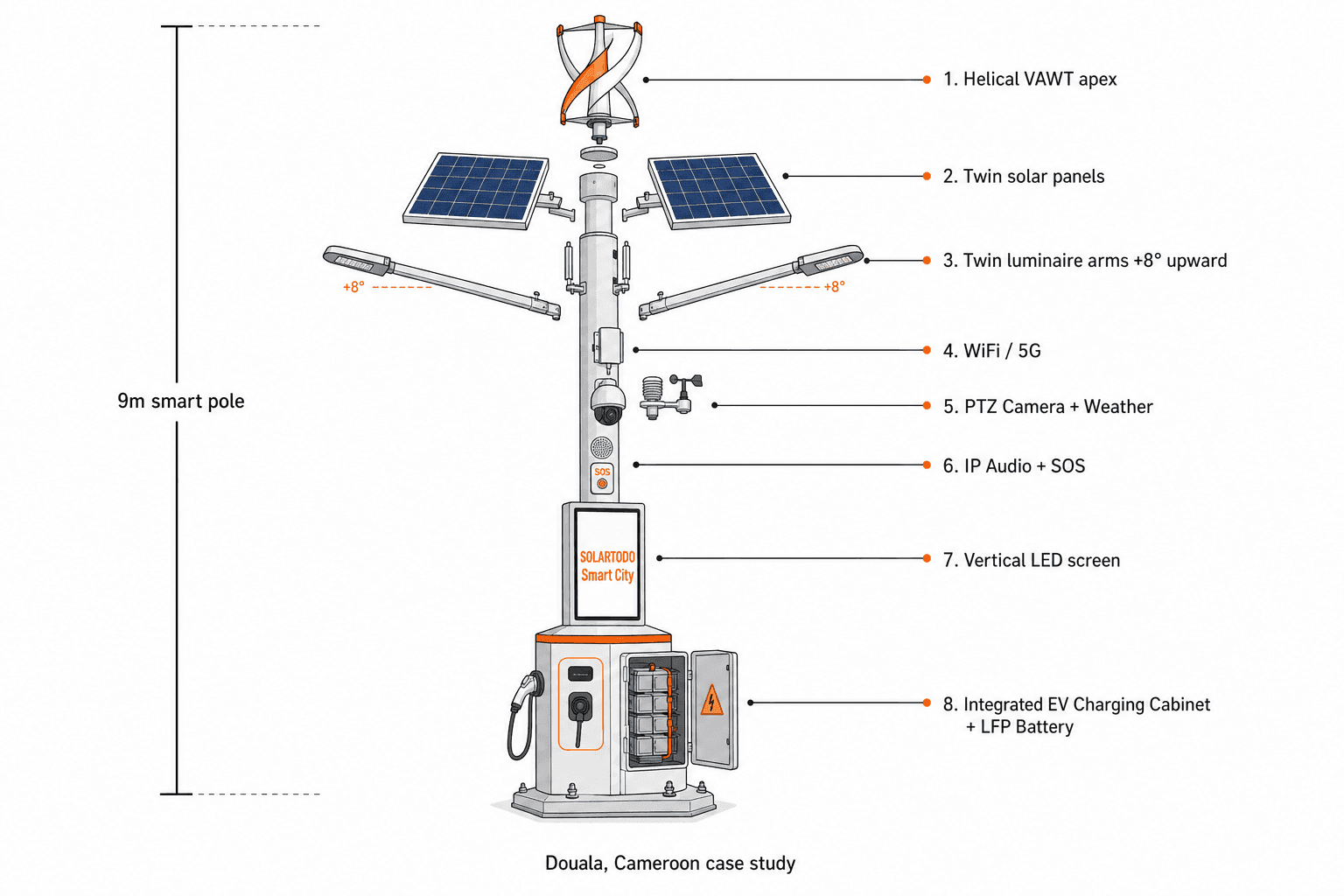
The hybrid generation package is appropriate for Douala because it diversifies energy input during variable weather. Each pole would use 1× 400 W Gorlov-type helical VAWT with 3 twisted white aluminum blades sized Ø70×100 cm, plus 2×100 W deep-black monocrystalline panels mounted mid-pole on 15° A-frame brackets in an east-west symmetric layout. A 5 kWh LFP battery inside the base with MPPT control would sustain night lighting and low-power electronics during feeder interruptions.
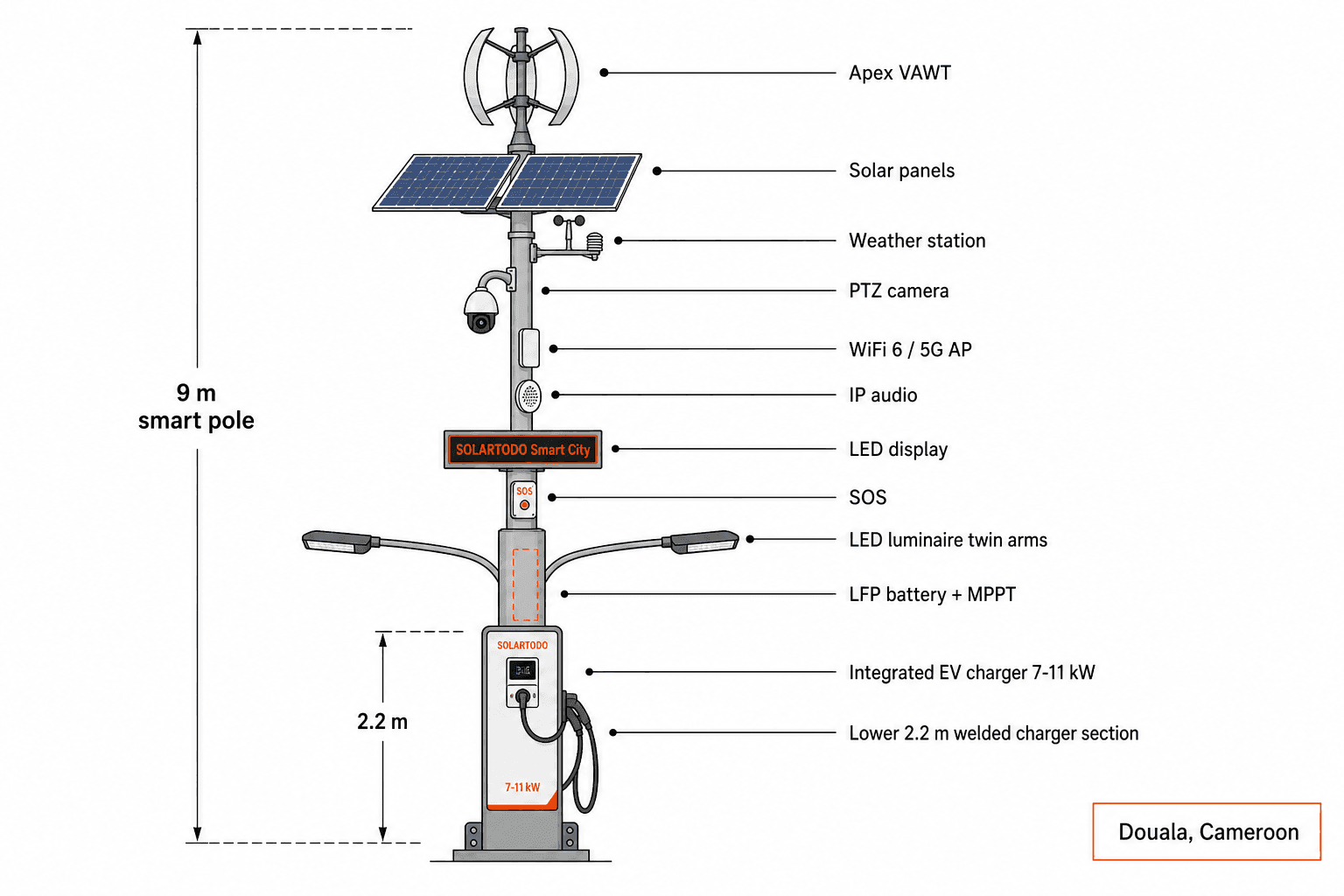
The charging architecture is a key differentiator. The lower 2.2 m of the pole is the EV charging cabinet itself, welded as one continuous steel structure rather than a separate pedestal. That matters on narrow sidewalks and roadside shoulders in Douala, where reducing street clutter can simplify civil works and lower the risk of impact damage. The charger specification is 11 kW single-gun AC, Type 2, OCPP 1.6J, with a 5 m coiled cable, touchscreen, emergency stop, maintenance door, and USB-A ×2 outputs.
Lighting output is sized for urban carriageways and pedestrian edges. Each pole would carry twin 1.5 m symmetric arms with +8° upward tilt, supporting 2×80 W LED luminaires at 150 lm/W and 4000 K. That equals 160 W total lighting load and about 24,000 lumens per pole. According to the IEA (2022), LEDs remain the most efficient mainstream road-lighting option, and this efficacy level supports lower operating energy than legacy sodium or metal-halide systems.
Security and public communication functions are also relevant in Douala’s transport and commercial districts. Each pole would include 1× 4 MP bullet camera with IR 50 m on a 30 cm short-arm bracket, 1× 4-parameter environmental sensor for temperature, humidity, wind speed, and noise, plus 2× 30 W / 93 dB IP audio columns mounted on opposite flat pole faces. The emergency package would include SOS, panic alarm, camera linkage, and emergency broadcast trigger.
For digital services, the recommended communications stack is dual-mode WiFi 6 + 5G gateway with GbE uplink + LoRaWAN, mounted flush at 8.7 m on the flat pole face. This supports municipal backhaul, public connectivity, and sensor aggregation in one point. SOLAR TODO positions this configuration well for corridors where lighting, security, and urban data collection need to share the same roadside asset.
Technical Specifications
The Douala-recommended Smart Streetlight specification centers on a 9 m hybrid pole, 11 kW integrated charger, and 5 kWh LFP battery, with all primary modules mounted within or against one continuous steel structure. The specification below follows the project-specific configuration exactly and fits city-road spacing of 35 m.
- Pole structure: 9 m octagonal tapered steel smart pole, base Ø45 cm to top Ø15 cm
- Finish: dark grey RAL7024 powder coat
- Integrated charger body: lower 2.2 m of pole is the charger cabinet, welded as one continuous steel structure
- Wind generator: Gorlov-type helical VAWT, 3 twisted white aluminum blades, 400 W, rotor size Ø70×100 cm, red aviation LED
- Solar generator: 2×100 W monocrystalline deep-black panels on 15° A-frame brackets, east-west symmetric pair
- Battery: 5 kWh LFP battery inside pole base with MPPT controller
- LED lighting: twin symmetric arms 1.5 m, +8° upward tilt, 2×80 W LED, 150 lm/W, 4000 K
- Camera: 4 MP bullet camera with IR 50 m, mounted on 30 cm short-arm bracket
- Environmental sensing: 4-parameter top sensor for temperature, humidity, wind speed, and noise
- Public address: 2× IP audio columns, Ø10×50 cm, 30 W / 93 dB, TCP/IP networked, color-matched to pole
- Emergency system: SOS + panic alarm + camera linkage + emergency broadcast trigger
- EV charging: integrated 11 kW single-gun AC charger, Type 2, OCPP 1.6J, 5 m coiled cable, touchscreen, E-stop, maintenance door
- Auxiliary charging: USB-A ×2, 5 V / 2.4 A
- LED display: P5 vertical LED screen, 1280×2560 mm, portrait, >5000 cd/m², content set to “SOLARTODO Smart City” in white sans-serif on deep blue
- Communications: WiFi 6 + 5G gateway, GbE uplink + LoRaWAN, flush-mounted at 8.7 m
- Spacing: 35 m typical interval
- Applicable standards: IEC 60598, GB/T 37024, IEC 62196-2
According to IEC (2020), IEC 60598 covers luminaire safety and construction, while IEC (2022) notes that IEC 62196-2 supports standardized AC vehicle coupler interfaces. According to China’s standardization framework, GB/T 37024 applies to smart multifunction poles and is relevant when specifying integrated urban pole assemblies for export procurement.
Implementation Approach
A practical Douala rollout would typically be delivered in 5 phases over 4-8 months, depending on customs clearance, civil permits, utility approvals, and corridor traffic management windows. For a 138-unit program, phased implementation reduces disruption and allows communications, charging, and safety systems to be validated section by section.
1. Corridor survey and utility coordination
The first phase would map carriageway width, sidewalk offsets, underground utility conflicts, and feeder availability at intervals close to the planned 35 m pole spacing. In Douala, this step is important because drainage, telecom ducts, and informal roadside activity can affect exact foundation positions. A survey package should also define camera sightlines, EV parking bay geometry, and backhaul handoff points.
2. Foundation and conduit design
Each pole would require a reinforced concrete foundation sized to local soil bearing capacity, wind loading, and equipment mass. Because Douala receives roughly 3,600 mm/year of rainfall, drainage detailing matters: cable entries, base seals, and conduit slopes should be designed to prevent standing water near the battery compartment. This phase also sets earthing and surge-protection requirements for charger and communications circuits.
3. Factory fabrication and pre-assembly
The steel poles, charger sections, audio columns, display housings, and communications modules would typically be pre-fabricated and pre-wired before shipment. For a 138-unit order, buyers often request FAT documentation for charger communication, LED display brightness, and controller logic. SOLAR TODO can be assessed at this stage against exact pole geometry, module placement, and standards compliance before dispatch.
4. Installation and commissioning
On site, the sequence would normally be foundation cure, anchor setting, conduit pull, pole erection, EV charger energization, lighting tests, and network commissioning. A 138-pole corridor may be divided into 3-5 sections so traffic control stays manageable. Commissioning should verify 11 kW charging output, camera streaming, WiFi/5G connectivity, SOS triggers, and battery charge-discharge behavior.
5. Acceptance and O&M handover
Final acceptance would include lux verification, charging interoperability checks under IEC 62196-2, and emergency broadcast tests through the 2×30 W IP audio columns. O&M handover should define cleaning intervals for the 2×100 W PV modules, inspection of the 400 W VAWT, firmware update procedures, and battery-health reporting. In Douala’s humidity, a preventive inspection cycle of quarterly visual checks and annual electrical testing is reasonable.
Expected Performance & ROI
For Douala, a hybrid Smart Streetlight scheme can reduce grid dependence for critical pole loads while adding EV charging, surveillance, and communications to one 9 m roadside asset; payback would usually depend more on avoided separate infrastructure and service revenue than on lighting energy alone. The strongest ROI case is on commercial corridors where one pole replaces 3-5 standalone devices.
Lighting consumption is straightforward to estimate. The LED load is 160 W per pole, so 138 poles equal 22.08 kW of connected lighting load. If operated for 12 hours/night, annual lighting energy would be about 96,710 kWh before considering hybrid generation and dimming strategies. According to the IEA (2022), LED systems materially reduce electricity demand compared with conventional road lighting, which improves lifecycle economics even before adding smart controls.
The hybrid package offsets part of this demand and improves resilience. Each pole includes up to 600 W of nameplate renewable input (400 W wind + 200 W solar) plus 5 kWh LFP storage. Real output will vary with Douala’s wind regime, shading, rainfall, and maintenance, so buyers should model renewable contribution conservatively. According to NREL (2023), urban renewable yield assumptions should be based on local resource data and system losses rather than panel nameplate alone.
The larger economic argument is infrastructure consolidation. A conventional approach may require one lighting pole, one EV charger pedestal, one CCTV mast, one PA column, and one communications cabinet or mounting point. A SOLAR TODO Smart Streetlight condenses these into one footprint, which can reduce trenching, foundations, permit complexity, and visual clutter. In dense Douala streets, those avoided civil works can materially affect total project cost and implementation speed.
Authority guidance supports this integrated approach. The IRENA states, "Electric vehicle charging infrastructure needs to be planned together with power systems and urban development." The ITU states, "Smart sustainable cities use information and communication technologies to improve quality of life, efficiency of urban operation and services, and competitiveness." Both statements fit Douala’s need to combine transport, lighting, safety, and connectivity on shared street assets.
A realistic payback range for a corridor of this type is often 5-9 years when the business case includes avoided standalone equipment, advertising value from the 1280×2560 mm P5 display, parking/charging fees, and reduced maintenance truck rolls through remote monitoring. If the analysis includes only lighting electricity savings, payback is usually longer. Municipal and PPP buyers should therefore model multi-service ROI, not just luminaire energy.
Results and Impact
For Douala, the expected impact of a 138-pole, 4.8 km Smart Streetlight corridor is better nighttime visibility, added public-safety coverage, and a practical first layer of curbside EV charging without installing separate roadside cabinets every 30-50 m. The strongest benefit is not a single feature; it is the concentration of lighting, charging, surveillance, audio, and connectivity into one managed asset.
From an urban-operations perspective, this configuration would support four measurable outcomes. First, it can improve road and sidewalk illumination through 24,000 lm per pole. Second, it adds distributed emergency points through SOS + panic alarm linkage. Third, it creates digital infrastructure through WiFi 6 + 5G + LoRaWAN at every pole. Fourth, it prepares selected districts for EV adoption with 11 kW Type 2 AC charging at curbside locations.
For B2B buyers, the main procurement question is not whether Douala needs lighting; it is whether a single 9 m pole can replace multiple separate devices efficiently. In corridors with commercial frontage, public transport activity, and nighttime foot traffic, the answer is often yes. That is where SOLAR TODO’s integrated Smart Streetlight format has the clearest technical fit.
Comparison Table
The table below compares the recommended Douala hybrid configuration against a simpler modular smart pole and a conventional separated-street-furniture approach for the same urban street class.
| Metric | Recommended Douala Hybrid Smart Streetlight | Standard Modular Smart Pole | Conventional Separate Assets |
|---|---|---|---|
| Pole height | 9 m | 6-12 m | Varies by asset |
| Pole spacing | 35 m | 25-50 m | 25-50 m lighting + separate charger spacing |
| Lighting load per pole | 2×80 W = 160 W | 80-150 W typical | 80-150 W typical |
| Renewable input | 400 W wind + 200 W solar | Optional/limited | Usually none |
| Battery storage | 5 kWh LFP | Optional | Separate UPS if required |
| EV charging | Integrated 11 kW AC, Type 2 | Optional 7 kW typical | Separate 7-22 kW pedestal |
| Camera | 4 MP IR 50 m | Optional PTZ/bullet | Separate CCTV mast or wall mount |
| Public address | 2×30 W IP audio columns | Optional | Separate speaker pole |
| Communications | WiFi 6 + 5G + LoRaWAN | Optional | Separate cabinet/radio point |
| Display | P5 1280×2560 mm, >5000 cd/m² | Optional smaller display | Separate billboard/signage |
| Street footprint | One integrated structure | One structure with add-ons | Multiple structures |
| Best fit in Douala | Commercial corridors, transit streets, mixed-use avenues | General urban roads | Sites with no integration requirement |
Pricing & Quotation
SOLAR TODO offers three pricing tiers for this product line: FOB Supply (equipment ex-works China), CIF Delivered (including ocean freight and insurance), and EPC Turnkey (fully installed, commissioned, with 1-year warranty). Volume discounts are available for large-scale deployments. Configure your system online for an instant estimate, or request a custom quotation from our engineering team at [email protected].
Frequently Asked Questions
This FAQ answers the main buyer questions on Douala Smart Streetlight deployments, including 9 m pole specs, 11 kW charging, implementation timing, ROI, maintenance, and warranty scope. Each answer is concise and aligned with the recommended 138-unit hybrid city-corridor profile.
Q1: What Smart Streetlight configuration is the best technical fit for Douala?
For dense urban corridors in Douala, the strongest fit is the 9 m hybrid octagonal tapered steel pole with 400 W VAWT, 2×100 W PV, 5 kWh LFP battery, 2×80 W LED lighting, and 11 kW Type 2 AC charging. It suits city streets with 35 m spacing, not highways or park paths.
Q2: Why use a hybrid wind-solar design instead of a grid-only pole in Douala?
Douala has high rainfall, humidity, and variable utility conditions, so hybrid generation adds resilience for lighting, communications, and emergency functions. The combination of 400 W wind, 200 W solar, and 5 kWh storage helps maintain core services during feeder interruptions, while the grid tie supports charging continuity and battery backup.
Q3: How many poles would a typical Douala corridor require?
At the specified 35 m spacing, a 1 km corridor would typically need about 28-29 poles. A 138-unit layout corresponds to roughly 4.8 km of roadway, depending on intersection geometry, setbacks, and whether both sides of the road are equipped. Final quantity should follow a site survey and lighting layout.
Q4: What is integrated about the EV charger design?
The charger is not a separate pedestal beside the pole. The lower 2.2 m of the pole itself is the charging cabinet, welded into one continuous steel structure. This design reduces roadside clutter, simplifies the visual profile, and can lower the number of separate foundations and protective barriers needed on narrow urban sidewalks.
Q5: How long would installation usually take for a 138-pole program?
A realistic program window is often 4-8 months, depending on permitting, customs, utility approvals, and civil readiness. The work is usually phased into 3-5 sections covering foundation works, conduit installation, pole erection, charger energization, and communications commissioning. Rain season scheduling in Douala can extend groundworks if drainage is not prepared early.
Q6: What kind of ROI should buyers expect?
For integrated smart poles, ROI usually comes from multiple value streams rather than energy savings alone. A common planning range is 5-9 years when the model includes avoided separate CCTV, PA, charger, and communications infrastructure, plus charging revenue and display value. If only lighting electricity savings are counted, payback is usually longer.
Q7: What maintenance does this Smart Streetlight need?
Typical maintenance includes quarterly visual inspection, cleaning of the 2×100 W PV panels, checking the 400 W VAWT fasteners and blade condition, annual charger testing, and battery-health review for the 5 kWh LFP pack. In Douala’s humid climate, seal inspection and corrosion checks should be part of every scheduled service visit.
Q8: How does this compare with a standard smart pole without hybrid generation?
A standard smart pole can still provide LED lighting, camera, WiFi, and sensors, but it depends more heavily on continuous grid supply and often uses lower EV charging capacity such as 7 kW. The recommended Douala hybrid version adds 600 W renewable input and 5 kWh storage, which improves resilience for critical services.
Q9: What standards should be written into the tender documents?
At minimum, buyers should reference IEC 60598 for luminaire safety, IEC 62196-2 for the Type 2 AC charging interface, and GB/T 37024 for smart multifunction pole assemblies. Tender documents should also define charger communication as OCPP 1.6J, LED efficacy at 150 lm/W, and the exact 9 m integrated-pole geometry.
Q10: Is EPC pricing available, or only equipment supply?
Both models are possible. Buyers can request FOB Supply, CIF Delivered, or EPC Turnkey depending on whether local contractors will handle civil works and installation. For Douala, EPC can be useful where utility coordination, commissioning, and charger-network integration need one accountable scope. Use the quotation links for configuration-based pricing.
Q11: What warranty structure is typical for this product class?
Warranty terms vary by contract scope, but the pricing section specifies 1-year warranty for EPC Turnkey supply. Buyers should also ask for separate warranty schedules by subsystem, such as LED drivers, charger electronics, battery pack, communications gateway, and display module. This is standard practice on integrated urban infrastructure procurements.
Q12: Can the system support future smart-city expansion in Douala?
Yes. The WiFi 6 + 5G gateway + LoRaWAN stack gives room for later services such as parking sensors, traffic counters, environmental monitoring, or municipal alert systems. Because the pole already includes power, communications, and a managed controller, adding edge devices later is usually easier than retrofitting separate legacy lighting columns.
References
- World Bank (2023): Cameroon urban population indicators and national urbanization data relevant to Douala demand concentration.
- World Bank (2022): Access to electricity in Cameroon, supporting the case for hybrid street infrastructure in mixed-reliability grid environments.
- Climate-Data.org (2024): Douala climate profile, including annual rainfall of roughly 3,600 mm and high humidity conditions affecting outdoor equipment design.
- IEC (2020): IEC 60598 luminaire safety requirements for lighting equipment.
- IEC (2022): IEC 62196-2 dimensional compatibility and interchangeability requirements for AC EV connectors including Type 2.
- IEA (2022): Energy efficiency and lighting market guidance showing LED lighting as the dominant high-efficiency road-lighting technology.
- NREL (2023): Urban renewable-energy performance guidance emphasizing site-specific yield modeling and system-loss assumptions.
- ITU (2023): Smart sustainable city and ICT infrastructure guidance relevant to urban connectivity, public services, and digital street assets.
- IRENA (2022): EV charging and urban energy planning guidance supporting coordinated deployment of transport and power infrastructure.
Equipment Deployed
- 9 m octagonal tapered steel smart pole, base Ø45 cm to top Ø15 cm, dark grey RAL7024 powder coat
- Integrated lower 2.2 m pole-as-charger cabinet, welded as one continuous steel structure
- Gorlov-type helical VAWT, 3 twisted white aluminum blades, 400 W, rotor Ø70×100 cm, red aviation LED
- 2×100 W monocrystalline deep-black solar panels on 15° A-frame brackets, east-west symmetric pair
- 5 kWh LFP battery inside pole base with MPPT controller
- Twin 1.5 m symmetric lighting arms with +8° upward tilt
- 2×80 W LED luminaires, 150 lm/W, 4000 K
- 4 MP bullet camera with IR 50 m on 30 cm short-arm bracket
- 4-parameter environmental sensor for temperature, humidity, wind speed, and noise
- 2× IP audio columns, Ø10×50 cm, 30 W / 93 dB, TCP/IP networked
- SOS + panic alarm + camera linkage + emergency broadcast trigger
- Integrated 11 kW single-gun AC EV charger, Type 2, OCPP 1.6J, 5 m coiled cable, touchscreen, E-stop, maintenance door
- USB-A ×2, 5 V / 2.4 A on charging cabinet
- P5 vertical LED display, 1280×2560 mm, portrait, >5000 cd/m²
- WiFi 6 + 5G gateway with GbE uplink + LoRaWAN, flush-mounted at 8.7 m
- Applicable standards: IEC 60598, GB/T 37024, IEC 62196-2