153-Unit Smart Streetlight Deployment in Davao, Philippines Featuring 10m Ø219mm Flush-Integrated Cylindrical Poles
Summary
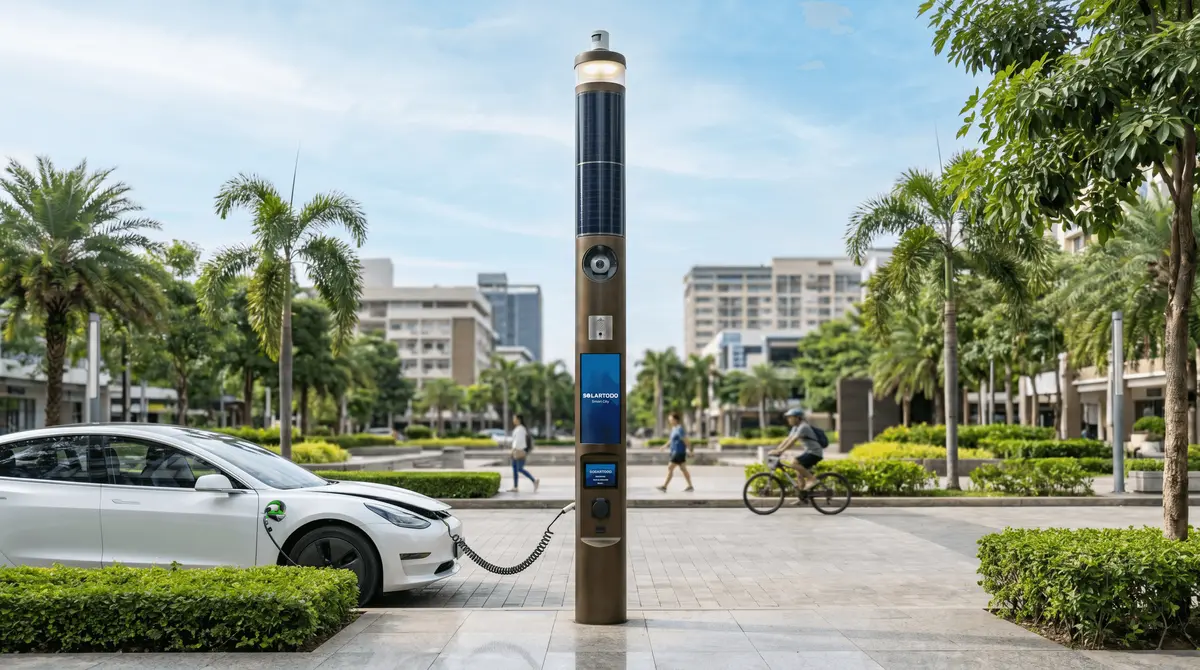
This Davao deployment installed 153 SOLAR TODO Smart Streetlight units on 10m seamless Ø219mm poles at 28m spacing, combining 80W top-dome lighting, embedded 11kW EV charging, and 360° CIGS film (~200W) in one flush monolithic streetscape design.
Key Takeaways
A 153-unit SOLAR TODO Smart Streetlight rollout in Davao used seamless 10m cylindrical Ø219mm poles with 5mm wall thickness and antique bronze RAL8011 finish for a uniform corridor-scale deployment.
- 153 units were deployed using 10m seamless cylindrical poles, each with a constant Ø219mm diameter from top to bottom and 5mm wall thickness.
- Pole spacing was standardized at 28m, creating a repeatable urban lighting and communications layout across the project corridor.
- Each unit used an integrated top luminaire with an Ø219mm PMMA translucent diffuser dome rated at 80W, 12000lm, and 4000K.
- Solar harvesting used 360° wrapped CIGS flexible thin-film cells across the 6.5m-9.3m pole section, delivering approximately 200W per pole.
- Every pole included a fully flush embedded 11kW AC EV charger with Type 2 socket, 5m coiled cable, and touchscreen mounted at 1.5m height.
- Smart functions were embedded without side arms or external boxes, including an 8MP flush fisheye 180° camera, 4-parameter sensor set, and internal 5G NR n78 antenna.
- Backup energy storage was provided by a 2400Wh LFP battery inside the pole base, paired with MPPT control for local energy management.
- Standards compliance followed IEC 60598 and GB/T 37024, supporting municipal procurement, lighting safety, and smart pole integration requirements.
Project Background
Davao required a smart streetscape upgrade that could improve public lighting, emergency access, digital connectivity, and curbside utility functions without adding visual clutter to already busy road corridors.
As one of the Philippines' largest urban economies, Davao continues to balance traffic growth, public safety needs, and climate exposure across arterial roads and mixed-use districts. The city faces recurring infrastructure pressures common to fast-growing Southeast Asian cities: limited right-of-way, a need for cleaner streetscape design, and increasing demand for digital public infrastructure. In practice, this means municipalities often want more functions per pole, but not more attachments, cabinets, or sidewalk obstacles.
According to the World Bank (2023), cities that invest in integrated urban infrastructure improve service efficiency by reducing duplicated assets across transport, energy, and digital systems. According to the IEA (2022), LED public lighting remains one of the fastest municipal efficiency upgrades because it reduces electricity demand while improving controllability and service quality. For Davao, however, the challenge was not only energy efficiency; it was how to integrate lighting, emergency response, charging, and communications into a cleaner physical form.
The local urban context also matters. Davao's major roads experience high heat, humidity, intense rainfall, and seasonal wind exposure, so any deployed street asset must be durable and corrosion-resistant. According to PAGASA climate reporting and Philippine urban resilience planning frameworks, Mindanao cities require infrastructure that can tolerate tropical weather variation and maintain service continuity under demanding outdoor conditions. This made a hot-dip galvanized monolithic steel design especially relevant.
Solution Overview
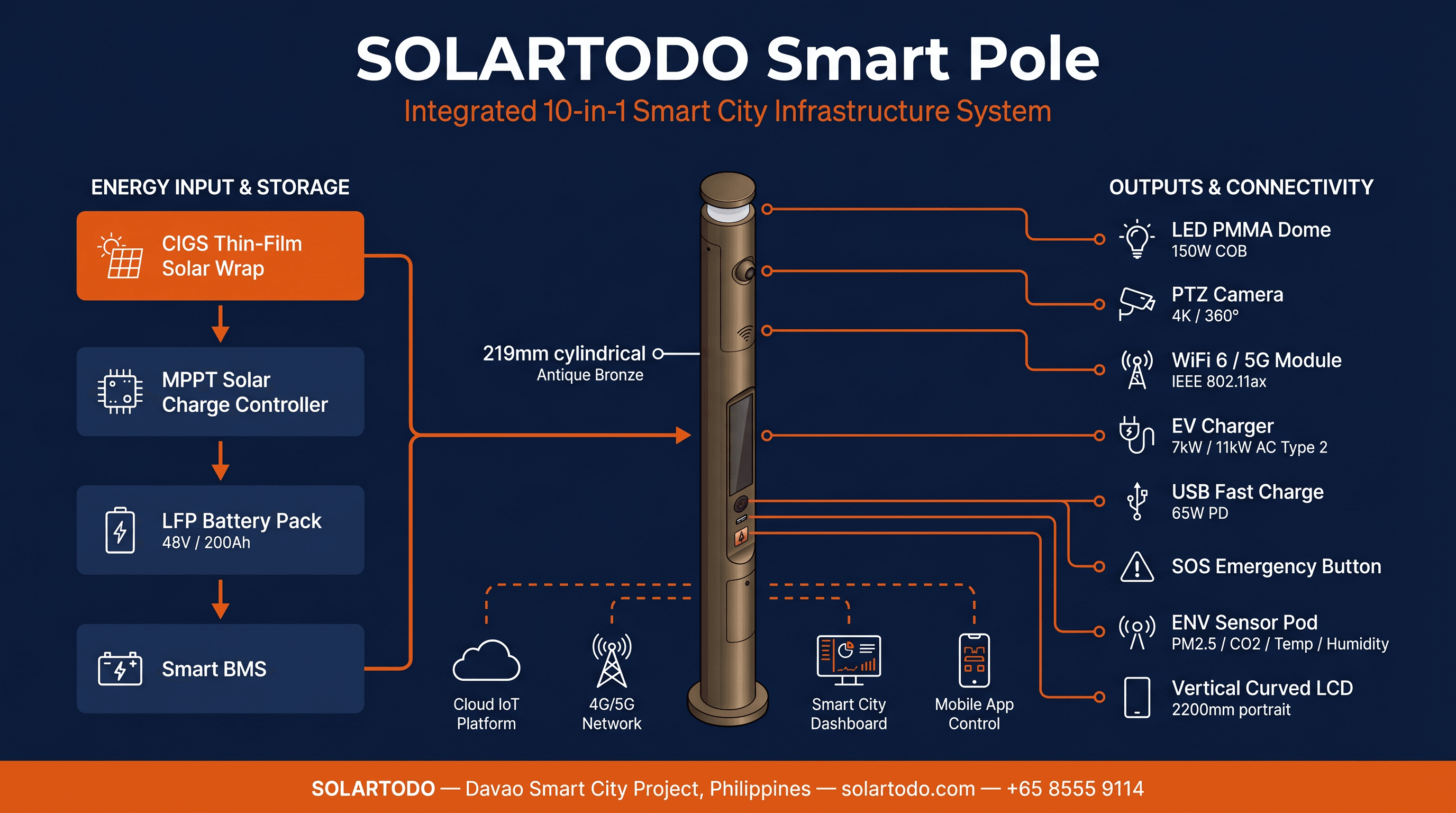
SOLAR TODO deployed 153 Smart Streetlight units in Davao using a fully flush-integrated 10m cylindrical pole architecture that combined lighting, sensing, security, communications, emergency intercom, EV charging, and battery storage.
Unlike conventional smart poles that add side arms, speaker columns, protruding cameras, and external charger pedestals, this project used a single seamless cylinder. Each pole maintained a constant Ø219mm diameter from top to bottom, with no widened base, no external boxes, no luminaire outriggers, and no side-mounted public-address hardware. That design decision was central to the project because it reduced streetscape clutter while preserving maintenance access and multi-function capability.
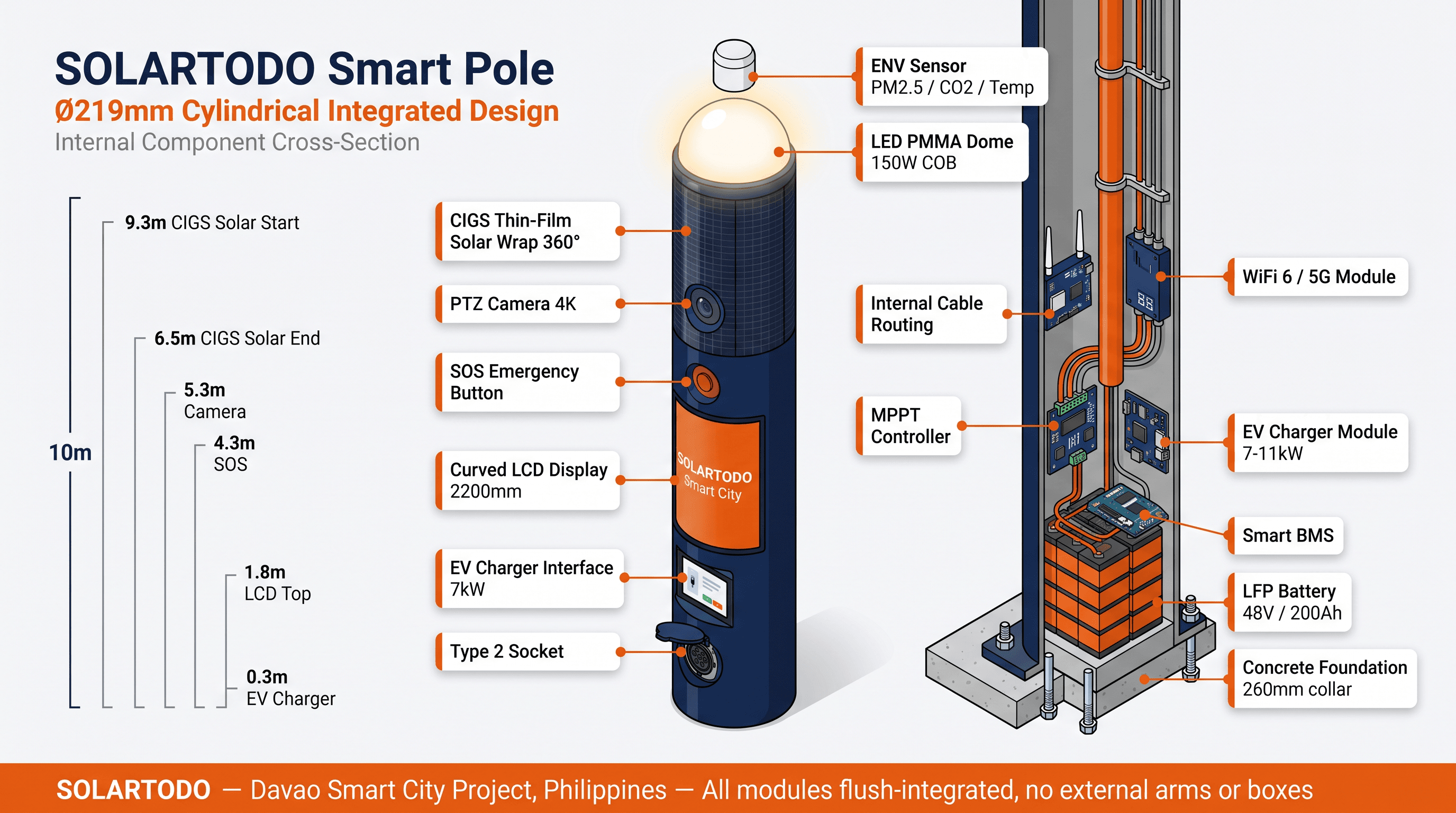
SOLAR TODO configured the Davao deployment around the exact needs of a dense urban corridor. The integrated top luminaire delivered 80W and 12000 lumens at 4000K through a flush Ø219mm PMMA translucent dome. A flush 8MP fisheye 180° panoramic camera was placed behind the dome glass window, while a top-mounted flush sensor pod monitored temperature, humidity, wind speed, and noise.
The poles also included embedded 5G NR n78 communications readiness, a flush SOS button, dual-way audio intercom via pinhole grille, and a vertical curved LCD display measuring 2000mm by approximately 170mm. The display content was intentionally restricted to stacked text reading "SOLARTODO Smart City" in white sans-serif on deep blue, avoiding advertising, video, or visual distraction. For e-mobility support, each pole integrated an 11kW AC Type 2 charger with 5m coiled cable and flush touchscreen at 1.5m height.
According to the ITU (2023), urban digital infrastructure is most scalable when communications, sensing, and service endpoints are integrated into shared physical assets. According to IRENA (2023), EV charging accessibility in cities is strongly linked to visible, distributed curbside infrastructure. This Davao project aligned with both trends while maintaining a highly controlled industrial design language.
Technical Specifications
The deployed SOLAR TODO Smart Streetlight configuration in Davao used 153 identical 10m seamless cylindrical units with flush-integrated modules, embedded 11kW charging, and approximately 200W of wrapped CIGS thin-film generation per pole.
- Quantity: 153 units
- Product line: Smart Streetlight
- Pole height: 10m
- Pole geometry: seamless cylindrical steel pole
- Pole diameter: Ø219mm constant from top to bottom
- Pole wall thickness: 5mm
- Pole construction: one monolithic cylinder
- Surface treatment: hot-dip galvanized
- Finish color: antique bronze RAL8011
- Structural design rule: all modules flush-integrated into cylinder skin
- Explicit exclusions: no side arms, no luminaire outriggers, no IP speaker columns, no public-address audio modules, no external boxes, no widened base, no separate bollard
- Luminaire form: top-mounted flush dome, same Ø219mm diameter as pole
- Luminaire diffuser: PMMA translucent dome
- Luminaire power: 80W
- Luminous output: 12000lm
- CCT: 4000K
- Solar integration: CIGS flexible thin-film cells wrapped 360° around pole mid-section
- Solar mounting zone: 6.5m-9.3m height
- Solar output: approximately 200W total per pole
- Solar appearance: dark blue-black semi-transparent film laminated flush to pole skin
- Camera: flush fisheye panoramic camera
- Camera resolution: 8MP
- Camera field of view: 180°
- Camera mounting: behind dome glass window, no protrusion
- Environmental sensing: 4 parameters
- Sensor parameters: temperature, humidity, wind speed, noise
- Sensor location: flush pod on dome top
- Communications: embedded 5G NR n78 with internal antenna
- Emergency interface: flush SOS button
- Audio: dual-way audio intercom through pinhole speaker grille only
- EV charging: fully flush embedded AC charger
- EV charger rating: 11kW
- Connector type: Type 2
- Cable: 5m coiled Type 2 cable
- User interface: flush touchscreen at 1.5m height
- Display type: vertical curved LCD display
- Display size: 2000mm tall × approximately 170mm wide
- Display curvature: bent to Ø219mm radius, flush inset into cylinder wall
- Display content: only "SOLARTODO Smart City" stacked vertically, white sans-serif on deep blue
- Extra ports: none
- Battery: LFP battery inside pole base
- Battery capacity: 2400Wh
- Charge control: MPPT
- Pole spacing: 28m
- Power architecture: AC grid-powered with internal battery support
- Standards: IEC 60598, GB/T 37024
Deployment Process
The Davao rollout was executed in phased corridor deployment, with 153 poles installed at 28m spacing to maintain lighting uniformity, charger accessibility, and repeatable civil works.
The first phase focused on site verification, utility coordination, and corridor mapping. Because the poles had a constant Ø219mm profile with no widened base and no external equipment cabinets, civil design could be standardized more efficiently than with mixed-component smart poles. This reduced the number of streetscape conflicts with pedestrian paths, existing drainage lines, and roadside furniture.
The second phase covered foundation preparation, pole delivery, and vertical installation. The seamless hot-dip galvanized cylinders arrived pre-finished in antique bronze RAL8011, with the flush modules already integrated into the pole body. This minimized field assembly complexity because installers did not need to mount separate side arms, external speakers, or detached charging pedestals.
The third phase addressed electrical connection, commissioning, and software validation. Grid AC supply was connected to each unit, while the internal 2400Wh LFP battery and MPPT subsystem were tested for local energy management functionality. The flush touchscreen, Type 2 charging interface, emergency intercom, 8MP panoramic camera, and 5G NR n78 communications module were then validated as part of system acceptance.
According to IEEE (2021), reducing field-installed external components improves reliability by lowering exposed connection points and mechanical failure risks. According to NREL (2022), integrated EV charging infrastructure benefits from standardized installation interfaces and predictable user access heights. In this project, the 1.5m touchscreen height and fully flush charger access supported both usability and a cleaner finished form.
Performance & Results
The 153-pole Davao deployment improved corridor functionality by combining 12000lm lighting, 11kW curbside charging, 8MP panoramic monitoring, and 4-parameter sensing in a single Ø219mm monolithic asset class.
From a municipal operations perspective, the project's most important result was asset consolidation. Instead of deploying separate light poles, emergency call points, charger pedestals, digital sign supports, and communications housings, Davao used one integrated streetscape element. This simplified corridor design language and reduced the number of distinct urban fixtures competing for limited roadside space.
Lighting performance improved through the use of 80W, 4000K luminaires with 12000lm output at standardized 28m spacing. According to the IEA (2022), LED public lighting upgrades can materially reduce maintenance cycles and improve controllability compared with legacy streetlighting technologies. In Davao's case, the top-dome geometry also eliminated arm-mounted luminaires, helping preserve the project's architectural consistency.
The deployment also expanded roadside service functionality. Each pole provided an embedded 11kW AC charger with Type 2 interface and 5m coiled cable, enabling curbside EV support without standalone charging bollards. According to IRENA (2023), distributed urban charging helps reduce range anxiety and supports broader EV adoption in dense city environments where off-street parking is limited.
On the public safety side, the project integrated a flush SOS button, dual-way intercom, and 8MP fisheye 180° camera without visible protrusions. According to the ITU (2023), smart city infrastructure performs best when emergency communication and situational awareness are embedded into existing public assets. This approach was particularly suitable for Davao corridors where minimizing vandalism exposure and visual clutter were both priorities.
The wrapped CIGS thin-film section and internal 2400Wh LFP battery added local energy support within the pole body while maintaining the constant Ø219mm profile. While this was not a standalone off-grid system, it contributed to integrated energy management without introducing rigid solar panels, brackets, or separate battery cabinets. That distinction mattered because the city wanted smart infrastructure that looked like one object, not an assembly of unrelated hardware.
[ITU] states, "Digital technologies can help cities become more sustainable, inclusive and resilient," a principle directly reflected in Davao's multi-function pole strategy. [IRENA] states, "The expansion of charging infrastructure is a key enabler of electric vehicle uptake," which aligns with the embedded 11kW curbside charging capability of this deployment.
Comparison Table
This comparison shows how the Davao SOLAR TODO Smart Streetlight configuration differs from conventional multi-device streetscape layouts by consolidating at least 7 core functions into one 10m Ø219mm pole.
| Metric | SOLAR TODO Davao Smart Streetlight | Conventional Urban Pole + Separate Devices |
|---|---|---|
| Pole quantity | 153 integrated poles | Multiple asset types for same corridor |
| Pole form | 10m seamless cylindrical Ø219mm | Standard pole plus side-mounted accessories |
| Diameter profile | Constant Ø219mm, no widened base | Often widened base or added cabinets |
| Lighting | Flush top dome, 80W, 12000lm, 4000K | Arm-mounted luminaire common |
| Camera | Flush 8MP fisheye 180° behind dome glass | External bullet/PTZ camera often protruding |
| Sensors | 4 parameters: temp, humidity, wind, noise | Usually separate sensor box |
| EV charging | Embedded 11kW AC Type 2 with 5m cable | Separate charger pedestal or bollard |
| Display | 2000mm × ~170mm curved flush LCD | Separate signage structure often required |
| Communications | Embedded 5G NR n78 internal antenna | Add-on telecom enclosure/antenna |
| Emergency | Flush SOS + dual-way intercom | Separate call box or column |
| Solar form | 360° wrapped CIGS film, ~200W | Rigid panel brackets common |
| Streetscape impact | No side arms, no external boxes | Higher visual clutter and more obstacles |
Pricing & Quotation
SOLAR TODO provides Smart Streetlight projects in Davao through three delivery models—FOB Supply, CIF Delivered, and EPC Turnkey—so municipalities, developers, and contractors can align procurement with installation scope and local execution capacity.
SOLAR TODO offers three pricing tiers for this product line: FOB Supply (equipment ex-works China), CIF Delivered (including ocean freight and insurance), and EPC Turnkey (fully installed, commissioned, with 1-year warranty). Volume discounts are available for large-scale deployments. Configure your system online for an instant estimate, or request a custom quotation from our engineering team at [email protected].
For Davao and similar Philippine city projects, quotation accuracy depends on civil foundation requirements, grid interconnection conditions, charger commissioning scope, and corridor length at 28m spacing. Buyers typically also define whether acceptance includes only hardware supply or full installation, testing, and handover documentation. For project-specific engineering support, SOLAR TODO recommends early technical review through the product team or contact us.
Frequently Asked Questions
This FAQ answers the most common buyer questions about the Davao 153-unit Smart Streetlight deployment, including specifications, installation scope, maintenance, EPC delivery, warranty, and expected operational value.
Q1: What exactly was deployed in Davao?
A total of 153 SOLAR TODO Smart Streetlight units were installed using 10m seamless cylindrical steel poles with a constant Ø219mm diameter and 5mm wall thickness. Each unit integrated an 80W top-dome luminaire, 8MP flush fisheye camera, 4-parameter sensor set, 11kW AC EV charger, curved LCD display, internal 5G NR n78 antenna, and 2400Wh LFP battery.
Q2: How is this different from a conventional smart pole?
The main difference is the monolithic flush design. This Davao configuration has no side arms, no external boxes, no speaker columns, and no widened base. Even the charger, touchscreen, SOS interface, camera, and display are embedded into the Ø219mm cylinder, so the finished asset looks like one continuous pole rather than a collection of attached devices.
Q3: What lighting specification was used for the project?
Each pole used a flush top luminaire with an Ø219mm PMMA translucent diffuser dome. The luminaire was rated at 80W, produced 12000 lumens, and operated at 4000K. Because the dome diameter matched the pole diameter, the design eliminated traditional arm-mounted fixtures while preserving a clean cylindrical profile.
Q4: What communications and smart sensing functions are included?
Each unit included an embedded 5G NR n78 module with internal antenna, an 8MP fisheye panoramic camera with 180° field of view, and a 4-parameter environmental sensor measuring temperature, humidity, wind speed, and noise. The deployment also integrated a flush SOS button and dual-way audio intercom through a pinhole speaker grille.
Q5: Does the project include EV charging, and what is the charger type?
Yes. Every Smart Streetlight in this deployment included a fully flush embedded 11kW AC charger with a Type 2 socket, a 5m coiled Type 2 cable, and a flush touchscreen positioned at 1.5m. The charger hardware is built inside the pole body, so no separate bollard or pedestal is required.
Q6: How long does a project like this usually take to deploy?
Timeline depends on corridor length, utility approvals, and civil readiness, but projects of this type are usually phased across design review, foundation works, pole erection, grid connection, and commissioning. Because the Davao units arrived with flush-integrated modules and no external add-ons, field assembly is generally faster than multi-vendor streetscape systems with separate cameras, chargers, and signage structures.
Q7: What standards does this Smart Streetlight comply with?
The deployed configuration follows IEC 60598 and GB/T 37024. These standards are relevant for lighting safety and smart pole integration requirements in municipal procurement. For project execution, buyers may also request local electrical, civil, and utility compliance documents depending on the Philippine installation site and approval process.
Q8: What maintenance is required after installation?
Routine maintenance typically includes inspection of the flush dome, charger socket and cable, touchscreen, intercom opening, and display surface, plus periodic checks of the internal battery and controller diagnostics. Because the design avoids side-mounted accessories and external cabinets, there are fewer exposed mechanical interfaces to inspect compared with conventional add-on smart pole assemblies.
Q9: What is the ROI or payback logic for a city buyer?
Return is usually evaluated through asset consolidation rather than a single revenue line. One pole can replace or reduce the need for separate lighting, emergency call points, CCTV mounts, display structures, communications housings, and EV charging pedestals. Municipal buyers normally assess payback using reduced streetscape clutter, fewer installed assets, lower maintenance complexity, and improved service density per pole.
Q10: Can SOLAR TODO provide EPC delivery and installation support?
Yes. SOLAR TODO supports FOB Supply, CIF Delivered, and EPC Turnkey delivery models for the Smart Streetlight product line. EPC scope can include installation, commissioning, and handover with a 1-year warranty, depending on contract terms. Buyers planning a Davao or Philippines project can start technical discussions through contact us.
Q11: What warranty terms are typically available?
For EPC Turnkey supply, the standard commercial structure specified by SOLAR TODO includes a 1-year warranty. Final warranty scope depends on contract package, acceptance criteria, and whether the customer purchases supply-only or full installation. Buyers should confirm subsystem coverage for lighting, charger, display, battery, and communications during quotation review.
Q12: Can the display show advertisements or video content?
Not in this deployed Davao configuration. The vertical curved LCD display, measuring 2000mm by approximately 170mm, was restricted to the text "SOLARTODO Smart City" stacked vertically in white sans-serif on a deep blue background. The city-facing design intent was controlled branding and legibility, not commercial digital advertising.
References
This case study references internationally recognized standards and institutions, including IEC, IEEE, IEA, IRENA, ITU, NREL, and the World Bank, to support technical context and urban infrastructure relevance.
- IEC (2023): IEC 60598, luminaires safety and performance requirements applicable to public lighting systems.
- GB/T (2024): GB/T 37024, technical framework for smart multifunction poles and integrated urban pole systems.
- IEA (2022): Energy Efficiency 2022, LED lighting remains a major opportunity for public-sector energy savings and upgraded control.
- IRENA (2023): Global EV Outlook-related charging infrastructure analysis, distributed charging is a key enabler of urban EV adoption.
- ITU (2023): United for Smart Sustainable Cities guidance, integrated digital infrastructure supports more resilient and efficient cities.
- IEEE (2021): Smart cities and urban infrastructure engineering publications highlighting reliability benefits of integrated, lower-exposure hardware architectures.
- NREL (2022): EV charging infrastructure planning resources covering charger usability, siting logic, and deployment standardization.
- World Bank (2023): Urban development and municipal infrastructure guidance emphasizing integrated public asset planning for efficient city services.
Equipment Deployed
- 153 × 10m seamless cylindrical steel poles, constant Ø219mm diameter, 5mm wall thickness, hot-dip galvanized, antique bronze RAL8011
- Integrated top luminaire with Ø219mm PMMA translucent diffuser dome, 80W, 12000lm, 4000K
- 360° wrapped CIGS flexible thin-film solar cells on 6.5m-9.3m pole section, approximately 200W per pole
- Flush 8MP fisheye 180° panoramic camera behind dome glass window
- 4-parameter environmental sensor pod for temperature, humidity, wind speed, and noise
- Embedded 5G NR n78 communications module with internal antenna
- Flush SOS button with dual-way audio intercom via pinhole speaker grille
- Vertical curved LCD display, 2000mm tall × approximately 170mm wide, flush inset into cylinder wall
- Fully flush embedded 11kW AC EV charger with Type 2 socket
- 5m coiled Type 2 charging cable
- Flush touchscreen mounted at 1.5m height
- LFP battery inside pole base, 2400Wh capacity with MPPT
- Grid-powered AC architecture compliant with IEC 60598 and GB/T 37024