Dakar Smart Traffic System Market Analysis: 17-Intersection 6m L-Arm Configuration Guide
Summary
Dakar’s urban mobility profile supports a typical 17-intersection Smart Traffic System rollout using 6m hot-dip galvanized L-arm poles, 4K AI vision, and 77GHz radar. With Senegal’s urban population above 49% and mobile broadband coverage expanding, a 5G/fiber-connected EPC turnkey configuration is a practical fit for adaptive signal control and emergency priority.
Key Takeaways
- A typical Dakar deployment of this profile would cover approximately 17 intersections using 6m L-arm hot-dip galvanized steel poles in dark grey for dense urban corridors.
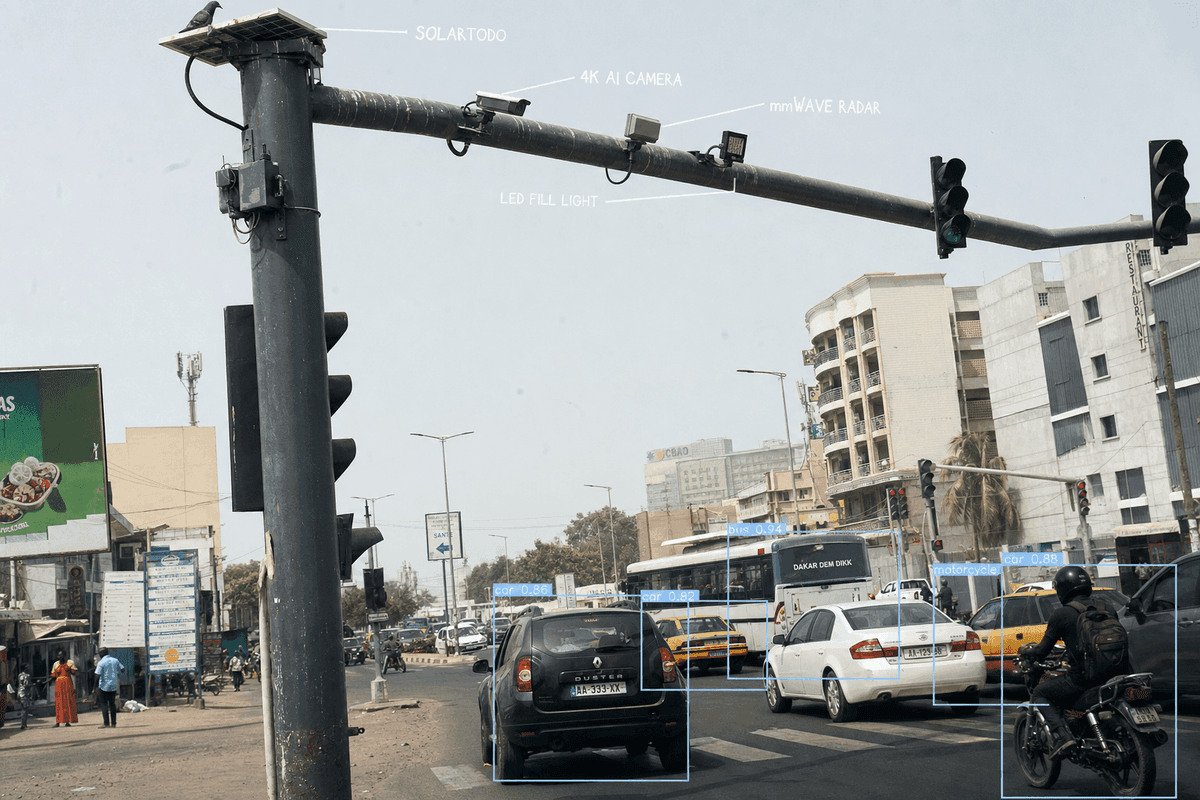
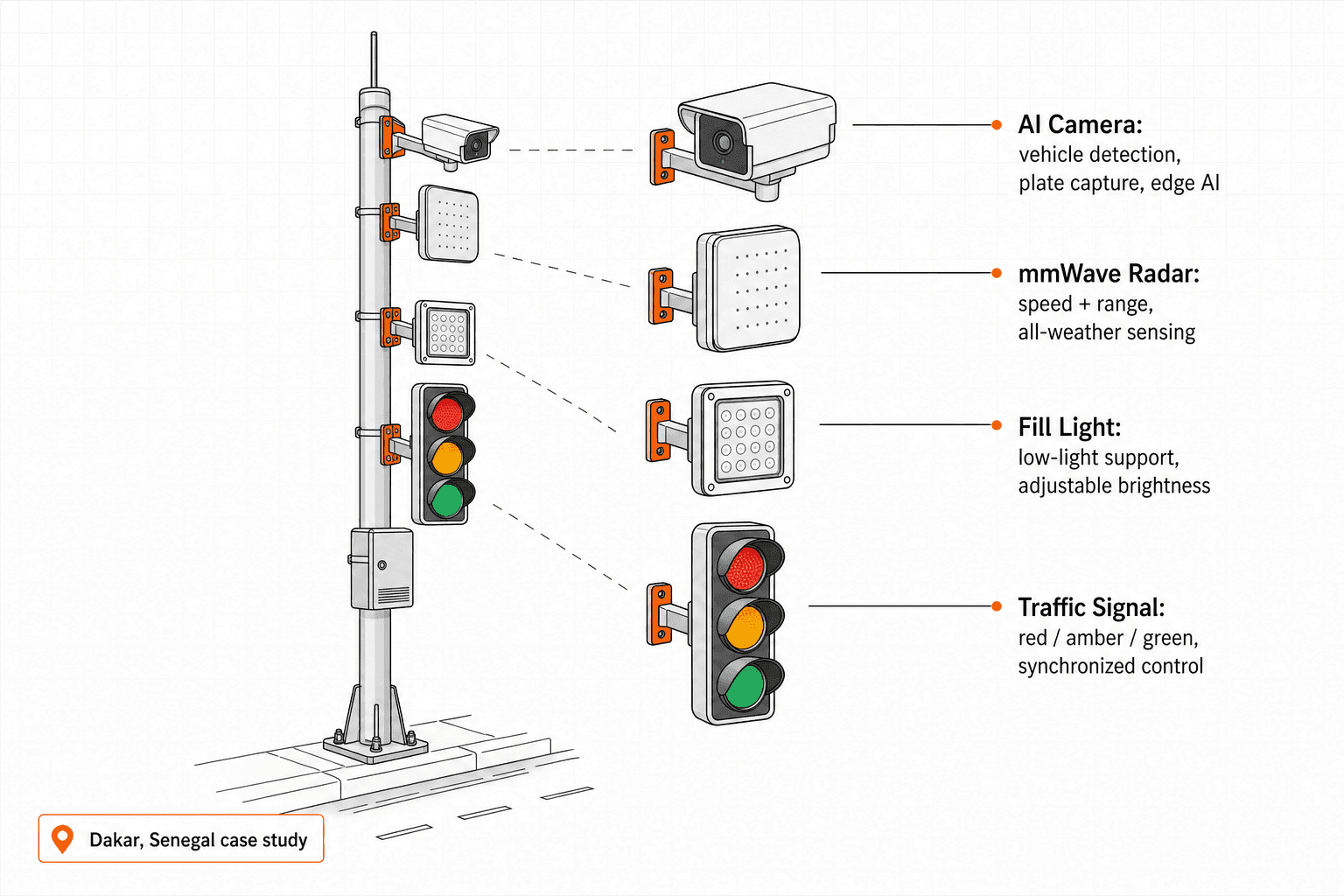
- Each pole would combine 4K AI camera, 77GHz mmWave radar, LED fill light, and LED signal head in one 4-in-1 Smart Traffic System assembly.
- The edge stack uses NVIDIA Jetson processing with <50ms response time and 98% detection accuracy for up to 45+ object and behavior types.
- Recommended functions for Dakar include adaptive signal control, emergency vehicle priority, wrong-way alert, and full 45-type detection at high-conflict junctions.
- Backhaul should use 5G and fiber to a TrafficGPT central platform, allowing natural-language traffic queries and multi-intersection coordination.
- The specified commercial model for this city profile is EPC turnkey, which fits municipal procurement better than BOT for a 17-junction package.
- Dakar’s coastal climate and saline air make hot-dip galvanizing important for corrosion control, especially on poles exposed to Atlantic humidity and seasonal rainfall.
- Standards alignment should include NTCIP for traffic communications and GB 25280 for signal-related equipment performance, with local civil works adapted to Senegalese road authority practice.
Market Context for Dakar
Dakar is Senegal’s largest urban concentration, and its transport challenge is defined by density, corridor congestion, and a coastal operating environment that affects roadside equipment life. According to the World Bank (2023), Senegal’s urban population exceeds 49% of the national total, with the Dakar metropolitan area remaining the country’s primary economic and mobility hub. For a Smart Traffic System, that matters because intersections in a capital city with high commuter concentration typically require faster detection, shorter control latency, and stronger central coordination than lower-density secondary cities.
According to ANSD, Senegal’s national statistics agency, the Dakar region concentrates a large share of the country’s population and economic activity on a relatively small land area, which increases traffic pressure at signalized junctions. In practical terms, this means a city-center deployment should prioritize multi-approach detection, adaptive timing, and incident alerting rather than only basic signal replacement. SOLAR TODO’s Smart Traffic System fits this profile because the 4-in-1 pole combines sensing, signaling, lighting, and edge processing in a single roadside asset.
Climate is also a technical design factor in Dakar at approximately 14.69, -17.44 on the Atlantic coast. According to the World Bank Climate Change Knowledge Portal (2021), Senegal has a marked wet season and high coastal humidity, while Dakar’s marine environment increases corrosion risk for exposed steel components. That is why a hot-dip galvanized steel pole is the correct base material for this market, and why a dark grey finish is practical for urban visual consistency and reduced dirt visibility.
Telecom readiness supports intelligent traffic systems. According to the ITU (2023), mobile broadband penetration across Africa continues to rise, and capital cities such as Dakar are usually first in line for upgraded backhaul and municipal fiber access. A Dakar traffic deployment should therefore be designed around 5G/fiber backhaul, not standalone local control only. This matches the provided configuration and supports centralized analytics through TrafficGPT.
Policy direction also supports smarter corridor management. According to the African Development Bank (2022), Senegal continues to invest in urban mobility modernization, including road management and public transport improvements in the Dakar area. For procurement teams, this means a Smart Traffic System is more likely to be evaluated on measurable outcomes such as intersection throughput, incident response time, and signal timing efficiency, not just on pole hardware cost.
Two authority statements reinforce the need for data-driven traffic control. The International Energy Agency states, "Digitalisation can improve the efficiency and reliability of infrastructure systems," which applies directly to signal coordination and roadside sensing in urban transport. The World Bank notes that "better-managed urban mobility is essential for productivity and access," a relevant point for Dakar where a few overloaded intersections can affect corridor-wide travel time.
Recommended Technical Configuration
A Dakar configuration of this scale would typically use approximately 17 intersections with 6m L-arm steel poles, because urban junction geometry usually favors compact mast heights over 8m or 10m highway-class structures. The provided project-specific configuration is well matched to city-center and arterial intersections where signal heads, cameras, and radar must be mounted above driver sightlines without the larger footprint of gantry systems. In Dakar, the 6m variant is the correct choice for standard crossroads and T-junctions rather than expressway ramps.
A typical 17-intersection deployment in this profile would consist of 6m dark grey hot-dip galvanized L-arm poles carrying one integrated 4-in-1 Smart Traffic System per approach or selected approach, depending on lane count and turning complexity. The fixed module set is: 4K AI camera, 77GHz mmWave radar, LED fill light, and LED signal head. This is not a solar-lighting product; it is a traffic control and sensing platform designed for roadside power and communications.
For Dakar’s mixed traffic environment, the most important feature set is the one already specified: full 45-type detection, adaptive signal control, emergency vehicle priority, and wrong-way alert. A 45-type detection library is useful in West African capitals because intersections often include private cars, buses, minibuses, motorcycles, pedestrians, and informal stopping behavior in the same conflict zone. The <50ms response time from edge AI processing helps convert those detections into usable control decisions without waiting on cloud-only processing.
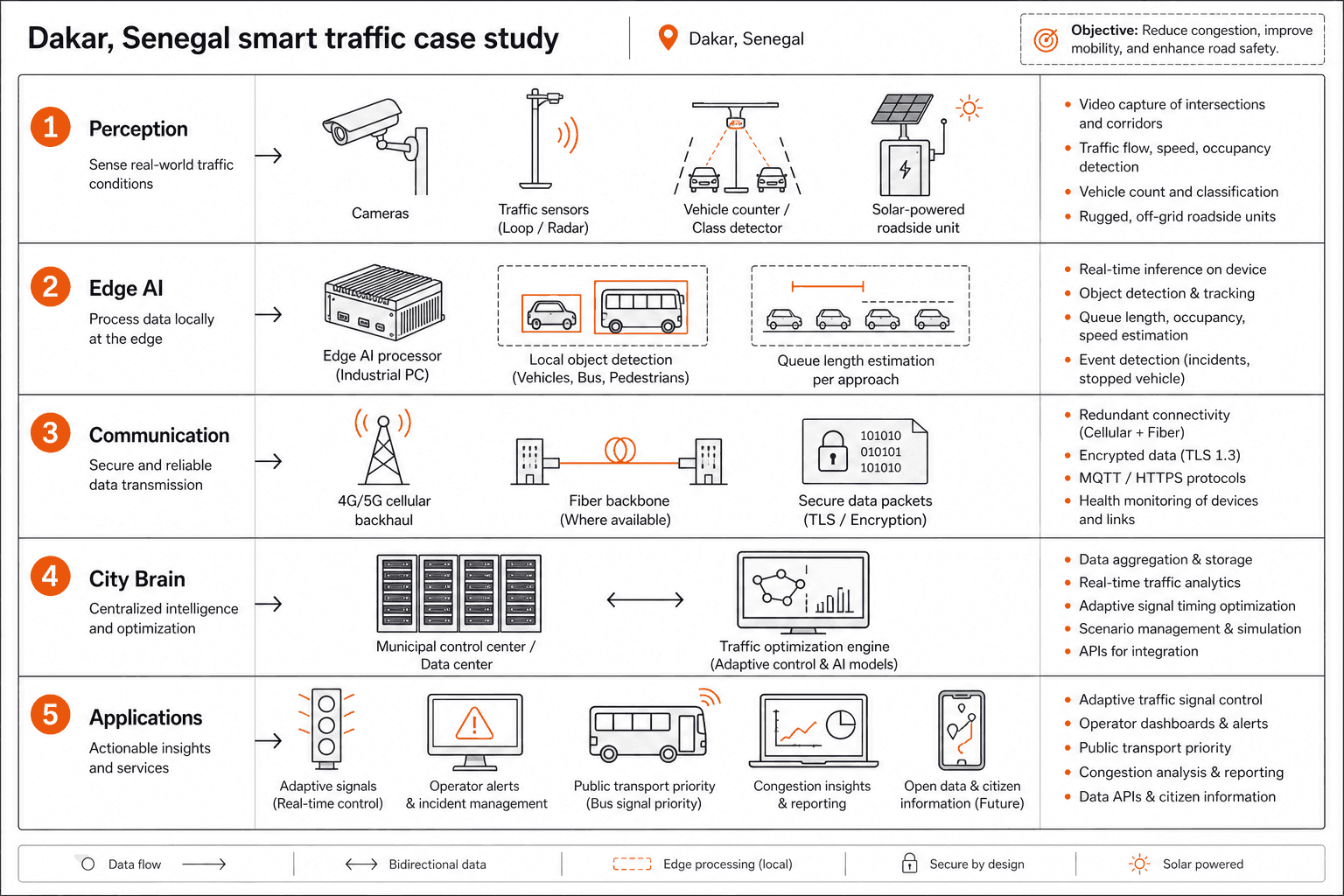
The recommended communications architecture is 5G/fiber backhaul to the TrafficGPT central platform. In practical terms, fiber should be used wherever municipal ducting or roadside telecom access already exists, while 5G should cover difficult links or phased expansions. This hybrid backhaul approach reduces trenching cost at some sites while keeping enough bandwidth for 4K video, radar events, and central command functions.
The commercial recommendation for Dakar is the specified EPC turnkey model. For a 17-intersection package, EPC usually gives municipal buyers the clearest scope definition: civil works, pole supply, controller integration, communications setup, testing, and commissioning under one contract. SOLAR TODO can therefore be positioned as a technical supplier and EPC delivery partner for a city authority or prime contractor evaluating corridor modernization.
Technical Specifications
The specified Dakar configuration uses a 6m L-arm hot-dip galvanized steel pole with integrated sensing, signaling, and edge computing, aligned to NTCIP and GB 25280 for signal communications and equipment performance.
- Product type: SOLAR TODO Smart Traffic System / 4-in-1 smart traffic pole
- Deployment profile: 17 intersections
- Pole form: L-arm steel pole
- Pole height: 6m
- Pole finish: Dark grey
- Corrosion protection: Hot-dip galvanized steel for coastal durability
- Integrated vision module: 4K AI camera
- Detection accuracy: 98%
- Detection library: 45-type detection
- Response latency: <50ms
- Radar module: 77GHz mmWave radar
- Lighting module: LED fill light
- Signal module: LED signal head
- Edge computing platform: NVIDIA Jetson
- Core functions: Adaptive signal control, emergency vehicle priority, wrong-way alert, multi-class traffic detection
- Backhaul: 5G/fiber
- Central software layer: TrafficGPT with natural-language queries
- Communications standard: NTCIP
- Signal-related standard: GB 25280
- Commercial model: EPC turnkey
- Typical intersection density: 4-12 poles per intersection under the broader product family, though a 17-junction city package would be finalized after lane-by-lane survey
From an engineering standpoint, the 6m height is appropriate for urban intersections where the objective is lane coverage, stop-line visibility, and radar line-of-sight without overbuilding the support structure. The broader SOLAR TODO product family also includes 8m and 10m variants, but those are more suitable for larger intersections or highway approaches. Dakar’s dense built environment usually favors the lower mast class for easier permitting and reduced foundation loads.
According to NTCIP guidance, interoperability between field devices and traffic management software reduces vendor lock-in and simplifies future upgrades. According to GB 25280, LED signal devices should meet defined optical and operational performance criteria, which is relevant for visibility under Dakar’s bright daytime conditions and wet-season glare. These standards are important because municipal buyers increasingly ask for communications compatibility, not just hardware lists.
Implementation Approach
A 17-intersection Dakar rollout would typically be executed in 5 phases over roughly 4 to 8 months, depending on civil permits, telecom access, and utility coordination. The sequence should start with site survey and traffic counts, then proceed to pole foundation design, equipment installation, communications commissioning, and adaptive control tuning. This is the most practical path for an EPC turnkey package in a live urban corridor.
Phase 1 is site assessment. Each of the 17 intersections should be surveyed for lane geometry, turning movements, pedestrian crossings, mast-arm visibility, and existing controller cabinet condition. At this stage, planners should also confirm whether each site needs one pole per approach or additional auxiliary poles, because the full product family allows 4-12 poles per intersection depending on road width and conflict complexity.
Phase 2 is design and procurement. Pole base plates, anchor bolts, cable routes, and communication links should be designed after confirming local geotechnical conditions and utility maps. In Dakar’s coastal environment, galvanizing quality and coating inspection should be treated as acceptance items, not optional extras. SOLAR TODO should also align controller communications, edge AI logic, and TrafficGPT integration before shipment to reduce field rework.
Phase 3 is civil and electrical work. Foundations, ducts, cabinets, and roadside power interfaces are usually the schedule-critical items in urban projects. Fiber access should be used where available, while 5G can support interim operation or hard-to-trench intersections. According to the ITU (2023), resilient urban digital infrastructure depends on layered connectivity, which is why dual-path communication is preferable for traffic systems that handle emergency priority.
Phase 4 is installation and commissioning. The 6m L-arm poles are erected, aligned, and fitted with the 4K AI camera, 77GHz radar, LED fill light, and LED signal head. Edge devices based on NVIDIA Jetson are then configured for 45-type detection, calibration zones are set, and latency is verified against the <50ms requirement.
Phase 5 is optimization. Adaptive timing requires at least several weeks of observation after commissioning, especially in corridors with peaking patterns tied to schools, ports, markets, or bus terminals. A city authority should compare before-and-after queue lengths, green utilization, emergency clearance time, and wrong-way alerts. This is where the TrafficGPT platform adds value because operators can query event patterns in natural language rather than manually reviewing raw logs.
Expected Performance & ROI
For Dakar, a 17-intersection Smart Traffic System would typically target measurable gains in traffic efficiency, incident visibility, and maintenance productivity rather than a single headline metric. According to the World Bank (2023), urban congestion imposes direct economic costs through lost time and reduced logistics reliability. That means ROI should be evaluated across travel time reduction, signal efficiency, collision risk reduction, and lower manual enforcement cost.
According to the U.S. Department of Transportation FHWA (2023), adaptive signal control can reduce travel time by more than 10% in suitable corridors and reduce delay by larger margins where timing plans are outdated. Dakar’s benefit would depend on baseline congestion and enforcement conditions, but a well-tuned 17-intersection corridor could reasonably be assessed against travel-time savings, stop reduction, and emergency vehicle progression. The key point is that 4K vision + 77GHz radar + edge AI gives richer inputs than loop detectors or fixed-time plans alone.
Maintenance economics also improve with integrated roadside assets. Instead of separate procurement lines for camera poles, radar brackets, fill lights, and signal heads, one 4-in-1 pole reduces mounting interfaces and simplifies spare-parts planning. According to IEA (2023), digital monitoring improves infrastructure asset management by allowing condition-based intervention rather than fixed inspection cycles. For a municipal buyer, this can reduce truck rolls and shorten fault diagnosis time.
Payback periods vary by labor cost, congestion severity, and whether benefits are valued mainly as public-service gains or as strict financial returns. For a capital-city corridor with recurring peak-hour congestion, a typical payback window could fall in the 3 to 6 year range when time savings, lower incident response cost, and reduced manual traffic management are included in the model. Buyers should request an intersection-level business case with traffic counts and controller inventory before final budgeting.
Results and Impact
A Dakar Smart Traffic System program of 17 intersections would be expected to improve junction-level awareness, shorten response time to abnormal movements, and support more consistent signal timing across connected corridors. The strongest impact usually comes from combining 98% detection accuracy, <50ms edge response, and centralized policy control through TrafficGPT. This is more useful than isolated smart cameras because the system can convert detections into signal actions.
For city operations, the practical gains are threefold. First, adaptive timing can improve green allocation during peak periods without waiting for manual retiming cycles. Second, emergency vehicle priority can reduce clearance delay at selected routes used by ambulances or fire services. Third, wrong-way alerting adds a direct safety function that is especially relevant at channelized turns, one-way approaches, and poorly observed night-time movements.
For procurement teams, the impact should also be measured against asset life and standards compliance. A hot-dip galvanized pole body is important in Dakar because corrosion can shorten service life if untreated steel is used near the coast. SOLAR TODO’s specified combination of galvanized steel, integrated modules, and standards-based communications gives a practical fit for municipal modernization programs that need both traffic control and data visibility.
Comparison Table
This comparison shows why a 6m 4-in-1 AI pole is usually a better fit for central Dakar than conventional fixed-time signals or larger 8m-10m highway-class structures.
| Option | Typical use case | Pole height | Detection stack | Control capability | Backhaul | Fit for Dakar urban intersections |
|---|---|---|---|---|---|---|
| SOLAR TODO Smart Traffic System (recommended) | Dense urban intersections | 6m | 4K AI camera + 77GHz radar | Adaptive signal, emergency priority, wrong-way alert | 5G/fiber | High |
| Conventional LED signal pole | Basic signalized junction | 6m | None or limited vehicle loop | Fixed-time or manual retiming | Local controller only | Medium-low |
| Camera-only smart pole | Monitoring-focused site | 6m-8m | 4K camera only | Limited unless integrated with controller | 4G/5G/fiber | Medium |
| Highway-class smart gantry/pole | Wide arterial or expressway | 8m-10m+ | Camera + radar | Corridor control possible | Fiber preferred | Low for standard Dakar junctions |
A second comparison is useful for procurement planning.
| Metric | Recommended Dakar configuration | Why it matters |
|---|---|---|
| Intersections | 17 | Matches medium urban corridor package |
| Pole type | L-arm hot-dip galvanized steel | Better corrosion resistance in coastal air |
| Height | 6m | Suitable for city junction geometry |
| AI response | <50ms | Supports real-time control decisions |
| Detection accuracy | 98% | Reduces false event handling |
| Radar frequency | 77GHz | Improves speed and presence detection |
| Platform | NVIDIA Jetson + TrafficGPT | Edge processing plus central analytics |
| Commercial model | EPC turnkey | Clear scope for municipal procurement |
Pricing & Quotation
SOLAR TODO offers three pricing tiers for this product line: FOB Supply (equipment ex-works China), CIF Delivered (including ocean freight and insurance), and EPC Turnkey (fully installed, commissioned, with 1-year warranty). Volume discounts are available for large-scale deployments. Configure your system online for an instant estimate, or request a custom quotation from our engineering team at [email protected].
For Dakar, final EPC pricing would depend on 17-site survey results, local civil scope, controller integration depth, and whether fiber can be reused at more than 50% of intersections. The largest cost variables are usually foundations, trenching, cabinet upgrades, and traffic management during installation. Buyers should ask SOLAR TODO for a bill of quantities split into equipment, civil works, communications, commissioning, and optional software support.
Frequently Asked Questions
This section answers 10 common buyer questions on Dakar Smart Traffic System sizing, EPC scope, ROI, maintenance, and standards using the specified 17-intersection, 6m, 4-in-1 configuration.
Q1: Why is a 6m pole recommended for Dakar instead of 8m or 10m?
A 6m L-arm pole is usually sufficient for standard urban intersections where signal visibility and stop-line detection are the main requirements. In Dakar, many junctions are compact and surrounded by buildings, utilities, and sidewalks, so 6m reduces civil complexity. The 8m and 10m variants are more suitable for larger crossroads or highway-type approaches.
Q2: What exactly is included in the 4-in-1 Smart Traffic System?
The specified system combines four modules on one roadside structure: a 4K AI camera, a 77GHz mmWave radar, an LED fill light, and an LED signal head. It also includes NVIDIA Jetson edge computing, adaptive signal logic, emergency vehicle priority, wrong-way alerting, and 5G/fiber connection to the TrafficGPT platform.
Q3: How many poles would a 17-intersection Dakar project typically need?
The exact count depends on lane geometry and whether each approach needs a dedicated pole. Under the broader product family, intersections can use about 4 to 12 poles each. For budgeting, a site survey should confirm approach count, turning lanes, medians, and pedestrian phases before issuing a final bill of quantities.
Q4: How long would deployment usually take for 17 intersections?
A practical EPC schedule is often around 4 to 8 months. The biggest variables are permit approval, foundation work, underground duct conditions, and telecom connection timing. Equipment installation itself is faster than civil works, so projects move best when survey, design, and utility coordination are finished before shipment.
Q5: What performance should Dakar buyers expect from the AI detection stack?
The provided specification states 98% detection accuracy and under 50ms response time. In practice, that supports near-real-time signal inputs, event alerts, and multi-class traffic recognition across 45 detection types. Actual field performance still depends on camera angle, lighting, weather, and calibration quality at each intersection.
Q6: Is 5G enough, or should Dakar require fiber at every site?
Fiber is preferred for the busiest intersections because it offers stable bandwidth for 4K streams and central coordination. However, 5G is useful where trenching is difficult or as a backup link. A mixed 5G/fiber architecture is often the most cost-effective option for a 17-site urban rollout.
Q7: What is the likely ROI or payback period?
For a capital-city corridor, payback is commonly assessed in a 3 to 6 year range when travel-time savings, lower manual traffic control cost, and better incident response are included. Exact ROI depends on baseline congestion, staffing cost, and whether the city values public-service benefits alongside direct budget savings.
Q8: What maintenance does this system require?
Routine maintenance usually includes lens cleaning, radar health checks, cabinet inspection, firmware updates, and signal visibility verification. In Dakar’s coastal air, galvanizing condition and fastener corrosion should also be inspected periodically. A preventive cycle every 3 to 6 months is common, with remote diagnostics used between site visits.
Q9: How does EPC turnkey compare with supply-only procurement?
EPC turnkey usually gives the city one accountable scope covering design support, foundations, installation, integration, testing, and commissioning. Supply-only can reduce initial invoice value, but it shifts civil and integration risk to the buyer. For a 17-intersection package, EPC often produces better schedule control and clearer acceptance criteria.
Q10: What warranty terms should buyers ask for?
The pricing section specifies EPC turnkey with a 1-year warranty. Buyers should still ask for a detailed warranty matrix covering pole structure, signal heads, camera modules, radar units, edge computer, and software support response times. Spare-parts availability and remote troubleshooting terms are also important for municipal operations.
References
- World Bank (2023): Senegal urban development and mobility context; urban population exceeds 49% and Dakar remains the main economic hub.
- ANSD Senegal (2023): Regional demographic and economic statistics showing Dakar’s high population concentration and transport pressure.
- World Bank Climate Change Knowledge Portal (2021): Senegal climate profile, including coastal humidity and seasonal rainfall relevant to corrosion and roadside equipment design.
- ITU (2023): ICT development and mobile broadband expansion across Africa, supporting 5G/fiber-connected intelligent transport systems.
- African Development Bank (2022): Senegal urban mobility and infrastructure investment priorities in the Dakar area.
- FHWA U.S. Department of Transportation (2023): Adaptive Signal Control Technologies guidance and corridor performance benefits.
- NTCIP (latest applicable edition): National Transportation Communications for Intelligent Transportation System Protocol, device interoperability for traffic systems.
- GB 25280 (latest applicable edition): Signal-related equipment performance requirements relevant to LED traffic signaling.
- International Energy Agency (2023): Digitalisation improves infrastructure efficiency, monitoring, and operational reliability.
For project scoping, buyers can review the SOLAR TODO Smart Traffic System page and contact us for a Dakar-specific EPC quotation and intersection survey checklist.
Equipment Deployed
- 17-intersection Smart Traffic System package
- 6m L-arm steel pole, dark grey, hot-dip galvanized
- 4K AI camera with 98% detection accuracy
- 77GHz mmWave radar module
- LED fill light
- LED traffic signal head
- NVIDIA Jetson edge AI computing unit
- Adaptive signal control software
- Emergency vehicle priority function
- Wrong-way alert function
- 45-type detection algorithm package
- 5G/fiber backhaul interface
- TrafficGPT central management platform with natural-language queries
- NTCIP-compliant communications interface
- GB 25280-aligned signal equipment